After we left Khao-I-Dang we did not find out until the next day that the North Vietnamese had probed and killed 30 people right there at the intersection in front of the Khao-I-Dang Camp just after we left. You may recall that I wrote about the man at that camp who had been the only pastor in Cambodia, and how the Khmer Rouge had found him and put him into one of their killing fields camps. I told how God had actually sent one of his “shinning angels” to miraculously protect him from certain execution, just like others Billy Graham wrote about in his book, Angels.
However, we wanted to visit one more refugee camp before dark, Sa Kaeo II. By now things were working just as the KGB had planned. The North Vietnamese Communists were coming into Cambodia and driving the Khmer Rouge out. This was a new camp and was already mostly populated by Khmer Rouge refugees who were themselves escaping Cambodia.
When we arrived, they were pulling this enormous chain across the entrance to block any North Vietnamese tanks from coming in. There were no UN people there. The place was run by a Thai officer. They called him down to the entrance to check our credentials, and right away we found how casual this place was. He came down only clad in his T-shirt and his drawers. He was really nice. He put a soldier on the outside step of our little bus with his automatic weapon and told us to go anywhere we wished.
Everything there was made of big stalks of bamboo, and most all of it was still green. The people here were much younger than the previous camp, and there were many young children.
I walked up to the top of a hill where a Swiss NGO had constructed a hospital. All workers at the hospital had already gone home, but there was a group of the most interesting young boys gathered there. They were all between the ages of 12 and 16. But what was so strange was that almost every one of them had some kind of injury. Some had lost a leg or an arm or and eye, but most just had flesh wounds that were almost healed. They all crowded around me, for they were all in the process of learning English in the hopes of getting to the US some day and had never met an American.
One of the older ones was named Hem-Hatch. He could speak fairly good English, so I asked him about all these boys. Where were their parents? He said: “No parents.” So I asked: “What is your story?” So, he told me that they all had the same story. They had all been in Cambodia in different villages. The Khmer Rouge had come to their villages and lined everyone up and started going down the line, shooting every person, one at a time. These guys saw their parents and siblings shot. They realized that if they did not get out of there, they were going to be dead. So, they just bolted for the jungle. They ran as fast as they could, zigzagging as they ran to dodge the bullets. Most had been hit at least once or lost an eye to the thorns as they crashed through the jungle. What a strange group of orphans, but they were full of energy and enthusiasm.
I corresponded with Hem-hatch for quite a while and sent him some Thai Baht that I could buy at a Dallas bank. I don’t know what finally happened to him. In the last letter I received from him he stated that he had the chance to go to France, but they were trying to get him to go back into Cambodia. I wrote him to get his rear-end into France, for I knew that the North Vietnamese were intercepting those repatriation busses as soon as they crossed the border and killing everyone on them.
When I got back to our little bus, the folks there had found this young lady. She was somewhere between age 19 to 24. She was one of those new Christians that were coming out of Cambodia that I mentioned earlier. And they were not just casual Christians. That terror had bonded them so close to God that it was spooky. This girl had taken upon herself the task to teach bible stories and Christian principals to every young child in the camp that she possibly could. She was teaching groups of children all day and into the night. There were 90,000 people already in that camp. She stayed on the verge of exhaustion all the time. Her dream was to get to the US and attend a bible-oriented college some day.
She gave me the name and address of a young lady friend who worked for the UN and would be able to bring things into the camp to her. When I got back to Dallas I went to several Christian book stores and bought all the different boxes of felt bible stories and sent them to her. Those are where you put up the different characters of a bible story on a felt board for the children as you tell the story. She wrote back how thrilled she was and how she used them to great effect for all those children. I also sent her quite a lot of Thai Baht so that she could buy things such as soccer balls for the older children.
So, before we left, we wanted to have a prayer for this lovely young Christian lady. I was sitting on the front row of the little bus and she sat just above me on the chrome supports. After we prayed, she prayed. And I will never forget for the rest of my life what happened. The bus was air conditioned, so it must have been cooler than normal for her. But as she prayed, I felt water dripping down onto me. When that girl prayed, the intensity of her prayer, the intensity of her communication with God, caused her to become wet all over. Evidently, because of the necessity of what she was doing, God had infused her with a prodigious amount of his mighty Spirit Power.
To this day, I feel guilty that I have never been able to pray like that……with the intensity of that girl.
(“Do not be conformed to the former lusts which were yours in your ignorance, but be like the holy One who called you, be holy.”)
Do you sense something in your life needs to change? Are there areas that simply aren’t working? Are you willing to say, “Lord, I want to exalt You. I’ve had enough of my own way—I want to live by Yours”?
If so, ask God to identify the areas where you’re like self-centered, and struggling rather than Christ centered and victorious. Whatever He brings to mind, acknowledge that He is right and make the decision to turn from your ways. He will show you how as you read Scripture.
As He reveals principles from His Word, apply them to your life—even when they don’t completely make sense—and trust Him to bless your obedience.
Answer all of the questions, dilemmas, and challenges you encounter with this: “Lord Jesus, what would You have me do? I want to obey You.” Not only will doing so transform your life, it will build the most wonderful, profound, and indescribable intimacy between you and the Savior.
“Guard your steps as you go to the house of God and draw near to listen.”
When you pray, do you do all the talking? To have God speak to your heart is an awesome experience—one you may miss if you monopolize the conversation and never pause to listen.
But when you remain quiet the Lord will transform you, changing how you think and conforming you to His ways. How does He do so? He may remind you of an important passage of scripture, reveal a biblical truth for you to apply, expose unconfessed sin, or bring someone to mind that needs your ministry. In other words, He will direct your path (Proverbs 3:6).
This is why it is so important for you to sit before Him in silence and allow Him to pour Himself into you. He will reveal His will and bring peace to your inner being.
Friend, sitting before God allows Him to speak to your heart clearly, positively, and unmistakably—showing you what to do. You will know that the Lord has truly spoken to you—and that’s the definition of life at its very best.
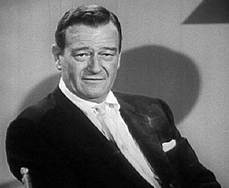
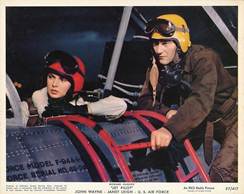
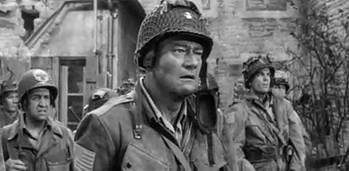
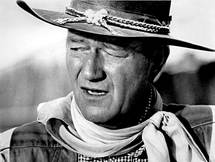
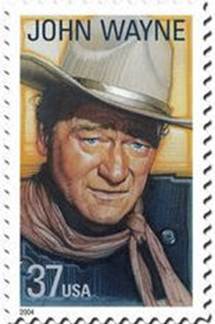
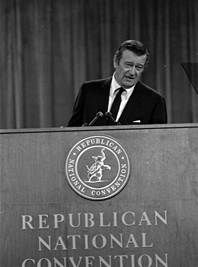
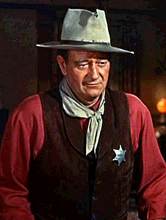
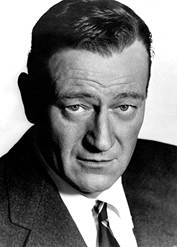
(Yes, he was a movie star, but his persona and his sayings and his thoughts that he expressed on what is best for securing the safety and ‘health’ of America were an influence on many in our whole country for a generation. Below I have chronicled a bit of his life, and some of his sayings and thoughts on the preservation of America for you. John Wayne was for sure a “man’s man”!)
John Wayne was born May 26, 1907.
His given name was Marion Mitchell Morrison, grandson of a Scots-Irish Presbyterian veteran of the Civil War.
He played football for University of Southern California. and worked behind-the-scenes at Fox Studios.
Raoul Walsh, director of film The Big Trail (1930), first suggested his screen name be “Anthony Wayne” after Revolutionary War general “Mad Anthony” Wayne, but settled upon “John Wayne.”
He became an Academy Award winning actor for portraying cowboys and soldiers in action western and war films, appearing in over 200 films, and holding the Hollywood record of starring in 142 films.
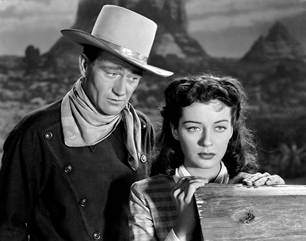
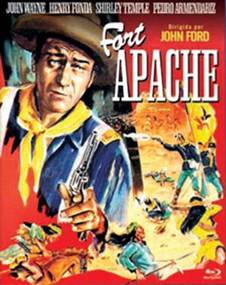
John Wayne’s career took off when director John Ford cast him in epic western films such as:
Fort Apache (1948);
She Wore A Yellow Ribbon (1949); and
Rio Grande (1950).
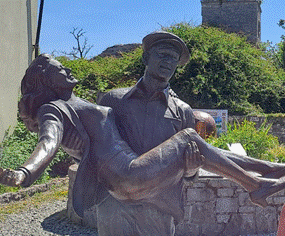
The immensely popular 1952 movie, The Quiet Man, depicting the humorously stubborn traditions of Irish courtship, is memorialize by a statue in the town of Cong, Ireland, with John Wayne carrying his fiery-tempered redhead co-star, Maureen O’Hara.
John Wayne became an icon of the U.S. Armed Forces for depicting the strength and sacrifice of American military personnel during World War II, Korea and Vietnam:
The Flying Tigers (1942);
The Fighting Seabees (1944);
They Were Expendable (1945);
Back to Bataan (1945);
The Sands of Iwo Jima (1949);
The Flying Leathernecks (1951);
Operation Pacific (1951);
The Longest Day (1962);
In Harm’s Way (1965); and
The Green Berets (1968).
These films had the international effect of publicizing America’s military might and moral values, was demonstrated when Japanese Emperor Hirohito visited the United States in 1975 and asked to meet John Wayne.
Wayne stated:
“Courage is being scared to death, but saddling up anyway.”
“All battles are fought by scared men who’d rather be some place else.”
“Life it tough, but it’s tougher if you’re stupid.”
Regarding socialism, John Wayne stated in an interview, May 1971:
“In the late Twenties, when I was a sophomore at University of Southern California, I was a socialist myself — but not when I left.
The average college kid idealistically wishes everybody could have ice cream and cake for every meal.
But as he gets older and gives more thought to his and his fellow man’s responsibilities, he finds that it can’t work out that way — that some people just won’t carry their load.
I believe in welfare — a welfare work program. I don’t think a fella should be able to sit on his backside and receive welfare.
I’d like to know why well-educated idiots keep apologizing for lazy and complaining people who think the world owes them a living.
I’d like to know why they make excuses for cowards who spit in the faces of the police and then run behind the judicial sob sisters.
I can’t understand these people who carry placards to save the life of some criminal, yet have no thought for the innocent victim.”
Wayne stated:
“… Government has no wealth, and when a politician promises to give you something for nothing, he must first confiscate that wealth from you — either by direct taxes, or by the cruelly indirect tax of inflation.”
“… I would think somebody like Jane Fonda and her idiot husband would be terribly ashamed and saddened that they were a part of causing us to stop helping the South Vietnamese. Now look what’s happening. They’re getting killed by the millions. Murdered by the millions. How the hell can she and her husband sleep at night?”
“… My hope and prayer is that everyone know and love our country for what she really is and what she stands for.”
On May 26, 1979, the U.S. Congress awarded him the Congressional Gold Medal.
President Jimmy Carter, who later awarded John Wayne the Presidential Medal of Freedom posthumously, stated:
“I have today approved a specially struck gold medal to John Wayne. For nearly half a century, the Duke has symbolized the American ideals of integrity, courage, patriotism, and strength and has represented to the world many of the deepest values that this Nation respects.”
In 1998, the U.S. Navy Memorial Foundation honored John Wayne with the Naval Heritage Award for his support of the U. S. Navy and military.
A Harris Poll, January 2011, ranked John Wayne third among America’s favorite film stars.
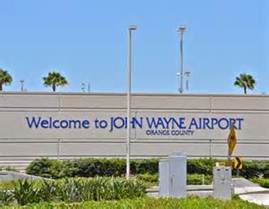
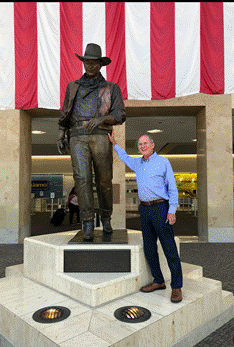
In 1979, California’s Orange County airport was named John Wayne Airport.
Ronald Reagan said November 5, 1984:
“I noted the news coverage about the death of my friend, John Wayne. One headline read ‘The Last American Hero’ …
No one would be angrier than Duke Wayne at the suggestion that he was America’s last hero.
Just before he died, John Wayne said in his unforgettable way, ‘Just give the American people a good cause, and there’s nothing they can’t lick.'”
“Guide me in your truth and teach me, for you are God my Savior, and my hope is in you.”
The Father has given you the powerful gift of choice—the ability to select the direction of our life. In fact, every day you’ll face a continuous series of options—some that honor the Lord and others that don’t. Some that lead to His abundant life and others that divert you away from it to destruction.
One of the most powerful, life changing decisions you can make is to invite God to guide you—trusting that everything He allows in your life is for the purpose of building your character and bringing you into his freedom.
Friend, God’s plan for you is unquestionably the best. The question is: will you allow Him to direct you? If so, pray:
“Lord change me and work through me in any way You please. I believe that You will form Your character in me, shape me into Your likeness through my circumstances, and lead me to life at its best. Thank You, dear Jesus, amen.”
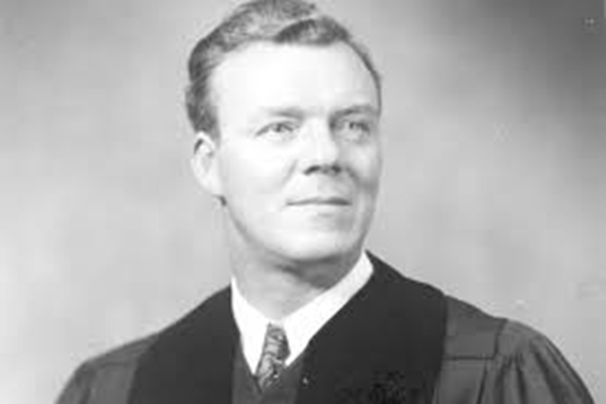
(We hear about and study the early great men who founded our country, and we should. However, there were great men in recent times who had a profound influence on our country, also. One of those was the Chaplain of the United States Senate, Peter Marshall. You have probably heard of him, but he was so incredible, that I would like you to know more about him and his amazing life and thoughts. Below, I have supplied those for you. Do read them.)
The morning of December 7, 1941, Rev. Peter Marshall addressed the midshipmen at the U.S. Naval Academy in Annapolis, class of ’42.
At the last minute, he set aside his prepared remarks and felt compelled to preach instead, a prophetic message………”Go Down, Death.”
Within an hour after he finished, news of Imperial Japan’s attack at Pearl Harbor spread across the nation. And in his remarks Marshall had just stated: “I am one of those who believe that there are some principles worth fighting for and worth dying for, if need be.
Senate Chaplain Peter Marshall had also just stated:
“The trouble with our time is that when we can’t believe there is anything left to us worth dying for, then we’re not sure there’s anything worth living for either.
God permits war in order that we might see what sin really is.”
“War forces us to examine the very foundations of life itself.”
“What man refuses to learn in times of peace, God teaches him in times of war.”
After the war and the wonderful patriotism fostered in our country by war, times began to change. The socialist tactic of “deconstruction” began and started to infiltrate our very schools. Peter Marshall commented on the socialist tactic of “deconstruction” in a publication that he published in 1971:
“Then there dawned the day when with our higher education came a debunking contest. This debunking became a sort of national sport. It was smarter to revile than to revere. more fashionable to depreciate than to appreciate. In our classrooms no longer did we laud great men—those who had struggled and achieved. Instead, we merely ferreted out their faults. Our debunking is a sign of decaying foundations of character to the individual and in the national life.”
At the age of 25, Peter Marshall emigrated from Scotland, arriving at New York’s Ellis Island in 1927. Members of his Sunday School class paid his way to seminary in Atlanta, where he graduated in 1931.
Rev. Peter Marshall pastored a small church in Covington, Georgia, then preached at Atlanta’s Westminster Presbyterian Church. There he met Catherine Wood, a student at Agnes Scott College, and they married.
Catherine Marshall’s book on Peter’s life, A Man Called Peter, was turned into the movie. Her novel, Christy, was made into a CBS television series.
In 1937, at the age of 35, Peter Marshall became pastor of Washington, D.C.’s prestigious New York Avenue Presbyterian Church, the same church where Dr. Phineas Gurley was pastor during Lincoln’s presidency.
Rev. Peter Marshall stated in a 1971 Publication: “I have come to know Lincoln, the heart and spirit of the man, since I met him in the tradition of this church I now serve in Washington, than ever I knew him in history books.
Soon after assuming this pastorate, I happened one day upon an old safe, little used, in the church basement. Fascinating minutes of session meetings were there, dating almost back the year the church was born, 1802.
Among these were some pew rental books, and I flipped open to a page with the inscription at the top: ‘A. Lincoln.’ The annual rent of the pew was fifty dollars a year, and the notations of payments began in March, 1861, and continued until the President’s assassination four years later.”
Marshall continued: “Upon coming to Washington, Mr. Lincoln had sought the advice of a member of his cabinet on the choice of ‘a suitable church home’ for himself, his wife, and his three boys. One of his stipulations was that it had to be ‘a clergyman who holds himself aloof from politics.’ The President’s choice was Dr. Phineas Gurley of this church.
As the clouds of Civil War gathered, increasingly, Mr. Lincoln sought the friendship of the clergyman. On nights when the President would be deeply disturbed by the horror of Americans having to fight fellow-Americans, he would sometimes ask to see Dr. Gurley.
Later, Dr. Gurley was to tell how the two of them would walk up and down the south portico of the White House, up and down, all through the night talking and praying until dawn flushed pink in the eastern sky. For here was a man on the horns of that terrible dilemma: he believed that a nation divided could not stand; that the Union was worth saving, yet he loathed war, all of it from Fort Sumter to Appomattox.”
He continued: “In the end, according to Dr. Gurley who knew Lincoln so well, Lincoln found no way except the route of faith in God: After being near him steadily and with him often for more than four years, Dr. Gurley said, ‘I can affirm that God’s guidance and mercy were the props on which he humbly and habitually leaned; that they were the best hope he had for himself and for his country. He recognized and received the truth that God is the governor among the nations, and that our only hope, in the President’s own words, was; to humble ourselves, confess our national sins, and pray for clemency and forgiveness.'”
Marshall added: “The biographers who have rather desperately tried to prove that Abraham Lincoln was an unbeliever, have wisely ignored Dr. Gurley’s testimony. The minister was present when little Willie Lincoln died in the White House, and received from him the little iron bank containing pennies which the little boy asked him to give to the Sunday school. He was there in the tiny hall bedroom in the red brick house on Tenth Street, keeping an all-night vigil with the leaders of the nation, as the President lay dying. As daylight broke and the faint breathing died away, the Secretary of War, Mr. Stanton, broke the stillness with words which were almost a sob, ‘Now he belongs to the ages.’ Then he asked Dr. Gurley to pray.”
Marshall concluded: “The nation needed prayer more than ever, without Lincoln. That was the note of the eulogy in the East Room which Dr. Gurley delivered, ‘It is by his steady confidence in God that he would speak to us today. His message would be: Cling to liberty and right, battle for them, bleed for them, if need be, but most important, have faith in God.’ It is because of those intimate anecdotes. and many more, that we in this church treasure the memory of men like Abraham Lincoln.”
Marshall ministered to Presidents, Cabinet members, and Supreme Court Justices.
Rev. Peter Marshall became a U.S. citizen in 1938.
He was asked to preach the Christmas Sermon to President Franklin D. Roosevelt and his family.
After World War II ended and as the Korean War began, the U.S. Senate appointed Peter Marshall to be their Chaplain on January 4, 1947.
On May 22, 1947, during the 80th Congress, U.S. Senate Chaplain Peter Marshall offered the prayer: “God of our fathers, give unto us, thy servants, a true appreciation of our heritage, of great men and great deeds in the past, but let us not be intimidated by feelings of our own inadequacies for this troubled hour. Remind us that the God they worshiped, and by whose help they laid the foundations of our Nation, is still able to help us uphold what they bequeathed and give it meaning.”
Chaplain Marshall further prayed: O Lord our God, even at this moment as we come blundering into Thy presence in prayer, we are haunted by memories of duties unperformed, promptings disobeyed, and beckonings ignored. Opportunities to be kind knocked on the door of our hearts and went weeping away.”
On July 3, 1947, the day before Independence Day, U.S. Senate Chaplain Peter Marshall prayed: God of our Fathers, whose Almighty hand hath made and preserved our Nation, grant that our people may understand what it is they celebrate tomorrow. May they remember how bitterly our freedom was won, the down payment that was made for it, the installments that have been made since this Republic was born, and the price that must be paid for our liberty.”
He continued: “May freedom be seen not as the right to do as we please but as the opportunity to please to do what is right. May it be ever understood that our liberty is under God and can be found nowhere else. May our faith be something that is not merely stamped upon our coins, but expressed in our lives. Let us, as a nation, be not afraid of standing alone for the rights of men, since we were born that way, as the only nation on earth that came into being ‘for the glory of God and the advancement of the Christian faith.'”
Marshall concluded: “We know that we shall be true to the Pilgrim dream when we are true to the God they worshiped. To the extent that America honors Thee, wilt Thou bless America, and keep her true as Thou hast kept her free, and make her good as Thou hast made her rich. Amen.”
In Senate Marshall stated: “The world has enough women who are popular. It needs more who are pure. We need women, and men, too, who would rather be morally right than socially correct. Character is what a person does when he is alone, the decisions he makes away from the persuasions of his friends. True character must always be founded upon Christianity.”
Just 6 months before he died, June 11, 1948, U.S. Senate Chaplain Peter Marshall opened Congress with the prayer: “Help us, our Father, to show other nations an America to imitate, the America that loves fair play, honest dealing, straight talk, real freedom and faith in God.”
He explained: “Most of us never think of death or dying. We act as if we had a long lease on life as though we had immunity somehow. The first disciples (of Jesus) knew that human personality will survive because One who went into the grave and beyond, had come back to say: ‘Whosoever believeth in Me shall not perish but have eternal life.'”
Peter Marshall died of a heart attack in 1949 at the age of 46. He had stated: “When the clock strikes for me, I shall go, not one minute early, and not one minute late. Until then, there is nothing to fear.”
Arthur Vandenberg of Michigan described Peter Marshall: “He always spoke with courage, with deepest human understanding, and with stimulating hope.”
Laying of the cornerstone of the New York Avenue Presbyterian Church, April 3, 1951, President Harry S Truman stated: “New York Avenue Presbyterian Church has played an important part in the history of Washington. For almost 150 years a Presbyterian congregation has worshiped on or near this spot. During all that period, this church has preached the Christian message to this busy Capital City.”
At the cornerstone laying ceremony, Rev. Peter Marshall’s young son, Peter John Marshall, gave President Truman a New Testament, to which the President responded: “Well, thank you very much for this Testament. I appreciate very much having it. And all I can say to you is, I hope you will grow up to be as good a man as your father.”
The son, Peter John Marshall, grew up to become a best-selling author, who, together with co-author David Manuel, wrote popular books chronicling God’s Providential Hand in the expansion of liberty in America’s early history.
These books include: The Light and the Glory; From Sea to Shining Sea; andSounding Forth The Trumpet.
Finally, On January 13, 1947, U.S. Senate Chaplain Peter Marshall stated: “The choice before us is plain: Christ or chaos, conviction or compromise, discipline or disintegration. I am rather tired of hearing about our rights. The time is come to hear about responsibilities. America’s future depends upon her accepting and demonstrating God’s government.”
He challenged: “We all hate and loathe war; it is contrary to all the principles and ethics of Christ, yet there are certain liberties, certain precious heritages for which a man should be willing to fight and even dare to die.”
“Christ loved the church. He gave up his life for her to make her holy and clean, washed by the cleansing of God’s word.”
Do you ever avoid reading the Bible because it makes you uncomfortable. Certainly, God often works through His Word to reveal the areas of your heart He wants to heal, and that’s not always easy (Hebrews 4:12). But Scripture is crucial for the well-being of your soul. The Holy Spirit speaks through it to help you move ahead spiritually, emotionally, and relationally.
Of course, you may be tempted to skip reading God’s Word or dismiss what it says because it contradicts how you think. But don’t. The Father does His greatest transformational work in you as you meditate on His truth (Romans 12:2).
So if you have any desire for God; any yearning for healing; any longing for a life of meaning, hope, and joy—then open Scripture, drink in its life-giving words, and do as it says. Not only does the Lord understand who you are, He will help you see how your life can be more fulfilling, healthy, and significant.
(This battle was so important to ending the American Revolution that I thought you should know about it. And how the Great God, Jehovah was so closely involved in events that ended that war should be remembered as shown below for you to see.)
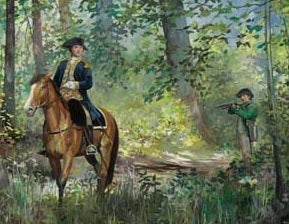
On May 12, 1780, after the British had captured Charleston, South Carolina, the 19-year-old express rider, James “Jimmy” Blair, made a ride similar to that of Paul Revere. Though shot in the chest, he successfully alerted Americans prior to the Battle of King’s Mountain.
Jimmy Blair, who was later a U.S. Congressman, was memorialized in a poem written by John Trotwood Moore, titled “The Ride of the Rebel”: “The race of the rebel, wilderness run, The race for a nation just begun, You will find it not on the gilded page, But on King’s Mountain’s starlit stage. The race for a nation just begun, Over the Border the British came, Their jackets red as the sun, City and hamlet had felt of the fall ,From the flash of the Red Coat’s gun. Over the border Ferguson rode, He never rode back again, For Jimmy Blair his horse bestode, And galloped with might and main, O’er hill and o’er valley he sped, And roused the patriots as he went, As Gabriel would rouse the dead. Go! For your country’s life, he said, And away like a ghost he was gone, Riding from morn to midnight on to morn.”
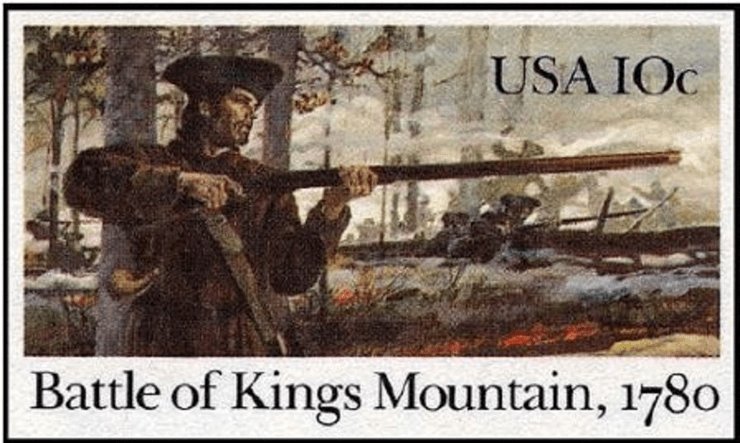
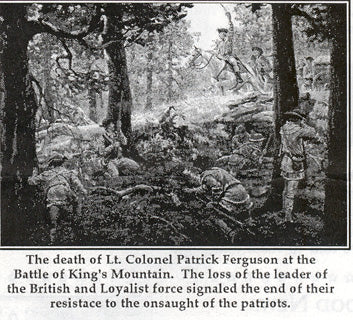
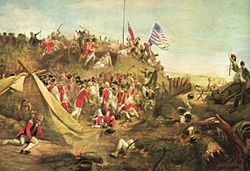
The Battle of King’s Mountain was October 7, 1780. Where the Americans had 29 killed, the British suffered 668 captured, 163 wounded and 290 killed, including the feared British sharp shooter Major Patrick Ferguson.
Ferguson, earlier at the Battle of Brandywine, had the opportunity to sharp shoot in the back General Washington and Count Casimir Pulaski, “father of the American cavalry,” but declined due to his code of honor.
The Battle of Kings Mountain was described by Thomas Jefferson as “the turn of the tide of success” in the War for Independence.
The Americans were exceptionally accurate riflemen, as British Colonel George Hanger wrote: “I never in my life saw better rifles, or men who shot better than those made in America.”
Theodore Roosevelt wrote of the Battle of Kings Mountain: “This brilliant victory marked the turning point of the American Revolution.”
President Herbert Hoover stated at the 150th anniversary of the Battle of Kings Mountain, October 7, 1930: “This is a place of inspiring memories. Here less than a thousand men, inspired by the urge of freedom, defeated a superior force intrenched in this strategic position. This small band of Patriots turned back a dangerous invasion well designed to separate and dismember the united Colonies. It was a little army and a little battle, but it was of mighty portent. History has done scant justice to its significance, which rightly should place it beside Lexington, Bunker Hill, Trenton and Yorktown.”
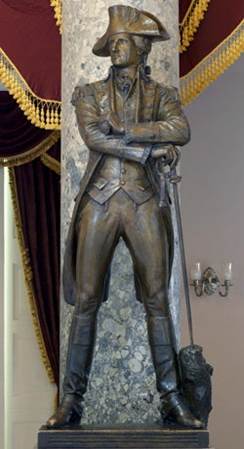
Colonel Sevier
One of the heroes of King’s Mountain was Colonel John Sevier, who later was elected the first Governor of Tennessee. His statue is in the U.S. Capital Statuary Hall.
Not long after the Battle of Kings Mountain, American General Daniel Morgan defeated the British at the Battle of Cowpens, January 17, 1781.
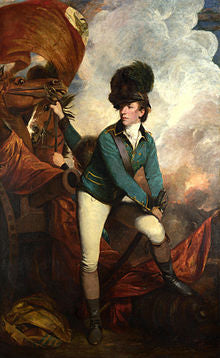
Colonel Tarleton
The British troops, under the command of 26-year-old Colonel Banastre Tarleton, suffered 110 killed, 229 wounded and 829 captured. Captured British officer Major McArthur of the 71st Highlanders commented that “he was an officer before Tarleton was born; that the best troops in the service were put under ‘that boy’ to be sacrificed.” (In the recent 2OOO movie The Patriot, the peaceful farmer Benjamin Martin played by Mell Gibson is driven to lead the Colonial Militia during the American Revolution when a sadistic British officer ‘Colonel Tarleton’ murders his son.)
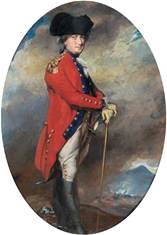
General Cornwallis
When news of loss was told to British Lord Cornwallis he leaned on his sword so hard the blade snapped.
British General Cornwallis took off in a hasty pursuit of American General Daniel Morgan, who was joined by General Nathanael Greene. To travel faster, Cornwallis discarded his slow supply wagons and heavy equipment, but to no avail, the Americans successfully retreated into Virginia.
Crediting God, Yale President Ezra Stiles wrote, May 8, 1783: “Should we not ascribe to a Supreme Energy the wise generalship displayed by General Greene leaving the roving Cornwallis to pursue his helter-skelter ill fated march into Virginia.”
The British technically won the following Battle of Guilford Court House on March 15, 1781, but they failed in their attempt to capture much needed American supplies. Their loss of over 500 British killed or wounded resulted in the battle being considered a strategic victory for the Americans. Desperately low on supplies for his army, Cornwallis was ordered by British General Henry Clinton to move his 8,000 troops to Yorktown and wait for British ships.
Meanwhile, Washington was desperate for funds to finish the war.
Providentially, Ben Franklin and Marquis de Lafayette had succeeded in persuading French King Louis the Sixteenth to send ships and troops the help the Americans.
French Admiral de Grasse wrote to Rochambeau, July 28, 1781: “The Saint-Domingue Colony has no money, but I will send a frigate to Havana in quest of it.”
In September of 1781, a fundraising campaign was organized by Cuba’s Governor General Juan Manuel de Cagigal y Monserrat. The citizens of Cuba generously responded, most notably the Cuban women, from Havana to Matanzas to Pinar del Rio. They donated their gold and jewelry, and sent it to help General Washington defeat the British at Yorktown. The message that the “Ladies of Havana” sent with their contribution was: “So the American mothers’ sons are not born as slaves.”
Their gift is estimated at $28 million in today’s money. Washington reportedly threw his hat in the air when he heard news of their gift. It literally saved the revolution.
General Jean Baptiste de Rochambeau wrote in his “Daily Memoirs,” Library of Congress: “The joy was enormous when it was received, the money from Havana: The contribution of 800,000 silver pounds which helped stop the financial bankruptcy of the Revolutionary Army, and raised up the moral spirit of the Army that had began to dissolve.”
Historian Stephen Bonsal wrote in When the French Were Here, 1945 (Doubleday, Doran & Co.,1945) “The millions that was supplied by the ladies of Havana, may, with truth, be regarded as the ‘bottom dollars’ upon which the edifice of American independence was erected.”
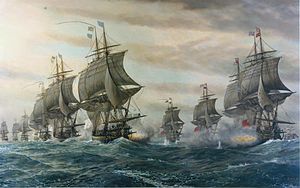
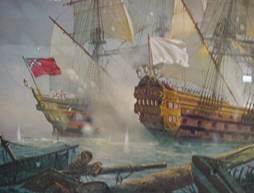
French Admiral de Grasse left off fighting the British in the West Indies and sailed 24 ships to the mouth of Chesapeake Bay, where, in the Battle of the Virginia Capes, he drove off 19 British ships which were trying to evacuate Cornwallis’ men.
De Grasse’s 3,000 French troops and General Rochambeau’s 6,000 French troops hurriedly joined General Lafayette’s division as they marched to help Washington trap Cornwallis against the sea.
General Washington trapping Cornwallis
They joined the troops of Generals Benjamin Lincoln, Baron von Steuben, Modecai Gist, Henry Knox and John Peter Muhlenberg. And Alexander Hamilton led 400 infantry to capture British redoubt number 10.
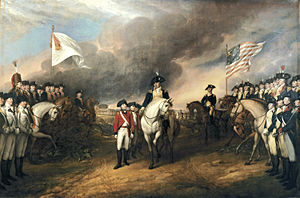
Altogether, 17,000 French and American troops surrounded Cornwallis and forced him to surrender on OCTOBER 19, 1781. This was an overwhelming victory for young America that was the main event that caused the British to end the war in America’s favor.
Yale President Ezra Stiles wrote, May 8, 1783: “Who but God could have ordained the critical arrival of the Gallic French fleet, so as to assist in the siege of Yorktown? It is God who had raised up for us a powerful ally, a chosen army and a naval force: who sent us a Rochambeau to fight side by side with a Washington in the battle of Yorktown.”
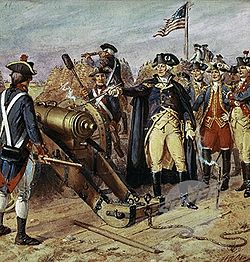
Washington wrote October 20, 1781: “To diffuse the general Joy through every breast the General orders Divine Service to be performed tomorrow in the several Brigades, To diffuse the general Joy through every breast the General orders … Divine Service to be performed tomorrow in the several Brigades. The Commander-in-Chief earnestly recommends troops not on duty should universally attend with that gratitude of heart which the recognition of such astonishing Interposition of Providence demands.”
General Washington celebrating the victory at Yorktown
On October 11, 1782, the Congress of the Confederation passed: “It being the indispensable duty of all nations to offer up their supplications to Almighty God the United States in Congress assembled do hereby recommend it to the inhabitants of these states in general, to observe the last Thursday of November next, as a Day of Solemn Thanksgiving to God for all his mercies.”
On September 3, 1783, the Revolutionary War officially ended with the Treaty of Paris, signed by Ben Franklin, John Adams, John Jay and David Hartley: “In the name of the Most Holy and Undivided Trinity. It having pleased the Divine Providence to dispose the hearts of the most serene and most potent Prince George the Third, by the Grace of God, King of Great Britain and of the United States of America, to forget all past misunderstandings and differences. Done at Paris, this third day of September, in the year of our Lord one thousand seven hundred and eighty-three.”
George Washington wrote to General Nathanael Greene, February 6, 1783: “It will not be believed that such a force as Great Britain has employed for eight years in this country could be baffled in their plan of subjugating it by numbers infinitely less, composed of men oftentimes half starved; always in rags, without pay, and experiencing, at times, every species of distress which human nature is capable of undergoing.”
Washington added in his Farewell Orders, November 2, 1783: The singular interpositions of Providence in our feeble condition were such, as could scarcely escape the attention of the most unobserving; the perseverance of the Armies of the United States, through almost every possible suffering and discouragement for the space of eight long years, was little short of a standing miracle.”
Washington added in his Farewell Orders, November 2, 1783: The singular interpositions of Providence in our feeble condition were such, as could scarcely escape the attention of the most unobserving; while the perseverance of the Armies of the United States, through almost every possible suffering and discouragement for the space of eight long years, was little short of a standing miracle.”
Harvard President Samuel Langdon stated in his address “The Republic of the Israelites an Example to the American States, June 5, 1788: “The signal interpositions of divine providence, in saving us from the vengeance of a powerful irritated nation … in giving us a WASHINGTON to be captain-general of our armies in carrying us through the various distressing scenes of war and desolation, and making us triumphant, and finally giving us peace, with a large territory, and acknowledged independence; all these laid together fall little short of real miracles. We cannot but acknowledge that God hath graciously patronized our cause, and taken us under his special care, as he did his ancient covenant people.”
Chief Justice John Jay noted in 1777: This glorious revolution is distinguished by so many marks of the Divine favor and interposition, that no doubt can remain of its being supported in a manner so singular, and I may say miraculous, that when future ages shall read its history they will be tempted to consider a great part of it as fabulous exaggerated. Will it not appear extraordinary that thirteen colonies should immediately become one people, and though without funds, without magazines, without disciplined troops, in the face of their enemies, unanimously determine to be free, and, undaunted by the power of Britain, refer their cause to the justice of the Almighty, and resolve to repel force by force.
We should always remember that the many remarkable and unexpected means and events by which our wants have been supplied and our enemies repelled or restrained, are such strong and striking proofs of the interposition of Heaven, that our having been hitherto delivered from the threatened bondage of Britain ought, like the emancipation of the Jews from Egyptian servitude, to be forever ascribed to its true cause, and kindle in them a flame of gratitude and piety which may consume all remains of vice and irreligion.”
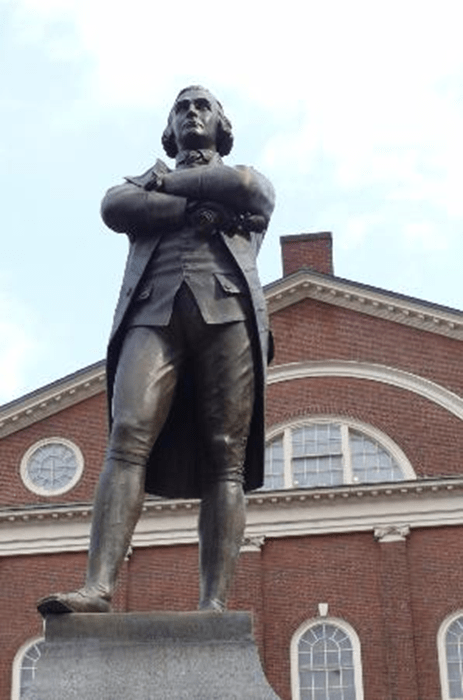
Samuel Adams
Samuel Adams stated August 1, 1776: There are instances of an almost astonishing Providence in our favor; success has staggered our enemies, and almost given faith to infidels; so that we may truly say it is not our own arm which has saved us. The hand of Heaven appears to have led us on to be, perhaps, humble instruments and means in the great Providential dispensation which is completing.”
Benjamin Franklin stated at the Constitutional Convention, 1787: In the beginning of the Contest with Great Britain, when we were sensible of danger we had daily prayer in this room for the divine protection. Our prayers, Sir, were heard, and they were graciously answered.
Benjamin Franklin
All of us who were engaged in the struggle must have observed frequent instances of a superintending providence in our favor.”
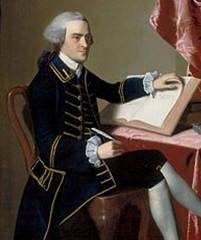
With the war over, Massachusetts Governor John Hancock proclaimed, November 8, 1783: “The Citizens of these United States have every Reason for Praise and Gratitude to the God of their salvation. I do appoint the 11th day of December next, the day recommended by the Congress to all the States to be religiously observed as a Day of Thanksgiving and Prayer, that all the people may then assemble to celebrate that He hath been pleased to continue to us the Light of the Blessed Gospel. That we also offer up fervent supplications to cause pure Religion and Virtue to flourish and to fill the world with His glory.”
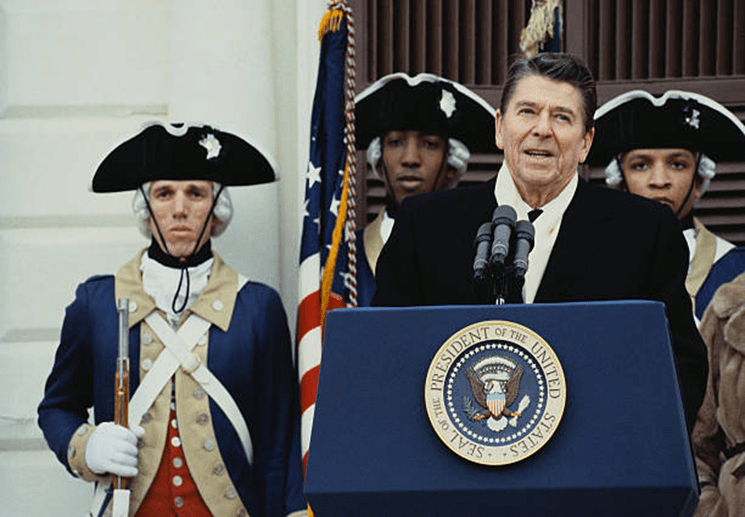
Ronald Reagan
Ronald Reagan proclaimed a Day of Prayer, January 27, 1983, stating: “A year before the Declaration of Independence, in 1775, the Continental Congress proclaimed the first National Day of Prayer as the initial positive action they asked of every colonist.”
Reagan continued: “In 1783, the Treaty of Paris officially ended the long, weary Revolutionary War during which a National Day of Prayer had been proclaimed every spring for eight years.”
On March 27, 1854, the 33rd Congress voted unanimously to print Representative James Meacham’s report, Journal of U.S. House of Representatives, which stated: “Down to the Revolution, every colony did sustain religion in some form. It was deemed peculiarly proper that the religion of liberty should be upheld by a free people. Had the people, during the Revolution, had a suspicion of any attempt to war against Christianity, that Revolution would have been strangled in its cradle.”
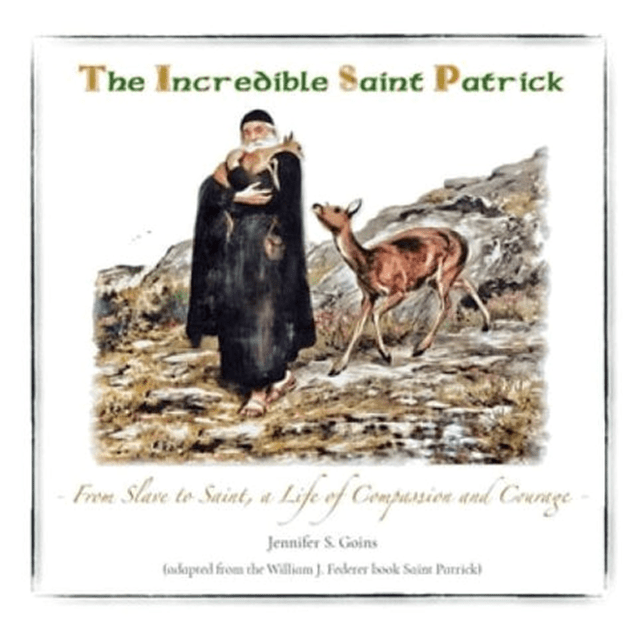
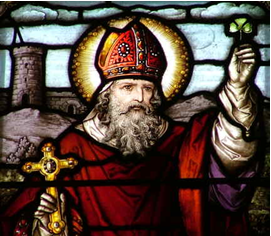
(St. Patrick’s Day is celebrated every year on March 17, which marks the date of his death. Many celebrate on this day with drinking and parades and festivities, but few know the real story of this man’s amazing life. Below, I have chronicled a brief history of it. Do read it so that you will know the story of his amazing life.)
The backstory of Saint Patrick begins with the Great Wall of China along the Mongolian border having large sections completed by the Later Eastern Han Dynasty in 220 AD. This made it harder for the Huns to attack into China, so they turned westward, attacking and displacing tribes throughout Central Asia.
These tribes migrated further west, overrunning the western borders of the Roman Empire: Visigoths, Ostrogoths, Franks, Anglos, Saxons, Alemanni, Thuringians, Regains, Jutes, Picts, Burgundians, Lombards, Alans, and Vandals.
Rome had to withdraw its Legions from other areas of the Empire, such as the frontiers of Britain, in order to place them along the Roman border. This left Britain, which had been a Roman territory since Julius Caesar 55 BC, unprotected.
Ireland was ruled by the bloodthirsty, superstitious pagan Druids.
Thomas Cahill wrote in How the Irish Saved Civilization (Random House, 1995): “Romans, in their first encounters with these exposed, insane warriors, were shocked and frightened. They were howling and, it seemed, possessed by demons, so outrageous was their strength featuring all the terrors of hell itself. The Druids, from whom Halloween originated, believed that the trees and hills were inhabited by good and evil spirits which constantly needed to be appeased.”
Cahill continued: “(Druids) sacrificed prisoners of war to the war gods and newborns to the harvest gods. Believing that the human head was the seat of the soul, they displayed proudly the heads of their enemies in their temples and on their palisades; they even hung them from their belts as ornaments, used them as footballs in victory celebrations, and were fond of employing skull tops as ceremonial drinking bowls. They also sculpted heads – both shrunken, and decapitated heads.”
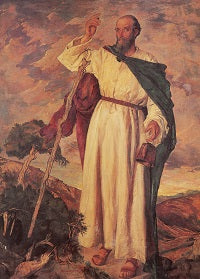
Patrick’s British name at birth was Sucat, but his Latin name was “Patricius,” meaning “Nobleman.”
Around 405 A.D., at the age of 16 years old, while working on his father’s farm near the sea, 50 currachs (longboats) filled with raiders weaved their way toward the shore.
Mary Cagney, author of the article “Patrick The Saint” (Christian History, Issue 60), wrote: “With no Roman army to protect them (Roman legions had long since deserted Britain to protect Rome from barbarian invasions), Patricius and his town were unprepared for attack. The Irish warriors, wearing helmets and armed with spears, descended on the pebble beach. Their braying war horns struck terror into Patricius’ heart, and he started to run toward town. The warriors quickly demolished the village, and as Patricius darted among the burning houses and screaming women, he was caught. Barbarians dragged him aboard a boat bound for the east coast of Ireland.”
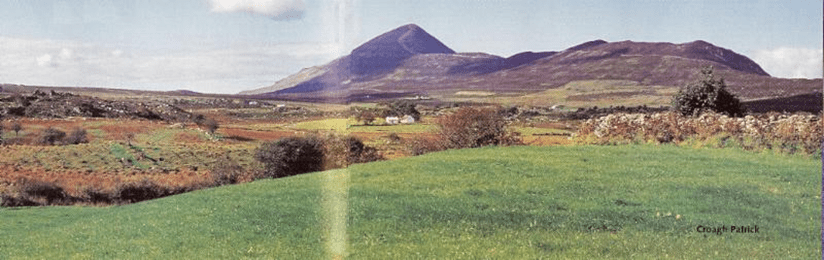
For six years Patrick herded animals for a Druid chieftain. He wrote in his life’s story, called The Confession of Saint Patrick: “But after I came to Ireland, every day I had to tend sheep, and many times a day I prayed; the love of God and His fear came to me more and more, and my faith was strengthened. And my spirit was moved so that in a single day I would say as many as a hundred prayers, and almost as many in the night, and this even when I was staying in the woods and on the mountains; and I used to get up for prayer before daylight, through snow, through frost, through rain.
There the Lord opened the sense of my unbelief that I might at last remember my sins and be converted with all my heart to the Lord my God who comforted me as would a father his son.”
Then Patrick had a dream, as he wrote: One night I heard in my sleep a voice saying to me: `It is well that you fast, soon you will go to your own country.’ And again a voice saying to me: `See, your ship is ready.’
And it was not near, but at a distance of perhaps two hundred miles. Then I took to flight. I went in the strength of God who directed my way, until I came to that ship.” He ran away and found a ship taking wolf-hounds back to Europe to sell as dogs and they let him come along.
He eventually made his way back to Britain and was reunited with what was left of his family with whom he stayed.
Then, when he was about 40 years old, he had another dream calling him back to Ireland as a missionary.
In his Confession, Patrick wrote: “In the depth of the night, I saw a man named Victoricus coming as if from Ireland, with innumerable letters, and he gave me one and while I was reading I thought I heard the voice of those near the western sea call out: ‘Please, holy boy, come and walk among us again.’ Their cry pierced my very heart, and I could read no more, and so I awoke.”
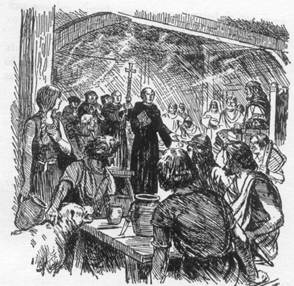
Patrick returned to Ireland where he confronted the Druids, and converted chieftains.
The Druids tried to ambush and kill Patrick nearly a dozen times: “Daily I expect murder, fraud or captivity, but I fear none of these things because of the promises of Heaven. The merciful God often freed me from slavery and from twelve dangers in which my life was at stake–not to mention numerous plots. God is my witness, who knows all things even before they come to pass, as He used to forewarn even me of many things by a divine message. I came to the people of Ireland to preach the Gospel, and to suffer insult from the unbelievers. I am prepared to give even my life without hesitation and most gladly for His name, and it is there that I wish to spend it until I die.”
Encyclopedia Britannica stated that Patrick challenged: “royal authority by lighting the Paschal fire on the hill Slane on the night of Easter Eve. “It chanced to be the occasion of a pagan festival at Tara, during which no fire might be kindled until the royal fire had been lit.”
As Patrick’s fire on the Hill of Slane illuminated the countryside, King Loigaire (King Leary) is said to have exclaimed: If we do not extinguish this flame it will sweep over all Ireland.”
Mary Cagney, in “Patrick the Saint” (Christianity Today, Issue 60), wrote: “Predictably, Patrick faced the most opposition from the Druids, who practiced magic and advised Irish kings. Biographies of the saint are replete with stories of Druids who ‘wished to kill holy Patrick’. One biographer from the late 600’s, Muirchu’, described Patrick challenging Druids to contests at Tara. The custom was that whoever lit a fire before the king on that night of the year (Easter’s eve) would be put to death. Patrick lit the paschal fire before the king on the Hill of Slane. People saw Patrick’s fire throughout the plain, and the king ordered 27 chariots to go and seize Patrick. Seeing that the impious heathen were about to attack him, Patrick rose and said clearly and loudly, ‘May God come up to scatter his enemies and may those who hate him flee from his face.’ By this disaster, caused by Patrick’s curse in the king’s presence because of the king’s order, seven times seven men fell. And the king driven by fear, came and bent his knees before the holy man.'”
Many miraculous acts were attributed to Patrick.
In his thirty years of ministry, Saint Patrick is credited with baptizing 120,000 people and founding 300 churches. He used the three-leaf clover to teach the Trinity.
In his Confession, Patrick wrote: “I had long had it in mind to write, but up to now I have hesitated. I was afraid lest I should fall under the judgment of men’s tongues because I am not as well read as others. As a youth, nay, almost as a boy not able to speak, I was taken captive. Hence to-day I blush and fear exceedingly to reveal my lack of education; for I am unable to tell my story to those versed in the art of concise writing — in such a way, I mean, as my spirit and mind long to do, and so that the sense of my words expresses what I feel.”
In his letter to Coroticus, he wrote: “I, Patrick, a sinner, very badly educated.”
Coroticus was a tyrant king in Britain who carried off some of Patrick’s converts into slavery. Patrick wrote to him: “You prefer to sell them to a foreign nation that has no knowledge of God. You betray the members of Christ as it were into a brothel. Ravenous wolves have gulped down the Lord’s own flock which was flourishing in Ireland, and the whole church cries out and laments for its sons and daughters.”
Leslie Hardinge wrote in The Celtic Church in Britain (Random House, 1995): “Wherever Patrick went and established a church, he left an old Celtic law book, Liber ex Lege Moisi (Book of the Law of Moses) along with the books of the Gospel.” . So, when the Irish converted to Christianity, they abandoned their pagan Druid laws, which Patrick replaced with Bible-based Latin-Irish laws. This became called the “Senchus Mor” or “Code of Patrick.”
On MARCH 17, around 461 AD, Saint Patrick died. Patrick’s influence was so profound that over 1500 years later, there is still a date on the calendar to remember him.
An enormous wave of immigration occurred as a result of the Great Irish Potato Famine, 1845-1849. Millions of Irish died in Ireland and millions immigrated, causing the Catholic population in America to increase to 20 percent.
33 million Americans have Irish ancestry, composing about 11 percent of the U.S. population. Twenty-two U.S. Presidents have some Irish ancestry. Communities across America have Saint Patrick’s Day Parades, where all, both Protestants and Catholics, join together in celebrating St. Patrick and Irish heritage.
In his Confession, Saint Patrick wrote: “Patrick the sinner, an unlearned man to be sure. None should ever say that it was my ignorance that accomplished any small thing, it was the gift of God.”
The World Book Encyclopedia (Chicago, IL: Field Enterprises, Inc., 1957, p. 6142) stated of Saint Patrick: “He found Ireland all heathen and left it all Christian.”
“We have fixed our hope on the living God, who is the Savior.”
You have a living hope in Jesus Christ. Take this truth to heart today—though all around you appears desperate and your dreams seem to have perished No matter the present circumstances, you can take courage in the knowledge that your Savior is the triumphant Warrior who has defeated our every foe (Revelation 17:14). He helps you and will continue to fight for you regardless of what circumstances arise.
This is the strength and joy of your Christian life—it is always possible to live above the present because your future is secure. You have an incorruptible inheritance, and unwavering Defender, and your God’s unfailing love. But you must choose to believe His promises (2 Corinthians 1:20).
So if you’ve experienced loss, do not despair. This defeat is only for the moment and what is truly important can never be taken from you. Focus on your living hope. Set your eyes on Jesus, your Lord and Savior, and expect Him to lead you to victory.
(The news has been just full of the happenings in Iran. However, most folks know very little about the real history of Iran, especially its recent history. The major news networks have even eulogizedAyatollah Ali Khamenei. Which is just amazing, considering how grossly evil he was and the multitudes that he murdered. Below, I have compiled a brief history of Iran for you. Do read every word. The CIA and Israel, who both really know, tell us that Iran’s leaders already have enough enriched uranium to make eleven atomic bombs and are close to having much more. And that they will for sure find a way to get them into the U.S. unless they are stopped.)
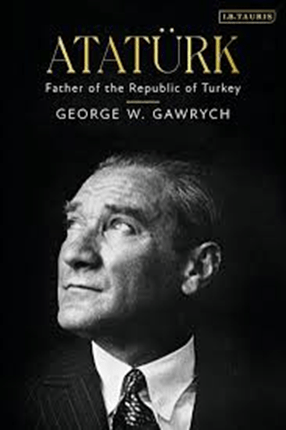
Ataturk became Turkey’s leader in 1923 and proceeded to secularize Muslim Turkey.
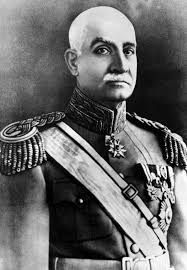
Likewise in Iran, Reza Shah seized power from the Qajar Dynasty in 1925 and secularized Persia (Iran).
He allowed women to be educated and wear fashionable clothing. He replaced sharia with a civil code, similar to French law, and replaced religious courts with state courts. To emphasize national identity, Reza Shah began referring to Persia as “Iran.”
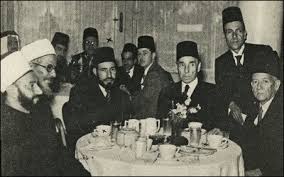
Some Middle Easterners who resisted secularism formed the Muslim Brotherhood in 1928 and with other Islamist groups targeted secular leaders with assassinations, even siding with Nazis.
When World War Two began, Reza Shah hesitated driving out Germans, so in 1941, Britain and Soviet Russia joined in a coup to remove him and replace him with his son, Reza Pahlavi.
Reza Pahlavi appointed Mossadegh as Prime Minister, a powerful position within Iran’s government.
During the Cold War, Mossadegh grew anti-western, being supported by Iran’s Tudeh Communist Party. Mossadegh assumed emergency powers, dissolved Parliament and limited the Shah’s authority.
In a power struggle, Mossadegh nationalized Iran’s oil industry in 1951, and confiscated the largest oil refinery in the world, owned by the Anglo-Iranian, BP. Oil Company.
As a result, Britain experienced an oil shortage and appealed to President Eisenhower for help.
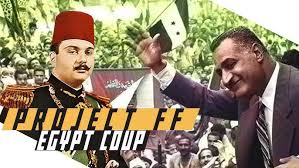
Eisenhower’s CIA Director Allen Dulles had joined in Project FF in 1952 to remove Egypt’s King Farouk, as he had opened relations with Soviet Russia.
In 1953, the CIA carried out Operation Ajax, led by Kermit Roosevelt, Jr., grandson of Theodore Roosevelt, to remove Iran’s Prime Minister Mossadegh in order to solidify support for a new leader for Iran, Shah Reza Pahlavi, a strong ally with America.
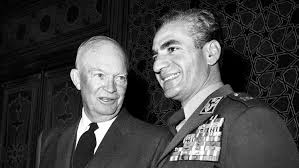
Shah Pahlavi with Eisenhower
During his 37 years in office, Reza Pahlavi created one of the fastest-growing economies in the world. He was just incredible as a leader and a friend of the U.S.
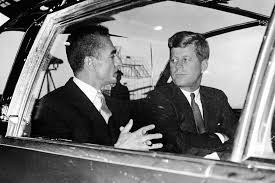
Shah Pahlavi conferring with John kennedy
He arranged trade deals with the U.S., even having the Cadillac Seville manufactured in Iran.
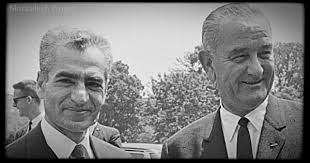
The Shah with Lyndon Johnson
He promoted a secular government with freedoms, especially for women.
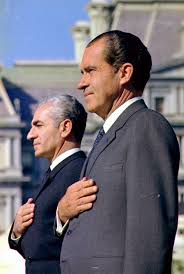
The Shah with Nixon
Pahlavi was wary of socialists and Islamists plotting to overthrow him.
The United States supported Shah Reza Pahlavi, who met with Presidents Truman, Eisenhower, Kennedy, Johnson, Nixon and Ford. He was one of the greatest friends that the U.S. ever had on the international stage. He kept us in good relations with most everyone in the Middle East. And he was very instrumental in keeping the different factions in the Middle East at peace with each other, which proved no easy task as later events would prove.
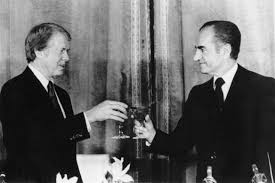
The Shah with Jimmy Carter
This all changed with President Jimmy Carter.
On New Year’s Eve, December 31, 1977, Carter toasted the Shah, praising his leadership for making Iran “an island of stability in one of the more troubled areas of the world.”
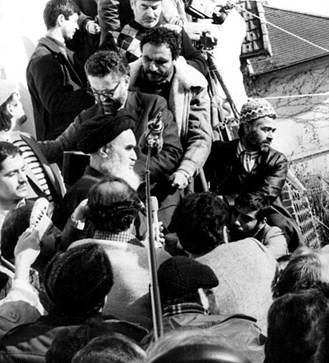
The following year, though, Carter would begin planning with Ayatollah Khomeini, exiled in France, to replace the Shah. The situation was that socialist groups had recruited idealistic youth to participate in protests against the Shah. When he tried to restore order, they escalated it into color revolution riots and violence. This convinced the Carter administration that the Shah would end up being ousted and replaced with a pro-Soviet puppet leader.
Of course this was not true. President Carter’s betrayal of this great friend of the U.S., was probably one of the greatest of his many horrible acts that many of us consider bordering on treason.
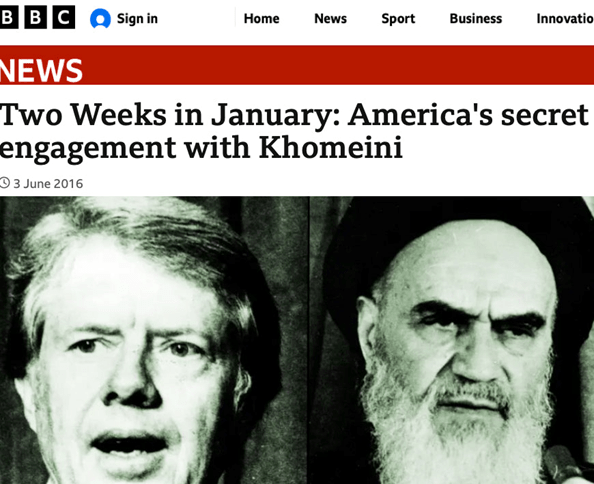
The BBC published an article, June 3, 2016, titled “Two Weeks in January: America’s secret engagement with Khomeini.
In The BBC published article, of June 3, 2016 there was a trove of newly declassified US government documents that tell the largely unknown story of America’s secret engagement with Khomeini, an enigmatic cleric who would soon inspire Islamic fundamentalism and anti-Americanism worldwide.”
The BBC explained: “From his home in exile outside Paris, the defiant leader of the Iranian revolution effectively offered the Carter administration a deal: If President Jimmy Carter could use his influence on the military to clear the way for his takeover, Khomeini suggested, he would calm the nation.”
The article added: “On November 9, 1978, in a now-famous cable, ‘Thinking the Unthinkable,’ the US ambassador to Iran, William Sullivan argued that Washington should get the Shah and his top generals out of Iran, and then make a deal, (with) Khomeini.”
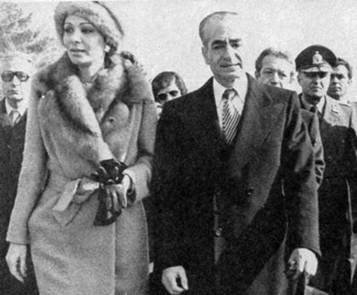
The Shah and His Wife Leaving in Sorrow ‘Thanks to Carter’
Carter, influenced by his globalist advisors, pressured the Shah to leave Iran in 1979. Carter’s diary recorded he was skiing at Camp David on February 11, 1979, the exact day Khomeini’s revolutionary forces took control of Iran.
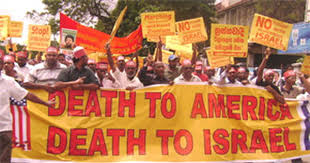
Though Khomeini had assured Carter, “You will see we are not in any particular animosity with the Americans,” within a short time Khomeini called America “The Great Satan,” chanted “death to America,” and vowed to fight American imperialism worldwide, saying: “We will export our revolution to the entire world.”
Khomeini exported revolution, supporting Islamist organizations such as Hezbollah, Hamas, and Houthis, which attacked Israel for being the last major obstacle in reestablishing the Caliphate — a world Islamic government.
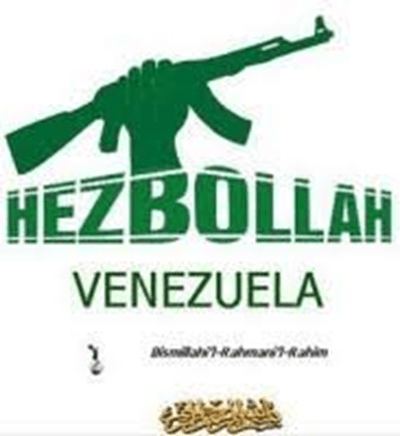
Hezbollah established a base in Venezuela and has infiltrated drug gangs that travel through Central America into the United States.
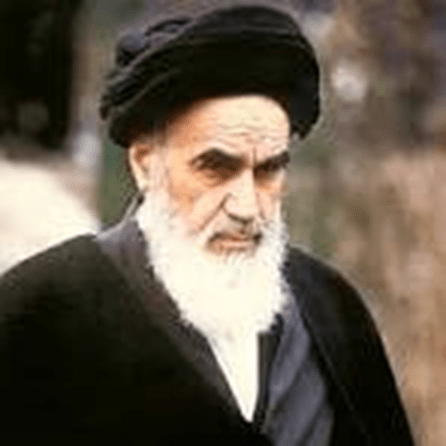
Khomeini executed pro-American Iranian generals on a high school rooftop, hunted down Shah supporters, and killed them by the thousands. One of his clerics even threatened to destroy the ancient palace of King Cyrus located at Persepolis, as the Shah had used it to rally national identity.
Khomeini’s strategy had been to assemble a broad coalition of people unhappy with the Shah, including liberals, moderates, leftists, Marxists, socialists, poor, and urban youth, by making promises he had no intention of keeping. Once in power, he began liquidating those groups one-by-one. Naive youth who had joined Marxist socialist groups to help Khomeini come to power were ordered shot.
In typical Islamist “taqiyya” fashion, Khomeini broke every promise he made to Carter.
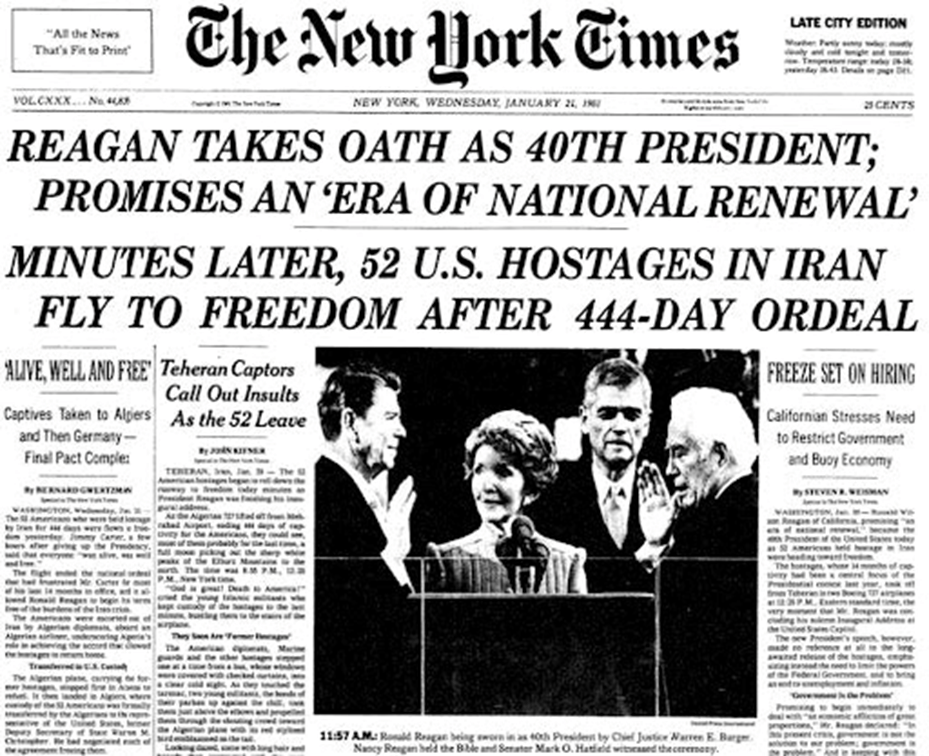
He imprisoned 52 Americans, all those from our embassy in Iran, for 444 days, only releasing them minutes after the swearing in of the next President, Ronald Reagan, whom he feared greatly.
UPI Archives recorded Ronald Reagan, October 21, 1984: “I criticized President Carter for undercutting what was a stalwart ally, the Shah of Iran. I am not at all convinced that he was that far out of line with his people or that they wanted (the Muslin revolution) to happen. The Shah had done our bidding and carried our load in the Middle East for quite some time. And I did think that it was a blot on our record that we let him down. The Shah was building low cost housing, had taken land from the mullahs and was distributing it to the peasants so they could be land owners. Things of that kind. But we turned it over to a maniacal fanatic who has slaughtered thousands of thousands of people calling it executions.”
Jimmy Carter’s 1979 foreign policy decision had ripple effects. It was soon followed by Iran, under the Ayatollah, fighting Iraq, under Saddam Hussein, from 1980 to 1988, with the U.S. and U.S.S.R. involved behind the scenes. Over a million died.
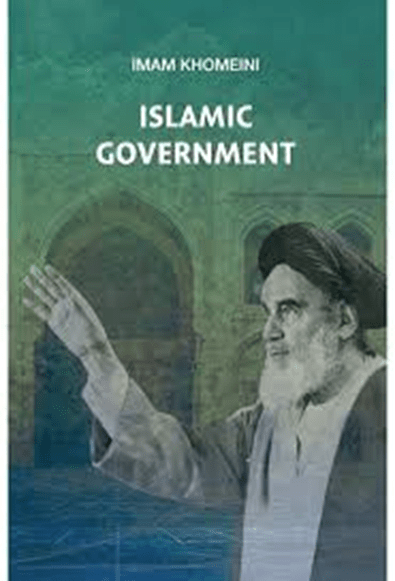
Khomeini wrote a book on sharia law in 1970 titled Islamic Governance of the Jurist “Hokumat-e Islami: Velayat-e faqih.” He advocated:
The laws of society should be made up only of sharia. Other laws are unnecessary because sharia laws cover “all human affairs”. Those holding government posts should have deep knowledge of sharia. Rule by “those claiming to be representatives of the majority of the people” are proclaimed “wrong” by Islam. Clerical rule is necessary to prevent injustice. Islamic leaders were so strict they insisted the Qur’an only be recited in Arabic, yet the language of the people is Farsi.
Condemning democracy, Khomeini ordered mass executions of those he deemed “enemies of Islam,” as he instituted the world’s only Shi’a Islamic theocracy. His religious police, Gasht-e Ershad, enforced sharia law: Beating and flogging women who do not adhere to strict dress codes of being covered with veils; No freedom for liberals, leftists, or feminists, with Farrokhrou Parsa, the first woman to serve in Iran’s cabinet, being executed by a firing squad; No woman can leave her house without her husband’s permission; No woman can leave her house unless accompanied by a male relative; A woman must obey her husband in all matters or else she has no right to clothing, housing, or food.
And he continued: A man can have multiple wives, as young as 13; A man may physically discipline a wife for disobedience; No right for a woman to divorce her husband; Men possess exclusive right to divorce, and can divorce a wife without her knowledge, consent, or formal proceeding, only two male witnesses need hear husband’s announcement. Children are automatically in custody of father; No dogs are allowed as indoor pets; -tattoos are frowned upon and cannot depict anything clerics deem obscene or western; -no alcohol, western movies, or dances; -no music, including on radio or television; -no men and women swimming or sunbathing; -men punished for wearing shorts;
And he continued on with all his “laws” for the Iranians: -all homosexuals are to be exterminated; -execution of drug addicts and prostitutes; -no freedom of speech, with “fatwa” decrees to assassinate those insulting Islam. -anything that is not Islam insults Islam; -no freedom of assembly if deemed detrimental to the principles of Islam; -no right for general public to own weapons unless part of government-approved groups; -no meaningful right for the people to petition the government for a redress of grievances; -all education must be Islamized; -youth are encouraged to martyrdom for Islam; -no right to a public trial by an impartial jury; -no right to be secure from arbitrary arrests, home invasions or property seizures; -four fingers of right hand amputated for theft, and for second offense left foot amputated; -torture systematically used against political prisoners; -death penalty for converting to Christianity.
Voice of the Martyrs reported: “The Iranian government is among the most oppressive regimes in the world. It is illegal to leave Islam, and Christians face the constant threat of imprisonment and being falsely charged with ‘acting against national security’ for owning Bibles or even talking about Christ.”
No wonder that there was such great celebration by the people that Donald Trump was coming to their ‘rescue’.
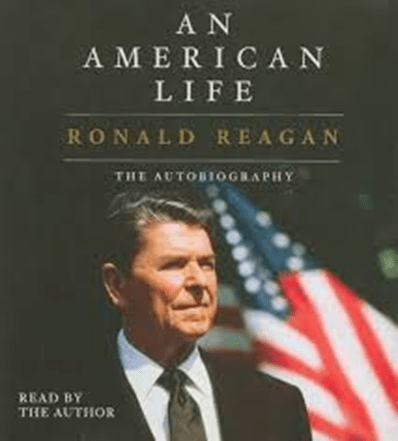
Ronald Reagan warned in his autobiography, An American Life, 1990 (Simon and Schuster): “Twice in recent years, America has lost loyal allies in the Middle East, the Shah of Iran and Anwar Sadat. I don’t think you can overstate the importance that the rise of Islamic fundamentalism could have to the rest of the world in the century ahead; especially if fanatical elements get their hands on nuclear and chemical weapons.”
Obama’s foreign policy allowed the Islamic Republic of Iran to access billions of dollars while they were covertly developing nuclear technology. CNN ran the headline, June 7, 2018: “Obama admin. worked to allow Iran to exchange billions to bypass sanctions.”
Trump’s first term sanctioned Iran’s oil sales, depriving the regime of revenue. Then Biden stopped enforcing the sanctions, allowing Iran’s oil revenues to surge.
Russia helped Iran develop dual-use nuclear technology adaptable to weapons.
Iran’s Supreme Leader, Ayatollah Ali Khamenei, adheres to Twelver Shi’a eschatology where he believes he is the prophesied “Seyed Khorasani” who will start a “final battle” of global chaos and conflict that will usher in the reappearance of the Twelfth Imam, Imam Mahdi, who will annihilate Israel, “the Little Satan,” and the United States, “the Great Satan.”
Ayatollah Ali Khamenei
In January of 2026, Supreme Leader Ayatollah Ali Khamenei crushed Iranians wanting freedom. TIME Magazine reported, January 25, 2026, “Iran Protest Death Toll Could Top 30,000.” Reza Pahlavi, son of the last shah, received reports that 50,000 were killed.
An Iranian refugee “estimates that the regime has killed thousands and more than 330,000 injured, with most victims reportedly under the age of 30. Of the more than 24,000 protestors who had been jailed: “They will not be coming back,” the refuge said, “They will be killed in jail.”
Sadly once protesters realized they would simply be mowed down with no hope of bringing about regime change, they gave up.”
But, Praise God, our intrepid Donald Trump had enough of these Muslim Clerics and has done what previous presidents never did what they should have done: He is wiping them out, and on the road to finishing them all off and finishing their regime. Pray for him and all the military involved!
Despite persecutions, “Iran’s Crown Prince says Christianity is the Fastest Growing Religion in the Islamic Nation.”
Billy Hallowell of CBN has reported: “Iranian Muslims Find Jesus in Truly Miraculous Ways”: “God is using dreams to speak to Iranians all the time,” Lana Silk, U.S. director of Transform Iran told CBN News: “Iranians are open to dreams, and God uses that to speak to them” Previously, it was a death sentence to accept Christ.
Please, Let us pray for the people of Iran, and all who live under oppression, especially followers of Jesus. Today, millions of Iranians desire the freedoms taken for granted in America.
Iran has a long history, going all the way back to Elam, the grandson of Noah who lived there. And the Bible says in Jeremiah 49:39 “But it will be in the last days that I will reverse the captivity and restore the fortunes of Elam, says the Lord.”

 True Texan Tales