(“See how great a love the Father has bestowed on us, that we would be called Children of God.”)
No one loves you more intimately and unconditionally than God does. He created you to be in relationship with Him—to glorify Him, have fellowship with Him, and be His beloved child forever.
He wants you to know how deeply and unconditionally He cares for you. There is nothing you could ever do to surprise or disappoint Him because He knows all things and is never shocked by your actions. Although He does not approve of sin, and may urge you to repent of ungodly behavior. He will always invite you back into His presence and accept you when you repent.
Therefore, when you do stumble, always remember you have an Advocate before the Father—Jesus Christ—who hears your prayers for forgiveness and cares when you are hurting. God may discipline you when you yield to temptation, but He will never withhold His love from you. You are His child. This truth never changes. And because He is righteous, loving, and steadfast, He will certainly never fail you.
Pray: Lord, thank You for forgiving me. No matter what, Your love is everlasting—and I am so grateful! Amen.
(There is much confusion about America’s conflicts with these ruthless pirates along this coast and the Muslim countries of Tripoli, Algeria, Tunis and others. We declared war on them three different times, mostly for their capture of our ships and enslaving their crews. Below I have recorded accurately an account of the history of our conflicts with them. Do read it so that you will understand those conflicts in accurat context.)
The TREATY OF TRIPOLI is of particular interest as secularists have attempted to use a phrase from it out-of-context.
The phrase, “the government of the United States of America is not in any sense founded on the Christian religion,” has been presented as a definitive expression of the intent of America’s founders regarding religion and government.
This view, though, is discounted when one considers four points:
1) historical context shows the treaty’s conciliatory language was an attempt to appease Muslim Barbary pirates;
2) the treaty was negotiated on behalf of the Federal government, while at that time “religion” in America was under each states’ jurisdiction;
3) the treaty’s misquoted phrase is a sentence fragment that must be read with the qualifying words following it; and
4) if treaties are to be considered as showing the founders intent, then all other U.S. treaties must also be examined, including those which favorably acknowledge religion.
The historical context of the Treaty of Tripoli&n bsp;begins in March of 1785, when John Adams and Thomas Jefferson met in France with Tripoli’s ambassador Abdrahaman. Subject of the meeting was to determine why Muslim Barbary pirates were attacking and capturing American ships in the Mediterranean and imprisoning American sailors.
Jefferson had previously acquired a translation of the Qur’an. After reading it, Jefferson wrote to William Canby, September 18, 1813: “Of all the systems of morality, ancient or modern, which have come under my observation, none appear to me so pure as that of Jesus.”
Jefferson studied why Muslim pirates perpetrated unprovoked attacks and enslave non-Muslims. He asked Tripoli’s ambassador Abdrahaman what the new nation of the United States had done to offend or provoke Muslim Barbary States. Writing to U.S. Secretary of Foreign Affairs John Jay, Thomas Jefferson described: “The ambassador answered us that it was founded on the laws of the prophet, it was written in their Koran, that all nations which had not acknowledged the Prophet were sinners, whom it was the right and duty of the faithful to plunder and enslave; and that every mussulman who was slain in this warfare was sure to go to paradise. He said, also, that the man who was the first to board a vessel had one slave over and above his share, and that when they sprang to the deck of an enemy’s ship, every sailor held a dagger in each hand and a third in his mouth; which usually struck such terror into the foe that they cried out for quarter at once.”
He wrote again to John Jay, 1787, explaining his efforts to ransom captured American sailors through the mediation of the Catholic Order of Mathurins, which was later disbanded during the French Revolution:
“There is an Order of priests called the Mathurins, the object of whose institution is to beg alms for the redemption of captives. They keep members always in Barbary,&nb sp;searching out the captives of their country, and redeem, I believe, on better terms than any other body, public or private. It occurred to me, that their agency might be obtained for the redemption of our prisoners at Algiers. The General of the Order undertook to act for us, if we should desire it. He told me that their last considerable redemption was of about 300 prisoners who cost them somewhat upwards of 1,500 livres apiece, and that it must be absolutely unknown that the public concern themselves in the operation or the price would be greatly enhanced.”
Congress directed Jefferson and Adams to borrow $80,000 from Dutch bankers to make the extortion tribute payment, as Jefferson wrote to John Jay, 1787:
“If Congress decide to redeem our captives, it is of great importance that the first redemption be made at as low a price as possible, because it will form the future tariff. If these pirates find that they can have a very great price for Americans, they will abandon proportionally their pursuits against other nations to direct them towards ours.”
John Jay, who later would be the First Chief Justice, wrote to the President of Congress Richard Henry Lee, October 13, 1785: “Algerian Corsairs and the Pirates of Tunis and Tripoli (would cause Americans to unite, since) the more we are ill-treated abroad the more we shall unite and consolidate at home.”
In 1788, Jefferson arranged for John Paul Jones, referred to by some as the “Father of the American Navy,” to fight for Empress Catherine the Great of Russia against the Muslim Ottoman navy near the Crimean Peninsula during the 2nd Russo-Turkish War, 1787-92.
Jefferson wrote to General George Washington:
“The war between the Russians and the Turks has made an opening for our Commodore Paul Jones. The Empress has invited him into her service. She insures to him the rank of rear admiral. I think she means to oppose him to the Captain Pacha, on the Black Sea. He has made it a condition, that he shall be free at all times to return to the orders of Congress and also, that he shall not bear arms against France. I believe Congress had it in contemplation to give him the grade of admiral, from the date of his taking the Serapis. Such a measure would now greatly gratify him.”
John Paul Jones wrote in Narrative of the Campaign of the Liman of victoriously sailing his flagship Vladimir against the Turks near the Black Sea’s Dnieper River. The night before the battle, Jones and a Cossack sailor silently rowed out to scout the position of the Turkish fleet. On the side of one Turkish ship, Jones chalked in giant letters: “TO BE BURNED. PAUL JONES.” In the next day’s battle, that ship was among those destroyed by Jones. Jones was then appointed U.S. Consul to negotiate the release of captured U.S. Navy officers held in the dungeons of Algiers.
When John Paul Jones died suddenly, Joel Barlow filled the post. U.S. Consul Joel Barlow tried to stop Tripoli’s Barbary Pirates from continuing to terrorize the seas and capturing American sailors.
In 1793, Muslim Barbary pirates captured the U.S. cargo ship Polly. The fundamentalist Muslim captain justified the crew’s brutal treatment: “For your history and superstition in believing in a man who was crucified by the Jews and disregarding the true doctrine of Allah’s last and greatest prophet, Mohammed.”
In 1795, Muslim Barbary Pirates of Algiers captured 115 American sailors. The U.S. paid ransom of nearly a million dollars.
Tripoli followed sharia law which prohibited them from making treaties with “infidel” Christians:
Infidels are those who declare: ‘God is the Christ, the son of Mary’ (Sura 5:17);
Infidels are those that say ‘God is one of three in a Trinity’ (Sura 5:73).
Believers, do not take the Jews and the Christians as allies (Sura 5:51);
Infidels are your sworn enemies (Sura 4:101);
Make war on the infidels who dwell around you (Sura 9:123);
Prophet, make war on the infidels (Sura 66:9);
When you meet the infidel in the battlefield strike off their heads (Sura 47:4);
Muhammad is Allah’s apostle. Those who follow him are ruthless to the infidels (Sura 48:29);
Believers, do not make friends with those who have incurred the wrath of Allah (Sura 60:13).
So do not falter or cry for peace, for you will have the upper hand and Allah is with you. (Sura 47:35)
But once the Sacred Months have passed, kill the polytheists who violated their treaties wherever you find them, capture them, besiege them, and lie in wait for them on every way. (Sura 9:5)
Barlow realized that Islamic law frowned upon fundamentalist Muslims making friendship alliances with infidel nations. His challenge was to make a distinction in the minds of the Barbary powers that they were negotiating with a nation-state, not the Christian religion.
This is the second point to consider. Joel Barlow was negotiating the Treaty of Tripoli on behalf of the “nation-state” – the “government of the United States of America” — the “Federal” Government. This was a necessary distinction to make, as Muslims had been at war with the “Christian nations” of Europe for over 1,000 years. The concept of a “nation-state” where citizens within the country had freedom of conscience to join or leave a religion as they wished was unfamiliar and unwelcome to fundamental Muslims, as it still is today among fundamentalist groups like ISIS and the Muslim Brotherhood.
In the United States, the “Federal” Government was prohibited by the First Amendment from having jurisdiction over religion, as religion was under each individual state’s jurisdiction. Supreme Court Justice Joseph Story wrote in Commentaries on the Constitution of the United States, 1833: “The whole power over the subject of religion is left exclusively to the state Governments, to be acted upon according to their own sense of justice and the State Constitutions.”
Jefferson explained in his Second Inaugural Address, March 4, 1805: “In matters of religion I have considered that its free exercise is placed by the Constitution independent of the powers of the General (Federal) Government. I have therefore undertaken, on no occasion, to prescribe the religious exercise suited to it; but have left them, as the Constitution found them, under the direction and discipline of state and church authorities.”
Jefferson told Samuel Miller, January 23, 1808: “I consider the (Federal) Government of the United States as interdicted (prohibited) by the Constitution from inter-meddling with religious institutions, their doctrines, discipline, or exercises. This results not only from the provision that no law shall be made respecting the establishment or free exercise of religion, but from that also which reserves to the states the powers not delegated to the United States (10th Amendment).”
In fact, it was the states’ jealous desire to keep religion under their jurisdictions that motivated the states to insist that a First Amendment be added to the U.S. Constitution to prohibit the Federal Government from inter-meddling with religion.
This was not the case in most European countries which had established churches, or in fundamental Muslim countries which controlled citizens’ religious life through threats of death or dismemberment.
The Islamic understanding of religion and government being synonymous is seen in the original Arabic translation of the 1797 Treaty of Tripoli:
“Glory be to God! Declaration of the third article. We have agreed that if American Christians are traveling with a nation that is at war with the well preserved Tripoli, and (the Tripolitan) takes (prisoners) from the Christian enemies and from the American Christians with whom we are at peace, then sets them free; neither he nor his goods shall be taken.
Praise be to God! Declaration of the twelfth article.
If there arises a disturbance between us both sides, and it becomes a serious dispute, and the American Consul is not able to make clear his affair, and the affair shall remain suspended between them both, between the Pasha of Tripoli, may God strengthen him, and the Americans, until Lord Hassan Pasha, may God strengthen him, in the well-protected Algiers, has taken cognizance of the matter.
We shall accept whatever decision he enjoins on us, and we shall agree with his condition and his seal; May God make it all permanent love and a good conclusion between us in the beginning and in the end, by His grace and favor, amen!”
The wording of the Treaty of Tripoli of 1797 was not to discredit Christianity’s historical contribution to the founding of America, but rather it was an attempt for the Federal government of the United States to negotiate with Muslim powers using phraseology they could relate to and which they would be obliged to honor.
With that background, the phrase in Treaty of Tripoli under discussion was:
“As the government of the United States of America is not in any sense founded on the Christian religion, -as it has in itself no character of enmity against the law, religion or tranquility of the Musselmen-, and as the said States never have entered into any war or act of hostility against any Mehomitan nation, it is declared by the parties that no pretext arising from religious opinion shall ever produce an interruption of the harmony existing between the two countries.”
Noted religious critic and anti-theist Christopher Hitchens admitted in his work Jefferson Versus the Muslim Pirates (2007):
“Of course, those secularists like myself who like to cite this Treaty must concede that its conciliatory language was part of America’s attempt to come to terms with Barbary demands.”
In grammar, a comma indicates a qualifying relationship between a dependent clause and an independent clause.
The phrase “As the government of the United States of America is not in any sense founded on the Christian religion,” is followed by a comma indicating that the preceding dependent phrase is qualified by the subsequent phrase which should always accompany it, “-as it has in itself no character of enmity against the law, religion or tranquility of the Musselmen.”
The Treaty of Tripoli, as Christopher Hitchens explained, contained “conciliatory language” in an “attempt to come to terms with Barbary demands.”
John Adams’ Secretary of War James McHenry protested the language of the Treaty of Tripoli, writing to Secretary of the Treasury Oliver Wolcott, Jr., September 26, 1800:
“The Senate ought never to have ratified the treaty alluded to, with the declaration that ‘the government of the United States, is not, in any sense, founded on the Christian religion.’
What else is it founded on? This act always appeared to me like trampling upon the cross. I do not recollect that Barlow was even reprimanded for this outrage upon the government and religion.”
Immediately after Jefferson was inaugurated President in 1801, the Pasha of Tripoli demanded $225,000 in an extortion tribute payment to keep his Barbary pirates from seizing American ships, confiscating cargo and selling crews into slavery.
When Jefferson refused to pay, the Pasha declared war – the first war after the U.S. became a nation.
Jefferson stated in his First Annual Message to Congress, December 8, 1801:
“Tripoli, the least considerable of the Barbary States, had come forward with demands unfounded either in right or in compact, and had permitted itself to (announce) war on our failure to comply before a given day. The style of the demand admitted but one answer.
I sent a small squadron of frigates into the Mediterranean, with assurances to that power of our sincere desire to remain in peace, but with orders to protect our commerce against the threatened attack. The measure was seasonable and salutary.
The Bey (lord) had already declared war. His cruisers were out.
Two had arrived at Gibraltar.
Our commerce in the Mediterranean was blockaded and that of the Atlantic in peril. The arrival of our squadron dispelled the danger.
One of the Tripolitan cruisers having fallen in with and engaged the small schooner Enterprise, commanded by Lieutenant Sterret, which had gone as a tender to our larger vessels, was captured, after a heavy slaughter of her Muslim men, without the loss of a single one on our part.
The bravery exhibited by our citizens on that element will, I trust, be a testimony to the world. We are bound with peculiar gratitude to be thankful to Him that our own peace has been preserved through a perilous season.”
On December 29, 1803, the 36-gun USS Philadelphia was cruising the Mediterranean when it ran aground on an uncharted sand bar off the coast of North Africa. Muslims surrounded it and captured its crew.
They imprisoned Captain William Bainbridge and his 307 man crew for 18 months.
To keep this ship from being used by Muslim pirates, Lieut. Stephen Decatur sailed his ship, Intrepid, February 16, 1804, into Tripoli’s harbor and set the USS Philadelphia ablaze.
British Admiral Horatio Nelson called it the “most bold and daring act of the age.”
After negotiations, for $60,000 and 89 Muslim prisoners captured in skirmishes, the crew of the USS Philadelphia was released, less 6 who had died in captivity and 5 who converted to Islam, much to the annoyance of the rest.
When the Pasha of Tripoli offered the 5 converts the choice of staying in Tripoli or returning to America, 4 decided to renounce Islam and return home.
Horror covered their faces as the insulted Pasha ordered guards to drag them away, following the instruction in Hadith al-Bukhari:
“Mohammed said, Whoever changes his Islamic religion, kill him.”
In April of 1805, Jefferson sent in the Navy and Marines, led by Commodore Edward Preble, Commodore John Rogers, Captain William Eaton, Lieut. Stephen Decatur, and Lieut. Presley O’Bannon.
The Marines landed at Alexaria, Egypt, the closest port to Derna, the major city and center of the slave trade with its slave markets.
As mentioned, at that time the center of the Muslim slave markets was at Derna on the Barbary Coast, in the province of Tripoli. It was quite secure, since it had large, land-based cannons. The ships which really wanted to bombard Derna did not have cannons that large and were kept awau, so this strategic town was quite safe. It could not be attacked from the land either because to its rear was a formidable desert, 600 miles across.
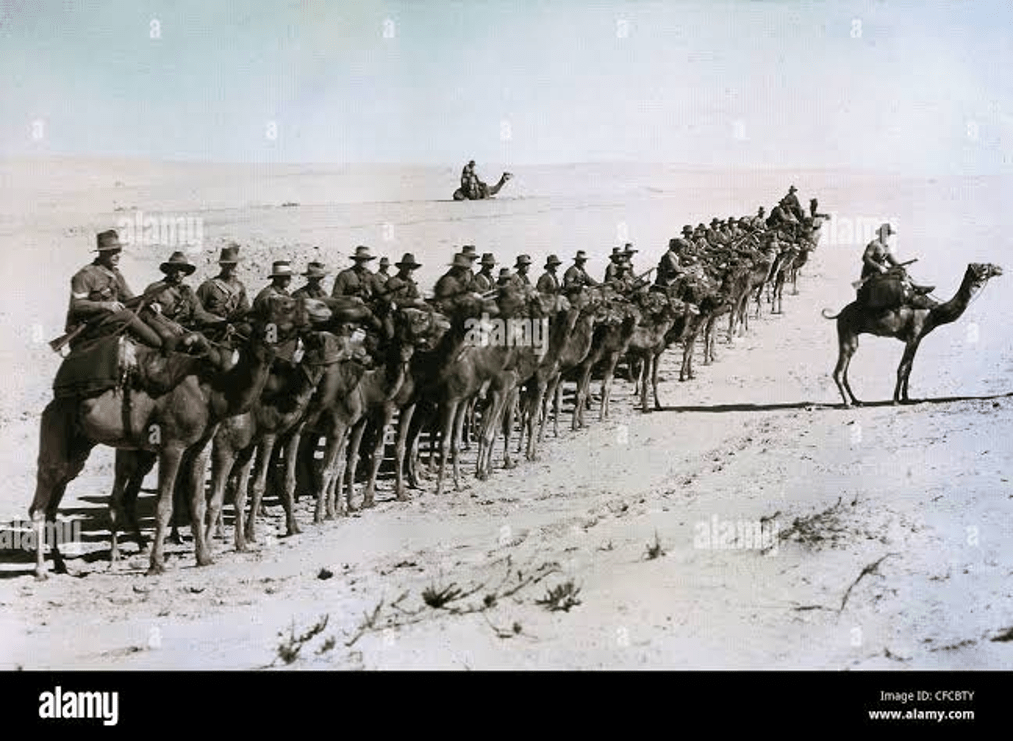
The Marines in Alexandrina became fast friends of the Bedouin desert worriors. The Bedouin loved those Marines becaus they were so tough and aggesive. The two banded together and decided to attempt to cross that formidible 600 mile desert and attack Derna. For the first time those Marines had to use camels. But as we learned in WW II nothing stops the U.S. Marines.
The Marines became friends with the Bedouin desert warriors there and were highly respected by the Bedouin because they were so tough and aggressive. The Marines made an alliance with the Bedouin warriors to go with them to attack Derma since the Bedouin were not Muslims.
They crossed that formidable, supposedly impossible 600 miles by finding just enough water with the help of those Bedouin. And when they came charging out of the desert with both groups yelling their respective war cries those Muslims just could not believe it. The Marines were armed with the Henry Repeating Rifles like the Texas Rangers were now using along the Mexican border. The Muslims in Derna and along the Barbary coast had nothing like them.
They just obliterated Derna and all of its land based cannons, and totally stopped that horrible slave trade forever, such as this European girl captured and made a slave, and being given to the Pasha:
They seized the Barbary harbor of Derna and the terrorist attacks ceased up and down the whole Barbzry Coast, giving rise to the Marine Anthem:
“From the Halls of Montezuma to the shores of Tripoli …”
Many “mameluke ” Muslim slave-soldiers had their curved scimitar swords confiscated, which became the Marine “Mameluke” sword. And to this day is part of the United States Marine’s dress uniform.
Marines were called “leathernecks” for the wide leather straps they wore around their necks to prevent them from being beheaded, as Sura 47:4, stated: “When you meet the infidel in the battlefield, strike off their heads.”
Jefferson then had a new Treaty of Peace and Amity with Tripoli, April 12, 1806, but this time it was negotiated from a position of strength and therefore it did not contain the controversial conciliatory wording of the 1797 Treaty of Tripoli.
Francis Scott Key wrote a song to honor the and Marines titled “When the Warrior Returns from the Battle Afar,” published in Boston’s Independent Chronicle, December 30, 1805, being written to the same tune that nine years later Key would use for the Star-Spangled Banner:
“In conflict resistless each toil they endur’d
Till their foes shrunk dismay’d from the war’s desolation:
And pale beamed the Crescent, its splendor obscur’d
By the light of the Star-Bangled Flag of our nation.
Where each flaming star gleamed a meteor of war,
And the turban’d head bowed to the terrible glare.
Then mixt with the olive the laurel shall wave
And form a bright wreath for the brow of the brave.”
The Europeans and others had tried for so many years to stop the raiding and confiscating such huge numbers from Europe and from the ships at sea for slavery by the Muslim Pirates from the Barbary Coast. However, it took those tough U.S. Marines to finally accomplish it.
Soon after beginning his ministerial career in England in 1852, he abandoned the concept of the traditional church pulpit in favor of taking the gospel of Jesus Christ directly to the people. Walking the streets of London, he preached to the poor, the homeless, the hungry, and the destitute.
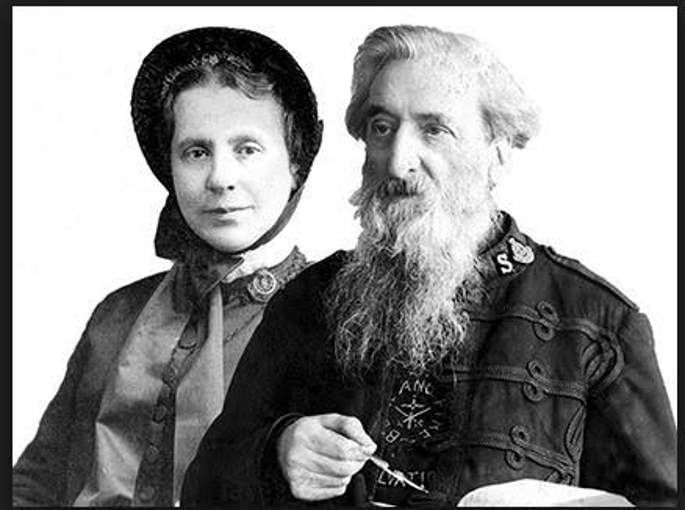
When fellow clergymen disagreed with Booth’s unconventional approach, he and his wife Catherine withdrew from the church to train evangelists throughout England. The couple returned to the East End of London in 1865, where many followers joined their fight for the souls of lost men and women. Within 10 years, their organization, operating under the name The Christian Mission, had over 1,000 volunteers and evangelists.
Thieves, prostitutes, gamblers, and drunkards were among their first converts to Christianity. And soon, those converts were also preaching and singing in the streets as living testimonies to the power of God.
When Booth read a printer’s proof of the 1878 Christian Mission annual report, he noticed the statement, “The Christian Mission is a volunteer army.” Crossing out the words “volunteer army,” he penned in “Salvation Army.” From those words came the basis of the foundation deed of The Salvation Army.
From that point onward, converts became soldiers of Christ and were known then, as now, as Salvationists. They launched an offensive throughout the British Isles that, in spite of violence and persecution, converted 250,000 Christians between 1881 and 1885. Their message spread rapidly, gaining a foothold in America and soon after Canada, Australia, France, Switzerland, India, South Africa, Iceland, and Germany.
Today, The Salvation Army is active in virtually every corner of the world and serves in 133 countries, offering the message of God’s healing and hope to all those in need.
Soon after beginning his ministerial career in England in 1852, William Booth abandoned the concept of the traditional church pulpit in favor of taking the gospel of Jesus Christ directly to the people. Walking the streets of London, he preached to the poor, the homeless, the hungry, and the destitute.
When fellow clergymen disagreed with Booth’s unconventional approach, he and his wife Catherine withdrew from the church to train evangelists throughout England. The couple returned to the East End of London in 1865, where many followers joined their fight for the souls of lost men and women. Within 10 years, their organization, operating under the name The Christian Mission, had over 1,000 volunteers and evangelists.
Thieves, prostitutes, gamblers, and drunkards were among their first converts to Christianity. And soon, those converts were also preaching and singing in the streets as living testimonies to the power of God.
When Booth read a printer’s proof of the 1878 Christian Mission annual report, he noticed the statement, “The Christian Mission is a volunteer army.” Crossing out the words “volunteer army,” he penned in “Salvation Army.” From those words came the basis of the foundation deed of The Salvation Army.
From that point onward, converts became soldiers of Christ and were known then, as now, as Salvationists. They launched an offensive throughout the British Isles that, in spite of violence and persecution, converted 250,000 Christians between 1881 and 1885. Their message spread rapidly, gaining a foothold in America and soon after Canada, Australia, France, Switzerland, India, South Africa, Iceland, and Germany.
Today, The Salvation Army is active in virtually every corner of the world and serves in 133 countries, offering the message of God’s healing and hope to all those in need.
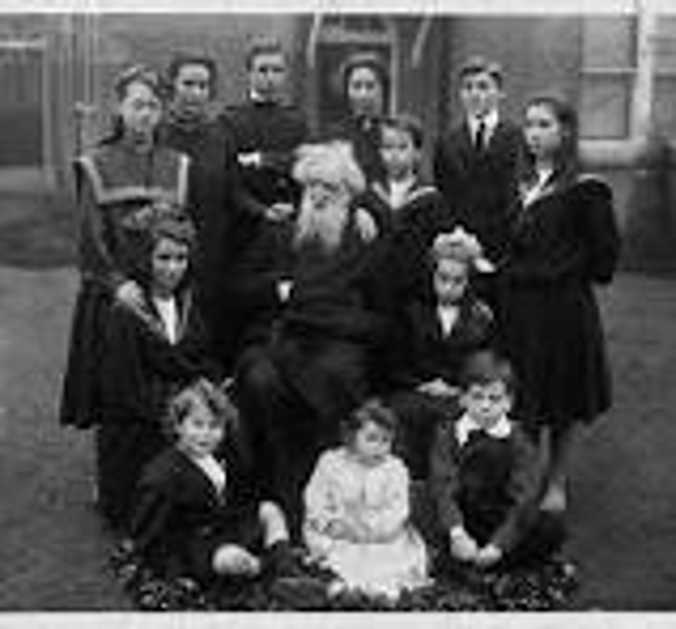
William Booth with all his Children. He was one prolific Dude.
(“Create in me a clean heart, O God. Renew a loyal spirit within me.”)
When God points out areas of your life to work on, it’s because He loves you. He wants to cleanse you so that you will be filled with His life and joy.
But be aware, these are the very timess you will be tempted to run away from the Father, imagining He’s angry with you or no longer loves you. Don’t do it. Stay the course and develop you relationship with Him.
Because it is when you’re willing to sit before the Lord and allow Him to expose your heart that your life is transformed. He prunes whatever isn’t spiritually edifying from your life. So whatever He brings to your mind today, the best thing you can do is admit it, confess it, repent of it, and deal with it. That’s the sure way to keep your sweet fellowship with the Father alive and healthy.
Friend, don’t ignore God or rationalize your actions because that will only stymie your growth. Rather, humble yourself befor Him, confess your transgressions and ask Him to clense you. And be assured, He will never turn you away.
Pray: “Lord, cleanse me so that I can enjoy uninterrupted fellowship with You. Thank You for forgiving me. amen.”
(Today on Independence Day we are celebrating the 250th year of the signing or the Declaration of Independence. So, what has really made America great? I propose that it is the depencence of this nation on God. As proof of that, below, I have shown the except from the Constitution of all 50 states where they each and everyone aacknowledge God!)
“O Beautiful, For Spacious Skies, For Amber Waves of Grain “
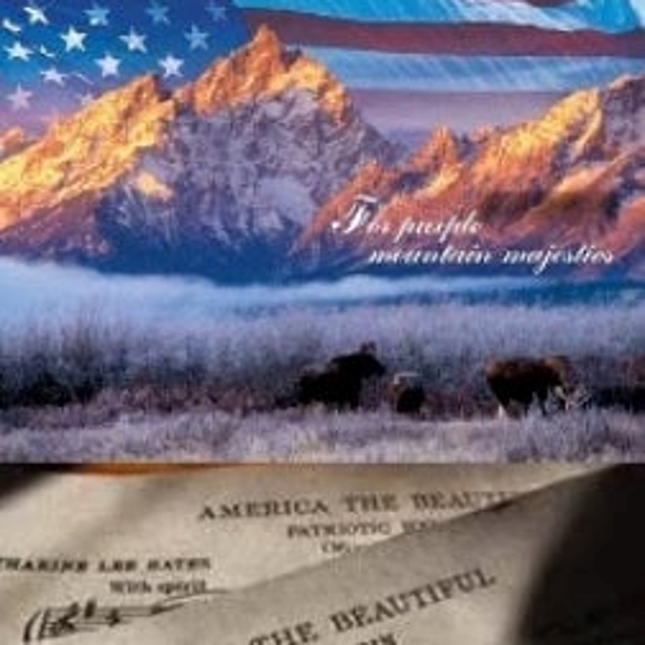
Yes, It was Almost chosen as the National Anthem in 1926, “America the Beautiful” was written by Katherine Lee Bates, born August 12, 1859.
Daughter of a Congregational minister, Katherine Lee Bates taught high school, then English literature at Wellesley College. She hosted gatherings at her home for students and literary guests, including Robert Frost, Carl Sandburg and William Butler Yeats.
Of her 1893 Colorado journey, Katherine Lee Bates wrote: “Some of the other teachers and I decided to go on a trip to 14,000-foot Pikes Peak. We hired a prairie wagon. Near the top we had to leave the wagon and go the rest of the way on mules. I was very tired. But when I saw the view, I felt great joy. All the wonder of America seemed displayed there, with the sea-like expanse.”
America, the Beautiful” was quoted by President Lyndon Johnson in his first formal address before a joint session of Congress, Supreme Court Justices and the Cabinet, November 27, 1963: “Let us here highly resolve that John Fitzgerald Kennedy did not live-or die-in vain. As we gather together to ask the Lord’s blessings and give Him our thanks, let us unite in those familiar and cherished words: ‘America, America, God shed His grace on thee, And crown they good With brotherhood From sea to shining sea.'”
“America, the Beautiful” was referred to by President Ronald Reagan in meeting South Korean President Chun Doo Hwan, November 14, 1983: “At the worship service Sunday morning with our soldiers less than a mile from one of the most tyrannical regimes on Earth, a choir of little girls, all orphans closing the service, singing “America, the Beautiful” in our language, was a spiritual experience.”
Katharine Lee Bates’ poem was printed in The Congregationalist for Independence Day, July 4, 1895:
O Beautiful for Spacious Skies, For Amber Waves of Grain, For Purple Mountain Majesties Above the Fruited Plain!
America! America! God Shed His Grace on Thee, And Crowned Thy Good with Brotherhood From Sea to Shining Sea!
O Beautiful for Pilgrims Feet, Whose Stern Impassioned Stress, A Thoroughfare for Freedom Beat Across the Wilderness!
America! America! God Mend Thy Every Flaw, Confirm Thy Soul in Self-Control, Thy Liberty in Law!
O Beautiful for Heroes Proved In Liberating Strife, Who More Than Self Their Country Loved, And Mercy More Than Life!
America! America! May God Thy Gold Refine, Till All Success Be Nobleness And Every Gain Divine!
O Beautiful for Patriots Dream, That Sees Beyond the Years, Thine Alabaster Cities Gleam, Undimmed by Human Tears!
America! America! God Shed His Grace On Thee, And Crown Thy Good With Brotherhood, From Sea to Shining Sea!
Deuteronomy 28 states: “And it shall come to pass, if thou shalt hearken diligently unto the voice of the Lord thy God, to observe and to do all his commandments. All these blessings shall come on thee, and overtake thee.”
God shed His grace from sea to shining sea, as all 50 states have acknowledged God in their state’s constitutions:
(So, here I have documented for you exactly where all 50 states have acknowledged God in their Constitutions. Please read them, if for no other reason than that the ACLU and the ‘Marxist’ dominated Democratic party will not admit it.)
Alabama 1901, Preamble. We the people of the State of Alabama invoking the favor and guidance of Almighty God, do ordain and establish the following Constitution …
Alaska 1956, Preamble. We, the people of Alaska, grateful to God and to those who founded our nation and pioneered this great land …
Arizona 1911, Preamble. We, the people of the State of Arizona, grateful to Almighty God for our liberties, do ordain this Constitution …
Arkansas 1874, Preamble. We, the people of the State of Arkansas, grateful to Almighty God for the privilege of choosing our own form of government …
California 1879, Preamble. We, the People of the State of California, grateful to Almighty God for our freedom …
Colorado 1876, Preamble. We, the people of Colorado, with profound reverence for the Supreme Ruler of Universe …
Connecticut 1818, Preamble. The People of Connecticut, acknowledging with gratitude the good Providence of God in permitting them to enjoy …
Delaware 1897, Preamble. Through Divine Goodness all men have, by nature, the rights of worshiping and serving their Creator according to the dictates of their consciences
Florida 1885, Preamble. We, the people of the State of Florida, grateful to Almighty God for our constitutional liberty establish this Constitution …
Georgia 1777, Preamble. We, the people of Georgia, relying upon protection and guidance of Almighty God, do ordain and establish this Constitution …
Hawaii 1959, Preamble. We, the people of Hawaii, Grateful for Divine Guidance … establish this Constitution …
Idaho 1889, Preamble. We, the people of the State of Idaho, grateful to Almighty God for our freedom, to secure its blessings …
Illinois 1870, Preamble. We, the people of the State of Illinois, grateful to Almighty God for the civil, political and religious liberty which He hath so long permitted us to enjoy and looking to Him for a blessing on our endeavors …
Indiana 1851, Preamble. We, the People of the State of Indiana, grateful to Almighty God for the free exercise of the right to chose our form of government …
Iowa 1857, Preamble. We, the People of the State of Iowa, grateful to the Supreme Being for the blessings hitherto enjoyed, and feeling our dependence on Him for a continuation of these blessings establish this Constitution …
Kansas 1859, Preamble. We, the people of Kansas, grateful to Almighty God for our civil and religious privileges establish this Constitution …
Kentucky 1891, Preamble. We, the people of the Commonwealth of Kentucky, grateful to Almighty God for the civil, political and religious liberties …
Louisiana 1921, Preamble. We, the people of the State of Louisiana, grateful to Almighty God for the civil, political and religious liberties we enjoy …
Maine 1820, Preamble. We the People of Maine acknowledging with grateful hearts the goodness of the Sovereign Ruler of the Universe in affording us an opportunity and imploring His aid and direction …
Maryland 1776, Preamble. We, the people of the state of Maryland, grateful to Almighty God for our civil and religious liberty …
Massachusetts 1780, Preamble. We the people of Massachusetts, acknowledging with grateful hearts, the goodness of the Great Legislator of the Universe in the course of His Providence, an opportunity and devoutly imploring His direction …
Michigan 1908, Preamble. We, the people of the State of Michigan, grateful to Almighty God for the blessings of freedom establish this Constitution …
Minnesota 1857, Preamble. We, the people of the State of Minnesota, grateful to God for our civil and religious liberty, and desiring to perpetuate its blessings …
Mississippi 1890, Preamble. We, the people of Mississippi in convention assembled, grateful to Almighty God, and invoking His blessing on our work …
Missouri 1945, Preamble. We, the people of Missouri, with profound reverence for the Supreme Ruler of the Universe, and grateful for His goodness establish this Constitution …
Montana 1889, Preamble. We, the people of Montana, grateful to Almighty God for the blessings of liberty establish this Constitution …
Nebraska 1875, Preamble. We, the people, grateful to Almighty God for our freedom … establish this Constitution …
Nevada 1864, Preamble. We the people of the State of Nevada, grateful to Almighty God for our freedom establish this Constitution …
New Hampshire 1792, Part One, Article One, Section Five. Every individual has a natural and unalienable right to worship God according to the dictates of his own conscience-
New Jersey 1844, Preamble. We, the people of the State of New Jersey, grateful to Almighty God for civil and religious liberty which He hath so long permitted us to enjoy, and looking to Him for a blessing on our endeavors …
New Mexico 1911, Preamble. We, the People of New Mexico, grateful to Almighty God for the blessings of liberty …
New York 1846, Preamble. We, the people of the State of New York, grateful to Almighty God for our freedom, in order to secure its blessings …
North Carolina 1868, Preamble. We the people of the State of North Carolina, grateful to Almighty God, the Sovereign Ruler of Nations, for our civil, political, and religious liberties, and acknowledging our dependence upon Him for the continuance of those-
North Dakota 1889, Preamble. We, the people of North Dakota, grateful to Almighty God for the blessings of civil and religious liberty, do ordain …
Ohio 1852, Preamble. We the people of the state of Ohio, grateful to Almighty God for our freedom, to secure its blessings and to promote our common …
Oklahoma 1907, Preamble. Invoking the guidance of Almighty God, in order to secure and perpetuate the blessings of liberty establish this …
Oregon 1857, Bill of Rights, Article One, Section Two. All men shall be secure in the Natural right, to worship Almighty God according to the dictates of their consciences-
Pennsylvania 1776, Preamble. We, the people of Pennsylvania, grateful to Almighty God for the blessings of civil and religious liberty, and humbly invoking His guidance-
Rhode Island 1842, Preamble. We the People of the State of Rhode Island … grateful to Almighty God for the civil and religious liberty which He hath so long permitted us to enjoy, and looking to Him for a blessing …
South Carolina 1778, Preamble. We, the people of the State of South Carolina grateful to God for our liberties, do ordain and establish this Constitution …
South Dakota 1889, Preamble. We, the people of South Dakota, grateful to Almighty God for our civil and religious liberties establish this Constitution …
Tennessee 1796, Article Eleven, Section Three. That all men have a natural and indefeasible right to worship Almighty God according to the dictates of their conscience …
Texas 1845, Preamble. We the People of the Republic of Texas, acknowledging, with gratitude, the grace and beneficence of God …
Utah 1896, Preamble. Grateful to Almighty God for life and liberty, we establish this Constitution …
Vermont 1777, Preamble. Whereas all government ought to enable the individuals who compose it to enjoy their natural rights, and other blessings which the Author of Existence has bestowed on man …
Virginia 1776, Bill of Rights, Article Sixteen Religion, or the Duty which we owe our Creator can be directed only by Reason and that it is the mutual duty of all to practice Christian Forbearance, Love and Charity towards each other …
Washington 1889, Preamble. We the People of the State of Washington, grateful to the Supreme Ruler of the Universe for our liberties, do ordain this Constitution …
West Virginia 1872, Preamble. Since through Divine Providence we enjoy the blessings of civil, political and religious liberty, we, the people of West Virginia reaffirm our faith in and constant reliance upon God …
Wisconsin 1848, Preamble. We, the people of Wisconsin, grateful to Almighty God for our freedom, domestic tranquility …
Wyoming 1890, Preamble. We, the people of the State of Wyoming, grateful to God for our civil, political, and religious liberties establish this Constitution …
After reviewing acknowledgments of God from all 50 state constitutions, one is faced with the prospect that, the ACLU and the out-of-control federal courts and the Democratic Party are wrong.
Psalm 33:12 states: “Blessed is the nation whose God is the Lord.”
(“Those who, having heard the word and with a noble and good heart, keep it and bear fruit with patience.”)
Nowhere in Scripture does God tell onyone to rush into a decision. Though there may be times when you need to hear from Him quickly, the Lord will never tell you to hurry forward blindly.
Satan, on the other hand, always encourages you to act immediately, because his desire is to rush you to destruction. The enemy knows if you back off and think long enough about a decision, you’ll make a better choice, thwarting his ultimate plan.
Friend, if you feel an overwhelming urge to act spontaneously, pull in the reins. Be willing to listen to God persistently and patiently, even when doing so stretches your faith. Your loving heavenly Father has promised to speak to your heart, so you can expect Him to do so faithfully.
Just realize God most likely won’t tell you everything the moment you desire the information. Instead, He will guide you one step at a time, waiting until all the details are in their proper places for your good, and then He will instruct you how to proceed.
Pray: “Father”, may Your Spirit work patience in me so I can wait with joy for your instruction. amen.”
(Socialism and Communism are becoming popular once again, and being preached in many of our major universities as preferable to Capitalism. They are even being brought into governing bodies, such as New York City as amazing as that is, considering that they have been proven as total failures time and again. To be accepted, they must overcome Christianity, for it is totally opposed to them. One way that those who advocate them use to overcome Christianity is to advocate “Separation of Church and State”. They use that phrase or doctor-in as a way to oppose Christianity. Is it a valid, legal doctor-in? The answer to that question is very important. Below, I have shown for sure, whether it is a legal precept in America or not. Do read it so that you can know for sure.)
“Italian socialist Antonio Gramsci wrote in an article “Audacia e Fede,” printed in the Avanti!newspaper, May 1916. Gramsci wrote:
“Socialism is precisely the religion that must overwhelm Christianity.”
Gary North explained (Remnant Review, March 14, 2013): “Gramsci in the 1930s acknowledged that Western society was deeply religious, and that the only way to achieve a proletarian revolution would be to break the faith of the masses of Western voters in Christianity and the moral system derived from Christianity. He placed religion and culture at the base of the pyramid.”
On January 10, 1963, Democrat Congressman Albert Sydney Herlong, Jr. (FL-4th) read into the Congressional Record 45 Communist goals to capture America. These included:
“24. Eliminate all laws governing obscenity by calling them ‘censorship’ and a violation of free speech and free press.
16. Use technical decisions of the courts to weaken basic American institutions by claiming their activities violate civil rights.
28. Eliminate prayer or any phase of religious expression in the schools on the ground that it violates the principle of ‘separation of church and state.'”
The Communist goals also included:
“17. Get control of the schools. Use them as transmission belts for socialism and current communist propaganda. Soften the curriculum. Get control of teachers’ associations. Put the party line in textbooks.
18. Gain control of all student newspapers.
19. Use student riots to foment public protests against programs or organizations which are under communist attack.
25. Break down cultural standards of morality by promoting pornography and obscenity in books, magazines, motion pictures, radio, and TV.
26. Present homosexuality, degeneracy and promiscuity as ‘normal, natural, healthy.’
27. Discredit the Bible and emphasize the need for intellectual maturity, which does not need a ‘religious crutch.'”
With the stated goal of socialists to use the phrase “wall of separation between church and state,” to oppose Christianity, it is helpful to review opinions regarding it by past Supreme Court Justices.What did the courts decide about it?
Justice William Orville Douglas served the longest term on the bench in the Supreme Court’s history — 36 years, until his death January 19, 1980.
He was one of the eight Supreme Court Justices nominated by Democrat President Franklin D. Roosevelt.
He previously taught law at Columbia Law School and Yale Law School, and served on the U.S. Securities and Exchange Commission.
Justice William O. Douglas wrote the majority decision in the 1952 case of Zorach v. Clauson: “The First Amendment, however, does not say that in every and all respects there shall be a separation of church and state. Otherwise the state and religion would be aliens to each other — hostile, suspicious, and even unfriendly.
Municipalities would not be permitted to render police or fire protection to religious groups.
Policemen who helped parishioners into their places of worship would violate the Constitution.
Prayers in our legislative halls;
the appeals to the Almighty in the messages of the Chief Executive;
the proclamations making Thanksgiving Day a holiday;
‘So Help Me God’ in our courtroom oaths.
these and all other references to the Almighty that run through our laws, our public rituals, our ceremonies would be flouting the First Amendment. A fastidious atheist or agnostic could even object to the supplication with which the Court opens each session: ‘God save the United States and this Honorable Court.'”
Justice Douglas continued:
“We are a religious people whose institutions presuppose a Supreme Being. When the state encourages religious instruction, it follows the best of our traditions. For it then respects the religious nature of our people and accommodates the public service to their spiritual needs.
To hold that it may not would be to find in the Constitution a requirement that the government show a callous indifference to religious groups. That would be preferring those who believe in no religion over those who do believe.”
Douglas concluded:
“We find no constitutional requirement which makes it necessary for government to be hostile to religion and to throw its weight against efforts to widen the effective scope of religious influence. We cannot read into the Bill of Rights such a philosophy of hostility to religion.”
Chief Justice Warren E. Burger cited Justice Douglas’ Zorach v. Clauson opinion in the 1984 decision of Lynch v Donnelly: “The concept of a ‘wall’ of separation between church and state is a figure of speech, but the metaphor itself is not a wholly accurate description of the practical aspects of the relationship that in fact exist between church and state. The Constitution does not require complete separation of church and state; it affirmatively mandates accommodation, not merely tolerance, of all religions, and forbids hostility toward any. Anything less would require the ‘callous indifference’ (Zorach v. Clauson), that was never intended by the Establishment Clause. Indeed, we have observed, such hostility would bring us into ‘war with our national tradition as embodied in the First Amendment’s guaranty of the free exercise of religion. (McCollum).”
Justice Stanley Reed wrote in his dissent of McCullum v Board of Education, 1948: “Rule of law should not be drawn from a figure of speech.”
Justice Potter Stewart wrote in his dissent of Engle v Vitale, 1962: “The Court is not aided by the invocation of metaphors like the ‘wall of separation,’ a phrase nowhere to be found in the Constitution.”
Justice William Rehnquist wrote in his dissent of Wallace v Jaffree, 1984: “The ‘wall of separation between church and State’ is a metaphor based on bad history, a metaphor which has proved useless as a guide to judging. It should be frankly and explicitly abandoned. It is impossible to build sound constitutional doctrine upon a mistaken understanding of Constitutional history. The establishment clause had been expressly freighted with Jefferson’s misleading metaphor for nearly forty years. There is simply no historical foundation for the proposition that the framers intended to build a wall of separation. The recent court decisions are in no way based on either the language or intent of the framers. But the greatest injury of the ‘wall’ notion is its mischievous diversion of judges from the actual intentions of the drafters of the Bill of Rights.”
Judge Richard Suhrheinrich wrote in ACLU v Mercer County, 2006: “The ACLU makes repeated reference to ‘the separation of church and state.’ This extraconstitutional construct has grown tiresome. The First Amendment does not demand a wall of separation between church and state. Our nation’s history is replete with governmental acknowledgment and in some cases, accommodation of religion.”
In Committee for Public Education & Religious Liberty v. Nyquist, 413 U.S. 756, 760 (1973), the Court stated: “This Nation’s history has not been one of entirely sanitized separation between church and state. It has never been thought either possible or desirable to enforce a regime of total separation.”
The Tennessee Supreme Court stated in Carden v. Bland, March 9, 1956: “Great stress is laid upon the need of maintaining the doctrine of ‘separation of church and state’, but it should not be tortured into a meaning that was never intended by the Founders of this Republic, with the result that the public school system of the several states is to be made a godless institution.”
The U.S. Supreme Court stated in Lemon v. Kurtzman, 403 U.S. 602 (1971):
“Our prior holdings do not call for total separation between church and state; total separation is not possible in an absolute sense.”
Chief Justice Warren E. Burger continued in Lynch v Donnelly, 1984:
“That neither the draftsmen of the Constitution, who were Members of the First Congress, nor the First Congress itself, saw any establishment problem in employing Chaplains to offer daily prayers in the Congress is a striking example of the accommodation of religious beliefs intended by the Framers. Our history is pervaded by official acknowledgment of the role of religion in American life, and equally pervasive is evidence of accommodation of all faiths and all forms of religious expression and hostility toward none. It would be ironic if the inclusion of the creche in the display, as part of a celebration of an event acknowledged in the Western World for 20 centuries, and in this country by the people, the Executive Branch, Congress, and the courts for 2 centuries, would so ‘taint’ the exhibition as to render it violative of the Establishment Clause. To forbid the use of this one passive symbol while hymns and carols are sung and played in public places including schools, and while Congress and state legislatures open public sessions with prayers, would be an overreaction contrary to this Nation’s history and this Court’s holdings.”
Burger continued in Lynch v Donnelly:
“A significant example of the contemporaneous understanding of that Clause is found in the events of the first week of the First Session of the First Congress in 1789. In the very week that Congress approved the Establishment Clause as part of the Bill of Rights for submission to the states, it enacted legislation providing for paid Chaplains for the House and Senate. It is clear that neither the 17 draftsmen of the Constitution who were Members of the First Congress, nor the Congress of 1789, saw any establishment problem in the employment of congressional Chaplains to offer daily prayers in the Congress, a practice that has continued for nearly two centuries. It would be difficult to identify a more striking example of the accommodation of religious belief intended by the Framers.”
Chief Justice Burger continued:
“Our history is replete with official references to the value and invocation of Divine guidance in deliberations and pronouncements of the Founding Fathers and contemporary leaders. Beginning in the early colonial period long before Independence, a day of Thanksgiving was celebrated as a religious holiday to give thanks for the bounties of Nature as gifts from God. President Washington and his successors proclaimed Thanksgiving, with all its religious overtones, a day of national celebration and Congress made it a National Holiday more than a century ago. That holiday has not lost its theme of expressing thanks for Divine aid any more than has Christmas lost its religious significance. Executive Orders and other official announcements of Presidents and of the Congress have proclaimed both Christmas and Thanksgiving National Holidays in religious terms. And, by Acts of Congress, it has long been the practice that federal employees are released from duties on these National Holidays, while being paid from the same public revenues that provide the compensation of the Chaplains of the Senate and the House and the military services. Thus, it is clear that Government has long recognized — indeed it has subsidized — holidays with religious significance.”
Burger added:
“Other examples of reference to our religious heritage are found in the statutorily prescribed national motto ‘In God We Trust,’ which Congress and the President mandated for our currency, and in the language ‘One nation under God,’ as part of the Pledge of Allegiance to the American flag. That pledge is recited by many thousands of public school children, and adults, every year. Art galleries supported by public revenues display religious paintings of the 15th and 16th centuries, predominantly inspired by one religious faith. The National Gallery in Washington, maintained with Government support, for example, has long exhibited masterpieces with religious messages, notably the Last Supper, and paintings depicting the Birth of Christ, the Crucifixion, and the Resurrection, among many others with explicit Christian themes and messages. The very chamber in which oral arguments on this case were heard is decorated with a notable and permanent, not seasonal, symbol of religion: Moses with the Ten Commandments. Congress has long provided chapels in the Capitol for religious worship and meditation. There are countless other illustrations of the Government’s acknowledgment of our religious heritage and governmental sponsorship of graphic manifestations of that heritage.”
Burger continued:
“Congress has directed the President to proclaim a National Day of Prayer each year ‘on which (day) the people of the United States may turn to God in prayer and meditation at churches, in groups, and as individuals.’ Our Presidents have repeatedly issued such Proclamations. Presidential Proclamations and messages have also been issued to commemorate Jewish Heritage Week, Presidential Proclamation No. 4844, 3 CFR 30 (1982), and the Jewish High Holy Days, 17 Weekly Comp. of Pres. Doc. 1058 (1981).”
Chief Justice Warren E. Burger concluded the Lynch v. Donnelly decision:
“One cannot look at even this brief resume without finding that our history is pervaded by expressions of religious beliefs such as are found in Zorach. Equally pervasive is the evidence of accommodation of all faiths and all forms of religious expression, and hostility toward none. Through this accommodation, as Justice Douglas observed, governmental action has ‘follow[ed] the best of our traditions’ and ‘respect[ed] the religious nature of our people.'”
Justice Anthony Kennedy wrote in Town of Greece v. Galloway, May 5, 2014: “In Marsh v. Chambers, 463 U. S. 783, the Court found no First Amendment violation in the Nebraska Legislature’s practice of opening its sessions with a prayer delivered by a chaplain paid from state funds. The decision concluded that legislative prayer, while religious in nature, has long been understood as compatible with the Establishment Clause. As practiced by Congress since the framing of the Constitution, legislative prayer lends gravity to public business, reminds lawmakers to transcend petty differences in pursuit of a higher purpose, and expresses a common aspiration to a just and peaceful society. Legislative invocations are compatible with the Establishment Clause. The First Congress made it an early item of business to appoint and pay official chaplains, and both the House and Senate have maintained the office virtually uninterrupted since that time. That the First Congress provided for the appointment of chaplains only days after approving language for the First Amendment demonstrates that the Framers considered legislative prayer a benign acknowledgment of religion’s role in society. In the 1850’s, the judiciary committees in both the House and Senate reevaluated the practice of official chaplaincies after receiving petitions to abolish the office. The committees concluded that the office posed no threat of an establishment.”
Justice Kennedy was referring to the House Judiciary Committee Report of Congressman James Meacham of Vermont, March 27, 1854: “At the adoption of the Constitution, we believe every State — certainly ten of the thirteen — provided regularly for the support of the Church as for the support of the Government.”
Justice Kennedy continued in Greece v. Galloway: “Any test the Court adopts must acknowledge a practice that was accepted by the Framers and has withstood the critical scrutiny of time and political change. An insistence on nonsectarian or ecumenical prayer as a single, fixed standard is not consistent with the tradition of legislative prayer outlined in the Court’s cases. The Congress that drafted the First Amendment would have been accustomed to invocations containing explicitly religious themes of the sort respondents find objectionable.”
Kennedy continued:
“One of the Senate’s first chaplains, the Rev. William White, gave prayers in a series that included the Lord’s Prayer, the Collect for Ash Wednesday, prayers for peace and grace, a general thanksgiving, St. Chrysostom’s Prayer, and a prayer seeking ‘the grace of our Lord Jesus Christ. The decidedly Christian nature of these prayers must not be dismissed as the relic of a time when our Nation was less pluralistic than it is today.”
Kennedy added:
“The Court instructed that the ‘content of the prayer is not of concern to judges’. To hold that invocations must be nonsectarian would force the legislatures that sponsor prayers and the courts that are asked to decide these cases to act as supervisors and censors of religious speech, a rule that would involve government in religious matters to a far greater degree than is the case under the town’s current practice of neither editing or approving prayers in advance nor criticizing their content after the fact. It would be but a few steps removed from that prohibition for legislatures to require chaplains to redact the religious content from their message in order to make it acceptable for the public sphere. Government may not mandate a civic religion that stifles any but the most generic reference to the sacred any more than it may prescribe a religious orthodoxy. See Lee v. Weisman, 505 U.S. 577, 590 (1992) (‘The suggestion that government may establish an official or civic religion as a means of avoiding the establishment of a religion with more specific creeds strikes us as a contradiction that cannot be accepted’); Schempp, 374 U. S., at 306 (Goldberg, J., concurring) (arguing that ‘untutored devotion to the concept of neutrality’ must not lead to ‘a brooding and pervasive devotion to the secular’).”
Justice Kennedy added:
“The First Amendment is not a majority rule, and government may not seek to define permissible categories of religious speech. While these prayers vary in their degree of religiosity, they often seek peace for the Nation, wisdom for its lawmakers, and justice for its people, values that count as universal and that are embodied not only in religious traditions, but in our founding documents and laws. The first prayer delivered to the Continental Congress by the Rev. Jacob Duché on Sept. 7, 1774, provides an example: ‘Be Thou present O God of Wisdom and direct the counsel of this Honorable Assembly; enable them to settle all things on the best and surest foundations; that the scene of blood may be speedily closed; that Order, Harmony, and Peace be effectually restored, and the Truth and Justice, Religion and Piety, prevail and flourish among the people. Preserve the health of their bodies, and the vigor of their minds, shower down on them, and the millions they here represent, such temporal Blessings as Thou seest expedient for them in this world, and crown them with everlasting Glory in the world to come. All this we ask in the name and through the merits of Jesus Christ, Thy Son and our Saviour, Amen’.”
Justice Anthony Kennedy concluded the Town of Greece v. Galloway decision, May 5, 2014:
“As a practice that has long endured, legislative prayer has become part of our heritage and tradition, part of our expressive idiom, similar to the Pledge of Allegiance, inaugural prayer, or the recitation of ‘God save the United States and this honorable Court’ at the opening of this Court’s sessions. It is presumed that the reasonable observer is acquainted with this tradition. Their purpose is largely to accommodate the spiritual needs of lawmakers and connect them to a tradition dating to the time of the Framers. Ceremonial prayer is but a recognition that, since this Nation was founded and until the present day, many Americans deem that their own existence must be understood by precepts far beyond the authority of government to alter or define, and that willing participation in civic affairs can be consistent with a brief acknowledgment of their belief in a higher power, always with due respect for those who adhere to other beliefs.”
(So, if you have stayed with me as we waded through all these legal decisions where the Judges ruled totally against the people who were trying to use the phrase: “Separation of Church and State” to block Christianity or Christian prayer anywhere it was found. Thus, you now know that Christianity or Christian prayer may not be stopped or extinguished in America, anywhere as totally acknowledged by official Jurisprudence, and that it is not even a valid term.)
(“My Grace is all you need. My Power works best in weakness.” So now I am glad to boast about my weakness, so that the power of Christ can work through me.)
When you struggle with a heavy load of any kind, isn’t it wonderful when someone offers to help, or insists that you rest as they take care of things for a while? This this is what happens with your life when you acept Christ and remain in relationship with Him. He says that as you grow in Him, He will work out His perfection in you. You don’t have to struggle, strive, or wear yourself out. He will work in you, in His timing, using His methods, and all for His purposes
Friend, he encourages. Nobody can be the best always. Nobody gets it right every time. But it’s in your times of weakness and failure that You have the capacity to grow the most.
When you have fallen short, you are in the perfect position to trust God to cover your failings. Therefore, take Heart and rely on Him to help you succeed.
Pray: “Heavenly Father help me view my times of weakness as opportunities to grow in You. amen.”
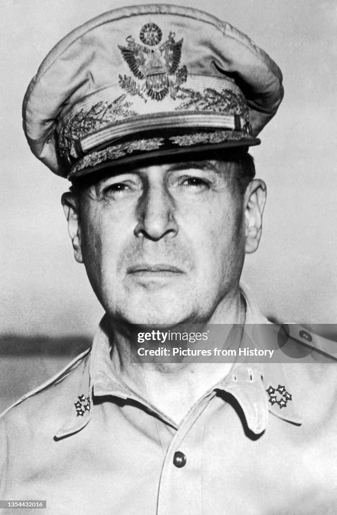
General MacArthur on a trip to see his young son Arthur
(Below is the history of Father’s Day in Amreica and thoughts about Father’s Day by some of its greatest leaders. Do read it.)
U.S. Census Bureau, U.S. Department of Health & Human Services, Center for Disease Control, and other agencies report that children from fatherless homes are:
Five times more likely to live in poverty;
Twenty times more likely to go to in prison;
Higher risk of drug and alcohol abuse;
Increased incidents of internalized and externalized aggressive behavioral problems;
Greater chance of runaways and homelessness;
Twice as likely to commit suicide.
The first “Father’s Day” was conceived by Grace Golden Clayton. She was inspired by the first Mother’s Day observance in 1908. She reminisced of her father, Methodist Reverend Fletcher Golden, who raised her and her siblings after their mother died.
Grace was also moved by the West Virginia Monongah Coal Mine explosion, December 6, 1907 – the worst mine disaster in the nation’s history. In the town of 1,000 people, 360 men died in the mine, leaving families fatherless. Grace arranged for a single special service at Central United Methodist Church on July 5, 1908, saying: “It was partly the explosion that set me to think how important and loved most fathers are. All those lonely children and those heart-broken wives and mothers, made orphans and widows in a matter of a few minutes. Oh, how sad and frightening to have no father, no husband, to turn to at such an awful time.”
The person responsible for making Father’s Day an annual observance was Sonora Louise Smart Dodd. Hearing a church sermon on the newly established Mother’s Day, Sonora wanted to honor her father, Civil War veteran William Jackson Smart, who had raised six children by himself after his wife died in childbirth. The 28-year-old Sonora Louise Smart Dodd drew up a petition supported by the Young Men’s Christian Association and the ministers of Spokane, Washington, to celebrate Fathers’ Day on June 19, 1910. Sonora, with the help of the Y.M.C.A, spread the celebration of Father’s Day on the third Sunday in June, to Oregon, then Chicago and then around the nation.
In 1924, President Calvin Coolidge signed a Father’s Day resolution: “To establish more intimate relations between fathers and their children and to impress upon fathers the full measure of their obligations.” Coolidge stated further: “My father had qualities that were greater than any I possess. He was a man of untiring industry and great tenacity of purpose. He always stuck to the truth. It always seemed possible for him to form an unerring judgment of men and things. He would be classed as decidedly a man of character. I have no doubt he is representative of a great mass of Americans who are known only to their neighbors; nevertheless, they are really great.”
Coolidge wrote to his father: “I am sure I came to it (the presidency) largely by your bringing up and your example.”
In 1966, Lyndon Johnson issued the first Presidential Father’s Day Proclamation.
In 1972, President Nixon established Father’s Day as a permanent national observance, Proclamation 4127, stating: “To have a father — to be a father — is to come very near the heart of life itself. In fatherhood we know the elemental magic and joy of humanity. In fatherhood we even sense the divine, as the Scriptural writers did who told of all good gifts corning “down from the Father of lights, with whom is no variableness, neither shadow of turning” (James 1:17)—symbolism so challenging to each man who would give his own son or daughter a life of light without shadow.”
Nixon added: “Our identity in name and nature, our roots in home and family, our very standard of manhood—all this and more is the heritage our fathers share with us. It has long been our national custom to observe each year one special Sunday in honor of America’s fathers; and from this year forward, by a joint resolution of the Congress approved April 24, 1972, that custom carries the weight of law. Let each American make this Father’s Day an occasion for renewal of the love and gratitude we bear to our fathers, increasing and enduring through all the years. Now, Therefore, I, Richard Nixon, President of the United States of America, do hereby request that June 18, 1972, be observed as Father’s Day.”
On May 20, 1981, in a Proclamation of Father’s Day, President Ronald Reagan stated: “‘Train up a child in the way he should go: and when he is old, he will not depart from it,’ Solomon tells us. (Proverbs 22:6) Clearly, the future is in the care of our parents. Such is the responsibility, promise, and hope of fatherhood. Such is the gift that our fathers give us.”
Dr. Ben Carson
Dr. Ben Carson explained: “The more solid the family, the more likely you are to be able to resist peer pressure. Human beings are social creatures. We all want to belong, we all have that desire, and we will belong, one way or another. If the family doesn’t provide that, the peers will, or a gang will, or you will find something to belong to.”
On Father’s Day, 1988, Ronald Reagan said: “Children, vulnerable and dependent, desperately need security, and it has ever been a duty and a joy of fatherhood to offer it. Being a father requires strength and more than a little courage to persevere, to fight discouragement, and to keep working for the family. With God’s grace, fathers find the patience to teach, the fortitude to provide, the compassion to comfort, and the mercy to forgive. All of this is to say that they find the strength to love their wives and children selflessly. American Indians had a name for a man who proved he had courage to defend his family without regard for his own life –– a ‘brave.'”
Reagan ended: “Let us express our thanks and affection to our fathers, whether we can do so in person or in prayer.”
On December 6, 1904, President Theodore Roosevelt addressed Congress “No Christian and civilized community can afford to show a happy-go-lucky lack of concern for the youth of to-day; for, if so, the community will have to pay a terrible penalty of financial burden and social degradation in the to-morrow.”
Roosevelt continued: “The prime duty of the man is to work, to be the breadwinner; the prime duty of the woman is to be the mother, the housewife. All questions of tariff and finance sink into utter insignificance when compared with the tremendous, the vital importance of trying to shape conditions so that these two duties of the man and of the woman can be fulfilled under reasonably favorable circumstances.”
Genesis 18:19 records one of the reasons God chose Abraham: “For I know him (Abraham), that he will teach his children (to) keep the way of the LORD, to do justice and judgment.”
Deuteronomy 4:9: “Teach them to your children and grandchildren.”
Deuteronomy 6:7: “And you shall teach them diligently to your children.”
Williams Jennings Bryan gave over 600 public speeches during his Presidential campaigns, with his most famous being “The Prince of Peace,” which was printed in The New York Times, September 7, 1913:
“Christ promoted peace by giving us assurance that a line of communication can be established between the Father above and the child below.”
U.S. Senate Peter Marshall commented on Marxist social deconstruction (20 Centuries of Great Preaching Vol. 12 Waco: Word, 1971 p. 11-19):
“The history of the world has always been the biography of her great men. There was a time in these United States when youth was inspired by heroes, when a picture of Washington or Lincoln adorned every school room wall. Along with the ponderous Family Bible on the Victorian table and the hymn books on the old-fashioned square piano, there looked down from the walls the likenesses of our national heroes. Those were the days of great beliefs — belief in the authority of the Scriptures, belief that prayer was really answered, belief in marriage and the family as permanent institutions, belief in the integrity and worth of America’s great men. These beliefs laid the groundwork for producing more great men, for many a boy figured, “If that man could do it, get an education, make his life count for something, then I can too.'”
Marshall continued:
“Then there dawned the day when the pictures of Washington and Lincoln did not fit in with our concept of modern décor. The old Family Bible looked embarrassingly out of place. So the pictures and the Bible were often relegated to the Attic of Forgotten Things. There went with them some of the most stabilizing influences of American life. We had become a more sophisticated people, somewhat cynical of the cherished beliefs of our ancestors, rather blasé, frankly skeptical of old-fashioned sentimentalism. Along with our higher education came a debunking contest. This debunking became a sort of national sport. It was smarter to revile than to revere, more fashionable to depreciate than to appreciate. In our classrooms at all levels of education, no longer did we laud great men — those who had struggled and achieved. Instead, we merely took their dimensions and ferreted out their faults. We decided that it was silly to say God sent them for a special task. They were merely products of their environments. The Constitution, that hitherto cherished charter of American liberties, was drawn up by men who never spoke on a telephone or flew in a plane, therefore, we should change the Constitution to suit modern ways.”
Marshall’s concerns were echoed by others.
Thomas Sowell, a Senior Fellow at the Hoover Institution at Stanford University, stated:
“Ours may become the first civilization destroyed, not by the power of our enemies, but by the ignorance of our teachers and the dangerous nonsense they are teaching our children. In an age of artificial intelligence, they are creating artificial stupidity.”
In writing for The Federalist, June 12, 2020, Katy Faust and Stacy Manning reported: “NAACP president Kweisi Mfume, when asked if white racism or the absence of fathers posed a greater threat to black Americans, replied without hesitation, ‘The absence of black fathers.'”
Senate Chaplain Marshall added that sons and daughters need courageous fathers to defend them against predatory agendas:
“We failed to realize that when we were denying the existence of great men, we were also denying the desirability of great men. So now, many of our children have grown up without the guiding star holding in their hands only a bunch of question marks, with no keys with which to open the doors of knowledge and life. The young no longer had any particular ambition to become heroes. Their ambition now was to make as much money as possible, as quickly as possible, in whatever way was most convenient. Thus, our debunking is a sign of decaying foundations of character to the individual and in the national life. We who are Christians, believe that God gives the world a few great men to lead the rest of us closer to Him, that to depreciate or to deny their greatness is to deny one of God’s revelations of Himself to mankind. The heroes the Christian cherishes were (or are) human. They have their weakness. Their faults are well-known to their friends, better known to themselves. But the point is that with God and His guidance, they can provide the moral leadership that our nation so sorely needs. America needs heroes on the battlefield of everyday life in our homes, in our schools, on college campuses, in offices and factories, who can lead us towards a return to idealism. For time is running out for us.”
U.S. Senate Chaplain Peter Marshall concluded:
“The call today is for Christian heroes and heroines who are willing to speak a good word for Jesus Christ, who are willing to live by the undiluted values of Christian morality in the pagan atmosphere of our society surrounded by lewdness, pornography, and profanity. This may be a higher bravery than that of any battlefield: to face ridicule, sarcasm, sneering disdain for what one believes to be right. To fight for goodness and right, fighting the battle first in our own hearts and souls, seeking God’s help to overcome our particular temptations for the sake of peace, for the sake of America, for our own sake, for God’s sake.”
In 1942, General MacArthur was named Father of the Year.
He stated: “By profession I am a soldier and take pride in that fact. But I am prouder, infinitely prouder to be a father. A soldier destroys in order to build; the father only builds, never destroys. The one has the potentiality of death; the other embodies creation and life. And while the hordes of death are mighty, the battalions of life are mightier still. It is my hope that my son, when I am gone, will remember me not from the battle but in the home repeating with him our simple daily prayer, ‘Our Father Who Art in Heaven.'”
MacArthur composed “A Father’s Prayer”:
“Build me a son, O Lord, who will be strong enough to know when he is weak, brave enough to face himself when he is afraid, one who will be proud and unbending in honest defeat, and humble and gentle in victory. Build me a son whose wishes will not take the place of deeds; a son who will know Thee — and that to know himself is the foundation stone of knowledge. Lead him, I pray, not in the path of ease and comfort, but under the stress and spur of difficulties and challenge. Here let him learn to stand up in the storm; here let him learn compassion for those who fail. Build me a son whose heart will be clear, whose goal will be high; a son who will master himself before he seeks to master other men; one who will reach into the future, yet never forget the past. And after all these things are his, add, I pray, enough of sense of humor, so that he may always be serious, yet never take himself too seriously. Give him humility, so that he may always remember the simplicity of true greatness, the open mind of true wisdom, and the meekness of true strength. Then, I, his father, will dare to whisper, ‘I have not lived in vain.'”
Ronald Reagan with his Son and Daughter
President Reagan ended his Father’s Day message:
“With God’s grace, fathers find the patience to teach, the fortitude to provide, the compassion to comfort, and the mercy to forgive. All of this is to pray that they find the strength to love their wives and children selflessly.”
On this one trip to Honduras, it was so very hot and humid. I worked mostly in the dental clinic, for there were always way more people needing relief from severe dental problems than we could possibly treat.
Before we go, I always ask the doctors going for the first time to go back and study some of the things that they had in medical school but have never seen in their practice in the US. On this one occasion I remember that an older man came in with advanced jungle rot. His whole foot was grossly swollen and just covered in a mass of it. The doctor came over to me and said: “Ronald, I don’t know what to do about this. I can’t do an amputation down here. What shall I do?”
I told his nurse to spray it all down with Hydrogen Peroxide and bandage it up. The old gentleman went away happy and smiling.
Also, on this trip, I was walking through the room where the ladies were finding the glasses from all those that had been donated to match the prescriptions that Dr. Youngerman had written. They were then adjusting them to fit the heads of the patients with that prescription after those glasses had been found. Just as I was about to leave, I noticed this one lady who was just standing there, quietly crying.
Of course, I asked her what was wrong, like was she ill? She assured me that she was fine, but that it had to do with this one older Hispanic lady who had just left. She said that after she had fitted the lady with her new glasses, she just stood there looking at her hands. She asked the lady if something was wrong with her hands.
Did she need to go see one of the doctors? The Hispanic lady said that her hands were fine.
She just said: “This is the first time that I have been able to see my hands in as long as I can remember.”
This just struck an emotional chord with this lovely lady volunteer from Hurst, Texas and brought her to tears.
As you might suspect, finding the optimum job for each volunteer can be a challenge. And in that heat and pressure, some folk’s temper gets the better of them late in the day.
On several trips this one guy went with us who was not mean, but just very aggressive. The other team members called him “Rambo”. I finally found just the right job for Rambo. Almost without exception almost everyone down there needs worming. It won’t last that long with the grownups, but we hope that the children will be able to stay worm free long enough for their mental facilities to develop so that they will not be impaired later in life. I learned to put Rambo out in the very front of each clinic. His job was to worm every single person coming into the clinic. It worked great, and he really “adapted himself” to the task.
But on this trip, we encountered a major catastrophe. We ran out of worm medicine with several more days to go. I rely on the doctors to furnish the particular drugs that they think that they will need. Much of the time they are able to use the samples that the drug salesmen leave at their offices. However, someone slipped up this time and did not order nearly enough worm medicine.
On this trip our pharmacist was the pharmacy director for a Sack-and-Save store in Denton, Texas. He was a real character. Some might have described him as a “real piece of work.” He told me not to worry about it, that he would take care of it. And he for sure did. He went to the one agricultural store in that town of Tela and bought a supply of cattle spray. He was good; he knew what he was doing. He diluted it down sufficiently with some organic chemicals and that became our worm medicine. It turned out to be a bright pink, and, wow, was it effective. I kid you not, for years after that I got calls from down there wanting some more of that pink worm medicine. They had never had anything so effective.
So, I kept hearing a rumor on this one trip that some of the people had found a little girl and were planning on bringing her back with us. I did not investigate and did not talk with them, but only when we got to the airport at San Pedro Sula did I see the little girl. Her mother had dressed her in her best dress, and she was just a darling girl with the most engaging smile. Her problem was that this massive growth covered the whole area of what would have been her right eye…….that whole area of her face. I guessed her to be about 9 years old.
One of the doctors with us had called his friend in Mississippi who he knew specialized in such things. The doctor in Mississippi had promised to operate on her. Other than that horrible growth, she was just the cutest thing with her very best dress on. Her name is Valentina.
She may have that growth, but her beautiful smile never left her face
I did not see her again until we got to Houston. I waited until most all of our group had gone through immigration. Then I looked way over where those huge curtains were pulled back from the floor to ceiling windows in the Houston terminal. There was this group of our people with the little girl. No one was headed toward immigration so I went over to see what was wrong.
They had panicked. They had realized that this girl had no passport and no visa to enter the United States. No one wanted to be the person to try to take her up to immigration, so they just handed her to me.
I don’t know how to tell you what happened next. Just believe me.
At that moment this powerful rush of power or energy just invaded my body. It seemed to permeate every single cell. I suddenly felt as if I could walk through fire or even walk on water. I just took that little girl by the hand and said: “Come on ‘little darlin’ Valentina, let’s go to the Estados Unidos”. I headed straight ahead to the first open immigration station.
Ron and the Little Honduran Girl, Headed to Immigration, and notice Ron’s “miracle watch”
I had my passport out, but, of course, she had nothing, not even any ID. There behind the counter was this huge black man in his green uniform. He was not fat, he was just really huge and quit official and imposing looking. He knew why she was there. He looked down at that little girl, and she just smiled up at him. Big tears welled up in his eyes. All he could say was: “Lord bless you sir, Lord bless you sir. You all just go right on.”
He did not check my passport or anything as respects Valentina. So, we just went right on. She sat next to me on the flight to Dallas. When we got there, I took her on up to my ranch west of Denton, Texas. She really enjoyed visiting with my two daughters and my two youngest sons by the swimming pool that looks out over the prairie. They were so kind to her.
Before dark, I took her back to Carrollton to Onelia. Onelia, who is from Honduras and is a nurse with a U.S. RN degree, escorted her to Mississippi the next morning.
A few days later I called Onelia to inquire about the operation. She said that it was successful, but that the doctors told her that they estimated that the girl would have died in only 3 more weeks without that operation.
Onelia hopes to get her an artificial eye, later, some day.
On every trip that I took to Honduras, this wonderful, impressive lady went with us. Her name is Barbara Borre. She is over six feet tall and perfectly proportioned, not overweight and not skinny and very nice looking. She was one of the top Immigration Officials in the Dallas Region. Barbara just effused authority. Since her shoulders were a little wider than most women and the military way in which she carried herself made her all the more impressive looking, especially when she put on her Immigration uniform.
It was very helpful to have her on those trips, since she could tell us what we could take out of the US and what we could bring in. On every trip she worked in the Dental Clinic.
When she heard about the little Honduran girl that I have just described and how she was able to get into the US without a passport or even a visa, here is what Barbara said to me by phone: “Ronald, I can tell you with authority, that was absolutely a miracle from God!”
PS: When writing this, I became curious about whatever happened to Valentina, so I called down there to Honduras just now. They told me that she was living up in the mountains with her father and doing fine.