Man First Conquers Space

Elon Musk has reenergized America in the interest of exploring space. Brilliant young engineers are once again volunteering to become astronauts. So, I thought it would be prescient to review the history of when we first conquered space and walked on the moon. In compiling this I was amazed to discover how everyone of the first astronauts, especially those who ventured into outer space, became so much closer to God because of those experiences. James Irwin even came back from walking on the moon and became an evangelical minister to tell people about Jesus the rest of his life. Do read the following to see how their ventures into space brought those highly trained astronauts so much closer to God. Ron

After World War II, Werner von Braun, and 1,600 German scientists, surrendered to the United States in Operation Paperclip, stating: “I myself, and everybody you see here, have decided to go West. We knew that we had created a new means of warfare. We felt that only by surrendering such a weapon to people who are guided by the Bible could such an assurance to the world be best secured.”

On October 4, 1957, Soviets launched Sputnik 1, the first man-made satellite.

Werner von Braun and my best friend, Jack Smith developed America’s first space satellite, Explorer 1, launched on January 31, 1958. The Space Race was on. (Everyone was clamoring for the U.S. to put up a satellite like the Russians. The government tried its regular aircraft customers and they failed to get one up. Then Werner von Braun and Jack Smith used one of the rockets from McGregor, Texas and got one up in a few days.)

On April 12, 1961, Soviet cosmonaut Yuri Gagarin became the first person in space, completing one orbit of the Earth in 108 minutes, reaching an altitude of 91 miles.

Less than a month later, May 5, 1961, American Alan Shepard piloted the Mercury Freedom 7 to become the second person in space. His 15 minute flight reached an altitude of 101.2 nautical miles above the earth.

On February 20, 1962, Astronaut John Glenn piloted the Mercury Friendship 7. “Godspeed, John Glenn,” radioed backup-pilot Scott Carpenter from the blockhouse as the rockets fired up. Glenn became the first American to orbit the earth, circling 3 times in just under 5 hours, reaching an altitude of 162 nautical miles.

NASA’s first manned spaceflight program was Mercury, 1958-1963. Mercury Astronauts answered questions at a press conference in Washington, D.C., April 9, 1959: Alan Shepard, Malcolm Carpenter, Leroy Cooper, Gus Grissom, Walter Schirra, Donald Slayton, and John Glenn.

When questioned about his faith, John Glenn stated: “I don’t think any of us could really go on with something like this if we didn’t have pretty good backing at home, really. My wife’s attitude toward this has been the same as it has been all along through all my flying. If it is what I want to do, she is behind it, and the kids are too, a hundred percent.”

Glenn added: “I am a Presbyterian, a Protestant Presbyterian, and I take my religion very seriously, as a matter of fact.” Glenn told of teaching Sunday school classes, being on church boards, and doing church work with his family: “We are placed here with certain talents and capabilities. It is up to each of us to use those talents and capabilities as best you can. If you do that, I think there is a Power greater than any of us that will place the opportunities in our way, and if we use our talents properly, we will be living the kind of life we should live.”

John Glenn, who had flown 147 combat missions in World War II and the Korean War, addressed Congress in 1962: “I still get a lump in my throat when I see the American flag passing by.”

Later that year, President Kennedy stated at Rice University in Houston, September 12, 1962: “Space is there and we’re going to climb it, and the moon and planets are there and new hopes for knowledge and peace are there. And, therefore, as we set sail we ask God’s blessing on the most hazardous and dangerous and greatest adventure on which man has ever embarked.”

The Mercury Program was followed by the Gemini Program, 1961-1966, which had longer missions and developed techniques of orbital maneuvers, extra-vehicular activity, space rendezvous, docking and reentry. This put America ahead in the Space Race. Werner von Braun, father of modern space flight, developed the powerful Saturn V rocket capable of sending a spacecraft beyond Earth’s orbit in NASA’s Apollo Program.

An “astronaut” is defined as someone who has ascended over 62 miles (100km) above the Earth’s surface. As of 2021, over 570 individuals are in that group. Only 24 individuals have left Earth’s orbit, and only 12 have walked on the Moon.

The first mission to leave Earth’s orbit and fly around the moon was Apollo 8 in 1968.   The tiniest mistake would have sent them crashing into the moon’s surface or plummeting off into endless space. As they successfully went into lunar orbit, astronaut William Anders snapped the famous Earthrise photo that was printed in LIFE Magazine.

Apollo 8’s three man crew looked down on the earth from 250,000 miles away on Christmas Eve, 1968.

Commander Frank Borman radioed back a message, quoting from the Book of Genesis: “We are now approaching lunar sunrise. And for all the people back on Earth, the crew of Apollo 8 has a message that we would like to send to you:

“In the beginning God created the heaven and the earth. And the earth was without form, and void; and darkness was upon the face of the deep. And the Spirit of God moved upon the face of the waters. And God said, Let there be light: and there was light. And God saw the light, that it was good: and God divided the light from the darkness. And God called the light Day, and the darkness he called Night. And the evening and the morning were the first day.

“And God said, Let there be a firmament in the midst of the waters, and let it divide the waters from the waters. And God made the firmament, and divided the waters which were under the firmament from the waters which were above the firmament: and it was so. And God called the firmament Heaven. And the evening and the morning were the second day.

Commander Borman continued: “And God said, Let the waters under the heaven be gathered together unto one place, and let the dry land appear: and it was so. And God called the dry land Earth; and the gathering together of the waters called he Seas: and God saw that it was good.”

Frank Borman ended by saying: “And from the crew of Apollo 8, we close with good night, good luck, a Merry Christmas, and God bless all of you – all of you on the good Earth.”

After returning to earth, a reporter told Borman that a Soviet cosmonaut returned from space and said he did not see God. Borman replied: “I did not see Him either, but I saw His evidence.” Later Frank Borman described his voyage: “I had an enormous feeling that there had to be a power greater than any of us – that there was a God, that there was indeed a beginning.”

The first mission to walk on the moon was Apollo 11, which blasted off JULY 16, 1969, from Cape Kennedy.

President Richard Nixon stated in Proclamation 3919: “Apollo 11 is on its way to the moon. It carries three brave astronauts; it also carries the hopes and prayers of hundreds of millions of people. That moment when man first sets foot on a body other than earth will stand through the centuries as one supreme in human experience. I call upon all of our people to join in prayer for the successful conclusion of Apollo 11’s mission.”

On July 20, 1969, Astronauts Neil Armstrong and Buzz Aldrin, landed their lunar module, the Eagle on the moon. Buzz Aldrin read John 15:5 and partook of communion before exiting the lunar module. They spent a total of 21 hours and 37 minutes on the moon’s surface before redocking with the command ship Columbia.

President Richard Nixon spoke to the astronauts on the moon, July 20, 1969: “This certainly has to be the most historic telephone call ever made from the White House. The heavens have become a part of man’s world. For one priceless moment in the whole history of man all the people on this earth are truly one, one in our prayers that you will return safely to earth.”

President Nixon greeted the astronauts on the USS Hornet, July 24, 1969: “The millions who are seeing us on television now feel as I do, that our prayers have been answered. I think it would be very appropriate if Chaplain Piirto, the Chaplain of this ship, were to offer a prayer of thanksgiving.”

Addressing a joint session of Congress, September 16, 1969, Commander Neil Armstrong stated: “To those of you who have advocated looking high we owe our sincere gratitude, for you have granted us the opportunity to see some of the grandest views of the Creator.”

Apollo 12 Astronauts Charles “Pete” Conrad and Alan Bean walked on the moon for 31 hours.

Alan Bean later became an artist. One of his painting is of an astronaut kneeling in prayer on the moon, titled “We Came in Peace for All Mankind.”

On the Apollo 14 mission, February 6, 1971, Astronauts Edgar Mitchell and Alan Shepard left a tiny microfilm copy of the King James Bible aboard the lunar module Antares on the moon’s Fra Mauro highlands.

On Apollo 15’s mission, 1971, Astronaut James Irwin became the 8th person to walk on the moon. He spoke of leaving earth: “As we got farther and farther away it diminished in size. Finally it shrank to the size of a marble, the most beautiful marble you can imagine. That beautiful, warm, living object looked so fragile, so delicate, that if you touched it with a finger it would crumble and fall apart. Seeing this has to change a man, has to make a man appreciate the creation of God and the love of God.”

Jim Irwin and Dave Scott were mentioned in astronaut Alan Bean’s book: “Jim Irwin was one of my favorite astronauts. Jim was, unexpectedly, more religious than most of us realized. I can remember when he and Dave were riding along on their rover near the end of their third EVA and Dave said, ‘Oh, look at the mountains today, Jim. When they’re all sunlit isn’t that beautiful?’ Jim answered, ‘Really is, Dave. I’m reminded of a favorite Biblical passage from Psalms, ‘I look unto the hills from whence cometh my help.'”

Bean continued: ‘Jim would later say, ‘I was aware on the Moon that thousands of people on Earth were praying for the success of our mission. The hours I spent on the Moon were the most thrilling of my life. Not because I was there but because I could feel the presence of God. There were times I was filled with new challenges and help from God was immediate.'”

Alan Bean concluded: “Dave and Jim journeyed into space as test pilot astronauts and most of us returned the same way. But Jim changed outwardly. As he explained, ‘I returned determined to share with others that profound experience with God on the Moon and lift man into his highest flight of life.’”

Later, Astronaut James Irwin became an evangelical minister. Of his experience of walking on the moon, he stated: “I felt the power of God as I’d never felt it before. Being on the moon had a profound spiritual impact upon my life. Before I entered space with the Apollo 15 mission in July of 1971, I was a silent Christian, but I feel the Lord sent me to the moon so I could return to the earth and share His Son, Jesus Christ.”

He added: “Jesus walking on the earth is more important than man walking on the moon.”

Apollo 16 Astronaut Charles Duke wrote (Charles Duke: Moonwalker, Rose Petal Press, 2nd edition, 2011, p. 256-261): “I used to say I could live ten thousand years and never have an experience as thrilling as walking on the moon. But the excitement and satisfaction of that walk doesn’t begin to compare with my walk with Jesus, a walk that lasts forever.”

The Amazing Dr. Livingstone

I am sure you have heard of David Livingstone, the famous missionary to Africa. However, not much has been written about him in recent times. In his travels of 29,000 miles back and forth across Africa he introduced Christianity to the people of a plethora of tribes; most of whom had never even hear of Jesus. As the very first white man or any outsider to ever visit so much of Africa, it is interesting to me what to him was the most important thing that he found there. We know from his personal diary and his writings what it was. Please read what I have compiled below, if you would like to know also: Ron

Dr. Livingstone was the internationally renowned missionary who had discovered the Zambezi River, Victoria Falls, and searched for the source of the Nile.

He had not been heard from in years and was rumored to have died. Stanley, a skeptic, was sent from America to find him and write a story about him if he could find him alive.

“Doctor Livingstone, I presume,” stated New York Herald reporter Henry Stanley on NOVEMBER 10, 1871, as he met David Livingstone on the banks of Africa’s Lake Tanganyika after searching all across Arica for him and finally finding him. His statement upon finding him became one of the most famous lines in modern history. I am sure you have heard it.

David Livingstone had been raised in the Church of Scotland, then the Congregational Church, and committed his life to Christ to become a medical missionary to China.

When the medical school required him to learn Latin, David Livingstone met a local Irish Catholic to tutor him, Daniel Gallagher, who later became a priest and founded St. Simon’s Church in Glasgow. David Livingstone’s plans changed when the Opium Wars broke out in China.

Livingstone was convinced by Missionary Robert Moffat to go to South Africa where there was “the smoke of a thousand villages, where no missionary had ever been.”

In his journal, David Livingstone wrote: “I place no value on anything I have or may possess, except in relation to the kingdom of Christ. If anything will advance the interests of the kingdom, it shall be given away or kept, only as by giving or keeping it, I shall promote the glory of Him to whom I owe all my hopes in time and eternity.”

Traveling 29,000 miles back and forth across Africa, David Livingstone was horrified by the Arab Muslim slave trade. His letters, books, and journals stirred up a public outcry to abolish slavery.

Livingstone often passed caravans of 1,000 slaves tied together with neck yokes or leg irons, marching single file 500 miles down to the sea carrying ivory and heavy loads. Slaves who complained were speared and left to die, resulting in slave caravans being traced by vultures and hyenas feasting on corpses.

David Livingstone recorded in his journal: “To overdraw its evils is a simple impossibility. We passed a woman tied by the neck to a tree and dead. We came upon a man dead from starvation. We passed a slave woman shot or stabbed through the body and lying on the path. Onlookers said an Arab who passed early that morning had done it in anger at losing the price he had given for her, because she was unable to walk any longer.”

He added: “The strangest disease I have seen in this country seems really to be broken heartedness, and it attacks free men who have been captured and made slaves.”

Livingstone estimated that each year 80,000 died while being captured or forced to march from the African interior to the Arab Muslim slave markets of Zanzibar.

Describing the Muslim slave trade as “a monster brooding over Africa,” Livingstone once walked 120 miles near Lake Nyasa without seeing a single human being, as Arab slave traders had so depopulated the area.

In 1862, David Livingstone received a steam boat, but attempts to navigate the Ruvuma River failed due to the paddle wheels continually hitting bodies thrown in the river by slave traders.

He had hoped to open up “God’s Highway” to bring “Christianity, Commerce and Civilization” into Africa, and thereby put an end to the Arab Muslim slave trade, as he wrote to the editor of The New York Herald: “And if my disclosures regarding the terrible Ujijian slavery should lead to the suppression of the East Coast slave trade, I shall regard that as a greater matter by far than the discovery of all the Nile sources together.”

Sadly, slavery of Africans still continues in Islamic dominated areas of Africa, and political groups that demand reparations for past slavery are strangely silent about modern-day slavery.

Fredrick Ngugi wrote May 5, 2017, Face2FaceAfrica.com: “It may be more than two centuries since the Trans-Atlantic Slave Trade ended, but slavery is still very much alive in many African countries as well as much of the ancient world. Other varied forms of slavery still exist across the continent, including domestic service, debt bondage, military slavery, slaves for sacrifice, local slave trade, and more. Here are the top five African countries where slavery is still rampant: Mauritania; Sudan; Libya; Egypt’s Sinai Peninsula; South Africa.”

Reaching the headwaters of the Congo at Lualaba River in 1871, which he mistakenly thought to be the Nile, Livingstone recorded that at Nyangwe he saw Arab Muslim slave traders massacre nearly 400 Africans.

Disheartened, he went back to Ujiji on Lake Tanganyika, where, after years of the world not hearing from him, The New York Herald reporter Henry Stanley found him.

Henry Stanley described the famous old missionary: “Here is a man who is manifestly sustained as well as guided by influences from Heaven. The Holy Spirit dwells in him. God speaks through him. The heroism, the nobility, the pure and stainless enthusiasm as the root of his life come, beyond question, from Christ. There must, therefore, be a Christ; and it is worth while to have such a Helper and Redeemer as this Christ undoubtedly is, and as He here reveals Himself to this wonderful disciple.”

David Livingstone, ever the explorer, stated: ”I am prepared to go anywhere, provided it be forward.”

Once he was attacked by a lion. Livingstone wrote that it: “caught me by the shoulder as he sprang, and we both came to the ground together. Growling horribly close to my ear, he shook me as a terrier does a rat.”

Livingstone was so loved by Africans that when they found him dead in 1873 near Lake Bangweulu, kneeling beside his bed after suffering from malaria, they buried his heart in Africa. His body was sent, packed in salt, back to England to be buried in Westminster Abbey.

Monuments around the world are dedicated to the memory of David Livingstone, as well as movies and documentaries, including the 1939 film Stanley and Livingstone, starring Spencer Tracy.

In his Missionary Travels and Researches in South Africa, 1857, Dr. David Livingstone revealed what motivated him: “The perfect fullness with which the pardon of all our guilt is offered in God’s Book, drew forth feelings of affectionate love to Him who bought us with His blood. A sense of deep obligation to Him for His mercy has influenced my conduct ever since.”

Dr. Livingstone

Georgia

The history of this great state is just amazing, especially its Christian history which was so integral to its founding. I find it so interesting that I have compiled a synopsis of that history from the time before its founding as a colony to the 20th Century. If you would like to know about this state’s amazing history, do read the following:

Ron

Early in his career, Eugene of Savoy, under the command of Polish King Jan Sobieski, helped repel 200,000 Ottoman Turks on September 11, 1683, thus saving the city of Vienna, Austria. Austrian Prince Eugene of Savoy went on to become one of Europe’s most famous commanders.

Savoy helped drive the Ottomans from Budapest in 1686. In 1687, he gallantly commanded a cavalry brigade defeating the Turkish army at the Second Battle of Mohács in Hungary.

This defeat was so significant that the Ottoman army mutinied against its leadership, resulting in the Grand Vizier, Sarı Süleyman Pasha, being executed, and the Sultan, Mehmed IV, being deposed.

Prince Eugene of Savoy was famous for his victory over 100,000 Islamic warriors at the Battle of Zenta, Serbia, September 11, 1697.

The Ottoman army then invaded Russia. The new Turkish Grand Vizier, Baltacı Mehmet, defeated Peter the Great’s Russian Army in the Russo-Turkish War (1710-1711).

Turks then went on the offensive, invading Greece and Venetian territories, led by Turkish Grand Vizier Damat Ali in the Turkish-Venetian War (1714-1718). Once again, Europe was rescued by Austrian Prince Eugene of Savoy in the Austro-Turkish War, 1716-1718. In 1716, Savoy defeated the Ottoman Turks at Petrovaradin, captured the Banat (areas of Romania, Serbia and Hungary) and the capital city of Timisoara. In 1717, Savoy recaptured Belgrade, Serbia, whose Christian population had been brutally crushed and enslaved by numerous Islamist campaigns dating back to 1521. Savoy’s successful halt of the Ottoman invasion into Europe resulted in the Turkish Empire suing for peace in 1718 with the Treaty of Passarowitz, as the sharia practice was, when you are strong, attack without mercy, but when you are weak, make treaties until you can become strong again.

One of the young soldiers fighting at the Battle of Belgrade, who served as an aide-de-camp to Prince Savoy, was 17-year-old Englishman James Oglethorpe.

Oglethorpe fought with distinction in the Austro-Turkish War, and then returned to England at the age of 21. He unintentionally killed a man in a brawl and spent five months in prison. Upon release, James followed in the footsteps of his father, Sir Theophilus Oglethorpe, and became a member of Parliament, where he served for 32 years, 1722-1754.

In Parliament, he became known for opposing slavery. In 1728, one of James Oglethorpe’s friends, Robert Castell, was unable to pay his debts and was thrown into London’s notorious Fleet Debtor’s Prison. At the time, in English prisons, prisoners had to pay the guards to get food and a decent room. As Castell was unable to pay, he was put in a cell with someone dying of smallpox. Castell caught the disease and died. When Oglethorpe heard the news, he was distraught. He began a national campaign for prison reform, and headed a parliamentary committee to investigate them. Steps were made to end the extortion and abuse of prisoners, and improve sanitary conditions.

James Oglethorpe conceived of an idea for a colony in America where poor debtors and religious refugees could get a second chance. He named the colony “Georgia” after Britain’s King George II.

Georgia’s Colonial Charter, 1732, stated regarding religious freedom: “There shall be a liberty of conscience allowed in the worship of God, and that all such persons, except papists, shall have a free exercise of their religion.”

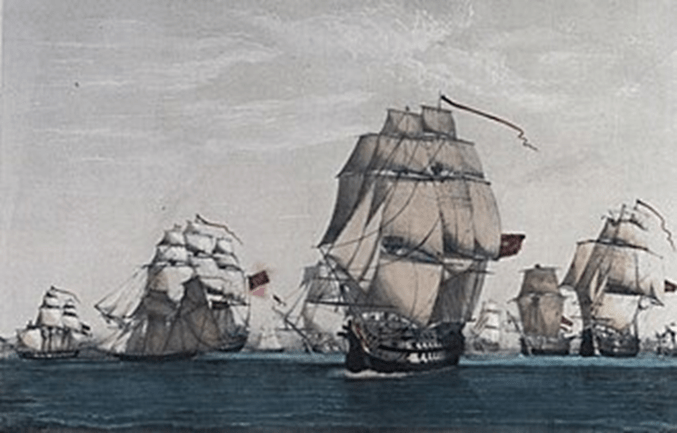
Sailing on the ship Ann, the 115 settlers landed on JANUARY 13, 1733.

A year later, Protestant refugees from Salzburg, Austria, called “Salzburgers,” settled the town of Ebenezer, Georgia. In 1735, Moravian Christian settlers from Bohemia arrived and built Fort Argyle. Scottish Presbyterians arrived from New Inverness in 1736. And in the same year, Huguenot Protestant refugees arrived from France.

James Oglethorpe’s secretary was Charles Wesley, who later became a hymn writer, composing among others, the carol “Hark, the Herald Angel Sings.”

Charles Wesley’s brother, John Wesley, served in 1735 as Georgia’s Anglican minister. The Wesleys’ friend, Rev. George Whitefield, preached to enthusiastic crowds in Georgia in 1738, and later started an orphanage there.

On July 11, 1733, 34 Portuguese Sephardic Jews and 8 German Ashkenazic Jews, arrived in Savannah, Georgia. This was the largest group of Jews to land in North America prior to the Revolutionary War. They began the Holy Congregation Hope of Israel-“Kahal Kodesh Mickve Israel,” the third oldest Jewish congregation in the United States.

In 1742, during the War of Jenkin’s Ear, some 3,000 Spanish soldiers landed on Georgia’s St. Simon’s Island. Oglethorpe repelled the Spanish in the Battle of Bloody Marsh, July 7, 1742. The next year, Oglethorpe returned to England where he served in the military.

Beginning in 1755, Britain expelled all French Catholics from Acadia, Canada. Some expelled Catholics traveled to South Carolina, others to St. Dominique Island, and still others to the French Catholic Louisiana Territory, where the pronunciation of “Acadian” evolved to “Cajun.”

Other Protestants arrived in Georgia.

In 1772, Daniel Marshall established Kiokee Baptist Church – the first Baptist Church in Georgia. Georgia is also known for Polish General Casmir Pulaski, father of the American cavalry, who died fighting the British at Savannah In the Revolutionary War.

Georgia had many Revolutionary War patriots, such as Nancy Hart. While her husband was away, six British soldiers converged on their frontier home.

Soldiers shot her prize gobbler and ordered her to cook it. After feeding and serving them lots of wine Nancy grabbed one of their guns, promising to shoot the first one that moved. After shooting two, her husband showed up and they hung the rest.

Colonel Mordecai Sheftall of Georgia became the Continental Army’s highest ranking Jewish officer, serving as Deputy Commissary General for American troops in 1778.

In 1777, Georgia passed its first State Constitution, stating: “We the people of Georgia, relying upon the protection and guidance of Almighty God, do ordain and establish this Constitution.” Georgia’s Constitution, 1777, Article 6 stated: “Representatives shall be chosen out of the residents in each county and they shall be of the Protestant religion.”

In 1788, Georgia was the 4th State to ratify the U.S. Constitution. In 1789, Georgia’s population was over 82,000. It adopted a second Constitution which removed the Protestant requirement, simply stating: “All persons shall have the free exercise of religion.” A third Georgia Constitution was adopted in 1798, establishing religious toleration.

In the first 34 years of Georgia’s statehood, conflicts arose between settlers and Indians, especially when gold was discovered on Cherokee land in 1829, causing the Georgia Gold Rush. An Indian Removal Act was hurriedly rushed through a Democrat controlled Congress in 1830. This resulted in the tragic “Trail of Tears” where over 16,000 men, women, and children of the tribes Chickasaw, Choctaw, Creek, Seminole, and Cherokee, were evicted form their homes and rounded up at gun point by Federal troops. They were first put in wooden stockade Federal internment camps, then, in the bitter winter of 1838, marched from Georgia and southeastern regions of the United States to the Oklahoma Territory. Over 4,000 died on the march.

Georgia’s religious history included the Jewish Mickve Israel Congregation, which in 1786 had an attendance of 73. In 1790, Georgia’s Governor granted the Jewish congregation a State Charter. President Washington wrote to the Hebrew Congregation in Savannah, Georgia, May 1790: “May the same wonder-working Deity, who long since delivered the Hebrews from their Egyptian oppressors, planted them in the promised land, whose Providential Agency has lately been conspicuous in establishing these United States as an independent nation, still continue to water them with the dews of Heaven, and make the inhabitants of every denomination partake in the temporal and spiritual blessings of that people, whose God is Jehovah.”

The first Catholic residents moved into Georgia from Maryland around 1793. They initially had no priests, but when the French Revolution sparked a slave revolt on the Island of St. Dominique-Haiti, a few French priests fled to Georgia. In 1810, the State Legislature incorporated the Catholic Church of Augusta. In 1820, Irish Bishop John England was appointed over the State’s one hundred Catholics in Savannah, plus a few more in Augusta.

Bishop England founded America’s first Catholic newspaper, The United States Catholic Miscellany. In 1826, Bishop John England delivered the first Catholic Sermon in the U.S. Capitol, at a Sunday morning Church service held in the House of Representatives.

The overflow audience included President John Quincy Adams, who had previously referred to the Catholic Church in an address, July 4, 1821, as “fetters of ecclesiastical domination” incompatible with republican institutions.

Bishop England reassured the predominately Protestant audience, January 8, 1826: “We do not believe that God gave to the Church any power to interfere with our civil rights, or our civil concerns. I would not allow to the Pope, or to any bishop of our Church the smallest interference with the humblest vote at our most insignificant balloting box.”

In 1836, Methodists founded Emory College, named after Methodist Bishop John Emory, in the city of Oxford, and Wesleyan Female College at Macon — the first institution of learning founded specifically for women in America.

Georgia was devastated as the Civil War progressed, especially in the fall of Atlanta and General Sherman’s march to the sea.

The population of Georgia in 1870 was 1,184,109. In 1877, Georgia’s Constitution stated: “Relying upon the protection and guidance of Almighty God, all men have the natural and inalienable right to worship God, each according to the dictates of his own conscience.”

In 1877, Baptists founded Shorter College at Rome, and in 1881, Methodists founded Morris Brown College.

In 1895, history was made at the International Exposition in Atlanta when the black President of the Tuskegee Institute, Booker T. Washington, was invited to give a keynote address.

In 1900, the population of Georgia was 2,216,331. As of 1910, the State of Georgia gave full liberty of conscience in matters of religious opinion and worship, but did not legalize willful or profane scoffing. It was unlawful to conduct any secular business on Sunday.

As of 1910, the State of Georgia gave full liberty of conscience in matters of religious opinion and worship, but did not legalize willful or profane scoffing.

It was unlawful to conduct any secular business on Sunday. Georgia’s oath of office was administered with one hand upon the Bible and the other uplifted, with the affirmation: “You do solemnly swear in the presence of the ever living God.”  Legislative sessions opened with prayer.

When James Oglethorpe and the first settlers touched Georgia’s shore, JANUARY 13, 1733, they knelt while Rev. Herbert Henry offered prayer. They declared: “Our end in leaving our native country is not to gain riches and honor, but singly this: to live wholly to the glory of God.”

Their object was: “To make Georgia a religious colony.”

James Oglethorpe

John Quincy Adams

This great man was so very influential in American history. He not only was President of the Unite States, he was one of the only patriots who not only knew all of the Founding Fathers, including George Washington, but also knew Abraham Lincoln. I think you would be interested in the fact that he was one of the first who recognized how dangerous Muslims were. And no U.S. political figure was ever as great a scholar of the Bible as this amazing man. He mastered Russian, Dutch, Portuguese, French, German, Greek, Latin, and Hebrew as written in the time of Christ. His intellect was astounding. We can learn much from what such intellect chose to be centered upon. Do read some of his story that I have compiled below: Ron

The son of the second President, John Adams, John Quincy Adams had one of the longest careers in American politics.

His many positions included:

At age 11, he accompanied his father as part of a diplomatic team to France and the Netherlands, 1778;

At 14 , he was secretary to the American diplomat to Russia, 1781-1783;

At 17, he assisted his father’s diplomatic role in England, 1784;

President Washington appointed him U.S. Ambassador to the Netherlands, 1794-1797;

U.S. Ambassador to Portugal, 1796;

U.S Ambassador to Prussia, 1797-1801;

U.S. Senator from Massachusetts, 1803;-1808

Professor of Logic at Brown University, 1803-1808;

Professor Rhetoric & Oratory, Harvard University, 1806-1809;

Argued before Supreme Court, Fletcher v. Peck, 1809;

President Madison appointed him to be First U.S. Minister to Russia, 1809-1814;

Published Lectures on Rhetoric & Oratory, 1810;

President Madison nominated him to the Supreme Court, being confirmed unanimously by the Senate, but declined, 1811;

He negotiated the Treaty of Ghent, which favorably ended the War of 1812 (Britain intended to retain the territory around the Great Lakes);

President Madison appointed him U.S. Minister to Great Britain, appointed by Madison, 1815-1817;

U.S. Secretary of State, under President Monroe, 1817-1825, where he negotiated the Adams-Onis Treaty, obtaining Florida from Spain;

He was the 6th President of the United States, 1825-1829;

U.S. Congressman from Massachusetts, 1831-1848.

John Quincy Adams was the only U.S President to serve as a Congressman in the U.S. House of Representatives after having been President.

In Congress, he earned the nicknamed “The Hell-Hound of Slavery” for relentlessly speaking out against slavery. In 1839, he introduced a constitutional amendment to ban slavery in all new states entering the Union.

In 1841, at the age of 73, John Quincy Adams spoke for nine hours defending the 53 Africans accused of mutiny aboard the Spanish slave ship La Amistad. With the help of lawyer Francis Scott Key, he argued their case before the U.S. Supreme Court and won, giving them back their freedom.

He was the only major figure in American history to know both the Founding Fathers, including George Washington, and Abraham Lincoln.

The annotated John Quincy Adams-A Bibliography, compiled by Lynn H. Parsons (Westport, CT, 1993, p. 41): “The natural hatred of the Mussulmen towards the infidels is in just accordance with the precepts of the Koran. The fundamental doctrine of the Christian religion is the extirpation of hatred from the human heart. It forbids the exercise of it, even towards enemies.

He continued:

“In the 7th century of the Christian era, a wandering Arab spread desolation and delusion over an extensive portion of the earth. (Muhammad)

He declared undistinguishing and exterminating war as a part of his religion. The essence of his doctrine was violence and lust, to exalt the brutal over the spiritual part of human nature.”

“Prophet, We have made lawful to you the slave girls whom Allah has given you as booty.”

John Quincy Adams-A Bibliography reported that during the Barbary Pirate Wars: “Our gallant Commodore Stephen Decatur chastised the pirate of Algiers. The Dey (Omar Bashaw) disdained to conceal his intentions; ‘My power,’ said he, ‘has been wrested from my hands; draw ye the treaty at your pleasure, and I will sign it; but beware of the moment, when I shall recover my power, for with that moment, your treaty shall be waste paper.'”

Frederick Leiner wrote in The End of the Barbary Terror-America’s 1815 War Against the Pirates of North Africa (Oxford University Press): “Commodore Stephen Decatur and diplomat William Shaler withdrew to consult in private. The Algerians were believed to be masters of duplicity, willing to make agreements and break them as they found convenient.”

The Annotated John Quincy Adams-A Bibliography (NY: 1830) continued with the statement: “The vanquished may purchase their lives, by the payment of tribute; the victorious may be appeased by a false and delusive promise of peace. The faithful follower of the prophet may submit to the imperious necessities of defeat: but the command to propagate the Moslem creed by the sword is always obligatory, when it can be made effective. The commands of the prophet may be performed alike, by fraud, or by force.”

John Quincy Adams described Muslim behavior in “Essay on Turks” (The American Annual Register for 1827-28-29): “Such is the spirit, which governs the hearts of men, to whom treachery and violence are taught as principles of religion.”

Scottish philosopher David Hume wrote the Prophet of Islam in Of the Standard of Taste, 1760: “Let us attend to his narration; and we shall soon find, that the prophet bestows praise on such instances of treachery, inhumanity, cruelty, revenge, bigotry, as are utterly incompatible with civilized society.”

Winston Churchill described Muslim behavior in The Story of the Malakand Field Force (Dover Publications, 1898):   “Their system of ethics, which regards treachery and violence as virtues rather than vices, has produced a code of honor so strange and inconsistent, that it is incomprehensible to a logical mind.”

After reading the insight of John Quincy Adams, Winston Churchill and David Hume, one is faced with a perplexing question — if someone is capable of decapitating you, would they first be willing to lie to you about their intentions?

While General Andrew Jackson was fighting the British in the area of Louisiana, Mississippi, Alabama, and West Florida, John Quincy Adams was negotiating the Treaty of Ghent in Belgium, which ended the War of 1812.

Afterwards, he traveled to Paris and saw Napoleon being returned to power for his famous 100 last days as Emperor.

One of the major influences that shaped the views and actions of John Quincy Adams was the Bible, as he wrote in his diary, September 26, 1810: “I have made it a practice for several years to read the Bible through in the course of every year. I usually devote to this reading the first hour after I rise every morning. I have this morning commenced it anew, this time with Ostervald’s French translation.”

In September of 1811, John Quincy Adams wrote to his son from St. Petersburg, Russia: “My dear Son, you mentioned that you read to your aunt a chapter in the Bible or a section of Doddridge’s Annotations every evening. This information gave me real pleasure; for so great is my veneration for the Bible. It is of all books in the world, that which contributes most to make men good, wise, and happy. My custom is, to read four to five chapters every morning immediately after rising from my bed.

Adams continued:

It is essential, my son that you should form and adopt certain rules of your own conduct. It is in the Bible, you must learn them. ‘Thou shalt love the Lord thy God, with all thy heart, and with all thy soul, and with all thy mind, and with all thy strength, and thy neighbor as thy self.’ On these two commandments, Jesus Christ expressly says, ‘hang all the law and the prophets.'”

John Quincy Adams’ correspondence to his son is compiled in Letters of John Quincy Adams to his son, on the Bible and its Teachings, which contains his statement: “No book in the world deserves to be so unceasingly studied, and so profoundly meditated upon as the Bible.”

On March 13, 1812, John Quincy Adams noted: “This morning I finished the perusal of the German Bible.”

Adams wrote December 24, 1814: “You ask me what Bible I take as the standard of my faith — the Hebrew, the Samaritan, the old English translation, or what? I answer, the Bible containing the Sermon on the Mount. The New Testament I have repeatedly read in the original Greek, in the Latin, in the Geneva Protestant, in Sacy’s Catholic French translations, in Luther’s German translation, in the common English Protestant, and in the Douay Catholic translations. I take any one of them for my standard of faith.”

On December 31, 1825, John Quincy Adams wrote in his diary: “I rise usually between five and six. I walk by the light of the moon or stars, or none, about four miles, usually returning home. I then make my fire, and read three chapters of the Bible.”

The Real Origin of Americas Government

Very few people know the real origin of America’s government.  It is the origin of the Pilgrim’s Compact and the origin of the Colonial pastors sermons from which our Constitution was patterned. I really want you to know it. So, if you will read the following, you will for sure know:      Ron   

Hartford’s Traveler’s Square has a bronze statue of Connecticut’s first settlers and a plaque which reads: “In June of 1635, about one hundred members of Thomas Hooker’s congregation arrived safely in this vicinity with one hundred and sixty cattle. They followed old Indian trails from Massachusetts Bay Colony to the Connecticut River to build a community. Here they established the form of government upon which the present Constitution of the United States is modeled.”

This is a significant acknowledgment, that their “covenant” congregational church government became their colonial government, which then became the model for the U.S. Constitution. The U.S. Constitution was completely modeled on the sermon preached by the pastor of this church.

As explained by the famous historian Dr. Charles Wolfe in his writings in 1989: “The pastor of this church, Rev. Hooker preached a scholarly sermon that guided the men of Connecticut in framing the Fundamental Orders of Connecticut in 1639, commonly called ‘the world’s first complete written constitution’. And this document became the exact model of the America’s constitution”

In New England, instead of separation of church and state, it was pastors and churches that created the state. How could someone say, “Pastor, do not preach on politics” when it is a pastor’s sermon that became their constitution? How could someone say “Church members should not be involved in politics” when all there was in Hartford at that time was the church members?

President Calvin Coolidge stated at the 150th Anniversary of the Declaration of Independence, Philadelphia, July 5, 1926: “The principles which went into the Declaration of Independence are found in the sermons of the early colonial clergy who were earnestly undertaking to instruct their congregations in the great mystery of how to live. They preached equality because they believed in the fatherhood of God and the brotherhood of man. They justified freedom by the text that we are all created in the divine image, placing every man on a plane where he acknowledged no superiors, where no one possessed any right to rule over him, he must inevitably choose his own rulers through a system of self-government.

In other countries the authority was the king or ruler, a Mullah, a Potentate, a Czar……always, one supreme arthority. However, when the Pilgrims landed at Plymouth instead of way south where they were supposed to land where they had a governing charter, they had no governing instrument. So, they devised what they called a Charter. It was a form of government that was controlled completely by the people. This became an example for our Constitution. And as President Coolidge stated above, the Pastors of the Colonies that were formed in early America preached a form of self government that also became an examplr for our Constitution.

But where did they get those those revoutionary ideas for self government? The answer to that is what I have written all of this to finally explain.

Since the Pilgrims and the Colonial pastors were so very steeped in the Bible, it is only logical that their ideas about government came from the bible. In early and even most all later times, governments were ruled by a king or some other similar authority. The first government where the people ruled was the four hundred years that the “Children of Israel” had a republican government where the people were the rulers. It was the four hundred years where their government was the one they had when they finally lived in their Promised Land together.

During those first four hundred years in the Promised Land they had peace, prosperity, and they multiplied greatly. For all those years, they lived under a covenant with God. Their laws were those that God himself had set up and were given to the people by Moses on Mount Sinai directly from God. For all those years they strictly kept those laws out of reverence to God.

Eventually they most all decided that they wanted a king, like the other nations surrounding them had. God did not want them to have a king, but He finally let them have a king such as they were clamoring for. He warned them through his prophets that such a government was not nearly as good as the republican one with just the people ruling which they had prospered under since arriving in the Promised Land.

The got their king, King Saul; and sure enough he immediately executed over one thousand priests and prophets to solidify his authority. They were not nearly as well off as they had been during those four hundred years, but it was too late now.

Where did America’s founders get this idea of people ruling themselves?

They did draw some ideas from the Roman Republic and the Athenian city states. Ultimately, though, America’s New England founders looked back to Ancient Israel, that four hundred years where they prospered upon finally arriving in the Promised Land.

Harvard President Samuel Langdon gave an address, June 5, 1788, titled “The Republic of the Israelites an Example to the American States stating: The ISRAELITES may be considered as a pattern to the world in all ages. Government on republican principles, required laws; without which it would have degenerated immediately into absolute monarchy. How unexampled was this quick progress of the ISRAELITES, from abject slavery, ignorance, and almost total want of order, to a national establishment perfected in all its parts far beyond all other kingdoms and states! From a mere mob, to a well regulated nation, under a government and laws far superior to what any other nation could boast!”

Langdon concluded:

“It was a long time after the law of Moses was given before the rest of the world knew any thing of government by law. It was six hundred years after Moses before Grecian republics received a very imperfect code of laws from Lycurgus. It was about five hundred years from the first founding of the celebrated Roman empire before the first laws of that empire.”

Dr. Pat Robertson wrote in America’s Dates with Destiny, 1986: “What was happening in America had no real precedent, even as far back as the city-states of Greece. The only real precedent was established thousands of years before by THE TRIBES OF ISRAEL in the covenant with God and with each other.”

What was the Republic of the Israelites? Around 1,400 BC, the Children of Israel left Egypt and entered the Promised Land.

As explained in detail in the book “Rise of the Tyrant: Volume Two of Change to Chains-The 6,000 Year Quest for Global Control”:

*Ancient Israel was the first well-recorded instance of an entire nation ruled without a king, that first 400 year period in the Promised Land.

*Ancient Israel taught that everyone, male and females, was made in the image of the Creator who was not a respecter of persons, commanding judges to treat everyone equally before the law. This was the beginning of the concept of equality on planet earth. There was no royal family to curry favor with for the 400 year period prior to King Saul.

*Ancient Israel had a system of honesty, as God hates unjust weights and measures. This provided a basis for commerce.

*Ancient Israel had the land divided up and permanently titled to each individual family. This prevented a dictator from gathering up the land and putting the people back into slavery. If someone owned land, they could accumulate possessions: the Bible called this being blessed. And you could give away some of your possessions: the Bible called this “charity.” Karl Marx wanted the exact opposite, as he wrote in his Communist Manifesto, 1848: “The theory of the Communists may be summed up in the single sentence: Abolition of private property.”

*Ancient Israel had a bureaucracy-free welfare system. When someone harvested their field, they left the gleanings for the poor.

*Ancient Israel was the first nation where everyone was taught to read.

*Ancient Israel had no police, as the people were not only taught the Law, they were accountable to enforce it.

Albert Einstein stated: “The strength of the Constitution lies entirely in the determination of each citizen to defend it. Only if every single citizen feels duty bound to do his share in this defense are constitutional rights secure.”

*Ancient Israel had no prisons, as the Law required swift justice at the city gates and a “city of refuge” where fugitives could flee to await a trial.

*Ancient Israel had no standing army, as every man was in the militia, armed, and ready at a moment’s notice to defend his community.

*Ancient Israel had the people of every town gather in the meeting house — synagogue — where they were taught the Law and where they chose their elders who would sit in the gates:

  • Deuteronomy 1:3-13: “How can I myself alone bear … your burden? … TAKE YOU wise men, and understanding, and KNOWN AMONG YOUR TRIBES, and I will make them rulers over you.”
  • Deuteronomy 16:18–19 “Judges and officers SHALT THOU MAKE THEE IN ALL THY GATES which the Lord thy God giveth thee throughout thy tribes.”
  • Exodus 18:21 “Moreover thou shalt provide OUT OF ALL THE PEOPLE able men, such as fear God, men of truth, hating covetousness; and place such over them, to be rulers of thousands, and rulers of hundreds, rulers of fifties, and rulers of tens.”

But why would a person obey internal morals? Ancient Israel had the key ingredients: 1) God is watching everyone; 2) God wants you to be fair; and 3) God will hold you accountable in the future.

If you had the opportunity to steal and not get caught, you might considered it.

But if you remember God is watching, that He wants you to be fair, and that He will hold you accountable in the future, you would hesitate.

This is called having a “conscience.

Secretary of State William Jennings Bryan stated in 1908: “There is a powerful restraining influence in the belief that an All-seeing eye scrutinizes every thought and word and act of the individual.”

This only works, though, with the God of the Bible. An Islamic Allah permits lying, stealing, and raping infidel kafir non-Muslims. Only the God of the Bible declares that all men and women are equal, made in the image of the Creator, and to do unto others as you would have them do unto you.

E.C. Wines wrote in Commentaries on the Laws of the Ancient Hebrews, with an Introductory Essay on Civil Society & Government (NY: Geo. P. Putnam & Co., 1853): “Another of those great ideas, which constituted the basis of the Hebrew state, was liberty. The Hebrew people enjoyed as great a degree of personal liberty, as can ever be combined with an efficient and stable government. There is a powerful restraining influence in the belief that an All-seeing eye scrutinizes every thought and word and act of the individual.”

Ancient Israel’s unique system was dependent upon the Levites and priests teaching the Law.

Noah Webster wrote in the preface of his 1828 Webster’s Dictionary: “The Christian religion is the most important and one of the first things in which all children, under a free government ought to be instructed. No truth is more evident to my mind than that the Christian religion must be the basis of any government intended to secure the rights and privileges of a free people.”

(So, if you have been patient to follow along with these words and the history that they represent, now you know the real origin of America’s government.)

`

Virginia – First English Colony in Ameria

Many colonies were attempted in America. The Pilgimes, without a Charter, even formed their own government structure. Yet, most all were wiped out by the indians. However, Virginia was the first English colony in America that lasted. Its history is rather amazing, especially its religious history. I thought you may be interested in reading about America’s first English colony. Please do so below: Ron

Virginia

In 1585, Sir Walter Raleigh attempted to settle Roanoke Island, Virginia, which he named after the “Virgin Queen” Elizabeth the First.

The Grant for the Colony stated: “Elizabeth, by the Grace of God and of England, Defender of the Faith, grant to our trusty and well beloved servant Walter Raleigh to discover barbarous lands, not actually possessed of any Christian Prince, nor inhabited by Christian People. Upon finding such remote lands it shall be necessary for the safety of all men to live together in Christian peace, Ordinances agreeable to the laws of England, and also so as they be not against the true Christian faith.”

Thomas Jefferson wrote in his Autobiography, 1821: “The first settlers of Virginia were Englishmen, loyal subjects to their King and Church, and the grant to Sir Walter Raleigh contained an express proviso that their laws ‘should not be against the true Christian faith, now professed in the Church of England.'”

Unfortunately, due to the Spain’s Invincible Armada attacking England in 1588, supplies to the Roanoke colony were delayed. When ships finally arrived in 1590, they found the Roanoke settlement abandoned, causing it be referred to as the “Lost Colony.”

Sir Walter Raleigh personally lost 40,000 pounds sterling on the venture.

After more than two decades, the Virginia Company was formed. One of the investors in the Virginia Company was the Earl of Southampton, who also financed William Shakespeare.

King James the First granted to the Virginia Company the First Charter of Virginia, April 10, 1606, which stated: “For the Furtherance of so noble a Work, which may, by the Providence of Almighty God, hereafter tend to the Glory of His Divine Majesty, in propagating of Christian Religion to such People, as yet live in Darkness and miserable Ignorance of the true Knowledge and Worship of God.”

The next year, Captain Christopher Newport arrived on April 26, 1607, with 105 settlers on the ships Susan Constant, Godspeed, and Discovery. Their “First Landing” was at Cape Henry, named for Prince Henry of Wales, the eldest son of King James I.

Their first act was to erect a wooden cross and commence a prayer meeting, led by Church of England minister, Rev. Robert Hunt.

They ascended the James River, named for King James I, and settled Jamestown, the first permanent English settlement in America.

One of Jamestown’s leaders was Captain John Smith, who served on the Council and a one year term as Governor. As recorded in his book, The True Travels, Adventures and Observations of Captain John Smith in Europe, Asia, Africa and America. He had previously spent five years fighting the armies of Ottoman Sultans Mehmed III and Ahmed I in the Long Turkish War, 1593-1606, in Hungary, Wallachia, Moldova, Romania and Transylvania near the Black Sea. During one of the campaigns led by Romanian Prince Michael the Brave, John Smith introduced ingenious battle tactics using gunpowder, which resulted in a victory and his promotion to captain.

In one incident, Smith killed three Turks in hand-to-hand combat, for which he was awarded a coat of arms.

Captain John Smith was captured, made a slave in Constantinople, killed his master, escaped to Russia, then fought the Ottoman navy on the Mediterranean before returning to England in 1605, and setting sail for Virginia in 1606. After landing in Virginia, Smith was exploring in December of 1607 and captured by Chief Powhatan, who intended to bash his brains out, till his daughter Pocahontas interceded. Pocahontas later was baptized, the painting of which is in the U.S. Capitol Rotunda

As Indians smoked tobacco in “peace pipes,” and Indians were healthy, people in England thought that smoking tobacco would make one healthy, thus causing a great demand for the crop.

On May 23, 1609, King James granted a Second Charter of Virginia, which stated: “The principal Effect which we can expect is the Conversion and reduction of the people in those parts unto the true worship of God and the Christian Religion. It shall be necessary for all such of our loving Subjects to live together, in the Fear and true Worship of Almighty God, Christian Peace, and civil Quietness, with each other.”

The Colony was almost abandoned in 1610, had it not been for the providential arrival of more settlers and supplies brought by Lord De La War, for whom the Colony of Delaware was later named.

The Third Charter of Virginia, March 12, 1611, stated: “Our loving Subjects for the Propagation of Christian Religion, and Reclaiming of People barbarous, to Civility and Humanity, We have granted unto them the first Colony in Virginia.”

In May of 1611, the London Company sent Sir Thomas Dale to Virginia. He sailed up the James River and founded Henricus, the colony’s second settlement, also named after James’ eldest son, Prince Henry.

In 1619, Henricus became the location of the first English hospital in America and the first chartered college in the English colonies, initially designed for Powhatan’s children to learn trades, agriculture, and Christianity, “the work of conversion.”

Unfortunately, it was destroyed in the 1622 Indian uprising. The uprising started after Chief Powhatan died.

The new chief, Opechancanough, led coordinated surprise attacks in which Indians killed 347 men, women and children in outlying settlements, a full quarter of Virginia’s entire population.

Fortunately for Jamestown, an Indian convert to Christianity named Chanco, saved the town by warning Richard Pace. The account to the London Company, stated: “This slaughter was a deep and grievous wound to the yet weak and infant colony; but it would have been much more general, and almost universal, if God had not put it into the heart of a converted Indian, to make a discovery. This convert, whose name was Chanco, lived with one Richard Pace, who treated him, as his own son. The night before the massacre, another Indian, his brother, was with him; and told him of the Chief’s command, and that the attack would be performed the next day and urged him to rise and tell Pace. As soon as his brother was gone, the Christian Indian rose, and went and revealed the whole matter to Pace; who immediately gave notice thereof to Captain William Powel, and having secured his own house, rowed off before day to James-Town, and informed the Governor of it.”

A plaque erected at Jamestown reads: “In memory of Chanco, the Indian who lived with Richard Pace, in this county, and who on the night of March 22, 1622, informed Pace of Opechancanough’s plot and thus saved the Jamestown Colony.”

The Colony of Virginia suffered many droughts, famines, starvation, diseases, and attacks. Jamestown’s mortality rate was so high, that at times the dead were buried in mass graves. Between1608 and 1624, of the 6,000 settlers that came to Jamestown, only 3,400 survived.

Unfortunately, in 1624, King James the First revoked the Virginia Company charter and ruled directly over Virginia as a Royal Crown Colony.

Thus, the official denomination in Virginia was the Church of England, which was established from 1606 till 1786.

Noah Webster’s 1828 Dictionary defined “establishment” of religion as “The episcopal form of religion, so called in England.”  Establishment also meant that settlers had to take the “oath of supremacy.” The Oath of Supremacy, 1535, stated: “I declare that the King’s Highness is the only Supreme Governor of this Realm in all Spiritual or Ecclesiastical things.”

Church attendance was now mandatory. The Virginia House of Burgesses passed an ordinance in 1623: “To see that the Sabbath was not profaned by working or any employments, or journeying from place to place, On March 5, 1624, Virginia’s legislature passed the ordinance: “Whosoever shall absent himself from Divine service any Sunday without an allowable excuse shall forfeit a pound of tobacco”

It continued: “That there be an uniformity in our Church as near as may be to the Canons in England and that all persons yield ready obedience unto them under pain of censure.”

In 1699, the Virginia Assembly adopted the statutes of monarchs William and Mary allowing for limited toleration of some Protestant dissenters.

James Madison wrote to Robert Walsh, March 2, 1819: “The English Church was originally the established religion. Of other sects there were but few adherents, except the Presbyterians who predominated on the west side of the Blue Mountains. A little time previous to the Revolutionary struggle, the Baptists sprang up, and made very rapid progress. At present the population is divided, with small exceptions, among the Protestant Episcopalians, the Presbyterians, the Baptists and the Methodists.”

U.S. Supreme Court Justice Hugo Lafayette Black wrote in Engel v. Vitale, 1962: “As late as the time of the Revolutionary War, there were established Churches in at least eight of the thirteen former colonies. The successful Revolution against English political domination was shortly followed by intense opposition in Virginia where the minority religious groups such as Presbyterians, Lutherans, Quakers and Baptists had gained such strength.”

Justice Black continued: “In 1785-1786, those opposed to the established Church obtained the enactment of the famous ‘Virginia Bill for Religious Liberty’ by which all religious groups were placed on an equal footing.”

The “Virginia Bill for Religious Liberty,” drafted by Thomas Jefferson, prevented the government from infringing on the rights of conscience, January 16, 1786: “Almighty God hath created the mind free, and manifested his supreme will that free it shall remain by making it altogether insusceptible of restraint; that all attempts to influence it by temporal punishments are a departure from the plan of the holy author of our religion, who being lord both of body and mind, yet chose not to propagate it by coercions on either, as was in his Almighty power to do, but to extend it by its influence on reason alone”

Jefferson continued: “To compel a man to furnish contributions of money for the propagation of opinions which he disbelieves and abhors, is sinful and tyrannical, that laying upon him an incapacity of being called to offices of trust unless he renounce this or that religious opinion, is depriving him injuriously of those privileges to which he has a natural right, that the opinions of men are not the object of civil government, nor under its jurisdiction; that to suffer the civil magistrate to intrude his powers into the field of opinion is a dangerous fallacy, which at once destroys all religious liberty, because he being of course judge of that tendency will make his opinions the rule of judgment, and approve or condemn the sentiments of others, that truth is great and will prevail if left to herself”

Jefferson concluded: “Thus that no man shall be molested on account of his religious opinions or belief; but that all men shall be free to profess, and by argument to maintain, their opinions in matters of religion.”

So, because of the great victory of the American Revolution over England, all these protestant churches in Virginia now had complete freedom to worship God as they felt divinely directed.

Elizabeth I, Virgin Queen of England

Most people in the United States know amost nothing about the Virgin Queen of England. However, if she had not risen up and called upon God to assist her in destroying the great Spanish Armade anchored right there on the shores of England, there would not have been 13 Colonies in America and no United States. And we would all be speaking Spanish to this Day. So do read about her and what happened: Ron

The Story of England’s Virgin Queen

When Henry the Eighth died in 1547, his nine-year-old son by Jane Seymour, Edward the Sixth, reigned for six years.

Edward the Sixth

He advanced Protestantism in England, most notably by requiring the use of The Book of Common Prayer, prepared the Thomas Cranmer, the Archbishop of Canterbury. After the Bible, The Book of Common Prayer is considered the most influential book in the English language, followed by the works of Shakespeare.

When it became apparent that Edward’s illness was terminal, he passed over his older half sisters, Mary and Elizabeth, to appoint his Protestant first cousin, Lady Jane Grey as his heir.

Upon Edward’s death in 1553, Mary, Henry the Eighth’s oldest daughter, from his marriage to Catherine of Aragon, quickly ascended to power. She executed Lady Jane Grey – the Nine Day Queen, and put Elizabeth in the Tower of London, the same place where Elizabeth’s mother, Anne Boleyn, had been beheaded 18 years earlier.

Queen Mary

Queen Mary reigned 5 years. Her popularity suffered in 1554 when, at the age of 38, she married her 27-year-old first cousin, the future King of Spain, Philip the Second. Phillip spent most of his time absent from England, fighting in the Netherlands.

Mary repealed the Protestant reforms of her father, Henry the Eighth, and her half-brother, Edward the Sixth, and brought back the Heresy Acts. She had over 300 executed, resulting in the sobriquet “Bloody Mary.”

Among those she had executed were the Oxford Martyrs:

– Bishop Hugh Latimer, who had been Edward the Sixth’s chaplain;

– Reverend Nicholas Ridley, who had been the Bishop of London; and

– Thomas Cranmer, the former Archbishop of the Anglican Church, who published The Book of Common Prayer.

As they were about to be burned at the stake, October 16, 1555, Bishop Hugh Latimer exhorted Nicholas Ridley: “Play the man, Master Ridley. We shall this day light such a candle, by God’s grace, in England, as I trust shall never be put out.”

Thomas Cranmer was taken to a tower and forced to watch their execution. Cranmer was then given the opportunity to give a sermon to publicly renounce his Protestant teaching. Unexpectedly, he reaffirmed them, was immediately pulled from the pulpit, taken outside and burned at the stake. As he was engulfed in flames, he was heard saying “Lord Jesus, receive my spirit. I see the heavens open and Jesus standing at the right hand of God.”

Mary had two false pregnancies, then died, November 17, 1558, resulting in her half-sister Elizabeth becoming Queen.

Elizabeth I

Elizabeth continued the hierarchical Church of England, also called the Anglican Church, begun when her father separated from Rome in order to marry her mother, Anne Boleyn.

Some in England insisted that the Anglican Church separate even further from Rome. They wanted to “purify” it, resulting in them being called “Puritans.” Puritans had a theology influenced by John Calvin, Ulrich Zwingli, John Knox, and other Protestant Reformers.

Elizabeth attempted to take the middle ground between Puritan fundamentalist views on one side, and England’s centuries old Catholic heritage on the other.

At her Coronation in 1558, Elizabeth was questioned as to the presence of Christ in the Sacrament. She responded: “Christ was the Word that spake it, He took the bread and brake it, And what that Word did make it, I do believe and take it.”

Elizabeth stated: “There is only one Christ, Jesus, one faith. All else is a dispute over trifles.”

Elizabeth reissued The Act of Supremacy, declaring the Monarch was the: “Supreme Governor in all Spiritual or Ecclesiastical Things.”

She enacted The Act of Uniformity, making Anglican Church attendance compulsory, and required use of The Book of Common Prayer, though penalties for nonconforming were not extreme. Though an estimated 300 Catholic priests lost their jobs, Catholic “papists” or “recusants” were tolerated and simply had to pay a weekly fine for not attending the Anglican Church.

Elizabeth did not like Henry the Eighth’s Great Bible, which relied on the Latin Vulgate. She also did not like the Geneva Bible, which had John Calvin’s margin notes recommending Presbyterian church government of elders chosen as representatives of the congregation. She authorized the Bishops’ Bible, which supported an episcopalian church government led by Anglican bishops appointed by the monarch.

Anglicans drew their ideas of government from the Old Testament period of King Saul and afterwards, where Israel had an anointed King.

Puritans drew their ideas of government from the 400 year period pre-King Saul, where people of Israel were in a covenant with God and with each other.

The Hebrew Republic was the first instance in world history of a nation with millions of people and no king, maintaining order with an educated population where every citizen was taught God’s Law and personally accountable to God to follow it.

Puritans divided into two main forms of church government: Presbyterian and Congregational. Presbyterians favored elders, called presbyters, who gathered together to make decisions in local synod assemblies – synod is derived from the same root word as synagogue, which means “meeting place.” Congregationalists favored a church government were each congregation was completely independent. These were called Radical Puritans, Separatists, Independents, Dissenters, Non-conformists, Brownists – followers of Robert Browne, Baptists – followers of John Smyth, John Murton and Thomas Helwys. The latter were referred to as the “Pilgrims.” They believed the “gathered church” was founded by the Holy Spirit, not by man or the state, therefore each individual church had the right to determine its own affairs.

Pilgrim Separatists fled to Holland, and then later to America in 1620.

Mainstream Puritans came in large numbers beginning in 1630, with the Great Puritan Migration to escape the persecution of King Charles the First. In America, both Pilgrims and Puritans were generally referred to as “Congregationalists.”

During Queen Elizabeth’s 45 year reign, monumental achievements occurred. Shakespeare wrote 38 plays impacting world literature.

Sir Francis Bacon began the scientific revolution. In his treatise titled, Of Atheism, Francis Bacon declared: “A little philosophy inclineth man’s mind to atheism, but depth in philosophy bringeth men’s minds about to religion.”

In 1577, Sir Francis Drake began the second voyage in history to circumnavigate the globe, almost 60 years after Ferdinand Magellan’s first voyage.

In 1579, Oxford educated priest Thomas Stephens became one of the first western Christian missionaries, and probably the first Englishman, to reach India, converting many of the upper Indian society by writing Kristpurana – Story of Christ.

In 1600, English navigator William Adams, sailing for the Dutch East India Company, arrived in Japan.

In 1584, Sir Walter Raleigh began a colony he named Virginia, in honor of the “Virgin Queen Elizabeth.”

Virginia’s Charter, 1584, stated: “Elizabeth, by the Grace of God of England, Defender of the Faith, grant to our trusty and well beloved servant Walter Raleigh, to discover barbarous lands, not actually possessed of any Christian Prince, nor inhabited by Christian People. Upon finding such remote lands it shall be necessary for the safety of all men to live together in Christian peace, and Ordinances agreeable to the laws of England, and also so as they be not against the true Christian faith.” 

Phillip’s half-brother, Don Juan of Austria, in what was considered a miraculous victory, defeated the Ottoman Muslim fleet at the Battle of Lepanto in 1571.

Afterwards, instead of freeing the rest of the Mediterranean from Muslim control, Spain turned its attention to stopping the Reformation in Holland and England.

Beginning in 1572, Spanish General Alba, known as the Iron Duke, committed the “Spanish Furies,” pillaging, burning, raping and slaughtering in the Netherlands. This led to the Eighty Years War and eventually Holland’s independence.

Philip the Second of Spain had proposed marriage to Elizabeth, but she continually put him off. They were cordial until Elizabeth began aid the Netherlands. Considering this as aiding his enemies, Philip the Second of Spain sent his Invincible Spanish Armada to invade England in 1588.

The Armada consisted of 130 ships, 1,000 iron guns, 1,500 brass guns, 7,000 sailors, 18,000 soldiers, plus 30,000 soldiers from the Spanish Netherlands. It looked like the end of England and the Virgin Queen.

Queen Elizabeth told her troops, August 19, 1588: “Let tyrants fear. I know I have the body but of a weak and feeble woman; but I have the heart and stomach of a king, and of a king of England too, and think foul scorn that Spain, or any prince of Europe, should dare to invade the borders of my realm. I myself will take up arms, I myself will be your general. We shall shortly have a famous victory over those enemies of my God, of my kingdom, and of my people.”

(Many of us are convinced that God miraculously intervened at that point, in an amazing miracle.)

England’s smaller, more maneuverable vessels proved difficult for the Spanish to apprehend. Then, at midnight, July 28, 1588, Sir Francis Drake set eight English ships on fire and floated them downwind to the closely anchored Spanish ships of that great Spanish Armada.

In a panic, the Spanish ships cut anchor. And at that very moment, an unusual violent hurricane scattered and destroyed most of the Spanish Armada.

When King Philip the Second of Spain learned of the loss, he exclaimed: “I sent the Armada against men, not God’s winds and waves.”

If Spain would have won, there would not only have been no Anglican England, there would have been no Puritans, no Pilgrims, no New England, and no United States.

(This is a good place to end the story of England’s Queen Elizabeth I. However, this is not the end of the story. So much still happened because of her, includeing the founding of America. Do continue on, finishing this story of the Virgin Queen if you wish) Ron

In 1596 and 1597, Philip the Second again sent Armadas to England, but they were also destroyed in storms. These losses contributed to Spain’s financial bankruptcy and ended Spain’s monopoly of the seas.

England soon became a major European power, and joined the countries of Holland, Sweden, and France in founding colonies in America.

Adam Smith wrote The Wealth of Nations, 1776. In it he said: “The Spaniards, by virtue of the first discovery, claimed all America as their own, and such was the terror of their name, that the greater part of the other nations of Europe were afraid to establish themselves in any other part of that great continent; but the defeat of their Invincible Armada put it out of their power to obstruct any longer the settlements of the other European nations. In the course of the 17th century English, French, Dutch, Danes, and Swedes attempted to make some settlements in the new world.”

When Elizabeth died, March 24, 1603, James the First became King of England. He was the son of Mary Queen of Scots.

Though James’ mother was Catholic, and though he was raised and tutored by Scottish Presbyterians, when he became King he acted as an absolute monarch, embracing Anglicanism with all the hierarchical power concentrated in the hands of the King. James was noted for the Jamestown Colony and the King James Bible in 1611.

Before her death, Queen Elizabeth, the last monarch of the House of Tudor, stated in 1566: “I am your Queen. I will never be by violence constrained to do anything. I thank God I am endued with such qualities that if I were turned out of the Realm in my petticoat I were able to live in any place in Christendom.”

Elizabeth told William Lambarde in 1601: “He that will forget God, will also forget his benefactors.”

Rebellions and assassinations were a constant threat. In France, King Henry the Third was assassinated in 1589. France’s “Good King” Henry the Fourth survived at least a dozen attempts on his life before he was eventually assassinated in 1610.

Elizabeth faced the rebellion of the Catholic Northern Earls in 1569. Though Elizabeth was relatively tolerant toward Catholics, things changed when Pope Pius the Fifth officially excommunicated her in 1570, declaring her an illegitimate queen.

In response, she passed the Treason Acts of 1571, making it a crime for anyone to say she was not the legitimate queen.

The Religion Act was passed in 1580 making it high treason to persuade subjects to not be loyal to the Queen or the Church of England, increasing recusant fines to £20 a month or imprisonment for being absent from Anglican Church service, or attending a Catholic mass.

There were numerous plots to remove Elizabeth:

The Ridolfi Plot, 1571;

The Throckmorton Plot, 1583;

The Babington Plot, 1586.

When rumors arose in England of a possible assassination plot, Elizabeth executed dozens, including, sadly, her Catholic cousin, Mary Queen of Scots, who was under her protection.

Before her death, responding to questions from Parliament regarding succession after her death, Elizabeth stated: “I know I am but mortal and so therewhilst prepare myself for death, whensoever it shall please God to send it.”

Of her epitaph, Queen Elizabeth I had it put:  “I am no lover of pompous title, but only desire that my name may be recorded in a line or two, which shall express my name, my virginity, the years of my reign, and the reformation of religion under it.”

(End of the Story of the Virgin Queen, Elizabeth I}

How We Almost Lost Our Great American Republic

It says in the Bible that God is not just interested, but involved in the affairs of nations. Many of us firmly believe that He was explicitly involved in the outcome of the last Presidential Election. We had almost lost our great American Republic. Most don’t know how close that was. So that such never happens again, I think that it is very important for us to understand how we got to that point. If you will read the following, you will know:

How We Got There

From the Civil War to Lyndon Johnson, Southern Democrats utilized the negative motivation of intimidation to keep African Americas from voting. But as television and media reporting revealed the horrors of these intimidation tactics, it was bad press for the Democrat Party.

Political strategists proposed a different tactic to control minority voters, namely, switching from “intimidation” to “entitlement.” In other words, instead of suppressing the minority vote through intimidation, it could be controlled through dependency on entitlement programs.

According to Ronald Kessler’s book, Inside The White House (1996), Lyndon Johnson, who had a reputation for vulgarity in private conversations, explained his intention to make the BIG SWITCH in strategy from intimidation to entitlement to two Democrat governors aboard Air Force One, saying: “I’ll have those n****rs voting Democratic for the next 200 years.”

Malcolm X exposed this liberal Democrat tactic in a 1963 address: “The white liberal differs from the white conservative only in one way: the liberal is more deceitful, more hypocritical than the conservative. Both want power, but the white liberal is the one who has perfected the art of posing as the Negro’s friend and benefactor, and by winning the friendship and support of the Negro, the white liberal is able to use the Negro as a pawn or a weapon in this political football game that is constantly raging between the white liberal and the white conservative. The American Negro is nothing but a political football and the white liberals control this ball through tricks or tokenism, false promises of integration and civil rights. In this game of deceiving and using the American Negro, the white liberals have complete cooperation of the Negro civil rights leaders who sell our people out for a few crumbs of token recognition, token gains, token progress.”

Manning Johnson, a black activist recruited by Marxists, but later left them to write Color, Communism and Common Sense, 1957: “White leftists descended on Negro communities like locusts, posing as ‘friends’ come to help ‘liberate’ their black brothers. Everything was inter-racial, an inter-racialism artificially created, cleverly devised as a camouflage of the red plot to use the Negro.”

At first this was difficult, as most blacks were independent and self-reliant, averse to being dependent on gifts from an all-powerful government.

This attitude was expressed by George W. Carver, who wrote in A Brief Sketch of My Life, 1922: “I would never allow anyone to give me money, no matter how badly I needed it. I wanted literally to earn my living.”

Democrat social workers overcame this initial opposition from those “too proud” to take a hand out, and enrolled increasingly larger numbers. This gradually led to a cultural shift of generational dependency, and with it, a strong tendency for recipients to vote for Democrat candidates who promised more hand outs. In other words: more dependents translates into more votes. As lower income voters grew more dependent on government programs, it proportionally increased the Democrat Party’s voting constituency.

Alexis de Tocqueville warned: “The American Republic will endure, until politicians realize they can bribe the people with their own money.”

George Bernard Shaw stated: “A government policy to rob Peter to pay Paul can be assured of the support of Paul.”

Vote-buying eventually leads to national bankruptcy, as Margaret Thatcher warned: “The problem with socialism is that you eventually run out of other people’s money.”

Lyndon Johnson, with the help of Democrat Senator Edward Kennedy, changed immigration quotas to bring in more immigrants from poorer, third world countries. These could be immediately enrolled in entitlement programs, and thus, be inclined to vote for the party promising to continue free benefits.

LBJ’s immigration policy change initiated a demographic transformation reminiscent of the Fall of Rome.

Will and Ariel Durant wrote in The Story of Civilization: “If Rome had not engulfed so many men of alien blood in so brief a time. If she had occasionally closed her gates to let assimilation catch up with infiltration, she might have gained new racial and literary vitality from the infusion, and might have remained a Roman Rome, the voice and citadel of the West.”

In other words, a person needs food, but they should only eat it as fast as their body can assimilate it. A nation needs immigrants, but they should only be brought in as fast as the “body-politic” can assimilate them.

These policies contributed to California transitioning from a Republican state into a Democrat state. If more immigrants can be let into a state, and counted in the census, the state will gain more congressional districts, increasing its power in Congress. And since electoral votes are allotted to each state based on their number of congressional districts, plus two senators, and since the President is elected by electoral votes, if a state can increases its population, it will get a greater say in determining who the next President will be.

Another observation is, that as homelessness and crime increase in major cities, many pro-family and pro-business individuals with financial means move out–a higher percentage being Republican.

The city is left with a higher percentage of dependents on entitlements and welfare programs, a higher percentage being Democrat. Thus, more crime results in more of a Democrat monopoly in city government.

What has been the impact of the socialist Welfare State on families and neighborhoods?

Lyndon Johnson’s Great Society Welfare State provided more money to a household if the father was not present in the home. This adversely affected the strong church-centered black families and neighborhoods.

Prior to LBJ’s “War on Poverty,” less than 2 percent of the Federal Budget was on welfare spending. Fifty years later, spending on anti-poverty programs mushroomed to 27 percent of the Federal Budget, costing $22 trillion (adjusted for inflation), three times the cost of all U.S. military wars since the Revolution, yet the percentage of people in poverty has not improved.

Before LBJ’s “War on Poverty,” less than 5 percent of children were born to unmarried parents. 50 year later it has skyrocketed to 40 percent.

Before LBJ’s “War on Poverty,” less than 10 percent of U.S. children lived in single parent households. 50 years later that number has exploded to 33 percent, with the poverty rate of single female parent households growing to 37.1 percent.

In 1965, Labor Department sociologist Daniel Patrick Moynihan reported that 25 percent of all black children were born illegitimately. In 2015, that number had grown to 72 percent.

As was posted by the White House Office of Public Liaison: “This is perhaps the most dismal legacy of the Johnson years, and a sad testament to the vision of social planners who believed more government would mean stronger families and marriages.”

African American Republican Rep. J.C. Watts, Jr., stated February 5, 1997: “For the past 30 years our nation’s spent $5 trillion trying to erase poverty, and the result, as you know, is that we didn’t get rid of it at all. In fact, we spread it. We destroyed the self-esteem of millions of people, grinding them down in a welfare system that penalizes moms for wanting to marry the father of their children, and penalizes moms for wanting to save money. Friends, that’s not right.”

Internationally renown Pediatric Neurosurgeon Dr. Ben Carson was appointed U.S. Secretary of Housing and Urban Development. He stated: “My mother worked as a domestic, two, sometimes three jobs at a time because she didn’t want to be on welfare. She felt very strongly that if she gave up and went on welfare, that she would give up control of her life and of our lives, and I think she was probably correct about that. But, one thing that she provided us was a tremendous example of what hard work is like.”

Dr. Carson added:

“The more solid the family foundation, the more likely you are to be able to resist peer pressure. Human beings are social creatures. We all want to belong, we all have that desire, and we will belong, one way or another. If the family doesn’t provide that, the peers will, or a gang will, or you will find something to belong to. That’s why it becomes so critical for families with young children to understand what a critical anchor they are.”

Beginning in the 1960s, educational emphasis transitioned from academic achievement to behavior modification. Voters who were less educated could be more easily manipulated and controlled, as was the case in the Democrat pre-Civil War South. Basic public morality has been replaced with situation ethics, abortion, unrestrained sexual agendas, and the inciting of racial tensions for political advancement.

Sigmund Freud wrote in Case Histories II: About psychological projection, where humans, when they are cornered and their guilt is about to be exposed, resort to the defensive mechanism of denying in themselves the existence of unpleasant behavior while attributing that exact behavior to others, ie., a rude person accusing others of being rude.

In Genesis 39, Potiphar’s wife accused Joseph of lusting after her when she was lusting after him.

A noted political technique, “accuse the victim of what you do,” was echoed by Democrat Political advisor David Axelrod: “In Chicago, there was an old tradition of throwing a brick through your own campaign office window, and then calling a press conference to say that you’ve been attacked.”

Saul Alinsky wrote in Rules for Radicals: “The organizer’s first job is to create the issues or problems. The organizer’s first job is to create the issues or problems. The organizer must first rub raw the resentments of the people of the community. The organizer polarizes the issue and helps to lead his forces into conflict. An organizer must stir up dissatisfaction and discontentl’ Fan the latent hostilities of many of the people to the point of overt expression. He must search out controversy and issues, rather than avoid them for unless there is controversy people are not concerned enough to act.”

This was observed by Republican Booker T. Washington: “There is a certain class of race-problem solvers who do not want the patient to get well, because as long as the disease holds out they have not only an easy means of making a living, but also an easy medium through which to make themselves prominent before the public.”

Retired NBA player Charles Barkley stated on a CBS panel, April 3, 2021: “Man, I think most white people and black people are great people, but I think our system is set up where our politicians, whether they’re Republicans or Democrats, are designed to make us not like each other so they can keep their grasp of money and power. They divide and conquer.”

Franklin D. Roosevelt stated in a Fireside Chat, December 29, 1940: “These trouble-breeders have but one purpose. It is to divide our people into hostile groups and to destroy our unity and shatter our will to defend ourselves.”

And he said again:

“Remember the NAZI technique — Pit race against race, religion against religion, prejudice against prejudice. Divide and conquer!” And in another chat he said: “May this country never forget that its power has come from its citizens, living in freedom and equality. May it marshal its righteous wrath against those who would divide it by racial struggles.”

Rep. J.C. Watts, Jr., stated February 5, 1997: “Too often when we talk about racial healing, we make the old assumption that government can heal the racial divide. Republicans and Democrats – red, yellow, black and white – have to understand that we must individually, all of us, accept our share of responsibility. It does not happen by dividing us into racial groups. It does not happen by trying to turn rich against poor or by using the politics of fear. It does not happen by reducing our values to the lowest common denominator. And friends, it does not happen by asking Americans to accept what’s immoral and wrong in the name of tolerance. We must be a people who dare, dare to take responsibility for our hatred and fears and ask God to heal us from within. And we must be a people of prayer, a people who pray as if the strength of our nation depended on it, because it does.”

Then Rep. Watts told a story to emphasize his point: “I’ve often told the story of a boy and his father. The father was trying to get some work done, and the boy wanted the daddy’s attention, but the father was busy at his desk with so much to do. To occupy the boy, this father remembered that he had seen a picture of the world in this magazine. In what he thought was a stroke of genius, the father tore out the picture and tore it into 20 different pieces, and he said, ‘Here son. Go put the world back together.’

And you know what happened? Five minutes later the little Michelangelo was back, saying, ‘Daddy, look what I’ve done.’

The father looked, and he said, ‘Son, how did you do it so quickly? How did you put the world back together so quickly?’

And the little boy answered, ‘Dad, it was easy. There was a picture of a man on the back of the map, on the back of the world. And once I put the man back together, the world fell into place.’

And friends, this is our agenda: to put our men and women back together, and, in that way, keep our country together.”

How The Muslims Almost Took Over The World

In the late 1500’s the Muslims almost took over the whole world. It is my opinion that God did not want that to happen. How he prevented it is one of the most interesting periods in world history. If you would like to know how it all happend, here is the story:

The Story

In 1571, Lala Kara Mustafa Pasha surrounded the Christians in Famagusta, Cyprus, the last stronghold of Western Europe in the Eastern Mediterranean. He promised the defenders of Cyprus that if they surrendered, they would be allowed to leave.

Lala Kara Mustafa Pasha broke his promise. He flayed alive Venetian commander, Marco Antonio Bragadin, and ordered the execution of all 6,000 Christian prisoners. The beautiful St. Nicholas Church was turned into the Lala Mustafa Pasha Mosque. The Church of Saints Peter and Paul was converted into the Sinan Pasha Mosque. After this, the Sultan planned on attacking Rome, and from there conquer the rest of western Europe.

The Sultan’s threat was taken seriously, as centuries earlier, in 846 AD, Rome was attacked by 11,000 Muslim pirates. They sacked the city, looted the old St. Peter’s basilica, and the church St. Paul Outside the Wall, and desecrated the graves of both St. Peter and St. Paul.

So, in 1571 after conquering Cyprus, with the Sultan again threatening Rome, Pope Pius V used all his influence to get the Christian states of Spain, Naples, Sicily, Venice, Genoa, Sardinia, Savoy, Urbino, Papal States, Germans, and Croatians to assemble into the Holy League.

On October 7, 1571, the largest and most decisive sea battle on the Mediterranean took place — the Battle of Lepanto off the western coast of Greece. The Holy League insisted that their fleet be led by the 24-year-old son of King Charles V of Spain – Don John of Austria.

Don John of Austria led the 212 ships with nearly 68,000 soldiers and sailors of the Holy League. A danger for soldiers fighting at sea, was that if they fell overboard, their armor would cause them to immediately sink.

Ali Pasha led the Muslim Ottoman Turks, consisting of 82,000 soldiers and sailors on 251 ships powered by thousands of Christian galley slaves rowing under the decks. This was the last major battle with rowing vessels.

As the sun rose on the day of battle, the Holy League found itself at a great disadvantage, having to row against a strong wind. Don John led his men on deck in a prayer, then suddenly the wind changed 180 degrees to favor the Holy League.

The Holy League’s ships collided into Ali Pasha’s ships. Fierce fighting went on for hours. Don John sailed his flagship Real crashing into Ali Pasha’s ship. Ali Pasha was soon killed, his vessel’s crescent flag was lowered and his head was hung high in its place. This caused Ottoman warriors to lose heart.

The Ottomans lost 200 of their 230 ships. Some 12,000 Christian galley slaves were released from under the decks. Had the Ottomans not been defeated, they would have invaded Italy and possibly conquered Europe.

Hilaire Belloc wrote in The Great Heresies (1938): “The last great Turkish organization working now from the conquered capital of Constantinople, proposed to cross the Adriatic, to attack Italy by sea and ultimately to recover all that had been lost in the Western Mediterranean. There was one critical moment when it looked as though the scheme would succeed. A huge Mohammedan armada fought at the mouth of the Gulf of Corinth against the Christian fleet at Lepanto. The Christians won that naval action and the Western Mediterranean was saved. But it was a very close thing, and the name of Lepanto should remain in the minds of all men with a sense of history as one of the half dozen great names in the history of the Christian world.”

So, it was not God’s plan for the Muslims to conquor Europe and control the whole world. Otherwise there would not have been a New England and the American Colonies.

Epilogue: However, years later the Muslims started raiding American ships in the Mediterranean. President Teddy Roosevelt was one tough dude and did not countenance that. He sent the U.S. Marines there to extinguish the Muslim threat for good. Thus, in the United States Marine Corpse Fight Song that is why the words: “We fought our Countrie’s battles on the shores of Tripoli.” are included.

And if you saw the historically accurate, and my favorite movie, “The Wind and The Lion”; Teddy Roosavelt wanted to liberate Mrs. Pedecaris who was captured and being held by the Berber Chief, Raisulie The Magnificent. Teddy sent a contingent of United States Marines. They marched to their beating drums in full-dress uniform and formed up in front of the Pasha’s palace with their guns ready; and on command they mowed down every last one of those Muslim Guards. So, Mrs. Pedecaris was immediately set free. And President Roosevelt sat down alone in front of his huge mounted grizzly bear and read the letter to him from the Raisuli: “The Raisuli: To Theodore Roosevelt You are like the Wind and I like the Lion. You form the Tempest. The sand stings my eyes and the Ground is parched. I roar in defiance but you do not hear.

Ron

How Does a Republic Differ from a Democracy

In the historic 2024 election, President Donald J. Trump not only won the electoral vote but also the popular vote. This puts those accusing him of being a “threat to democracy” in an awkward position. Since the majority of citizens voted for him, those organizing resistance are now the ones being a “threat to democracy,” as they are resisting a democratically-elected President. Elon Musk remarked on TCN on X, October 7, 2024: “Those who are saying that Trump is a threat to democracy are themselves actually the threat to democracy” 

It is important for Americans to understand what a Democracy is vs. a Republic. Please read the following so that you will know for sure:

In Greek, the word “demos” means “people” and “cracy” means “to rule.” A “democracy” is where the citizens rule themselves. The people are king.

“Democracy” has two basic definitions. One is a reference to “popular” government, where the population is involved in ruling itself. This definition was popularized by President Roosevelt during World War Two, contrasting democracy with Germany’s National Socialist Workers Party; and by President Truman during the Cold War, contrasting democracy with the Union of Soviet Socialist Republics.

Truman stated in his Inaugural Address, January 20, 1949: “Communism is based on the belief that man is so weak and inadequate that he is unable to govern himself, and therefore requires the rule of strong masters. Democracy is based on the conviction that man has the moral and intellectual capacity, as well as the inalienable right, to govern himself with reason and justice.”

The other definition of democracy is a reference to the specific political system, such as what existed in the Greek city-state of Athens.

Noah Webster’s 1828 Dictionary has the definition: “Government by the people; a form of government, in which the supreme power is lodged in the hands of the people collectively, or in which the people exercise the powers of legislation. Such was the government of Athens.”

As a political system, democracy such as that in Athens only worked on a small-scale. It was very time consuming, as every citizen was required to be present at every meeting, every day to talk about every issue. Those refusing to get involved It was very time consuming, as every citizen was required to be present at every meeting, every day to talk about every issue. Those refusing to get involved in politics were liable to penalties. Logistically, it could not function in an area larger than a city, as citizens were not able to travel longer distances to be in attendance everyday.

“Politics” is simply the “business of the city.” Residents of the “polis” were called “polités,” and the way they treated each other was called being “polite.”

In Latin, “city” residents were called “citi-zens,” and the way they treated each other was called being “civil.” Citizens not keeping up with what was being talked about everyday were called “idiotes.”

Thomas Sowell wrote in “Degeneration of Democracy,” June, 2010: “A democracy needs informed citizens if it is to thrive, or ultimately even survive.”

Will and Ariel Durant wrote in The Lessons of History (Simon & Schuster, 1968): “Democracy is the most difficult of all forms of government, since it requires the widest spread of intelligence, Ignorance, lends itself to manipulation by the forces that mold public opinion.”

Public opinion in ancient Greece was molded by the speaking technique of rhetoric, using ethos, logos, and pathos to persuade citizens. Public opinion was also molded by the Greek invention of theater, with comedies, tragedies and satires. Plays ridiculed certain points of view and honored others. From that time till now, media and entertainment have always been political in a country where it is the people who make the decisions. “Polités,” or “citizens,” ruled themselves, governing as co-rulers, co-sovereigns, co-kings.

Webster’s 1828 Dictionary defined “KING” as: “The chief or SOVEREIGN of a nation; a man invested with supreme authority over a nation, tribe or country; a monarch. Kings are absolute.”

Where kings have “subjects” who are subjected to the king’s will, democracies and republics have “citizens” who rule themselves.

The Greek city-state of Athens had about 6,000 citizens, who were called out of their homes to gather in the market place, called “agora,” to discuss city business. The gathering of citizens was called “ekklesia” – “ek” means “out of” and “klesia” means “calling.” Jesus used this word when he said in Matthew 16:18, “upon this rock I will build my ekklesia or congreation.”

What is the difference between a democracy and a republic? Where a democracy could only get as large as a city, as every citizen had to be present everyday, a “republic” could grow larger, as citizens could take care of their families and farms, and send a representative in their place to the marketplace to talk politics everyday.

A “republican” form of government is a “representative” form of government. Where in a “democracy” citizens rule themselves directly — being physically present at every meeting, a “republic” is where citizens rule indirectly through representatives.

The United States is a constitutional republic, with democratically-elected representatives. Representatives are limited by rules set forth in the constitution. Most importantly, the purpose of America’s constitutional republic is to guarantee to each citizen their Creator-given rights, as acknowledged in the Declaration of Independence.

Jefferson wrote to the citizens of South Carolina, March 23, 1801: “The will of the people is the only legitimate foundation of our government, and to protect its free expression should be our first object.”

America’s constitutional republic was an unprecedented experiment.

President Theodore Roosevelt stated in 1903: “In NO other place and at NO other time has the experiment of government of the PEOPLE, by the PEOPLE, for the PEOPLE, been tried on so vast a scale as here in our own country.”

Thomas Jefferson wrote in 1801 to Joseph Priestley (ME 10:229): “We can no longer say there is nothing new under the sun. For this whole chapter in the history of man is new. The great extent of our republic is new. Its sparse habitation is new. The mighty wave of public opinion which has rolled over it is new.”

Americans “pledge allegiance to the flag, and to the republic for which it stands.” We are basically pledging allegiance to us being in charge of ourselves. When someone protests the flag, what they are effectively saying is, “I don’t want to be king anymore.  I protest this system where I participate in ruling myself.”

So, then the subject comes up: “Should churches be involved in politics?” Well, in America, it was actually the churches that created the politics! Nearly a century before Europe’s “Age of Enlightenment,” while most of the world was still ruled by kings, tsars, sultans, emperors, and chieftains, Pilgrims and Puritans fled from the King of England to settle New England. They adapted the ancient Hebrew Republic’s “covenant” government into the congregational church structure which was then adapted into their civil government structure.

Most of the history that we have preserved of the politics of the firt colonies in New England are the sermons that were preached in their churches where the pastors were instructing the congregations on who to vote for.

In 1636, Congregational minister, Rev. Thomas Hooker, and his whole church, left Massachusetts to found Hartford, Connecticut. When they got there, the church members wanted to know what kind of government they should set up. His church members asked him to preach a sermon on how they should set up their government.

Rev. Hooker began his sermon, May 31, 1638, citing the Bible verse: “Deuteronomy 1:13 ‘CHOOSE YOU wise men and understanding and known among your tribes and I will make them heads over you captains over thousands, captains over hundreds, fifties, tens ‘”

Rev. Hooker continued: “The choice of public magistrates belongs unto THE PEOPLE by Gods own allowance. The privilege of election ,belongs to THE PEOPLE, according to the blessed will and law of God. They who have power to appoint officers and magistrates it is in their power also to set the bounds and limits of the power and places unto which they call them. The foundation of authority is laid firstly in the free consent of THE PEOPLE.”

In Hartford’s Travelers Square there is a bronze statue of Connecticut’s first settlers with a plaque which reads: “In June of 1635, about one hundred members of Thomas Hooker’s congregation arrived safely in this vicinity with one hundred and sixty cattle. They followed old Indian trails from Massachusetts Bay Colony to the Connecticut River to build a community. Here they established the form of government upon which the present Constitution of the United States is modeled.”

Yes, the Constitution of the United States was modeled on that famous sermom of Rev. Thomas Hooker.

President Gerald Ford stated at Southern Methodist University, September 13, 1975: “Never forget that in America our SOVEREIGN is the CITIZEN. The State is a servant of the individual. It must never become an anonymous monstrosity that masters everyone.”

President Calvin Coolidge stated in July of 1926, at the 150th anniversary of the Declaration of Independence: “It can scarcely be imagined that Jefferson was unacquainted when he took up the task of drafting the Declaration of Independence, the sermons of these early pastors. Coolidge wrote: ‘The end of all good government is to cultivate humanity and promote the happiness of all and the good of every man in all his rights, his life, liberty, estate, honor, and so forth.’

Again Coolidge stated: ‘Democracy is Christ’s government in church and state. Here was the doctrine of equality, popular sovereignty, and the substance of the theory of inalienable rights clearly asserted by these early pastors at the opening of the eighteenth century, just as we have the principle of the consent of the governed stated by Rev. Hooker as early as 1638.”

Coolidge concluded: “This was their theory of democracy. In those days such doctrines would scarcely have been permitted to flourish and spread in any other country. In order that they might have freedom to express these thoughts and opportunity to put them into action, whole congregations with their pastors had migrated to the colonies.”

Ronald Reagan opened the John Ashbrook Center in 1983, stating of America’s founders: “The Founding Fathers understood that only by making government the servant, not the master, only by positing SOVEREIGNTY in THE PEOPLE and not the state can we hope to protect freedom.”