American Indians – Greed vs. The Gospel

Throughout history, in the United States there have been two competing factions as respects the native American Indians: Those who wanted to lead them to Jesus and understand the Gospel vs. those who wanted to exploit them and take their lands.  Following is a brief history of both factions:

Ron

Throughout history, there have been those motivated by GREED, who:

  • took land from Indians;
  • sold people into slavery;
  • hung signs in their shops: “Help Wanted-No Irish Immigrants Need Apply”;
  • British East India Company merchants who grew opium in India and imported it into China;
  • seen more recently as in this Huffington Post article, May 5, 2017: “Since the U.S.-led invasion, Afghan opium production has increased 35-fold. Overdoses from heroin, an opium derivative, and other opioids kill more than 27,000 people each year.”

Greed is evident in political tactics:

  • organizers engaging in “race-baiting” — intentionally inciting racial tensions for political gain;
  • politicians who create or capitalize on national crisis as an excuse for the government to usurp rights away from the people and set up totalitarian dictatorships.
  • people who vote for candidates promising entitlements, while advocating immorality and disregard for human life.

Scripture states in I Timothy 6:10 – “For the love of money is the root of all evil.”

On the other hand, there have been those motivated by the GOSPEL, such as those who:

  • dug wells in native villages;
  • opened orphanages and medical clinics;
  • founded hospitals, inoculated children;
  • taught farming techniques;
  • provided literacy programs;
  • donated money, food & clothes to help the poor;
  • took in homeless;
  • visited those in prison;
  • fought to abolish slavery, forced marriages, and sex-trafficking.

Matthew 25:44-45: “Lord, when saw we thee an hungred, or athirst, or a stranger, or naked, or sick, or in prison, and did not minister unto thee?

Then shall he answer them, saying, Verily I say unto you, Inasmuch as ye did it not to one of the least of these, ye did it not to me.”

It is not the color of one’s skin but the thinking in one’s brain.

In other words, it is not a situation where one race is good and another bad, as people of the same race can treat each other poorly.

It is a battle over thinking – what behavioral software is guiding a person’s action.

Is it selfish greed or the caring love of the Gospel. Besides the American Indians, there were many others who ministered to similar down and out peoples:

Though many Spanish conquistadors were greedily searching for gold and glory, there were sincere Spanish missionaries, like Bartolome’ de Las Casas, who were motivated by the love of the GOSPEL to minister and care for native peoples.

Some of those motivated by the GOSPEL include: Scottish Missionary to the Congo David Livingstone, who worked to end the Muslim slave trade in Africa;

Scottish Missionary to Nigeria Mary Slessor, who promoted women’s rights and the ending twin killing;

Adoniram Judson, missionary to Burma, who created a Burmese-English Dictionary;

Baptist Missionary Lottie Moon, who helped famine victims in China;

Missionary to India William Carey, who helped end the practice of “sati”–the burning of widows on their husband’s ashes;

George Muller, who founded orphanages in the slums of England;

Gladys Aylward, missionary to China who helped end the binding of little girls’ feet;

Hudson Taylor, who was a missionary and physician to the poor in China;

Irish missionary Amy Carmichael, who worked with orphans in India;

Olympic athlete Eric Liddell, who was a missionary and teacher among the extreme poor in war torn areas of North China;

Jake DeShazer, who was a prisoner-of-war turned missionary to war-torn Japan;

Nate Saint and Jim Elliot, who were missionary martyrs to Ecuador’s Auca Indians;

and Mother Teresa of Calcutta, who said: “I see Jesus in every human being. I say to myself, this is hungry Jesus, I must feed him. This is sick Jesus. This one has leprosy or gangrene; I must wash him and tend to him. I serve because I love Jesus.”

Scripture states in James 1:27 “Pure and undefiled religion in the sight of our God and Father is this: to visit orphans and widows in their distress, and to keep oneself unstained by the world.” (NASB)

Those motivated by the GOSPEL spread uniquely Judeo-Christian ideals like:

  • women and children first;
  • charity and philanthropy;
  • tolerance, equality, honesty, marital fidelity;
  • civil rights;
  • volunteerism;
  • forgiveness;
  • racial healing.

The competing motivations of GREED versus the GOSPEL can be observed most prominently when more advanced civilizations have clashed with less advanced civilizations.

The Pulitzer Prize winning book Guns, Germs, and Steel: The Fates of Human Societies by Jared Diamond (1997), explained how the first humans were hunter-gatherers, foraging and scavenging for their daily food, pursuing wild animals and collecting wild plants.

As time progressed, some advanced from hunter-gather to domesticating crops and animals, these being the first occupations: “tiller of the ground” and “keeper of flocks.”

As methods of food storage developed, these peoples advanced from spending all day hunting and gathering to now developing other occupations, inventions, writing skills, bureaucracies, and eventually armies, with which they displaced less advanced hunter-gathers.

Mesopotamia had the largest share of domesticable crops and animals, along with favorable climate conditions:

  • Cereals: Wheat, Barley, Rye, Oats;
  • Pulses: Lentil, Pea, Chickpea, Bean;
  • Other: Almonds, Olives;
  • Flax: a source of linseed oil and fiber for clothes, ropes, rugs, bedding, curtains, sails; and
  • Animals: such as donkey, horse, camel, pig, chicken, cattle and oxen.

Mesopotamia’s had a head start in advancing civilization, which spread into Europe, the East and North Africa.

For the most part, Asia was limited to just rice.

Africa had large animals, but, other than camels and elephants, their wild dispositions rendered them untamable, i.e., water buffalo, rhino, giraffe, zebra, and gazelle–who could run 60 miles an hour.

In Australia, varieties were scarce.

The American continent had lots of wild game and fish, but only a small selection of domesticable crops, mainly: beans, squash, potatoes, and later maize-corn. These were limited by climate and terrain from spreading north or south across equatorial central America.

America’s buffalo, llama, and alpaca, were difficult to domesticate, and dogs could only pull sleds.

The people of the Americas survived because there was a plentiful abundance of food which could be hunted and gathered.

When the Europeans immigrated to the New World, they were carrying with them 5,000 years of advancement in civilization, whereas the aboriginal inhabitants of the Americas were still predominantly hunting and gathering, living somewhere between the stone age and the bronze age, without even the invention of a usable wheel.

As a result, there was a civilization clash.

The American Indians were caught in the clash of technological disparity, as well as in the struggle between GREED versus the GOSPEL.

They were often pulled into larger global conflicts.

For example, many Indians were persuaded to side with the French against the British during the French and Indian War.

When the French lost, the Indians also lost, and some of their land was confiscated.

Many Indians were persuaded to side with the British during the Revolutionary War as Britain limited colonial westward expansion in 1763.

When the British lost, Indians again lost more land with the Treaty of Greenville, 1795.

Many Indians were persuaded to side with the British during the War of 1812.

When the British lost, Indians lost more land with the Treaty of Fort Jackson, 1814.

Catholic and Protestant missionaries were motivated by the GOSPEL to better the condition of Indians, such as:

Fr. Isaac Jogues, S.J., missionary martyr to the Iroquois;

-Fr. Charles Garnier, S.J., missionary martyr to the Iroquois;

-Rene Goupil, S.J., missionary martyr to the Mohawk and Huron;

-Fr. Anthony Daniel, S.J., missionary martyr to the Huron Indians;

-Fr. John de Brebeuf, S.J., missionary to the Huron Iroquois Indians; 

-John Elliott, missionary to the Massachusetts Indians;

-Pierre Jacques Marquette, S.J., missionary to Natives along the Saint Lawrence River, the Great Lakes and the Mississippi River;

-David Brainerd, missionary to Mohican Indians in New York and Delaware Indians in Pennsylvania and New Jersey; 

-Francis Makemie, Scotch-Irish founder of the Presbyterian Church in America and Barbados;

-John Stewart, African-American missionary to the Wyandot Tribe;

-Dr. Marcus and Narcissa Whitman, missionaries to the Pacific Northwest;

-Pierre-Jean DeSmet, S.J., missionary to midwestern Indian tribes;

-Fr. François Blanchet, missionary to Pacific Northwest;

-Fr. Modeste Demers, missionary to Willamette Valley tribes;

-Jason Lee and nephew Daniel Lee, missionaries to Oregon;

-Henry and Eliza Spalding, missionary to Nez Perce;

-William Gray, missionary carpenter to Walla Walla, Washington;

-Elkanah and Mary Walker, missionaries to Spokane Tribe;

-David Leslie, missionary and founder of Salem, Oregon;-Hiram Bingham, missionary to Hawaiian Islands.

On April 26, 1802, President Jefferson extended a 1787 act of Congress in which special lands were designated: “For the sole use of Christian Indians and the Moravian Brethren missionaries for civilizing the Indians and promoting Christianity.”

After the Louisiana Purchase, Jefferson asked Congress to ratify a treaty with the Kaskaskia Tribe, negotiated by William Henry Harrison – the future 9th President.

The Kaskaskia Treaty, December 3, 1803, stated:  “And whereas the greater part of the said tribe have been baptized and received into the Catholic Church, to which they are much attached, the United States will give annually, for seven years, one hundred dollars toward the support of a priest of that religion, who will engage to perform for said tribe the duties of his office, and also to instruct as many of their children as possible, in the rudiments of literature, and the United States will further give the sum of three hundred dollars, to assist the said tribe in the erection of a church.”

In 1806 and 1807, two similar treaties were made withthe Wyandotte and Cherokee tribes.

Jefferson compiled “The Life and Morals of Jesus of Nazareth Extracted Textually from the Gospels in Greek, Latin, French and English.”

It was first published in 1804, then again in 1816, with the intention of it being a book of ethics to help Christianize and civilize the Indians, reasoning that if they were given the entire Bible, they may emulate Old Testament stories of warfare.

Jefferson wrote on the cover page:  “The Philosophy of Jesus of Nazareth–extracted from the account of his life and doctrines as given by Matthew, Mark, Luke & John–being an abridgement of the New Testament for the use of the Indians unembarrassed with matters of fact or faith beyond the level of their comprehensions.”

When gold was discovered in Georgia, greedy settlers rushed in.

A Democrat controlled Congress hurriedly passed a big government solution — the Indian Removal Act of 1830, signed by Democrat President Andrew Jackson.
Christian missionary Jeremiah Evarts, motivated by the Gospel, organized resistance to the Federal Government’s removal plan, with many other missionaries being arrested by the State of Georgia and sentenced to years of hard labor.

Christian missionaries Samuel Worcester and Elizur Butler were arrested and their case defending the Indians went to the U.S. Supreme Court, where Chief Justice John Marshall ruled in favor of the Cherokee in Worcester v. Georgia, 1832.

Jackson ignored the Supreme Court decision, being convinced that removal was the only “wise and humane” way to prevent the Indians from “utter annihilation” by greedy, encroaching settlers.

The Federal Government then moved to the Indian Territory of Oklahoma thousands of:

  • Chickasaw,
  • Choctaw,
  • Muscogee-Creek,
  • Seminole, and
  • Cherokee.

Four thousand died on the Trail of Tears, resulting from the Treaty of Fort Armstrong, 1832 and Treaty of Echota, 1835.

President Jackson stated in his Third Annual Message, December 6, 1831: “The removal of the Indians beyond jurisdiction of the States does not place them beyond the reach of philanthropic aid and Christian instruction.”

President Jackson stated in a Message to Congress, January 20, 1830: “According to the terms of an agreement between the United States and the United Society of Christian Indians the latter have a claim to an annuity of $400, commencing from the 1st of October, 1826, for which an appropriation by law for this amount will be proper.”

In the 1850’s, the territory of the Five Civilized Tribes in the eastern Oklahoma had Gospel-motivated missions, schools and academies:

  • Presbyterians’ Dwight Mission, Cherokee, 1820, 1828;
  • Chuala Female Academy, Choctaw, 1842;
  • Tullahassee Manual Labor Boarding School, Cherokee, 1848;
  • Congregational-American Board of Commissioners for Foreign Missions’s Wheelock Academy, Choctaw, 1832;
  • Methodist Episcopal Church’s Quapaw Mission, 1843; and
  • Bloomfield Academy for Chickasaw Females, 1852.

President Lincoln stated in his 3rd Annual Message, December 3, 1863:  “It is hoped that the treaties will result in permanent friendly relations with such of these tribes. Duty to these wards of the Government demand our anxious and constant attention to their material well-being, to their progress in the arts of civilization, and, above all, to that moral training which under the blessing of Divine Providence will confer upon them the elevated and sanctifying influences, hopes and consolations, of the Christian faith.”

Some Indians sided with the Confederacy during the Civil War.

When the South lost, Indians lost more land.

Eventually the Democrat policy of Indians REMOVAL was replaced with the Republican policy of RESERVATIONS.

To pressure nomadic tribes into settling on reservations, as well as to make way for profitable railroads, millions of buffalo were unfortunately killed off.

Once Indians were on reservations, oil and minerals were found there.

Again, greedy politicians soon took land from the Indians, such as in the Teapot Dome Scandal.

President Grant’s “Quaker Policy” removed entrepreneurs from being Indian agents and replaced them with missionaries, stating in his First Annual Message, December 6, 1869:  “I have attempted a new policy toward these wards of the nation. The Society of Friends (Quakers) is well known as having succeeded in living in peace with the Indians in the early settlement of Pennsylvania. They are known for their opposition to all strife, violence, and war, and are generally noted for their strict integrity and fair dealings. These considerations induced me to give the management of a few reservations of Indians to them. The result has proven most satisfactory.”

In 1869, the Board of Indian Commissioners noted in its annual report: “The religion of our blessed Savior is the most effective agent for the civilization of any people.”

President Grant stated in his 2nd Annual Message, December 5, 1870:  “Reform in Indian affairs has received special attention. The experiment of making it a missionary work was tried with a few agencies given to the denomination of Friends (Quakers), and has been found to work most advantageously. Indian agencies being civil offices, I determined to give all the agencies to such religious denominations as had heretofore established missionaries among the Indians, and perhaps to some other denominations to Christianize and civilize the Indians, and to train him in the arts of peace.”

President Grant stated to Congress, January 1, 1871:  “Civilized Indians of the country should be encouraged in establishing for themselves forms of Territorial government compatible with the Constitution. This is the first indication of the aborigines desiring to adopt our form of government, and it is highly desirable that they become self-sustaining, self-relying, Christianized, and civilized.”

President Grant stated in his 3rd Annual Message, December 4, 1871:  “The policy pursued toward the Indians has resulted favorably. Through the exertions of the various societies of Christians … many tribes of Indians have been induced to settle upon reservations, to cultivate the soil, to perform productive labor of various kinds, and to partially accept civilization. I recommend liberal appropriations to carry out the Indian peace policy, not only because it is humane, Christian-like, and economical, but because it is right.”

Oklahoma had missions run by:

  • Baptists,
  • Methodists,
  • Episcopalians,
  • Presbyterians,
  • Mennonites,
  • Quakers,
  • Moravians,
  • Nazarene,
  • Catholics, and others.

Mennonites had a mission among the Comanches at Post Oak Mission and at Colony.

Catholics had missions in the Potawatomi Nation at Sacred Heart Abbey, at Anadarko on the Kiowa-Comanche-Apache Reservation, and in north central Oklahoma among the Osage, Ponca, and Otoe.

In 1884, one of the first missionaries to the Yupik Indians in Alaska was John Henry Killbuck, great-grandson of Lenape Chief Gelelemend, who in 1778 made the first Indian Treaty with the United States and later was converted to Christianity by German Moravian missionaries.

President Cleveland issued the Proclamation respecting Church property in Alaska, November 14, 1896: “Whereas the Russian Empire ceded to the US the Territory of Alaska … the churches which have been built in the ceded territory shall remain the property of such members of the Greek Oriental Church. The Cathedral Church of St. Michael. The Church of the Resurrection called the Kalochian Church,  situated near the battery number at the palisade separating the city from the Indian village. Three timber houses for lodging of priests. Four lots of ground belonging to the parsonages.”

In the 1871 Indian Appropriations Act, Indians officially made legal wards of the state, an idea first introduced in the 1831 case of Cherokee Nation v. Georgia.

This meant that U.S. government no longer needed to make treaties with tribal leaders, and through Federal government assistance, tended to create a crippling dependency.

In 1924, Republican President Calvin Coolidge signed the Indian Citizen Act granting citizenship to Native Americans born in the United States.

In 1927, President Coolidge was “adopted” into the Sioux tribe at Fort Yates in North Dakota.

As a boy, Herbert Hoover had spent several months living on the Osage Indian Reservation in Oklahoma Territory.

Republican President Hoover chose as his Vice-President Charles Curtis, the nation’s first Native American Vice-President, from the Kaw tribe in Kansas.

Hoover reorganized and provided increased funding to the Bureau of Indian Affairs.

The next President, Franklin D. Roosevelt, had John Collier serve as Commissioner of Indian Affairs, 1933-45. The son of a successful Atlanta businessman, John Collier pressured Congress to pass the Indian Reorganization Act of 1934. This preserved Indian identity by restoring native lands, improving reservation medical services, and promoting development of business opportunities for Indians.

The two competing threads of human motivation, Greed versus the Gospel, can be traced through history, and the struggle between them still continues to this day.

Jesus explained in Matthew 13:30, let the wheat and tares grow together until the harvest.

Some individuals of American Indian ancestry who have become well-known include:

Will Rogers: 1879-1935, cowboy, actor, humorist, and newspaper columnist, of Cherokee descent.

Jim Thorpe: 1887-1953, Olympic athlete, of Sac and Fox descent.

Oral Roberts: 1918-2009, evangelist who reached millions, broadcast television pioneer, founder of Oral Roberts University, of Cherokee and Choctaw descent.

Navajo Code Talkers: Chester Nez, Willson Price, William McCabe, Teddy Draper, Sr., Carl Gorman, Peter MacDonald, Kee Etsicitty, Samuel Tom Holiday, Joe Vandever, Keith Little, John Kinsel, Samuel Tso, together with over 400 Navajo sent vital communications during World War II that the Japanese were unable to decode, allowing for the success of major Marine assaults.

Chuck Norris: b.1940, actor, martial artist, film producer, of Cherokee descent.

John Bennett Herrington: b.1958, first American Indian Astronaut, launched into space with NASA on November 23, 2002, of Chickasaw descent.

First Prayer in U.S. Congress

Yes, each session of the U.S. Congress starts with a prayer, but this is the amazing story of the very first prayer and its history.  Do read this and be inspired:

The First Session of the First Continental Congress opened in September of 1774 with a prayer in Carpenter’s Hall, Philadelphia.

America was being threatened by the most powerful monarch in the world, Britain’s King George III.

On September 7, 1774, as the Congress began, the founding fathers listened to Rev. Jacob Duche’ read Psalm 35, which was the “Psalter” for the day according to the Anglican Book of Common Prayer: “Plead my cause, Oh, Lord, with them that strive with me, fight against them that fight against me. Take hold of buckler and shield, and rise up for my help. Draw also the spear and the battle-axe to meet those who pursue me; Say to my soul, ‘I am your salvation.’ Let those be ashamed and dishonored who seek my life; Let those be turned back and humiliated who devise evil against me.”

Then Rev. Jacob Duche’ prayed:  “Be Thou present, O God of Wisdom, and direct the counsel of this Honorable Assembly; enable them to settle all things on the best and surest foundations; that the scene of blood may be speedily closed; that Order, Harmony and Peace may be effectually restored, and that Truth and Justice, Religion and Piety, prevail and flourish among the people. Preserve the health of their bodies, and the vigor of their minds, shower down on them, and the millions they here represent, such temporal Blessings as Thou seest expedient for them in this world, and crown them with everlasting Glory in the world to come. All this we ask in the name and through the merits of Jesus Christ, Thy Son and our Saviour, Amen.”

That same day, September 7, 1774, John Adams wrote to his wife, Abigail, describing the prayer:  “When the Congress met, Mr. Cushing made a motion that it should be opened with Prayer.  It was opposed by Mr. Jay of New York, and Mr. Rutledge of South Carolina because we were so divided in religious sentiments, some Episcopalians, some Quakers, some Anabaptists, some Presbyterians, and some Congregationalists, that we could not join in the same act of worship.”

Adams continued:

“Accordingly, next morning Reverend Mr. Duche’ appeared with his clerk and in his pontificals, and read several prayers in the established form, and read the collect for the seventh day of September, which was the thirty-fifth Psalm. You must remember, this was the next morning after we heard the horrible rumor of the cannonade of Boston. I never saw a greater effect upon an audience. It seemed as if heaven had ordained that Psalm to be read on that morning.

After this, Mr. Duche’, unexpectedly to every body, struck out into an extemporary prayer, which filled the bosom of every man present. I must confess, I never heard a better prayer, or one so well pronounced. Episcopalian as he is, Dr. Cooper himself never prayed with such fervor, such ardor, such earnestness and pathos, and in language so elegant and sublime, for America, for the Congress, for the province of Massachusetts Bay, and especially the town of Boston. It has had an excellent effect upon everybody here. I must beg you to read that Psalm.”

The Library of Congress printed a historical placard of Carpenter’s Hall, Philadelphia, which stated: “Washington was kneeling there with Henry, Randolph, Rutledge, Lee, and Jay, and by their side there stood, bowed in reverence the Puritan Patriots of New England. ‘It was enough’ says Mr. Adams, ‘to melt a heart of stone. I saw the tears gush into the eyes of the old, grave, pacific Quakers of Philadelphia.'”

The Journals of Congress then recorded their appreciation to Rev. Mr. Duche’:

“Wednesday, SEPTEMBER 7, 1774, 9 o’clock a.m. Agreeable to the resolve of yesterday, the meeting was opened with prayers by the Rev. Mr. Duche’. Voted, That the thanks of Congress be given to Mr. Duche’ for performing divine Service, and for the excellent prayer, which he composed and delivered on the occasion.”

In the Supreme Court case of Town of Greece, NY, v. Galloway et al, Justice Kennedy wrote in the decision, May 5, 2014:

“Government may not mandate a civic religion that stifles any but the most generic reference to the sacred any more than it may prescribe a religious orthodoxy. In the Supreme Court case of Town of Greece, NY, v. Galloway et al, Justice Kennedy wrote in the decision, May 5, 2014: “Government may not mandate a civic religion that stifles any but the most generic reference to the sacred any more than it may prescribe a religious orthodoxy. The first prayer delivered to the Continental Congress by the Rev. Jacob Duché on Sept. 7, 1774, provides an example:  ‘All this we ask in the name and through the merits of Jesus Christ, Thy Son and our Saviour, Amen’.  From the earliest days of the Nation, these invocations have been addressed to assemblies. Our tradition assumes that adult citizens can tolerate and perhaps appreciate a ceremonial prayer delivered by a person of a different faith.”

Town of Greece v. Galloway was cited by the 8th Circuit Court of Appeals in upholding “In God We Trust” on national currency, August 28, 2018:

“We recognize that convenience may lead some Plaintiffs to carry cash, but nothing compels them to assert their trust in God. The core of the Plaintiffs’ argument is that they are continually confronted with ‘what they feel is an offensive religious message.’ But Galloway makes clear that ‘offense does not equate to coercion.'”

Ten months after the First Prayer in Congress, Rev. Jacob Duche’ exhorted Philadelphia’s soldiers, July 7, 1775:

“Considering myself under the twofold character of a minister of Jesus Christ, and a fellow-citize involved in the same public calamity with yourselves, addressing myself to you as freemen: ‘Stand fast, therefore, in the liberty, wherewith Christ hath made us free’ (Galatians, ch. 5).”

The Amazing Will Rogers

Will Rogers was one of the most popular men in America.  He was invited to be governor of Oklahoma.  He did agree to be Mayor of Beverly Hills.  His column in the New York Times reached 40 million readers. The US Post Office even created two stamps of him. As a Cherokee Indian cowboy he went a long way.

It is my opinion that we need men like him today, with his insight into politics, which he expressed in his own brand of humor.  If you would like to know more about this amazing man, do read the following brief expose of him that I have sent:

The Preamble of the Oklahoma State Constitution, 1907, states: “Invoking the guidance of Almighty God, in order to secure and perpetuate the blessing of liberty; to secure just and rightful government; to promote our mutual welfare and happiness, we, the people of the State of Oklahoma, do ordain and establish this Constitution.”

A Cherokee delegate to the Oklahoma State Constitutional Convention was Clement Rogers of Rogers County.

His son was William Penn Adair ‘Will’ Rogers. His mother wanted him to become a Methodist preacher.

During this era, there were popular traveling shows, such as:

  • Great Pawnee Bill’s Show;
  • Bee Ho Gray’s Wild West; and
  • Buffalo Bill’s Wild West Show, with notable figures Chief Sitting Bull, “Wild Bill” Hickok, Calamity Jane, and Annie Oakley.

Will Rogers got his start with Texas Jack’s Wild West.

A Cherokee cowboy skilled in roping, Will Rogers became popular on stage in vaudeville shows and the Ziegfeld Follies.

He even performed before President Woodrow Wilson, roasting his political audience with hilariously witty remarks, which became his trademark:

  • “The U.S. Senate opens with a prayer and closes with an investigation.”
  • “If we got one-tenth of what was promised to us in these acceptance speeches there wouldn’t be any inducement to go to heaven.”
  • “With Congress — every time they make a joke it’s a law. And every time they make a law it’s a joke.”
  • “The short memories of American voters is what keeps our politicians in office.”
  • “This country has come to feel the same when Congress is in session as when a baby gets hold of a hammer.”
  • “Never blame a legislative body for not doing something. When they do nothing, that don’t hurt anybody. When they do something is when they become dangerous.”
  • “Be thankful we’re not getting all the government we’re actually paying for.”
  • “The budget is a mythical bean bag. Congress votes mythical beans into it, and then tries to reach in and pull real beans out.”
  • “I don’t make jokes. I just watch the government and report the facts.”
  • “If pro is the opposite of con, what is the opposite of Congress?”
  • “If you ever injected truth into politics you’d have no politics.”
  • “The trouble with practical jokes is that very often they get elected.”
  • “Everything is changing. People are taking the comedians seriously and the politicians as a joke.”

In 1908, Will Rogers married Betty Blake, and together they had four children:

  • Will Rogers, Jr., who became a WWII hero and was elected to Congress;
  • Mary, who became a Broadway actress;
  • James, who was a newspaperman, and
  • Fred, who died at age two of diphtheria.

He had a large radio audience in the 1920’s and made 48 silent movies. When movies had sound, he appeared in 21 feature films.

One of his most notable roles was in Mark Twain’s A Connecticut Yankee in King Arthur’s Court.

Rogers had a syndicated column, “Will Rogers says,” in the The York Times, which reached 40 million readers. He wrote frequently for The Saturday Evening Post.

Will Rogers stated:

  • “There are two theories to arguing with a woman. Neither works.”
  • “Always drink upstream from the herd.”
  • “Everyone is ignorant, only on different subjects.”
  • “There is nothing so stupid as the educated man if you get him off the thing he was educated in.”
  • “The problem ain’t what people know. It’s what people know that ain’t so that’s the problem.”
  • “The minute you read something that you can’t understand, you can almost be sure that it was drawn up by a lawyer.””
  • “Hitler got his start in a beer hall and before he’s through he’ll give the world a hangover.”

Will Rogers commented on taxes:

  • “The income tax has made liars out of more Americans than golf.”
  • “I don’t want to complain, but every time they build a tax structure, the first thing they nail is me.”
  • “The only difference between death and taxes is that death doesn’t get worse every time Congress meets.”
  • “Next to guinea pigs, taxes have been the most prolific animal.”
  • “The government shoves you in the creek once a year and all that don’t get wet you can keep.

Once, while entertaining polio victims and severely handicapped at the Milton H. Berry Institute in Los Angeles, he suddenly left the stage and rushed to the rest room. Milton Berry followed him to give him a towel, only to find him weeping like a child. In a few minutes, he was back on the platform, as jovial as before.

Will Rogers fundraised for the American Red Cross during the Great Depression, served as goodwill ambassador to Mexico, and briefly served as mayor of Beverly Hills. He was offered the nomination to be Oklahoma’s Governor, but he declined.

The State of Oklahoma placed a statue of Will Rogers in the U.S. Capitol’s Statuary Hall. Called the Cowboy Philosopher, where he said:

“The farmer has to be an optimist or he wouldn’t still be a farmer.”

“Even if you’re on the right track, you’ll get run over if you just sit there.”

An advocate of aviation, he was friends with the famous pilots Charles Lindbergh and Wiley Post. Will Rogers flew with Wiley Post to Alaska, but getting caught in bad weather, they died in plane crash, August 15, 1935.

Oklahoma City named its international airport the Will Rogers World Airport.

The U.S. Post Office issued a stamp with Will Rogers image in 1948, and again in 1979.

With his cowboy philosopher wit, Rogers said: “The Lord constituted everybody that no matter what color you are, you require the same amount of nourishment.”

He remarked: “Live in such a way that you would not be ashamed to sell your parrot to the town gossip.”

Will Rogers quipped: “Lord, let me live until I die,”

And with great insight, the amazing and so popular Will Rogers finally said:

“The trouble with our praying is, we just do it as a means of last resort.”

Really – What is a Republic

This is Constitution Week in America. In that context I have provided you the following:

The most common form of government in world history is power concentrated into the hands of one person.

The most common form of government in world history is power concentrated into the hands of one person.

This person is called by different names in different countries: King, Khan, Caesar, Kaiser, Czar, Sultan, Maharaja, Emperor, Chairman Mao, Comrade Stalin, or El Presidente.

Though the name changes, the function remains the same — one person rule.

At the time of the American Revolution, the King of England was the most powerful king on the planet.

The writers of the Constitution had one overriding concern — how to prevent power from re-concentrating.

They designed Constitution to take the concentrated power of a king and separate it into three branches and pit the branches against each other in a three-way tug-of-war to check power; then separate power into Federal and State levels, then tie up this Federal Frankenstein with ten handcuffs–the First Ten Amendments.

In a word, the U.S. Constitution is simply a way to prevent a President from ruling through mandates and executive orders — to prevent one-person rule.

The founders sacrificed to brake away from a tyrant who had weaponized law enforcement against his political opponents, as they admitted in the Declaration of Independence: “The history of the present King of Great-Britain is a history of repeated injuries and usurpations, all having in direct object the establishment of an absolute Tyranny over these States.

He has made judges dependent on his Will alone.

He has erected a multitude of new offices, and sent hither swarms of officers to harass our people.

A Prince whose character is thus marked by every act which may define a Tyrant, is unfit to be the ruler of a free people.”

A monarchy is where the power flows TOP-DOWN, from the king through a deep-state bureaucracy to the lowly subjects below.

In contrast, in democracies and republics, the power flows BOTTOM-UP, from the citizens to their elected public-servant representatives.

It is the difference between a dead pyramid, ruled from top-down, and a living tree, where every root, even the tiniest, must participate from the bottom-up to keep the tree alive; every citizen must be involved.

Where kings have “subjects” who are subjected to the king’s will, democracies and republics have “citizens.”

“Citizen” is a Greek word having the meaning of co-ruler, co-sovereign, co-king.

Citizens are in charge of their own lives, and together, are in charge of the country.

“Polis” is the Greek word for “city.”

Residents of the city were called “polités” — the Greek word for “citizen.”

“Politics” is simply “the business of the city.”

The Latin word “civics” means “relating to a citizen.”

Aristotle wrote in his work Politics (335-323 BC): “Man is a political animal.”

Now know……………A republic differs from a democracy.

The word “democracy” has two general definitions:

  • one is a general reference to “popular” governments, where the population, the people rule themselves;
  • the other is an actual system of government.

As an actual system of government, a democracy only worked on a small-scale where THE PEOPLE rule directly by being present at every meeting.

A republic, on the other hand, is where THE PEOPLE rule indirectly through their representatives.

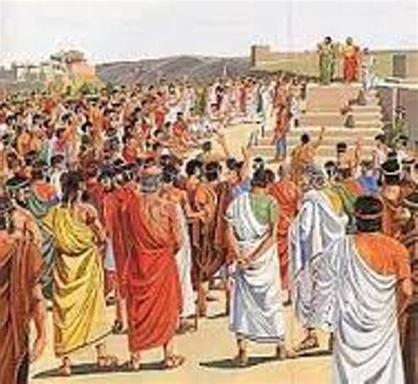
As a system of government, a DEMOCRACY only successfully worked on a small scale, like the Greek city-states that began to around 800 BC.

City-states were limited in size, as logistically, every citizen had to go to the marketplace everyday to discuss every issue face to face. It was very time consuming.

If a democracy grew larger than where citizens could travel the distance to the market everyday, power subtlety transferred to the busy-body messengers who carried news of the issues back and forth, and they could slant it any way they wanted.

Republics could grow larger than democracies, as citizens could spend their time taking care of their families and farms, and have representatives in their place go to the market everyday to discuss politics.

America’s republic is unique in that it has grown to have the most citizens of any republic in world history, as Theodore Roosevelt stated October 24, 1903: “In no other place and at no other time has the experiment of government of the people, by the people, for the people, been tried on so vast a scale as here in our own country.”

In the Roman Republic, “representatives” were hereditary positions.

The American Republic is a hybrid, where representatives are democratically elected.

A “constitutional” republic limits representatives with a set of rules approved by the citizens.

Where democracies are susceptible to being whipped into a frenzy, allowing a majority to carry out sudden mob justice, constitutional republics are slower to change, especially when they have the goal of guaranteeing to citizens’ their Creator-given rights.

America’s founders designed a government that was intentionally slow to change — frustratingly slow at times in making good changes, but thankfully slow in making irreversible bad changes.

The founders realized it could take a lifetime to build a mansion and one irresponsible match to burn it down in a day.

A signer of the Constitution James McHenry noted in his diary (American Historical Review, 1906), that after Ben Franklin left the Constitutional Convention, he was asked by Mrs. Elizabeth Powel of Philadelphia:

“Well, Doctor, what have we got, a republic or a monarchy?”

Franklin replied, “A republic, if you can keep it.”

The Amazing Tennyson

Alfred Lord Tennyson embellished the medieval legend of the Lady of the Lake who gave the sword Excalibur to the courageous young King Arthur.

Scenes of this were portrayed in Disney’s 1963 animated musical fantasy movie, The Sword in the Stone.

Born August 6, 1809, Alfred Lord Tennyson was the son of an Anglican clergyman.

As a young poet, Tennyson came to the attention of poet Samuel Taylor Coleridge (1772-1834).

Coleridge had written in “The Rime of the Ancient Mariner,” 1798:

“He prayeth best who loveth best, All things both great and small;

For the dear God who loveth us, He made and loveth all.”

In 1850, Tennyson married Emily Sellwood, to whom he had been engaged for a long time.

He wrote: “The peace of God came into my life before the altar when I wedded her.”

Alfred, Lord Tennyson also wrote: “Bible reading is an education in itself.”

Tennyson wrote in “Maud,” 1855, part II, sec. iv, st. 3:

“Oh, Christ, that it were possible, For one short hour to see, The souls we loved, that they might tell us, What and where they be.”

Tennyson’s In Memoriam, 1850, chapter XXVII, stanza 4, has the line:

“Tis better to have loved and lost, Than never to have loved at all.”

Tennyson wrote In Memoriam, 1850, chapter XXXI:

“When Lazarus left his charnel-cave, And home to Mary’s house returned, Was this demanded-if he yearned To hear her weeping by his grave?

“‘Where wert thou, brother, those four days?’ There lives no record of reply ,Which, telling what it is to die, Had surely added praise to praise.

“From every house the neighbors met, The streets were filled with joyful sound; A solemn gladness even crowned The purple brows of Olivet.

“Behold a man raised up by Christ; The rest remained unrevealed; He told it not, or something sealed The lips of that Evangelist.”

Queen Victoria once said: “Next to the Bible, In Memoriam is my comfort.”

Queen Victoria honored Alfred Lord Tennyson as Britain’s Poet-Laureate.

A line from Alfred Lord Tennyson’s poem In Memoriam is displayed in the Library of Congress in Washington, D.C., in the Jefferson Building’s Main Reading Room above the figure of History: “ONE GOD, ONE LAW, ONE ELEMENT, AND ONE FAR-OFF DIVINE EVENT, TO WHICH THE WHOLE CREATION MOVES.”

Tennyson was referred to by U.S. Supreme Court Justice David Josiah Brewer in his lecture “The Promise and Possibilities of the Future,” 1905: “Some think that we are mere atoms of matter tossed to and fro.

Speaker Reed once said great events of history were brought about by an intelligent and infinite Being.  If you will reflect a little you will be led to the conclusion that, as Tennyson writes ‘Through the ages one increasing purpose runs.'”

Justice Brewer continued:

“If there be a ‘purpose running’ through the life of the world, is it not plain that one thought in the divine plan was that in this Republic should be unfolded and developed in the presence of the world the Christian doctrine of the fatherhood of God and the brotherhood of man?”

Alfred Lord Tennyson echoed an older poet ,Sir Walter Scott (1771-1832), who wrote in “The Monastery,” 1830, chapter XII: “Oh, on that day, that wrathful day, When man to judgment wakes from clay, Be Thou, O Christ, the sinner’s stay Though heaven and earth shall pass away.”

Tennyson wrote in “Crossing the Bar,” 1889, st. 3: “I hope to see my Pilot face to face When I have crossed the bar.”

Alfred Lord Tennyson recorded the obedience and courage of the British Cavalry in the poem “The Charge of the Light Brigade,” which occurred during the Crimean War with Russia, 1853-1856.

Taking place on the north side of the Black Sea, over a million and a half fought, and a half-million died in the Crimean War.

The Siege of Sevastopol lasted eleven months. Sevastopol is a major port and the largest in Crimea. It fell to the British, French, and Italians from Italy’s Piedmont region, who were fighting on the side of the Muslim Ottoman Turkish Empire against Russia. Russia sank its entire fleet in order to block the entrance of the harbor.

A woman who cared for wounded soldiers during the Crimean War was Florence Nightingale. She was known as “The Lady with the Lamp,” as she made her rounds at night to check on injured soldiers. Florence Nightingale is considered to be the pioneer of the modern nursing profession and was an inspiration to Clara Barton, founder of the American Red Cross.

During the Crimean War, as the allies’ advance toward Sevastopol, the Battle of Balaclava took place October 25, 1854. A mistaken command sent the British cavalry riding headlong to their deaths, directly into the path of firing Russian cannons.

Tennyson wrote:

“Half a league, half a league, Half a league onward, All in the valley of DeathRode the six hundred. ‘Forward, the Light Brigade! ‘Charge for the guns!’ he said:Into the valley of Death Rode the six hundred.

‘Forward, the Light Brigade!’ Was there a man dismay’d Not tho’ the soldier knew Someone had blunder’d: Theirs not to make reply, Theirs not to reason why, Theirs but to do and die: Into the valley of Death Rode the six hundred.”

In 1936, Errol Flynn and Olivia de Havilland starred in the Warner Bros film The Charge of the Light Brigade.

After Russia lost the Crimean War, it feared Britain’s Hudson Bay Company would be tempted to expand its Canadian territory of British Columbia into Russian Alaska. To preempt this, Tsar Alexander II offered to sell Alaska to Prince Johann II of Liechtenstein in 1867, but he decline, thinking the land had no use. Russia then sold Alaska to the United States that same year.

Alaska has a unique history. Researchers have studied ancient DNA evidence which indicate a migration from eastern Siberia across the Bering Strait occurred either across a land bridge or frozen ice, an estimated 5,000 years ago. Immigrants then spread south across North America, Central America and South America. Inhabitants of Alaska, like those of Hawaii, the Pacific Islands, and other New World territories, had no gunpowder, cannons, or steel weapons. They spoke 300 different languages, none of which were written. This meant that at some point in time, any one of the global powers would attempt to colonization it.

Russian Tsar Peter the Great proposed mapping the Arctic coast of Northern Siberia.

In 1733, Danish explorer Vitus Bering, in the service of Russia, began his 6,000 mile expedition, crossing through the strait separating Asia and America, later named for him — Bering Strait.

In 1741, Bering’s men rowed a longboat and set foot on the shores of Alaska, claiming it for Russia.

In 1778, British Captain Cook sailed by Alaska and described the area of Anchorage. A statue of  Captain Cook marks the spot.

With Alaska’s furs being considered the finest in the world, Russian fur traders founded a trading post in 1799 called Fort Saint Sitka Michael the Archangel, present, Sitka Alaska.

Russia’s sale of Alaska to the United States was negotiated by William Henry Seward.

Seward had been Governor of New York, 1839-1843; U.S. Senator from New York, 1849-1861, and Secretary of State under Abraham Lincoln during the Civil War. Like Lincoln, Seward was an abolitionist Republican and stood strongly against the pro-slavery policies of the Democrat South.

As a result, the same night Lincoln was shot, an accomplice of John Wilkes Booth, Lewis Powell, broke into Seward’s home and attempted to assassinate him by repeatedly stabbing him in the neck. Providentially, nine days earlier, Seward had broken his jaw in a carriage accident. The doctors had devised a metal neck brace to hold his jaw in place, which deflected the assassin’s knife.

After the Civil war, Seward continued as Secretary of State under President Andrew Johnson, 1865-1869, during which time he negotiated the purchase of Alaska from Russia on March 30, 1867. It was the second largest land purchase in history, consisting of 586,412 square miles for $7.2 million — about two cents per acre.

The largest was the Louisiana Purchase from France of 828,000 square miles in 1803. The third largest was the Mexican Cession of 520,000 square miles in 1848.

Seward also pushed through the 1856 Guano Islands Act, allowing the U.S. to annex unclaimed islands with bird droppings, a source of fertilizer and an ingredient of gunpowder. One of islands Seward claimed was the Pacific Island of Midway, where in 1942, the U.S. won a battle which turned the course of the war with Imperial Japan.

Initially, Alaska was thought to be of no value, being referred to as Seward’s Folly. Only later, after Alaska was found to be rich in natural resources, was appreciation shown to Seward. The city of Seward on Alaska’s Resurrection Bay is named for him. A few years after Seward’s purchase, in 1870, gold began to be mined from placers (surface deposits) southeast of Juneau, Alaska.

In 1896, the Klondike Gold Rush began along the Yukon River. It drew an estimated 100,000 prospectors from Seattle, San Francisco and other American cities north. They populated the Alaskan cities of Juneau, Anchorage, Fairbanks, and the Canadian Dawson City.

William H, Seward stated in his oration, “The Destiny of America” (Columbus, Ohio, September 14, 1853): “Shall we look to the sacred desk? Yes, indeed; for it is of Divine institution, and is approved by human experience. The ministers of Christ, inculcating Divine morals, under Divine authority, with Divine sanction, and sustained and aided by special cooperating influences of the Divine Spirit, are now carrying further and broadly onward the great work of the renewal of the civilization of the world, and its emancipation from superstition and despotism.”

As vice-president of the American Bible Society, William Henry Seward stated in 1836: “I know not how long a republican government can flourish among a great people who have not the Bible; the experiment has never been tried; but this I do know: that the existing government of this country never could have had existence but for the Bible. And, further, I do, in my conscience, believe that if at every decade of years a copy of the Bible could be found in every family in the land its republican institutions would be perpetuated.”

Seward stated:

“I do not believe human society … ever have attained, or ever can attain, a high state of intelligence, virtue, security, liberty, or happiness without the Holy Scriptures; even the whole hope of human progress is suspended on the ever-growing influence of the Bible.”

Tennyson

Alfred Lord Tennyson referenced the Bible verse 1st Peter 5:7 when he wrote line 222 of the poem “Enoch Arden,” 1864:

“Cast all your cares on God; that anchor holds.”

Amen!

Pirates and Miracles in America

Yes, the British used pirates to help in their defense against the Spanish in the Caribbean , but up in the Colonies, the Americans were threatened by an enormous French fleet with over 13,000 soldiers aboard. It would have for sure have devastated and captured all the Colonies. However, one of the greatest miracles to ever, happened in America when the Colonists fasted a prayed desperately.  God immediately sent an enormous hurricane that wiped out the whole French fleet and caused plague to descend upon the survivors.  Do read about it below:

Ron

In 1655, British Admiral William Penn, the father of Pennsylvania’s founder, captured Jamaica from the Spanish. 

As Jamaica was too far from England be defended, inhabitants turned to privateers, freebooters, buccaneers and pirates for protection.

Port Royal, Jamaica, became a haven for the likes of Blackbeard, Calico Jack and Captain Henry Morgan.

With English, Portuguese, French and Dutch establishing bases in the Caribbean, Spain’s power was being challenged.

Spain’s most prosperous port in the New World was Porto Bello, Panama.

Spanish ships were loaded at Porto Bello with gold and silver from Peru, and then they set sail for Spain.

In 1668, English privateer Captain Henry Morgan and some 500 buccaneers attacked and captured Porto Bello.

They cruelly tortured the inhabitants to get them to surrender their treasures.

Captain Morgan demanded 100,000 pesos of silver and gold from the Spanish to ransom the inhabitants of the fort and its town.

The repercussions of this attack ended the tenuous cease-fire between Spain and England, renewing open hostilities.

In 1669, Captain Henry Morgan sacked the Spanish port of Maracaibo, Venezuela.

Sailing into Lake Maracaibo in search of more treasure, Morgan was almost trapped.

He sent forward a decoy ship filled with gunpowder, which exploded and destroyed a Spanish ship.

He then faked a land attack, causing the Spanish fort to reposition its cannons landward, allowing him to quickly sail past to the sea.

In 1671, Morgan again sacked Panama.

In 1731, a Spanish commander in the Caribbean detained an English ship.

He cut off the ear of the English Captain Robert Jenkins and told him to take it to his King. This began the War of Jenkins’ Ear.

British Admiral Edward Vernon recruited 400 American colonists, including Lawrence Washington, George Washington’s older half-brother. They sailed to Panama and captured the port city of Porto Bello.

British Admiral Edward Vernon also attacked Cartagena, Columbia, but was unable to capture it.

Lawrence Washington returned to Virginia as a 25-year-old war hero.

Lawrence served in Virginia’s assembly and militia, and named his farm “Mount Vernon” in honor of Admiral Edward Vernon.

After Lawrence died, George, at age 20, inherited Mount Vernon.

In 1742, the War of Jenkin’s Ear became combined with the War of Austrian Succession, which began when Marie Theresa became the first woman to take Austria’s throne.

This pulled Prussia and France into the war which because of intertwining treaties enlarged into a conflict called King George’s War in America.

The threat of war shook colonists in America out of complacency and contributed to the spread of the Great Awakening Revival.

The British took the French city of Louisbourg, Nova Scotia, in 1745, which had been the third busiest seaport in America, behind Boston and Philadelphia.

It also was New France’s second most important commercial city after Quebec.

France wanted Louisbourg back, so they sent Admiral d’Anville in 1746.

Admiral d’Anville set sail with the most powerful fleet of its day: 73 ships with 800 cannons and 13,000 troops.

D’Anville intended to: “expel the British from Nova Scotia, consign Boston to flames, ravage New England, and waste the British West Indies.”

Massachusetts Governor William Shirley declared a Day of Prayer and Fasting, October 16, 1746, to pray for deliverance.

Boston citizens gathered in the Old South Meeting House, where Rev. Thomas Prince prayed:

“Send Thy tempest, Lord, upon the water, scatter the ships of our tormentors!”

Historian Catherine Drinker Bowen related that as he finished praying, the sky darkened, winds shrieked and church bells rang. “a wild, uneven sound though no man was in the steeple.”

A violent hurricane scattered the entire French fleet from Canada to the Caribbean.

Lightning struck several ships, igniting gunpowder magazines, causing explosions and fire.

With 2,000 dead, including Admiral d’Anville, and 4,000 sick with typhoid, French Vice-Admiral d’Estournelle threw himself on his sword.

A historical marker near Louisbourg read:  “In the autumn of 1746 Duc d’Anville’s formidable but storm shattered expedition sent from France to recover Acadia, encamped along the shore.  Chebucto d’Anville died and many of his men fell victims of fever. Owing to the storms and disease, the Enterprise utterly failed. 

This great deliverance encouraged Ben Franklin to organized Pennsylvania’s first “volunteer” militia with 10,000 signing up.

This began Franklin’s career of public service, as he became the most popular person in the colony.

Ben Franklin also proposed a General Fast which was approved by Pennsylvania’s Council and published in the Pennsylvania Gazette, December 12, 1747:  “The calamities of a bloody war seem every year more nearly to approach us, and there is just reason to fear that unless we humble ourselves before the Lord and amend our ways, we may be chastised with yet heavier judgments.  We have thought fit to appoint a Day of Fasting & Prayer, exhorting all, both Ministers & People to join with one accord in the most humble & fervent supplications that Almighty God would mercifully interpose and still the rage of war among the nations & put a stop to the effusion of Christian blood.”

The threat of war was averted, Philadelphia was spared. Americans went on to fight in the French and Indian War, and in the Revolution to become a new nation.

George Whitefield & The Great Awakening Revival

There have been several great Christian revivals across America over the years.  However, none were as important as the one that just preceded the American Revolution and lasted on through it.  It was started and was led by the great George Whitefield who came over from England, obviously under the direction of God. Below is a brief account of that very important event in American history.  And let me say, that it is my opinion that we need another one now!

Ron

George Whitefield & The Great Awakening Revival

George Whitefield had attended Oxford with John and Charles Wesley, who began the Methodist revival movement within the Anglican Church.

In 1733, when he finally understood and believed the Gospel, George Whitefield exclaimed: “Joy-joy unspeakable-joy that’s full of, big with glory!”

Beginning in 1740, George Whitefield preached seven times in America. He spread the Great Awakening Revival, which helped unite the Colonies prior to the Revolutionary War.

Whitefield’s preaching stirred crowds with enthusiasm, which was criticized by the formal, established churches of the day.

When they closed their doors to him, Whitefield began preaching out-of-doors.

Crowds grew so large that no church could have held the number of people, sometimes being as large as 25,000.

Ben Franklin wrote in his Autobiography that George Whitefield’s voice could be heard over 500 feet away:  “He preached one evening from the top of the Court-house steps. Streets were filled with his hearers. I had the curiosity to learn how far he could be heard by retiring backwards down the street and found his voice distinct till I came near Front-street.”

Franklin continued his description of evangelist George Whitefield:  “Multitudes of all denominations attended his sermons. It was wonderful to see the change soon made in the manners of our inhabitants. From being thoughtless or indifferent about religion, it seemed as if all the world were growing religious, so that one could not walk thro’ the town in an evening without hearing psalms sung in different families of every street.”

At a time in history when most countries had established state religions which mandated doctrinal adherence, it was novel for Whitefield to champion in America freedom of conscience, for people to have the opportunity to make a voluntary choice to believe the Gospel.

This controversy was called “Old Lights,” who emphasized tradition, versus “New Lights,” who were open to a move of the Holy Spirit.

Sarah Edwards, the wife of Jonathan Edwards, wrote to her brother in New Haven concerning the effects George Whitefield’s ministry:  “It is wonderful to see what a spell he casts over an audience by proclaiming the simplest truths of the Bible.  Our mechanics shut up their shops, and the day laborers throw down their tools to go and hear him preach, and few return unaffected.”

George Whitefield was one of the first ministers to publicly preach the Gospel to slaves.

This profoundly influenced many preachers, such as Rev. Samuel Davies, and denominations, such as Baptists, Methodists and Quakers, to be inclusive of blacks.

A young black teenager named John Marrant heard Whitefield preach in Charleston, South Carolina. Marrant converted and went on to become one of America’s first black preachers, even preaching among Cherokee, in England and in Nova Scotia.

George Liele, a black slave in Georgia, heard a Great Awakening preacher. He converted and began preaching with such conviction that his master freed him. Liele founded one of America’s first black churches – Silver Bluff Baptist Church in Beach Island, South Carolina, 1773, and then became one of America’s first foreign missionaries, arriving in Jamaica in 1792.

George Whitefield advocated for the improvement of the treatment of slaves, though he sadly held the typical 18th century view which accommodated the institution of slavery.  It was not until 1770 that Pennsylvania Quaker Anthony Benezet pioneered the movement to abolish slavery by founding the Negro School at Philadelphia, and, in 1775, the Society for the Relief of Free Negroes Unlawfully Held in Bondage, of which Franklin became the president in 1785.

Benezet’s school was inspired by Whitefield, who had first proposed in 1739 that Philadelphia have a Charity School for blacks and poor orphan children.

Franklin later merged the Charity School with his newly formed Academy of Philadelphia.

Franklin helped finance the building of an auditorium for Whitefield to preach in, after which it became one of the first buildings of the Academy, which turned into the University of Pennsylvania.

For over a century, a bronze statue of George Whitefield has stood on Pennsylvania University’s campus, in the Dormitory Quadrangle near Ware College House.

In 2020, as part of the “cancel culture,” the University voted to remove the statue.

This tactic, also called “deconstruction,” is a process of intentionally separating a nation from its past in order to transition into a socialist future.

Deconstruction, or cancel culture, was part of:

  • The French Revolution tearing down the statue of Good King Henry IV, 1792, and publicly burning the remains of Ste. Genevieve, the Patron Saint of Paris, 1793;
  • Stalin’s changing the name of St. Petersburg to Leningrad, 1924;
  • Mao Zedung’s “Great Leap Forward,” 1953-1962, and “Cultural Revolution,” 1966-1976, which destroyed innumerable Chinese artifacts, including Beijing’s ancient Gate of China, and the Luoyang White Horse Temple–the oldest Buddhist temple in China.
  • Pol Pot’s Khmer’s Rouge in Cambodia, 1975-1979, which killed anyone who wore eye-glasses, since if they could read they knew history, which needed to be erased;
  • Taliban and ISIS, which destroyed ancient Assyrian and Buddhist statues and artifacts during Islamic jihad in Iraq and Syria, 2014-2016.

George Orwell wrote of this tactic in his socialist dystopian novel 1984:  “Every record has been destroyed or falsified, every book rewritten, every picture has been repainted, every statue and street building has been renamed, every date has been altered.  Nothing exists except an endless present in which The Party is always right.”

George Whitefield’s preaching and the Great Awakening Revival resulted in the founding of many respected American universities, such as:

  • Princeton,
  • Brown,
  • Dartmouth,
  • Rutgers and
  • Columbia

Franklin printed Whitefield’s journal and sermons. Being Postmaster in Philadelphia, Franklin helped spread Whitefield’s sermons through colonial America.

In one sermon, George Whitefield proclaimed:  “Never rest until you can say, ‘the Lord our righteousness.’ Who knows but the Lord may have mercy, nay, abundantly pardon you? Beg of God to give you faith; and if the Lord give you that, you will by it receive Christ, with his righteousness, and his all. None, none can tell, but those happy souls who have experienced it with what demonstration of the Spirit this conviction comes.”

Whitefield continued: “Oh, how amiable, as well as all sufficient, does the blessed Jesus now appear! With what new eyes does the soul now see the Lord its righteousness! Brethren, it is unutterable. Those who live godly in Christ, may not so much be said to live, as Christ to live in them. They are led by the Spirit as a child is led by the hand of its father. They hear, know, and obey his voice. Being born again in God they habitually live to, and daily walk with God.”

George Whitefield’s influence was so profound, that when there was a threatened war with Spain and France, Ben Franklin drafted and printed a General Fast for Pennsylvania, December 12, 1747:

“As the calamities of a bloody War, in which our Nation is now engaged, seem every Year more nearly to approach us there is just reason to fear that unless we humble ourselves before the Lord & amend our Ways, we may be chastised with yet heavier Judgments. We have, therefore, thought fit to appoint the seventh Day of January next, to be observed throughout this Province as a Day of Fasting & Prayer, exhorting all to join with one accord in the most humble & fervent Supplications;

That Almighty God would mercifully interpose and still the Rage of War among the Nations & put a stop to the effusion of Christian Blood.”

In 1752, George Whitefield wrote to Benjamin Franklin, who had invented the lightning rod:

“My Dear Doctor I find that you grow more and more famous in the learned world.”

In 1764, George Whitefield received a letter from Benjamin Franklin, in which Franklin ended with the salutation:  “Your frequently repeated Wishes and Prayers for my Eternal as well as temporal Happiness are very obliging. I can only thank you for them, and offer you mine in return.”

Franklin wrote to Whitefield:  “I sometimes wish you and I were jointly employed by the Crown to settle a colony on the Ohio, a strong body of religious and industrious people!  Might it not greatly facilitate the introduction of pure religion among the heathen, if we could, by such a colony, show them a better sample of Christians than they commonly see in our Indian traders?”

In 1769, Whitefield wrote Franklin on the night before his last trip to America.

In this last surviving letter, Whitefield shares his desire that both he and Franklin would:

“Be in that happy number of those who is the midst of the tremendous final blaze shall cry Amen.”

Whitefield founded an orphanage in Georgia.

He left it to Selina Shirley, the Countess of Huntingdon, who had financially helped both Whitefield and John Wesley in the spread of Methodism.

She financed the construction of 64 chapels in Wales and England, supported missions in Sierra Leone, Africa, and was the first female principal of Trefeca College in Wales, which educated Methodist ministers.

The Countess of Huntingdon was patron of the famous black female poet, Phillis Wheatley.

Phillis Wheatley corresponded with John Newton, author of the song Amazing Grace, and General George Washington, who was so impressed with her writing that he met with her at his headquarters in Cambridge.

George Whitefield died September 30, 1770.

As he was dying, he declared:  “How willing I would ever live to preach Christ! But I die to be with Him!”

The famous black poet, Phillis Wheatley, wrote in her poem, “On the Death of the Rev. Mr. George Whitefield,” (1770):

“HAIL, happy saint, on thine immortal throne, Possest of glory, life, and bliss unknown; We hear no more the music of thy tongue, Thy wonted auditories cease to throng. Thy sermons in unequall’d accents flow’d, And ev’ry bosom with devotion glow’d; Thou didst in strains of eloquence refin’d Inflame the heart, and captivate the mind. Unhappy we the setting sun deplore, So glorious once, but ah! it shines no more. Behold the prophet in his tow’ring flight! He leaves the earth for heav’n’s unmeasur’d height, And worlds unknown receive him from our sight. There Whitefield wings with rapid course his way, And sails to Zion through vast seas of day. Thy pray’rs, great saint, and thine incessant cries Have pierc’d the bosom of thy native skies. Thou moon hast seen, and all the stars of light, How he has wrestled with his God by night. He pray’d that grace in ev’ry heart might dwell, He long’d to see America excel; He charg’d its youth that ev’ry grace divine Should with full lustre in their conduct shine; That Saviour, which his soul did first receive, The greatest gift that ev’n a God can give, He freely offer’d to the num’rous throng, That on his lips with list’ning pleasure hung. Take him, ye wretched, for your only good, Take him ye starving sinners, for your food; Ye thirsty, come to this life-giving stream, Ye preachers, take him for your joyful theme; Take him my dear Americans, he said, Be your complaints on his kind bosom laid: Take him, ye Africans, he longs for you, “Impartial Saviour is his title due: Wash’d in the fountain of redeeming blood, You shall be sons, and kings, and priests to God. Great Countess, we Americans revere Thy name, and mingle in thy grief sincere; New England deeply feels, the Orphans mourn, Their more than father will no more return. But, though arrested by the hand of death, Whitefield no more exerts his lab’ring breath, Yet let us view him in th’ eternal skies, Let ev’ry heart to this bright vision rise; While the tomb safe retains its sacred trust, Till life divine re-animates his dust.”

In one of his sermons, George Whitefield declared:  “Would you have peace with God?Away, then, to God through Jesus Christ, who has purchased peace; the Lord Jesus has shed his heart’s blood for this.  He died for this; he rose again for this; he ascended into the highest heaven, and is now interceding at the right hand of God.”

The Real War of 1812

Yes, we defeated the British in the Revolutionary War, but they were not satisfied with the result.  They came back in 1812 and tried to regain territory from what was now the United States.  They burned Washington D.C. and won other confrontations.  They put a fleet of ships onto Lake Erie that dominated that part of the country.  However, the United States constructed a fleet of ships of is own in a bay at Presque Isle on Lake Erie.  28 year old Captain Oliver Hazard Perry was put in command of this American fleet to face the powerful British ships.  In their first real confrontation the long range British cannon shot Captain Perry’s flag ship the USS Lawrence all to pieces, killing 80% of his crew and damaging every gun. 

But Perry did not give up.  He and his remaining crew rowed in their life boats half a mile under heavy fire to the USS Niagara from which they could fight again. In what many called a “direct act of God” these experienced British sailors on the two largest British ships managed the get them entangled with each other, making them helpless.  Captain Perry sailed down the British line and wiped out the whole British fleet.  It was the first time in history that an entire British fleet had been wiped out in one engagement.  The British summoned the Duke of Wellington to come and finish of the Americans, but he said that without control of Lake Erie, it was impossible.  So, he sailed the whole British army back to Europe in defeat.  If you would like to read the details of all this, I have provided them below:

 1811, Britain began to intercept American ships headed to French ports.

They seized American goods and impressed thousands of American sailors into the British navy.

With Napoleon conquering Europe, Britain secretly harbored thoughts of re-acquiring some of the area it had lost to the United States.

The British Government, as it had done during the Revolutionary War, supplied weapons to Indians and incited them to terrorize and attack American frontier settlements.

In alliance with the British, Shawnee Chief Tecumseh approached many tribes across a thousand-mile frontier in an attempt to form a confederation.

In the Shawnee language, the name “Tecumseh” means “shooting star.”

The appearance of the Great Comet of 1811, which reached its brightest in October, added to the panic.

This was followed by the New Madrid Earthquakes, December 16, 1811 to February 7, 1812, which was the greatest earthquake recorded in North America.

It was felt hundreds of miles away, and even temporarily reversed the flow of the Mississippi River.

The fear associated with these events contributed to Tecumseh raising nearly 5,000 warriors under his direction.

Some were Shawnee, who had been forced from the east and resettled in northwestern Ohio and Northeastern Indiana; and Lenape who had resettled in south-central Indiana.

Others were from:

• Miami in central Indiana;

• Pottawatomie in northern Indiana and Michigan;

• Wea, Kickapoo and Piankeshaw in western Indiana and eastern Illinois;

• Sauk in northern Illinois;

• Iroquois in Canada;

• Chickamauga; Ojibway; Mascouten; Wyandot; Fox; Winnebago; Ottowa; Mingo; Seneca; and Red Stick Creek in Alabama.

On July 17, 1812 British and Native American tribes captured Fort Mackinac.

On August 15, 1812, Pottawatomie attacked Fort Dearborn, massacring 38 American soldiers, 2 women, 12 children, and took 41 prisoners.

The British with Native American allies threatened or captured American forts:

• Fort Osage;

• Fort Madison;

• Fort Shelby;

• Rock Island Rapids;

• Credit Island;

• Fort Johnson;

• Fort Cap au Gris; and

• won the Battle of the Sink Hole.

700 British regulars and Canadian militia joined Tecumseh’s warriors in the capture of Fort Detroit, forcing 2,500 Americans to surrender August 16, 1812.

With a rumor British would pay in gold for American scalps, over 500 Americans were massacred by the Red Stick Creeks in Fort Mims, Alabama, August 30, 1813.

On July 23, 1813, President James Madison recommended a day of Public Humiliation and Prayer:

“Whereas in times of public calamity such as that of the war brought on the United States by the injustice of a foreign government, it is especially becoming that the hearts of all should be touched with the same feelings and the eyes of all be turned to that Almighty Power in whose hands are the welfare and the destiny of nations:

I do therefore recommend to all who shall be piously disposed to unite their hearts and voices in addressing at one and the same time their vows and adorations to the Great Parent and Sovereign of the Universe that they assemble on the SECOND THURSDAY OF SEPTEMBER next (September 9th) in their respective religious congregations.”

Madison continued:

“He has blessed the United States with a political Constitution rounded on the will and authority of the whole people and guaranteeing to each individual security, not only of his person and his property, but of those sacred rights of conscience so essential to his present happiness and so dear to his future hopes.

And with supplications to the same Almighty Power that He would look down with compassion on our infirmities, that He would pardon our manifold transgressions and awaken and strengthen in all the wholesome purposes of repentance and amendment; that in this season of trial and calamity He would inspire all citizens with a love of their country; that as He was graciously pleased heretofore to smile on our struggles against the attempts of the Government of the (British) Empire; so He would now be pleased to bestow His blessing on our arms in resisting the hostile and persevering efforts of the same power to degrade us on the ocean.”

The United States had no navy on Lake Erie.

Captain Daniel Dobbins convinced President Madison of the need of a fleet on the Lake.

Ship building supplies from Buffalo, Cleveland, Meadville, and Pittsburgh were brought to Erie, Pennsylvania, where his ships were assembled in the bay surrounded by the peninsula called Presque Isle.

Carronades (short cast-iron cannons) for the ships were made at Henry Foxall’s foundry in Georgetown.

Carronades (short cast-iron cannons) for the ships were made at Henry Foxall’s foundry in Georgetown.

Foxall reportedly promised that, if America won the War of 1812, he would build a church, which he did — Foundry United Methodist Church on 16th Street, established in 1814.

As there was no pitch on the Isle, lead was used to caulk the ships’ hulls.

It was called the Fleet of the Wilderness.

28-year-old Captain Oliver Hazard Perry was put in command of the fleet, with many of his crew being free Blacks from Ohio.

Overcoming a bout of “lake fever” (typhoid), he waited for the right opportunity to bring his ships into the Lake, as he was constantly being watched by the British fleet in the distance.

Called “Perry’s Luck”, on July 31, 1813, British General Barclay accepted a dinner invitation from the citizens of Port Dover and sailed his five ships away.

Perry quickly took advantage of this providential break and worked all night.

His 5 schooners, 3 brigs and 1 sloop, were unloaded of everything heavy, then floated across the six-foot deep sand bar where Presque Isle Bay emptied into Lake Erie.

He sailed his nine ships approximately 150 miles to Put-in-Bay on South Bass Island, where he began a blockade of the British ships at Fort Malden on the Detroit River at Amherstburg, Ontario.

Perry’s presence on the Lake prevented British ships from bringing food and supplies to Amherstburg.

Perry’s crew of nearly 500 men at South Bass Island were falling ill.

A severe algae bloom on the Lake made the water undrinkable.

It was considered as a providential gift from God, that a cave was discovered on the island where 52 feet below the surface, there was found a rare subterranean lake containing an abundance of fresh water.

British forces at Fort Malden in Amherstburg were in desperate need of food.

British Commodore Robert Barclay attempted to break Perry’s blockade with a squadron of six ships.

Barclay was a decorated British officer who had his arm blown off fighting Napoleon’s French fleet.

The day after the National Day of Prayer recommended by President Madison, Captain Oliver Hazard Perry confronted the British squadron on September 10, 1813.

Strong winds prevented Perry from getting into a safe position.

Long-range British cannons splintered Perry’s flagship, the USS Lawrence, to pieces, killing or wounding 80 percent of the Lawrence’s crew, leaving every gun damaged.

Faithful to his battle flag, “DON’T GIVE UP THE SHIP,” Perry and his men did not give up.

They courageously boarted their life boats, and rowed a half mile through heavy gunfire to the USS Niagara from which they could fight again.

The wind suddenly changed directions.

Two British ships, HMS Detroit and HMS Queen Charlotte, attempted to maneuver and turn about, but in the process collided and became entangled, sitting helplessly in the water.

Perry sailed broadside directly across the British line, firing every cannon continuously.

After 15 minutes, the smoke cleared to reveal that all of Barclay’s ships had been disabled.

This was the first time in history that an entire British naval squadron had been disabled at one time.

To the sailors on deck Captain Perry remarked:

“The prayers of my wife are answered.”

That same day, Captain Oliver Hazard Perry sent a dispatch to U.S. Major General William Henry Harrison:

“Dear Gen’l, WE HAVE MET THE ENEMY, AND THEY ARE OURS, two ships, two brigs, one schooner and one sloop. Yours with great respect and esteem. H. Perry.”

Captain Oliver Hazard Perry wrote to the Secretary of the Navy:

“It has pleased the Almighty to give the arms of the United States a signal victory over their enemies on this lake.

The British squadron, consisting of two ships, two brigs, one schooner, and one sloop have this moment surrendered to the force of my command after a sharp conflict.”

The British summoned the Duke of Wellington to recapture western Canada, but Wellington refused, stating that without naval control of Lake Erie, it would be impossible.

(Two years later the Duke of Wellington defeated Napoleon at the Battle of Waterloo, June 18, 1815.)

President James Madison stated in his 5th Annual Message, December 7, 1813:

“It has pleased the Almighty to bless our arms. On Lake Erie, the squadron under the command of Captain Perry having met the British squadron of superior force, a sanguinary (bloody) conflict ended in the capture of the whole.”

As a result of Perry’s victory, the British abandoned Fort Malden.

Major General William Henry Harrison was then able to recapture Fort Detroit and defeat the British and their Indian ally Shawnee Chief Tecumseh at the Battle of the Thames, October 5, 1813.

This was decisive in securing for the United States the Northwest Territory, from which eventually six states were formed.

Captain Oliver Hazard Perry died August 23, 1819, being hailed as a national hero for his victorious role in the War of 1812.

It was reported that near the end of the Revolutionary War, when Benjamin Franklin was informed that Americans had won independence, he remarked: “Sir, you mean the Revolution, the War of Independence is yet to come.”

After Perry’s Battle of Lake Erie, together with the American’s victory in the War of 1812, the United States could finally claim to have won independence.

Jefferson and Adams

Both men were the authors of our Declaration of Independence.  They both died on the very same day, July 4th, exactly 50 years from the date of its signing. That God should have opened the doors of Heaven and ushered in these two devout men together on this auspicious occasion, seems to be beyond just chance.  

Ron                             

Both served in the Continental Congress.

Both signed the Declaration of Independence.

Both served as U.S. Ministers in France.

Both were U.S. Presidents, one elected the 2nd President and the other the 3rd.

 Once political enemies, they became close friends in later life.

An awe swept America when they both died on the same day, JULY 4, 1826, exactly 50 years since they approved the Declaration of Independence.
Their names were John Adams and Thomas Jefferson.
Thomas Jefferson’s handwritten Declaration of Independence used the wording “inalienable rights” as seen in the copies at the American Philosophical Society in Philadelphia, the New York Public Library, and the Massachusetts Historical Society in Boston.

John Adams hand copied Jefferson’s original draft and changed the spelling to “unalienable rights” when he oversaw the printing of the Declaration on the Dunlap broadside.
The Broadway musical 1776 even has a scene portraying their disagreement over the spelling.

According to The American Heritage Guide to Contemporary Usage and Style (Houghton Mifflin Co.), “unalienable” and “inalienable” both mean: “That which cannot be given away or taken away.”

John Quincy Adams, son of John Adams, was the 6th President at the time and told Congress, December 5, 1826: “Since your last meeting at this place, the 50th anniversary of the day when our independence was declared, two of the principal actors in that solemn scene — the HAND that penned the ever-memorable Declaration and the VOICE that sustained it in debate, were by one summons, at the distance of 700 miles from each other, called before the Judge of All to account for their deeds done upon earth.”

John Quincy Adams wrote in an Executive Order, July 11, 1826: “A coincidence so wonderful gives confidence that the patriotic efforts of these men were Heaven directed, and furnishes a new … hope that the prosperity of these States is under the special protection of a kind Providence.”

Daniel Webster stated at Fanuel Hall in Boston, August 2, 1826: “But the concurrence of their death on the anniversary of Independence has naturally awakened stronger emotions.
Both had been President, both had lived to great age, both were early patriots, and both were distinguished and ever honored by their immediate agency in the act of independence. 
It cannot but seem striking and extraordinary, that these two should live to see the fiftieth year from the date of that act that they should complete that year and that then, on the day which had fast linked forever their own fame with their country’s glory, the heavens should open to receive them both at once.
As their lives themselves were the gifts of Providence, who is not willing to recognize in their happy termination, as well as in their long continuance, proofs that our country and its benefactors are objects of His care?”

Defending the Declaration, John Adams told the Continental Congress, July 1, 1776:  “Before God, I believe the hour has come when all that I have, and all that I am, and all that I hope in this life, I am now ready here to stake upon it.

Live or die, survive or perish, I am for the Declaration. It is my living sentiment, and by the blessing of God it shall be my dying sentiment. Independence now, and Independence forever!”

John Adams stated, June 21, 1776: “Statesmen, my dear Sir, may plan and speculate for liberty, but it is Religion and Morality alone, which can establish the principles upon which Freedom can securely stand. The only foundation of a free Constitution is pure Virtue, and if this cannot be inspired into our People … they may change their Rulers and the forms of Government, but they will not obtain a lasting liberty.”

In 1819, John Adams wrote to Jefferson:  “Have you ever found in history, one single example of a nation thoroughly corrupted that was afterwards restored to virtue?  And without virtue, there can be no political liberty. Will you tell me how to prevent luxury from producing effeminacy, intoxication, extravagance, vice and folly?  No effort in favor of virtue is lost.

The Jefferson Memorial has a warning from Jefferson: “God who gave us life gave us liberty.

Can the liberties of a nation be secure when we have removed a conviction that these liberties are the gift of God?
Indeed, I tremble for my country when I reflect that God is just, that his justice cannot sleep forever.”

Inscribed on the Jefferson Memorial on the south banks of Washington D.C.’s Tidal Basin, are Jefferson’s words:

“Almighty God hath created the mind free.
All attempts to influence it by temporal punishments or burdens are a departure from the plan of the Holy Author of our religion.
No man shall otherwise suffer on account of his religious opinions or belief, but all men shall be free to profess and by argument to maintain, their opinions in matters of religion.”

After Abigail Adams died in 1818, John wrote to Jefferson: “I do not know how to prove physically, that we shall meet and know each other in a future state; nor does Revelation, as I can find, give us any positive assurance of such a felicity.

My reasons for believing it, as I do most undoubtedly, are that I cannot conceive such a Being could make such a species as the human, merely to live and die on this earth.
If I did not believe in a future state, I should believe in no God. This Universe, this all would appear, with all of its swelling pomp, a boyish firework.
And if there be a future state, why should the Almighty dissolve forever all the tender ties which unite us so delightfully in this world, and forbid us to see each other in the next?”

Jefferson replied, assuring Adams: “It is of some comfort to us both that the term is not very distant at which we are to deposit, in the same cerement, our sorrows and suffering bodies, and to ascend in essence to an ecstatic meeting with the friends we have loved & lost and whom we shall still love and never lose again.”

Jefferson described Adams as:  “The pillar of the Declaration’s support on the floor of Congress, its ablest advocate and defender.”

John Adams’ last words were:  “Thank God, Jefferson lives!”

In his last letter, Jefferson reiterated his rejection of overpowering government, as he told Roger C. Weightman, June 24, 1826: “The mass of mankind has not been born with saddles on their backs, nor a favored few booted and spurred, ready to ride them.”

Calvin Coolidge, the only President born on July 4th, stated at the 150th Anniversary of the Declaration of Independence, 1926:

“The principles which went into the Declaration of Independence are found in the sermons of the early colonial clergy who were earnestly undertaking to instruct their congregations in the great mystery of how to live.They preached equality because they believed in the fatherhood of God and the brotherhood of man.They justified freedom by the text that we are all created in the divine image. This preaching reached the neighborhood of Thomas Jefferson, who acknowledged that his ‘best ideas of democracy’ had been secured at church meetings.”

An item of interest is that five years after Adams and Jefferson died, the fifth President James Monroe, died on JULY 4, 1831.

James Monroe stated in his Eighth Annual Message to Congress, December 7, 1824:
“For these blessings we owe to Almighty God, from whom we derive them, and with profound reverence, our most grateful and unceasing acknowledgments.
Having commenced my service in early youth, and continued it since with few and short intervals, I have witnessed the great difficulties to which our Union has been exposed, and admired the virtue and intelligence with which they have been surmounted.
That these blessings may be preserved and perpetuated will be the object of my fervent and unceasing prayers to the Supreme Ruler of the Universe.”

C.S. Lewis

Below is a short synopsis of the life of this great man. His death went unnoticed, as he died the same day John F. Kennedy was shot.
His books are some of the most widely read in English literature, with over 200 million sold worldwide. Nearly 50 years after his death, his books continue to sell a million copies every year.  If you decide to read this about him, it will help you to know that it is written in three sections:  The first is Lewis as an atheist.  The second are thoughts about God as expressed by some of his very famous friends.  The third are thoughts of Lewis, himself after he found the Real God.

Ron

His name was Clive Staples Lewis, born November 29, 1898.

At age 19, he fought in the trenches in World War I.

After the War, C.S. Lewis taught at Magdalen College, Oxford, 1925-54; and was professor of Medieval and Renaissance English at Cambridge University, 1954-1963.

Originally an agnostic, C.S. Lewis credited his Catholic colleague at Oxford, J.R.R. Tolkien, whom he met in 1926, as being instrumental in his coming to faith in Jesus Christ.

J.R.R. Tolkien wrote The Hobbit, 1937, and Lord of the Rings, 1937-1949, which is one of the best-selling novels ever written, with over 150 million copies sold.

C.S. Lewis’ writing style was influenced by George MacDonald, a writer and Christian minister.

MacDonald’s fantasy literature pioneered an entire genre, influencing:

• Lewis Carroll, who wrote Alice’s Adventures in Wonderland, 1865;
• L. Frank Baum, who wrote The Wizard of Oz, 1900; and
• J.R.R. Tolkien, The Hobbit, and The Lord of the Rings, 1937.

C.S. Lewis regarded MacDonald a”master,” stating:
“Picking up a copy of Phantastes (1858) one day at a train-station bookstall, I began to read. A few hours later, I knew that I had crossed a great frontier.”

G.K. Chesterton cited George MacDonald’s The Princess and the Goblin (1872) as a book that had “made a difference to my whole existence.”

George MacDonald wrote:

• “There are things that must be done in faith, else they never have being.”
• “Faith is that which, knowing the Lord’s will, goes and does it; or, not knowing it, stands and waits, content in ignorance as in knowledge, because God wills — neither pressing into the hidden future, nor careless of the knowledge which opens the path of action.”
• “Doubts are the messengers of the Living One to be honest. They are the first knock at our door of things that are not yet, but have to be, understood.  Doubts must precede every deeper assurance; for uncertainties are what we first see when we look into a region hitherto unknown, unexplored, unannexed.”
• “The principle part of faith is patience.”
• “A perfect faith would lift us absolutely above fear.”
• “All about us, in earth and air, wherever the eye or ear can reach, there is a power ever breathing itself forth in signs, now in daisy, now in a wind-waft, a cloud, a sunset; a power that holds constant and sweetest relation with the dark and silent world within us. The same God who is in us, and upon whose tree we are the buds, if not yet the flowers, also is all about us inside, the Spirit; outside, the Word. And the two are ever trying to meet in us.”
• “If we do not die to ourselves, we cannot live to God, and he that does not live to God, is dead.”
• “Any faith in Him, however small, is better than any belief about Him, however great.”

C.S. Lewis was also influenced by Gilbert Keith Chesterton’s book, The Everlasting Man (1925), written in rebuttal of H.G. Wells’ The Outline of History.

                  Chesterton

Lewis explained:
“The best popular defense of the full Christian position I know is G.K. Chesterton’s The Everlasting Man.”

Chesterton wrote in The Everlasting Man, 1925:

“Nobody can imagine how nothing could turn into something. Nobody can get an inch nearer to it by explaining how something could turn into something else.  

It is really far more logical to start by saying ‘In the beginning God created heaven and earth’ even if you only mean ‘In the beginning some unthinkable power began some unthinkable process.’
For God is by its nature a name of mystery, and nobody ever supposed that man could imagine how a world was created any more than he could create one. 

But evolution really is mistaken for explanation. It has the fatal quality of leaving on many minds the impression that they do understand it and everything else.”

He continued:
“I do not believe that the past is most truly pictured as a thing in which humanity merely fades away into nature, or civilization merely fades away into barbarism, or religion fades away into mythology, or our own religion fades away into the religions of the world.  

In short I do not believe that the best way to produce an outline of history is to rub out the lines.”

Again, G.K. Chesterton wrote in The Everlasting Man,1925:
“If there is one fact we really can prove, from the history that we really do know, it is that despotism can be a development, often a late development and very often indeed the end of societies that have been highly democratic.  

A despotism may almost be defined as a tired democracy.  As fatigue falls on a community, the citizens are less inclined for that eternal vigilance which has truly been called the price of liberty; and they prefer to arm only one single sentinel to watch the city while they sleep.”

Chesterton added:
“As for the general view that the Church was discredited by the War, they might as well say that the Ark was discredited by the Flood.  

When the world goes wrong, it proves rather that the Church is right.  The Church is justified, not because her children do not sin, but because they do.”
G.K. Chesterton continued:
“Christendom has had a series of revolutions and in each one of them Christianity has died.  

Christianity has died many times and risen again; for it had a God who knew the way out of the grave.”

In 2021, the movie was released titled The Most Reluctant Convert — The Untold Story of C.S. Lewis.

In the movie Lewis described how he resisted believing, “kicking, struggling, resentful, and darting his eyes in every direction for a chance to escape,” as he wrote in Surprised by Joy, 1955.

How finally, in 1929, he came to believe in God:

“You must picture me alone in that room in Magdalen (College, Oxford) night after night, feeling, whenever my mind lifted even for a second from my work, the steady, unrelenting approach of Him whom I so earnestly desired not to meet.
That which I greatly feared had at last come upon me.

In the Trinity Term of 1929 I gave in, and admitted that God was God, and knelt and prayed: perhaps, that night, I was the most dejected and reluctant convert in all England.”

In 1931, after a late-night discussion with J.R.R. Tolkien and Hugo Dyson about faith in Jesus Christ, C.S. Lewis described his deepening spiritual journey in Surprised by Joy:
“I know very well when, but hardly how, the final step was taken.  

I was driven to Whipsnade zoo one sunny morning on one of those double-decker English buses.  When we set out I did not believe that Jesus Christ is the Son of God, and when we reached the zoo I did.

Yet I had not exactly spent the journey in thought. Nor in great emotion. ‘Emotional’ is perhaps the last word we can apply to some of the most important events.  

It was more like when a man, after long sleep, still lying motionless in bed, becomes aware that he is now awake.  And it was, like that moment on top of the bus, ambiguous.  Freedom, or necessity?  Or do they differ at their maximum? At that maximum a man is what he does; there is nothing of him left over or outside the act.

Among C.S. Lewis’ most notable books are:
• The Problem of Pain, 1940;
• The Screwtape Letters, 1942;
• Abolition of Man, 1943;
• Miracles, 1947; and
• The Chronicles of Narnia, 1950-1956, which includes: The Lion, Witch and Wardrobe.

C.S. Lewis stated, speaking in The Oxford Socratic Club (1944. pp. 154-165):

“If I swallow the scientific cosmology as a whole, then not only can I not fit in Christianity, but I cannot even fit in science.  

If minds are wholly dependent on brains, and brains on bio-chemistry, and bio-chemistry (in the long run) on the meaningless flux of atoms, I cannot understand how the thought of those minds should have any more significance than the sound of the wind in the trees.”

Someone who attended C.S. Lewis’ lectures at Cambridge was Oxford mathematician John C. Lennox, who stated: 
“God to me is the explanation for the miracle of existence – why there is something rather than nothing  The apostle Paul says what many pioneers of modern science believed that nature itself is part of the evidence for the existence of God.  

Indeed, faith is a response to evidence (That) clever mathematical laws all by themselves bring the universe and life into existence, is pure fiction. To call it science-fiction would besmirch the name of science.

  To the majority of those who have reflected deeply and written about the origin and nature of the universe, it has seemed that it points beyond itself to a source which is non-physical and of great intelligence and power.”

Cambridge biochemist Rupert Sheldrake, author of Morphic Resonance: The Nature of Formative Causation, 2009, remarked in a TEDx Talk (Whitechapel, 1/12/13) “The Science Delusion”:

“As (ethnobotanist) Terence McKenna used to say, ‘Modern science is based on the principle, “Give us one free miracle and we’ll explain the rest.  And the one free miracle is the appearance of all the matter and energy in the universe, and all the laws that govern it, from nothing in a single instant.”

Nobel Prize winning physicist Eugene Wigner wrote in The Unreasonable Effectiveness of Mathematics in the Natural Sciences,1960:

“It is difficult to avoid the impression that a miracle confronts us here or the two miracles of the existence of laws of nature and of the human mind’s capacity to divine them.”

Frank Turek and Norman Geisler published the book, I Don’t Have Enough Faith to be an Atheist (2004), pointing out the irrationality of believing in nothing and the rationality of believing in a Creator.  Hebrews 11:3 states:  

“Through faith we understand that the worlds were framed by the word of God, so that things which are seen were made of things which do not appear.”

English poet William Cowper wrote:
“Nature is but a name for an effect, Whose cause is God.”

Danish poet Hans Christian Andersen said: 
“The whole world is a series of miracles, but we’re so used to them we call them ordinary things.”

In The Problem of Pain, Lewis wrote:

“The human spirit will not even begin to try to surrender self-will as long as all seems to be well with it.  

Now error and sin both have this property, that the deeper they are the less their victim suspects their existence; they are masked evil.  Pain is unmasked, unmistakable evil; every man knows that something is wrong when he is being hurt.  God whispers to us in our pleasures, speaks in our conscience, but shouts in our pains: it is His megaphone to rouse a deaf world.  No doubt pain as God’s megaphone is a terrible instrument; it may lead to final and unrepented rebellion.  But it gives the only opportunity the bad man can have for amendment, it removes the veil; it plants the flag of truth within the fortress of the rebel soul. Suffering is not good in itself. What is good in any painful experience is, for the sufferer, his submission to the will of God.  If tribulation is a necessary element in redemption, we must anticipate that it will never cease till God sees the world to be either redeemed or no further redeemable.”

In Mere Christianity, 1952, C.S. Lewis wrote:

“All that we call human history – money, poverty, ambition, war, prostitution, classes, empires, slavery – is the long terrible story of man trying to find something other than God which will make him happy.”

Lewis expressed in Mere Christianity, 1952:

“I am trying here to prevent anyone saying the really foolish thing that people often say about Him: ‘I’m ready to accept Jesus as a great moral teacher, but I don’t accept his claim to be God.’  

That is the one thing we must not say.  A man who was merely a man and said the sort of things Jesus said would not be a great moral teacher.  He would either be a lunatic – on the level with the man who says he is a poached egg, or else he would be the Devil of Hell.

You must make your choice.  Either this man was, and is, the Son of God, or else a madman or something worse.  You can shut him up for a fool, you can spit at him and kill him as a demon or you can fall at his feet and call him Lord and God, but let us not come with any patronizing nonsense about his being a great human teacher.  He has not left that open to us. He did not intend to.”

In The Screwtape Letters, 1942, Lewis wrote:
“The safest road to Hell is the gradual one, the gentle slope, soft underfoot, without sudden turnings, without milestones, without signposts.”

In the final chapter of The Abolition of Man, 1943, Lewis warned:

“I am very doubtful whether history shows us one example of a man who, having stepped outside traditional morality and attained power, has used that power benevolently.”

and C.S. Lewis wrote:
• “There are two kinds of people: those who say to God, ‘Thy will be done,’ and those to whom God says, ‘All right, then, have it your way.'”
• “If I find in myself desires which nothing in this world can satisfy, the only logical explanation is that I was made for another world.”
• “Everyone says forgiveness is a lovely idea, until they have something to forgive.”
• “Relying on God has to begin all over again every day as if nothing had yet been done.”

Lewis wrote:
“Christianity is a religion you could not have guessed.  

It is not the sort of thing anyone would have made up.  It has just that queer twist about it that real things have.”

In Mere Christianity, 1942, C.S. Lewis wrote:

“God made us: invented us as a man invents an engine.  

A car is made to run on petrol, and it would not run properly on anything else.  Now God designed the human machine to run on Himself.  He Himself is the fuel our spirits were designed to burn, or the food our spirits were designed to feed on. There is no other.  That is why it is just no good asking God to make us happy in our own way without bothering about religion.  God cannot give us a happiness and peace apart from Himself, because it is not there. There is no such thing”