The Amazing History of Basketball

This is not only a history of the invention and development of Basketball, it shows why Basketball was invented, it shows how Alonso Staggs developed the game of football, and how James Naismith started the NCAA and many other things in the sports that we play today. Most people have no idea that they all came about to bring people to Jesus. Do read this so that you will be informed about the sports that we play today around the world:

Did you know BASKETBALL was invented by an instructor for the Young Men’s Christian Association.

The game was invented by James Naismith, who was born in 1861 in Ontario, Canada.

Both of his parents died of typhoid fever in 1870, when he was just nine years old.

He was taken in by his grandmother who died in 1872, leaving him with his Uncle Peter, who stressed self-reliance and reliability.

James worked farm chores, chopped trees, sawed logs, and drove horses. He walked five miles to and from a small school. Though he struggled academically, he learned honesty, initiative, independence, and ruggedness.

A poor student, he left school at age 15 and worked as a lumberjack. It was then that he had a life-changing encounter with Jesus.

Edwin Brit Wyckoff recorded in the book, The Man who Invented Basketball: James Naismith and His Amazing Game (Enslow Publishers, Inc, Berkeley Heights, NJ, 2008), that Naismith said:

“It was with a firm determination and a great sense of confidence that I was to enter the study for the ministry …”

He continued:

“For several years I had been wondering what I wanted to accomplish. Finally I decided that the only real satisfaction that I would ever derive from life was to help my fellow beings.”

Naismith added:

“I was lying on the bed on Sunday and thought, ‘What is this all about? What is life about? What are you going to do? What are you going to be? What motto will you hold up before you?’ I put up on the wall, not in writing, but in my mind this thought: ‘I want to leave the world a little bit better than I found it.’ This is the motto I had then and it is the motto I have today.”

With the goal of becoming a minister, he entered McGill University in 1883, located in Montreal, Quebec, Canada. There he studied Philosophy and Hebrew.

McGill included athletics as part of the college life.

It was at McGill that students organized the very first hockey club in 1877, and wrote the first hockey rule book.

Naismith graduated in 1887, and enrolled to study theology at a McGill-affiliated school, Presbyterian College.

To pay his tuition, he worked at McGill as an instructor in physical education.

At Presbyterian College, he was involved in religious activities, the Missionary Society, the Literary and Philosophical Society, and was a staff member of the Presbyterian College Journal.

He was also an avid athlete.

In addition to gymnastics, he played baseball, field hockey, football, rugby and lacrosse – sometimes referred to as “legalized murder.”

Dr. Ed and Janice Hird wrote in “Dr. James Naismith: An Examination of the Global Impact of the Basketball Founder” (Engage Magazine, 7/2121, engage.lightmagazine.ca) how contact sports resulted in injuries, with Naismith getting a kick to the face, a concussion, temporary memory loss, and permanently swollen cauliflower ears.

As a result, he and his future wife, Maude Shermann, designed one of football’s earliest helmets.

He was counseled by some to leave the evils of the athletic life and only devote himself to studying and Christian duties.

A simple incident, though, gave James direction.

During a rugby game in his senior year in seminary, a teammate uttered profanity.

When he looked up and saw James, he embarrassingly apologized and said “I forgot you were there.”

James began to realize that by combining both athletics and religious ministry, he could use sports to help men build godly Christian character.

At the age of 29, he came to the United States to work as the physical education teacher at the Young Men’s Christian Association department of the School for Christian Workers in Springfield, Massachusetts, renamed the YMCA International Training School.

The YMCA pioneered integrating prayer and Bible study with athletics.

This was part of a 19th century movement known as “Muscular Christianity,” which led to the concept of “good sportsmanship.”

During the harsh New England winter of 1891, the class of young men were bored with calisthenics, sit-ups and marching, so Naismith was asked by Dr. Luther Gulick, Jr., to devise a game which could be played indoors.

Dr. Gulick, who designed the YMCA’s triangle logo—Spirit, Mind, & Body, also founded, with his wife, Charlotte “Lottie” Emily Vetter, the Camp Fire Girls.

Alluding to Book of Ecclesiastes, Dr. Gulick told Naismith: “There is nothing new under the sun. All so-called new things are simply re-combinations of the factors of things that are now in existence.”

James took the initiative, saying: “All that we have to do is to take the factors of our known games and then recombine them, and we will have the new game we are looking for.”

He also wanted a game that would result in fewer concussions and more sportsmanship.

On December 21, 1891, drawing upon a game he played as a boy called “Duck on a Rock,” he created a new game with the goal of lopping a soccer ball into peach basket.

Naismith described in a New York radio interview:

“Something had to be done. One day I had an idea. I called the boys to the gym and divided them into two teams of nine and gave them an old soccer ball.

I showed them two peach baskets I had nailed at each end of the gym, and I told them the idea was to throw the ball into the other team’s peach basket.”

Without rules, brawls would break out on the floor, so Naismith wrote the original 13 rules of basketball, which incorporated aspects of soccer, football and hockey.

With the players not running with the ball, there would be no injuring from tackling as in rugby or football. With the basket up high, there would be less harm near the goal as in hockey.

Michael Zogry, associate professor in the Department of Religious Studies at the University of Kansas, stated:

“Naismith believed an umpire was essential in basketball. He said an umpire could enforce the rules and remind players how to behave.

Naismith’s hand-written original 13 rules of basketball sold for $4.3 million in 2010. A KU alumnus, David Booth and his wife, Suzanne, purchased the rules as a gift to KU.”

Yale divinity student Amos Alonzo Stagg further developed basketball with five players.

He worked alongside James Naismith at the YMCA’s training center in Springfield, Massachusetts.

Stagg later pioneered coaching and innovations for the game of football.

Naismith’s director, Dr. Gulick, explained his strict standards for players’ behavior in an 1897 article:

“The game must be kept clean. It is a perfect outrage for an institution that stands for Christian work in the community to tolerate not merely ungentlemanly treatment of guests, but slugging and that which violates the elementary principles of morals.

Excuse for the rest of the year any player who is not clean in his play.”

Naismith was an advocate of racial equality, opposing segregation in all its forms.

He believed that good coaching would produce: “initiative, agility, accuracy, alertness, co-operation, skill, reflex judgement, speed, self-confidence, self-sacrifice, self-control, and sportsmanship.”

U of K Professor Michael Zogry, further explained Naismith’s approach to sports and faith:

“His approach was to put Christianity out there in front of people and try to influence them through positive character development, but he reserved his formal preaching for when he was a guest minister at area churches.”

For Naismith, basketball was not simply a game, but an evangelization tool.

Basketball became so popular, that two years later, in 1893, the YMCA began promoting it internationally.

Zogry added:

“YMCAs began to integrate the game into their mission trips and it is recorded that many young people were brought to Christ through these missionaries and the game of basketball.”

YMCA missionaries first took the game to Canada, then overseas to Japan, the Philippines, Puerto Rico, Cuba, and around the globe.

Christian missionaries brought basketball to China through the YMCA, it has become one of the nation’s most popular sports.

YMCA missionary T.D. Patton took basketball to India.

In 1894, Naismith married Maude, and together they had five children.

The next year they moved to Colorado, where James took the position as Physical Education director at the Denver YMCA.

When his brother, Robbie, died suddenly from an infection, James decided to become a doctor.

In 1898, Naismith obtained a medical degree from Gross Medical College, which was merged in 1912 with the University of Colorado Medical School.

He earned four doctorate degrees before the age of 35.

As a minister, coach and medical doctor, was a holistic missionary caring for the whole person–spirit, mind, and body.

Moving to Lawrence, Kansas, he was the assistant gymnasium director, campus chaplain, and basketball coach of the Jayhawks at the University of Kansas.

Professor Michael Zogry stated:

“Naismith arrived at KU in 1898 after he had earned a medical degree while employed by the Denver YMCA.

KU hired him to be the chapel director (daily prayer services were compulsory for students then), campus physician, physical education program director and, yes, the basketball coach.

In addition to basketball and physical fitness, Naismith nurtured the study of religion at KU. In 1921, he was among those founding the Kansas School of Religion just a few steps off the university campus. The Kansas School of Religion was a forerunner of KU’s Department of Religious Studies.”

Professor Zogry wrote of a another famous KU coach:

“Forrest Clare (Phog) Allen was not only known as the father of basketball coaching but is thought to have been Naismith’s student at KU.”

Basketball continued to grow in popularity, being demonstrated at the 1904 Summer Olympics in St. Louis, Missouri.

During the early 1900s, some viewed sports a distraction of the devil.

Dr. Ed and Janice Hird wrote in “Dr. James Naismith: An Examination of the Global Impact of the Basketball Founder” that his sister, Annie, was disappointed James chose sports ministry instead of being the pastor of a congregation.

However, Naismith wrote:

“A few years ago, on a visit to my only sister I asked her if she had ever forgiven me for leaving the ministry. She looked seriously at me, shook her head, and said, ‘No Jim, you put your hand to the plow and then turned back.’

As long as she lived, she never witnessed a basketball game, and I believe that she was a little ashamed to think that I had been the originator of the game.”

Naismith saw sports as a platform to build Christian character, instill good sportsmanship, to love your neighbor, to play by the Golden Rule.

He said he “could best serve God by influencing young men’s characters, being convinced that, “he could better exemplify the Christian life through sports than in the pulpit.”

Naismith wrote:

“Self-control, the subordination of one’s feelings for a purpose. The player who permits his feelings to interfere with his reflexes is not only a hindrance to his team, but he is also occupying a place that might better be filled by another.”

He believed sports provided an opportunity to develop strength to stand in faith to fight life’s battles, strength to live a fulfilled live in accordance with the Bible, and strength to serve others, developing:

“a willingness to place the good of the team above one’s personal ambitions

playing the game vigorously, observing the rules definitely, accepting defeat gracefully, and winning courteously.”

He added:

“I may say in conclusion: Let us all be able to lose gracefully and to win courteously; to accept criticism as well as praise; and last of all, to appreciate the attitude of the other fellow at all times.”

Naismith explained: “There is no place in basketball for the egotist.”

In 1911, Naismith published the book, A Modern College.

When World War I started in 1914, he volunteered at the age of 54.

Being a Canadian, he was able to get official ordination credentials from the Presbyterian Church and be appointed by the governor as an honorary captain and the chaplain of the nascent First Kansas Infantry.

In 1916, he was stationed at Fort Riley, Kansas, where two years later the Spanish Flu appeared of debated origins.

His unit was transferred to Eagle Pass, Texas, where soldiers served as guards during the Mexican Border War with Pancho Villa.

James Patton wrote in “Remembering a Veteran: Dr. James Naismith, YMCA” (Roads to the Great War, April 2, 2018):

“Naismith took his calling as the chaplain very seriously, approaching the task just like coaching a team of his young players, encouraging them to realize their potential.

He conducted church services, counseled soldiers, and advised his CO as to the spiritual needs of the unit. He was particularly concerned with efforts to keep the troops away from prostitutes, gambling, alcohol, and brawls with the locals.

To this end, and to keep them busy and physically fit, he organized basketball games, baseball games, and boxing matches involving the entire garrison at Eagle Pass.”

Patton explained Naismith’s emphasis on Biblical morality:

“In June 1917 Naismith was accepted as a lecturer on ‘moral conditions and sex education.’ His job was training counselors, inspiring troops and developing programs to improve morale and morality. His experience in this work formed a large part of the material for his book, Essence of a Healthy Life, 1918.

In the fall of 1918, he was sent to France as a YMCA Overseas Secretary, where his work continued as before but now in the shadow of the front. He wrote of this time, ‘I feel that I’m fitted for this work.’ With his breadth of experience, probably no one was a better choice.”

Naismith as a Chaplain in France

James Patton recorded a statement Naismith wrote in France:

“It is a pretty big job to go over and make the camps clean places for the boys to fight. And also get the right spirit into the men.

That involves two things. Educate the men and eliminate the evils from the camps and vicinity. Pershing is very anxious to have this done.

I go without instructions to find out the best thing to do and then get the machinery working. It is no child’s play, especially when it is among the old-fashioned type of soldier and in France where ideals are so different.

The responsibility is great but I am going into it determined. I do wish that you and the family would pray for me, for I have never felt so much in need of help as I do at this present minute.”

Of his 19 months with the YMCA in France, Naismith said he was thankful for “the knowledge that I have tried to help the people of the world to make it a little better, and that I have tried to love my neighbor as myself.”

Returning stateside as a 57-year-old war veteran, he resumed his position as director of physical education at the University of Kansas.

In 1925, he officially became an American citizen.

In 1936, three years before his death, he saw basketball recognized as an official event at the 1936 Summer Olympic Games in Berlin.

Though he shunned publicity, he accepted the invitation to throw the first jump ball at the opening ceremony.

Afterwards, he was chosen to hand out the medals: U.S won gold; Canada won silver; and Mexico won bronze.

In 1937, he helped form the National Association of Intercollegiate Basketball, renamed National Association of Intercollegiate Athletics (NAIA).

In 1939, just eight months after the birth of the National Collegiate Athletic Association (NCAA) Basketball Championship, Dr. James Naismith died at the age of 78.

He had challenged the NCAA to “use every means to put basketball (as) a factor in the molding of character.”

One of his players remembered: “With him, questions of physical development inevitably led to questions of moral development, and vice versa.”

The Journal of Health and Physical Education praised Naismith as “a physician who encouraged healthful living through participation and through vigorous activities” building “character in the hearts of young men.”

Basketball grew to be one of the biggest sports in North America, with 24 million participating in 2009 according to the U.S. Census Bureau, and played by over 450 million worldwide. Only soccer is more popular.

In 2015 “March Madness” attracted 80.7 million people worldwide who watched the tournament online.

Unlike athletes today, Naismith did not profit from inventing basketball. He even lost two houses to foreclosure.

Jayson Jenks wrote in “The Rules of the Game: Bill Self, Kansas, and basketball history” (March 22, 2012):

“Naismith never cashed in on his creation. He had offers to do commercials and advertisement campaigns, but except for lending his name as endorsement for a Rawlings basketball, he declined.”

Naismith stayed committed to his mission, which was “to win men for the Master (Jesus) through the gym.”

Tuskegee professor George W. Carver wrote to YMCA official Jack Boyd in Denver, March 1, 1927:

“Keep your hand in that of the Master, walk daily by His side, so that you may lead others into the realms of true happiness, where a religion of hate, – which poisons both body and soul – will be unknown, having in its place the ‘Golden Rule’ way, which is the ‘Jesus Way’ of life, will reign supreme.”

Naismith stated:

“I am sure that no man can derive more satisfaction from money or power than I do from seeing a pair of basketball goals in some out of the way place. Deep in the Wisconsin woods, High in the Colorado mountains, halfway across the desert, all are constant reminders that I have at least partially accomplished the objective that I set up.”

Basketball nets adorn garages, walls, barns, schools and YMCAs in communities across the globe. It was the first game requiring gymnasium’s to have high ceilings.

Naismith wrote:

“Whenever I witness games in a church league, I feel that my vision, almost half a century ago, of the time when the Christian people would recognize the true value of athletics, has become a reality.”

Two years after his death, Naismith’s book, Basketball—its Origins and Development, was published in 1941.

Jon Ackerman wrote in the article “Upward Sports is carrying out the vision of the late Dr. James Naismith” (Sports Spectrum Magazine, Winter 2017):

“Dr. James Naismith invented basketball as a way to reach young people for Jesus. That same vision is fueling Upward Sports, the world’s largest Christian youth sports organization.

James Pomeroy Naismith, now 81, is the last living grandson of Dr. Naismith. He was 3 when his famous grandfather passed away.

Speaking of his grandfather, ‘He could see a potential for an outreach, a Christian outreach to young people using competitive sports, and it is perfectly clear that he himself loved competitive sports. If you can take something you love and apply it not only to your life, but through outreach to give others a better life, now that’s a really good vision.”

Naismith is honored in eight Canadian and American Halls of Fame. He is featured on postage stamps in both Canada and the United States.

The U.S. Census Bureau statistics (2009) report that over 24 million Americans play BASKETBALL.

In 1892, William Morgan came to study at the International Young Men’s Christian Association Training School — Springfield College. There he met Naismith.

William Morgan then became physical education director at the YMCA in Holyoke, Massachusetts.

It was there that Morgan invented the game of VOLLEYBALL in 1895.

Morgan wrote the original rules for volleyball and had them printed in the first edition of the Official Handbook of the Athletic League of the Young Men’s Christian Associations of North America (1897).

He needed a ball that was lighter than a basketball, so he asked A.G. Spalding & Bros. of Chicopee, Massachusetts to design one.

Volleyball spread to other countries around the world.

In 1916, the rules of volleyball at the YMCA were shared with the National Collegiate Athletic Association (NCAA).

In 1922, the first official national tournament in the U.S. was held by the National YMCA Physical Education Committee in New York City.

The United States Volleyball Association (USVBA) formed in 1928.

Renamed USA Volleyball (USAV), it organizes major volleyball tournaments nationwide.

The U.S. Census Bureau statistics (2009) report that over 10 million Americans play VOLLEYBALL.

KU Professor Michael Zogry stated:

“Naismith’s goals in life, as he stated on his application to the International YMCA Training School, were to try to help ‘win men for the Master,’ to build character and to be an example for the men.”

Zogry added:

“The story of Naismith’s creation of the game is widely known … Less well-known is that his game also was meant to help build Christian character and to inculcate certain values of the muscular Christian movement.”

Edwin Brit Wyckoff described how Naismith, along with Theodore Roosevelt, was an admirer of British author Thomas Hughes’ popular book, Tom Brown’s Schooldays, 1857:

“Muscular Christianity is Christianity applied to the treatment and use of our bodies. It is an enforcement of the laws of health by the solemn sanctions of the New Testament.”

The Real History of The YMCA

The YMCA has grown to be the oldest and largest youth charity in the world, with a membership of millions in 124 countries. In many places like in Hong Kong it has its own hotel where I have stayed several times. It even spawned the invention of Basketball and Volleyball. If you would like to read about its founding and amazing growth, I have prepared the following for you:

The founder of the YMCA was George Williams, who was born in 1821 on an English farm in Dulverton, Someset.

Baptized into the Church of England, he described himself growing up to be “a careless, thoughtless, godless, swearing young fellow.”

As a result, his family sent him away to apprentice at a draper’s shop in Bridgwater.

In 1837, Williams converted to Congregationalism and became an active member of the Zion Congregational Church.

He moved to London in 1841, and worked his way up to be a draper shop department manager.

Attending Weigh House Congregational Church, he became active in evangelizing.

Williams was inspired by reading Revival Lectures, published in 1835 by American lawyer-turned preacher Charles Finney.

Finney’s Lectures on Revival also inspired William and Catherine Booth who founded an organization in London to fight child sex-trafficking, preaching the saving Gospel among the poor – The Salvation Army.

Williams was appalled at the immoral conditions surrounding young working men, so he gathered his fellow drapers in London and, on June 6, 1844, founded a place where young men could go and not be tempted into sin.

It was called the YMCA, and pioneered integrating prayer and bible study with athletics.

This was the beginning of the 19th century movement known as “Muscular Christianity,” which led to the concept of “good sportsmanship.”

Williams named this interdenominational Christian organization the Young Men’s Christian Association (YMCA), to be a:  “refuge of Bible study and prayer for young men seeking escape from the hazards of life on the streets.”

One of George William’s earliest converts and contributors was his employer, George Hitchcock, whose daughter, Helen, Williams married in 1853. 

Concerned with keeping young men from temptation, especially sexual sin and immorality, Sir George Williams stated:  “My life-long experience as a business man, and as a Christian worker among young men, has taught me that the only power in this world that can effectually keep one from sin, in all its varied and often attractive forms is that which comes from an intimate knowledge of the Lord Jesus Christ as a present Savior.”

Williams continued:

“And I can also heartily testify that the safe Guide-Book by which one may be led to Christ is the Bible, the Word of God, which is inspired by the Holy Ghost.”

After 50 years of bringing young men to Christ, Williams was knighted by Queen Victoria in 1894.

YMCA Founder Sir George Williams died November 6, 1905.

He was buried in the historic St. Paul’s Cathedral.

A stained-glass window in his honor was placed in Westminster Abbey.

In Montreal, Canada, the YMCA founded Sir George Williams University. Though later merged into Concordia University, it retained the campus name “Sir George Williams Campus.”

The early 1881 emblem for the YMCA had the names of the five parts of the world: Europe, Asia, Oceania, Africa and America.

It has grown to be the oldest and largest youth charity in the world, with a membership of millions in 124 countries.

An early emblem of the YMCA had at the center an open Bible displaying John 17:21, referencing the verse: “That they all may be one; as thou, Father, art in me, and I in thee, that they also may be one in us: that the world may believe that thou hast sent me.”

Underneath the triangle were the letters XP, called the “Chi-Rho,” which were the first two Greek letters of the name of Christ — “Χριστοῦ.”

In 1885, the words “Spirit-Mind-Body” in a triangle were added by Dr. Luther Gulick, Jr., director of the YMCA International Training School in Springfield, Massachusetts.

Dr. Gulick stated: “The triangle stands for the symmetrical man, each part developed with reference to the whole, and not merely with reference to itself. What authority have we for believing that this triangle idea is correct?  It is scriptural. Such statements as, “Thou shalt love the Lord Thy God with all they heart and soul and mind and strength,” indicate the scriptural view that the service of the Lord includes the whole man. The words, which in the Hebrew and Greek are translated “strength,” refer in both cases entirely to physical strength.”

In Switzerland, the Geneva chapter of the YMCA was founded by Henri Dunant in 1852.

Dunant wrote (Martin Gumpert, Dunant, The Story of the Red Cross, NY: Oxford University Press, 1938, p. 22): “A group of Christian young men has met together in Geneva to do reverence and worship to the Lord Jesus whom they wish to serve. They have heard that among you, too, there are brothers in Christ, young like themselves, who love their Redeemer and gather together that under His guidance, and through the reading of the Holy Scriptures, they may instruct themselves further. Being deeply edified thereby, they wish to unite with you in Christian friendship.”

Henri Dunant then founded the International Red Cross in 1863, for which he became the first recipient of the Nobel Peace Prize.

During the Civil War, D.L. Moody ministered to soldiers on the battle-lines with the YMCA’s United States Christian Commission. He went on to become an internationally renown evangelist.

When the 1871 Great Chicago Fire destroyed Chicago’s YMCA, D.L. Moody raised funds to rebuild it.

Chicago White Stocking baseball star Billy Sunday began attending YMCA meetings in 1886 before beginning his career as a revival preacher.

YMCA instructor James Naismith, at the behest of Dr. Gulick, invented the game of Basketball in 1891, at the YMCA International Training School in Springfield, Massachusetts.

YMCA missionaries took Basketball around the world.

In 1892, William Morgan came to study at the International Young Men’s Christian Association Training School — Springfield College. After meeting James Naismith, Morgan invented the game of Volleyball in 1895, at the YMCA in Holyoke, Massachusetts.

Theodore Roosevelt also championed muscular Christianity, addressing the Holy Name Society, August 16, 1903:

“I am not addressing weaklings, or I should not take the trouble to come here. I am addressing strong, vigorous men, who are engaged in the active hard work of life … men who will count for good or for evil who have strength to set a right example to others. You cannot retain your self-respect if you are loose and foul of tongue, that a man who is to lead a clean and honorable life must inevitably suffer if his speech likewise is not clean and honorable.”

“A man must be clean of mouth as well as clean of life — must show by his words as well as by his actions his fealty to the Almighty. We have good Scriptural authority for the statement that it is not what comes into a man’s mouth but what goes out of it that counts.”

He added:

“Every man here knows the temptations that beset all of us in this world. At times any man will slip. I do not expect perfection, but I do expect genuine and sincere effort toward being decent and cleanly in thought, in word, and in deed.  I expect you to be strong. I would not respect you if you were not.

I do not want to see Christianity professed only by weaklings; I want to see it a moving spirit among men of strength.”

Armenia – section two

In the first section on Armenia I related how that country was one of the most Christian in the world. In this section I cronicle how that caused them to become one of the most persecuted countries, ever, by the Musilms. What happened to them is one of the most stupendos atrocities in world history. You must read about it.

Ron

Armenia’s medieval capitol of Ani was called “the city of a 1,001 churches,” with a population of 200,000, rivaling the populations of the largest cities of the era, such as: Constantinople, Baghdad, Damascus, Florence, Rome, Paris, London, and Milan. And it was all Christian.

Islam emerged in the 7th century and quickly conquered throughout north Africa, Egypt and the Middle East.

In 704 AD, Caliph Walid tricked Armenian nobles to meet in St. Gregory’s Church in Naxcawan and Church of Xram on the Araxis River. Once they were all inside, he broke his promise, a practice called “taqiya,” and ordered his soldiers to surround the church, set it on fire, and burn to death everyone inside.

In 1064, Muslim Sultan Alp Arslan and his Seljuk Turkish army invaded Armenia and after a 25-day siege, destroyed the city of Ani.

Arab historian Sibt ibn al-Jawzi recorded:  “The city became filled from one end to the other with bodies of the slain. The army entered the city, massacred its inhabitants, pillaged and burned it, leaving it in ruins. Dead bodies were so many that they blocked the streets; one could not go anywhere without stepping over them. And the number of prisoners was not less than 50,000 souls. I was determined to enter city and see the destruction with my own eyes. I tried to find a street in which I would not have to walk over the corpses; but that was impossible.”

Ottoman Turks reduced conquered Christians, Jewish, and non-Muslim populations to a second-class status called “dhimmi,” and required them to annually ransom their lives by paying an exorbitant tax called “jizyah.”

Sultan Murat I (1359-1389) began the practice of “devshirme” — taking away boys from the conquered Armenian and Greek families. These innocentboys were systematically traumatized and indoctrinated into becoming ferocious Muslim warriors called “Janissaries,” similar to Egypt’s “Mamluk” slave soldiers. Janissaries were required to call the Sultan their “father” and were forbidden to marry, giving rise to depraved practices and abhorrent pederasty — “the sodomy of the Turks.”

For centuries Ottomans conquered throughout the Mediterranean, Middle East, Eastern Europe, Spain and North Africa, carrying tens of thousands into slavery.

Beginning in the early 1800s, the Ottoman Empire began to decline. Greece, Serbia, Bulgaria and Romania won their independence.

When Armenia’s sentiments leaned toward independence, Sultan Abdul Hamid II put an end to it by massacring 100,000 from 1894-1896.

President Grover Cleveland reported to Congress, December 2, 1895: “Occurrences in Turkey have continued to excite concern. Massacres of Christians in Armenia and the development of a spirit of fanatic hostility to Christian influences have lately shocked civilization.”

The next year, President Cleveland addressed Congress, December 7, 1896: “Disturbed condition in Asiatic Turkey, rage of mad bigotry and cruel fanaticism, wanton destruction of homes and the bloody butchery of men, women, and children, made martyrs to their profession of Christian faith. Outbreaks of blind fury which lead to murder and pillage in Turkey occur suddenly and without notice. It seems hardly possible that the earnest demand of good people throughout the Christian world for its corrective treatment will remain unanswered.”

President William McKinley told Congress, December 5, 1898: “The envoy of the United States to Turkey is charged to press for a just settlement of our claims of the destruction of the property of American missionaries resident in that country during the Armenian troubles of 1895.”

On December 6, 1904, President Theodore Roosevelt reported to Congress of: “systematic and long-extended cruelty and oppression of which the Armenians have been the victims, and which have won for them the indignant pity of the civilized world.”

Sultan Abdul Hamid II made a league with Kaiser Wilhelm of Germany, trading guns for access to oil.

When Sultan Hamid was deposed in 1908, there was a brief euphoria among the citizens of Turkey, as they naively hoped the country would adopt a constitutional government guaranteeing individual rights and freedoms.

Instead, the government was taken over by the “Young Turks” — three leaders or “pashas”:

  • Mehmed Talaat Pasha,
  • Ismail Enver Pasha, and

Ahmed Djemal Pasha.

They acted as if they were planning democratic reforms while they clandestinely planned a genocidal scheme called “Ottomanization,” ridding the country of all who were not Muslims Turks.

In the first step unsuspecting Armenian young men were recruited into the military. Next they made them “non-combatant” soldiers and took away their weapons. Finally, they marched them into the woods and deserts where they were ambushed and massacred.

With the Armenian young men gone, Armenian cities and villages were defenseless. Nearly 2 million old men, women and children were marched into the desert, thrown off cliffs or burned alive.

Armenian cities of Kharpert, Van and Ani were leveled. Entire Armenian populations were deported to the deserts of Syria and Mesopotamia where hundreds of thousands were killed or starved to death.

Theodore Roosevelt recorded the fate of Armenians in his 1916 book Fear God and Take Your Own Part:

“Armenians, who for some centuries have sedulously avoided militarism and war are so suffering precisely and exactly because they have been pacifists whereas their neighbors, the Turks, have been militarists. During the last year and a half. Armenians have been subjected to wrongs far greater than any that have been committed since the close of the Napoleonic Wars. Fearful atrocities. Serbia is at this moment passing under the harrow of torture and mortal anguish.”

Roosevelt continued:

“Armenians have been butchered under circumstances of murder and torture and rape that would have appealed to an old-time Apache Indian. The slaughter of the Armenians must be shared by the neutral powers headed by the United States for their failure to protest when this initial wrong was committed. The crowning outrage has been committed by the Turks on the Armenians. They have suffered atrocities so hideous that it is difficult to name them, atrocities such as those inflicted upon conquered nations by the followers of Attila and of Genghis Khan. It is dreadful to think that these things can be done and that this nation nevertheless remarks ‘neutral not only in deed but in thought,’ between right and the most hideous wrong, neutral between despairing and hunted people — people whose little children are murdered and their women raped — by the victorious and evil wrong-doers. I trust that all Americans worthy of the name feel their deepest indignation and keenest sympathy aroused by the dreadful Armenian atrocities. I trust that they feel that a peace obtained without righting the wrongs of the Armenians would be worse than any war.”

Historian Arnold Toynbee wrote: “Turkish rule is slaughtering or driving from their homes, the Christian population. Only a third of the two million Armenians in Turkey have survived, and that at the price of apostatizing to Islam or else of leaving all they had and fleeing across the frontier.”

Attaturk was the founding father of the Republic of Turkey and served as President from 1924 to 1938, ushering in an era of moderation. He abolished sharia courts, and made Friday a workday, instituting the “weekend” of Saturday and Sunday. He outlawed polygamy and elevated the status of women, appointing the first female judges, and insisting on education of girls. He abolished women wearing of scarves, veils, chadors or burqas – the full-length body dress worn by Muslim women, and requiring women to wear skirts.

Ataturk stated:

“If henceforward the women do not share in the social life of the nation, we shall never attain to our full development. We shall remain irremediably backward, incapable of treating on equal terms with the civilizations of the West.”

Ataturk abolished the position of the Sultan and set up a secular government. He ended the religious Caliphate, thus preventing Muslim religious leaders from controlling government affairs.

In an effort to cut ties with the fundamentalist past, he introduced the western use of last names, replaced Arabic Islamic names with Turkish names, and encouraged the next generation not to take Arabic names but instead ethnic Turkish names. He abolished the use of Arabic and Persian script, and replaced it with the Latin alphabet.

In spite of all that Ataturk did, In some Islamist countries, Christian minorities continue to suffer persecution and even genocide:

  • Iraqi Chaldean Christians,
  • Assyrian Christians,
  • Syriac Christians,
  • Lebanese Maronite Christians,
  • Egyptian Coptic Christians,
  • Aramaic Christians,
  • Melkite Christians, and

Kurds.

Harvard Professor George Santayana wrote in Reason in Common Sense (Vol. I of The Life of Reason, 1905):

“Those who cannot remember the past are condemned to repeat it.”

Similarly, Will and Ariel Durant wrote in The Lessons of History (NY: Simon & Schuster, 1968): “Civilization is not inherited; it has to be learned and earned by each generation anew. If the transmission should be interrupted civilization would die, and we should be savages again.”

Armenia – section one

Most folks dont know about the very old civilization of the Armenians, and its very important part in world history. In fact, it is so important that I thought that you would want to know more about it. Its history is so colossal that I have needed to put it into two parts. Below is the first part that I hope you will read with interest. Ron
One of the oldest civilizations is that of the Armenians. According to ancient tradition, Noah’s Ark rested on Mount Ararat in the Armenian Mountain Range.
Noah’s Ark on Mount Ararat is featured on Armenia’s National Coat of Arms.

The ancient Armenian historian Movses Khorenatsi (410-490 AD) recounted the tradition that Noah’s son Japheth had a descendant named Hayk.

He refused to submit to Bel (Nimrod), builder of the Tower of Babel in Babylon. Bel (Nimrod) was the first tyrant of the ancient world who centralized government power.

In this legend, Hayk reportedly led his people north to the land near Mount Ararat, but Bel (Nimrod) chased them. In a battle near Lake Van (c.2492 or 2107 BC), Hayk is said to have pulled his powerful long bow and made a nearly impossible shot with an arrow and killed Bel (Nimrod).

Hayk is the origin of “Hayastan,” the Armenian name for Armenia.

Armenia’s major city of Yerevan, founded in 782 BC in the shadow of Mount Ararat, is one of the oldest continuously inhabited cities in the world.

Armenia was mentioned in the Book of Isaiah when King Sennacherib of Assyria invaded Judah around 701 BC. In this national emergency, King Hezekiah and the Prophet Isaiah prayed and Judah was miraculously saved.

Sennacherib returned to Assyria, where he was killed by his sons who then escaped to Armenia: “And it came to pass, as Sennacherib was worshiping in the house of Nisroch his god, that Adrammelech and Sharezer his sons smote him with the sword; and they escaped into the land of Armenia.” (Isaiah 37:38)

Armenia was first mentioned by name in secular records in 520 BC by Darius the Great of Persia in his Behistun inscription, as being one of the countries he sent troops into to put down a revolt.

In 331 BC, Alexander the Great conquered Persia, but never conquered Armenia.

In 67 BC, Roman General Pompey invaded the nearby Kingdom of Pontus on the Black Sea. Its king, Mithridates VI, fled to Armenia, which unfortunately implicated that country in the Mithridatic Wars with Rome.

Adding to the tension, King Tigranes’ son wanted to overthrow his father, so he foolishly invited Pompey to invade Armenia. Pompey let King Tigranes continue to rule in exchange for tribute, but arrested the son and sent him back to Rome as a prisoner.

Then Pompey received word that there was a terrible civil war going on in Judea between the Sadducees and the Pharisees. He decided it was an opportune time to invade Judia.

Though the history of Judea is somewhat complicated, it is nevertheless important. In 539 BC, Cyrus of Persia let Jews return to Israel and build the Second Temple. Ezra led the nation in returning to studying the Scriptures. This was the origin of the Pharisees.

Then 336-323 BC, Alexander the Great conquered from Greece, to Egypt, to Persia, spreading the Greek language and culture all over the world, a process called “Hellenization.”

Pharisees vigorously opposed “Hellenization” as they considered Greek culture sensuous, immoral and pagan. They emphasized a decentralized system where in each village the scriptures were taught by rabbis every Sabbath in a synagogue.

Sadducees were Jews who, in varying degrees, were “Hellenized” in order to have favor with their new Greek rulers.

As a result, they were politically connected, wealthy elites in charge of the centralized priestly system of Temple worship in Jerusalem. The difference between the views of the more liberal Sadducees and more conservative Pharisees is somewhat reflected in the modern differences between Reformed Judaism and Orthodox Judaism.

When Alexander the Great died in 323 BC, four of his generals divided up his empire, with Seleucus I Nicator taking Syria to Persia, founding the Seleucid Empire in 312 BC. This included the land of Israel.

A successor Seleucid king was Antiochus IV Epiphanes. He was so intent on Hellenizing Judea that he tried to completely erase the Jewish religion.

Jews were rallied by Judah Maccabee to rebel in the Maccabean Revolt, 167-160 BC. This is commemorated by the Feast of Hanukkah.

After Judah Maccabee’s death, his brother, Simon Thassi, founded the Hebrew Hasmonean Dynasty, which eventually gained independence for Judea.

Simon Thassi the Hasmonean was assassinated by his son-in-law at a banquet. Afterwards, Simon’s son, John Hyrcanus, served as both the political leader and the High Priest, though he still respected the decentralized authority of “The Assembly of the Jews.”

Hyrcanus was successful in establishing a relationship with the distant Roman Senate, getting it to recognize Judah’s independence.

When John Hyrcanus died, his son, Aristobulus I, seized control, threw his mother in prison, concentrated political power, and reestablished the monarchy. He was the first person in Jewish history to claim the actual titles of both King and High Priest.

Sadducees, who were Hellenized political insiders, had no problem with Aristobulus I having both titles. Pharisees, on the other hand, did have a problem, as they were religious students of the Law and believed that only a descendant of David could be king.

When Aristobulus I died in 103 BC, his widow, Alexandra-Salome, married his brother, Alexander Jannaeus, who also was King and High Priest.

Alexander Jannaeus, a Sadducee, ordered 800 Pharisees to be crucified. When he died, his wife, Alexandra-Salome, ruled Judea, but she switched to align with the Pharisees. She ruled as a monarch and appointed her son, Hyrcanus II, to be High Priest. Judea was noticeably blessed during the reign of Alexandra-Salome.

After her death in 67 BC, her two sons started a civil war which culminated in the end of Judea’s independence. Aristobulus II, was backed by the Sadducees. Hyrcanus II was backed by the Pharisees.

As civil war violence escalated, word of it reached Roman General Pompey who was located north of Judea in the area of Pontus and Armenia. Aristobulus II sent a large golden vine weighing over 1000 lbs. to Pompey requesting his help against his brother, Hyrcanus II. Pompey decided this was the ideal time to invade Judea.

In 63 BC, Pompey left the area of Armenia and marched south toward the city of Jerusalem, which was divided into warring sections due to the civil war. Hyrcanus II and the Pharisees allowed Pompey to enter their section of the city. The Sadducees, though, refused to let Pompey into the Temple complex.

Pompey laid siege, defeated the Sadduccees, and entered the Holy of Holies of the Temple. After seeing Ark of the Covenant, he exited the Temple and forbade his soldiers from desecrating it. The next day, he order the Temple area cleansed of defilement.

Historian Josephus wrote: “Of the Jews there fell twelve thousand and no small enormities were committed about the temple itself, which, in former ages, had been inaccessible, and seen by none; for Pompey went into it, and not a few of those that were with him also, and saw all that which was unlawful for any other men to see, but only for the High Priests. There were in that temple the golden table, the holy candlestick, and the pouring vessels, and a great quantity of spices; and besides these there were among the treasures two thousand talents of sacred money; yet did Pompey touch nothing of all this, on account of his regard to religion; and in this point also he acted in a manner that was worthy of his virtue. The next day he gave order to those that had the charge of the temple to cleanse it, and to bring what offerings the law required to God.” 

Pompey ended Judea’s independence by making it a Roman province. He recognized Hyrcanus II as High Priest, but arrested Aristobulus II and sent him back to Rome as a prisoner.

Hyrcanus II was a weak ruler. He had an official named Antipater the Idumaean, who was opportunistic and forceful. Idumaea was the land of Edom, a neighboring kingdom to Judea, where lived the descendants of Esau, Jacob’s brother.

In 49 BC, a civil war broke out in the Roman Empire between Pompey and Julius Caesar. In 47 BC, a key battle took place near Alexandria, Egypt. At a critical moment in the battle, when it looked like Caesar would be defeated, Antipater the Idumaean came to his rescue.

In gratitude for his timely assistance, Caesar appointed Antipater as epitropos (regent) over Judea with the right to collect taxes, and left Hyrcanus II as High Priest. Antipater was the father of Herod the Great.

Julius Caesar was assassinated in 44 BC, and Antipater was poisoned in 43 BC. Another Roman civil war began between Caesar’s general, Mark Anthony, and Caesar’s nephew, Octavian.

Then, in 40 BC, war broke out between the Romans and the Parthians over who would rule Armenia.

The conflict spilled over into Judea.

The son of Aristobulus II, Antigonus Mattathias, sided with the Parthians and with their support, was proclaimed King and High Priest in Judea. He seized his uncle, Hyrcanus II, and, according to Josephus, bit off his ear to disqualify him from being High Priest, and had him taken away captive by the Parthians into Babylonia. In 36 BC, Antigonus was defeated by Antipater’s son, Herod, with help from the Romans. Herod ransomed Hyrcanus II from the Parthians.

Herod then ruled in Judea. He married Mariamme, the granddaughter of both Hyrcanus II and Aristobulus II, which provided Hasmonean legitimacy to Herod’s rule.

Mariamme pressured Herod to appoint her 17-year-old brother, Aristobulus III, as High Priest. Since Aristobulus III was the last male of the Hasmonean royal line, Herod feared him as a potential rival to the throne. Two years later, Herod ordered Aristobulus III to be assassinated by drowning while bathing in a pool at a party.

At the height of the Roman civil war, the naval Battle of Actium took place in 31 BC, between Octavian and Mark Anthony with Cleopatra VII of Egypt. It is considered one of the most consequential battles in history, as it effectively ended the Roman Republic and began the Roman Empire, with Octavian, the victor, becoming Emperor — the undisputed most powerful man in the world. Octavian changed his name to Augustus Caesar.

And as you have heard, Mark Anthony and Cleopatra committed suicide in Egypt.

Herod met with Augustus Caesar on the Island of Rhodes and pledged his allegiance. In return, Augustus confirmed Herod as King of Judea. Suspicious of plots against him, Herod had the 80-year-old former High Priest Hyrcanus II executed.

Herod the Great supported the Sadducees and funded the reconstruction of the Second Temple in Jerusalem. When Jesus’ disciples were admiring the Temple, He told them: “Do you see all these buildings? I tell you the truth, they will be completely demolished. Not one stone will be left on top of another!” (Matthew 24:2 NLT)

Herod had many wives and children. His sons by Mariamme were Aristobulus and Alexander. Alexander married a Cappadocian Princess Glapyre, and together they had a son, Tigranes V, who became the future King of Armenia.

Herod was paranoid of treason. He divorced, disowned, exiled or executed many of his family, including his wife, Mariamme, and her sons, Alexander and Aristobulus; as well as Antipater, a son by another wife.

His psychotic behavior was displayed when the magi visited from the east to see the new born “King of the Jews,” resulting in Herod massacring all the male children in Bethlehem who were two years old and younger.

Herod was so hated that he feared no one would mourn him when he died, so he ordered that upon his death all the distinguished leaders in Jerusalem would be immediately arrested and executed. Herod’s son, Herod Archelaus, did not carry out this order.

Herod’s young grandson Tigranes V, after Herod had killed his father, Alexander, departed with his Cappadocian mother Glaphyra to Armenia. Glaphyra later married Herod’s son, Herod Archelaus.

Tigranes V was sent to finish his education in Rome, and afterwards he was appointed by Augustus Caesar to be King of Armenia.

Tiberius, the future Emperor, accompanied Tigranes to Armenia’s capital of Artaxata, where he was crowned in 6 AD.

In 52 AD, the King of Parthia installed his brother, Tiridates I as King of Armenia, beginning the Arsacid Dynasty. For the next several centuries, Armenia was caught in the violent middle between Rome in the West and Parthia in the East during the Roman-Parthian Wars,

According to tradition, it was during this time in the 1st century AD, that the Apostles Bartholomew and Thaddeus of Edessa went to the area of Armenia and healed Abgar V of Edessa of leprosy. They then founded the Armenian Apostolic Church, which is considered one of the oldest Christian institutions in the world.

Briefly, from 114 to 118 AD, Armenia was once again a Roman province under Emperor Trajan. In the 3rd century AD, Roman Emperor Diocletian betrayed Armenian King Tiridates III and captured large areas of Armenia.

Gregory preached to King Tiridates, and then baptized him in 301 AD.

St. Gregory the Illuminator is credited with turning Armenia from paganism to Christianity.

Armenia is considered the first nation to “officially” adopt Christianity as its state religion when King Tiridates III converted in 301 AD.

In 313 AD, Constantine the Great ended the persecution of Christians throughout the Roman Empire.

The Amazing Marco Polo

Marco Polo traveled with his father and uncle the thousands of miles of the Silk Road by land from Europe all the way to China where Marco stayed for many years.  The publication of his life experiences and travels there changed European history.  Two hundred years later, even Christopher Columbus used this publication as his inspiration to sail to find the “New World”.  Here, I have prepared for you an account of Marco Polo’s journey and adventures:

Between the 7th and 8th Crusades, Venetian traders Niccolo and Matteo Polo settled on the Black Sea in 1259, in an area conquered a few years earlier by Genghis Khan. This was over two centuries before Columbus sailed west.

The Polos traveled east, where, after 5,600 miles, they made it to China. There they were received by the new Mongol ruler, Kublai Khan, 1215–1294, grandson of Genghis Khan. He was Emperor of China, Korea, North India, Persia, Russia and Hungary.

Kublai Khan sent Nicole and Matteo Polo back to the Pope requesting 100 teachers of the Christian faith and a flask of oil from Christ’s empty tomb in Jerusalem.

Upon reaching Rome, they found out that the Pope, Clement the Fourth, had died. The new Pope, Gregory the Tenth, had just been elected and was preoccupied with the wars in Europe.

Due to the unsettled situation, only two preaching Dominican friars accompanied the Polo’s on their return to China in 1271. Niccolo also brought along his 17-year-old son, Marco Polo.

As they crossed a warring area of Turkey, the fearful friars turned back, leaving only speculation as to how history would have been different had they continued the journey and turned China all Christian.

They gave Kublai Khan the flask of oil from Jerusalem. He was so impressed with young Marco Polo that he employed him as an envoy for 17 years. Marco Polo learned several Asian languages.

He requested the Christian Bible be brought to him for Easter and Christmas, which he would kiss. Kublai Khan also honored Saracen-Muslim, Jewish and Buddhist feast days.

When asked why he did this, not understanding the incompatibility of differing beliefs, he responded: “I respect and honor all four great Prophets: Jesus Christ, Mohammed, Moses and Buddha, so that I can appeal to any one of them in heaven.”

Most folks don’t realize that a thriving Nestorian Christian community existed in China throughout Kublai Khan’s Yuan Dynasty, but declined during the subsequent Ming Dynasty when Mongolian and other “foreign influences” were forced out.

During the many years that Marco stayed in China, he occupied many high positions for Kublai Khan. He traveled extensively there and learned very much about the culture and customs of China and the Far East.

In 1291, the Polos accompanied the Mongol princess Kököchin to Persia for Kublai Khan. From there, they travelled to Constantinople and then to Venice, returning home after being gone for 24 years.

Marco was captured during the Battle of Curzola in 1298 and imprisoned in Genoa.

There he recited to his cellmate, Rustichello da Pisa his travels to Persia, China, Mongolia, and India. Upon being published, it became Medieval Europe’s best-seller, The Travels of Marco Polo.

It was nicknamed “Il Milione” or One Million Lies, as it described many things unbelievable to Europeans:

  • India’s worship of cattle;
  • homes smeared with cow dung;
  • naked holy men;
  • exotic herbs and spices;
  • indigo blue dye;
  • fields of cotton cloth being dyed;
  • China’s spaghetti noodles;
  • a Chinese compass;
  • gunpowder;
  • paper from tree pulp;
  • printed paper currency;
  • ice-cream;
  • eye glasses;
  • wheelbarrow;
  • thread from worms – silk;
  • porcelain dishes – “China”;
  • burning black stones – coal;
  • pinatas;
  • wine from rice;
  • asbestos from a mineral;
  • feet-binding of little girls so their feet remain tiny;
  • arrows shot from a recurve bow; and
  • an imperial “pony-express” style postal system.

Marco Polo surprised Europeans with the claims that the Magi, who brought gifts to baby Jesus, were buried in Saveh, a town in Persia south of Tehran, Iran.

After a year, Marco Polo was released. He returned to Venice, married, had three children and became a successful merchant. He died in 1324 and was buried in Venice’s San Lorenzo Church.

Marco Polo stated regarding his return to Europe from China:  “I believe it was God’s will that we should come back, so that men might know the things that are in the world, since, as we have said in the first chapter of this book, no other man, Christian or Saracen, Mongol or pagan, has explored so much of the world as Messer Marco, son of Messer Niccolo Polo, great and noble citizen of the city of Venice.”

The End

Veterans Day in America

On this Veterans Day, I have provided you below a brief history of this special Day. Do read it in honor of all those who have died defending our courntry. Ron

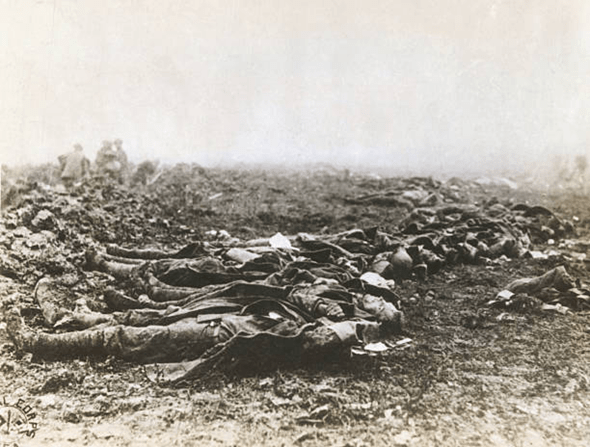
The 11th hour of the 11th day of the 11th month of 1918, World War One ended.

Though the “cease-fire,” called “Armistice,” was signed at 5:00am in the morning, it specified that 11:00am would be the hour the actual fighting would cease. Tragically, in the intervening six hours of fighting, an additional 11,000 more were killed. 

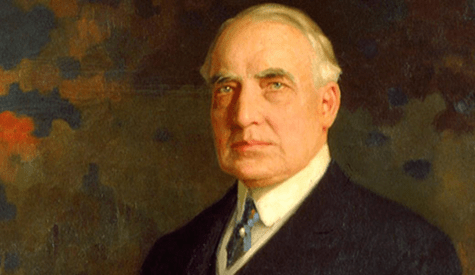
Following World War One — “the war to end all wars” — President Warren Harding, in 1921, had the remains of an unknown soldier killed in France brought to Arlington Cemetery and buried in the Tomb of the Unknown Soldier.

Inscribed on the Tomb are the words: “Here rests in honored glory an American soldier known but to God.”

On October 4, 1924, President Calvin Coolidge stated at the dedication of the Monument to the American Expeditionary Forces: “They did not regard it as a national or personal opportunity for gain or fame or glory, but as a call to sacrifice for the support of humane principles and spiritual ideals. If anyone doubts the sacrifices which they have been willing to make in behalf of what they believe to be the welfare of the nation, let them gaze upon this monument and other like memorials that have been reared in every quarter of our broad land. Let them look upon the representative gatherings of our VETERANS, and let them remember that America has dedicated itself to the service of God and man.”

In 1926, President Coolidge began issuing proclamations honoring veterans every year, and in 1938 the day became a legal holiday.

In 1954, the name “Armistice Day” was changed to “Veterans Day” to honor all soldiers of all American wars. Four million Americans served in World War One.

Sixteen million served in World War Two.

Nearly seven million served in the Korean War.

Nearly nine million served in the Vietnam War.

From the First Gulf War till the present, 7.4 million men and women served.

While Veterans Day honored the living soldiers, Memorial Day honored those who died while serving. 

General Douglas MacArthur told West Point cadets, May 1962: “The soldier, above all other men, is required to practice the greatest act of religious training — sacrifice. In battle and in the face of danger and death, he discloses those Divine attributes which his Maker gave when He created man in His own image. No physical courage and no brute instinct can take the place of Divine help which alone can sustain him. However horrible the incidents of war may be, the soldier who is called upon to offer and to give his life for his country is the noblest development of mankind.

In 1958, President Eisenhower placed a soldier in the Tomb of the Unknown Soldier from World War Two, and another soldier from the Korean War.

In 1984, President Ronald Reagan placed a soldier from the Vietnam War in the Tomb of the Unknown. 

DNA test later identified the body as that of pilot Michael Blassie, who was flying an A-37B Dragonfly when he was shot down near An Loc, South Vietnam. 

In 1998, the body of Michael Blassie was reburied at Jefferson Memorial Cemetery in St. Louis, Missouri. Michael Blassie was a graduate of the U.S. Air Force Academy in 1970, and before that, a graduate of St. Louis University High School in 1966.

On Veterans Day, November 11, 1921, President Warren G. Harding stated: “On the threshold of eternity, many a soldier, I can well believe, wondered how his ebbing blood would color the stream of human life, flowing on after his sacrifice.  Standing today on hallowed ground it is fitting to say that his sacrifice, and that of the millions dead, shall not be in vain. I can sense the prayers of our people, of all peoples, that this Armistice Day shall mark the beginning of a new and lasting era of peace on earth, good will among men.

Let me join in that prayer.

‘Our Father who are in heaven, hallowed be Thy name. Thy kingdom come, Thy will be done on earth, as it is in heaven. Give us this day our daily bread and forgive us our trespasses as we forgive those who trespass against us. And lead us not into temptation, but deliver us from evil, for Thine is the kingdom, and the power, and the glory, forever. Amen.'”

U.S. Army veteran Charles Michael Province wrote the poem: 

“It is the Soldier, not the minister Who has given us freedom of religion. 

It is the Soldier, not the reporter Who has given us freedom of the press. 

It is the Soldier, not the poet Who has given us freedom of speech. 

It is the Soldier, not the campus organizer Who has given us freedom to protest. 

It is the Soldier, not the lawyer Who has given us the right to a fair trial. 

It is the Soldier, not the politician Who has given us the right to vote. 

It is the Soldier who salutes the flag,  Who serves beneath the flag,

And whose coffin is draped by the flag,  Who allows the protester to burn the flag.”

Baptist Chaplain John Inzer spoke at the American Legion’s founding meeting in St. Louis in 1919: “Gentlemen if you can only think about this Legion as the jewel of the ages. I cannot say anything greater than this: I believe God raised up America for this great hour. I can say that the strong young man of the time is to be The American Legion in this country and in the world.”

The Preamble to the American Legion Constitution begins “For God and Country.”

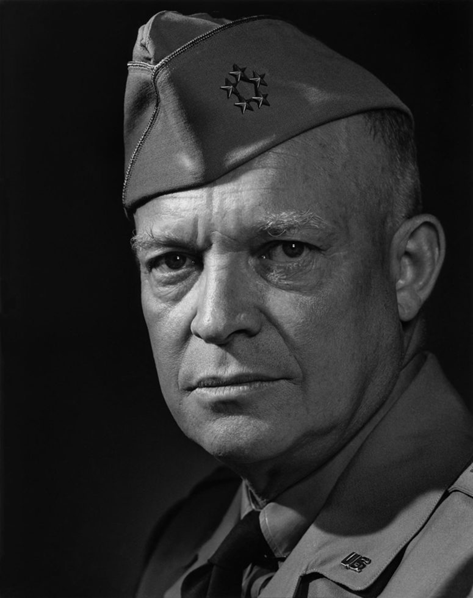
In 1954, the American Legion sponsored a Back-to-God program. President Dwight Eisenhower addressed them in a broadcast from the White House, February 7, 1954: “As a former soldier, I am delighted that our VETERANS are sponsoring a movement to increase our awareness of God in our daily lives. In battle, they learned a great truth-that there are no atheists in the foxholes. They know that in time of test and trial, we instinctively turn to God for new courage and peace of mind. All the history of America bears witness to this truth. Out of faith in God, and through faith in themselves as His children, our forefathers designed and built this Republic.”

Eisenhower continued:

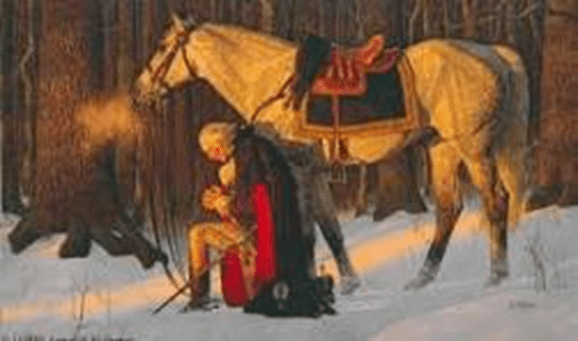
“We remember the picture of the Father of our Country, on his knees at Valley Forge seeking divine guidance in the cold gloom of a bitter winter. Thus Washington gained strength to lead to independence a nation dedicated to the belief that each of us is divinely endowed with indestructible rights. We remember, too, that three-fourths of a century later, on the battle-torn field of Gettysburg, and in the silence of many a wartime night, Abraham Lincoln recognized that only under God could this Nation win a new birth of freedom.” 

Eisenhower concluded:

“Today as then, there is need for positive acts of renewed recognition that faith is our surest strength, our greatest resource.  This ‘Back to God’ movement is such a positive act. As we take part in it, I hope that we shall prize this thought:  Whatever our individual church, whatever our personal creed, our common faith in God is a common bond among us. In our fundamental faith, we are all one. Together we thank the Power that has made and preserved us as a nation. By the millions, we speak prayers, we sing hymns — and no matter what their words may be, their spirit is the same — ‘In God is our trust.'”

The next year, on February 20, 1955, President Dwight Eisenhower again addressed the American Legion Back-To-God Program: “The Founding Fathers recognizing God as the author of individual rights, declared that the purpose of Government is to secure those rights. In many lands the State claims to be the author of human rights. If the State gives rights, it can – and inevitably will – take away those rights. Without God, there could be no American form of Government, nor an American way of life.

Recognition of the Supreme Being is the first-the most basic-expression of Americanism.”

Elections

So, we held an “election” in America yesterday where we elected a new president and numerous elected represenatives. However, you may not know that the very word “election” was coined by the first churches in America and and was taken directly from the Holy Bible. Do read the following narative so that you will know about the very first elections in our country and how they came about. Ron

Theodore Roosevelt stated October 24, 1903 “In no other place and at no other time has the experiment of government of the people, by the people, for the people, been tried on so vast a scale as here in our own country.”  

How did America’s experiment in self-government begin?

At a time when most of the world was ruled by kings, Americans held their first popularly elected legislative assembly.

Jamestown was initially a “company colony,” run by the 1606 Virginia Company Charter, which had by-laws and an appointed governor.

Unforeseen crises, such as famines, diseases, Indian attacks, labor shortages, and struggles to establish a cash crop necessitated the calling of the first meeting of the Virginia House of Burgesses, July 30, 1619.

A burgess was a citizen elected to represent a “borough” (neighborhood).

There were eleven Jamestown boroughs which elected twenty-two representatives.

They met in the church choir loft. Master John Pory was appointed as the assembly’s Speaker. He wrote “A Report of the Manner of Proceeding in the General Assembly Convented at James City, July 30, 1619: “But forasmuch as men’s affairs do little prosper where God’s service is neglected, all the Burgesses took their places in the Quire (choir) till a prayer was said by Mr. Bucke, the Minister, that it would please God to guide and sanctify all our proceedings to his own glory and the good of this Plantation. The Speaker delivered in brief to the whole assembly the occasions of their meeting. Which done he read unto them the commission for establishing the Council of Estate and the general Assembly, wherein their duties were described to life and forasmuch as our intent is to establish one equal and uniform kind of government over all Virginia.”

The House of Burgesses set the price of tobacco at three shillings per pound, and passed prohibitions against gambling, drunkenness, idleness, and made it mandatory to observe the Sabbath.

The freezing winters, epidemics, and the Indian attack of March 22, 1622, where some 400 colonists were massacred, led to the Virginia Company’s Charter being revoked and the king sending over a crown governor.

In 1624, Virginia went from being a “company colony” to a “crown colony” ruled directly by the king through his royal-appointed governor.

As the king did not pay the governor’s salary, the royal-appointed governor instructed the House of Burgesses to provide his funding. As long as they paid that, he did not mind them discussing other issues and otherwise functioning largely on their own.

England went through a Civil War, 1642-1651, and King Charles the First was beheaded.

During this time the House of Burgesses took an increased role in running the Colony.

In 1660, King Charles the Second was brought back from exile and restored to the throne of his father.

Soon, Virginia’s liberties returned to being restricted, leading to Nathaniel Bacon’s rebellion in 1674, which restored their liberties once again.

Virginia’s House of Burgesses served as a legislative model for other colonies.

In Massachusetts, Puritan delegates controlled the legislature, insisting that only Puritans be allowed to vote.

Various pastors thought that voting should be extended to anyone who was a Christian. These pastors led their congregations to leave and found other communities in New England.

It was in these New England communities that pastors had the freedom to apply biblical principles to voting.

  • Rev. Roger Williams founded Providence, Rhode Island, in 1636;
  • Rev. John Wheelwright founded Exeter, New Hampshire, in 1638;
  • Rev. John Lothropp founded Barnstable, Massachusetts, in 1639;

Rev. Thomas Hooker founded Hartford, Connecticut, in 1636.

  • After leading his church congregation through the wilderness they founded Hartford which greatly prospered.

(Then on May 31, 1638 one of the most important episodes in Americh history happened. It did not seem profound at the time, but for sure turned out to be.)

Rev. Thomas Hooker gave a sermon at Hartford which was now the colonies’ capitol city. In it he championed universal Christian suffrage (voting), stating: “The foundation of authority is laid firstly in the free consent of the people.”

This was a blueprint for other New England colonies and eventually the Declaration of Independence, which states: “That to secure these rights, Governments are instituted among Men, deriving their just powers from the consent of the governed.”

Hooker’s sermon had the line: “The privilege of election belongs to the people according to the blessed will and law of God.”

One of the first elections in America was in church. In 1629, the Massachusetts Bay Colony needed to select a pastor for the Salem Church. Since they did not have a king-appointed minister, members of the church fasted and prayed, then wrote on pieces of paper the name of who they thought was God’s chosen person to be the next pastor, thus allowing God’s will to expressed through them. The belief was, that God had preordained someone to be their pastor and church members were simply to recognize the one God had chosen.

Being chosen by God was called being “the elect.”

First Peter 1:1-2 “Peter, an apostle of Jesus Christ, to God’s elect.”

Paul wrote in Colossians 3:12 “As the elect of God, holy and beloved, put on tender mercies.”

Second Timothy 2:10: “I endure all things for the elect’s sakes.”

Mark 13:20 described the last days: “And except that the Lord had shortened those days, no flesh should be saved: but for the elect’s sake, whom he hath chosen, he hath shortened the days.”

The process of putting down the name of God’s “elect” was called an “election.”

This election process was revolutionary, as most of the world at the time was ruled by kings, emperors, sultans, czars and chieftains who did not ask people for their consent.

New England was the beginning of a polarity change in the flow of power, instead of government being run top-down, it became bottom-up, a model that eventually turned into the U.S. Constitution, which states: “We the People in order to form a more perfect union and secure the blessings of liberty to ourselves and our posterity do ordain and establish this Constitution.” 

Instead of powerful political leaders forcing their will on the people through emergency mandates, it was the people’s will being carried out by their elected representatives.

Rev. Thomas Hooker’s sermon notes became known as the “Fundamental Orders of Connecticut,” 1639, which was used as the foundation of Connecticut’s government until 1818.

According to Connecticut historian John Fiske, the Fundamental Orders, inspired by Hooker’s sermon, comprised one of the first written constitutions in history that created a government.

Hartford’s Traveller’s Square has a bronze statue of Connecticut’s first settlers and a plaque which reads: “In June of 1635, about one hundred members of Thomas Hooker’s congregation arrived safely in this vicinity with one hundred and sixty cattle. They followed old Indian trails from Massachusetts Bay Colony to the Connecticut River to build a community. Here they established the form of government upon which the present Constitution of the United States is modeled.”

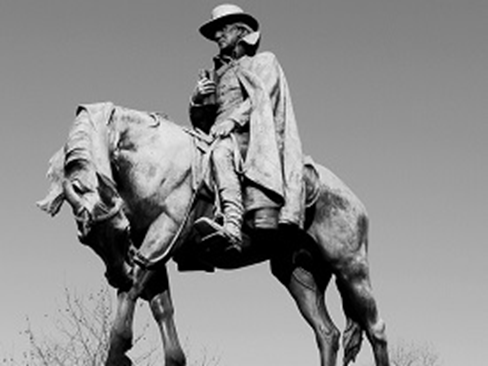
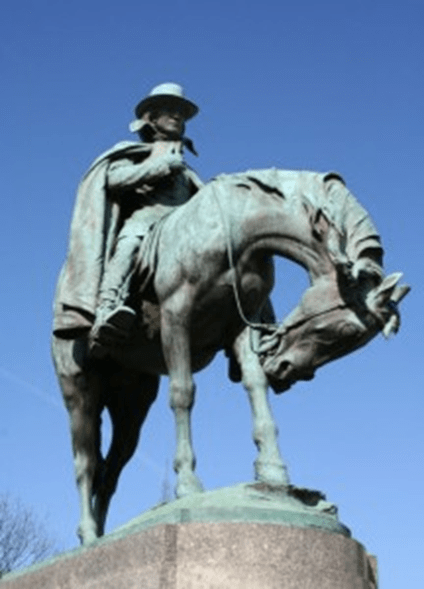
Rev. Thomas Hooker’s statue holding a Bible stands at the Old State House in Hartford, Connecticut.

The base of the statue reads: “Leading his people through the wilderness, he founded Hartford in June of 1636. On this site he preached the sermon which inspired The Fundamental Orders. It was the first written constitution that created a government.”

President Calvin Coolidge stated July 5, 1926: “The principles of our declaration had been under discussion in the Colonies for nearly two generations. In the assertion of the Rev. Thomas Hooker of Connecticut as early as 1638, when he said in a sermon before the General Court that: ‘The foundation of authority is laid in the free consent of the people. The choice of public magistrates belongs unto the people by God’s own allowance.’

This doctrine found wide acceptance among the nonconformist clergy who later made up the Congregational Church.”

Coolidge added:

“The principles which went into the Declaration of Independence are found in the texts, the sermons, and the writings of the early colonial clergy who were earnestly undertaking to instruct their congregations in the great mystery of how to live. They preached equality because they believed in the fatherhood of God and the brotherhood of man. They justified freedom by the text that we are all created in the divine image, all partakers of the divine spirit. Placing every man on a plane where he acknowledged no superiors, where no one possessed any right to rule over him, he must inevitably choose his own rulers through a system of self-government.

In New England, instead of “separation of church and state,” it was churches and pastors who CREATED the State!

Coolidge concluded his address: “But even in that we come back to the theory of John Wise that ‘Democracy is Christ’s government.’ The ultimate sanction of law rests on the righteous authority of the Almighty. Ours is a government of the people. It represents their will. Its officers sometimes go astray, but that is not a reason for criticizing the principles of our institutions. The real heart of the American Government depends upon the heart of the people. It is from that source that we must look for all genuine reform.  It was in the contemplation of these truths that the fathers made their Declaration and adopted their Constitution.”

President Grover Cleveland stated, July 13, 1887: “The SOVEREIGNTY OF 60 MILLIONS OF FREE PEOPLE, is the working out of the divine right of man to govern himself and a manifestation of God’s plan concerning the human race.”

America’s founders set up a democratically-elected Constitutional Republic. The Pledge of Allegiance is “to the Flag and to the Republic for which it stands.” A “Republic” is where the people are king, ruling through their servants, called representatives. The word “citizen” is from the Greek and means “co-ruler” or “co-king.”

In 1832, Noah Webster wrote in his History of the United States: “When you become entitled to exercise the right of voting for public officers, let it be impressed on your mind that God commands you to choose for rulers ‘just men who will rule in the fear of God.’ The preservation of a republican government depends on the faithful discharge of this duty.”

He continued: “If the citizens neglect their duty and place unprincipled men in office, the government will soon be corrupted; laws will be made not for the public good so much as for the selfish or local purposes; corrupt or incompetent men will be appointed to execute the laws; the public revenues will be squandered on unworthy men; and the rights of the citizens will be violated or disregarded.

If a republican government fails to secure public prosperity and happiness, it must be because the citizens neglect the divine commands, and elect bad men to make and administer the laws.”

Columbus – Amazing First Voyge

At the time of Columbus, most everyone thought that the earth was flat. No one had ever sailed as far as Columbus in the open ocean beyond the sight of land. So, after five weeks most of his sailors thougt that thy were for sure going to fall off of the earth. Following is the amazing history of those days.

Yes, others found the “New World” before Columbus, but were never made public, since few believed them. His discovery was made public to the whole world. We gave him great credit and honor for discovering America, though he always thought it was Asia. We even had a holiday to honor him……..”Columbus Day”. Do read the following exact histoy of those times:

Columbus was looking for a SEA route to India and China because nearly 40 years earlier Muslim Turks conquered Constantinople in 1453 cutting off the LAND routes.

A biography of Columbus was written by Washington Irving in 1828, titled A History of the Life and Voyages of Christopher Columbus. In it, Irving created an imaginative dialogue of Europeans arguing over whether the Earth was round or flat. His book was so popular, that people actually thought such a debate took place when it had not.

Washington Irving was known for mixing entertainment with history and legend. He wrote Rip Van Winkle, The Legend of Sleepy Hallow, and Diedrich Knickerbocker’s A History of New-York from the Beginning of the World to the End of the Dutch Dynasty, filled with tales of visits from St. Nick coming to New York City, which he nickname “Gotham.”

Some Europeans knew the Earth was round.

Pythagoras had speculated that the earth was a sphere in the 6th century BC, and Aristotle validated it in the 4th century BC.

In the 3rd century BC, Eratosthenes computed the circumference of the earth with amazing accuracy. He had heard that at Aswan, Egypt, the sun cast no shadow down a well at noon on the summer solstice, June 21, yet at the exact same moment in Alexandria, Egypt, a column cast a shadow with a 7.2 degree angle.

7.2 degrees is 1/50th of a 360 degree circle.

It was known that the distance between Alexandria and Aswan was 5,000 stadia, approximately 500 miles, or 800 kilometers.

All Eratosthenes had to do was multiply 500 miles times 50, which equals 25,000 miles, just 99 miles off from the Earth’s actual circumference of 24,901 miles (or 800 km x 50 to equal 40,000 kilometers, just 75 kilometers less than the actual 40,075 km circumference).

Eratosthenes also calculated distance to the sun and moon, the tilt of the earth, and created the first world map with parallel latitude and meridian longitude lines.

In the 1st century BC, Posidonius used stellar observations at Alexandria and Rhodes to confirm Eratosthenese’s measurements.

In the 2nd century AD, astronomer Ptolemy had written a Guide to Geography, in which he described a spherical earth with one ocean connecting Europe and Asia.

St. Isidore of Seville, Spain, wrote in the 7th century that the earth was round.

Around the year 723 AD, Saint Bede the Venerable wrote in his work Reckoning of Time that the Earth was spherical.

The Book of Isaiah 40:22 states: “It is He that sitteth upon the globe of the earth.” (Douay-Rheims Bible)

Columbus knew the Earth was round, but the question was, how far around. The confusion was over the length of a mile.

Columbus read Cardinal Pierre d’Ailly’s “Imago Mundi,” which gave Alfraganus’ estimate that a degree of latitude (at the equator) was around 56.7 miles.

What Columbus did not realize was that this was expressed in longer Arabic miles rather than in shorter Roman miles. Therefore Columbus incorrectly estimated the Earth to be smaller in circumference, about 19,000 miles, rather than the actual nearly 24,901 miles.

Columbus knew there was land to the west, as he may have read Ptolemy’s account, written in 150 AD, of the Greek sailor named Alexander, who visited the Far East port city of Kattigara, beyond the Malay Peninsula (Golden Chersonese).

He could have heard of the Roman traveler, during the reign of Roman Emperors Antoninus Pius or Marcus Aurelius, who made his way to the court of the Chinese Emperor of the Han Dynasty.

Indeed, Roman glassware and medallions dating from this period were found at Guangzhou along the South China Sea, and at Óc Eo in Vietnam, near the Chinese province of Jiaozhi.

Great amounts of Roman coins were found in India, indicating there was Roman sea trade.

Columbus most likely heard the story of Irish monk St. Brendan, who sailed west in 530 AD to “The Land of the Promised Saints which God will give us on the last day.”

Columbus would have known of the Christian Viking Leif Erickson’s voyage in the year 1000 to Vinland (Newfoundland), called Markland in the Nordic Grœnlendinga Saga.

A Dominican friar in Milan, Italy, named Galvaneus Flamma, wrote an essay titled Cronica universalis, c.1345, in which he referred to the Icelandic description of a wooded land far to the west called Marckalada.

Columbus owned a copy of Marco Polo’s travels to China and India in 1271.

Columbus may have possibly seen maps, rumored to have been in Portugal’s royal archives, from China’s treasure fleets which were sent out in 1421 by Ming Emperor Zhu Di, led by Admiral Zheng He.

Columbus corresponded with Florentine physician Paolo dal Pozzo Toscanelli, who suggested China was just 5,000 miles west of Portugal. Based on this, Columbus estimated that Japan, or as Marco Polo called it “Cipangu,” was only 3,000 Roman miles west of the Canary Islands, rather than the actual 12,200 miles.

As a young man, Columbus began sailing on a trip to a Genoese colony in the Aegean Sea named Chios. In 1476, he sailed on an armed convoy from Genoa to northern Europe, docking in Bristol, England, and Galway, Ireland, and even possibly Iceland in 1477.

When Muslim Turks conquered Constantinople in 1453 and hindered land trade routes from Europe to India and China, Portugal, which had been freed from Islamic occupation for two centuries, began to search for alternative sea routes.

The treasures of the East were long brought overland to Alexandria, or Constantinople, or the cities of the Levant, and thence distributed to Europe by the galleys of Genoa or of Venice. “But when the Turk placed himself astride the Bosporus, and made Egypt his feudatory, new routes had to be found.”

Historian Howard Zinn admitted in A People’s History of the United States (1980): “Now that the Turks had conquered Constantinople and the eastern Mediterranean, and controlled the land routes to Asia, a sea route was needed.

The Spanish Monarchs then joined the quest for a sea trade route to India and China. They backed Columbus’ plan. Though Columbus was wrong about the miles and degrees of longitude, he did understand trade winds across the Atlantic.

On August 3, 1492, Columbus set sail on the longest voyage to that date out of the sight of land.

Trade winds called “easterlies” pushed Columbus’ ships for five weeks to the Bahamas. On OCTOBER 12, 1492, Columbus sighted what he thought was India.

He imagined Haiti was Japan and Cuba was the tip of China.

He called the first island he saw “San Salvador” for the Holy Savior.

Thus, in his search for the riches of Cipangu (Japan), Columbus stumbled upon America.

The great Genoese lived and died under the illusion that he had reached the outmost verge of Asia; and though even in his lifetime men realized that what he had found was no less than a new world.”

In his journal, Columbus referred to the native inhabitants as “indians” as he was convinced he had successfully arrived in India: “So that they might be well-disposed towards us, for I knew that they were a people to be converted to our Holy Faith rather by love than by force, I gave to some red caps and to others glass beads.

They became so entirely our friends that I believe that they would easily become Christians.”

The End

The Greatest Betrayal in American History

Most folks have heard about Benedict Arnold and that he was a traitor, but don’t know much else about him. Below I have provided you the amazing details of what he did and how he was discovered and what happened to him. Do read it and be informed.

Since photography had not been invented when the content of this post happened, the pictures had to be paintings or drawings.

The oath of military enlistment states: “I, _____, do solemnly swear (or affirm) that I will support and defend the Constitution of the United States against all enemies, foreign and domestic.”

The most common form of government in history is kings. The king of England was the most powerful king in the world at the time of the Revolution.

The Constitution was a way to take power away from a king and give it to the people.

In other words, the Constitution’s purpose is to prevent power from re-concentrating back into the hands of the government; to prevent the return to a king; to keep one person from ruling as a dictator.

In a word, the Constitution’s ultimate purpose it is to prevent a President from ruling through Executive Orders and Mandates.

General Douglas MacArthur addressed Massachusetts State Legislature in Boston, on July 25, 1951: “I find in existence a new and heretofore unknown and dangerous concept that the members of our Armed Forces owe primary allegiance to those who temporarily exercise the authority rather than to the Constitution which they are sworn to defend. No proposition could be more dangerous. For its application would at once convert them from their traditional and constitutional role as the instrument for the defense of the Republic into something partaking of the nature of a praetorian guard, owing its allegiance to the political master of the hour.”

Cicero addressed the Roman Senate, c.42 BC: “A nation can survive its fools and even the ambitious. But it cannot survive treason from within. An enemy at the gates is less formidable, for he is known and he carries his banners openly against the city. But the traitor moves among those within the gates freely, his sly whispers rustling through all alleys, heard in the very halls of government itself. He works secretly and unknown in the night to undermine the pillars of a city; he infects the body politic so that it can no longer resist. A murderer is less to be feared.”

Probably the most painful betrayal of America during the Revolution was that of Benedict Arnold.

Benedict Arnold was one of America’s most popular leaders, renown for helping Ethan Allen capture Fort Ticonderoga in 1775.

Arnold fought courageously on Lake Champlain at the Battle of Valcour Island in 1776.

He fought in the Battle of Ridgefield, Connecticut and came to the rescue at the Siege of Fort Stanwix.

Benedict Arnold was considered the hero of the pivotal Battle of Saratoga in 1777, leading a daring flanking charge, though he disobeyed a direct order to do so.

Shot in the leg during the battle, his career was sidelined for a season.

For his courageous, patriotic service, Arnold was, at this time, as popular as George Washington.

Philadelphia was the largest city in America, with a population of 43,000.

The next biggest cities were:

  • New York City, with 25,000;
  • Boston, with 16,000;
  • Charleston, with 12,000; and
  • Newport, Rhode Island, with 11,000.

A year earlier, rather than coming to the rescue of British General Burgoyne at the Battle of Saratoga, British General William Howe, possibly due to professional rivalry, abandoned Burgoyne, left New York, and sailed for Pennsylvania.

Howe defeated General Washington at the Battle of Brandywine, September 11, 1777, then marched into Philadelphia, being gloriously greeted by the large number of British Loyalists still in the city.

The British occupied the city for eight months, but gaining no strategic benefit from being there, they left Philadelphia in June of 1778.

Americans once again took control, with Benedict Arnold being appointed the military commander of Philadelphia.

As Philadelphia had a significant population of Quakers, who refused for religious reasons to take up arms in defense of America, citizens who were still loyal to the King of England could blend in.

While military commander of Philadelphia, Benedict Arnold became captivated by Peggy Shippen, the daughter of a wealthy loyalist-leaning judge.

Arnold and Peggy were married in 1779.

At the same time, Arnold was accused of using his position for his own financial benefit. He had to endure a long and drawn out court-martial trial. Interestingly, during the trial, Arnold, vehemently accused his prosecutors of being disloyal to the patriot cause.

This behavior was later termed by Sigmund Freud as “psychological projection,” where a guilty person accuses their innocent opponent of the exact crime that they, themselves, are guilty of.

Arnold was eventually cleared in the trial, but the ordeal, along with being passed over for promotion, confirmed to his loyalist-leaning wife, Peggy, that the Americans did not appreciate her husband.

Meanwhile, Arnold incurred much debt attempting to maintain his wife’s upper-class lifestyle.

All this while, Peggy had maintained communication with a British spy, the young and handsome Major John Andre, who had stayed behind in Philadelphia posing as a civilian.

After a year of coaxing, Peggy finally convinced Benedict to meet with Andre.

That same year, 1779, the Continental Congress declared a Day of Public Prayer to Almighty God.

Virginia Governor Thomas Jefferson observed this by signing a State Proclamation of Prayer: “Congress hath thought proper to recommend to the several States a day of public and solemn Thanksgiving to Almighty God, for his mercies, and of Prayer, for the continuance of his favor. That He would go forth with our hosts and crown our arms with victory; that He would grant to His church, the plentiful effusions of Divine Grace, and pour out His Holy Spirit on all Ministers of the Gospel; that He would bless and prosper the means of education, and spread the light of Christian knowledge through the remotest corners of the earth. I do therefore issue this proclamation appointing a day of public and solemn thanksgiving and prayer to Almighty God. Given under by hand this 11th day of November, in the year of our Lord, 1779, Thomas Jefferson.”

The next spring, April 6, 1780, General Washington issued the order from his headquarters at Morristown, New Jersey: “Congress having been pleased by their Proclamation of the 11th of last month to appoint Wednesday the 22nd instant to be set apart and observed as a day of Fasting, Humiliation and Prayer, there should be no labor or recreations on that day.”

Due to Arnold’s heroic reputation, Washington had a blind spot when it came to suspecting Arnold’s betrayal. General Benedict Arnold lobbied General Washington to put him in charge of West Point, which Washington did on August 3, 1780.

The fort at West Point was America’s largest and most important fort, designed by the Polish freedom fighter Tadeusz Kosciuszko.

West Point controlled the Hudson River Valley, which stretched from near Canada in the North to New York City in the south.

The Hudson River effectively divided colonial America in half, with the New England Colonies on the east and the Middle & Southern Colonies on the west. The surrender of West Point would have split the country and possibly cost the Americans the War.

By August 30, 1780, Benedict Arnold not only agreed to betray West Point, but to do so on the very day General Washington would arrive to inspect it. This way Washington would be captured.

In return, for his betrayal, the King’s British Empire would pay Benedict Arnold money, lots of money — 20,000 British pounds sterling, the equivalent of one million dollars today.

Arnold proceeded to intentionally weakened West Point’s defenses by neglecting repairs and removing supplies, all the while complaining to General Washington of shortages.

The trap was set. General George Washington and Major-General Lafayette set out on their way to West Point to examine its defenses.

On September 19, 1780, British General Henry Clinton left Charleston, South Carolina, and put his troops in position to capture West Point.

On September 23, 1780, Arnold met with British spy Major John Andre to arranged the final details of the fort’s surrender.

Talking too long, Andre missed the rendezvous with a British boat waiting in the Hudson River. This was due in part to some Americans, by chance, spotting the idle British boat and firing shots at it, causing it to retreat down river.

Arnold then had Andre dress as a civilian and take the risky route back to the British lines by land.

This was a fateful decision, for the accepted rules of warfare were, that if a combatant was captured in uniform, he was afforded certain treatment as a prisoner of war, but if the combatant was captured dressed as a civilian, he was considered a spy, for which the penalty was immediate hanging.

Historians question why Arnold did not take more precaution to keep Andre from being caught. It is suspected that Arnold may have been blinded by jealousy. Arnold seemed to harbor resentment toward the younger and more handsome Andre for maintaining a such a close relationship with his wife, Peggy.

Andre departed from Arnold, and hiked across the American controlled territory, and no-man’s land. He almost made it to the British lines when, providentially, some random American sentries spotted him in the woods and decided to stop him for questioning.

Trying to talk his way out of why he was there, the sentries were unconvinced. They searched him once and again.

They almost let him go when they decided to make him take off his boot. There, hidden in Andre’s sagging stocking, they found the folded up map of West Point.

The American sentries arrested Andre and immediately sent word to General Benedict Arnold. Arnold was anxiously waiting at West Point for the arrival of General Washington, supposedly to have breakfast, but where he intended to capture him.

Major James McHenry, for whom Fort McHenry was later named, rode ahead to let Arnold know that Washington was on his way, but had been delayed.

By the time Major McHenry arrived at West Point, Benedict Arnold had realized his plot was discovered. He left his wife and child, and fled to the waiting British ship, HMS Vulture.

His wife, Peggy, feigned insanity to avoid being questioned by Washington.

The day after Arnold’s plot was thwarted, American General Nathaniel Greene reported September 26, 1780: “Treason of the blackest dye was yesterday discovered! General Arnold who commanded at West Point, was about to give the American cause a deadly wound if not fatal stab. Happily the treason had been timely discovered to prevent the fatal misfortune. The providential train of circumstances which led to its discovery affords the most convincing proof that the Liberties of America are the object of divine Protection.”

On May 8, 1783, Yale President Ezra Stiles stated: “A providential miracle at the last minute detected the treacherous scheme of traitor Benedict Arnold, which would have delivered the American army, including George Washington himself, into the hands of the enemy.”

The Continental Congress issued a Day of Thanksgiving, October 18, 1780: “In the late remarkable interposition of His watchful providence, in the rescuing the person of our Commander-in-Chief and the army from imminent dangers, at the moment when treason was ripened for execution. It is therefore recommended a Day of Public Thanksgiving and Prayer to confess our unworthiness and to offer fervent supplications to the God of all grace to cause the knowledge of Christianity to spread over all the earth.”

Washington offered to do a prisoner exchange with the British. He would return John Andre to the British in exchange for Benedict Arnold being returned to the Americans. The British refused.

Since the British earlier hanged the captured 21-year-old American spy, Nathan Hale, General Washington insisted that the same fate be administered to the captured British spy Andre.

Major John Andre was hung on October 2, 1780.

Benedict Arnold fulfilled his betrayal by pledging loyalty to the King and joining the British ranks.

He led attacks where he fought and killed Americans, even burning the city of New London, Connecticut, in 1781.

Benedict Arnold led British troops to capture Richmond, Virginia.

They burned government buildings and homes, destroyed the foundry, and attempted to catch Governor Thomas Jefferson.

The U.S. Military Academy at West Point has plaques hanging in the Old Cadet Chapel commemorating the name of every general of the Revolutionary War, except one. Arnold’s plaque had his name struck off. It simply reads: “Major General ___________ Born 1740.”

Academy historian at West Point Steven Grove explained: “We wanted to commemorate all the war generals, so we have a plaque for him, but he disgraced his uniform, so we don’t put his name up there.”

John Jay, who was later appointed by George Washington as the first Chief Justice of the Supreme Court, stated September 8, 1777: “This glorious revolution is distinguished by so many marks of the Divine favor and interposition in a manner so singular, and I may say miraculous, that when future ages shall read its history they will be tempted to consider a great part of it as fabulous.

Will it not appear extraordinary like the emancipation of the Jews from Egyptian servitude.”

The End

Amazing Story from WW II

This is the story of how the Senior Pilot who led the attack on Pearl Harbor later amazingly became a Christian and became a Christian Evangelist.  Do read this and be inspired:

Japanese Emperor Meiji allowed many freedoms during the Meiji Restoration, 1868-1912.

The country industrialized, adopted many Western ideas, allowed voting, ended feudalism, permitted private citizens to own land, and abolished the historic distinctions of four social classes, though the samurai class opposed this.

In 1905, Japan won a war against Russia.

By the early 1900s, Japan expanded into one of the largest maritime empires in history.

It annexed Korea in 1910 and took control of Russian ports in Siberia in 1918.

Citizens of Japan experienced unprecedented freedom and prosperity during the “Taishō democracy,” 1912 to 1926.

Japan’s economy successfully survived World War I.

This all changed with the 1929 Stock Market Crash and Great Depression, which had global repercussions.

Exports from Japan to America and other Western nations dramatically dropped off, causing a financial crisis. This worldwide economic panic allowed Stalin to seize more power in Russia, Hitler in Germany, and Mussolini in Italy.

Similarly, Shōwa Emperor Hirohito and his generals, inspired by a resurgence of the nationalist spirit of the samurai, centralized power into a Japanese totalitarian, militaristic state. Power concentrated so much, that the emperor was revered by some Shinto followers as an incarnate divinity who must be obeyed without question, whose subjects were forbidden to criticize.

In 1937, Imperial Japan’s Army killed an estimated 200,000 in Nanking, China.

In 1941, it was the world’s 3rd largest naval power, with the 9th largest economy.

It made an alliance with Germany and Italy.

In 1941, over 3,000 Americans died when Imperial Japan attacked Pearl Harbor.

In 1942, over 20,000 Americans and Filipinos died on Bataan’s Death March, where starving prisoners were marched 65 miles in heat and jungles to a disease infested camp.

Similar to jihad suicide-bombers, kamikaze suicide-pilots were indoctrinated with the honor-shame samurai code, that it was more honorable to die killing the enemy than to shamefully surrender and be captured. Japanese fought fiercely, resulting in over 100,000 deaths as the Allies took Okinawa and Pacific islands through 1945. About 3,860 kamikaze pilots met their deaths hitting more than 400 Allied ships.

An incident in the Pacific War occurred September 2, 1944, when U.S. Navy torpedo-bombers were on a bombing raid near Chichi Jima in the Bonin Islands, 700 miles south of Japan. Ten pilots were hit with anti-aircraft fire and ejected from their burning planes.

As recorded in the book Navy Wings of Gold (3rd edition, 2010), Japanese boats sped from the shore and quickly captured nine of the ten downed pilots. The tenth pilot was able to get further out to sea before ejecting. He was only saved by the circling plane of American pilot Lt. “Blackie” Adams. “Blackie” Adams kept shooting at the Japanese boats till the submarine, USS Finback, could rescue the last downed pilot.

The rescued pilot was 20-year-old Lt. George H. W. Bush.

When Bush saw the submarine providentially surface near him, he thought he was seeing an hallucination. Had he not been rescued, he most certainly would have suffered the fate of the other nine captured pilots in what became known as the Chichi Jima Incident.

The book Flyboys: A True Story of Courage (2003) recorded what happened to Bush’s fellow pilots. Imperial officers Lt Gen. Yoshio Tachibana and Major Sueo Matoba ordered them to be beaten and cannibalized, sometimes amputating only one limb at a time.TIME Magazine reported in an article, “National Affairs: Unthinkable Crime,” September 16, 1946, that two of the soldiers were beheaded and their livers eaten.

Imperial military embraced the samurai code, preferring killing one’s self in hara-kiri more honorable than capture. As a result, they held contempt for captured prisoners of war.

The Telegraph (Feb. 6, 2017, published an article “George H.W. Bush narrowly escaped comrade’s fate of being killed and eaten by Japanese captors: Lt George Bush, then a 20-year-old pilot, was among nine airmen who escaped from their planes after being shot down during bombing raids on Chichi Jima, a tiny island 700 miles south of Tokyo, in September 1944, and was the only one to evade capture by the Japanese.”

The former President George H.W. Bush narrowly escaped being beheaded and eaten by Japanese soldiers when he was shot down over the Pacific in the Second World War, a shocking new history published in America has revealed. The book, Flyboys, is the result of historical detective work by James Bradley, whose father was among the marines later photographed raising the flag over the island of Iwo Jima.”

The two Imperial officers who ordered the gruesome acts were found guilty of war crimes and executed.

U.S. Marine fighter ace Greg “Pappy” Boyington, of the Black Sheep Squadron, was also shot down in the Pacific, January 1944. He was a prisoner of war for a year and a half, and his biography attests to similar horrendous treatment.

Realizing that every Japanese soldier would fight to the death instead of surrender, Democrat President Harry Truman made the secret and controversial decision August 6, 1945, to drop the Atomic Bomb on Hiroshima and Nagasaki. The reasoning was that, though devastating, it would prevent an additional one million casualties on both sides from a long, continuing war.

Emperor Hirohito finally made the official surrendered aboard the U.S.S. Missouri, anchored in Tokyo Bay, on SEPTEMBER 2, 1945.

After the war, George H. W. Bush graduated from Yale. He worked in the Texas oil industry and entered politics, being a Congressman, Ambassador, Director of the C.I.A., Vice-President, and eventually the 41st President of the United States.

In his Inaugural Address, George H.W. Bush, January 20, 1989, he stated: “I have just repeated the oath taken by George Washington 200 years ago, and the Bible on which I placed my hand is the Bible on which he placed his.

My first act as President is a prayer: Heavenly Father,make us strong to do Your work, and if our flaws are endless, God’s love is truly boundless.”

A story of redemption occurred after World War II. Mitsuo Fuchida was the Imperial Japanese Navy pilot who led the attack on Pearl Harbor, shouting, “Tora, Tora, Tora.”

Mitsuo Fuchida was depicted in the 1970 Movie Tora, Tora, Tora. “Tora,” meaning “tiger” was the Japanese code word meaning, the enemy is caught in complete surprise.

In 1950, after World War II was over, Fuchida became a Christian, then an evangelist, and then in 1960, an American citizen. His story was written in Readers Digest “God’s Samurai: Lead Pilot at Pearl Harbor” (February 1954).

Mitsuo Fuchida wrote in his biography From Pearl Harbor to Calvary (1953): “I was in Hiroshima the day before the atom bomb was dropped. Fortunately, I received a long distance call from my Navy Headquarters, asking me to return to Tokyo.

With the end of the war, my military career was over, since all Japanese forces were disbanded, I returned to my home village.

As I got off the train one day in Tokyo’s Shibuya Station, I saw an American distributing literature. When I passed him, he handed me a pamphlet entitled “I Was a Prisoner of Japan” (published by Bible Literature International). What I read was the fascinating episode which eventually changed my life.”

Fuchida continued:

“Jake DeShazer volunteered for a secret mission with the Jimmy Doolittle Squadron, a surprise raid on Tokyo from the carrier Hornet.

After the bombing raid DeShazer found himself a prisoner of Japan. There in the Japanese P.O.W. camp, he read and read (the Bible) and eventually came to understand that the Book was more than an historical classic. The dynamic power of Christ, which Jake DeShazer accepted into his life, changed his entire attitude toward his captors. His hatred turned to love.”

Fuchida wrote further, that after the War: “DeShazer returned to Japan as a missionary. And his story, printed in pamphlet form, was something I could not explain. Since the American had found it in the Bible, I decided to purchase one myself, despite my traditionally Buddhist heritage.

I was certainly one of those for whom He had prayed. The many men I had killed had been slaughtered in the name of patriotism, for I did not understand the love which Christ wishes to implant within every heart.

Right at that moment, I seemed to meet Jesus for the first time.

I understood the meaning of His death as a substitute for my wickedness, and so in prayer, I requested Him to forgive my sins and change me from a bitter, disillusioned ex-pilot into a well-balanced Christian with purpose in living. I became a new person. My complete view on life was changed by the intervention of the Christ I had always hated and ignored before.”

Fuchida added:

“I have traveled across Japan and the Orient introducing others to the One Who changed my life.

I believe with all my heart that those who will direct Japan, and all other nations in the decades to come must not ignore the message of Jesus Christ.

Youth must realize that He is the only hope for this troubled world. I would give anything to retract my actions of twenty-nine years ago at Pearl Harbor, but it is impossible.

Mitsuo Fuchida concluded:

“Instead, I now work at striking the death-blow to the basic hatred which infests the human heart and causes such tragedies.

And that hatred cannot be uprooted without assistance from Jesus Christ.”