The Most Infamous Duel in U.S. History

This Duel was fought between Alexander Hamilton and Aron Burr. Following is a brief history of both participants:

Alexander Hamilton:

Alexander Hamilton was born in the British West Indies on the Island of Nevis, either in the year 1755 or 1757, and grew up on the Island of St. Croix.

Since Alexander Hamilton’s parents were not legally married, he was not permitted to attend the Anglican academy, resulting in him being tutored at a private school by a Jewish headmistress.

Hamilton worked for merchants till, at the age of 17, he sailed to Massachusetts in 1772 to attend Elizabethtown Academy. He was studying at Columbia College in New York when the Revolutionary War started.

Alexander Hamilton fought in the Battle of White Plains and the Battle of Trenton. He served four years as aide-de-camp to General George Washington. Promoted to Lieutenant Colonel, Alexander Hamilton led a bayonet attack at night capturing Redoubt No. 10 which helped the Continental Army win the Battle of Yorktown, October 19, 1781.

During the Revolution, Alexander Hamilton wrote “The Farmer Refuted,” February 23, 1775, stating: “The Supreme Being gave existence to man, together with the means of preserving and beautifying that existence, and invested him with an inviolable right to personal liberty and personal safety. The sacred rights of mankind are not to be rummaged for among old parchments or musty records. They are written, as with a sunbeam, in the whole volume of human nature, by the Hand of the Divinity itself, and can never be erased or obscured by mortal power.”

Hamilton concluded: “Good and wise men, in all ages have supposed that the Deity, from the relations we stand in to Himself, and to each other, has constituted an eternal and immutable law, which is indispensably obligatory upon all mankind. This is what is called the law of nature dictated by God himself.”

In 1781, Hamilton helped U.S. Superintendent of Finance Robert Morris start the Bank of North America, the first private commercial bank in the United States. It served as the nation’s first de facto central bank, bringing stability to the fledgling nation’s finances after the fiat Continental currency became worthless, as the saying went, “not worth a continental.” This was vital to allow the United States to carry on international trade, as well as to project strength which discouraged other countries from restarting hostilities. Franklin and Jefferson were among the Bank’s founding shareholders. The Bank later merged to form the First Bank of the United States.

In June of 1784, Hamilton also founded The Bank of New York (Mellon) to provide money for the city’s shipping industry. The Bank also loaned money to the Federal government to pay salaries of the U.S. Congress. In 1792, the Bank of New York, the Bank of North America, and the First Bank of the United States were the first shares traded on the New York Stock Exchange, which moved in 1796 to Wall Street.

Alexander Hamilton helped write the U.S. Constitution, stating at the Constitutional Convention, June 22, 1787: “Take mankind as they are, and what are they governed by? Their passions. There may be in every government a few choice spirits, who may act from more worthy motives. One great error is that we suppose mankind is more honest that they are.”

After the Constitution was written, Hamilton helped convinced the States to ratify it by writing The Federalist Papers with James Madison and John Jay. Of the 85 Federalist Papers, Hamilton wrote 51.

Alexander Hamilton wrote of the Constitution in his Letters of Caesar, 1787: “Whether the New Constitution, if adopted, will prove adequate to such desirable ends, time, the mother of events, will show. For my own part, I sincerely esteem it a system, which, without the finger of God, never could have been suggested and agreed upon by such a diversity of interests.”

In 1789, Alexander Hamilton became the first Secretary of the U.S. Treasury — his statue is at the south entrance of the Treasury building in Washington, DC.

In 1790, Hamilton proposed The First Bank of the United States assume the role as the nation’s central bank. It covered the Revolutionary War debt of the states, established a mint, and imposed a federal excise tax.

In 1790, Hamilton pushed Congress to have ships, called Revenue Cutters, to collect revenue, confiscate contraband, and guard the coasts from piracy. This was the beginning of the U.S. Coast Guard, which freed almost 500 Africans from slavery. Being opposed to slavery, Hamilton and John Jay founded the New York Manumission Society which successfully helped pass legislation in 1799 to end New York’s involvement in the slave trade.

Alexander Hamilton served as Senior Officer of the United States Army during a threatened war with France in 1799. Hamilton condemned the French Revolution’s attempt to overthrow Christianity, as it was: “(depriving) mankind of its best consolations and most animating hopes, and to make a gloomy desert of the universe. The praise of a civilized world is justly due to Christianity; war, by the influence of the humane principles of that religion, has been stripped of half its horrors. The French renounce Christianity, and they relapse into barbarism; war resumes the same hideous and savage form which it wore in the ages of Gothic and Roman violence.”

In 1780, Alexander Hamilton married Elizabeth Schuyler, the daughter of Revolutionary War General Philip Schuyler who had served in the Continental Congress. Elizabeth Hamilton co-founded New York City’s first private orphanage.

Aaron Burr:

Burr had fought in the Revolution, was elected to the New York State Assembly, 1784-1785, and was appointed New York State Attorney General. In 1791, Burr ran a campaign to unseat Senator General Philip Schuyler, Hamilton’s father-in-law.

When Burr won, it created a political rift with Hamilton. In 1796, Burr lost in his bid to become the President of the United States, running against both John Adams and Thomas Jefferson.

Witnessing the beginning stages of the formation of political parties, George Washington warned in his Farewell Address, 1796, of the divisive “danger of Parties”: “And of fatal tendency to put, in the place of the delegated will of the Nation, the will of a party; often a small but artful and enterprising minority by which cunning, ambitious, and unprincipled men will be enabled to subvert the Power of the People and to usurp for the themselves the reins of Government; destroying afterwards the very engines which have lifted them to unjust dominion. I have already intimated to you the danger of Parties in the State. Let me now warn you in the most solemn manner against the baneful effects of the spirit of Party, generally. This spirit, unfortunately, is inseparable from our nature, having its roots in the strongest passions of the human mind. Domination of one faction over another, sharpened by the spirit of revenge natural to party dissension … has perpetrated the most horrid enormities, is itself a frightful despotism.”

New York badly needed a clean water supply to prevent malaria outbreaks. Under the pretense of establishing a water company, Aaron Burr solicited investors, but secretly he changed the company’s charter in 1799 to found the Bank of the Manhattan Company (JP Morgan Chase). This allowed him to compete with Hamilton’s Bank of New York.

In September 1799, John Church, whose wife was the sister of Hamilton’s wife, accused Burr of taking a political bribe from the Holland Company to influence state legislators to allow aliens to own land in New York. Burr challenged John Church to a duel where both fired and missed.

In the Presidential election of 1800, Thomas Jefferson and Aaron Burr received the same number of electoral votes – 73. Originally, in Presidential elections, the candidate receiving the most electoral votes was elected President, and the candidate receiving the second most votes was elected Vice-President. Alexander Hamilton used his influence to cause a vote to switch in favor of Jefferson, thus dashing Burr’s ambitions to be President. Burr instead became Vice-President.

In 1801, a supporter of Burr named George Eacker spoke at Columbia University, denigrating Hamilton. Alexander Hamilton’s 19-year-old son, Philip Hamilton, ran into George Eacker outside a play at New York’s Park Theater. Defending his father’s honor, their encounter became a screaming, hostile confrontation, ending with the challenge of a duel. They met on November 22, 1801, and, using John Church’s pistols, they fired at each other, resulting in George Eacker killing Philip Hamilton.

Burr was responsible for using the New York social club Tammany Hall, named for the Lanape Indian Chief Tamanend, for political purposes. It became a notorious Democrat political machine known for graft and corruption. The election of 1800 was also the beginning of the “winner-take-all” policy, where whoever was the winner of the state’s popular vote would get all of the states electoral votes, thus effectively usurping the votes of each individual Congressional district.

When Jefferson was running for reelection in 1804, Hamilton threatened to withdraw from the Federalist Party if it considered any support of Burr. When it became clear that Jefferson was not going to have Burr as his running-mate for a second term, Burr decided to run for Governor of New York. Alexander Hamilton again used his influence to have Burr defeated. Hamilton considered Burr a political opportunist, declaring: “I feel it is a religious duty to oppose his career.”

Aaron Burr took offense, and as both had been involved in duels before, he challenged Hamilton to a duel.

Considered the most infamous duel in American history, they met on the morning of July 11, 1804, at the dueling grounds near Weehawken, New Jersey, the same location where Hamilton’s son, Philip was killed in a duel 3 years earlier.

Using John Church’s pistols, Hamilton (being a gentleman) intentionally fired into the air. Burr took deadly aim, then shot and mortally wounding Hamilton in the stomach.

Hamilton requested Episcopal minister Dr. John Mason give him the Lord’s Supper, but Dr. Mason refused as his church principle was to “never to administer the Lord’s Supper privately to any person under any circumstances.” Dr. Mason did, though, affirm that the Lord’s Supper was not a requirement for salvation, to which Hamilton replied that his request was just a testimony of his faith: “I have a tender reliance on the mercy of the Almighty, through the merits of the Lord Jesus Christ.”

The duel ended Hamilton’s life.

It also ended Burr’s career, as he was immediately ostracized from American politics. Burr, now out of politics, contrived of a plan to take control over part of the Louisiana Territory and Mexico. When his plan came to light, Burr was indicted on charges of conspiracy and treason in 1807. He fled the United States in 1808 and lived in Europe for many years.

In 1798, Hamilton had written (The Works of Alexander Hamilton, NY, 1851, pg 676): “Americans rouse; be unanimous, be virtuous, be firm, exert your courage, trust in Heaven, and nobly defy the enemies both of God and man!”

Ron

Uncommon Sense

Uncommon Sense

It says in the Bible:  Proverbs 9:10 NIV   

“The fear of the Lord is the beginning of wisdom, and the knowledge of the Holy One is understanding.”

Common sense will not suffice in your situation.  So, no matter how tempted you are to draw a conclusion about your circumstances before seeking God, don’t do it.  Without the Lord’s point of view, you can only make a faulty assessment of what is happening to you.

A good example of this was when the king of Aram sent his massive army to capture the prophet Elisha (2 Kings 6:8-19).  Filled with fear because of the horses and chariots arrayed against them, Elisha’s servant Gehazi asked, “Master!  What shall we do?  Elisha responded by calmly praying that God would open Gehazi’s eyes.  Immediately, Gehazi perceived the spiritual reality—the Lord’s heavenly battalions were standing ready to defend Elisha.  The victory was already won. 

Likewise, there are influences in your situation that you cannot see—spiritual forces that almighty God has set in motion on your behalf.

So don’t rely on your natural eyes or pass judgment on your situation.  You will draw the wrong conclusion.  Rather, look to Him and for understanding and allow Him to lead you to triumph.

Ron 

History of The Founding of Harvard

Since Harvard is all in the news these days, I thought the following would be very pertinent: You may find it hard to believe, but Harvard’s declared purpose was: “To train a literate clergy.” This was consistent with 106 of the first 108 schools in America, which were all founded on Christianity.

Ten of the twelve presidents of Harvard prior to the Revolutionary War were ministers. Fifty percent of the 17th-century Harvard graduates became ministers. Harvard College was founded in “In Christi Gloriam” as its founders believed: “All knowledge without Christ was vain.” In 1692, the motto of Harvard was: “Veritas Christo et Ecclesiae” — “Truth for Christ and the Church”. Just look at the history of its founding as I have set out below:

The Founding of Harvard

John Harvard’s grandfather lived in Stratford-upon-Avon and was an associate of Shakespeare’s father. His father was a butcher and owner of Queen’s Head Inn and Tavern. John Harvard was born in London and baptized on November 29, 1607, in the old St. Savior’s Parish near the London Bridge, present-day Southwark Cathedral. Most of his family died when a plague swept England in 1625.

The same year, Muslim Corsair pirates sailed up the Thames River and raided England. Giles Milton wrote White Gold: The Extraordinary Story of Thomas Pellow and North Africa’s One Million European Slaves 2004:

In the book he recorded that the Islamist pirates attacked the coast of Cornwall, captured 60 villagers at Mount’s Bay and 80 at Looe. They attacked Lundy Island in Bristol Channel and raised the standard of Islam. By the end of 1625, over 1,000 English subjects were sent to the slave markets of Sale, Morocco.

Pilgrim Governor William Bradford wrote that in 1625, the Pilgrims sent back to London two ships of filled with dried fish and beaver skins to trade, and one was captured by the Turks: “Two fishing ships with codfish and 800 lbs. of beaver, as well as other furs, to a good value from the Pilgrims’ plantation went joyfully home till they were well within the England channel. But even there she was unhapply taken by a Turkish man-of-war and carried off to Saller Morocco where the captain and crew were made slaves.

Thus all their hopes were dashed and the joyful news they meant to carry home was turned to heavy tidings. In the other big ship Captain Myles Standish arrived at a very bad time. A plague very deadly in London. And now with their first ship taken by the Turks, It turned out that all trade was dead.”

John Harvard’s mother and surviving brother died not long after from the plague, leaving John the entire family estate. John is believed to have attended the grammar school at St. Savior’s, where the rector, Nicholas Morton, diligently prepared him for acceptance into Cambridge, an amazing achievement for someone of the commoner class.

John Harvard entered Cambridge’s Emmanuel College, known for its Puritan views, the same school where Connecticut founder Rev. Thomas Hooker attended. John Harvard received his bachelor’s degree in 1632 and his master’s degree in 1635. He was later memorialized by a stained glass window in Emmanuel College chapel there.

A classmate of John Harvard at Emmanuel College was John Sadler. Sadler became London’s town clerk, a Member of Parliament, and private secretary to Oliver Cromwell. John Sadler’s sister was Ann, with whom John Harvard fell in love. Harvard married Ann Sadler at St. Michael the Archangel Church in 1636, the same year that Harvard College at Cambridge was founded in Massachusetts.

During this time after the Renaissance and Reformation, there was a “Hebrew Revival” among Protestant and Catholic scholars. They studied the history of ancient Israel, especially the first 400 year period in the Promised Land before Israel got its first king, Saul. I have written about this amazing 400 hear period before. It was the first republican form of government in world history. The scholars in Europe and America studied it closely. It was from its history that “self government” on both sides of the Atlantic were eventually instituted.

The scholars of that day studied the self-governing ancient Hebrew republic; the Hebrew language; Jewish historian Josephus; the Jerusalem Talmud 2nd century A.D.; the Babylonian Talmud 4th century A.D.; Jewish philosopher Maimonides; and Rabbinic literature; all to learn about that amazing 400 year period of the Jewish government.

Claude Fleury wrote in The Manners of the Ancient Israelites, 1681: “The Israelites were perfectly free. They enjoyed the liberty cherished by Greece and Rome. Such was the purpose of God.”

E.C. Wines wrote in Commentaries on the Laws of the Ancient Hebrews, 1853 (NY: Geo. P. Putnam & Co., 1853): “Of those great ideas, which constituted the basis of the Hebrew state, the most important was liberty. The Hebrew people enjoyed as great a degree of personal liberty, as can ever be combined with an efficient and stable government.”

In England, the Universities of Oxford and Cambridge taught Hebrew. In America, Harvard students were required to study Hebrew. In 1685, Harvard had a commencement address delivered in the Hebrew language.

Yale, Dartmouth, Columbia, and other early American colleges had requirements for students to learn Hebrew. Yale has Hebrew letters on its Coat-of-Arms.

In 1722, Harvard hired Judah Monis, its first full-time Hebrew instructor, who published A Grammar of the Hebrew Tongue, 1735 – the first Hebrew textbook published in North America.

President Thomas Jefferson stated in his Second Inaugural, March 4, 1805: “I shall need, too, the favor of that Being in whose hands we are, who led our forefathers, as ISRAEL of old.”

Harvard President Samuel Langdon stated June 5, 1788: “The ISRAELITES may be considered as a pattern to the world in all ages of government on republican principles.”

In 1637, John and Ann Harvard sailed for Massachusetts where he took “the freeman’s oath.” And he served as a teaching elder. At age 31, Reverend John Harvard contracted tuberculosis and died on September 14, 1638.  Having no male heir, John left half of his 1,600 pound estate to Harvard at Cambridge, along with a library of over 400 volumes. John Harvard’s library included books by Homer, Plutarch, Aquinas, Bacon, Calvin, and Luther, Bible commentaries, volumes in Hebrew and Greek.

The General Court of Massachusetts Bay voted in 1639 to rename the College at Cambridge after John Harvard. It is the oldest institution of higher learning in America. On the wall by the old iron gate at Harvard University’s main campus entrance, and also noted in Harvard Divinity School’s catalog, is the statement of Harvard’s founders:

“After God had carried us safe to New England, and we had builded our houses, provided necessaries for our livelihood, rear’d convenient places for God’s worship, and settled the Civil Government: One of the next things we longed for, and looked after was to advance Learning and to perpetuate it to Posterity; dreading to leave an illiterate Ministry to the Churches, when our present Ministers shall lie in the Dust. And as we were thinking and consulting how to effect this great work, it pleased God to stir up the heart of one Mr. Harvard, a godly gentleman and a lover of learning there living amongst us, to give the one half of his estate towards the erecting of a college and all his Library.”

Harvard’s declared purpose was: “To train a literate clergy.” This was consistent with 106 of the first 108 schools in America, which were founded on Christianity.

Ten of the twelve presidents of Harvard prior to the Revolutionary War were ministers. Fifty percent of the 17th-century Harvard graduates became ministers. Harvard College was founded in “In Christi Gloriam” as its founders believed: “All knowledge without Christ was vain.” In 1692, the motto of Harvard was: “Veritas Christo et Ecclesiae” — “Truth for Christ and the Church”.

The word “Veritas” on the college seal referenced divine truth, and was embedded on a shield, which can be found on Memorial Church, Widener Library, and numerous Harvard Yard dorms. The shield has on top two books facing up and on the bottom a book facing down, symbolizing the limits of reason and the need for God’s revelation.

Ron

California’s Closing Churches

Please read below how California has been closing Christian Churches and Church Services:

George Orwell wrote in his dystopian novel 1984: “Every record has been destroyed or falsified, every book rewritten, every picture has been repainted, every statue and street building has been renamed, every date has been altered. Nothing exists except an endless present in which The Party is always right”

Called “deconstruction” or “cancel culture,” George Orwell had his novel’s main character, Winston, working at the Ministry of Truth where his job was to falsify the nation’s past, thus allowing the government to alter the trajectory of the nation’s future. After altering historical records, the truth was put down a “memory hole” which took it to an incinerator in the basement: “I know, of course, that the past is falsified, but it would never be possible for me to prove it, even when I did the falsification myself.

After the thing is done, no evidence ever remains. The only evidence is inside my own mind, and I don’t know that any other human being shares my memories. Everything faded into mist. The past was erased, the erasure was forgotten, the lie became truth.”

Orwell added: “Those who control the past control the future, and those who control the present control the past.”

Senate Chaplain Peter Marshall described this: “Along with our higher education came a debunking a sort of national sport. It was smarter to revile than to revere, more fashionable to depreciate than to appreciate. Debunking is a sign of decaying foundations.”

Deconstruction, is a type of gene-replacement therapy for a culture, selectively re-editing or ridiculing past individuals or events in order to advance a future political agenda. Karl Marx is attributed with stating: “The first battlefield is history rewriting” and “Take away the heritage of a people and they are easily persuaded.”

Zhou Enlai was the first Premier of the communist People’s Republic of China, who orchestrated Mao Zedong’s killing an estimated 20 million Chinese people. Zhou Enlai stated: “One of the delightful things about Americans is that they have absolutely no historical memory.”

President Donald J. Trump stated, July 3, 2020: “Our nation is witnessing a merciless campaign to wipe out our history, defame our heroes, erase our values, and indoctrinate our children. Angry mobs are trying to tear down statues of our founders, deface our most sacred memorials. One of their political weapons is ‘Cancel Culture’ — driving people from their jobs, shaming dissenters, and demanding total submission from anyone who disagrees. This is the very definition of totalitarianism, and it is completely alien to our culture and our values, and it has absolutely no place in the United States of America.”

Karl Marx is attributed with the narcissist statement: “Accuse others of what you do.” It is called “psychological projection,” where hateful people accuse their opponents of being hateful. It is like an autoimmune disease injected into the body politic. Socialists have used this gaslighting tactic in overthrowing nations, as President Trump explained: “Our children are taught in school to hate their own country, and to believe that the men and women who built it were not heroes, but that they were villains. The radical view of American history is a web of lies — all perspective is removed, every virtue is obscured, every motive is twisted, every fact is distorted, and every flaw is magnified until the history is purged and the record is disfigured beyond all recognition. No person who remains quiet at the destruction of this resplendent heritage can possibly lead us to a better future.”

Islamic leaders have used a similar practice in their conquest of infidel lands: “Abu’l-Hayyaj al-Asadi told that ‘Ali’ (b. Abu Talib) said to him: Do not leave an image without obliterating it, or a high grave without leveling it.” (Hadith Bk 4, No. 2115)

  • Caliph Umar, according to various accounts, ordered the destruction of ancient libraries, including the oldest in the world in Alexandria, Epypt, 641 AD;
  • Caliph Al-Ma’mun ordered raiders to plunder Pharaohs’ tombs, 832 AD;
  • Sufi Muhammad Sa’im al-Dahr reportedly destroyed the nose of the Great Sphinx, 1378 AD
  • Sultan Mehmet II conquered Constantinople and turned the largest Christian church in the world into a mosque;
  • Taliban destroyed the ancient 6th century Buddha statues in the Valley of Bamiyan in 2001.

Socialist have used the tactic also:

  • The French Revolution turned cathedrals in to “temples of reason,” and tore down the statue of Good King Henry IV, 1792, and publicly burned the remains of Ste. Genevieve, the Patron Saint of Paris, 1793;
  • Stalin changed the name of St. Petersburg to Leningrad, 1924;
  • Mao Zedung destroyed Beijing’s Gate of China, 1954, and thousands of ancient artifacts during the Cultural Revolution, 1966-1976, including the White Horse Temple in Luoyang, the oldest Buddhist temple in China;
  • Pol Pot’s Khmer’s Rouge killed anyone in Cambodia who wore eye-glasses as he figured if they could read they knew history, and he wanted to erase history, 1975.

California is deconstructing its history, with socialist-leaning government officials allowing violent Antifa-type groups to pull down statues of its founders, including missionary Junípero Serra.

California was founded with churches, and went on to become one of the most prosperous places on Earth.

Now, California is closing down churches, restricting businesses, experiencing record numbers of people leaving, and has become the most in debt state in America.

What is the real history? In 1535, Hernán Cortés explored the Baja California Peninsula, sailing the Sea of Cortés and founding the city of La Paz.

In 1539, Francisco de Ulloa sailed around the Cedros Islands off the coast of Baja California. He was the first to call it “California,” a name taken from a heroic romance novel, Amadis de Gallia, published by Garci Rodríguez de Montalvo around 1510.

In 1542, Juan Rodríguez Cabrillo is believed to be the first European to actually explore the California coast. Landing at San Diego Bay, then sailing around the channel islands, he claimed “the Island of California” for Spain. He came ashore at San Pedro bay, which became the port of Los Angeles.

In 1579, Sir Francis Drake, sailing for England’s Virgin Queen Elizabeth I, explored up the coast of California on his voyage to circumnavigate the globe. Drake anchored north of San Francisco at Drake’s Bay.

In 1595, Spanish explorer Sebastian Rodriguez Cermeno, on his galleon San Agustin, sailed from the Philippines, named for King Philip II of Spain, to map the coasts of Oregon and California, down to Acapulco, Mexico.

In 1769, the first Spanish missions were founded in California by Franciscan missionary Junipero Serra, whose statue is in the U.S. Capitol’s Statuary Hall.

Most of the original cities in California were founded as Spanish Christian missions.

Prior to the Spanish Christian Missions, the Indian culture regarded manual labor as the role of women. Indian braves considered manual labor as degrading for men. Spanish Christian Missionaries taught men to work in industry and introduced into California irrigation and oranges, grapes, apples, peaches, pears, and figs.

Spanish Christian Missions introduced the Indians to the wheeled cart, which had been in existence in Mesopotamia since the 4th millennium BC, and the wheelbarrow, which was invented in China in the 2nd century BC. Technologically, native inhabitants had a “hunter-gatherer” existence somewhere between the stone age and the bronze age. Spanish Missionaries introduced cattle, oxen, sheep, horses, mules, burros, goats and swine. Missionaries built foundries, introducing Indians to the Iron Age with blacksmith furnaces smelting and fashioning iron into nails, crosses, gates, hinges, and cannons.

Spain lost California to Mexico in 1821, but instead of giving people rights and freedoms, Mexico set up a monarchy with Augustin Iturbide as Emperor. Iturbide was executed, and Mexico adopted a Federal Constitution in 1824.

In 1833, General Santa Anna became President and, together with his Vice-President Gomez Farias, instituted anti-clerical Mexican Secularization Acts. He took all Christian Mission property away from the Catholic Church and sold it to political insiders who supported his government. In 1834, General Santa Anna suspended Mexico’s Constitution and declared himself dictator, stating to U.S. minister to Mexico, Joel R. Poinsett: “A hundred years to come my people will not be fit for liberty a despotism is the proper government for them.”

When several Mexican States opposed Santa Anna, he sent his army and crushed the resistance. Santa Anna’s ruthless actions precipitated the Texas War of Independence, 1836, and the Mexican-American War, 1846.

After the wars, California was purchased from Mexico by the United States with the Treaty of Guadalupe Hidalgo in 1848.

In 1849, workers in California building a sawmill for John Sutter on the south fork of the American River, discovered gold. Soon prospectors, called “Forty-Niners,” arrived.

California became the 31st State on September 9, 1850. California’s Constitution, which prohibited slavery, stated: “We, the People of the State of California, grateful to Almighty God for our freedom do establish this Constitution.”

Regarding California’s Catholic Missions, the U.S. Board of Land Commissioners wrote, as recorded in W.W. Robinson’s book, Land in California (Los Angeles: University of California Press, 1948, p. 28): “The Missions were intended to be temporary. It was supposed that within that period of time the Indians would be sufficiently instructed in Christianity and the arts of civilized life.” So, they were confiscated and closed.

On May 23, 1862, President Lincoln restored all 21 California Missions taken by anti-clerical Mexican Secularization Acts back to the Catholic Church: “I grant unto the Bishop of Monterrey in trust for the religious purposes the tracts of land described in the foregoing survey.”

Spanish Missions were an integral part of California’s history.

In 2004, the ACLU, similar to Santa Anna’s Secularization Acts, pressured Los Angeles County to remove a tiny cross from its county seal.

Governor Newsom encouraged protestors to express their First Amendments rights by gathering and demonstrating without social distancing, allowed abortion clinics, marijuana dispensaries, and big box stores to stay open, but closed churches. Canyon News reported July 18, 2020: “Governor Newsom Ends Indoor Church Services Indefinitely.”

LifeNews.com reported June 14, 2020: “California Governor Gavin Newsom Closes Churches, but abortion Clinics Can Keep Killing Babies. Newsom is forcing churches to close, canceling worship services, but abortion businesses are exempted and can continue killing babies with abortion.  One pro-life leader was not happy with the decision to target churches again while letting abortion centers continue their grisly trade. He wrote: ‘Today’s decision shows Governor Newsom trusts big box stores like Costco and Target more than churches and synagogues,’ said Jonathan Keller, President of California Family Council. ‘Coupled with last week’s ban on singing during worship services, people of faith are increasingly alarmed by Sacramento’s disregard of their constitutional rights. We have to ask ourselves: where do we draw the line?'”

Many citizens are concerned that California may be acting out what Massachusetts colonial leader Cotton Mather wrote in Magnalia Christi Americana, 1702: “Religion begat prosperity, and the daughter devoured the mother.”

Methodist founder John Wesley left a sober warning July 2, 1789: “Christianity, true Scriptural Christianity, has a tendency in the process of time to destroy itself. For wherever true Christianity spreads, it must cause diligence and frugality, which, in the natural course of things, must beget riches! And riches naturally beget pride, love of the world, and every temper that is destructive to Christianity. Wherever it generally prevails, it ultimately saps its own foundation.”

Deuteronomy 6:10-12: “When the Lord your God brings you into the land he swore to your fathers, to Abraham, Isaac and Jacob, to give you—a land with large, flourishing cities, houses filled with all kinds of good things, like olive groves, then when you eat and are satisfied, as the Bible says in Deuteronomy 6:10-12:

“When the Lord your God brings you into the land he swore to your fathers, to Abraham, Isaac and Jacob, to give you—a land with large, flourishing cities houses filled with all kinds of good things, then when you eat and are satisfied, be careful that you do not forget the Lord.”

Ron

The Amazing History of Time

(How we measure time has an interesting history. Here I have recorded for you the history of how we now measure time across the world. Do study it so that you will always know how we got here:)

Prior to the invention of clocks, watches and digital devices, people all over the world looked to the position of the sun, moon and stars as a kind of clock in the sky. Ancient peoples, for millennia, based their calendars on the position of the moon, whose lunar cycles incrementally shifted throughout the seasons, serving as an enormous generational calendar.

Remnants of March being the first month of the year can be seen in the old Roman Latin names of months: September, October, November, and December: “Sept” is Latin for seven; “Oct” is Latin for eight (ie. octagon=eight sided); “Nov” is Latin for nine; and “Dec” is Latin for ten (ie. decimal=divisible by ten).

As the Roman Empire expanded and conquered more nations, these lunar calendars were difficult to reconcile with each other. In 45 BC, Roman Emperor Julius Caesar became, in a sense, the first globalist. He wanted a unified calendar for the entire Roman Empire.

Caesar made January 1st the beginning of the year, leading some Christian leaders to consider it a pagan date. Julius Caesar introduced the solar-based “Julian Calendar,” with 365 days, and an extra “leap day” at the end of February every 4th year. Rome’s old fifth month, Quintilis, was renamed after Julius Caesar, being called “July.” As it only had 30 days, Caesar took a day from the old end of the year, February, and added it to July, giving the month 31 days.

The next emperor, Augustus Caesar, renamed the old sixth month, Sextilis, after himself, calling it “August.” He also took a day from the old end of the year, February, and added it to August, giving that month 31 days, and leaving February with only 28 days.

Augustus Caesar also wanted a world-wide tracking system to monitor and tax everyone under his control — an empire-wide census. Luke 21:1-3 “And it came to pass in those days, that there went out a decree from Caesar Augustus, that all the world should be taxed. (And this taxing was first made when Cyrenius was governor of Syria.) And all went to be taxed, everyone into his own city.”

For the first three centuries of Christianity, followers of Christ were persecuted throughout the Roman Empire in ten major persecutions.

Finally, Emperor Constantine ended the persecutions in 313 AD, and effectively made Christianity the recognized religion of the Empire.

Just as Julius Caesar unified the Roman Empire with the Julian Calendar, Constantine proposed at the Council of Nicaea in 325 AD to to use the calendar to help unify the “Christian” Roman Empire.

The most important events in the Christian calendar were Christ’s Death, Burial and Resurrection. Christ’s crucifixion as the Passover Lamb occurred on the Jewish Feast of Passover; His being in the grave occurred on the Feast of Unleavened Bread; and His Resurrection occurred on the Feast of First Fruits, or as it was later called, Easter.

The Apostle Paul wrote in First Corinthians 5:7-8 “For even Christ our Passover is sacrificed for us. Therefore let us keep the feast, not with old leaven, neither with the leaven of malice and wickedness; but with the unleavened bread of sincerity and truth.”

First Corinthians 15:20 “But now is Christ risen from the dead, and become the first fruits of them that slept.”

Constantine wanted a common date to celebrate Easter, and insisted the date be on a Sunday in the Roman solar calendar. This effectively ended the original method of determining the date, which was by asking Jewish rabbis each year when the Passover Feast was to be observed based on the Hebrew lunar calendar – traditionally beginning the evening of 14th day of Nissan. Constantine’s act was a defining moment in the split between what had been a predominately Jewish Christian Church — as Jesus and his disciples were Jewish — and the emerging Gentile Christian Church.

The new method of determining the date of Easter was the first Sunday after the first paschal full moon falling on or after the Spring Equinox. Tables were compiled with the future dates of Easter, but over time a slight discrepancy became evident. “Equinox” is a solar calendar term: “equi” = “equal” and “nox” = “night.” Thus “equinox” is when the daytime and nighttime are of equal duration. It occurs once in the Spring around March 20 and once in the Autumn around September 22. In the year 325 AD, Easter was on March 21.

During the Middle Ages, France celebrated its New Year Day on Easter. Other countries began their New Year on Christmas, December 25, and still others on Annunciation Day, March 25.

By 1582, it became clear that the Julian Calendar was slightly inaccurate, by about 11 minutes per year, resulting in the compiled tables having the date of Easter ten days ahead of the Spring Equinox, and even further from its origins in the Jewish Passover.

In 1582, Pope Gregory XIII decided to revise the calendar by eliminating ten days. He set a leap year every 4th year with a minor adjustment. There is NO leap year in years divisible by 100, but not by 400. Thus, there is NO leap days in 1700, 1800, 1900, 2100. Yet there ARE leap days in the years 1600, 2000, 2400. It sounds complicated, but it is so accurate that the Gregorian Calendar is the most internationally used calendar today.

Pope Gregory’s “Gregorian Calendar” also returned the beginning of the new year BACK to Julius Caesar’s January 1st date. As England was an Anglican Protestant country, it reluctantly postponed adopting the more accurate Catholic Gregorian Calendar. Most of Protestant Europe did not adopt the Gregorian Calendar for nearly two centuries. This gave rise to some interesting record keeping. For example: ships would leave Protestant England on one date according to the Julian Calendar, called “Old Style” and arrive in Catholic Europe at an earlier date, as much of Europe was using the Gregorian Calendar, called “New Style.”

Another example is that England’s William Shakespeare and Spain’s Miguel de Cervantes, author of Don Quixote of La Mancha. They died on the same date, April 23, 1616, but when the differences between England’s Julian Calendar and Spain’s Gregorian Calendar are removed, Cervantes actually died ten days before Shakespeare.

In 1752, England and its colonies finally adopted the Gregorian Calendar, but by that time there was an 11 day discrepancy between the “Old Style” (OS) and the “New Style” (NS). When America finally adjusted its calendar, the day after September 2, 1752 (Old Style), became September 14, 1752 (New Style). There were reportedly accounts of confusion and rioting. As countries of Western Europe, particularly Portuguese, Spanish, French, Dutch and English, began to trade and establish colonies around the world, the Gregorian Calendar came into international use around the globe.

All dates in the world are either BC “Before Christ” or AD “Anno Domini” — meaning in the Year of the Lord’s Reign.

(So as confusing as all that appears, it is how we got to today’s calendar.)

Ron
 

Memorial Day in America

May 25, 2025 is Memorial Day in America.  It is the national holiday to honor those who have died in the U.S Military. Below, I have chronicled its history for you to aid you in celebrating it.

The actual founding of Memorial Day in America started with the ending of World War One.

On the 11th hour of the 11th day of the 11th month of 1918, World War One ended. Though the “cease-fire,” called “Armistice,” was signed at 5:00am in the morning, it specified that 11:00am would be the time the actual fighting would cease. Tragically, in the intervening six hours of fighting, an additional 11,000 more were killed.

Following World War One — “the war to end all wars” — President Warren Harding, in 1921, had the remains of an unknown soldier killed in France brought to Arlington Cemetery to be buried in the Tomb of the Unknown Soldier.

Inscribed on the Tomb are the words: “Here rests in honored glory an American soldier known but to God.”

On October 4, 1924, President Calvin Coolidge stated at the dedication of the Monument to the American Expeditionary Forces: “They did not regard it as a national or personal opportunity for gain or fame or glory, but as a call to sacrifice for the support of humane principles and spiritual ideals. If anyone doubts the sacrifices which they have been willing to make in behalf of what they believe to be the welfare of other nations, let them gaze upon this monument and other like memorials that have been reared in every quarter of our broad land. Let them look upon the representative gatherings of our VETERANS, and let them remember that America has dedicated itself to the service of God and man.”

American Soldiers Killed by German Machine Guns in World War One

In 1926, President Coolidge began issuing proclamations honoring veterans every year, and in 1938 the day became a legal holiday.

In 1954, the name “Armistice Day” was changed to “Veterans Day” to honor all soldiers of all American wars. Four million Americans served in World War One. Sixteen million served in World War Two. Nearly seven million served in the Korean War. Nearly nine million served in the Vietnam War. From the First Gulf War till the present, 7.4 million men and women served.

While Veterans Day honors the living soldiers, Memorial Day honors those who died while serving.

General Douglas MacArthur told West Point cadets, May 1962: “The soldier, above all other men, is required to practice the greatest act of religious training, sacrifice. In battle and in the face of danger and death, he discloses those Divine attributes which his Maker gave when He created man in His own image. No physical courage and no brute instinct can take the place of Divine help which alone can sustain him. However horrible the incidents of war may be, the soldier who is called upon to offer and to give his life for his country is the noblest development of mankind.”

General McArthur

In 1984, President Ronald Reagan placed a soldier from the Vietnam War in the Tomb of the Unknown Soldier. DNA tests later identified the body as that of pilot Michael Blassie, who was flying an A-37B Dragonfly when he was shot down near An Loc, South Vietnam. In 1998, the body of Michael Blassie was reburied at Jefferson Memorial Cemetery in St. Louis, Missouri. Michael Blassie was a graduate of the U.S. Air Force Academy in 1970, and before that, a graduate of St. Louis University High School in 1966.

A-37B Dragonfly

On Veterans Day, November 11, 1921, President Warren G. Harding stated: “On the threshold of eternity, many a soldier, I can well believe, wondered how his ebbing blood would color the stream of human life, flowing on after his sacrifice. Standing today on hallowed ground, it is fitting to say that his sacrifice, and that of the millions dead, shall not be in vain. I can sense the prayers of our people, of all peoples, that this Armistice Day shall mark the beginning of a new and lasting era of peace on earth, good will among men.

President Warren Harding

In 1954, The American Legion sponsored a Back-to-God program. President Dwight Eisenhower addressed them in a broadcast from the White House, February 7, 1954: “As a former soldier, I am delighted that our VETERANS are sponsoring a movement to increase our awareness of God in our daily lives. In battle, they learned a great truth—that there are no atheists in the foxholes. They know that in time of test and trial, we instinctively turn to God for new courage and peace of mind. All the history of America bears witness to this truth. Out of faith in God, and through faith in themselves as His children, our forefathers designed and built this Republic.”

President Eisenhower

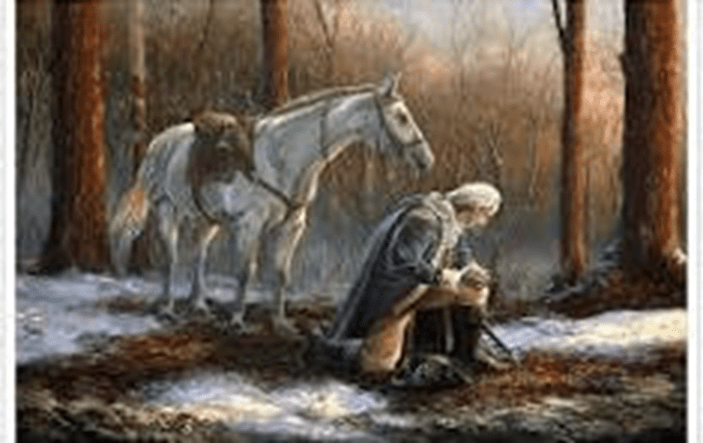
Eisenhower continued: “We remember the picture of the Father of our Country, on his knees at Valley Forge seeking divine guidance in the cold gloom of a bitter winter. Thus Washington gained strength to lead to independence a nation dedicated to the belief that each of us is divinely endowed with indestructible rights. We remember, too, that three-fourths of a century later, on the battle-torn field of Gettysburg, and in the silence of many a wartime night, Abraham Lincoln recognized that only under God could this Nation win a new birth of freedom.”

On February 20, 1955, President Dwight Eisenhower again addressed the Nation:  “The Founding Fathers recognizing God as the author of individual rights, declared that the purpose of Government is to secure those rights.  In many lands the State claims to be the author of human rights. If the State gives rights, it can – and inevitably will – take away those rights. Without God, there could be no American form of Government, nor an American way of life. Recognition of the Supreme Being is the first-the most basic-expression of Americanism.”

Ron


The Worst Supreme Court Decision in History

On September 21, 1996 the US Congress passed the Defense of Marriage Act. It was one of the most important and wonderful laws passed by Congress in modern times. Then, on June 26, 2015, the United States Supreme Court rendered its landmark Obergefell vs. Hodges decision which voided and wiped out the Defense of Marriage Act. It was one of the worst decisions of the Supreme Court in history. Below, I have chronicled these two events for you. And you just must understand them and how they changed US history.

As I mentioned above, this Public Law 104-199 (110 Statute 2419), passed by both Houses of Congress on September 21, 1996 was called The Defense of Marriage Act. Most legal analysts defined it as: “In determining the meaning of this Act of Congress, the word ‘marriage’ means only a legal union between one man and one woman as husband and wife, and the word ‘spouse’ refers only to a person of the opposite sex who is a husband or a wife.”

It was a good law. It upheld the meaning of marriage as expressed in the Bible and defined marriage as it was understood and acknowledged by most all of the population of America, both liberals and conservatives.

The Defense of marriage Act was not only acknowledge and welcomed by conservatives, but was welcomed by most all liberals in America. On September 21, 1996, President Bill Clinton signed the Defense of Marriage Act (DOMA) and stated: “I have long opposed governmental recognition of same-gender marriages and this legislation is consistent with that position.”

In 2000, Hillary Clinton stated: “Marriage has historic, religious and moral content that goes back to the beginning of time, and I think a marriage is as a marriage has always been, between a man and a woman.”

On February 2, 2004 Barack Obama stated in Chicago: “I am not a supporter of gay marriage. I think that marriage, in the minds of a lot of voters, has a religious connotation. I know that is true in the African-American community.”

So, the population all across America was very much in favor of the Defense of Marriage Act, including most all leaders, both private a governmental.

Then on June 26, 2015, the United States Supreme Court rendered its landmark Obergefell vs. Hodges decision, which stated that all states (1) must recognize marriage between two same-sex individuals within their state; and (2) must recognize marriages of same-sex couples performed in other states.

This amazing decision wiped out the Defense of Marriage Act and rendered it mute and ineffective. In 2015 we thought that the Supreme Court was conservative at that time. However, this decision proved otherwise. Legal analysts across the country could only say that there must have been a schism in the Supreme Court.

President Biden invited a drag queen, Marti Gould Cummings, to the White House to celebrate signing what is being referred to as the “Dis-Respect for Marriage Act,” effectively repealing the Defense of Marriage Act of 1996 and making the liberal Obergefell decision into a Federal law. This decision was a flagrant creation of federal law by the Supreme Court, as never intended by the Constitution.

Of the decision, Former Arkansas Governor Mike Huckabee stated: “This irrational, unconstitutional rejection of the expressed will of the people will prove to be one of the court’s most disastrous decisions. The Supreme Court isn’t the supreme branch. Five lawyers on the Supreme Court can no more repeal the laws of nature and nature’s God on marriage than they can the laws of gravity.

 Huckabee further added: “This irrational, unconstitutional decision threatens religious liberty — the heart of the 1st Amendment.  The Supreme Court is not the Supreme Being. The only outcome worse than this flawed, failed decision would be for the President and Congress, two co-equal branches of government, to surrender in the face of this out-of-control act of unconstitutional, judicial tyranny.”

Franklin Graham stated: “The court — since it never defined marriage — doesn’t have the right to redefine it. God gave us marriage. Period. And God doesn’t change his mind.

Graham stated further: “I’m disappointed because the government is recognizing sin. This court is endorsing sin. God gave marriage between a man and a woman and that’s what marriage is. If pastors are going to be forced to provide marriage services for gay couples, I’m not going to do it. Given the choice of obeying God or the government, I believe Christians will obey God, even if there is hell to pay.”

Abraham Lincoln stated in his Inaugural Address, March 4, 1861: “I do not forget the position assumed by some that constitutional questions are to be decided by the Supreme Court.

Lincoln stated further: “The candid citizen must confess that if the policy of the Government upon vital questions affecting the whole people is to be irrevocably fixed by decisions of the Supreme Court, the instant they are made, the people will have ceased to be their own rulers, having to that extent practically resigned their Government into the hands of the eminent tribunal.”

So, the Obergefell vs. Hodges decision is still the law of our land. And biological men are playing sports against girls and parading around naked in girl’s locker rooms. But I hope and pray that our Congress will pass a law to overturn and wipe-out the Obergefell vs. Hodges decision.

Jesus taught in Mark 10:6-9: “But from the beginning of the creation, God ‘made them male and female.’ For this reason a man shall leave his father and mother and be joined to his wife, and the two shall become one flesh.’”

The Obergefell vs. Hodges decision is being taught in many of our public Grade Schools, and is causing all manner of confusion to those young people. So, remember, Jesus added a warning in Matthew 18:6: “If anyone causes one of these little ones, those who believe in me to stumble, it would be better for them to have a large millstone hung around their neck and to be drowned in the depths of the sea.”

Ron
 

The Real History of Mother’s Day

(Tomorrow is Mother’s Day in America. So, I thought it would be very appropriate for me to give you the real history of the founding of that day in America. Do read it below so that you will know.)

After the Civil War, abolitionist Julia Ward Howe, writer of “The Battle Hymn of the Republic, led a Mother’s Day for Peace in New York on June 2, 1872, to promote peace, national healing and reconciliation. She composed a proclamation to “appeal to womanhood throughout the world”

Julia Ward Howe personally sponsored a Mothers’ Day celebration in Boston in for the next ten years till interest dwindled.

In the following decades, Protestant churches and schools observed Decision Day for committing to Christ, Roll Call Day for church membership, Missionary Day, Temperance Sunday, and Children’s Day. And numerous efforts arose for observing a Mother’s Day.

A suggestion for honoring motherhood was made by University of Notre Dame’s first athletic director, Frank Hering. In 1904, Hering observed a Notre Dame professor passing out penny postcards to students, with the instructions to write: “Anything. Anything at all as long as it’s to their mothers. We do this every month in this class. One day a month is mother’s day.”

Hering proposed “setting aside one day in the year as a nationwide memorial to the memories of mothers and motherhood,” stating: “Throughout history the great men of the world have given their credit for their achievements to their mothers. The Holy Church recognizes this, as does Notre Dame.”

Taking the day from a suggestion to a reality was Anna Jarvis. She is the person most responsible for making Mother’s Day a nationally observed event.

Anna was from Grafton, West Virginia, the granddaughter of a Baptist minister. She a member of Andrews Methodist Episcopal Church, where she taught Sunday school. In 1876, after one of her Bible lessons, Anna Jarvis closed with a prayer: “I hope and pray that someone, sometime, will found a memorial mothers day commemorating her for the matchless service she renders to humanity in every field of life. She is entitled to it.”

Similar to Clara Barton, founder of the American Red Cross, Anna Jarvis’ mother worked during the Civil War to organize Mothers’ Day Work Clubs to care for wounded soldiers, both Union and Confederate. Anna’s mother raised money for medicine, inspected bottled milk, and improved sanitation.

Anna’s mother raised money for medicine, inspected bottled milk, and improved sanitation. She arranged in 1868 a “Mother’s Friendship Day” — “to reunite families that had been divided during the Civil War.” She hired women to care for families where mothers suffered from tuberculosis, May 9, 1905. Inspired by her mother’s self-sacrifice and generosity, Anna Jarvis wanted to honor her and all mothers.

On May 12, 1907, Anna persuaded her church, Andrews Methodist Episcopal Church, to have a small Mother’s Day service. The church then agreed to set aside every year the 2nd Sunday in May, the anniversary of her mother’s death, as a day to show appreciation to all mothers — the makers of the home.

The next year, May 10, 1908, Anna organized a Mother’s Day two places: Andrews Methodist Episcopal Church, where she sent a telegram; and in Philadelphia, where she gave a moving speech in the auditorium of the 12-story Wanamaker Department Store.

John Wanamaker was a retail pioneer and founder of one the first department stores.

Wanamaker, who had paintings of Christ throughout his store, stated: “There is a power in the Gospel of the Lord Jesus Christ. Keep uppermost the profound conviction that it is the Gospel that is to win the heart and convert the world. The things that were sweet dreams in our childhood are now being worked out. The procession is being made longer and longer; the letters of Christ’s name are becoming larger and larger.”

With the financial backing of John Wanamaker and H.J. Heinz, maker of “57 varieties” of ketchup, Anna Jarvis began a letter-writing campaign to ministers and politicians to establish a “national” Mothers’ Day. Due to the overwhelming support of pastors and churches, by 1909, forty-five states observed Mother’s Day. People wore white and red Carnations on Sunday to pay tribute to their mothers. On May 8, 1914, Congress designated the second Sunday in May as Mother’s Day.

On MAY 9, 1914, President Woodrow Wilson proclaimed the first National Mothers’ Day as a: “public expression of love and reverence for the mothers of our country.”

President Reagan said in his Mother’s Day Proclamation, 1986: “A Jewish saying sums it up: ‘God could not be everywhere – so He created mothers.'”

Mothers have the role of imparting values into children, as American poet William Ross Wallace wrote: “The hand that rocks the cradle is the hand that rules the world.'”

Dr. James Dobson addressed the National Religious Broadcasters, Feb. 16, 2002: “If they can get control of children they can change the whole culture in one generation.”

On February 3, 1983, at the annual National Prayer Breakfast, President Ronald Reagan stated:

“I have a very special old Bible.

And alongside a verse in the Second Book of Chronicles there are some words, handwritten, very faded by now. And believe me, the person who wrote these words was an authority. Her name was Nelle Wilson Reagan. She was my mother.”

Reagan stated: “Freedom is never more than one generation away from extinction. We didn’t pass it to our children in the bloodstream. It must be fought for, protected, and handed on for them to do the same, or one day we will spend our sunset years telling our children and our children’s children what it was once like in the United States where men were free.”

On Mother’s Day, May 8, 2020, President Donald J. Trump proclaimed: “We celebrate the exceptional mothers in our lives, whether they became mothers through birth, adoption, foster care, or other means, these women are deserving of our unending gratitude and praise this day and every day. The intuition and wisdom passed from mother to child strengthens the fabric of our Nation and preserves generations of wisdom and familial values. In our earliest days, our mothers provide us with love and nurturing care. They often know our talents before we do, and they selflessly encourage us to use these God-given gifts to pursue our biggest dreams. I encourage all Americans to express their love and respect for their mothers, whether with us in person or in spirit, and to reflect on the importance of motherhood to the prosperity of our families, communities, and Nation.”

The Apostle Paul wrote to Timothy (2 Timothy 1:5): “I have been reminded of your sincere faith, which first lived in your grandmother Lois and in your mother Eunice and, I am persuaded, now lives in you also.

Abraham Lincoln’s father Thomas married Nancy Hanks in 1806. He took her to the humble cabin he had prepared for her, and within the first few years of her married life, she bore him three children. The first was a daughter named Sarah, who died; the third was a son (Thomas) who died in infancy. The second was Abraham, who, born into the humblest abode, under the humblest circumstances under the blessing of a Providence which he always recognized.

Mrs. Lincoln, the mother, was evidently a woman out of place among those primitive surroundings. She was five feet, five inches high, a slender, pale, sad and sensitive woman, with much in her nature that was truly heroic.”

In Holland’s The Life of Abraham Lincoln (1866) it says: “Those who knew the tender and reverent spirit of Abraham Lincoln later in life, will not doubt that he returned to his cabin-home deeply impressed by all that he had heard. It was the rounding up for him of the influences of a Christian mother’s life and teachings. It recalled her sweet and patient example, her assiduous efforts to inspire him with pure and noble motives, her simple instructions in divine truth, her devoted love for him, and the motherly offices she had rendered him during all his tender years. His character was planted by this Christian mother’s love.”

The Life of Abraham Lincoln (1866) recounted: “Providence began at his mother’s knee, and ran like a thread of gold through all the inner experiences of his life. This great man never drew his infant life from a purer or more womanly bosom than her own; and Mr. Lincoln always looked back to her with an unspeakable affection. Long after her sensitive heart and weary hands had crumbled into dust; he said to a friend, with tears in his eyes: ‘All that I am, or hope to be, I owe to my angel mother!'”

Lincoln wrote: “I remember my mother’s prayers and they have always followed me. They have clung to me all my life.”

Ron
 

The Amazing Francis Asbury

(This amazing man, who you have probably never even heard of, was so important if not more so, than anyone else in the founding of America.  Do, for sure, learn about him here:)

In 1735, a young Oxford graduate named John Wesley was sent as the Anglican minister to the new American Colony of Georgia. He sailed on a ship called the Simmons.

The Simmonds, was also carrying a group of 25 German Moravian missionaries, as Wesley noted in his journal: “Sunday, January 25, 1736 at seven I went to the Germans (Moravians). I had long before observed their humility by performing those servile offices for the other passengers, which none of the English would undertake saying ‘their loving Savior had done more for them’ If they were pushed, struck, or thrown down, they rose again and went away; but no complaint was found in their mouth.”

On the Wesleys’ trip to Georgia, their ship, the Simmonds, was caught in a terrible storm which shredded the main sail and flooded the deck.

John Wesley saw how everyone panicked in fear except for the Moravians, who continued to sing praise songs. He noticed their relationship with the Lord was closer than his, as he wrote in his journal: “There was now an opportunity of trying whether they were delivered from the spirit of fear. In the midst of the psalm wherewith their service began, the sea broke over, split the main-sail in pieces, covered the ship, and poured in between the decks, as if the great deep had already swallowed us up. A terrible screaming began among the English.

The Germans (Moravians) calmly sung on. I asked one of them afterwards, ‘Was you not afraid?’ He answered, ‘I thank God, no.’ I asked, ‘But were not your women and children afraid?’ He replied, mildly, ‘No; our women and children are not afraid to die.’ From them I went to their crying, trembling neighbors, and pointed out to them the difference in the hour of trial, between him that feareth God, and him that feareth him not. At twelve the wind fell. This was the most glorious day which I have hitherto seen.”

John Wesley was unsuccessful in his ministry in Georgia, and after a year, the he sailed back to England. Depressed at his failure, he accepted an invitation to attend a Moravian prayer meeting in Aldersgate in May of 1738. John was touched by the Holy Spirit and had a profound conversion experience, writing that his “heart strangely warmed.” He wrote in his journal after the prayer service: “I felt I did trust in Christ, Christ alone, for salvation; and an assurance was given me that He had taken away my sins, even mine, and saved me from the law of sin and death.”

Later in 1738, John Wesley traveled to Moravia in eastern Germany where he lived and worshiped for several months with Count Ludwig von Zinzendorf and the Moravian believers, experiencing first hand their sincere Christianity, being “the religion of the heart.” Wesley wrote in his journal: “God has given me, at length, the desire of my heart. I am with a church in whom is the mind of Christ, and who so walk as He walked.

John Wesley left Germany and returned to England, where he and his brother, Charles, began a revival movement within the Anglican Church called Methodism.

John preached thousands of sermons and organized a system of itinerate preachers who traveled through shires and towns in England in a circuit, or a circle of towns. John Wesley spoke of the inner witness of the presence of the Holy Spirit in one’s heart, as: “An inward impression on the soul of believers, whereby the Spirit of God directly testifies to their spirit that they are the children of God.”

Someone who was inspired by John Wesley to be an Anglican Methodist lay minister was 18-year-old Francis Asbury, born August 20, 1745.

(So, all the story about John Wesley is really just background; for the one that I really want you to know about is…..Francis Asbury.)

At the age 22, Francis Asbury was appointed by John Wesley to be a traveling preacher across England.

In 1771 most all of the preachers in America had died or were killed by the Indians. There was a great need for someone to go there and preach the gospel to the settlers Francis Asbury, at the age of 26, volunteered.

In 1771, Francis Asbury arrived in America, and for the next 45 years, he rode 300,000 miles on horseback, from the Atlantic to the Appalachians, from Maine to the Gulf of Mexico, spreading the Gospel. He became one of the primary forces and influences on the founding of America, though few today have ever heard of him.

In English colonies, everyone paid taxes to the King’s government, and the government paid the salaries of the Anglican pastors. Pastors lived on church-government owned farms called “glebes.”

On July 9, 1776, patriots in New York pulled down the statue of King George.

Several American colonies made it an act of treason for pastors to continued saying public prayers for the King. As the Revolution progressed, Anglican ministers faced a crisis of conscience. They had to choose between allegiance to the King and state, or allegiance to the patriotic American cause. The problem was, if they joined with those fighting for independence, they would lose their means of livelihood. As a result, most Anglican ministers returned to England, but Francis Asbury was one of the few who chose to stay in America.

Asbury stated: “I can by no means agree to leave such a field for gathering souls to Christ as we have in America.” Francis Asbury preached over 16,000 sermons in churches, town squares and court houses, addressing everyone he met, from travelers to workers in the fields to laborers in tobacco houses. He rode an average of 6,000 miles a year.

Episcopal ministers, Rev. William Smith of Maryland and Rev. William White of Philadelphia, in 1786, proposed a revised Book of Common Prayer where references to the King were replaced with references to Congress. Near that same time, at the Baltimore Christmas Conference in 1784, Francis Asbury moved the Methodist revival movement into its own denomination – the Methodist Episcopal Church.

Francis Asbury

Besides the Methodist Episcopal church the colonies had Presbyterians, Congregationalists, Puritans, Separatists, Pilgrims, Quakers, and Baptists.

Why so many churches? Answering that question is Robert D. Woodberry, assistant professor of sociology at the University of Texas–Austin who stated: “When Luther in 1521 defied an imperial order to recant by insisting that ‘my conscience is captive to the Word of God,’ he stopped being the reformer of an old order and instead became the founder of a new stream of Christianity. He could flout the commands of popes, church councils, and emperors, but not those of his own individual conscience.”

Woodberry continued: “Most Protestants follow his lead. They tend to believe that people can acquire saving faith only as they personally and individually appropriate God’s Word. They tend toward separation and independence from ancient church structures and traditions as well as political authorities. The main reason for this is the important role of individual conscience. Because saving faith must be uncoerced and individual, it requires in practice a diversity of independent churches to satisfy the inevitable diversity of individual consciences.”

So, how did diversity of churches lay the foundation for American independence? Woodberry at U.T. Austin explained: “’The authority of Christ,’ wrote the Scots Calvinist divine William Graham in 1768, ‘removes all civil distinctions. All are upon a level equally, as they shall soon be before the awful tribunal of the great Judge.’ This stirring fusion of theology, eschatology, and politics not only characterizes Scottish Calvinism but also says much about the relationship between Protestantism and democracy.”

Rather than view the many denominations negatively, it was instead viewed positively, that they would be a check on each other to insure no one would be established as the official state denomination.

Charles Carroll, the only Catholic to sign the Declaration, wrote to Rev. John Stanford, October, 9, 1827: “Observing the Christian religion divided into many sects, I founded the hope that no one would be so predominant as to become the religion of the state. That hope was thus early entertained because all of them joined in the same cause.”

So, Rev. Francis Asbury stated: “We should so work as if we were to be saved by our works; and so rely on Jesus Christ, as if we did no works. My soul is more at rest from the tempter when I am busily employed.”

Francis Asbury wrote: “My desire is to live more to God today than yesterday, and to be more holy this day than the last. God is gracious beyond the power of language to describe. O what pride, conforming to the world and following its fashions! Warn them, warn them for me, while you have strength and time and be faithful to your duty. Preach as if you had seen heaven and its celestial inhabitants, and had hovered over the bottomless pit, and beheld the tortures, and heard the groans of the damned.”

Francis Asbury’s leadership resulted in the Methodist Church in America growing from just 1,200 people to 214,000, with 700 ordained minsters, by the time of his death in 1816.

Shortly after being sworn in as the first President, George Washington was visited in New York on May 19, 1789, by Methodist Bishop in America, Francis Asbury. The Bishop greeted Washington with the words: “We express to you our sincere congratulations, on your appointment to the presidentship of these States. We place as full a confidence in your wisdom and integrity, for the preservation of those civil and religious liberties which have been transmitted to us by the Providence of GOD. Dependence on the Great Governor of the Universe which you have repeatedly expressed, acknowledging Him the source of every blessing, and particularly of the most excellent Constitution of these States, which is at present the admiration of the world.”

Asbury continued: “We enjoy a holy expectation that you will always prove a faithful and impartial patron of genuine, vital religion— the grand end of our creation and present probationary existence. We promise you our fervent prayers to the Throne of Grace, that GOD Almighty may endue you with all the graces and gifts of his Holy Spirit, that may enable you to fill up your important station to His glory.”

On May 29, 1789, President Washington wrote a reply: “To the Bishop Asbury of the Methodist-Episcopal Church: I return to you my thanks for the demonstrations of affection and the expressions of joy on my late appointment. It shall still be my endeavor to contribute towards the preservation of the civil and religious liberties of the American people. I hope, by the assistance of Divine Providence, not altogether to disappoint the confidence which you have been pleased to repose in me; in acknowledgments of homage to the Great Governor of the Universe”

Washington continued: “I trust the people of every denomination will have every occasion to be convinced that I shall always strive to prove a faithful and impartial patron of genuine, vital religion. I take in the kindest part the promise you make of presenting your prayers at the Throne of Grace for me, and that I likewise implore the Divine benediction on yourselves and your religious community.”

Francis Asbury’s carriage driver and traveling assistant was “Black Harry” Hosier.

He had been at Asbury’s Christmas Conference of December 24, 1784, which began the Methodist Church. Though illiterate, Hosier listened to Francis Asbury’s sermons and memorized long passages of Scripture. “Black Harry” Hosier became one of the country’s most popular preachers, drawing crowds in Virginia, North Carolina, South Carolina, Boston, Connecticut, Philadelphia, Delaware, Baltimore and New York. Hosier rejected slavery, lifted up the common working man, and charged audiences “that they must be holy.” Hosier’s popularity gave birth to the name “Hoosier” being used to refer to persons of humble, low-born background who firmly held to fundamental Bible values, as the settlers who crossed the Ohio River to the Indiana shore.

President Calvin Coolidge unveiled an Equestrian Statue of Francis Asbury in Washington, D.C., 1924, stating: “Francis Asbury, the first American Bishop of the Methodist Episcopal Church made a tremendous contribution.”

Coolidge continued: “Our government rests upon religion. It is from that source that we derive our reverence for truth and justice, for equality and liberty, and for the rights of mankind. Unless the people believe in these principles they cannot believe in our government. Calling the people to righteousness (was) a direct preparation for self-government. It was for a continuation of this work that Francis Asbury was raised up.”

Coolidge added: “The government of a country never gets ahead of the religion of a country. There is no way by which we can substitute the authority of law for the virtue of man. Real reforms which society in these days is seeking will come as a result of our religious convictions, or they will not come at all. Peace, justice, humanity, charity—these cannot be legislated into being. They are the result of a Divine Grace .”

Coolidge continued about Francis Asbury: “Frontier mothers must have brought their children to him to receive his blessings! It is more than probable that Nancy Hanks, the mother of Lincoln, had heard him in her youth. Adams and Jefferson must have known him, and Jackson must have seen in him a flaming spirit as unconquerable as his own. He is entitled to rank as one of the builders of our nation. On the foundation of a religious civilization which he sought to build, our country has enjoyed greater blessing of liberty and prosperity than was ever before the lot of man. These cannot continue if we neglect the work which he did.”

Coolidge concluded: “We cannot depend on the government to do the work of religion. I do not see how anyone could recount the story of this early Bishop (Asbury) without feeling a renewed faith in our own country.”

Squanto

To aid the founding of America, God himself prepared a special man to make it happen. Without him and God’s preparation of him, the Pilgrims would never have survived at all. Do read about this amazing man and God’s miraculous preparation of him for the founding of America below:

The Amazing Squanto

In November of 1620 the Pilgrims left English persecution in Europe and sailed to America with a government charter to set up a new colony south of what we now call New England. Because of storms they landed much farther north than their charter called for. Without such a charter directed location, they formed their own republican type government with what was called the Pilgrim Compact, since their ship captain would not take them south to their designated location.

They were not experienced for life in the wilderness and did not even have the proper clothing for such. As a result half of them died in that first terrible winter. Then when warm weather finally came this English speaking indain came to them, named Squanto. He had been a member of the tribe who formerly lived at their location of Plymouth. All of his very vicious tribe had died of the plague shortly before their arrival.

Several years before, Squanto had been lured onto an English ship which stopped there. He was taken to Spain and sold into the slave market. An English nobelman wound up with him and taught him Christianity, English ways, and language. However, he was finally able to get bact to his origianal tribal location. With all of his tribe dead, he took-up with a neighboring tribe. The Pilgrims found it amazing when he knocked on their door and said: “What are you doing here brothers and sisters in Christ?”

Squanto stayed with them and taught them how to successfully grow corn by putting a fish under each plant. He taught them how to fish and hunt and live in the wilderness. However, his greatest contribution was making treaties with all the neighboring tribes for their safety. The Pilgrims survived, when most all of the other colonies founded at that time were wiped-out be the indians. The Pilgrims knew for sure that God had arranged for Squanto to go to England, learn English, become a Christian, come back, and teach them how to survive. They knew that it was all a miracle directly from God.

Following is the story of Squanto as told by the Pilgrim leaders, in their own verbatim words. If you would like to read Squanto’s story exactly as they told it, please do below:

Of 102 Pilgrims that landed on the shores of Massachusetts in November of 1620, only half survived till Spring.

In the Spring of 1621, as recorded by Pilgrim Governor William Bradford in his Of Plymouth Plantation: “About the 16th of March, a certain Indian came boldly amongst them and spoke to them in broken English. His name was Samoset. He told them also of another Indian whose name was Squanto, a native of this place, who had been in England and could speak better English than himself.”

Samoset’s initial visit to the Pilgrims was recorded in Mourt’s Relation, written by Edward Winslow and Governor William Bradford in 1622: “Friday the 16th a fair warm day towards; this morning we determined to conclude of the military orders, which we had begun to consider of before but were interrupted by the savages, as we mentioned formerly; and whilst we were busied hereabout, we were interrupted again, for there presented himself a savage, which caused an alarm. He very boldly came all alone and along the houses straight to the rendezvous, where we intercepted him, not suffering him to go in, as undoubtedly he would, out of his boldness.

He saluted us in English, and bade us welcome, for he had learned some broken English among the Englishmen that came to fish at Monchiggon, and knew by name the most of the captains, commanders, and masters that usually come. He was a man free in speech, so far as he could express his mind, and of a seemly carriage. We questioned him of many things; he was the first savage we could meet withal.

We questioned him of many things; he was the first savage we could meet withal. He said he was not of these parts, but of Morattiggon, and one of the sagamores or lords thereof, and had been eight months in these parts, it lying hence a day’s sail with a great wind, and five days by land. He discoursed of the whole country, and of every province, and of their sagamores, and their number of men, and strength. The wind being to rise a little, we cast a horseman’s coat about him, for he was stark naked, only a leather about his waist, with a fringe about a span long, or little more; he had a bow and two arrows, the one headed, and the other unheaded. He was a tall straight man, the hair of his head black, long behind, only short before, none on his face at all; he asked some beer, but we gave him strong water and biscuit, and butter, and cheese, and pudding, and a piece of mallard, all which he liked well, and had been acquainted with such amongst the English.”

Mourt’s Relation continued:

“(Samoset) told us the place where we now live is called Patuxet, and that about four years ago all the inhabitants died of an extraordinary plague, and there is neither man, woman, nor child remaining, as indeed we have found none, so as there is none to hinder our possession, or to lay claim unto it.

All the afternoon we spent in communication with him; we would gladly have been rid of him at night, but he was not willing to go this night. Then we thought to carry him on shipboard, wherewith he was well content, and went into the shallop (small boat), but the wind was high and the water scant, that it could not return back. We lodged him that night at Stephen Hopkins’ house, and watched him.”

“The next day he went away back to the Massasoits, from whence he said he came, who are our next bordering neighbors. They are sixty strong, as he saith. The Nausets are as near southeast of them, and are a hundred strong, and those were they of whom our people were encountered, as before related. They are much incensed and provoked against the English, and about eight months ago slew three Englishmen, and two more hardly escaped by flight to Monchiggon; they were Sir Ferdinando Gorges his men, as this savage told us. These people are ill affected towards the English, by reason of one (Thomas) Hunt, a master of a ship, who deceived the people, and got them under color of trucking (bartering) with them, twenty out of this very place where we inhabit, and seven men from Nauset, and carried them away, and sold them for slaves like a wretched man (for twenty pound a man) that cares not what mischief he doth for his profit. Saturday, in the morning we dismissed the savage, and gave him a knife, a bracelet, and a ring; he promised within a night or two to come again, and to bring with him some of the Massasoits, our neighbors, with such beavers’ skins as they had to truck with us.”

Governor Bradford wrote that a few days later, “Tishsquantum,” or Squanto arrived with the neighboring Wampanoag Chief Massasiot: “Massasoyt, who about four or five days after, came with the chief of his friends and other attendants, and with Squanto. With him, after friendly entertainment and some gifts, they made a peace which has now continued for twenty-four years.”

Governor Bradford described Squanto: “Squanto stayed with them and was their interpreter and was a special instrument sent of God for their good beyond their expectation. He showed them how to plant corn, where to take fish and other commodities, and guided them to unknown places, and never left them till he died.”

Bradford added: “The settlers, as many as were able, then began to plant their corn, in which service Squanto stood them in good stead, showing them how to plant it and cultivate it. He also told them that unless they got fish to manure this exhausted old soil, it would come to nothing, and he showed them that in the middle of April plenty of fish would come up the brook by which they had begun to build, and taught them how to catch it, and where to get other necessary provisions; all of which they found true by experience. Nor was there a man among them who had ever seen a beaver skin till they came out, and were instructed by Squanto.”

Though records are scarce, it appears that Squanto may have been one of the five natives kidnapped around 1605 by Captain George Weymouth’s expedition. Sailing his ship Archangel, Weymouth was employed by the newly formed British East India Company to find a Northwest Passage to India and China. Sea voyages to find a Northwest Passage were first conceived after the Muslim Ottoman Turks had cut off the eastern land routes to India and China a century and a half earlier. Captain George Weymouth brought the natives back to England where they were introduced to William Shakespeare and the Earl of South Hampton, who funded both Shakespeare and the voyages. Three of the natives went to live in Plymouth, England, with Sir Ferdinando Gorges, who also funded the expedition and later, the settlement of Maine.

In A Briefe Narration of the Originall Undertakings for the Advancement of Plantations into the Parts of America (London: 1658), Sir Ferdinando Gorges mentioned the name “Tasquantum’: “(Captain George Weymouth, having failed at finding a Northwest Passage) happened into a River on the Coast of America, called Pemmaquid, from whence he brought five of the Natives, three of whose names were ManidaSellwarroes, and Tasquantum, whom I seized upon, they were all of one Nation, but of several parts, and several Families; This accident must be acknowledged the means under God of putting on foot, and giving life to all our Plantations.”

In 1614, an expedition sailed to map the coast of New England, with Squanto traveling along as interpreter. At this time, Squanto was able to return to his tribe of Patuxet.

(And as these Pilgrim leaders describe again.) In 1614, Squanto was kidnapped along with some other natives, by the wretched Captain Thomas Hunt, who took them to Malaga, Spain, a city notorious for slave trading, begun during its Muslim occupation. Had the Muslim Ottoman Empire not been occupied from the 15th to 17th centuries with conquests in Venice, Wallachia, Moldava, Hungary, Rhodes, Malta, Cyprus, Austria, and Poland-Lithuania, it may have colonized the New World, and native American culture may have been completely erased and replaced with Islamic culture, just as the Byzantine Christian culture was replaced in Turkey.
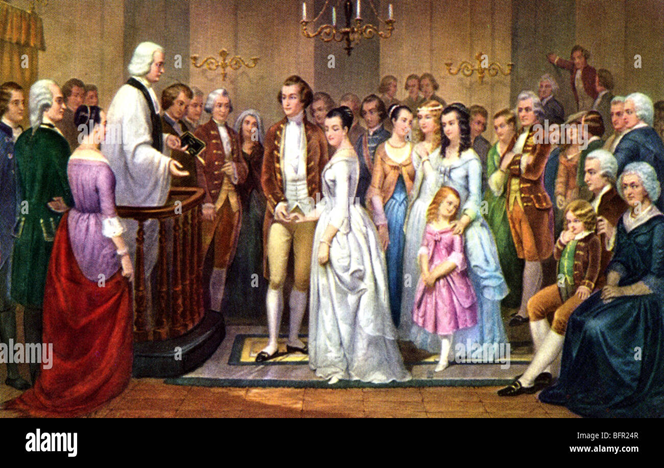
In Spain, Squanto appears to have been rescued by some Catholic friars, who may have introduced him to some Christian concepts. They proceeded to give him his freedom. Sir Ferdinando Gorges wrote in A briefe relation of the discovery and plantation of New England (1622: London), that Captain Thomas Hunt was able to sell a few natives, but when “friars of those parts” discovered his unscrupulous activity, they took the rest of the natives to be “instructed in the Christian Faith; and so disappointed this unworthy fellow of his hopes of gain.”

The friars gave Squanto his freedom and he made his way to England, where he was hired by John Slaney, treasurer of the Newfoundland Account. He then worked for Newfoundland Colony Governor John Mason, who was later granted the patent for New Hampshire. Squanto then worked for Captain Thomas Dermer, an agent of Sir Ferdinando Gorges.

Governor Bradford wrote: “Squanto was a native of these parts, and had been one of the few survivors of the plague hereabouts. He was carried away with others by one Hunt, a captain of a ship, who intended to sell them for slaves in Spain.”

Bradford continued: “(Squanto) got away for England, and was received by a merchant in London, and employed in Newfoundland and other parts, and lastly brought into these parts by a Captain Dermer, a gentleman employed by Sir Ferdinand Gorges.”

(And taking up the story of Squanto again.) In 1619, Squanto was finally able to return to his Patuxet tribe, but sadly found that they had all died in a plague. As tragic as his kidnapping had been, it may have saved Squanto from dying in that plague.

As Governor William Bradford relates: “About three years before, a French ship was wrecked at Cape Cod, but the men got ashore and saved their lives and a large part of their provisions. When the Indians heard of it, they surrounded them and never left watching and dogging them till they got the advantage and killed them, all but three or four, whom they kept, and sent from one Sachem to another, making sport with them and using them worse than slaves.”

Other such accounts were related by French Catholic missionaries. Though they were unarmed and sought to peacefully reach natives, many suffered the fate of martyrs. One was Fr. Isaac Jogues, who taken prisoner by the Iroquois in 1641. Indians gnawed off two of his fingers and roughly sawed off his thumb. He was forced to run the deadly gauntlet, as described in The Jesuit Martyrs of North America, but before they could kill him, he escaped. He wandered till he found some Dutch fur traders who helped him make his way back to Quebec. From there, he was able to sail back to France.

Isaac Jogues later returned to America to continue his missionary work, where he was eventually killed

Bradford concluded more of the story of Squanto: “In Manamiock Bay where Squanto had gone to help Captain Standis as a guide, He fell ill of Indian fever, bleeding much at the nose, which the Indians take for a symptom of death, and within a few days he died. He begged the Governor to pray for him, that he might go to the Englishmen’s God in Heaven, and bequeathed several of his things to some of his English friends, as remembrances. His death was a great loss.”

As half of the Pilgrims died that first winter, there was the real possibility that they would not have survived another, had it not been for Squanto. 

Governor Bradford acknowledged:

“Squanto was a special instrument sent of God for their good beyond their expectation.