I pray that the eyes of your heart may be enlightened, so that you will know what is the hope of His calling, what are the riches of the glory of His inheritance.
What do think of when you hear the word heir? Does it evoke images of wealth handed down through generations? Perhaps it reminds you of someone you love who has passed away.
The truth is, not many people inherit a vast estate or receive great gifts from wealthy relatives. But when Jesus becomes your Savior, He makes you a co-heir of all God’s immeasurable riches (Romans 8:16-17). He wants to be your fullness and abundant supply for every aspect of your life.
Do you need strength? God has all power and gives you energy for every task. Do you lack wisdom? He provides discernment and insight that can cut through even the densest fog of confusion. Are you searching for contentment? Jesus gives you peace beyond human understanding. Friend, material wealth can be depleted and taken away. But the inheritance you have in Christ is unchanging and inexhaustible forever. Therefore, embrace how rich you truly are in Him.
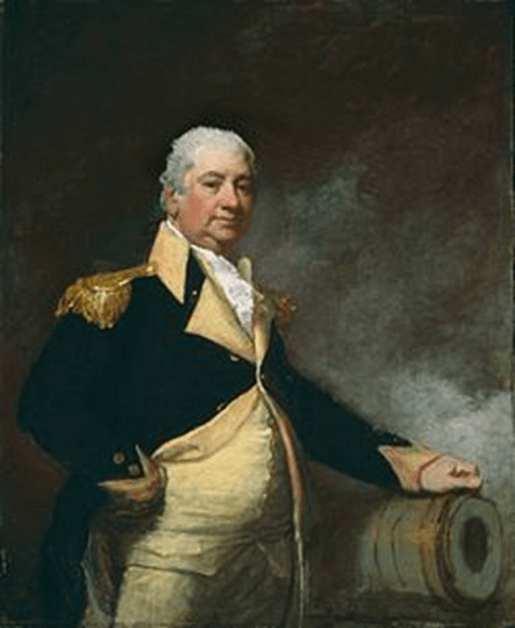
(General Thomas Gage had blockaded Boston and occupied it with 4,000 troops. Boston harbor was filled with his whole fleet. It was his plan to leave and burn the whole town to the ground as he left. General Washington knew that 300 miles north, on the Canadian border, Fort Ticonderoga had 59 large, long-range cannons. General Washington sent young Henry Knox way up there in the dead of winter to bring those cannons back down to Boston. Through amazing innovations and great difficulty, braving vicious blizzards, Knox got all of them back down to Boston.
In the dead of night General Washington got all of them up onto the high bluffs overlooking Boston and its harbor. The next morning when General Gage saw that look line of cannons looking down on him; he knew that General Washington could destroy his whole fleet right there. This changed the whole complex of the war for independence.
Do read the story below to see what happened, and the rest of the life and exploits of the amazing Henry Knox.)
William Knox had emigrated from Scotland to Ireland; then to the West Indies; then to Boston in 1728.He helped establish the Church of the Presbyterian Strangers. William Knox died in 1762 while on business in the West Indies.
His 12-year-old son, Henry Knox, began supporting the family by working as a bookbinder at Wharton and Bowe’s Book Store.
In 1771, at the age of 21, Knox opened his own bookstore in Boston. At age 23, while hunting birds on Noddle Island, his fowling piece misfired, taking off two fingers of his left hand. From then on, when in public, he covered that hand with a handkerchief.
A young woman who frequented Henry’s book shop was Lucy Flucker, whose father was Thomas Flucker, the Royal Secretary of the Province of Massachusetts.
To her father’s disapproval, Henry and Lucy fell in love. Her parents considered Henry in a lower class, and were put off because he associated with patriotic rebels. They tried to entice Henry to take a commission serving the King in the British Artillery, but he refused.
When Henry and Lucy were married, June 16, 1774, her parents disowned her.
Henry Knox witnessed the Boston Massacre in 1770. Then during the Boston Tea Party in 1773, Henry, who was six feet tall and over 250 pounds, served on guard duty to make sure no tea was unloaded from the ship Dartmouth until the night Sam Adams and the Sons of Liberty arrived.
On May 13, 1774, British General Thomas Gage arrived as Military Governor of Massachusetts. On June 1, 1774, Gage commenced a blockade of Boston’s Harbor by British ships. Knox experienced the resulting city’s deprivation.
With 4,000 British troops, Gage imposed a military occupation, confiscating over 2,000 muskets from the citizens. He prohibited town hall meetings, complaining that “democracy is too prevalent in America.”
Gage had Knox’s name put on a list of the most dangerous persons. Gage made Boston a prison. No one was permitted to leave.
The British looted Henry’s bookshop and used his home to lodge soldiers. One night in the spring of 1775, 25-year-old Henry, and his 19 -year-old wife, fled on horseback out of Boston. Lucy had sewn his sword inside her cape.
In March of 1775, Parliament replaced Thomas Gage with British Commander William Howe. Howe filled Boston with 4,500 more troops.
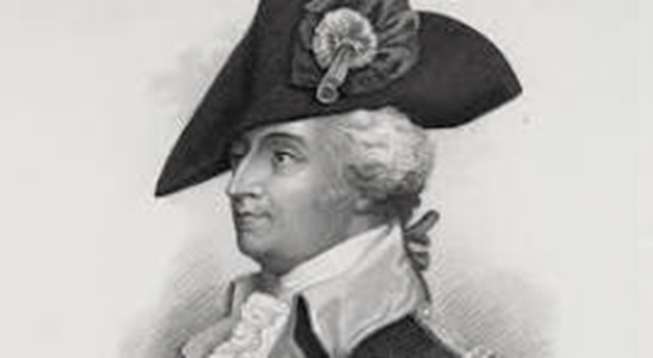
The Battle of Bunker Hill soon followed on June 17, 1775. Knox volunteered to serve in the American military. General George Washington, age 43, made Henry Knox a colonel because of his amazing exploits while fighting in that battle.
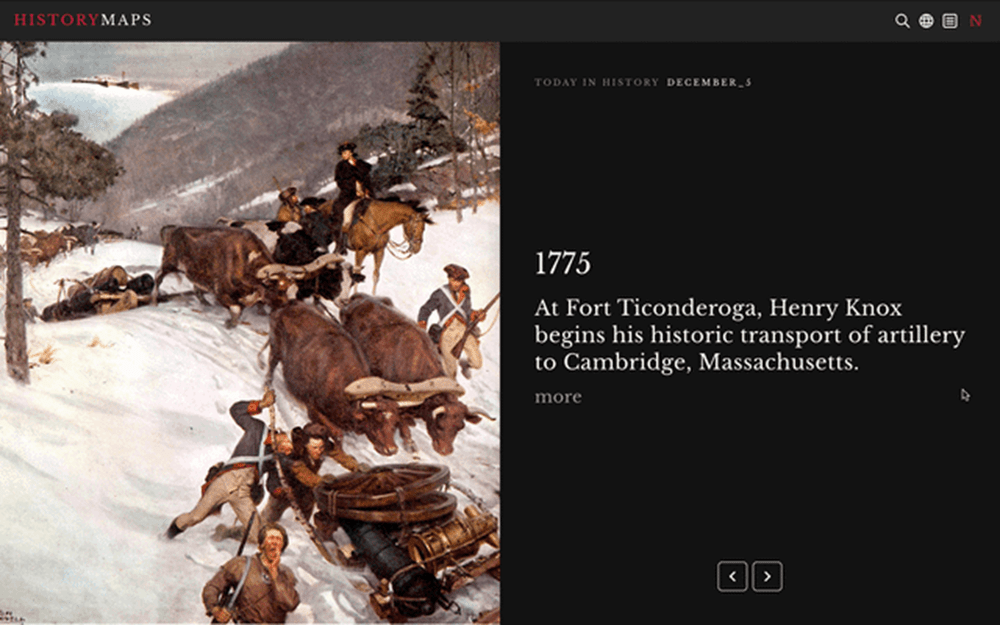
On December 1, 1775, General Washington sent Colonel Henry Knox to Fort Ticonderoga in upstate New York near Canada to bring 59 cannons to Boston to drive out the British.
Knox and his men arrived at Fort Ticonderoga. Knox put the cannons on big flat-bottomed boats, and rowed them through freezing weather to the southern end of Lake George. Knox dragged the cannons across the snow, as he reported to Washington, December 17, 1775: “I have had made 42 exceedingly strong sleds and have provided 80 yoke of oxen to drag them as far as Springfield where I shall get fresh cattle to carry them. I hope in 16 or 17 days to be able to present your Excellency a noble train of artillery.”
They arrived at the Hudson River, but the ice was not thick enough to support the sleds and one sank. On January 8, 1776, Knox wrote in his diary that local pastors organized farmers to help: “Went on the ice about 8 o’clock in the morning and proceeded so carefully that before night we got over 23 sleds and were so lucky as to get the cannon out of the River, owing to the assistance the good people of the city of Albany gave.”
The 3 month endeavor of dragging the cannons over 300 miles from Ft. Ticonderoga to Boston was called by historian Victor Brooks “one of the most stupendous feats of logistics ever performed in Young America.”
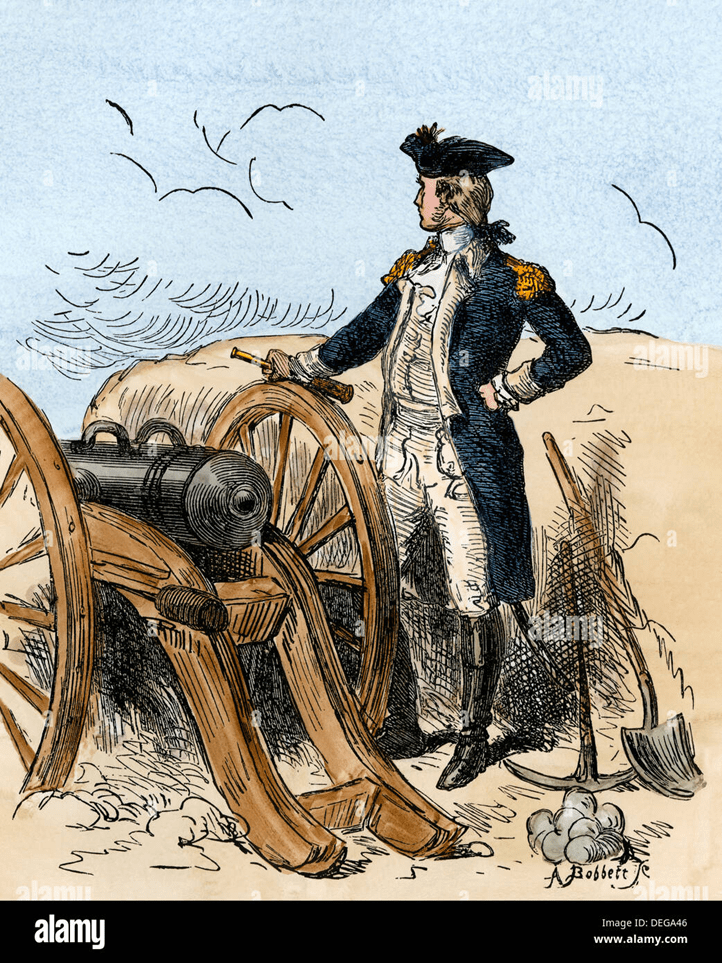
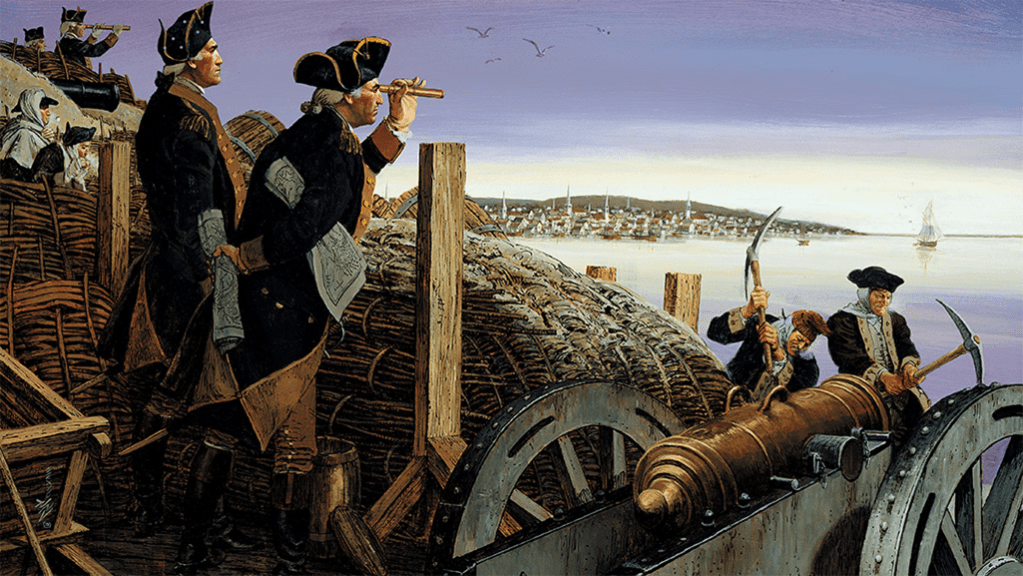
Knox arrived at Cambridge, Massachusetts. On the night of March 4th, a diversionary attack was made to distract the British, while Washington’s men wrapped the wagon wheels with straw to muffle the noise and frantically moved the cannons up to a strategic point on Dorchester Heights overlooking Boston Harbor.
To make it appear even more impressive, they painted some logs to look like cannons. The next morning an astonished British General William Howe looked up at Dorchester Heights and remarked: “The rebels did more in one night than my whole army would have done in one month.”
On March 6, 1776, from his Cambridge Headquarters, General Washington ordered: “Thursday, the 7th being set apart by this Province (Massachusetts) as a Day of Fasting, Prayer and Humiliation, to implore the Lord and Giver of all victory to pardon our manifold sins and wickedness, and that it would please Him to bless the Continental army with His divine favor and protection,’ all officers and soldiers are strictly enjoined to pay all due reverence and attention on that day to the sacred duties to the Lord of hosts for His mercies already received, and for those blessings which our holiness and uprightness of life can alone encourage us to hope through His mercy obtain.”
Coincidentally, on that Day of Fasting, March 7, 1776, General Howe was assembling 3,000 troops to land and charge up Dorchester Heights, but a violent snowstorm arose causing the sea to be too turbulent for the attack.
General Washington wrote his younger brother, John Augustine Washington, March 31, 1776: “Upon their discovery of the works (cannons on Dorchester Heights) next morning, great preparations were made for attacking them; but not being ready before the afternoon, and the weather getting very tempestuous, much blood was saved and a very important blow prevented. That this most remarkable Interposition of Providence is for a wise purpose, I have not a doubt.”
Rev. Alexander MacWhorter, who was a chaplain with Henry Knox’s brigade, wrote December 12, 1799: “General Washington attended divine services with his brigades. He considered the distinction of the great denominations of Christianity rather as necessary shades of differences, than anything substantial or essential to salvation.”
Because of that massive array of cannon looking down on them, on March 8, General Howe sent word to Washington that if the British were allowed to leave Boston unmolested, they would not burn the city on their way out.
Eights days passed, and on March 16, 1776, the Continental Congress approved without dissent a Day of Fasting: “Congress desirous to have people of all ranks and degrees duly impressed with a solemn sense of God’s superintending providence, and of their duty, devoutly to rely on his aid and direction do earnestly recommend a Day of Humiliation, Fasting and Prayer; that we may, with united hearts, confess and bewail our manifold sins and transgressions, and, by sincere repentance and amendment of life, appease God’s righteous displeasure, and, through the merits and mediation of Jesus Christ, obtain this pardon and forgiveness.”
The next day, March 17, 1776, British General Howe finally gave the order to his troops to board their ships and evacuate Boston. Sailing away with the British forces were nearly a thousand British loyalists. Among them were Lucy Knox’s parents, the Fluckers. She never saw them again.
Being newlyweds when the war started, Henry was separated from his wife, Lucy, for months at a time. He wrote to her: “I maledict this war only because it separates me from my Love. No man on earth separated from all that he holds Dear on earth has ever suffer’d more than I have suffer’d in being absent from (my Love) whom I hold dearer than every other object I think of rarely any thing else. Indeed, my dear Girl, I love you too well to be separated from you at all.”
Henry wrote to Lucy, August 25, 1777: “I shall reserve myself until I have the ineffable pleasure of seeing you. When that will be I can’t say, but please God at all events before Christmas. May God soon bring us together again and I sincerely beg Him to bless you, your affectionate husband. H Knox.”
Henry Knox went on to fight in New York, where Washington told his army after receiving a copy of the Declaration of Independence, July 1776: “This important event will serve as a fresh incentive to every officer, and soldier, to act with fidelity and courage, as knowing that now, the peace and safety of his country depends, under God, on the success of our arms.”
Knox fought in the New Jersey campaign. Also, he arranged Washington’s crossing of the Delaware River with John Glover’s seamen from Marblehead, Massachusetts, rowing the boats. It was Knox’s artillery that helped defeat the Hessian mercenaries at the Battle of Trenton after crossing the ice laden river.
Knox as promoted to Brigadier General, and fought at Princeton, in the Philadelphia campaign, Germantown, Monmouth, and Yorktown.
George Washington wrote to Henry Knox, March 2, 1797: “It is not for man to scan the wisdom of Providence. The best he can do, is to submit to its decrees. – Reason, Religion & Philosophy teaches us to do this, but ’tis time alone that can ameliorate the pangs of humanity, & soften its woes.”
In 1782, Knox was promoted to be the army’s youngest major general. In 1785, he was chosen as the nation’s second Secretary of War, following Benjamin Lincoln. In addition to Fort Knox, located in Kentucky, places named for him include: 14 counties and cities across America, including Knox County Texas, just north of Abilene.
In 1985, the U.S. Post Office issued a stamp honoring Henry Knox.
For nearly 20 years, Henry and Lucy did not have a home of their own, living in military encampments and army bases.
In the midst of the Revolution, Knox wrote to his wife, Lucy:
“We want great men, who when fortune frowns will not be discouraged. God will I trust in time give usthese men.”
“The sheep follow him because they know His voice.”
Do you know how investigators are trained to recognize counterfeit money? They diligently study the true currency—the real thing. Then, when held against the standard, the counterfeit bills stand out.
Likewise, the best way to learn the Lord’s voice is by studying the words He’s declared to all generations—by reading the Holy Bible.
There are several principles you can apply to what you’re hearing to gauge whether it is of God, but the most basic and most important is whether the message conflicts with Scripture. The Father won’t tell you to do anything that counters what He already has recorded for all mankind.
Therefore, the best way to know His voice is to get to know Him. Spend time in His Word and immerse yourself in His truth. Because as you do, you’ll be able to differentiate God’s direction from the messages the world, the enemy, or your flesh are sending you. You will know His voice, and He will certainly lead you well.
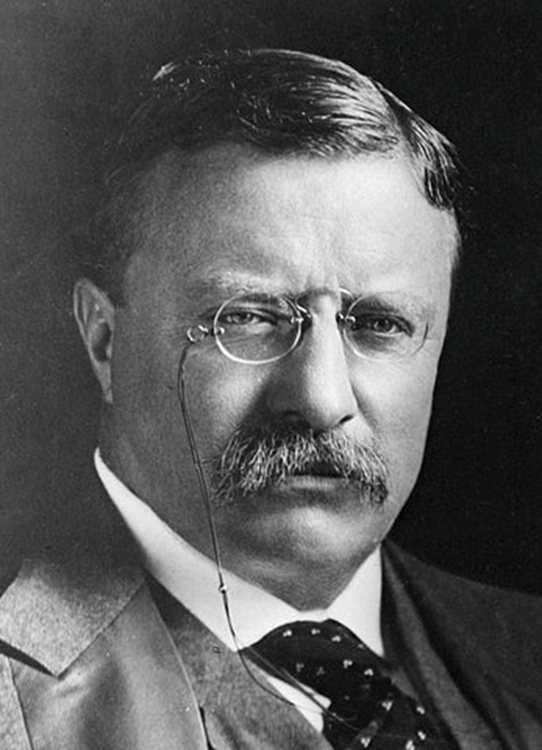
(Teddy Roosevelt warned us about the need to keep Christian Civilization alive at all costs. Here I have chronicled how that has been accomplished over the centuries, right up to today. I think it is important for you to know the major details of how it has been done. Do review them below.)
President William Howard Taft had stated at a missionary conference in 1908: “No man can study the movement of modern CIVILIZATION from an impartial standpoint, and not realize that Christianity and the spread of Christianity are the basis of hope of modern CIVILIZATION in the growth of popular self government. The spirit of Christianity is pure democracy. It is equality of man before God — the equality of man before the law, which is, as I understand it, the most God-like manifestation that man has been able to make.”
In 1923, in his last public address, titled “The Road Away from Revolution,” President Woodrow Wilson warned: “In these doubtful and anxious days, when all the world is at unrest, the road ahead seems darkened by shadows which portend dangers. Ground for the universal unrest is not to be found in superficial politics or in mere economic blunders. It probably lies deep at the sources of the spiritual life of our time”
Wilson added: “That supreme task, which is nothing less than the salvation of CIVILIZATION, now faces democracy. We call ours a Christian CIVILIZATION, a Christian conception of justice. Our CIVILIZATION cannot survive materially unless it be redeemed spiritually. It can be saved only by becoming permeated with the spirit of Christ and being made free and happy by the practices which spring out of that spirit.”
President Franklin D. Roosevelt stated October 6, 1935: “The 400th anniversary of the printing of the first English Bible is an event of great significance. We trace not only a measurable increase in the cultural value and influence of this greatest of books, but a quickening in the widespread dissemination of those moral and spiritual precepts that have so greatly affected the progress of Christian CIVILIZATION.”
Franklin D. Roosevelt stated at the Dedication of Great Smoky Mountains National Park, September 2, 1940: “There is another enemy at home that mocks at ideals, sneers at sacrifice and pretends that the American people can live by bread alone. If the spirit of God is not in us, and if we will not prepare to give all that we have and all that we are to preserve Christian CIVILIZATION in our land, we shall go to destruction.”
John F. Kennedy wrote to Brazil’s President, January 31, 1961: “To each of us is entrusted the heavy responsibility of guiding the affairs of a democratic nation founded on Christian ideals.”
British Prime Minister Winston Churchill stated June 18, 1940: “The Battle of France is over. I expect that the Battle of Britain is about to begin. Upon this battle depends the survival of Christian CIVILIZATION.”
Churchill stated July 14, 1940: “We are not fighting for ourselves alone. Here in this strong City of Refuge which enshrines the title-deeds of human progress and is of deep consequence to Christian CIVILIZATION; here, girt about by the seas and oceans where the Navy reigns, shielded from above by the prowess and devotion of our airmen, we await undismayed the impending assault.”
President Truman introduced Winston Churchill in Fulton, Missouri, March 5, 1946. Churchill stated: “Except in the British Commonwealth and in the United States where Communism is in its infancy, the Communist parties or fifth columns constitute a growing challenge and peril to Christian CIVILIZATION.”
On V-J Day, August 14, 1945, President Harry S Truman stated at a News Conference announcing the end of World War II: “I have received this afternoon a message from the Japanese Government. ‘His Majesty the Emperor is prepared to authorize all the forces under their control wherever located to cease active operations, to surrender arms.’
The next day, President Truman released a message: “The enemies of CIVILIZATION who would have destroyed completely all freedom of religion have been defeated. All faiths unite in thanksgiving to Almighty God on our victory over the forces of evil. Let us now all join to create the kind of peace settlement which will keep alive freedom of religious belief all over the world, and prevent the recurrence of all this misery and destruction. That is the most fitting memorial we can erect to those who have fought and suffered and labored and died in this struggle for mankind.”
On August 16, 1945, Truman proclaimed a Day of Prayer: “The warlords of Japan have surrendered unconditionally. This is the end of the schemes of dictators to enslave the peoples of the world, destroy their CIVILIZATION, and institute an era of darkness and degradation.”
He added: “Our global victory has come from the courage of free men and women united in determination to fight. It has come from the massive strength of arms created by peace-loving peoples who knew that unless they won, decency in the world would end. It has come from millions of peaceful citizens turned soldiers overnight, who showed a ruthless enemy that they were not afraid to fight.”
Truman concluded: “It has come with the help of God, Who was with us in the early days of adversity and Who has now brought us to this glorious day of triumph. Let us give thanks to Him and dedicate ourselves to follow in His ways.”
President Theodore Roosevelt included in his book Fear God and Take Your Own Part (1916), his address to the American Sociological Congress: “The CIVILIZATION of Europe, America and Australia exists today at all only because of the victories of civilized man over the enemies of CIVILIZATION. Because of victories stretching through the centuries from Charles Martel in the 8th century and those of John Sobieski in the 17th century. During the thousand years that included the careers of the Frankish soldier and the Polish king, the Christians of Asia and Africa proved unable to wage successful war with the Moslem conquerors; and in consequence Christianity practically vanished from the two continents; and today nobody can find in Mohammedism any ‘social values’ whatever, in the sense in which we use the words, so far as the sphere of Mohammedan influences are concerned.”
Roosevelt continued: There are such ‘social values’ today in Europe, America and Australia only because during those thousand years the Christians of Europe possessed the warlike power to do what the Christians of Asia and Africa had failed to do— that is, to beat back the Moslem invader.”
In his last public address, President Richard Nixon warned August 8, 1974: “In the Middle East, there are 100 million people in the Arab countries who worship Mohamed. Down deep, they are a major potential enemy. We must continue to oppose their principles if necessary, so that cradle of CIVILIZATON will not become its grave.”
David Horowitz, a conservative author who had previously been a 1960s radical Marxist, wrote in the Jewish World Review, September 6, 2001: “The ‘social justice’ organizations, socialist protesters of today, are the Fifth Column vanguards plotting to tear down Christian Civilization from within.”
What is at stake?
Do you, as an individual, like having the choice of where to live, what career to pursue, who to marry, what religion to adhere to, or not, how to dress, what to eat, and what to think? If you like making these choices for yourself, you like Western Civilization. Western Civilization can be summed up in one word — “individual.”
President Dwight Eisenhower addressed the American Legion’s Back-to-God Program, February 20, 1955: “The Founding Fathers expressed the ideal of Government based on the individual. That ideal previously, had existed only in the hearts and minds of men. They recognized God as the author of individual rights.”
Simply put, you have a worth and an identity simply because you are made in the image of God.
All other social structures can be summed up in the word “group.” In them your worth and identity are in relation to your acceptance by a group, a clan, a tribe, a gang, a family, a community, an ummah, a clique, a brotherhood, a society, a state, a company, a social network, the vaccinated, or a political party.
They are called “honor-shame cultures,” if you conform or contribute to this group and the group praises you, you are worth more. Online, it is being friended, followed, liked, trending. If you do not contribute, or are considered a drain or a threat to the group, you are worth-less, and the group shames, fires, ostracizes, or kills you. Online, it is being unfriended, unfollowed, unliked, blocked, de-platformed, cyber-bullied, cancelled. And like a pecking order, every group ends up having an influencer, a party boss, a gang leader, a king.
Critical Race Theory is the process of categorizing everyone into groups, then pitting them against each other to create division, fear, panic, and hysteria. In the confusion, people will trade freedom for security, allowing the government to usurp power.
In the Old Testament, God called ancient Israel out of the group — the Egyptian world, and set them apart.
In the New Testament, Jesus calls each individual to come out of the world, to personally love Him more than being accepted by any group. Believers are to shun peer-pressure and the fear of man, and leave the herd mentality, the mob mentality, the pack mentality, and instead, care only about being accepted in the sight of God.
Jesus said: “How can you believe, who receive honor from one another, and do not seek the honor that comes from the only God?” John 5:44
This thought influenced America’s founders. President Reagan stated in 1961: “In this country of ours took place the greatest revolution that has ever taken place in the world’s history. Every other revolution simply exchanged one set of rulers for another. Here for the first time in all the thousands of years of man’s relation to man the founding fathers established the idea that you and I had within ourselves the God-given right and ability to determine our own destiny.”
Henry Cabot Lodge, Chairman of the Senate Foreign Committee, spoke against joining the League of Nation, August 12, 1919: “The United States is the world’s best hope. Beware how you trifle with your marvelous inheritance; this great land of ordered liberty. For if we stumble and fall, freedom and CIVILIZATION everywhere will go down in ruin.”
And to sum it all up, once again we turn to the great, tough Teddy Roosevelt, who warned in 1909:
“I believe that the next half century will determine if we will continue to advance the cause of Christian CIVILIZATION or revert to the horrors of brutal paganism. The choice between the two is upon us.”
The Lord desires for you to have an intimate relationship with Him, but He doesn’t stop there. He wants you to have enriching fellowship with other people as well. When you are lonely, you are to turn first to the Father. But you can also rely upon the people He has placed in your life.
Friend, God has given you people to love. They may not be the ones you wish you had a relationship with, but the Lord has placed them in your life for a purpose. And your loneliness will be remedied by interaction with them rather than by an escape into fantasy or other addictive behavior.
One of the greatest blessings in life is a godly friend. So don’t be reluctant to call upon your loved ones when you experience moments of loneliness, grief, debilitating loss, or profound despair. He has placed other people in your life to love you, spend time with you, and help you break through the wall of separation you feel from the world.
Therefore, don’t remain isolated. Reach out to others and thank God for your friendships.
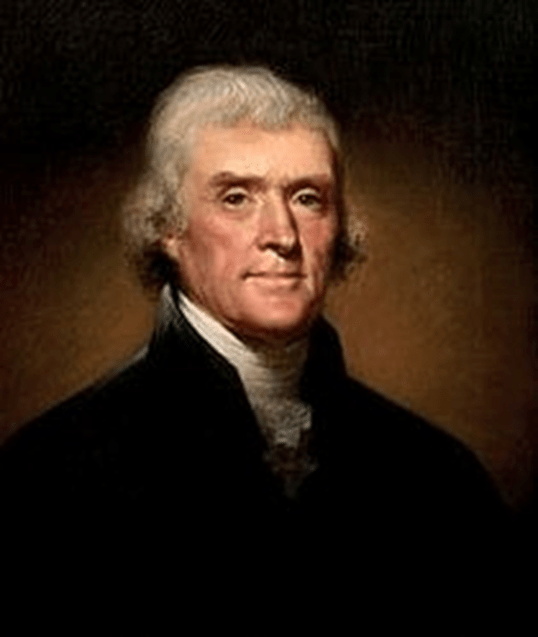
(Jefferson is most known for writing the Declaration of Independence. He also contributed significantly to the Constitution and the Bill of Rights and many other significant American documents. Since he was so important to the founding of America, I think it is significant to know where and how he got his ideas. Below, I have chronicled that for you. Do read it so that you will know.)
On January 1, 1802, the people of Cheshire, Massachusetts, delivered a giant block of cheese weighing 1,235 lbs to President Thomas Jefferson, being presented by the famous Baptist preacher, John Leland.
On the block of cheese, they put Jefferson’s motto, which was also on his personal seal: “Rebellion to Tyrants is Obedience to God.”
After delivering the cheese, John Leland was then invited to preach to the President and Congress in the U.S. Capitol. The subject of his talk was “separation of church and state.”
Baptists had been particularly persecuted in colonial Virginia, as Francis L. Hawks wrote in Ecclesiastical History (1836): “No dissenters in Virginia experienced for a time harsher treatment than the Baptists. They were beaten and imprisoned, Cruelty taxed and were subjected to new modes of punishment and annoyance.”
So many Baptist ministers were harassed, and their church services disrupted, that James Madison introduced legislation in Virginia’s Legislature on October 31, 1785, titled “A Bill for Punishing Disturbers of Religious Worship,” which passed in 1789.
Colonial Virginia had a government imposed belief system, an “establishment” of the Church of England, or “Anglican Church” from 1606 to 1786. Establishment meant mandatory membership, mandatory taxes to support it; and no one could hold public office unless they were a member. This was modeled after European nations who had establishments of different Christian denominations.
Patrick Henry almost succeeded in having Virginia not ratify the Constitution as it did not have a Bill of Rights guaranteeing, among other things, the freedom of religion. Baptist Preacher John Leland had considered running for Congress, as he wanted an Amendment added to the new United States Constitution which would protect religious liberty.
Leland reportedly met with James Madison near Orange, Virginia. Upon Madison’s promise to introduce what would become the First Amendment, Leland agreed to persuade Baptists to get involved in politics and support Madison.
John Leland wrote in Rights of Conscience Inalienable, 1791, that they wanted not just toleration, but equality: “Every man must give account of himself to God, and therefore every man ought to be at liberty to serve God in a way that he can best reconcile to his conscience. If government can answer for individuals at the day of judgment, let men be controlled by it in religious matters; otherwise, let men be free.”
Following George Whitefield’s First Great Awakening Revival, 1730-1755, a Second Great Awakening Revival took place between 1790-1840. In Thomas Jefferson’s county of Albemarle, Baptist, Presbyterian and Methodist revival meetings were held. Even Jefferson’s daughter, Mary, attended a Baptist revival preached by Lorenzo Dow.
On July 4, 1826, the editor of the Christian Watchman (Boston, MA) published an account: Thomas F. Curtis wrote in The Progress of Baptist Principles in the Last Hundred Years (Charleston, S.C.: Southern Baptist Publication Society, 1856): “ANDREW TRIBBLE was the Pastor of a small Baptist Church, which held its monthly meetings at a short distance from Mr. JEFFERSON’S house, eight or ten years before the American Revolution. Mr. JEFFERSON attended the meetings of the church for several months in succession, and after one of them, asked Elder TRIBBLE to go home and dine with him, with which he complied.
Mr. TRIBBLE asked Mr. JEFFERSON how he was pleased with their Church Government?
Mr. JEFFERSON replied, that it had struck him with great force, and had interested him so much; that he considered it the only form of pure democracy that then existed in the world, and had concluded that it would be the best plan of Government for the American Colonies.”
(Thus, it is recorded and codified that the Declaration of Independence and the U.S. Constitution were patterned after the democratic principles of the government of Baptist Churches which were found most preferable by Thomas Jefferson. Read further of you want to see them more iterated.)
“A gentleman in North Carolina knowing that the venerable Mrs. (Dolley) Madison had some recollections on the subject, asked her in regard to them. She expressed a distinct remembrance of Mr. Jefferson speaking on the subject, and always declaring that it was a Baptist church from which his views were gathered.”
President Calvin Coolidge stated at the 150th anniversary of the Declaration of Independence, July 4, 1926: “This preaching reached the neighborhood of Thomas Jefferson, who acknowledged that his ‘best ideas of democracy’ had been secured at church meetings.”
After Jefferson’s wife and two children died of the plage, he became depressed and moved to France for a little while. Upon returning to America, Jefferson introduced a bill in the Virginia Assembly. Jefferson’s bill, with the help of James Madison, was passed by Virginia’s Assembly, January 16, 1786.
So significant was this bill, that Jefferson noted it on his gravestone as “The Statute of Virginia for Religious Freedom.” It stated: “Almighty God hath created the mind free. All attempts to influence it by temporal punishments are a departure from the plan of the Holy Author of religion, who being Lord both of body and mind, yet chose not to propagate it by coercions on either, as was in His Almighty power to do. To compel a man to furnish contributions of money for the propagation of opinions, which he disbelieves is sinful and tyrannical. Be it enacted that no man shall suffer on account of his religious opinions.”
This last paragraph, if applied today, would mean that Jefferson would have opposed Christian parents having to pay taxes to have their children indoctrinated in public schools with anti-biblical views on sex and marriage.
Consistent throughout his life Jefferson believed that there was a Creator and that the government should never force one’s conscience. Over time, brilliant legal minds have used Jefferson’s words about the “separation of church and state” to prohibit Jefferson’s beliefs; even though he intended them to mean only that the state should not interfere with the church. He never intended that they should ever be used to separate one from the church, or God.
Jefferson believed in a Creator, as he wrote in the Declaration: “All men are endowed by their CREATOR.”
Yet in 2005, U.S. District Judge John E. Jones, in Kitzmiller v. Dover Area School District, ruled students could not be taught of a CREATOR: “to preserve the separation of church and state.”
Inscribed on the Jefferson Memorial, Washington, DC is Jefferson’s warning:
“God who gave us life gave us liberty. Can the liberties of a nation be secure when we have removed a conviction that these liberties are the gift of God? Indeed I tremble for my country when I reflect that God is just, that His justice cannot sleep forever.”
“let us come boldly to the throne of our gracious God. There we will receive his mercy, and we will find grace to help us when we need it most.”
God always wants you to go to Him. Always. As His child, you are eternally welcome in His holy presence. Any feeling of shame that keeps you from approaching Him originates from you—not from Him.
This is one of the reasons the enemy will temp you to sin or violate commands. He knows that if he can get you to rebel against God, you will feel so guilty and embarrassed about it, you will hide from the Father’s loving presence. The more the enemy can get you to focus on your unworthiness, the easier it is for him to keep you from the Savior who makes you worthy.
But understand that God wants to forgive you and welcome you into His presence no matter what you’ve done or how you feel. Go to Him. Pray to Him, turn from sin, and accept his grace. His loving arms faithfully await you.
Baylor grads remember the very popular physics professor at Baylor, Dr. Robert Packard. Many students wanted to take his introductory physics course which he made so very interesting for non-science students.
When he first came to Baylor his brilliance was little known. However, at that time, he taught me and a few others Baylors’ most advanced physics courses. We just loved him, for he was so close to God. He died recently at age 94. And he did not get to see the recent greatest breakthrough in all physics history. It is the most amazing scientific fete of all time.
Einstein predicted its theoretical possibility 80 years ago with his famous E=mc2 formula, which states that energy and matter (or mass) are interchangeable. The formula has now been proved, for actual matter has been created from pure light……real matter from pure light only.
It has been done at the Brookhaven National Laboratory under the U.S. Department of Energy. They caused two gold (Au) ions to move in opposite directions at 99.995% of the speed of light. As the ions pass one another without colliding, two photons from the electromagnetic cloud surrounding the ions can interact with each other to create a matter-antimatter pair: an electron and a positron. It was possible by using some of the most powerful lasers ever created.
In UPTON, NY—Scientists studying particle collisions at the Relativistic Heavy Ion Collider (RHIC)—a U.S. Department of Energy Office of Science user facility for nuclear physics research at DOE’s Brookhaven National Laboratory—have produced definitive evidence for physics phenomena predicted more than 80 years ago. The results were derived from a detailed analysis of more than 6,000 pairs of electrons and positrons produced in glancing particle collisions at the RHIC.
The primary finding is that pairs of electrons and positrons—particles of matter and antimatter—can be created directly by colliding with very energetic photons, which are quantum “packets” of light. This conversion of energetic light into matter is a direct consequence of Einstein’s famous E=MC2 equation, which states that energy and matter (or mass) are interchangeable. Nuclear reactions in the sun and at nuclear power plants regularly convert matter into energy. Now scientists have converted light energy directly into matter in a single step.
In other words, the results depend on the ability of RHIC’s STAR detector—the Solenoid Tracker at RHIC—to measure the angular distribution of particles produced in glancing collisions of gold ions (Au) moving at nearly the speed of light.
“On His robe and on His thigh He has a name written, ‘King of Kings and Lord of Lords'”
It’s amazing how quickly life can change. Perhaps you’re looking back today and remembering all that’s occurred since the year began. Problems that consumed your heart last January are a distant memory, while blessings and opportunities that didn’t seem possible a few months ago have appeared by surprise.
If you focus on the ever-changing nature of life, you may feel discouraged about the future. But nothing will encourage you more than considering God’s absolute faithfulness through it all.
Though this year ends, He remains sovereign over all that exists. Allow this truth to comfort you as you face the unknowns ahead. He remains sovereign over all that exists. No problem is too overwhelming for your heavenly Father. He is your perfect leader, who guides you wisely to triumph no matter what happens. And his love for you never fails.
So, as the new Year begins, rejoice that the One who’s always King will always be with you. And that’s a fact that will never change.
From 1714 to 1718, James Oglethorpe was a military aide under the command of Prince Eugene of Savoy fighting to drive the Muslim Turks out of Belgrade, Serbia.
After the battle, at the age of 22, Oglethorpe returned to England, where he entered Parliament and worked for prison reform after one of his friends died in debtors prison.
In 1732, Oglethorpe founded the Colony of Georgia in America for poor debtors and persecuted Christians. Oglethorpe defended Georgia from attacks launched out of Spanish Florida.
General James Oglethorpe’s secretary was Charles Wesley. Charles’ brother, John Wesley, served as the colony’s Anglican minister. John Wesley’s efforts to evangelize the Indians proved more difficult than anticipated, and his strict religiosity was resented by the colonists.
In 1737, John and Charles Wesley returned to England where they were befriended by a Moravian missionary named Peter Boehler, who was waiting for a ship to sail to Georgia. Peter Boehler shared with the Wesleys regarding the indwelling of the Holy Spirit, which resulted in their “Aldersgate experience” in May of 1738.
John Wesley wrote: “In the evening, I went very unwillingly to a Society in Aldersgate-Street, where one was reading Luther’s preface to the Epistle to the Romans. About a quarter before nine, while he was describing the change which God works in the heart through faith in Christ, I felt my heart strangely warmed. I felt I did trust in Christ; Christ alone, for salvation; and an assurance was given me, that he had taken away my sins, even mine, and saved me from the law of sin and death.”
John Wesley went over to Europe and lived with the Moravians for eight months. He accepted their faith “the religion of the heart.” The Wesleys’ began preaching that God’s grace was free for all. They influenced George Whitefield, who spread the Great Awakening Revival throughout the American colonies.
God is just, and therefore He must judge every sin; but God is love, as He provided His Son to take the judgement for our sins. The Lamb is God’s way to love us without having to judge us! This was foreshadowed when Abraham was taking his son, Isaac, to the top of Mount Moriah, Genesis 22:7-8: “Isaac spake unto Abraham. My father behold the fire and the wood: but where is the lamb for a burnt offering? And Abraham said, My son, God will provide himself a lamb for a burnt offering.”
This passage has a double meaning: First, that God will provide a sacrifice, a ram caught by its head in a thorn bush on top of Mount Moriah; and Second, that God will provide a sacrifice, His only begotten Son, upon whose head was a crown of thorns.
Charles Wesley wrote in a hymn published in 1738: “Amazing love! How can it be, That Thou, my God, shouldst die for me?”
Charles Wesley was the 18th child of Rev. Samuel and Susanna Wesley, born December 18, 1707, in Epworth, England. Susanna Wesley home-schooled all her 19 children, giving them a classical education which included learning Latin and Greek. Charles Wesley excelled in his studies. He attended Westminster School and Christ Church, Oxford, where he came to the attention of Garret Wellesley, a member of the British Parliament with a large fortune in Daugan, Ireland. Having no child, Garret Wellesley offered to adopt Charles as his heir, but Charles declined. Garret Wellesley then decided to leave his estate to his cousin Richard Colley Wellesly, the father of Arthur Wellesley, Duke of Wellington, who became famous for his role in defeating Napoleon at the Battle of Waterloo in 1815.
After graduating from Oxford, Charles Wesley sailed to the Colony of Georgia in 1732, serving as secretary to the colony’s founder, General James Oglethorpe.
In 1739, Charles Wesley penned “Hark! how all the Welkin – Heaven – rings.” George Whitefield suggested the first line be changed to “Hark! The Herald Angels Sing.” The song was put to the music of Lutheran composer Felix Mendelssohn, grandson of the notable Jewish philosopher, Moses Mendelssohn. “Hark! the Herald Angels Sing” was first published in 1739 in the collection Hymns and Sacred Poems. It was republished in George Whitefield’s Collection of Hymns for Social Worship in 1754.
In America, at this time, the French and Indian War was heating up. British General Edward Braddock fought the Battle of the Monongahela in 1755, assisted by the young officer named George Washington, who was miraculously spared. Also at the battle on the side of the British was 20-year-old wagon driver Daniel Boone. Colonial Americans found hope in singing Charles Wesley’s hymn:
“Hark, the Herald Angels sing,Glory to the new-born King,Peace on earth, and mercy mild,God and sinners reconciled.
Joyful all ye nations rise,Join the triumph of the skies;with angelic host proclaim,Christ is born in Bethlehem.”
Hark! The herald angels sing,“Glory to the newborn King!”
Christ by highest heav’n adored,Christ the everlasting Lord!Late in time, behold Him come,Offspring of a Virgin’s womb,Veiled in flesh the Godhead see,Hail the incarnate Deity!
Pleased as man with man to dwell,Jesus, our Emmanuel,Hark! The herald angels sing,”Glory to the newborn King!”
Hail the heav’n-born Prince of Peace!Hail the Son of Righteousness!Light and life to all He brings,Ris’n with healing in His wings.
Mild He lays His glory by,Born that man no more may die,Born to raise the sons of earth,Born to give them second birth.
Hark! The herald angels sing,“Glory to the newborn King!”
The same year Charles Wesley was born, 1707, Isaac Watts wrote the carol “Joy to the World,” which became one of the most published Christmas hymns in North America.
“Joy to the world! The Lord is come;Let earth receive her King;
Let every heart prepare him room,And heaven and nature sing,
And heaven and nature sing,And heaven, and heaven, and nature sing.
Joy to the world! The Saviour reigns;Let men their songs employ;
While fields and floods, rocks, hills, and plains
Repeat the sounding joy,Repeat the sounding joy,
Repeat, repeat the sounding joy.
No more let sins and sorrows grow,Nor thorns infest the ground;
He comes to make His blessings flow Far as the curse is found,
Far as the curse is found, Far as, the curse is found.
He rules the world with truth and grace,And makes the nations prove
The glories of His righteousness,And wonders of His love,
And wonders of His love,And wonders, wonders, of His love.”
At this time in Europe, composer George Frideric Handel was at a low point in his career, having suffered partial paralysis on his left side due to a stroke.
Incredibly, beginning August 22, 1741, George Handel composed “Messiah” in only 21 days, as part of a series of concerts in Dublin to benefit charities.
In Messiah, Handel included a line from the Book of Job 19:25:
“I know that my Redeemer liveth.”
The premiere was met with overwhelming success.
When it was performed in London, King George II stood to his feet during the singing of the “Hallelujah” Chorus.
In reflecting on the “Hallelujah Chorus,” 1742, Handel expressed what he saw in his mind and spirit that he expressed in the music:
“I did think I did see all heaven before me, and the great God Himself.
Another popular Christmas carol first published in 1751 was “O Come, All Ye Faithful,” originally written in Latin as “Adeste Fideles.” It is one of the oldest hymns, with attributions to 11th century Cistertian monks, 13th century St. Bonaventure, 17th century Portugal’s King John the Fourth, or 18th century John F. Wade, with music by John Reading:
“O come, all ye faithful, Joyful and triumphant,
O come ye, O come ye, to Bethlehem.
Come and behold Him, Born the King of angels!
– Chorus –
O come, let us adore Him, O come, let us adore Him,
O come, let us adore Him, Christ the Lord.
God of God, Light of Light,
Lo! he abhors not the Virgin’s womb;
Very God, Begotten not created.
– Chorus –
O come, let us adore Him, O come, let us adore Him,
O come, let us adore Him, Christ the Lord.
Sing, choirs of angels, Sing in exultation;
Sing, all ye citizens of heaven above!
Glory to God, In the highest;
– Chorus –
O come, let us adore Him, O come, let us adore Him,
O come, let us adore Him, Christ the Lord.
Yea, Lord, we greet Thee, Born this happy morning;
Jesus, to Thee be glory given; Word of the Father,
Now in flesh appearing.
– Chorus –
O come, let us adore Him, O come, let us adore Him,
How the world’s most famous Christmas carol came to be written and set to music:
O come, let us adore Him, Christ the Lord.”
How “Silent Night” the world’s most famous Christmas carol came to be written and set to music:
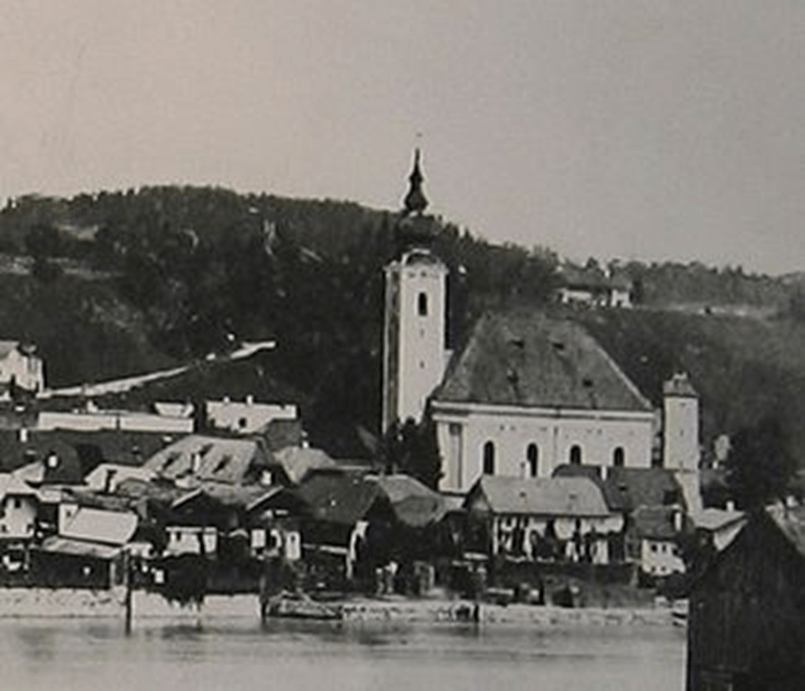
The original church building near Salzburg, Austria, in which “Silent Night” was first performed
In 1818, a roving band of actors was performing in towns throughout the Austrian Alps. On December 23, they arrived at Oberndorf, a village near Salzburg, where they were to re-enact the story of Christ’s birth in the small Church of St. Nicholas.
Unfortunately, the St. Nicholas’ church organ wasn’t working and would not be repaired before Christmas. Because the church organ was out of commission, the actors presented their Christmas drama in a private home. That Christmas presentation of the events in the first chapters of Matthew and Luke put assistant pastor Josef Mohr in a meditative mood. Instead of walking straight home that night, Mohr took a longer way to his house. The longer path took him up on a hill overlooking the village.
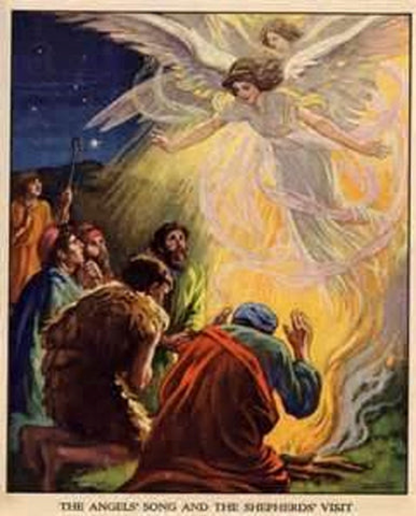
From that hilltop, Mohr looked down on the peaceful snow-covered village. Reveling in the majestic silence of a wintry night, he recalled a poem he had written a couple of years before about the night angels announced the birth of the Messiah to shepherds.
Mohr decided those words might make a good carol for his congregation the following evening at their Christmas Eve service. The problem was he didn’t have any music to which that poem could be sung. So, the next day, Mohr went to see the church organist, Franz Xaver Gruber. Gruber only had a few hours to compose a melody that could be played on a guitar. By that evening, Gruber had composed a musical setting for the poem. That the church organ was inoperable no longer mattered. They now had a Christmas carol that could be sung without an organ.
On Christmas Eve, the small Oberndorf congregation heard Gruber and Mohr sing their new composition to the accompaniment of Gruber’s guitar.
Weeks later, well-known organ builder Karl Mauracher arrived in Oberndorf to fix the organ in St. Nicholas church. When Mauracher finished, he let Gruber test the instrument. Gruber began playing the simple melody he had written for Mohr’s poem. Impressed, Mauracher took copies of the music and words back to his own Alpine village, Kapfing. There, two well-known families of singers — the Rainers and the Strassers — heard it. Captivated by “Silent Night,” both groups put the new song into their Christmas repertoire.
The Strasser sisters spread the carol across northern Europe. In 1834, they performed “Silent Night” for King Frederick William IV of Prussia, who liked it so much he ordered his cathedral Christmas Eve group to perform it.
Twenty years after “Silent Night” was written, the Rainers brought the song to the United States, singing the original German version at New York City’s Trinity Church.
In 1863, nearly fifty years after being sung in German, “Silent Night” was translated into English by either Jane Campbell or John Young. Eight years later, that English version made its way into print in Charles Hutchins’ Sunday School Hymnal. Today, the words of “Silent Night” are sung worldwide in more than 300 languages.
Artists who have recorded it in English include Bing Crosby, Elvis Presley, and Mariah Carey. Bing Crosby’s version is one of the best-selling singles of all time.
Here are the complete lyrics of Silent Night in English:
“Silent night, holy night All is calm, all is bright Round yon virgin mother and Child Holy Infant so tender and mild Sleep in heavenly peace Sleep in heavenly peace
Silent night, holy night Shepherds quake at the sight Glories stream from heaven afar Heavenly hosts sing halleluia Christ the Savior is born Christ the Savior is born
Silent night, holy night Son of God, love’s pure light Radiant beams from Thy holy face With the dawn of redeeming grace Jesus Lord at Thy birth Jesus Lord at Thy birth”


 True Texan Tales