Anniversery of D-Day

My fellow Americans, this is the anniversary of D-Day.  It was such a momentous event in American history and World history, please, let’s remember it again together.  Following, let’s go through the events together:

Ron 

After World War I, Germany’s economy suffered from depression and a devaluation of their currency.


On January 30, 1933, Adolph Hitler was elected Chancellor of Germany by promising hope and universal healthcare. Less than a month later, on February 27, 1933, a crisis occurred.  The Rheichstag, Germany’s Capitol Building, was suspiciously set on fire, with evidence pointing to Hitler’s supporters.  Hitler, though, blamed the attack on his political opponents and used the power of the state to falsely accuse and arrest them.


Hitler used the panic of the “crisis” as an opportunity to suspend citizens’ rights and systematically undermine Germany’s Weimar Republic.


He had radical homosexual activist Ernst Röhm and his feared Brownshirts, called “Sturmabteilung” (storm troopers), to storm into the meetings of his political opponents, disrupting and shouting down speakers.


Brownshirts organized protests and street riots, similar to modern day BLM/Antifa-style protests, smashing windows, blocking traffic, setting fires, vandalizing, and even beating to death innocent bystanders to spread fear and panic.
Nazis implemented boycotts of Jewish businesses.  The riots destabilized the country and led to the overthrow old political leaders. 

 
On Kristallnacht (Night of Broken Glass), they broke windows, looted and set on fire over 7,500 Jewish stores and 200 synagogues.


Once securely in power, Hitler had his SS and Gestapo secret police kill the Brownshirts in the Night of the Long Knives, thus eliminating competition and giving the public impression that he was cracking down on lawbreakers.

Hitler at Height of His Power


Hitler then confiscated weapons from law-abiding citizens.  An SA Oberführer warned of an ordinance by the provisional Bavarian Minister of the Interior:  “The deadline set for the surrender of weapons will expire on March 31, 1933. I therefore request the immediate surrender of all arms.  Whoever does not belong to one of these named units (SA, SS, and Stahlhelm) and keeps his weapon without authorization or even hides it, must be viewed as an enemy of the national government and will be held responsible without hesitation and with the utmost severity.”

Heinrich Himmler, head of Nazi S.S. (“Schutzstaffel” Protection Squadron), announced:  “Germans who wish use firearms should join the S.S. or the S.A. Ordinary citizens don’t need guns, as their having guns doesn’t serve the State.”


In 1938, when a suspected homosexual youth shot a Nazi diplomat in Paris, it was used as an excuse to confiscate all firearms from Jews.  German newspapers printed, November 10, 1938:  “Jews Forbidden to Possess Weapons by Order of SS Reichsführer Himmler, Munich  ‘Persons who, according to the Nürnberg law, are regarded as Jews, are forbidden to possess any weapon. Violators will be condemned to a concentration camp and imprisoned for a period of up to 20 years.'”


“The Berlin Police announced that the entire Jewish population of Berlin had been ‘disarmed’ with the confiscation of 2,569 hand weapons, 1,702 firearms and 20,000 rounds of ammunition.  Any Jews still found in possession of weapons without valid licenses are threatened with the severest punishment.”


Of the Waffengesetz (Nazi Weapons Law), March 18, 1938, Hitler stated at a dinner talk:  “The most foolish mistake we could possibly make would be to allow the subject races to possess arms. History shows that all conquerors who have allowed their subject races to carry arms have prepared their own downfall by so doing.  So, let’s not have any native militia or native police. German troops alone will bear the sole responsibility for the maintenance of law and order.”


Hitler’s Minister of Propaganda, Joseph Goebbels, pioneered the use of fake news to sway public opinion so that the entire nation accepted the lies of the deep-state:  “If you tell a lie big enough and keep repeating it, people will eventually come to believe it. The truth is the greatest enemy of the state.”

In socialist countries, a person’s life is only of worth if it benefits the state:  “No life still valuable to the state will be wantonly destroyed.” (German Penal Code, October 10, 1933)Those not promoting the deep-state narrative were driven from their jobs, publicly ridiculed, and eventually removed from society and sent to labor and concentration camps.”

Jews at Concentration Camp about to be Gassed

Anti-socialist John Basil Barnhill stated in a debate with Henry M. Tichenor, 1914 (National Rip Saw Publishing Co., St. Louis, MO):  “Where the people fear the government you have tyranny. Where the government fears the people you have liberty.”


This is similar to thoughts of Robert F. Kennedy, Jr., who warned at Hillsdale College, April 11, 2023:
“1. Any power that government takes from the people, it will never return voluntarily;2. Every power that government takes, it will ultimately abuse to the maximum extent possible;3. Nobody ever complied their way out of totalitarianism. The only thing we can do is resist.”


The National Socialist Workers Party operated over 1,200 concentration camps where millions of Jews, Poles, Gypsies, handicapped, and others were experimented, tortured, or were killed in gas chambers.

German churches were silent, as they had for centuries taught pietism – a version of separation of church and state where Christians were instructed to only focus on their own personal spiritual life and withdraw from involvement in worldly politics.
As a result, the church stood by silent as the National Socialist Workers Party usurped power, leaving the work of stopping Hitler to be done by the sacrifice of millions of courageous Allied soldiers.


By the time a few courageous Germany church leaders spoke out, such as Dietrich Bonhoeffer, it was too late — the government had grown so powerful it simply arrested and executed them.


Hitler’s National Socialist Workers’ Party used diplomatic intimidation, deception, and Blitzkrieg “lightning war” attacks to take control of:

  • Bohemia,
  • Moravia,
  • Poland,
  • Denmark,
  • Norway,
  • Luxembourg,
  • Belgium,
  • Holland,
  • France,
  • Monaco,
  • Greece,
  • The Channel Island (UK),
  • Czechoslovakia,
  • Baltic states,
  • Serbia,
  • Italy,
  • Hungary,
  • Romania,
  • Bulgaria,
  • Slovakia,
  • Finland,
  • Croatia,
  • Austria,
  • and more.


Other Axis Powers were also aggressively expanding:
• Italy had invaded Ethiopia in 1935, and
• the Empire of Japan had invaded China in 1937.

The United States entered World War II on December 7, 1941, when Pear Harbor was bombed by Imperial Japan, a Tripartite Pact partner with Nazi Germany and Italy’s Benito Mussolini.


The turning point in the Pacific War was the Battle of Midway, June 4, 1942.
The turning point in Europe was D-Day, JUNE 6, 1944.


Over 160,000 troops from America, Britain, Canada, free France, Poland, and other nations landed along a 50-mile stretch of the Normandy coast of France.


In his D-Day Orders, JUNE 6, 1944, Supreme Allied Commander General Dwight Eisenhower sent nearly 100,000 Allied troops marching across Europe to defeat Hitler’s National Socialist Workers Party with these instructions:
“You are about to embark upon the Great Crusade. The eyes of the world are upon you. The hopes and prayers of liberty loving people everywhere march with you.
You will bring about the elimination of Nazi tyranny over the oppressed peoples of Europe.Your task will not be an easy one. Your enemy is well trained, well equipped and battle hardened; he will fight savagely.
Let us all beseech the blessings of Almighty God upon this great and noble undertaking.”

It was the largest seaborne invasion force in world history, supported by 13,000 aircraft, 5,000 ships with 195,700 navy personnel.


Prior to the invasion, Allies attempted to mislead the Nazis as to where the attack would take place.


The invasion was supposed to take place June 5, but the weather was so bad aircraft could not fly. General Eisenhower gave the risky order to delay the attack 24 hours to allow the weather and tide to improve.


The night before, Allied aircraft launched an enormous air assault on Nazi defenses, batteries, and bridges.


Then paratroopers were sent in behind enemy lines to cut off their supplies.
President Ronald Reagan stated at the 40th Anniversary of D-Day:
“Something else helped the men of D-day: their rock-hard belief that Providence would have a great hand in the events that would unfold here; that God was an ally in this great cause.


And so, the night before the invasion, when Colonel Wolverton asked his parachute troops to kneel with him in prayer he told them:
‘Do not bow your heads, but look up so you can see God and ask His blessing in what we’re about to do.’


Also that night, General Matthew Ridgway on his cot, listening in the darkness thought of the promise God made to Joshua: ‘I will not fail thee nor forsake thee.'”


Then elite Army Rangers went in to scale the cliffs and take out Nazi gun positions.
President Reagan stated:
“40 years ago at this moment, the air was dense with smoke and the cries of men, and the air was filled with the crack of rifle fire and the roar of cannon.


At dawn, on the morning of the 6th of June, 1944, 225 Rangers jumped off the British landing craft and ran to the bottom of these cliffs.  Their mission was one of the most difficult and daring of the invasion: to climb these sheer and desolate cliffs and take out the enemy guns.  The Allies had been told that some of the mightiest of these guns were here and they would be trained on the beaches to stop the Allied advance.
The Rangers looked up and saw the enemy soldiers along the edge of the cliffs shooting down at them with machine guns and throwing grenades.  But the American Rangers began to climb. They shot rope ladders over the face of these cliffs and began to pull themselves up. When one Ranger fell, another would take his place.  When one rope was cut, a Ranger would grab another and begin his climb again. They climbed, shot back, and held their footing.

                           Rangers Climbing Point-du-Hoc

Soon, one by one, the Rangers pulled themselves over the top, and in seizing the firm land at the top of these cliffs, they began to seize back the continent of Europe. Two hundred and twenty-five came here.  After 2 days of fighting, only 90 could still bear arms.”
At 6:30am, Allied forces began landing.  Troops ran across the heavily fortified beaches of:
• Utah Beach• Pointe du Hoc• Omaha Beach• Gold Beach• Juno Beach• Sword Beach

Ocean water ran red with the blood of almost 9,000 killed or wounded.

In the next two and a half months, over two million soldiers arrived on the shores.

Paris was liberated on August 25, 1944, and the Nazi war machine was pushed back over the Seine River. It was a major turning point in World War II.


Reagan continued:
“The men of Normandy had faith that what they were doing was right, faith that they fought for all humanity, faith that a just God would grant them mercy on this beachhead or on the next.


It was the deep knowledge (and pray God we have not lost it) that there is a profound, moral difference between the use of force for liberation and the use of force for conquest.”

Shortly after D-Day, on July 20, 1944, a courageous German resistance movement was formed which attempted to assassinate Hitler, but he survived.
Hitler retaliated by killing over 7,000 Germans.

President Franklin Roosevelt stated JUNE 6, 1944:
“My fellow Americans: Last night, when I spoke with you about the fall of Rome, I knew at that moment that troops of the United States and our allies were crossing the Channel in another and greater operation.

I now ask you to join with me in prayer:

Almighty God, Our sons, pride of our Nation, this day have set upon a mighty endeavor, a struggle to preserve our republic, our religion, and our civilization.
Give strength to their arms, stoutness to their hearts, steadfastness in their faith. They will need Thy blessings. Their road will be long and hard.


For the enemy is strong. He may hurl back our forces. We know that by Thy grace, and by the righteousness of our cause, our sons will triumph.
Some will never return. Embrace these, Father, and receive them, Thy heroic servants, into Thy kingdom.”

FDR concluded his D-Day Prayer:
“Help us, Almighty God, to rededicate ourselves in renewed faith in Thee in this hour of great sacrifice.


I ask that our people devote themselves in a continuance of prayer. As we rise to each new day, and again when each day is spent, let words of prayer be on our lips, invoking Thy help to our efforts.


Give us strength and, O Lord, give us Faith. Give us Faith in Thee. With Thy blessing, we shall prevail over the unholy forces of our enemy, and a peace that will let all of men live in freedom, reaping the just rewards of their honest toil. Thy will be done, Almighty God.  Amen.”

Douglas MacArthur – Fourth Installment

McArthur was born January 26, 1880 to parents who both had military backgrounds.  His mother who most called Pinkey, was from well to do Virginia parents.  His father was already a rather famous U.S. Army officer. Compared to most famous people, Douglas McArthur lived what I would call four whole lives.  He was a commander in three major wars.  Therefore, in relating to you his amazing life, it will be necessary to convey it to you in sections or posts.  Following is the Fourth one.

Ron

The Rainbow Division was now moving into the lines in strength.  They scheduled three raids for the night of March 9.  With Menoher’s blessing MacArthur decided to join a battalion of Iowan’s against a section of German trench on the Salient du Feys for these raids. 

As zero hour approached, the enemy, anticipating visitors, opened up with forty batteries of heavy artillery, and American casualties began to mount before the attack had even begun.  To steady his men, MacArthur walked the line in his eccentric apparel, now augmented by a sweater bearing the big black “A” he had won at the Point by playing on its football team.  An Iowan said: “I couldn’t figure what a fellow dressed like that could be doing out there.  When I found out who his was, you could have knocked me over with a feather.”

Five minutes before zero, sixty French batteries began their protective barrage, and as the minute hands crept upright, MacArthur mounted a scaling ladder and went over the top as fast as he could.  He scrambled forward.  He said the blast was like a fiery furnace.  He wondered if any of the Rainbow guys were following, but quickly saw that they were all around him and some even ahead, a roaring avalanche of glittering steel and cursing men.

And they carried the enemy position.

Menoher reported: “He accompanied the assault wave of the American companies engaged with the sole view of lending his presence where it was reassuring to the troops who were then unaccustomed to this manner of warfare.  On this occasion, in the face of the determined and violent resistance of an alert enemy, he lent actual service on the spot to the unit commanders and by his supervision of the operation not only guaranteed its success, but left the division with the knowledge of the constant attention of their leaders to their problems in action and the sense of security which the wise and courageous leadership there impressed on the engaged companies.”

This time MacArthur received the distinguished Service Cross for his “coolness and conspicuous courage.”

                      MacArthur with his long muffler and squashed down hat.

A few days later, MacArthur, who was strict about his men carrying their gas masks but often neglected to bring his own, was gassed.

He was in bed with a mask covering his eyes since the gassings could make one go blind.  He Heard that the U.S. Secretary of War Baker was coming to survey the front lines.  He ripped off his blindfold in time to show Secretary Baker around the area on 19 March.

Upon the recommendation of Menoher, MacArthur was awarded his first general’s “star” when he was promoted to brigadier general on 26 June.  At the age of just thirty-eight, this made him the youngest general in the AEF.

Promoted, but still wearing crushed down hat, with riding crop, and cavalry boots

Around the same time, the 42nd Division was shifted to Châlons-en-Champagne to oppose the impending German Champagne-Marne offensive.

The Germans decided to now mobilize a push so massive that it would end the war.  They had not been successful at Verdun or other offences.  But they were sure they would now.  They even erected a high wooden observation platform behind the lines for the Kaiser to be able to view this offensive.

It started with an artillery barrage so massive that the Allied observers said it was the largest ever seen in any war.  MacArthur’s division was charged with stopping it on their southern sector, the spearhead of it.  He devised an unusual plan to try to stop it, though the Germans were sure that they would be able to proceed right on to Paris.  He set up a front line of suicide, shock troops that the Germans were to fight through first.  After they were tired out and somewhat disorganized, they would meet the main line of defense manned by the Rainbow Divisions main troops. 

This plan was unusually risky, but it succeeded gloriously.  The German troops were thrown back with massive losses and never caught site of Paris.

MacArthur was determined to know the real result of this massive battle.  He and his staff had no real intelligence to know. Hearing reports that the enemy may have withdrawn, MacArthur went forward on 2 August to see for himself. He later wrote:

“It was 3:30 that morning when I started from our right at Sergy. Taking runners from each outpost liaison group to the next, moving by way of what had been No Man’s Land, I will never forget that trip. The dead were so thick in spots we tumbled over them. There must have been at least 2,000 of those sprawled bodies. I identified the insignia of six of the best German divisions. The stench was suffocating. Not a tree was standing. The moans and cries of wounded men sounded everywhere. Sniper bullets sung like the buzzing of a hive of angry bees. An occasional shellburst always drew an angry oath from my guide. I counted almost a hundred disabled artillery guns of various sizes and several times that number of abandoned machine guns.”

MacArthur reported back to Menoher and Lieutenant General Hunter Liggett, the commander of I Corps (under whose command the 42nd Division fell), that the Germans had indeed withdrawn.  He was amazed to personally observe that the hilltop German Command center was empty, and there was a massive empty sector in the German lines.  He knew that if the AEF forces attacked immediately, they could push on at will and the war would be over.  He knew that it must be done, but no one in Pershing’s staff or the other primary officers would listen.  Later his insistence was acknowledged, but got no traction at the time, and thousands and thousands of allied troops were later lost as a result. 

As a result of his heroic personal observations, he was awarded a fourth Silver Star. He was also awarded a second Croix de guerre and made a commandeur of the Légion d’honneur.  MacArthur’s leadership during the Champagne-Marne offensive and counter-offensive campaigns was noted by General Gouraud when he said MacArthur was “one of the finest and bravest officers I have ever served with.”

MacArthur receiving the French Croix de Guerre medal from General Bazelaire

The 42nd Division earned a few weeks rest, returning to the line for the Battle of Saint-Mihiel on 12 September 1918. The Allied advance proceeded rapidly, and MacArthur was awarded a fifth Silver Star for his leadership of the 84th Infantry Brigade.

In his later life he recalled: 

“In Essey I saw a sight I shall never quite forget. Our advance had been so rapid the Germans had evacuated in a panic. There was a German officer’s horse saddled and equipped standing in a barn, a battery of guns complete in every detail, and the entire administration and music of a regimental band.”

He received a sixth Silver Star for his participation in a raid on the night of 25–26 September. The 42nd Division was relieved on the night of 30 September and moved to the Argonne sector where it relieved the 1st Division on the night of 11 October. On a reconnaissance the next day, MacArthur was gassed again, earning a second Purple Heart.

The 42nd Division’s participation in the Meuse–Argonne offensive began on 14 October when it attacked with both brigades. That evening, a conference was called to discuss the attack, during which Major General Charles P. Summerall, commander of V Corps, was present and demanded that Châtillon be taken by 18:00 the next evening. An aerial photograph had been obtained that showed a gap in the German barbed wire to the northeast of Châtillon. But Chatillon was the center and strength of the German forces.

General Summerall said that Chatillon must be taken or a casualty list of

5,000 casualties sent.  MacArthur said: “It will be taken by that deadline of 6:00 tomorrow evening or a casualty list of 6,000 dead with my name at the top will be sent.”  Summerall was so moved that he just left.
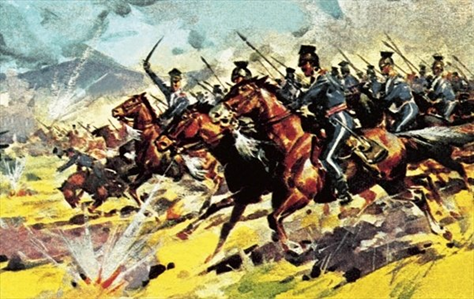
MacArthur enveloped the hill, mounting a frontal assault and, simultaneously, sending a battalion let by Major Lloyd Ross around it, snaking from hole to hole, cleaning out ravines and Machine-gun nests.

It was a bloody business.  In McArthur’s words:  “Officers fell and sergeants leaped to the command.  Companies dwindled to platoons and corporals took over.  At the end, Major Ross had only 300 men and 6 officers left out of 1,450 men and 25 officers.  That is the way the Cote-de-Chatillon fell.

Lieutenant Colonel Walter E. Bare—the commander of the 167th Infantry—proposed an attack from that direction, covered by a machine-gun barrage. MacArthur adopted this plan.  He was wounded, but not severely, while leading a reconnaissance patrol into no man’s land at night to confirm the existence of the gap in the barbed wire.  As he mentioned to William Addleman Ganoe a few years later, the Germans saw them and shot at MacArthur and the squad with artillery and machine guns. MacArthur was the sole survivor of the patrol, claiming it was a miracle that he survived. He confirmed that there was indeed an enormous, exposed gap in that area due to the lack of enemy gunfire coming from it.

At last the Americans had pierced the main German line.  Pershing called it  “a decisive blow” and said:  “The importance of this operation can hardly be overestimated”

Summerall recommended that MacArthur be promoted to major general and awarded the Medal of Honor.  However, neither happened.  He did receive a second distinguished Service Cross. Its citation read:  “For the manner to which he personally led his men, displaying indomitable resolution and great courage in rallying broken lines and reforming attacks, thereby making victory possible.”  The citation concluded, “on a field where courage was the rule, his courage was the dominant force.

MacArthur receiving Distinguished Service Cross from General Pershing

Following all this action there was a rest and then a council of war in an old farm house in late October.  With Menoher presiding, he asked this two Brigade commanders whether they thought the Rainbow, which had lost four thousand men in penetrating the Hindenburg Line, would be fit to play a role when the American advance resumed in November.  According to the divisional history, “MacArther jumped from his chair and started walking up and down, as he always did when talking about something in which he is greatly interested.  In his brilliant way he soon showed that there was no phase of the matter which he had not thoroughly considered from every possible point of view.  His discussion was such a comprehensive and competent analysis that his two auditors regretted then and afterwards that there was no stenographer present to take it all down and preserve it.”

There was more action by the Rainbow Divion, but by now the Germans had become demoralized.  There was news that there were insurrections back in Germany, and that the German fleet had mutinied when ordered to go out to sea and attack the British in a last ditch suicide raid.

MacArthur got word that there was an officer from Pershing’s staff snooping around divisional headquarters, asking the staff what they thought about their leader.  MacArthur interpreted this that they were out to get him on the ground “that I failed to follow certain regulations prescribed for our troops, that I wore no helmet, that I carried no gas mask, that I went unarmed, that I always had a riding crop in my hand, that I declined to command from the rear.”

Actually, this was not really the case.  Menoher was being promoted to corps commander, and MacArthur was designated his successor.  He was now the Commander of the 42nd Division.  At age thirty-eight he was the leader of twenty-six thousand men—the youngest divisional commander of the War.  At the same time, Persing wrote him that “it gives me great pleasure to inform you that on Oct. 17, I recommended you for promotion to the grade of Major General, basing my recommendation upon the efficiency of your service with the American Expeditionary Force.”

Finally, on 9 November, 1919 Armistice was declared.  That horrible, bloody war was over.  There was massive celebration all over the world, especially in America.

There would be no more promotions in the ranks, so MacArthur was not made Major General at that point.  However, for his service in WW I he received two Distinguished Service Crosses (just below the Congressional Medal of Honor), a Distinguished Service Medal (for exceptionally meritorious service in a duty of great responsibility), and seven Silver Stars (for gallantry in action against an enemy of the United States while engaged in military operations), as well as two Purple Hearts.  He was also awarded all manner of medals, citations, and military honors by other countries, especially the French, from whom MacArthur received two Croix de Guerre medals (awarded for extraordinary feats of bravery in Military action).
The Rainbow Division did not go home immediately.  It was chosen to participate in the occupation of the Rhineland in Germany.  It occupied the Ahrweiler District of the Rhineland in April of 1919 for 5 months.

Finally, the 42nd Division entrained to Brest and Saint-Nazaire where they boarded the ships to return to the United States.  MacArthur traveled on the ocean liner SS Leviathan, which reached New York on 25 April 1919.

You hear a lot about Douglas MacArthur for his exploits in WW II, and the Korean War and afterwards, but his exploits in WW I were enough to fill a lifetime for most people!

Though it may seem hard to believe, but considering the absolute facts, one has to concur that God was preserving the life of Douglas MacArthur during Word War I.

Memorial Day in America

 So, my friends, this is Memorial day in America. Join me in reflecting on it.

Memorial Day in America, as an annual observance, can be traced back to the end of the Civil War, a war in which over a half-million died.  Southern women scattered spring flowers on graves of both northern Union and southern Confederate soldiers.

 Ron

 On June 6, 1944 President Franklin Roosevelt offered a D-Day Prayer (as we readied for the great attack on Hitler’s Nazis), which is now part of the World War II Memorial in Washington, D.C.:  “My fellow Americans, I ask you to join with me in prayer: Almighty God, Our sons, pride of our Nation, this day have set upon a mighty endeavor, a struggle to preserve our republic, our religion, and our civilization.

 “Give strength to their arms, stoutness to their hearts, steadfastness in their faith. They will need Thy blessings. Their road will be long and hard. For the enemy is strong. He may hurl back our forces.

 We know that by Thy grace, and by the righteousness of our cause, our sons will triumph. Some will never return. Embrace these, Father, and receive them, Thy heroic servants, into Thy kingdom.”

In 1958, President Eisenhower placed soldiers in the tomb from World War II and the Korean War. In 1968, one hundred years after the first observance, Memorial Day was moved to the last Monday in May.

In 1984, President Ronald Reagan placed a soldier from the Vietnam War in that tomb. DNA tests later identified him as pilot Michael Blassie, whose 37B Dragonfly was shot down near An Loc, South Vietnam. He had graduated from the U.S. Air Force Academy in 1970.

In 2000, Congress passed The National Moment of Remembrance Act (Public Law 106-579), whereby on each Memorial Day, at 3:00 pm, citizens should pause for a moment of prayer:  “Congress finds that it is essential to remember and renew the legacy of Memorial Day to pay tribute to individuals who have made the ultimate sacrifice in service to the United States.

“Greater strides must be made to demonstrate appreciation for those loyal people whose values, represented by their sacrifices, are critical to the future of the United States and to encourage and to dedicate themselves to the principles for which those heroes of the United States died.

“A symbolic act of unity to honor the men and women of the United States who died in the pursuit of freedom and peace as a day of prayer for permanent peace.”

In his Memorial Day Address, May 31, 1923, President Calvin Coolidge said:  “Settlers came here from mixed motives. Generally defined, they were seeking a broader freedom.  They were intent upon establishing a Christian commonwealth in accordance to the principle of self-government.  It says in the Bible that ‘God sifted the nations that He might send choice grain into the wilderness.'”
 “The persecutions of the Puritans in England for non-conformity, and the religious agitations and conflicts in Germany by Luther, in Geneva by Calvin, and in Scotland by Knox, were the preparatory ordeals for qualifying Christian men for the work of establishing the civil institutions on the American Continent.

 “God sifted’ in these conflicts a whole nation that He might send choice grain over into the wilderness’; and the blood and persecution of martyrs became the seed of both the church and the state.  It was in these schools of fiery trial that the founders of the American republic were educated and prepared for their grand Christian mission.

 “They were trained in stormy times, in order to prepare them to establish the fundamental principles of civil and religious liberty and of just systems of civil government.”

 Concluding in his Memorial Day Address that America’s republic is worth preserving, President Calvin Coolidge stated May 31, 1923:

“They had a genius for organized society on the foundations of piety, righteousness, liberty, and obedience of the law. Who can fail to see in it the hand of destiy? Who can doubt that it has been guided by a Divine Providence?”

Douglas MacArthur told West Point cadets, May 1962:

 “The soldier, above all other men, is required to practice the greatest act of religious training-sacrifice.

 “In battle and in the face of danger and death, he discloses those Divine attributes which his Maker gave when He created man in His own image.

 “No physical courage and no brute instinct can take the place of Divine help which alone can sustain him.

 However horrible the incidents of war may be, the soldier who is called upon to offer and to give his life for his country is the noblest development of mankind.”

Douglas MacArthur – Third Installment

McArthur was born January 26, 1880 to parents who both had military backgrounds.  His mother who most called Pinkey, was from well to do Virginia parents.  His father was already a rather famous U.S. Army officer. Compared to most famous people, Douglas McArthur lived what I would call four whole lives.  He was a commander in three major wars.  Therefore, in relating to you his amazing life, it will be necessary to convey it to you in sections or posts.  Following is the Third one.

Ron

MacArthur returned to the War Department, where he was promoted to Major on 11 December 1915. In June 1916, he was assigned as head of the Bureau of Information at the office of the Secretary of War, Newton D. Baker. MacArthur has since been regarded as the Army’s first press officer.

Following the declaration of war on Germany on 6 April 1917 and the subsequent American entry into World War I, Baker and MacArthur secured an agreement from President Wilson for the use of the National Guard on the Western Front in France where they knew any Americans entering the war would be sent.

As you probably know, the National Guard was composed of soldiers from each individual state.  MacArthur suggested sending a division organized from units of different states, so as to avoid the appearance of favoritism toward any particular state.

MacArthur described it as a rainbow of colors from each state flag, and as a result it was named the Rainbow Division because of MacArthur’s description.  Baker approved the creation of this formation, which became the 42nd (“Rainbow”) Division and appointed Major General William Abram Mann, the head of the National Guard Bureau, as its commander. MacArthur was its chief of staff, and with his new role came the rank of colonel, skipping the rank of lieutenant colonel.

 At MacArthur’s request, this new Division was placed in the infantry rather than the engineers.

From its formation atMacArthur receiving the French Croix de Guerre medal from General Bazelairein August 1917, MacArthur was the division’s key sparkplug, prime motivator, and individual most responsible for its creation. Competent, efficient, innovative, highly intelligent, and tirelessly energetic, as division chief of staff MacArthur appeared everywhere, at all hours – badgering, cajoling, inspiring, intervening, and attending to every detail, large and small.

It sailed in a convoy from Hoboken, New Jersey, for the Western Front on 18 October 1917. On 19 December the 42nd’s commander, the 63-year-old Mann, was replaced by 55-year-old Major General Charles T. Menoher, after Mann–who was “ill, old, and bedridden”–[41] failed a physical examination. The new division commander and his chief of staff “became great friends”, in MacArthur’s words, who further described Menoher as “an able officer, an efficient administrator, of genial disposition and unimpeachable character”.

In 1917 Fance’s most striking geographic feature was a double chain of snakelike trenches which began on the English Channel and ended 466 miles away on the Swiss border.  Facing one another across the no-man’s land between these earthworks the great armies squatted in the western front amid the stench of urine, feces, and decaying flesh, living lives in candlelit dugouts and sandbagged ditches hewn from chalk or clay, or scooped from the porridge of swampy Flanders.

They had been there since the summer of 1914 when the gray tide of the German army had swept through Belgium and lapped at the very gates of Paris.  The titanic struggles which followed had been called battles, but although they had been fought on a fantastic scale, with nearly two million men lost at Verdun and on the Somme, strategically they were only siege assaults.  Every attack found the defenses of the Kaiser’s troops stronger.  The Tommies who crawled out of their filthy trenches, lay down in front of the jump-off tapes, and waited for their officers’ zero-hour whistles, would face as many as ten aprons or sections of barbwire with barbs thick as a man’s thumb, and then the multitude of German water-cooled machine guns.

A few trenches would be taken at shocking cost.  In one typical attack, one gain of seven hundred mutilated yards cost 26 thousand men, and then the sieges back and forth would start again. 

It was a weird, grimy life, unlike anything in their sheltered upbringing.  Most sounds and colors on the front were unearthly.  Bullets cracked and ricochets sang with an iron ring; overhead, shells warbled endlessly.  There were saffron shrapnel puffs, shaky yellowish mists of mustard gas souring the ground, and spectacular Very flares of all hues.

Arriving draftees were shipped up in boxcars to their new homes in the earth, where everything revolved around the trench—you had a trench knife a trench cane, a rod-shaped trench periscope and, if you were unlucky, trench foot, trench mouth, or trench fever.

Even in uncontested sectors there was a steady toll of shellfire casualties.  The methodical British called it “normal wastage.”  Such shellings were symbolic of the whole conflict—grotesque, impersonal, obscene, ghastly.  The war was, quite simpley the worst thing that had ever happened.

Despite the unparalleled horror—the insanities of World Was II, Korea, and Vietnam  never quite matched the madness of World War I.

After it was all over, in 1919 a colonel who hadn’t been overseas wrote of MacArthur that it was “hard for me to conceive of this sensitive, high-strung personage slogging in the mud, enduring filth, living in stinking clothing and crawling over jagged soil under criss-crosses of barbed wire to have a bloody clash with a bestial enemy.”  The explanation was that men like MacArthur, raised to believe in Victorian heroism, invested even the nightmare of trench warfare with extravagant thoughts of fantastic glory.

With General Charles Meneher as its ranking officer, the 42nd (Rainbow) division was sent immediately to the Western Front upon its arrival in France.  Everyone knew that the Germans were planning a big Spring offensive.  American units were desperately needed.  Pershing ordered the 42nd into the Luneville sector on the Lorraine plain.

With MacArthur as its Chief of Staff, he was second in command and, with some of the Division already going into the trenches, of course he was there with them instead of being back of the lines with the other ranking officers.  MacArthur was meticulous in organization and consummate in planning.  More and more he was delegating authority for operations, intelligence, and administration to majors and lieutenant colonels.  There was a kind if madness in his method: he wanted the staff to be self-sufficient so that he would be free to cross no-man’s-land with assault troops.

One of the first things that he heard was that a group of French commandos were planning and excursion or raid across no-man’s-land to the German trenches on February 24, 1918.  Knowing that he needed experience in this type of warfare and anxious to get into the fight, he asked for permission to accompany them from General Georges de Bazelaire. He was turned down but when he argued: “I cannot fight them if I cannot see them,” he was finally given permission.   

Next morning at daylight he is right there, ready for the excursion.  However, to the amazement of the other participants he is not dressed in the required uniform like the rest.  Typical of MacArthur, he is dressed in his cavalry riding britches, his scrunched-down cap instead of the steel helmet, his riding boots polished to a mirror finish, a four foot muffler knitted by his mother, a turtle neck sweater, and only a riding crop instead of any other weapon.

Captain Thoms Hardy, one of General Menoher’s aids asked to go along with him.  When he asked about MacArthur’s outlandish attire, MacArthur remembered his father and told him “It’s the orders you disobey that make you famous.”

The French soldiers were daubing sticky black mud on their faces.  MacArthur and Handy followed their example, and also accepted the loan of wire cutters and trench knives from a French lieutenant  

Upon the signal to advance, a tossed grenade, he started across no-man’s-land in front of those French commandos, leading them through all the barbed wire, machine gun fire and across and around the plethora of shell holes.

He got to the edge of the German trenches first and peered down.  Then the French soldiers caught-up and peered down also.  They wondered what should be their next move.  They did not have long to wait, for MacArthur jumped down into the German trench and yelled for them to follow.  They shot the surprised Germans right and left.  However, MacArthur rounded up a group of Germans as prisoners, including a high ranking German Colonel in his fancy German officer’s uniform. 

When they had done about all the damage they could do there, MacArthur led them back across no-man’s-land.  He was standing upright and prodding the German colonel along in front of him with his riding crop.  When he approached the allied trenches, with that German officer still being prodded along, a huge cheer went up from the Rainbow division men that were already there as well as an equally rousing cheer from the French soldiers.   In his words, Frenchmen “crowded around me, shaking my hand, slapping me on the back , and offering me cognac and absinthe.”

General de Bazelaire pinned a Croix de Guerre on him and kissed him on both cheeks. This was the first ever Croix de Guerre awarded to a member of the American Expeditionary Forces (AEF).  Menoher, awarded him the silver star afterward, and told a New York Times war correspondent: “Colonel MacArthur is one of the ablest officers in the United States Army and one of the most popular.

MacArthur receiving the French Croix de Guerre medal from General Bazelaire

Be Prepared for Fourth Installment

Douglas MacArthur – Second Installment

McArthur was born January 26, 1880 to parents who both had military backgrounds.  His mother who most called Pinkey, was from well to do Virginia parents.  His father was already a rather famous U.S. Army officer. Compared to most famous people, Douglas McArthur lived what I would call four whole lives.  He was a commander in three major wars.  Therefore, in relating to you his amazing life, it will be necessary to convey it to you in sections or posts.  Following is the Second one. Ron

Lt. MacArthur spent his graduation furlough with his parents at Fort Mason, California, where his father, now a major general, was commanding the Department of the Pacific.

Afterward, he joined the 3rd Engineer Battalion, which departed for the Philippines in October 1903. He did survey work around many of the islands. In November 1903, while working on Guimaras, he was ambushed by a pair of Filipino brigands or guerrillas; he shot and killed both.

He was promoted to first lieutenant in Manila in April 1904. In October 1904, his tour of duty was cut short when he contracted malaria during a survey on Bataan.

He returned to San Francisco, where he was assigned to the California Commission that was to regulate streams that had been devastated by being clogged from all the gold mining runoff, and in July 1905, he became chief engineer of the Division of the Pacific.

Lt. MacArthur served on his father’s staff for several years.  He did intelligence work all over the world.  He was transferred to Washington where he served as “an aide to assist at White House functions” at the request of President Theodore Roosevelt.  

He was then transferred to Leavenworth.  He was stuck there for several years, but eventually was stationed in Washington under the Chief of Staff of the Army, Major General Leonard Wood who had served with his father years ago.

By now Douglas had advanced to the rank of Captain. 

In this year of 1913 the United States and Mexico had drifted close to war with each other.  Mexican General Huerta had insulted the American Flag and was showing great belligerence.  President Wilson in and unusual move had ordered the U.S. Navy to seize the Mexican town of Vera Cruz.  A contingent of U.S. soldiers and marines was holding the town, but were surrounded by 11,000 of Mexican General Huerta’s troops.

The U.S. Secretary of War had alerted General Wood to be prepared to send an expeditionary force there if hostilities were to break out between the two countries.

Wood desperately needed intelligence to be ready for such.  Vera Cruz was being held by Brigadier General Frederick Funston with just a small circle around the town, and he had orders to not go beyond the lines of that circle.

General Wood decided that the ideal way to solve his lack of intelligence for his needs was so send Captain Douglas MacArthur down there in the role of a one-man spy operation to find out all that he could without telling anyone, even General Funston who was holding the town with his small contingent of U.S. forces.

Captain MacArthur sailed down there on the U.S.S. Nebraska and arrived in Vera Cruz on Friday, May 1.  What he found there called for both courage and skill.  As I mentioned, the small U.S. brigade was surrounded by 11,000 of Huerta’s forces.  And if it ever became known the U.S. was contemplating an attack against Mexico, Huerta would proceed to attack and destroy that American brigade. 

The night before a U.S. soldier had gotten lost and wandered across the line into Huerta’s side.  He was promptly executed, and this showed what danger Captain MacArthur faced if he went across the line to gather the intelligence that was so needed.

After sizing-up the situation, Douglas determined that the primary need that the U.S. needed was transportation from the port inland.  Vera Cruz lacked horses or mules or trucks.  However, there was a railroad, and it was obviously the best transportation that was available.  Douglas found that there was a large number of rail cars, but not a single engine to pull them in the town.  He knew that he must find some engines.

Operating as a one-man force he first found an engineer and two firemen who had worked on that train previously.  He promised each man $150 in gold if they could find him engines.  He searched the engineer and confiscated his 38 caliber pistol.  He then showed the engineer that he had no money or anything of value on himself other than a small derringer pistol.

These three dudes swore that they could show Douglas where to find those engines.

Douglas sent the two firemen on ahead, and he and the engineer followed. They confiscated a railroad handcar and started off inland.  They got about 15 miles and then were stopped by a bridge that was down over a river. They camouflaged the rail car and found a canoe to cross the river.  They mounted some ponies that they found tied to a small shack and took off down the tracks.

Eventually they came upon the two firemen who had another handcar ready for them. Deeper and deeper they penetrated Huerta country.  Since MacArthur was in uniform and obviously Anglo-Saxon he left the car as thy approached each settlement, lashing one man to him as a guide while he circled the village and met the car with the other two men on the other side.

At 1:00 A.M. they reached Alvarado, thirty-five miles beyond Funston’s outpost.  There they found five locomotives.  Two of them were useless switch engines, but three were just what he needed—fine big road pullers in excellent condition.  He made a careful inspection of them and then started back.

According to Douglas, the return trip was a “bloody affair”.  At Salinas five armed men opened fire on them.  MacArthur dropped two of them with his little derringer.  At Piedra they ran into 15 mounted gunmen.  The horsemen put three bullet holes through MacArthur’s clothing and wounded one of the Mexicans.  Douglas shot four of the assailants.  Near Laguna, three more mounted men fired at them.  Again, lead tore through MacArthur’s uniform, and again he brought an attacker down.

         {All those bullet holes through his clothing without a single one ever touching his skin was the start of the “idea” that Douglas MacArthur could face any enemy fire without ever being hit.  Many believed it, and considering the multitude of his later actions, it seems that he must have believed it also.}

Again, they crossed the Jamapa river and even though the canoe sank they carried the wounded Mexican up and at daybreak found the camouflaged handcar. Later in the morning they reentered American lines.

War was never declared, but they now had the intelligence needed if it were.  The Vera Cruz incident disclosed much about MacArthur:  his ingenuity, his eye for terrain, and his personal bravery. 

General Wood recommended him for the Medal of Honor, noting the expedition, which had been undertaken “at the risk of his life” and “on his own initiative,” showed “enterprise and courage worthy of high commendation.”  It was turned down by the rather prejudiced review committee, but was noticed across the U.S. army.

Be Prepared for Third Installment

Mother’s Day

If you would like to know the real, accurate history of how we got Mother’s Day, please read the following words: Ron

After the Civil War, abolitionist Julia Ward Howe, author of “The Battle Hymn of the Republic”, led a Mother’s Day for Peace march in New York on June 2, 1872, to promote peace, national healing and reconciliation.

She composed a proclamation to “appeal to womanhood throughout the world.”

She personally sponsored a Mothers’ Day celebration in Boston for the next ten years till interest dwindled.

In the following decades, Protestant churches and schools observed Decision Day for committing to Christ, Roll Call Day for church membership, Missionary Day, Temperance Sunday, and Children’s Day.

Numerous efforts arose for observing a Mother’s Day, but taking the day from a suggestion to a reality was Anna Jarvis. She is the person most responsible for making Mother’s Day a nationally observed event.

Anna was from Grafton, West Virginia, the granddaughter of a Baptist minister.  She was a member of Andrews Methodist Episcopal Church, where she taught Sunday school.

In 1876, after one of her Bible lessons, Anna Jarvis closed with a prayer:  “I hope and pray that someone, sometime, will found a memorial mothers day commemorating her for the matchless service she renders to humanity in every field of life. She is entitled to it.”

Similar to Clara Barton, founder of the American Red Cross, Anna Jarvis’ mother worked during the Civil War to organize Mothers’ Day Work Clubs to care for wounded soldiers, both Union and Confederate.

Anna’s mother raised money for medicine, inspected bottled milk, and improved sanitation.  She arranged in 1868 a “Mother’s Friendship Day to reunite families that had been divided during the Civil War.”

Inspired by her mother’s self-sacrifice and generosity, Anna Jarvis wanted to honor her, and all mothers. On May 12, 1907, Anna persuaded her church, Andrews Methodist Episcopal Church, to have a small Mother’s Day service.

The next year, May 10, 1908, Anna organized a Mother’s Day in two places:  Andrews Methodist Episcopal Church, and in Philadelphia, where she gave a moving speech in the auditorium of the 12-story Wanamaker Department Store.

Wanamaker, who had paintings of Christ throughout his store, stated:  “There is a power in the Gospel of the Lord Jesus Christ. Keep uppermost the profound conviction that it is the Gospel that is to win the heart and convert the world. The things that were sweet dreams in our childhood are now being worked out. The procession is being made longer and longer; the letters of Christ’s name are becoming larger and larger.”

John Wanamaker was a retail pioneer and founder of one of the first department stores.

With the financial backing of John Wanamaker and H.J. Heinz, maker of “57 varieties” of ketchup, Anna Jarvis began a letter-writing campaign to ministers and politicians to establish a “national” Mothers’ Day.

Then, a suggestion for honoring motherhood was made by University of Notre Dame’s first athletic director, Frank Hering. He proposed “setting aside one day in the year as a nationwide memorial to the memories of mothers and motherhood,” stating:  “Throughout history the great men of the world have given their credit for their achievements to their mothers.”

Due to the overwhelming support of pastors and churches, by 1909, forty-five states observed Mother’s Day.  People wore white and red Carnations on Sunday to pay tribute to their mothers.

On May 8, 1914, Congress designated the second Sunday in May as Mother’s Day.

On MAY 9, 1914, President Woodrow Wilson proclaimed the first National Mothers’ Day as a: “public expression of love and reverence for the mothers of our country.”

English Poet Robert Browning wrote: “Motherhood: All love begins and ends there.”

Mothers have the role of imparting values into children, as American poet William Ross Wallace wrote: “The hand that rocks the cradle is the hand that rules the world.”

This was echoed by historians Will and Ariel Durant in The Lessons of History, 1968: “Civilization is not inherited; it has to be learned and earned by each generation anew; if the transmission should be interrupted, civilization would die, and we would be savages again.”

On February 3, 1983, at the annual National Prayer Breakfast, President Ronald Reagan stated: “I have a very special old Bible. And alongside a verse in the Second Book of Chronicles there are some words, handwritten, very faded by now. And believe me, the person who wrote these words was an authority. Her name was Nelle Wilson Reagan. She was my mother.”

Reagan explained: “Freedom is never more than one generation away from extinction. We didn’t pass it to our children in the bloodstream. It must be fought for, protected,  and handed on for them to do the same, or one day we will spend our sunset years telling our children and our children’s children what it was once like in the United States where men were free.”


Douglas MacArthur

MacArthur was born January 26, 1880 to parents who both had military backgrounds. His mother who most called Pinkey, was from well to do Virginia parents.  His father was already a rather famous U.S. Army officer.

Compared to most famous people, Douglas MacArthur lived what I would call four whole lives.  He was a commander in three major wars.  Therefore, in relating to you his amazing life, it will be necessary to convey it to you in sections or posts.  Following is the first one.

Ron

As I mentioned above, he was born on January 26, 1880.  During the first years of his life his father was stationed as Commander of different forts along the frontier of West Texas and the deserts of New Mexico.

Young Douglas and his brother grew up with those U.S. Army horse soldiers at those forts where he was home-schooled by his mother.  Having been a woman of substance and culture of the Old South, the frontier life in those forts was really tough on her.

Douglas and his brother both had Navaho spotted ponies at a really early age.  They would ride great distances across the prairies hunting rabbits from horseback, but always watching for Indians. And they were immersed in the military customs and lives of those soldiers where they lived. My first recollection McArthur was fond of saying later “was that of a bugle call.”

In his mother’s lap he learned the virtue of physical courage and the disgrace of cowardice.  Once she told Doug that men do not cry.  He protested that his father’s eyes were often moist at the retreat ceremony.  That was different, she quickly explained; that was from love of country; that was allowed.  But tears of fear were forbidden.

Douglas was age seven when their Company K was posted to Leavenworth and he could be around youngsters his own age for the first time, and where he started the second grade in a real school for the first time.

One afternoon in the autumn of 1893, when he was thirteen, he overheard his father remark to his mother: “I think there is the material of a soldier in that boy.”  Many fathers say such things about their sons, hoping they follow in their footsteps. What mattered was that his son swore never to forget it—and never did.

In that same fall of 1893 Commander Arthur brought home the news, welcome to his younger son if not to his wife, that after four years away from troops they would head westward again, to San Antonio.

There Douglas entered West Texas Military Academy.  Douglas was dark, wiry and already handsome.  He crossed the Fort Sam Houston’s lower parade ground at 8 o’clock each morning wearing a braided gray cadet uniform and carrying, as required: a Bible, Prayer book, and a hymnal.  Chapel was held every day in the ivy-covered stone Church of Saint Paul, where the boy was confirmed the following April.

His last year was an unbroken series of triumphs. Both the football and baseball teams were undefeated. He was chosen first seargent of A Company, the highest rank he could attain. He organized and led a prizewinning drill squad and was one of four cadets to achieve perfect marks in deportment. With an academic average of 97.33 he won the Academy Gold Medal and became valedictorian of the class of 1897.

Douglas and his mother both were determined that he go to West Point.  But to do so, one must be nominated by a Congressman who is allowed very few nominations.  Pinkey thought that she had persuaded a Congressman friend to get Douglas in.  In that first year it did not happen.  Also, he flunked the physical due to curvature of the spine.  He worked extremely hard with a famous medical doctor named Pfister and got the problem cured.

Finaly Pinkey found a Congressman named Otjen who had thirteen applicants.  To solve his problem of who to send to the Point he decided to hold an examination.  He got 3 school principals to conduct it in the Milwaukee, Wisconsin City Hall.  Douglas worked extremely hard under another Principal that Pinkey hired as a tutor.  The Milwaukee Journal reported on the contest’s outcome on its first page:  Under the headline HE WILL GO TO WEST POINT.  The 1898 paper reported that Douglas had placed first among the thirteen applicants. The paper went on to say “young MacArthur is a remarkably bright, clever, and determined boy. His standing was 99.5 against the next man’s 77.9. He scored 700 points out of a possible 750. In his case preparedness is the key to success and victory.”

So, on the afternoon of Tuesday, June 13, 1899 , a West Shore Railroad train three hours out of Weehawken paused at West Point to discharge a youth wearing a light gray Stetson, and his small, severely dressed mother.  Yes, she went to West Point with him. 

They were standing on the U.S. Military Academy “plain,” a broad shelf of land overlooking the Hudson which was itself was overlooked by towering, thickly forested heights.  Facing the plain were various buildings and monuments.  The superintendent’s mansion gleamed whitely.  Gothic walls of gray granite, as grim as those of a penitentiary, enclosed the cadet barracks. A walkway wended itself downward to the river to an antebellum structure of yellow brick with a broad green wooden veranda where stood Craney’s Hotel.  Here Mrs. Arthur MacArthur would live for the next four years. Like Franklin Roosevelt at Harvard and Adlai Stevenson at Princeton, Douglas MacArthur would share much of his collegiate experience with an alert mother-in-residence.

The Corps at that time had only 332 cadets.  It had its own nomenclature all of which I won’t go into here, but the leader of the entire corps, the one who best embodied the Military ideal, was the “First Captain.”

The first three weeks there are the worst.  The plebes live in tents across the parade grounds, and are subjected to unbelievable hazing.  It was so bad in MacArthur’s first year that one Cadet died, and a Congressional Hearing was conducted, and young Douglas was required to appear and testify.

Since the other cadets knew that Douglas’s father was a U.S. Army General fighting in the Philippines he was observed very closely.  Many years later some of the cadets of that time were interviewed. I was able to read some of their remarks.  One said “to know MacArthur is to love him or to hate him—you can’t just like him.”

Robert E. Wood, who became a first classman that June, said that the older members of the corps “recognized intuitively that MacArthur was born to be a real leader of men.”  Wood also wrote later that he was “without a doubt the handsomest cadet that ever came into the academy.”  Various other cadets thought he seemed to be

“brave as a lion and smart as hell, a youth with a mind like a sponge, and one who would be flogged alive without changing his mind once it had been make up.”  Robert C Richardson wrote: “He had style. There was never a cadet quite like him.”

Douglas was number one in academics in each years’ class, an amazing accomplishment.  West Point had classes that were not present at other schools, such as horsemanship, and military deportment.

However, he displayed other talents.  He was so good at football and so well liked by the team that he was voted in as its Captain.  All his life he was very proud of his letter “A” that was earned.  He even wore it on his bathrobe at the Inchon Invasion way later.

Yet, at that time, football was still in its infancy.  Baseball was the most popular game, both nationally and at West Point.  And young MacArthur was really good at baseball.  On Saturday, May 18, 1901 Army and Navy played each other for the first time.  The Navy cadets sang a song ridiculing Douglas’ father, fighting as the General in the Philippines.  However, Army won 4 to 3 and Douglas scored the winning run.

He led another exploit there at the Academy that was never proved or publicized.  A small group of cadets

snuck across the parade grounds and brought over the cannon that was used in all the ceremonies.  They hoisted it to the top of the academic building.  It took an outside construction crew a whole week to get it down.  All the cadets knew that only Douglas had the ability to accomplish such a marvelous fete.

Not only did Douglas MacArthur finish first in his class of Cadets, but he compiled a record that has not been surpassed but twice since the Academy was founded in 1802—by an 1884 graduate and by Robert E. Lee of the class of 1829.  MacArthur scored a perfect 100 in law, history, and English.  He led his classmates in Mathematics, drill regulations, and ordinance and gunnery.

Wearing a First Captain’s gold stripes, he served as the superintendent’s representative, inspected the mess hall daily, and “drove the corps” to barracks wih with sharp, ringing commands each evening.

On Thursday, June 22,1903, that year’s class became full-fledged Members of “the Long Gray Line”— the procession of academy graduates which had begun with the first class in 1802.  “MacArthur” the adjutant bawled, and the twenty-three-year-old head of the Corps, the cadet whose classmates had voted man likeliest to succeed, received his certificate of graduation.  He in turn handed it to his father, who had arrived from San Francisco for the occasion, and smiled down at his beaming mother.

Old Hickory

Old Hickory

Most folks know that Andrew Jackson’s picture is on our $20 dollar bill, that he won the Battle of New Orleans, that he was the 7th president of the United   States, and that he was considered rough and rowdy in Washington, but little else about him. I hope you will read the following, and learn what an amazing man that he really was.  And how useful it would be to have a man like him back there again today!

Ron

Beginning in 1606, England’s King James I transplanted large numbers of Presbyterians from Scotland into Ulster, a province in Northern Ireland.  They were mostly tenant farmers who grew flax for the linen industry and grazed sheep for the wool industry.

In the first half of the 1700s, Ulster farmers suffered from rising rents and a famine. This led to a great Ulster migration of over 250,000 Scots-Irish Protestants to America.

One of these families was the Jackson family.  Andrew Jackson’s Scots-Irish parents emigrated to America two years before his birth, March 15, 1767.  A month before he was born, his father died in a log-hauling accident in Waxhaw hills of North Carolina.

At age 13, Andrew Jackson joined a local militia to fight during the Revolutionary War.

His eldest brother, Hugh Jackson, died during the Battle of Stono Ferry, June 20, 1779.

Andrew and another brother, Robert, were taken prisoner and nearly starved to death.  Robert contracted smallpox in prison and died.

A British officer ordered young Andrew Jackson to polish his boots.

When Andrew refused, the officer drew his sword and slashed him across the head, arm and hand, leaving Andrew with permanent scars.

On May 29, 1780, British forces, numbering 14,000, laid siege to Charleston, South Carolina.  After six weeks, American Major General Benjamin Lincoln surrendered.  Nearly 6,000 Americans were taken captive, the largest number of Americans taken captive prior to the Civil War.  Buildings were converted into prisons, and many prisoners were put on British starving ships where they contracted diseases.

Andrew Jackson’s mother, Elizabeth, along with other women, volunteered to care for the sick American prisoners.  Tragically, Elizabeth Jackson contracted “ship fever” and died, being buried in an unmarked grave.

Andrew Jackson was an orphan at age 14.

Jackson supported and educated himself, eventually becoming a frontier country lawyer.  In 1788, at the age of 21, was appointed prosecutor of the Western District.

In 1796, at the age of 29, Jackson was elected as a delegate to the Tennessee constitutional convention, where he is credited with proposing the Indian name “Tennessee.”

Tennessee citizens elected Jackson a U.S. Congressman, then U.S. Senator.

In 1798, Jackson served as a judge on Tennessee’s Supreme Court.

Speculating in land, Jackson bought the Hermitage plantation near Nashville and was one of three investors who founded Memphis.

Conflicts with Indians increased, being incited by the British.

The New Madrid Earthquake temporarily reversed the flow of the Mississippi River and the Great Comet of 1811 helped convince Indians to back Shawnee Chief Tecumseh, whose name meant “shooting star.”

Indians were armed by the British during the War of 1812.

British backed Red Stick Creek Indians massacred 500 Americans at Fort Mims, Alabama. 

Andrew Jackson was sent to fight the British-backed Red Stick Creek Indians at the Battle of Horseshoe Bend in 1814. One of Jackson’s soldiers was the young Sam Houston, who was wounded, but kept fighting.  Another soldier was Davy Crockett, who later became a Tennessee Congressman.  Davy Crockett and Sam Houston helped Texas gain independence from Mexico.  (These were the kinds’ of men who were attracted to “Old Hickory”.)

During the War of 1812, at the Battle of Tallasehatchee, a dead Creek woman was found clutching her living baby.  The other Indian women refused to care for the infant boy, so Jackson brought him home and raised him as his son, naming him Lincoyer.

Andrew Jackson drove the British out of Pensacola, November 9, 1814, then left the city in the control of the Spanish.

He went on to defend Mobile, Alabama, then New Orleans, Louisiana.

A strict battlefield officer, Jackson was described as being “tough as old hickory,” leading to his nickname “Old Hickory.”

Against overwhelming odds, Andrew Jackson defeated 10,000 British at the Battle of New Orleans on January 8, 1815.  Aided by Jean Lafitte’s French pirates, along with Kentucky and Tennessee sharpshooters, over 2,000 British were killed or wounded, as compared to only 71 American casualties.

Considered the greatest American land victory of the war, General Andrew Jackson wrote to Robert Hays, January 26, 1815:  “It appears that the unerring hand of Providence shielded my men from the shower of balls, bombs, and rockets, when every ball and bomb from our guns carried with them a mission of death.”

{Now be patient with me, and let me stop and give you a detailed description of this famous Battle of New Orleans:}

In December 1814, even as diplomats met in Europe to hammer out a truce in the War of 1812, British forces mobilized for what they hoped would be the campaign’s finishing blow. Following military victories against Napoleon in Europe earlier that year, Great Britain had redoubled its efforts against its former colonies and launched a three-pronged invasion of the United States.

American forces had managed to check two of the incursions at the Battle of Baltimore (the inspiration for Francis Scott Key’s “Star-Spangled Banner”) and the Battle of Plattsburgh, but now the British planned to invade New Orleans, a vital seaport and the gateway to the United States’ newly purchased territory in the West, procured through the Louisiana Purchase.

If it could seize the Crescent City, the British Empire would gain dominion over the Mississippi River and hold the trade of the entire American South and the West under its thumb.

Standing in the way of the British advance was Major General Andrew Jackson, who had rushed to New Orleans’ defense when he learned an attack by the British was in the works. Nicknamed “Old Hickory” for his legendary toughness, Jackson had spent the last year subduing hostile Creek Indians in Alabama and harassing the redcoats’ operations along the Gulf Coast.

The General had no love for the British, he had spent time as their prisoner during the Revolutionary War, and he was itching for a chance to confront them in battle. “I owe to Britain a debt of retaliatory vengeance,” he once told his wife, “should our forces meet I trust I shall pay the debt.”

After British forces were sighted near Lake Borgne, Jackson declared martial law in New Orleans and ordered that every available weapon and able-bodied man be brought to bear in the city’s defense. His force soon grew into a 4,500-strong patchwork of army regulars, frontier militiamen, free blacks, New Orleans aristocrats and Choctaw tribesmen. The frontier men from Alabama and Tennessee with their long, accurate rifles and their wild lust for action were formidable foes.

After some hesitation, Old Hickory even accepted the help of Jean Lafitte, a dashing pirate who ran a smuggling and privateering empire out of nearby Barataria Bay.

The two sides first came to blows on December 23, when Jackson launched a daring nighttime attack on British forces bivouacked nine miles south of New Orleans. Jackson then fell back to Rodriguez Canal, a ten-foot-wide millrace located near Chalmette Plantation off the Mississippi River.

Using the labor of all those available, he widened the canal into a defensive trench and used the excess dirt to build a seven-foot-tall earthen rampart buttressed with timber. When completed, this “Line Jackson” stretched nearly a mile from the east bank of the Mississippi to a nearly impassable marsh or swamp filled with cypress trees.

Jackson’s ramshackle army was to face off against some 8,000 British regulars, many of whom had served in the Napoleonic Wars, hardened real soldiers of those days.

At the helm was Lieutenant General Sir Edward Pakenham, a respected veteran of the Peninsular War and the brother-in-law of the Duke of Wellington.

The two sides first came to blows on December 23, when Jackson launched a daring nighttime attack on British forces bivouacked nine miles south of New Orleans. Jackson then fell back to Rodriguez Canal, a ten-foot-wide millrace located near Chalmette Plantation off the Mississippi River.

Using all available labor, he widened the canal into a defensive trench and used the excess dirt to build a seven-foot-tall earthen rampart buttressed with timber and cotton bales. When complete, this “Line Jackson” stretched nearly a mile from the east bank of the Mississippi to a nearly impassable marsh or swamp filled with cypress trees.

“Here we shall plant our stakes,” Jackson told his men, “and not abandon them until we drive these red-coat rascals into the river, or the swamp.”

Despite their imposing fortifications, Lieutenant General Pakenham believed the “dirty shirts,” as the British called the Americans, would wilt before the might of a British army in formation. Following a skirmish on December 28 and a massive artillery duel on New Year’s Day, he devised a strategy for a two-part frontal assault.

A small force was charged with crossing to the west bank of the Mississippi and seizing an American battery. Once in possession of the guns, they were to turn them on the Americans and catch Jackson in a punishing crossfire. At the same time, a larger contingent of some 5,000 men would charge forward in two columns and crush the main American line at the Rodriguez Canal.

Pakenham put his plan to action at daybreak on January 8. At the sound of a Congreve rocket whistling overhead, the red-coated throngs let out a cheer and began an advance toward the American line. British batteries opened up en masse, and were immediately met with an angry barrage from Jackson’s 24 artillery pieces, some of them manned by Jean Lafitte’s pirates.

While Pakenham’s main force moved on the canal near the swamp, British light troops led by Colonel Robert Rennie advanced along the riverbank and overwhelmed an isolated redoubt, scattering its American defenders.

Rennie had just enough time to howl, “Hurrah, boys, the day is ours!” before he was shot dead by a salvo of rifle fire from Line Jackson. With their commander lost, his men made a frantic retreat, only to be cut down in a hail of musket balls and grapeshot (small caliber round shot packed inside canvas).

Pakenham had counted on moving under the cover of morning mist, but the fog had risen with the sun, giving American rifle and artillerymen clear sightlines. Cannon fire soon began slashing gaping holes in the British line, sending men and equipment flying.

      General Pakenham

As the British troops continued the advance, their ranks were riddled with musket shot. General Jackson watched the destruction from a perch near the right side of the line, bellowing, “Give it to them, my boys! Let us finish the business today!” Old Hickory’s militiamen, having honed their aim hunting in the woods of the frontier, fired with terrifying precision.

Red-coated soldiers fell in waves with each American volley, many with multiple wounds. One stunned British officer later described the American rampart as resembling “a row of fiery furnaces.”

Pakenham’s plan was quickly unraveling. His men had bravely stood their ground amid the chaos of the American deluge, but a unit carrying ladders needed to scale Line Jackson was lagging behind. Pakenham took it upon himself to lead the outfit to the front, but in the meantime, his main formation was cut to ribbons by rifle and cannon fire.

When some of the redcoats began to flee, one of Pakenham’s subordinates unwisely tried to wheel the 93rd Highlanders Regiment to their aid. American troops quickly took aim and unleashed a maelstrom of fire that felled more than half the unit, including its leader. Around that same time, Pakenham and his entourage were laced by a blast of grapeshot. The British commander perished minutes later.

At Line Jackson, the British were retreating in droves, leaving behind a huge carpet of crumpled bodies. American Major Howell Tatum later said the enemy casualties were “truly distressing. Some had their heads shot off, some their legs, some their arms. Some were laughing, some crying. There was every variety of sight and sound.”

The assault on Jackson’s fortifications was a fiasco, costing the British some 2,000 casualties, including three generals and seven colonels all of it in the span of only 30 minutes. Amazingly, Jackson’s ragtag outfit had lost fewer than 71 men. Future President James Monroe would later praise the General by saying, “History records no example of so glorious a victory obtained with so little bloodshed on the part of the victorious.” The stunned British army lingered in Louisiana for the next several days, but its remaining officers knew that any chance of taking the Crescent City had slipped through their fingers. The British boarded their ships and sailed back into the Gulf of Mexico.

In 1817, President Monroe charged Jackson with stopping Seminoles in Florida from raiding into Georgia, resulting in the First Seminole War.

With Spain exhausted after Napoleon’s invasion, and with Mexico fighting for Independence, the Spanish government agreed to cede Florida to the U.S. in 1819 in exchange for payment, according to John Quincy Adams’ Adams-Onís Treaty.

This led to Jackson serving as Florida’s first territorial governor.  The city of Jacksonville is named for him.

Circuit-riding preacher Peter Cartwright wrote of meeting Jackson, as recorded in the Autobiography of Peter Cartwright the Backwoods Preacher (pp. 192-194):  “I then read my text: ‘What shall it profit a man if he gain the whole world and lose his own soul?’

After reading my text I paused. At that moment I saw General Jackson walking up the aisle; he came to the middle post, and very gracefully leaned against it, and stood, as there were no vacant seats.

Just then I felt someone pull my coat in the stand, and turning my head, my fastidious preacher whispering a little loud, said: ‘General Jackson has come in; General Jackson has come in.’

I felt a flash of indignation run all over me like an electric shock, and facing about to my congregation, and purposely speaking out audibly, I said, ‘Who is General Jackson? If he don’t get his soul converted, God will damn him as quick as he would anyone.’

Shortly after I met the General on the pavement; and before I approached him by several steps he smiled and reached out his hand and said:

‘Mr. Cartwright, you are a man after my own heart. I am very much surprised at Mr. Mac, to think he would suppose that I would be offended at you. No, sir; I told him that I highly approved of your independence; that a minister of Jesus Christ ought to love everybody and fear no mortal man.

I told Mr. Mac that if I had a few thousand such independent, fearless officers as you were, and a well-drilled army, I could take old England.”

Peter Cartwright continued: “General Jackson was certainly a very extraordinary man. He always showed a great respect for the Christian religion, and the feelings of religious people, especially ministers of the Gospel. I will here relate a little incident that shows his respect for religion.

I had preached one Sabbath near the Hermitage, and, in company with several gentlemen and ladies, went, by special invitation, to dine with the General. Among this company here was a young sprig of a lawyer from Nashville, of very ordinary intellect, and he was trying hard to make an infidel of himself. As I was the only preacher present, this young lawyer kept pushing his conversation on me, in order to get into an argument. I tried to evade an argument. This seemed to inspire the young man with more confidence.

I saw General Jackson’s eye strike fire, as he sat by and heard the thrusts he made at Christian religion.  At length the young lawyer asked me this question: ‘Mr. Cartwright, do you really believe there is any such place as hell, as a place of torment?’ I answered promptly, ‘Yes, I do.’

To which he responded, ‘Well, I thank God I have too much sense to believe any such thing.’  I was pondering in my own mind whether I would answer him or not, when General Jackson for the first time broke into the conversation, and directing his words to the young man, said with great earnestness: ‘Well, sir, I thank God that there is such a place of torment as hell.’ This sudden answer made with great earnestness seemed to astonish the youngster, and he exclaimed: ‘Why, General Jackson, what do you want with such a place of torment as hell?’  To which the General replied, as quick as lightning, ‘To put such d—–d rascals as you are in, that oppose and vilify the Christian religion. ‘The young lawyer was struck dumb, and presently was found missing.’”

Jackson’s wife, Rachel, was divorced and abandoned by her first husband, but she was unaware that he had failed to file the paperwork, leaving her still legally bound when she met and married Jackson.

Jackson defended his wife’s honor, even challenging slanderers to duel him.

His many duels left him with so many bullet fragments in his body, that they said he “rattled like a bag of marbles” when he walked.

Jackson described his wife as the most pious person he ever knew.

He wrote to her, December 21, 1823:  “I trust that the God of Isaac and of Jacob will protect you, and give you health in my absence, in Him alone we ought to trust, He alone can preserve, and guide us through this troublesome world, and I am sure He will hear your prayers. We are told that the prayers of the righteous prevaileth much, and I add mine for your health and preservation until we meet again.”

During his Presidential campaign, the vicious personal attacks on his wife brought her so much stress that she suffered a stroke and died.

Her last words before collapsing were: “I’d rather be a doorkeeper in the house of God than to live in that palace in Washington.”

Rachel was buried Christmas Eve,1828, on the Hermitage estate, dressed in the inaugural gown she would have worn in Washington.  Weeping profusely, Jackson said: “I know it’s unmanly, but these tears are due her virtues. She has shed many for me. In the presence of this dear saint, I can and do forgive my enemies. But those vile wretches who have slandered her must look to God for mercy.”

Jackson stated: “Heaven will be no heaven to me if I do not meet my wife there.”

Three months later, Jackson was sworn in as the 7th President, March 4, 1829.  In his 2nd Inaugural Address, Andrew Jackson stated: “It is my fervent prayer to that Almighty Being before whom I now stand, and who has kept us in His hands from the infancy of our Republic to the present day, that He will inspire the hearts of my fellow-citizens that we may be preserved from danger.”

Andrew Jackson, as President, made negative and positive decisions,

yet he paid off the national debt the only President to do so,

and curtailed the power of globalist-type bankers in The Bank War.

The Bank War began when Nicholas Biddle sought to have his Second Bank of the United States gain monopoly control over the nation’s financial system.

Twenty percent of the bank was owned by foreign investors.

Andrew Jackson withdrew Federal funds out of the Second Bank of the United States and vetoed a renewal of its charter, stating in 1832:

“Controlling our currency, receiving our public moneys, and holding thousands of our citizens in dependence, it would be more … dangerous than the naval and military power of the enemy.”

He continued: “Some of the powers possessed by the existing bank are unauthorized by the Constitution, subversive of the rights of the States, and dangerous to the liberties of the people.”

Andrew Jackson told his Vice-President Martin Van Buren: “The bank, Mr. Van Buren, is trying to kill me, but I will kill it.”

Jackson stated December 5, 1836: “The experience of other nations admonished us to hasten the extinguishment of the public debt …

An improvident (shortsighted) expenditure of money is the parent of profligacy corruption. No people can hope to perpetuate their liberties who long acquiesce in a policy which taxes them for objects not necessary to the legitimate and real wants of their Government.”

He continued: “To require the people to pay taxes to the Government merely that they may be paid back again nothing could be gained by it even if each individual who contributed a portion of the tax could receive back promptly the same portion.”

He added: “Congress is only authorized to levy taxes ‘to pay the debts and provide for the common defense and general welfare of the United States.’

There is no such provision as would authorize Congress to collect together the property of the country, under the name of revenue, for the purpose of dividing it equally or unequally among the states or the people.

Indeed, it is not probable that such an idea ever occurred to the states when they adopted the Constitution. There would soon be but one taxing power, and that vested in a body of men far removed from the people, in which the farming and mechanic interests would scarcely be represented”

Jackson ended: “The states would gradually lose their purity as well as their independence; they would not dare to murmur at the proceedings of the General Government, lest they should lose their supplies; all would be merged in a practical consolidation, cemented by widespread corruption, which could only be eradicated by one of those bloody revolutions which occasionally overthrow the despotic systems of the Old World.”

(These thoughts shown above about the Bank War were composed by liberal professors of history and are accurate, but not how I would describe the “Bank War”.  I would say that when Andrew Jackson encountered what we call today “The Deep State” in Washington and that were mostly composed of bankers, he just cleaned out the whole mess.  Really, we need him back today for the same purpose.)

On May 6, 1833, Jackson was on his way to lay the cornerstone for the monument to George Washington’s mother, Mary Ball Washington.

Stopping at Alexandria, Virginia, Robert Randolph came up and struck the President, then ran away. He was chased down by those accompanying the President, including writer Washington Irving, but Jackson refused to press charges.

Then, on January 30, 1835, following a funeral in Washington, Richard Lawrence approached Jackson and fired two pistols at him at point blank range, but both misfired, possibly due to a fog dampening the gunpowder.

Davy Crockett wrestled the assailant down.

Senator Thomas Hart Benton wrote how the incident:  “irresistibly carried many minds to the belief in a superintending Providence, manifested in the extraordinary case of two pistols in succession so well loaded, so cooly handled, and which afterwards fired with such readiness, force, and precision missing fire each in his turn, when leveled eight feet at the President’s heart.”

King William the Fourth of England heard of the incident and expressed his concern. President Jackson wrote back, exclaiming:  “A kind Providence had been pleased to shield me against the recent attempt upon my life, and irresistibly carried many minds to the belief in a superintending Providence.”

Since Andrew Jackson’s wife had died before he took office, his nephew’s wife, Emily Donelson, served as the unofficial First Lady.  When Emily Donelson died suddenly, President Jackson wrote to her husband, Colonel Andrew Jackson Donelson, December 30, 1836:  “We cannot recall her, we are commanded by our dear Savior, not to mourn for the dead, but for the living.  She has changed a world of woe for a world of eternal happiness, and we ought to prepare as we too must follow. ‘The Lord’s will be done on earth as it is in heaven.'”

On March 25, 1835, Andrew Jackson wrote in a letter to Ellen Hanson:

“I was brought up a rigid Presbyterian, to which I have always adhered.

Our excellent Constitution guarantees to everyone freedom of religion, and charity tells us and you know Charity is the real basis of all true religion — and charity says judge the tree by its fruit.  All who profess Christianity believe in a Savior, and that by and through Him we must be saved.”

Jackson concluded: “We ought, therefore, to consider all good Christians whose walks correspond with their professions, be they Presbyterian, Episcopalian, Baptist, Methodist or Roman Catholic.”

On JUNE 8, 1845, “Old Hickory” died.

Jackson had stated, referring to the Bible: “That book, Sir, is the Rock upon which our republic rests.”

During the War of 1812, General Andrew Jackson penned his 2nd Division Orders, March 7, 1812:  “Who are we? And for what are we going to fight?

Are we the titled slaves of George the third? The military conscripts of Napoleon the great? Or the frozen peasants of the Russian Czar?

No, we are the free born sons of America; the citizens of the only republic now existing in the world; and the only people on Earth who possess rights, liberties, and property which they dare call their own.”

George Washington’s Farewell

Just before Christmas on December 23, 1783 General and former President George Washington stood before Congress and resigned his Commission to return to private life on his farm.  Few men in history had amassed the power that he had in the Colonies, and almost no man in history had ever walked away from such power.  When King George III asked what Washington was going to do now that he had won the war, and was told that he was just going back to his farm.  King George exclaimed: “If he does that, he will be the greatest man in the world.”

Ron

After the victory over the British at Yorktown, many of the Continental soldiers grew disillusioned with the new American government, as they had not been paid in years. The Continental Congress had no power to tax to raise money to pay them. A disgruntled group of officers in New York met and formed a Newburgh Conspiracy. They plotted to march into the Capitol and force Congress to give them back pay and pensions.

With some British troops still remaining on American soil, a show of disunity could have easily renewed the war.

 On March 15, 1783, General George Washington surprised the conspiracy by showing up at their clandestine meeting in New York.

 Taking a letter from his pocket, Washington fumbled with a pair of reading glasses, which few men had seen him wear.

He gave a short but impassioned speech, urging them to oppose anyone “who wickedly attempts to open the floodgates of civil discord and deluge our rising empire in blood”:  “Gentlemen, you will permit me to put on my spectacles, for I have not only grown gray but almost blind in the service of my country.

Washington continued:  “And let me conjure you, in the name of our common Country, as you value your own sacred honor to express your utmost horror and detestation of the Man who wishes to overturn the liberties of our Country, and who wickedly attempts to open the flood Gates of Civil discord, and deluge our rising Empire in Blood. By thus determining you will defeat the insidious designs of our Enemies, who are compelled to resort from open force to secret Artifice. You will give one more distinguished proof of unexampled patriotism and patient virtue. You will afford occasion for Posterity to say, when speaking of the glorious example you have exhibited to Mankind, ‘had this day been wanting, the World had never seen the last stage of perfection to which human nature is capable of attaining.'”

Many present were moved to tears as they realized the sacrifice Washington had made in order to give Americans the opportunity of beginning a new nation completely free from the domination of a king.

With this one act by George Washington, the conspiracy collapsed.

Major General David Cobb, who served as aide-de-camp to General George Washington, wrote of the Newburgh affair in 1825:  “I have ever considered that the United States are indebted for their republican form of government solely to the firm and determined republicanism of George Washington at this time.”

The crisis was resolved when Robert Morris issued $800,000 in personal notes to the soldiers, and the Continental Congress gave each soldier a sum equal to five years pay in highly speculative government bonds. The bonds were redeemed by the new Congress in 1790.


Six months later the Treaty of Paris was signed, officially ending the war.

 George Washington wrote to General Nathanael Greene, February 6, 1783:  “It will not be believed that such a force as Great Britain has employed for eight years in this country could be baffled in their plan of subjugating it by numbers infinitely less, composed of men oftentimes half starved; always in rags, without pay, and experiencing, at times, every species of distress which human nature is capable of undergoing.”

Despite common misconceptions, George Washington never actually wore a wig. He was one of five Presidents who was a red-head, and he powdered his hair white, as white hair was still considered extremely fashionable, and a sign of wealth and knowledge.

 General George Washington issued his Farewell Orders, November 2, 1783, from his Rock Hill headquarters near Princeton, New Jersey:  “Before the Commander in Chief takes his final leave of those he holds most dear, he wishes to indulge himself a few moments in calling to mind a slight review of the past. The singular interpositions of Providence in our feeble condition were such, as could scarcely escape the attention of the most unobserving; while the unparalleled perseverance of the Armies of the United States, through almost every possible suffering and discouragement for the space of eight long years, was little short of a standing miracle”

Washington continued:  “To the Armies he has so long had the honor to Command, he can only again offer in their behalf his recommendations to their grateful country, and his prayers to the God of Armies. May ample justice be done then here, and may the choicest of Heaven’s favors, both here and thereafter, attend those who, under Divine auspices, have secured innumerable blessings for others.”

 In New York, December 4, 1783, in Fraunces Tavern’s Long Room, General George Washington bade a tearful farewell to his Continental Army officers:  “With a heart full of love and gratitude, I now take leave of you. I most devoutly wish that your latter days may be as prosperous and happy as your former ones have been glorious and honorable.”

On December 23, 1783, Washington resigned his commission, addressing Congress assembled in Annapolis, Maryland:  “I resign with satisfaction the appointment I accepted with diffidence; a diffidence in my abilities to accomplish so arduous a task; which however was superseded by a confidence in the rectitude of our cause, the support of the supreme power of the Union, and the patronage of Heaven. Having now finished the work assigned to me, I retire from the great theatre of action; and bidding an affectionate farewell to this august body, under whose orders I have so long acted, I here offer my commission, and take any leave of all the employments of public life.”

At a time when kings killed to get power and kings killed to keep power, George Washington’s decision to give up power gained world-wide attention.

Earlier in 1783, the American-born painter Benjamin West was in England painting the portrait of King George III.  When the King asked what General Washington planned to do now that he had won the war.

West replied:  “They say he will return to his farm.”

 King George exclaimed:  “If he does that, he will be the greatest man in the world.”

Poet Robert Frost wrote:  “I often say of George Washington that he was one of the few men in the whole history of the world who was not carried away by power.”

Prayer In America’sPublic Schools

You know that prayer has been eliminated from America’s public schools.  If you wondered exactly how that happened, I have shown you exactly how in the following words.  If you wondered whether God and prayer and refences to God have been eliminated from our national treasures in Washington, D.C., they certainly have not. Just look below and see:

Ron

In 1960, atheist Madalyn Murray O’Hair sued the Baltimore City Public School System in the case of Murray v. Curlett to have prayer and Bible reading taken out of public schools.

She used her 14 year old son, William J. Murray, III, as the plaintiff.

The case went to the Supreme Court where it was combined with the case of Abington Township v. Schempp, which gave the unprecedented decision that school-sponsored Bible reading in public schools is unconstitutional.

Then, in Engel v. Vitale, 1962, the Supreme Court made school-sponsored prayer in public schools unconstitutional.

O’Hair’s son, William J. Murray, III, disassociated himself from his atheist mother and became a renown Christian author and speaker. He founded the Religious Freedom Coalition to aid persecuted Christians in Communist and Islamic countries.

William J. Murray wrote a best-selling book, My Life Without God (2012).

Madalyn Murray O’Hair, referred to as “the most hated woman in America,” disappeared in 1995 amidst rumor and speculation.

In 2001, an FBI investigation discovered that her practice of hiring felons as body guards was a fateful mistake. The felons she had hired made her empty her bank accounts and give them the money. Then they murdered her and buried her mutilated body on a remote ranch in Texas.

President Ronald Reagan commented, March 6, 1984, regarding the Supreme Court’s opinion: “From the early days of the American colonies, prayer in schools was practiced and revered as an important tradition. Indeed, for nearly 2 centuries of our history it was considered a natural expression of our religious freedom. Then in 1962, the Supreme Court declared school prayer illegal. Well, I firmly believe the loving God who has blessed our land and made us a good caring people should never have been expelled from America’s classrooms.”

The simple prayer declared unconstitutional by the Supreme Court had been in a public school in New Hyde Park, New York:  “Almighty God, we acknowledge our dependence upon Thee, and we beg Thy blessings upon us, our parents, our teachers and our country. Amen.”

The Justice who issued Engle v. Vitale opinion 1962, was Hugo Black.

Prior to Franklin Roosevelt appointing him to the Supreme Court, Black had been a Democrat Senator from Alabama, whose only court experience was one year as a city court judge.

Many predicted that removal of prayer and Bible reading from public schools would result in an increase in crime in schools.

The Democrat Party’s three time candidate for President, William Jennings Bryan, had written in the New York Times, September 7, 1913:  “A religion which teaches personal responsibility to God gives strength to morality.  There is a powerful restraining influence in the belief that an all-seeing eye scrutinizes every thought and word and act of the individual.”

In a little over 50 years after prayer was taken out of schools, problems have gone from chewing gum and running in the hallways to drugs, fighting, robbery, vandalism, assault, rape, suicide, murder, school shootings, and the transgendered agenda, which effectively severed the last ties to Biblical morality.

Jesus taught in Mark 10:6, “But from the beginning of the creation God made them male and female” and warned in Matthew 18:6:  “If anyone causes one of these little ones who believe in Me to stumble, it would be better for him to have a large millstone hung around his neck and to be drowned in the depths of the sea.”

Two days after Hugo Black’s decision to stop school prayer, Senator Robert Byrd addressed Congress, June 27, 1962:  “Inasmuch as our greatest leaders have shown no doubt about God’s proper place in the American birthright, can we, in our day, dare do less?  In no other place in the United States are there so many, and such varied official evidences of deep and abiding faith in God on the part of Government as there are in Washington.”

Byrd continued:  “Inside the rotunda is a picture of the Pilgrims about to embark from Holland on the sister ship of the Mayflower, the Speedwell.  The ship’s revered chaplain, Brewster, who later joined the Mayflower, has open on his lap the Bible.  Very clear are the words, ‘the New Testament according to our Lord and Savior, Jesus Christ.’  On the sail is the motto of the Pilgrims, ‘In God We Trust, God With Us.'”

Senator Byrd added:  “Every session of the House and the Senate begins with prayer. Each house has its own chaplain.  The 83rd Congress set aside a small room in the Capitol, just off the rotunda, for the private prayer and meditation of members of Congress. The room is always open when Congress is in session, but it is not open to the public.  The room’s focal point is a stained glass window showing George Washington kneeling in prayer. Behind him is etched these words from Psalm 16:1: ‘Preserve me, O God, for in Thee do I put my trust’.

The phrase, ‘In God We Trust,’ appears opposite the President of the Senate, who is the Vice-President of the United States.  The same phrase, in large words inscribed in the marble, backdrops the Speaker of the House of Representatives.  Above the head of the Chief Justice of the Supreme Court are the Ten Commandments, with the great American eagle protecting them.  Moses is included among the great lawgivers in Herman A MacNeil’s marble sculpture group on the east front.

The crier who opens each session closes with the words, ‘God save the United States and this Honorable Court.’

Engraved on the metal on the top of the Washington Monument are the words: ‘Praise be to God.’

Lining the walls of the stairwell are such biblical phrases as ‘Search the Scriptures,’ ‘Holiness to the Lord,’ ‘Train up a child in the way he should go, and when he is old he will not depart from it.’

Numerous quotations from Scripture can be found within its (the Library of Congress) walls.

One reminds each American of his responsibility to his Maker: ‘What doth the Lord require of thee, but to do justly and love mercy and walk humbly with thy God'(Micah 6:8).

Another in the lawmaker’s library preserves the Psalmist’s acknowledgment that all nature reflects the order and beauty of the Creator, ‘The heavens declare the glory of God, and the firmament showeth His handiwork’ (Psalm 19:1).  And still another reference: ‘The light shineth in darkness, and the darkness comprehendeth it not’ (John 1:5).

Millions have stood in the Lincoln Memorial and gazed up at the statue of the great Abraham Lincoln.  The sculptor who chiseled the features of Lincoln in granite all but seems to make Lincoln speak his own words inscribed into the walls:  ‘That this Nation, under God, shall have a new birth of freedom, and that government of the people, by the people, for the people, shall not perish from the earth.’

At the opposite end, on the north wall, his Second Inaugural Address alludes to ‘God,’ the ‘Bible,’ ‘providence,’ ‘the Almighty,’ and ‘divine attributes.’  It then continues:  ‘As was said 3000 years ago, so it still must be said, The judgments of the Lord are true and righteous altogether.'”

Senator Robert Byrd concluded:  “On the south banks of Washington’s Tidal Basin, Thomas Jefferson still speaks:  ‘God who gave us life gave us liberty. Can the liberties of a nation be secure when we have removed a conviction that these liberties are the gift of God?

Indeed I tremble for my country when I reflect that God is just, that his justice cannot sleep forever.

Jefferson’s words are a forceful and explicit warning that to remove God from this country will destroy it.'”