(If you don’t know about this great man, you need to. He not only helped found America, his briliant mind and his pervsive influence shaped this country and its precepts that we live in. That he was so very close to the real God made his lasting influence even more important. Below I have written a synopsis of his life and some of his thoughts. Do read it.)
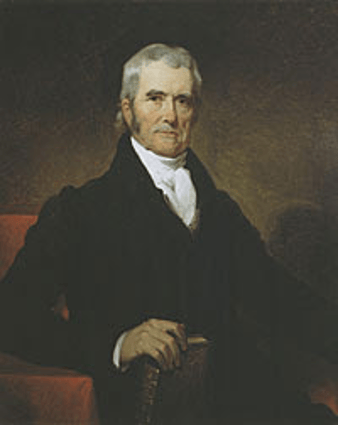
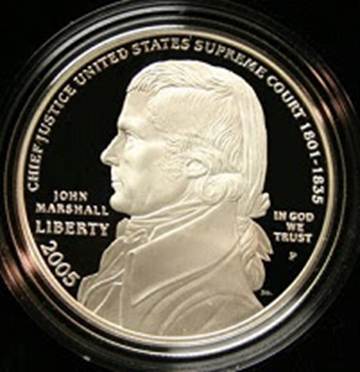
“The power to tax involves the power to destroy,” wrote Chief Justice John Marshall, McCulloch v. Maryland, 1819.Perhaps no one had a greater impact on the development of Constitutional Law than John Marshall.
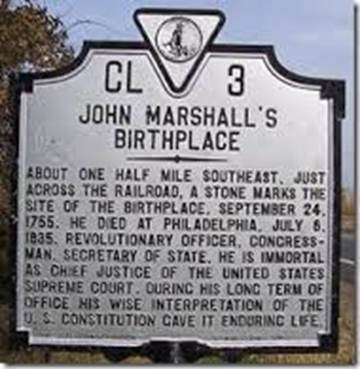
He was born September 24, 1755, and was home schooled as a youth.
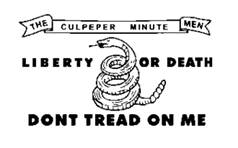
At the beginning of the Revolutionary War, John Marshall served with the Culpeper Minutemen.
Marshall joined the Continental Army and served as a captain in the Virginia Regiment under General George Washington, enduring the freezing winter at Valley Forge.
John Marshall later described George Washington: “Without making ostentatious professions of religion, he was a sincere believer in the Christian faith, and a truly devout man.”
John Marshall studied law at the College of William and Mary under Chancellor George Wythe, as did also Thomas Jefferson, James Monroe, Henry Clay, and Supreme Court Justice Bushrod Washington, the nephew of George Washington.
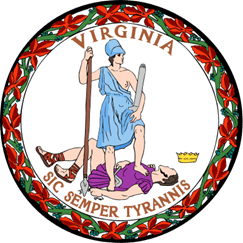
George Wythe was a prominent opponent of slavery, a signer of the Declaration of Independence, a delegate to the Constitutional Convention, and, with George Mason, he designed the Seal of Virginia with the motto Sic Semper Tyrannis – Thus Always to Tyrants.
Following George Wythe’s example of public service, John Marshall was elected a U.S. Congressman from Virginia, and became Secretary of State under President John Adams. John Adams nominated John Marshall to the Supreme Court, where, on February 4, 1801, he swore in as the fourth Chief Justice.
Marshall served 34 years on the Supreme Court, which met in the basement of the U.S. Capitol Building.
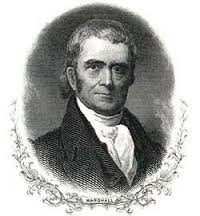
John Marshall was the longest serving Chief Justice, being on the Supreme Court during the administrations of:
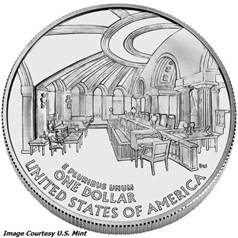
Every Supreme Court session opens with the invocation: “God save the United States and this Honorable Court.”
John Marshall decided in favor of the Cherokee Indian nation, stating the Indian Removal Act was unconstitutional and that Indians should be allowed to stay in Georgia.
The Indian Removal Act had been hurriedly pushed through a Democrat controlled Congress in 1830. Protesting the Indian Removal Act were Christian missionaries led by Jeremiah Evarts, being joined by New Jersey Senator Theodore Frelinghuysen and Tennessee Congressman Davy Crockett.
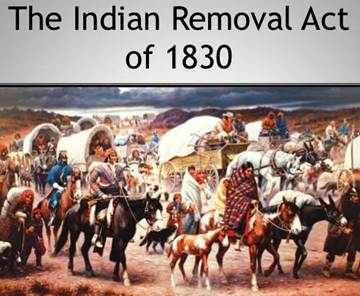
Despite Marshall’s decision favoring the Indians in Worcester v. Georgia, 1832, the Supreme Court had to rely on the President to enforce its decision.
Democrat President Andrew Jackson refused, as the popular apocryphal quote attributed to him was: “John Marshall has made his decision; now let him enforce it!”

The Federal Government proceeded to send in the military to forcibly remove over 46,000 Native Americans from their homes and relocate them west. This left 25 million acres vacant in the Democrat-controlled South into which slavery could be expanded.
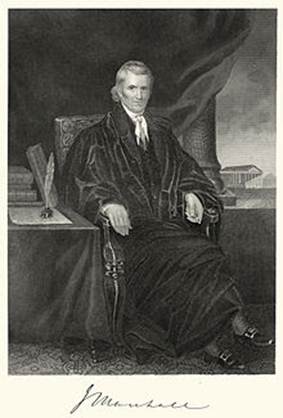
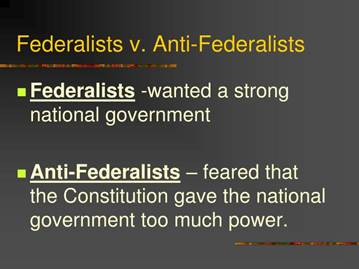
John Marshall helped write over 1,000 decisions, advancing the trend of “judicial review.” A Federalist, John Marshall was at the fulcrum of balancing the separate powers of government with the need to respond to immediate issues to keep the country united, often rendering decisions favoring a more powerful Federal Government.
Other famous Federalists were:
- Alexander Hamilton
- James Madison,
- John Jay;
- John Adams,
- Fisher Ames,
- Rufus King
- Charles Cotesworth Pinckney
- Thomas Pinckney, and,
- Noah Webster.
Opposite of John Marshall on the political spectrum were the Anti-Federalists who favored reserving more power to the State Governments, such as:
- Thomas Jefferson,
- Patrick Henry,
- Sam Adams,
- George Mason,
- Richard Henry Lee,
- James Monroe,
- Mercy Otis Warren,
- George Clinton, and
- Luther Martin.
Anti-Federalists had the foresight to see that giving the Federal Government more power may solve an immediate problem in the short run, but in the long run it would do irreparable harm to the country’s representative form of government.
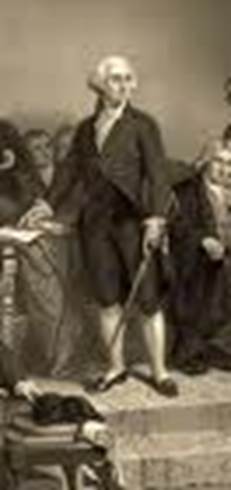
George Washington warned of the trend in his Farewell Address, September 19, 1796: “If in the opinion of the People, the distribution or modification of the Constitutional powers be in any way particular wrong, let it be corrected by an amendment in the way which the Constitution designates. But let there be no change by usurpation; for though this, in one instance, may be the instrument of good, it is the customary weapon by which free governments are destroyed. The precedent – of usurpation – must always greatly overbalance in permanent evil any partial or transient – brief – benefit which the use can at any time yield.”
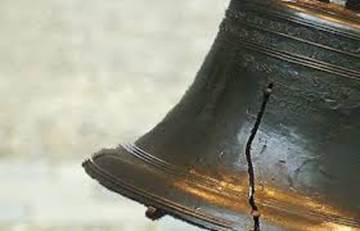
According to tradition, the Liberty Bell cracked while tolling at John Marshall’s funeral, July 8, 1835.
A hundred years after John Marshall’s death, Chief Justice William Howard Taft initiated the Supreme Court moving out of the basement of the Capitol into its own building in 1935. This coincided with court’s increased trend of usurpation of power from Congress by issuing opinions that effectively legislated from the bench.
A statue of John Marshall is in the lower floor of the Supreme Court Building.
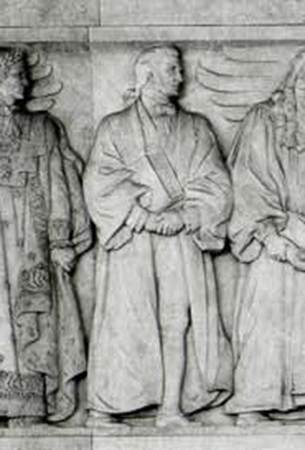
Inside the Supreme Court chamber are Adolph A. Weinman’s marble friezes depicting lawgivers throughout history, including John Marshall.
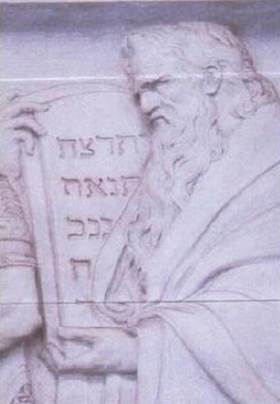
Also depicted in the frieze is Moses holding the Ten Commandments.
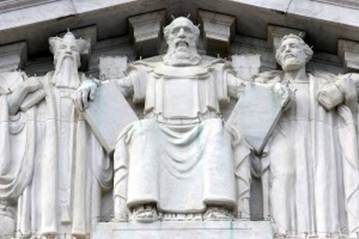
Moses is also in the center above the Supreme Court’s east portico holding two stone tablets.
A story about John Marshall was originally published in the Winchester Republican newspaper, and recounted in Henry Howe’s Historical Collections of Virginia, quoted in The Life of John Marshall, 1845: “There is, too, a story about an astonishing flash of eloquence from Marshall – ‘a streak of vivid lightning’ – at a tavern, on the subject of religion.
The impression made by Marshall on this occasion was heightened by his appearance when he arrived at the inn. he was negligently dressed, his knee buckles loosened.
In the tavern a discussion arose among some young men concerning ‘the merits of the Christian religion.’ The debate grew warm and lasted ‘from six o’clock until eleven.’No one knew Marshall, who sat quietly listening.
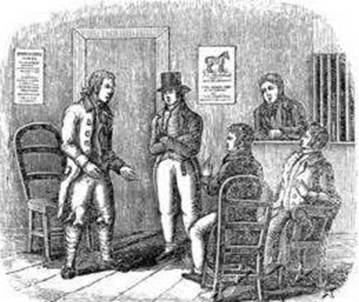
Finally one of the youthful combatants turned to him and said: ‘Well, my old gentleman, what think you of these things?’
Marshall responded with a ‘most eloquent and unanswerable appeal.’ He talked for an hour, answering ‘every argument urged against the teachings of Jesus.’ ‘In the whole lecture, there was so much simplicity and energy, pathos and sublimity, that not another word was uttered.’ The listeners wondered who the old man could be.
Some thought him a preacher; and great was their surprise when they learned afterwards that he was the Chief Justice of the United States Supreme Court.”
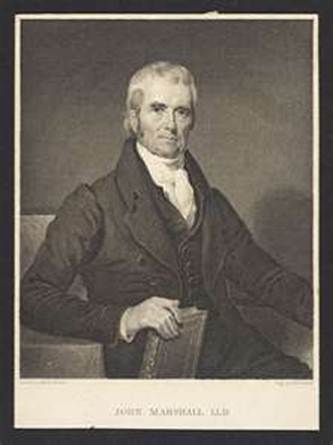
Chief Justice John Marshall commented May 9, 1833, on the pamphlet The Relation of Christianity to Civil Government in the United States written by Rev. Jasper Adams, President of the College of C:harleston, South Carolina: “Reverend Sir, I am much indebted to you for the copy of your valuable sermon on the relation of Christianity to civil government preached before the convention of the Protestant Episcopal Church in Charleston, on the 13th of February last. I have read it with great attention and advantage. The documents annexed to the sermon certainly go far in sustaining the proposition which it is your purpose to establish. One great object of the colonial charters was avowedly the propagation of the Christian faith. Means have been employed to accomplish this object, and those means have been used by government.”
“No person, I believe, questions the importance of religion to the happiness of man even during his existence in this world. It has at all times employed his most serious meditation, and had a decided influence on his conduct. The American population is entirely Christian, and with us, Christianity and Religion are identified. It would be strange, indeed, if with such a people, our institutions did not presuppose Christianity, and did not often refer to it, and exhibit relations with it. Legislation on the subject is admitted to require great delicacy, because freedom of conscience and respect for our religion both claim our most serious regard. You have allowed their full influence to both. With very great respect, I am Sir, your Obedient, J. Marshall.”
U.S. Attorney General Wayne MacVeagh concluded made these remarks on John Marshall Day, February 4, 1901:
“Let us, on this day of all days acknowledge that nations cannot live by bread alone … We have heretofore cherished, the Christian ideal of true national greatness; and our fidelity to that ideal, however imperfect it has been, entitled us in some measure to the divine blessing, for having offered an example to the world for more than an entire generation of how a nation could marvelously increase in wealth and strength and all material prosperity while living in peace with all mankind.
We all believe that the true glory of America and her true mission in this century is: to stand fast by Christ and his Gospel. In cherishing this we are wholly in the spirit of the great Chief Justice John Marshall; and so effectually honor his memory.
Ron
 True Texan Tales