(There is much confusion about America’s conflicts with these ruthless pirates along this coast and the Muslim countries of Tripoli, Algeria, Tunis and others. We declared war on them three different times, mostly for their capture of our ships and enslaving their crews. Below I have recorded accurately an account of the history of our conflicts with them. Do read it so that you will understand those conflicts in accurat context.)

The TREATY OF TRIPOLI is of particular interest as secularists have attempted to use a phrase from it out-of-context.
The phrase, “the government of the United States of America is not in any sense founded on the Christian religion,” has been presented as a definitive expression of the intent of America’s founders regarding religion and government.
This view, though, is discounted when one considers four points:
1) historical context shows the treaty’s conciliatory language was an attempt to appease Muslim Barbary pirates;
2) the treaty was negotiated on behalf of the Federal government, while at that time “religion” in America was under each states’ jurisdiction;
3) the treaty’s misquoted phrase is a sentence fragment that must be read with the qualifying words following it; and
4) if treaties are to be considered as showing the founders intent, then all other U.S. treaties must also be examined, including those which favorably acknowledge religion.
The historical context of the Treaty of Tripoli&n bsp;begins in March of 1785, when John Adams and Thomas Jefferson met in France with Tripoli’s ambassador Abdrahaman. Subject of the meeting was to determine why Muslim Barbary pirates were attacking and capturing American ships in the Mediterranean and imprisoning American sailors.
Jefferson had previously acquired a translation of the Qur’an. After reading it, Jefferson wrote to William Canby, September 18, 1813: “Of all the systems of morality, ancient or modern, which have come under my observation, none appear to me so pure as that of Jesus.”
Jefferson studied why Muslim pirates perpetrated unprovoked attacks and enslave non-Muslims. He asked Tripoli’s ambassador Abdrahaman what the new nation of the United States had done to offend or provoke Muslim Barbary States. Writing to U.S. Secretary of Foreign Affairs John Jay, Thomas Jefferson described: “The ambassador answered us that it was founded on the laws of the prophet, it was written in their Koran, that all nations which had not acknowledged the Prophet were sinners, whom it was the right and duty of the faithful to plunder and enslave; and that every mussulman who was slain in this warfare was sure to go to paradise. He said, also, that the man who was the first to board a vessel had one slave over and above his share, and that when they sprang to the deck of an enemy’s ship, every sailor held a dagger in each hand and a third in his mouth; which usually struck such terror into the foe that they cried out for quarter at once.”
He wrote again to John Jay, 1787, explaining his efforts to ransom captured American sailors through the mediation of the Catholic Order of Mathurins, which was later disbanded during the French Revolution:
“There is an Order of priests called the Mathurins, the object of whose institution is to beg alms for the redemption of captives. They keep members always in Barbary,&nb sp;searching out the captives of their country, and redeem, I believe, on better terms than any other body, public or private. It occurred to me, that their agency might be obtained for the redemption of our prisoners at Algiers. The General of the Order undertook to act for us, if we should desire it. He told me that their last considerable redemption was of about 300 prisoners who cost them somewhat upwards of 1,500 livres apiece, and that it must be absolutely unknown that the public concern themselves in the operation or the price would be greatly enhanced.”
Congress directed Jefferson and Adams to borrow $80,000 from Dutch bankers to make the extortion tribute payment, as Jefferson wrote to John Jay, 1787:
“If Congress decide to redeem our captives, it is of great importance that the first redemption be made at as low a price as possible, because it will form the future tariff. If these pirates find that they can have a very great price for Americans, they will abandon proportionally their pursuits against other nations to direct them towards ours.”
John Jay, who later would be the First Chief Justice, wrote to the President of Congress Richard Henry Lee, October 13, 1785: “Algerian Corsairs and the Pirates of Tunis and Tripoli (would cause Americans to unite, since) the more we are ill-treated abroad the more we shall unite and consolidate at home.”
In 1788, Jefferson arranged for John Paul Jones, referred to by some as the “Father of the American Navy,” to fight for Empress Catherine the Great of Russia against the Muslim Ottoman navy near the Crimean Peninsula during the 2nd Russo-Turkish War, 1787-92.
Jefferson wrote to General George Washington:
“The war between the Russians and the Turks has made an opening for our Commodore Paul Jones. The Empress has invited him into her service. She insures to him the rank of rear admiral. I think she means to oppose him to the Captain Pacha, on the Black Sea. He has made it a condition, that he shall be free at all times to return to the orders of Congress and also, that he shall not bear arms against France. I believe Congress had it in contemplation to give him the grade of admiral, from the date of his taking the Serapis. Such a measure would now greatly gratify him.”
John Paul Jones wrote in Narrative of the Campaign of the Liman of victoriously sailing his flagship Vladimir against the Turks near the Black Sea’s Dnieper River. The night before the battle, Jones and a Cossack sailor silently rowed out to scout the position of the Turkish fleet. On the side of one Turkish ship, Jones chalked in giant letters: “TO BE BURNED. PAUL JONES.” In the next day’s battle, that ship was among those destroyed by Jones. Jones was then appointed U.S. Consul to negotiate the release of captured U.S. Navy officers held in the dungeons of Algiers.
When John Paul Jones died suddenly, Joel Barlow filled the post. U.S. Consul Joel Barlow tried to stop Tripoli’s Barbary Pirates from continuing to terrorize the seas and capturing American sailors.
In 1793, Muslim Barbary pirates captured the U.S. cargo ship Polly. The fundamentalist Muslim captain justified the crew’s brutal treatment: “For your history and superstition in believing in a man who was crucified by the Jews and disregarding the true doctrine of Allah’s last and greatest prophet, Mohammed.”
In 1795, Muslim Barbary Pirates of Algiers captured 115 American sailors. The U.S. paid ransom of nearly a million dollars.
Tripoli followed sharia law which prohibited them from making treaties with “infidel” Christians:
- Infidels are those who declare: ‘God is the Christ, the son of Mary’ (Sura 5:17);
- Infidels are those that say ‘God is one of three in a Trinity’ (Sura 5:73).
- Believers, do not take the Jews and the Christians as allies (Sura 5:51);
- Infidels are your sworn enemies (Sura 4:101);
- Make war on the infidels who dwell around you (Sura 9:123);
- Prophet, make war on the infidels (Sura 66:9);
- When you meet the infidel in the battlefield strike off their heads (Sura 47:4);
- Muhammad is Allah’s apostle. Those who follow him are ruthless to the infidels (Sura 48:29);
- Believers, do not make friends with those who have incurred the wrath of Allah (Sura 60:13).
- So do not falter or cry for peace, for you will have the upper hand and Allah is with you. (Sura 47:35)
- But once the Sacred Months have passed, kill the polytheists who violated their treaties wherever you find them, capture them, besiege them, and lie in wait for them on every way. (Sura 9:5)
Barlow realized that Islamic law frowned upon fundamentalist Muslims making friendship alliances with infidel nations. His challenge was to make a distinction in the minds of the Barbary powers that they were negotiating with a nation-state, not the Christian religion.
This is the second point to consider. Joel Barlow was negotiating the Treaty of Tripoli on behalf of the “nation-state” – the “government of the United States of America” — the “Federal” Government. This was a necessary distinction to make, as Muslims had been at war with the “Christian nations” of Europe for over 1,000 years. The concept of a “nation-state” where citizens within the country had freedom of conscience to join or leave a religion as they wished was unfamiliar and unwelcome to fundamental Muslims, as it still is today among fundamentalist groups like ISIS and the Muslim Brotherhood.
In the United States, the “Federal” Government was prohibited by the First Amendment from having jurisdiction over religion, as religion was under each individual state’s jurisdiction. Supreme Court Justice Joseph Story wrote in Commentaries on the Constitution of the United States, 1833: “The whole power over the subject of religion is left exclusively to the state Governments, to be acted upon according to their own sense of justice and the State Constitutions.”
Jefferson explained in his Second Inaugural Address, March 4, 1805: “In matters of religion I have considered that its free exercise is placed by the Constitution independent of the powers of the General (Federal) Government. I have therefore undertaken, on no occasion, to prescribe the religious exercise suited to it; but have left them, as the Constitution found them, under the direction and discipline of state and church authorities.”
Jefferson told Samuel Miller, January 23, 1808: “I consider the (Federal) Government of the United States as interdicted (prohibited) by the Constitution from inter-meddling with religious institutions, their doctrines, discipline, or exercises. This results not only from the provision that no law shall be made respecting the establishment or free exercise of religion, but from that also which reserves to the states the powers not delegated to the United States (10th Amendment).”
In fact, it was the states’ jealous desire to keep religion under their jurisdictions that motivated the states to insist that a First Amendment be added to the U.S. Constitution to prohibit the Federal Government from inter-meddling with religion.
This was not the case in most European countries which had established churches, or in fundamental Muslim countries which controlled citizens’ religious life through threats of death or dismemberment.
The Islamic understanding of religion and government being synonymous is seen in the original Arabic translation of the 1797 Treaty of Tripoli:
“Glory be to God! Declaration of the third article. We have agreed that if American Christians are traveling with a nation that is at war with the well preserved Tripoli, and (the Tripolitan) takes (prisoners) from the Christian enemies and from the American Christians with whom we are at peace, then sets them free; neither he nor his goods shall be taken.
Praise be to God! Declaration of the twelfth article.
If there arises a disturbance between us both sides, and it becomes a serious dispute, and the American Consul is not able to make clear his affair, and the affair shall remain suspended between them both, between the Pasha of Tripoli, may God strengthen him, and the Americans, until Lord Hassan Pasha, may God strengthen him, in the well-protected Algiers, has taken cognizance of the matter.
We shall accept whatever decision he enjoins on us, and we shall agree with his condition and his seal; May God make it all permanent love and a good conclusion between us in the beginning and in the end, by His grace and favor, amen!”
The wording of the Treaty of Tripoli of 1797 was not to discredit Christianity’s historical contribution to the founding of America, but rather it was an attempt for the Federal government of the United States to negotiate with Muslim powers using phraseology they could relate to and which they would be obliged to honor.
With that background, the phrase in Treaty of Tripoli under discussion was:
“As the government of the United States of America is not in any sense founded on the Christian religion, -as it has in itself no character of enmity against the law, religion or tranquility of the Musselmen-, and as the said States never have entered into any war or act of hostility against any Mehomitan nation, it is declared by the parties that no pretext arising from religious opinion shall ever produce an interruption of the harmony existing between the two countries.”
Noted religious critic and anti-theist Christopher Hitchens admitted in his work Jefferson Versus the Muslim Pirates (2007):
“Of course, those secularists like myself who like to cite this Treaty must concede that its conciliatory language was part of America’s attempt to come to terms with Barbary demands.”
In grammar, a comma indicates a qualifying relationship between a dependent clause and an independent clause.
The phrase “As the government of the United States of America is not in any sense founded on the Christian religion,” is followed by a comma indicating that the preceding dependent phrase is qualified by the subsequent phrase which should always accompany it, “-as it has in itself no character of enmity against the law, religion or tranquility of the Musselmen.”
The Treaty of Tripoli, as Christopher Hitchens explained, contained “conciliatory language” in an “attempt to come to terms with Barbary demands.”
John Adams’ Secretary of War James McHenry protested the language of the Treaty of Tripoli, writing to Secretary of the Treasury Oliver Wolcott, Jr., September 26, 1800:
“The Senate ought never to have ratified the treaty alluded to, with the declaration that ‘the government of the United States, is not, in any sense, founded on the Christian religion.’
What else is it founded on? This act always appeared to me like trampling upon the cross. I do not recollect that Barlow was even reprimanded for this outrage upon the government and religion.”
Immediately after Jefferson was inaugurated President in 1801, the Pasha of Tripoli demanded $225,000 in an extortion tribute payment to keep his Barbary pirates from seizing American ships, confiscating cargo and selling crews into slavery.
When Jefferson refused to pay, the Pasha declared war – the first war after the U.S. became a nation.
Jefferson stated in his First Annual Message to Congress, December 8, 1801:
“Tripoli, the least considerable of the Barbary States, had come forward with demands unfounded either in right or in compact, and had permitted itself to (announce) war on our failure to comply before a given day. The style of the demand admitted but one answer.
I sent a small squadron of frigates into the Mediterranean, with assurances to that power of our sincere desire to remain in peace, but with orders to protect our commerce against the threatened attack. The measure was seasonable and salutary.
The Bey (lord) had already declared war. His cruisers were out.
Two had arrived at Gibraltar.
Our commerce in the Mediterranean was blockaded and that of the Atlantic in peril. The arrival of our squadron dispelled the danger.
One of the Tripolitan cruisers having fallen in with and engaged the small schooner Enterprise, commanded by Lieutenant Sterret, which had gone as a tender to our larger vessels, was captured, after a heavy slaughter of her Muslim men, without the loss of a single one on our part.
The bravery exhibited by our citizens on that element will, I trust, be a testimony to the world. We are bound with peculiar gratitude to be thankful to Him that our own peace has been preserved through a perilous season.”
On December 29, 1803, the 36-gun USS Philadelphia was cruising the Mediterranean when it ran aground on an uncharted sand bar off the coast of North Africa. Muslims surrounded it and captured its crew.
They imprisoned Captain William Bainbridge and his 307 man crew for 18 months.
To keep this ship from being used by Muslim pirates, Lieut. Stephen Decatur sailed his ship, Intrepid, February 16, 1804, into Tripoli’s harbor and set the USS Philadelphia ablaze.
British Admiral Horatio Nelson called it the “most bold and daring act of the age.”
After negotiations, for $60,000 and 89 Muslim prisoners captured in skirmishes, the crew of the USS Philadelphia was released, less 6 who had died in captivity and 5 who converted to Islam, much to the annoyance of the rest.
When the Pasha of Tripoli offered the 5 converts the choice of staying in Tripoli or returning to America, 4 decided to renounce Islam and return home.
Horror covered their faces as the insulted Pasha ordered guards to drag them away, following the instruction in Hadith al-Bukhari:
“Mohammed said, Whoever changes his Islamic religion, kill him.”
In April of 1805, Jefferson sent in the Navy and Marines, led by Commodore Edward Preble, Commodore John Rogers, Captain William Eaton, Lieut. Stephen Decatur, and Lieut. Presley O’Bannon.
The Marines landed at Alexaria, Egypt, the closest port to Derna, the major city and center of the slave trade with its slave markets.
As mentioned, at that time the center of the Muslim slave markets was at Derna on the Barbary Coast, in the province of Tripoli. It was quite secure, since it had large, land-based cannons. The ships which really wanted to bombard Derna did not have cannons that large and were kept awau, so this strategic town was quite safe. It could not be attacked from the land either because to its rear was a formidable desert, 600 miles across.
The Marines in Alexandrina became fast friends of the Bedouin desert worriors. The Bedouin loved those Marines becaus they were so tough and aggesive. The two banded together and decided to attempt to cross that formidible 600 mile desert and attack Derna. For the first time those Marines had to use camels. But as we learned in WW II nothing stops the U.S. Marines.

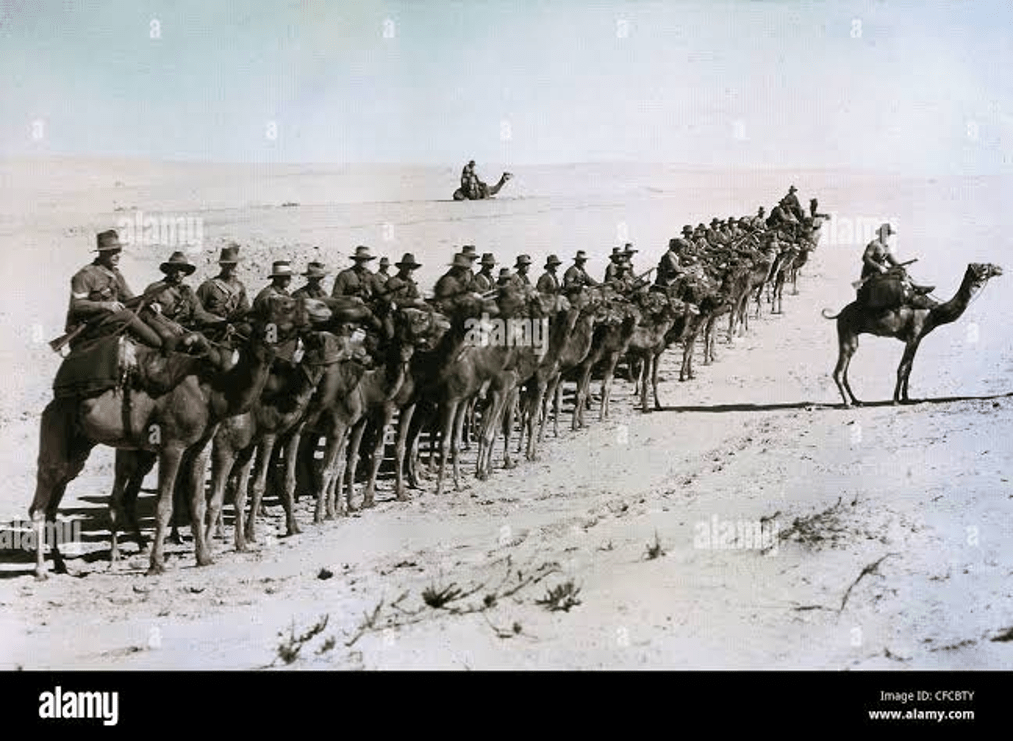
The Marines became friends with the Bedouin desert warriors there and were highly respected by the Bedouin because they were so tough and aggressive. The Marines made an alliance with the Bedouin warriors to go with them to attack Derma since the Bedouin were not Muslims.
They crossed that formidable, supposedly impossible 600 miles by finding just enough water with the help of those Bedouin. And when they came charging out of the desert with both groups yelling their respective war cries those Muslims just could not believe it. The Marines were armed with the Henry Repeating Rifles like the Texas Rangers were now using along the Mexican border. The Muslims in Derna and along the Barbary coast had nothing like them.
They just obliterated Derna and all of its land based cannons, and totally stopped that horrible slave trade forever, such as this European girl captured and made a slave, and being given to the Pasha:

They seized the Barbary harbor of Derna and the terrorist attacks ceased up and down the whole Barbzry Coast, giving rise to the Marine Anthem:
“From the Halls of Montezuma to the shores of Tripoli …”
Many “mameluke ” Muslim slave-soldiers had their curved scimitar swords confiscated, which became the Marine “Mameluke” sword. And to this day is part of the United States Marine’s dress uniform.

Marines were called “leathernecks” for the wide leather straps they wore around their necks to prevent them from being beheaded, as Sura 47:4, stated: “When you meet the infidel in the battlefield, strike off their heads.”
Jefferson then had a new Treaty of Peace and Amity with Tripoli, April 12, 1806, but this time it was negotiated from a position of strength and therefore it did not contain the controversial conciliatory wording of the 1797 Treaty of Tripoli.
Francis Scott Key wrote a song to honor the and Marines titled “When the Warrior Returns from the Battle Afar,” published in Boston’s Independent Chronicle, December 30, 1805, being written to the same tune that nine years later Key would use for the Star-Spangled Banner:
“In conflict resistless each toil they endur’d
Till their foes shrunk dismay’d from the war’s desolation:
And pale beamed the Crescent, its splendor obscur’d
By the light of the Star-Bangled Flag of our nation.
Where each flaming star gleamed a meteor of war,
And the turban’d head bowed to the terrible glare.
Then mixt with the olive the laurel shall wave
And form a bright wreath for the brow of the brave.”
The Europeans and others had tried for so many years to stop the raiding and confiscating such huge numbers from Europe and from the ships at sea for slavery by the Muslim Pirates from the Barbary Coast. However, it took those tough U.S. Marines to finally accomplish it.
Ron

