(Many people have heard about the Crusades, but know little about them; especially what really caused them to happen; and the history and outcome of each one. For your edification, below I have chronicled what really caused them, and then a brief history of each one. Do read it and become informed.)
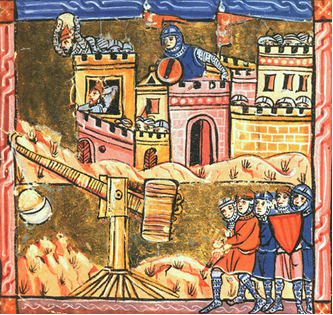
What happened Palm Sunday 937 AD that led Europe to respond with the Crusades.
Palm Sunday, 937 A.D., Caliph al-Radi ordered the destruction of Jerusalem’s Church of Calvary and the Church of the Resurrection.
What was the background of that?
Jerusalem had been a Jewish city since the time of King David, around 1000 B.C. It had been a Christian city since Emperor Constantine, circa 325 A.D.
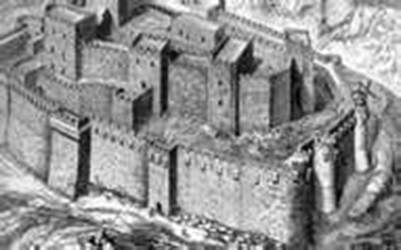
Syria, Lebanon, Palestine and Egypt, which had previously been Christian lands, were conquered by Islamists. Then Muslim warriors under Caliph Umar took Jerusalem away from the Christian Byzantine Patriarch Sophronius in 637 A.D. “Caliph” is the title of Islam’s supreme religious, political and military leaders.
Caliph Umar forced Christian and Jewish inhabitants to live as second-class citizens under “Jim Crow” style laws called “dhimmi.”
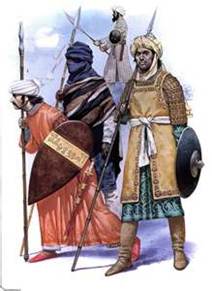
In the 700’s, Christians were banned from giving religious instruction to their children and displays of the cross were banned in Jerusalem. Pilgrims to the Holy Land began to be harassed, massacred and even crucified.
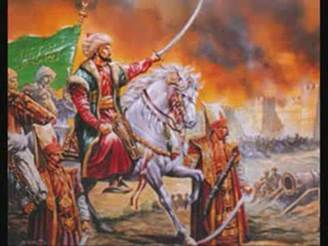
In 772 A.D., Caliph al-Mansur of the Abbasid Caliphate ordered Jews and Christians to be branded on the hand.
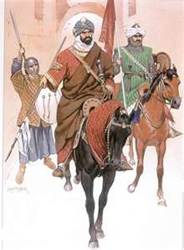
In 846 AD, 11,000 Arab Saracen Muslim warriors invaded Rome, Italy, and damaged the Basilica of St. Peters and the Church of St. Paul Outside the Walls, desecrating the graves of St. Peter and St. Paul. In response, Pope Leo IV built a 39 foot wall around the Vatican.
In 923 A.D., Caliph al-Muqtadir of the Abbasid Caliphate began enforcing sharia in Jerusalem, inciting Muslim rioters to destroy churches in Jerusalem.
In 937A.D., on Palm Sunday, Abbasid Caliph al-Radi ordered Muslim rioters to plunder the Church of Calvary and the Church of the Resurrection.
1004, Caliph al-Hakim bi-Amr Allah of the Fatimid Caliphate, known as the “Mad Caliph” or the “Nero of Egypt,” began a ten year persecution of Christians and Jews. Thousands were forced to convert or die. 30,000 churches were destroyed.
1008, Mad Caliph al-Hakim forbade Christians from having their annual Palm In Sunday procession from Bethany.
In 1009, al-Hakim ordered frenzied rioters to use picks, hammers and fire to destroy the Church of the Holy Sepulchre in Jerusalem, considered the holiest site in Christendom.
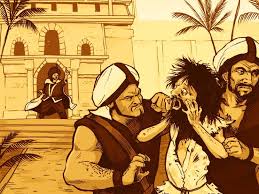
In Egypt, al-Hakim demanded everyone speak Arabic. Those caught speaking the traditional Egyptian language of Coptic had their tongues removed.
In In 1958, Egypt, President Gamal Nasser told a gathering: “I met with the head of the Muslim Brotherhood and he made his requests to make wearing the hijab mandatory in Egypt. I told him, if I make that a law they will say that we have returned to the days of al-Hakim bi-Amr Allah, who forbade people from walking at day and only allowed walking at night.”
1075, Seljuk Turkish Muslims captured Jerusalem from Arab Muslims. Travelers returning from pilgrimages to the Holy Land shared reports of Islamic persecution of “dhimmi” Christians.
The Italian city-states of Pisa, Genoa and Catalonia fought the Muslims who were raiding Italy’s coasts, Majorca, Sardinia, and Italian Catalonia.
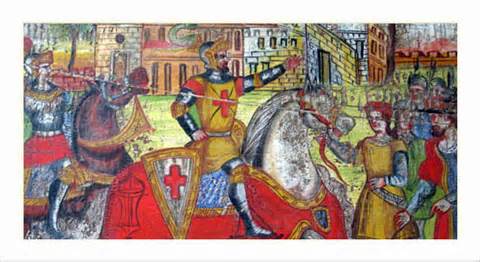
By 965, Muslim forces had succeeded in their 130 year conquest of Sicily.
Nearly a century later, in 1057, the Norman adventurer Robert Guiscard fought against the Islamic warriors of Sicily and gained control of Calabria in the “toe of Italy.”
In 1071, the Seljuk Turkish Muslims inflicted a major defeat on the Byzantine Christians at the Battle of Manzikert and took control of all but the coastlands of Asia Minor.
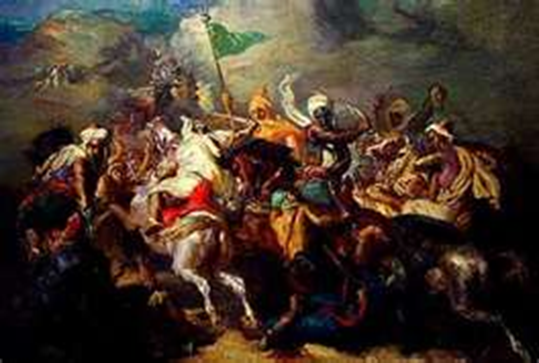
Cries for help were carried back to Europe. Europe sent help, it was called The Crusades.
Europeans had just two centuries of crusades compared to Islam’s fourteen centuries of jihad crusades which are still continuing, killing an estimated 240 million.
The Europeans’ nine major Crusades lasted from 1095 till 1291, when Acre was finally recaptured by Islamic forces. The First Crusade began when, in desperation, the proud Byzantine Emperor Alexius the First Comnenus humbled himself and sent ambassadors to the Council of Piacenza in March of 1095, appealing for aid from his religious rival, the Roman Catholic Pope.
The seriousness of this call for help is underscored by the fact that it occurred just a few years after the Great East-West Schism of 1054, where the Byzantine Church and the Roman Catholic Church split.
Pope Urban II gave an impassioned plea at the Council of Clermont in 1095 for Western leaders to set aside their doctrinal differences and come to the aid of their Byzantine Christians brethren.
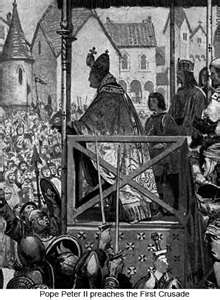
Pope Urban described how Christians were treated by Islamists, who “compel (them) to extend their necks and then, attacking them with naked swords, attempt to cut through the neck with a single blow,” as recorded by Robert the Monk in Medieval Sourcebook, Fordham University.
First Crusade (1096=1099)
With Spain exuberant after successfully driving the Muslim occupiers from Toledo and Leon a few years earlier, the First Crusade began in 1097, led by Godfrey of Bouillon. It freed Iconium, though it was later lost.
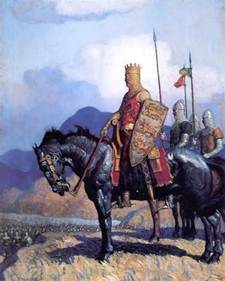
The First Crusade defeated Islamic warriors at Dorylaeum and Antioch, and captured Jerusalem in 1099, holding it for nearly 100 years.
Second Crusade (1147-1149)
After Muslims conquered Edessa, another crusade was called for by Bernard of Clairvaux in 1147. It was made up of French and German armies, led by King Louis VII and Conrad II.
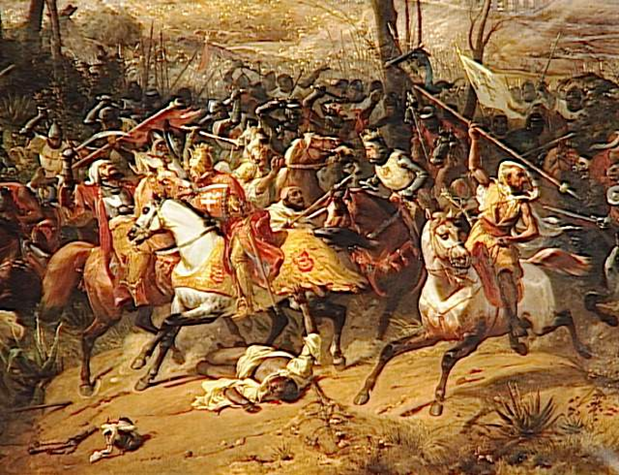
The Second Crusade failed to take Damascus and returned to Europe in 1150. Bernard of Clairvaux was disturbed by reports of misdirected violence toward some Jewish populations.
On July 4, 1187, the Muslim leader Saladin, founder of the Ayyubid dynasty, captured Crusaders who had not yet made it back to Europe at Hattim and ordered their mass execution.
Third Crusade (1187-1149)
In 1190, Pope Gregory VIII called for a Third Crusade. It was led by German King Frederick I, called Frederick Barbarossa—meaning Redbeard—who was the Emperor of the Holy Roman Empire. He was joined by Richard I of England and Philip II of France.
Frederick led 100,000 soldiers across Byzantium, driving out Muslims and temporarily freeing Iconium. He most likely would have freed Jerusalem had he not fallen off his horse while crossing the Göksu River in Cilicia, Asia Minor. Being 67 years old and weighted down with heavy armor, Frederick Barbarossa drowned in waist deep water and the Crusade went into confusion.
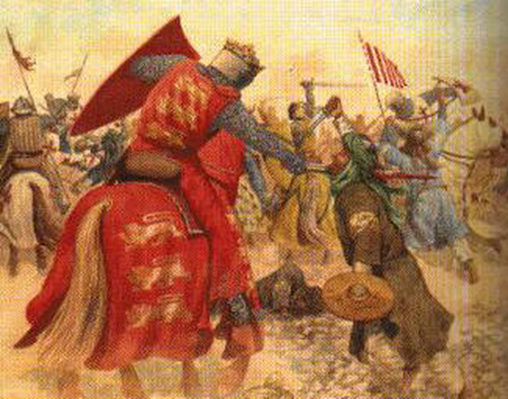
Richard the Lionheart was suddenly in charge leading the Third Crusade and successfully captured Acre. Due to rivalries, Philip II, without warning, abandoned the Crusade and returned to France in 1191.
Richard’s troops came within sight of Jerusalem in 1192 which had now been taken back by the Muslims under their very capable leader, Saladin. However, they grew weary as it did not look like they were making an impact.
Then word came to Richard that Phillip II was trying to take away Normandy from England, so Richard quickly ended his part in the Crusade to go back and defend his kingdom.
Richard got things in order back home, and then he heard that Crusade troops had Jerusalem surrounded and later heard Saladin was on the verge of defeat and was propping up dead soldiers along the walls. Saladin allowed some Christians to leave Jerusalem if they paid a ransom, but according to Imad al-Din, approximately 15,000 could not pay their ransom and were enslaved.
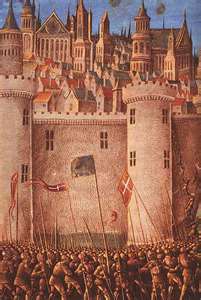
So, Richard was determined to return to Jerusalem. He went by ship to get there more quickly. But was shipwrecked and attempted to travel on foot across Europe in disguise. But he was recognized near Vienna and captured by Duke Leopold VI of Austria. He was then imprisoned at Dumstein for three years.
Legend has it that Richard’s loyal minstrel, Blondel, traveled from kingdom to kingdom across Europe trying to find him by singing Richard’s favorite song.
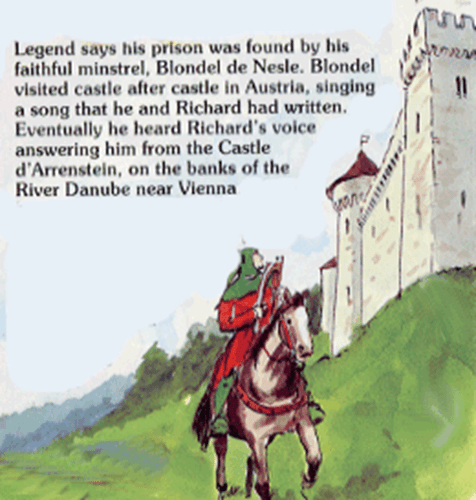
When Richard heard the song, he sang the second verse from the prison tower, and was found. Richard’s brother, King John, had to raise taxes for the “king’s ransom.” This was the origins of the story of Nottingham, Sherwood Forest, and Robin Hood.
The Holy Roman Emperor, Henry VI, prepared for another crusade in 1197, but died from malaria.
Once back in England, Richard ruled only a few years before being shot and killed with an arrow during the siege of a castle in Normandy.
His brother, King John, once again ruled, where he raised taxes oppressively. When he lost Britain’s claim to Normandy after the Battle of Bouvines in 1214, English baron’s were upset, as they also lost their titled lands there.
Angry barons then surrounded King John on the plains of Runnymede on June 15, 1215, and forced him to sign the Magna Carta – the cornerstone of English liberty.
(Yes, it was a political victory for the Barrons, but the Magna Carta turned out to be one of the most important documents in history. For the first time since the 400 year rule by ‘the people’ established way back there by Moses, people were able to rule themselves. Thus, England was able to become rich and powerful; so were the other countries in that area by copying its principles. And it sowed the seeds that ultimately caused the Pilgrims to self rule, and became the founding principle of the American Constitution. Rule by the people instead of a King.)
Saladin prevailed at Jerusalem; however, though almost defeated, and eventually took over all the surrounding country.
Richard’s exploits gave rise to the legends of the Lion-Hearted, and, through them, Richard acquired a posthumous prestige. Richard did regain Acre and Jaffa for the Christians, but that as all.
The agreement he finally reached with Saladin gave pilgrims free access to Jerusalem and little else. The city itself and the adjoining kingdom, except for some coastal cities were still subject to the same law—The Koran, not the Holy Bible. So the troops of the Third Crusade went home.
The Fourth Crusade (1202-1204)
Initiated by Pope Innocent III, the Fourth Crusade was largely composed of Frenchmen and Venetians.
Innocent was greatly disappointed by the events of the Crusade. In the original agreement, the Venetians had promised to transport the French crusaders to the Holy Land and to provide them with military equipment and provisions.
When the Frenchmen arrived in Venice, they were too few to pay for the contracted amount; only twelve thousand of the expected thirty thousand warriors came. The Venetians who had constructed ships and had assembled provisions for the original number. It was proposed that the Frenchmen make up the deficit by assisting them in attacking the seaport of Zara. Ruled by the Christian king of Hungry, Zara was the greatest Adriatic rival of Venice. To the Venetians, this was reason enough for an attack, and they cajoled the French into helping them make it.
Following the sack of Zara, the Venetians had another plan. They suggested that the expedition now direct its efforts against Constantinople and restore the dethroned Byzantine emperor, Isaac II Angelos. Pope Innocent again issued a reprimand to the crusaders, which they again disregarded; they captured Constantinople on April 13, 1204, and spent the next three days pillaging it. Their seizure of Zara had been uncalled for; their sack of Constantinople was unparalleled.
The crusaders established a new Latin empire and selected the Count of Flanders for its ruler. This empire lasted until 1261, but it never ruled all Byzantium; it comprised most of the land in Thrace and Greece, where the French barons were rewarded with feudal fiefs. For their contributions, the Venetians obtained the harbor rights in Constantinople plus a commercial monopoly throughout the empire and the Aegean Islands. The Fourth Crusade was a complete victory for the Venetians but for nobody else; it never reached the Holy Land.
So that part of the Fourth Crusade returned to Europe. However, there was another part to that Crusade that few have heard or. It was called:
The Children’s Crusade (1212)
This Crusade was the most pathetic of all Christian attempts to free the Holy Land. It was also the most senseless. The movement originated in France and Germany, and peasant children in two separate bands flocked to join it. They were convinced they could succeed where older and more sinful crusaders had failed: the miraculous power of faith would triumph where the force of arms had not. Many parish priests and parents encouraged such religious fervour and urged the children on. The pope and higher clergy opposed the outburst but were unable to stop it entirely. Despite all their efforts, a land of several thousand children (reportedly led by a Cologne boy named Nicholas) set out for Italy. About a third survived the march over the Alps and as far as Genoa, another group reached Marseilles. The luckier ones eventually managed to get safely home, but many others paid dearly for their innocence and ignorance. For them, the route to Jerusalem came to a dead end on the auction blocks of Mediterranean slave dealers.
The Fifth Crusade (1217-1221)
Instigated by Pope Innocent III at the Fourth Lateran Council in 1215, this Crusade was fixed for 1217 under John Brienne, king of Jerusalem, with the intention of conquering Egypt. John was replaced as leader by the papal legate Pelagius in 1218, and in 1219 the city of Damietta was captured by the Crusaders. The sultan of Egypt offered to exchange Jerusalem for Damietta but this was rejected. After an unsuccessful assault on Cairo in 1221, the Crusaders surrendered Damietta in return for the freedom to retreat.
The Sixth Crusade (1228-1229)
Often called the Diplomatic Crusade, this expedition was led by Emperor Fredrick II, the grandson of Frederick I Barbarossa. After several postponements, Frederick undertook the Crusade in 1228, but he fought no battles. Instead, by negotiation, he obtained Jerusalem and a strip of territory from Acre to Jerusalem for the Christians. He had previously (1225) married Yolanda, the young heiress of the kingdom. Following her death in 1228, Frederick crowned himself king of Jerusalem.
The Seventh Crusade (1248-1250)
Led by King Louis IX of France and directed against the Arabs of Egypt, this Crusade was a complete failure. After the capture of Damietta, the crusaders were decisively defeated at Cairo and King Louis was captured. Completely victorious, the Arabs demanded and received a huge ransom for the release of the king.
The Eighth Crusade (1270)
Disregarding his advisers, King Louis IX again attacked the Arabs in North Africa. This time he struck the city of Tunis. The Crusaders picked the hottest season of the year for campaigning and were devastated by a pestilence. One of its victims was Louis IX, whose death in 1270 ended the Crusade,
These holy wars were driven by religious zeal, seeking adventure, and reclaiming “Christian lands”. While achieving initial victories—notably the first crusade—they ultimately failed to hold Jerusalem permanently. However, they significantly increased trade, cultural exchange, and scientific knowledge between Europe and the Middle East, paving the way for the Renaissance.
Ron
—

