I just had the overwhelming compulsion that I was supposed to go to Russia. My father and I had sold the Russians several groups of Santa Gertrudis cattle, but I did not need to go there. They always came here for those purchases.
Also, in the early 1970’s most people from here were not especially welcome there. If you drew a chart of Russia’s meanness and their efforts to take over the whole world in the name of Communism, that would have been the time when the graph of meanness on the chart would have been at its peak.
But I thought I should go.Even though we had sold them cattle, you didn’t just apply for a visa and go on your own. That would have caused all kinds of suspicion and consternation. But I found a way (or was shown a way). There was a man from Houston who was getting together a small group of people to go to Russia for a “Cultural Tour”, mostly to listen to the Russian symphony orchestras and to particularly watch the Russian ballets. Russia had a long history in these areas and Communists were still proud of those traditions. In fact, in those days there, that was some of the only entertainment that they had.
So, my wife and I joined this cultural tour. A few of the people were from Houston and a few were from Dallas. We were to go to Moscow and St. Petersburg (called Leningrad under the Communists).
When you fly across Russia you realize just how huge that country is. As we were flying for hours and hours, I was thinking: How in the world could the Germans ever think they could conquer a place this huge.
In the early days of the 1970’s one of the first things you learned was that almost nothing had been built since the Communists took over in 1917. Most of the municipal buildings used by the Communist government are old palaces and the homes of formerly very wealthy people from pre-revolution days that have been converted to other uses. Even the main department store in Moscow was a converted palace.
The hotel where we stayed in Moscow was directly across the street from the huge Red Square. It and the room’s furniture was pre-1917. Our room even had a grand piano in it from those days.
Red Square with the Kremlin on the Right as seen across the street from my Hotel Window
Another thing that you had heard about and were now experiencing was that the government and the KGB controlled everything. They did not even check any of our luggage or belongings upon entering the country.
Their attitude was that if you brought in anything that you shouldn’t, they would know it because of their tight control. The floors on our four-story hotel were not very large, only a few rooms, but at the head of the stairs on every floor was a tough looking lady at a desk who just watched everything. Just for spite, I started leaving my room key with her whenever I left. She just kept it for me. She never said a word.
Another thing that you learned was that nothing worked. There was a small leak in my bathroom under the sink. I was told by the economics’ head of the US embassy in Moscow (with whom I had a most interesting visit) that I could come back years from now and that leak would still be there.
Our group did attend cultural events. One in particular was a “big deal”. Their most famous ballerina, their Prima Ballerina was about to retire. The ballet “Anna Karenina” was written just for her. It is based on the Russian novel by Tolstoy. She was going to dance it one more time and then it would never be danced again until after she died.
This was one of the biggest events in Moscow in many, many years. The wives of all the top officials in Moscow were there, dressed in their finest. However, I need to tell you about “their finest”. See, only recently every woman in all of Moscow had received a new coat from the government. The Russians love fur. But these were all cloth coats of different colors, but with only a fur collar. So, the wives of all these top officials could only have and wear these cloth coats with their fur collars; and they were no better than those same coats that the peasant ladies had gotten also.
We were given the best seats in the house. They were the very center seats in the first balcony. Sitting next to my wife was Mrs. Storey Stemmons from our group, whose husband had been the brother of John Stemmons. The big Stemmons Freeway leading into downtown Dallas is named after them. Mrs. Stemmons had on a full-length mink coat with a gorgeous sable collar. My wife had on a crimson dress with a wide gold belt and a full-length mink coat. I took a picture of all those hundreds of officials’ wives down below looking up and staring with envy.
In my book I tell much more about Russia as it was in those days. I tell about visiting in the Kremlin with the head of all animal husbandry in Russia who had been in Texas buying our cattle, and how I got lost inside the Kremlin and wandered into places that I never should have been. I also tell about meeting with some of their top leaders in the Kremlin and what they sincerely wanted from me, and also how I was officially detained by the KGB before leaving.
But who I really want to tell you about are two older ladies from Houston who went with us. At that time you could buy Russian rubles at a bank in the US for 17 cents. However, the Russians required you to pay $1.83 for each ruble there. They for sure did not want you to bring any rubles into the county from the outside. It was an automatic 8 years in prison if you were caught with contraband rubles. You didn’t even have a hearing. You just went.
However, these two ladies had brought a huge amount of rubles into Russia with them. They had brought them in their boots, in their coats and stuffed into all kinds of places. Like I mentioned earlier, the Russians did not check you upon coming in. Their attitude was that they had such control over their country that they did not need to check you upon entering. Later, these ladies informed me that all this money was for the Underground Church in Russia. That is all they said, except that……I was the one who was to pass all that money to the Underground church!!!!
Also, like I said earlier, I did not know why I thought I was compelled to go to Russia. Now I knew that this is probably why.
I did not know anything about the Underground Church. I did not even have a clue about where you might find it. I knew that the Russians had closed most all the churches and made atheist museums out of them. I had seen some of those. I also knew that they did have one Baptist Church in Moscow so that they could brag about having “religious freedom”, but I did not even have a clue about where it was or how to get there.
So, it was early-afternoon, and I just told God: “If I am really supposed to do this, You had better take over!”
And, so help me, and I cannot begin to explain it, but from that moment I was not in control of my own thoughts or my own actions. I walked out of the front of that hotel and down the street for about half a block. There across the street, in English, was a sign over a store front that read: “Tourist Information”.
I went in and asked this lady how one could get to the Christian Evangelical Church in Moscow? She said not a word but wrote this address down on a yellow slip of paper. I walked out into that wide street in front of our hotel, which was directly across from Red Square and the Kremlin, as I mentioned before.
I got several taxies to stop, but when I showed them the address, they all shook their heads, no. Then I looked over right in front of the hotel and there was a large black sedan with a fellow sitting in the driver’s seat. I showed him the address and he motioned for me to go back out and get a taxi. I tried several more taxies with the same lack of success.
I still cannot explain any of this, but I was just being led what to do. I went back to the big black sedan and said: “I think you are supposed to take me here”. He looked at the yellow slip of paper and motioned for me to get in. Off we went, way across Moscow. Every time we stopped at a stoplight, I noticed people starring at this big black car. Finally, we arrived at the church. I went in and was greeted by folks that spoke English. After some conversation they informed me that in a little more than an hour, they were going to have a full church service, and that I should get my wife and come attend.
I went back out and the black car was still there. I told him what I wanted in English, and he took me back to the hotel. But he never uttered a word. I got my wife and he took us all the way back to the church. They had us sit on the side of the balcony on its front row so we could look down at the congregation. It was packed full. And what was so interesting was that as they read the scripture from the pulpit, the people would hold their bibles up as high as their heads and the people behind would furiously copy the scripture.
When they sang, they did the same thing with the song books, and the people would furiously copy those words.
When this nice fellow came to escort us out, I could not believe it when these words came out of my mouth: “I need to find the Under Ground church people.” He looked at me and continued down this long hall. There were no windows or doors along that hall, but abruptly he stopped and pushed on a wooden panel of the wall to our right and it just opened up. There were all these young people in there. I knew instantly that I had contacted the Under Ground Church. I was brave enough to explain to them that I had money for them and that I needed someone to go with me to receive it.
A nice young man went outside with me and my wife. There was that big black car, patiently waiting on us. I don’t know if the guy was KGB or what, but it didn’t seem to matter. I asked him if I should pay him anything and he never said a word. I did reach over and stuff 20 rubles into his upper coat pocket.
We got back to the hotel and I went up to the ladies’ room while the young man waited outside. They had been taking a nap and were still a little groggy. I couldn’t seem to get through to them so I finally said: “I have come for the rubles!” They both put their fingers up to their lips to shush me. But I thought, oh really, there is no one listening to us.
They stuffed all those rubles into a shopping bag and handed it to me. I walked right past that lady at her desk at the head of the stairs with no problem. I handed it to the young man outside and he faded into the huge after work crowd.
Instantly, I was back into control and making my own decisions and actions again.
We were to have an early dinner so that we could attend another cultural function inside the Kremlin that night. The two ladies were a little late coming down to dinner; and, wow, did they look shaken. They said that no more and 15 minutes after I left their room, a KGB officer and some of his guys knocked on their door. They said that in his long leather coat, he looked just like one of the German Nazi Gestapo officers from a WWII movie, and that he was even holding his cigarette backwards in his hand just like the Nazi’s in the movies did.
They had heard my words. They searched every inch of that room, but found no contraband rubles, of course.
But then, mirabile dictu, at almost midnight when we got back to our room, the phone rang. Like, I don’t know anybody in Moscow. Who could possibly be calling?
This deep voice answered in quite good English and thanked me for our “interest in the Church of Moscow”. I immediately realized that he was talking so very officially and that I was supposed to “read between the lines”. He had once been out of the country to attend a Christian conference, so it was OK for him to call and talk to me.
Still talking very “officially” he wanted me to know that everything was cool and it was mission accomplished!
This is a note to the multitude of folks in China who are reading these stories:
After we left Khao-I-Dang we did not find out until the next day that the North Vietnamese had probed and killed 30 people right there at the intersection in front of the Khao-I-Dang Camp just after we left. You may recall that I wrote about the man at that camp who had been the only pastor in Cambodia, and how the Khmer Rouge had found him and put him into one of their killing fields camps. I told how God had actually sent one of his “shinning angels” to miraculously protect him from certain execution, just like others Billy Graham wrote about in his book, Angels.
However, we wanted to visit one more refugee camp before dark, Sa Kaeo II. By now things were working just as the KGB had planned. The North Vietnamese Communists were coming into Cambodia and driving the Khmer Rouge out. This was a new camp and was already mostly populated by Khmer Rouge refugees who were themselves escaping Cambodia.
Sa Kaeo II
When we arrived, they were pulling this enormous chain across the entrance to block any North Vietnamese tanks from coming in. There were no UN people there. The place was run by a Thai officer. They called him down to the entrance to check our credentials, and right away we found how casual this place was. He came down only clad in his T-shirt and his drawers. He was really nice. He put a soldier on the outside step of our little bus with his automatic weapon and told us to go anywhere we wished.
Everything there was made of big stalks of bamboo, and most all of it was still green.
The people here were much younger than the previous camp, and there were many young children.
Khamer Rouge Mothers with their New Babies
I walked up to the top of a hill where a Swiss NGO had constructed a hospital. All workers at the hospital had already gone home, but there was a group of the most interesting young boys gathered there. They were all between the ages of 12 and 16. But what was so strange was that almost every one of them had some kind of injury. Some had lost a leg or an arm or and eye, but most just had flesh wounds that were almost healed. They all crowded around me, for they were all in the process of learning English in the hopes of getting to the US some day and had never met an American.
Cambodian Orphans at Sa Kaeo II He may have his leg shot off, but he is still going to Play Soccer
One of the older ones was named Hem-Hatch. He could speak fairly good English, so I asked him about all theseboys. Where were their parents? He said: “No parents.” So I asked: “What is your story?” So, he told me that they all had the same story. They had all been in Cambodia in different villages. The Khmer Rouge had come to their villages and lined everyone up and started going down the line, shooting every person, one at a time. These guys saw their parents and siblings shot. They realized that if they did not get out of there, they were going to be dead. So, they just bolted for the jungle. They ran as fast as they could, zigzagging as they ran to dodge the bullets. Most had been hit at least once or lost an eye to the thorns as they crashed through the jungle. What a strange group of orphans, but they were full of energy and enthusiasm.
I corresponded with Hem-hatch for quite a while and sent him some Thai Baht that I could buy at a Dallas bank. I don’t know what finally happened to him. In the last letter I received from him he stated that he had the chance to go to France, but they were trying to get him to go back into Cambodia. I wrote him to get his rear-end into France, for I knew that the North Vietnamese were intercepting those repatriation busses as soon as they crossed the border and killing everyone on them.
When I got back to our little bus, the folks there had found this young lady. She was somewhere between age 19 to 24. She was one of those new Christians that were coming out of Cambodia that I mentioned earlier. And they were not just casual Christians. That terror had bonded them so close to God that it was spooky. This girl had taken upon herself the task to teach bible stories and Christian principals to every young child in the camp that she possibly could. She was teaching groups of children all day and into the night. There were 90,000 people already in that camp. She stayed on the verge of exhaustion all the time. Her dream was to get to the US and attend a bible-oriented college some day.
She gave me the name and address of a young lady friend who worked for the UN and would be able to bring things into the camp to her. When I got back to Dallas I went to several Christian book stores and bought all the different boxes of felt bible stories and sent them to her. Those are where you put up the different characters of a bible story on a felt board for the children as you tell the story. She wrote back how thrilled she was and how she used them to great effect for all those children. I also sent her quite a lot of Thai Baht so that she could buy things such as soccer balls for the older children.
So, before we left, we wanted to have a prayer for this lovely young Christian lady. I was sitting on the front row of the little bus and she sat just above me on the chrome supports. After we prayed, she prayed. And I will never forget for the rest of my life what happened. The bus was air conditioned, so it must have been cooler than normal for her. But as she prayed, I felt water dripping down onto me. When that girl prayed, the intensity of her prayer, the intensity of her communication with God, caused her to become wet all over. Evidently, because of the necessity of what she was doing, God had infused her with a prodigious amount of his mighty Spirit Power.
To this day, I feel guilty that I have never been able to pray like that……with the intensity of that girl.
This is an excerpt from the book that I have written that is soon to be published:
In the 1970’s and early 1980’s when Russia was pushing to take over as much of the world as possible; the Russian KGB had an effective tactic to take over a country. They would find some entity or group to create as much terror as possible so that the people of that country would welcome a Communist takeover to stop the terror.
That is what the KGB did in Cambodia. They backed this crazy guy named, Pol Pot. He called his organization and his fighters, the Khmer Rouge (the Red Khmer People). The KGB gave his band of young people guns and explosives and even artillery, and they created massive terror.
Pol Pot had this strange idea of putting everyone into the country-side, no cities. He and his cadres wanted “faithful” low IQ type followers. It was a death sentence if you were an “educated person”, if you could speak a foreign language, if you had ever been out of the county, all kinds of things, even if you could do arithmetic. United Nation’s estimates are that they murdered as much as 3 million people……25% of the population of the whole country. The capitol city of Phnom Penh finally fell in 1975 and the Khmer Rouge ran the country and continued the killing until 1980.
A documentary film was made about it, called “The Killing Fields”, and was shown all across the US. Some of the tourist attractions in Cambodia now are the enormous piles of human skulls from that time.
Many times certain people, particularly non-Christians, will ask: “How do you Christians know that your God is the only true God. How about the Buddhists, and the Muslims and the other religions?” What happened in Cambodia answered that question for me. Before 1975 there were less than 500 Christians in the whole country. But with that much intense terror and torture quite a few of the country’s 7 million people managed to escape, mostly into Thailand. The Thai’s could not let thousands of people just roam the county; they put them into refugee camps.
Here is what was so interesting to me, though. Like I said, there were less than 500 Christians in the whole country, but thousands and thousands of those escaping into Thailand were sincere new Christians. I took it to mean that if one is subjected to enough extreme, intense terror, he will be driven to what is true, really true. In this case it became obvious to some of us that they were driven to the one true God. I see no other explanation.
So, in the summer of 1980, Paul Eshelman and I and a small group of tough US businessmen went to visit those refugee camps in Thailand. The Thai Generals and the United Nations were supposed to be co-equal over the camps. But like in George Orwell’s book, “The Animal Farm”, the United Nations was a little more equal. However, we secured letters from the Thai Generals to allow us to enter them.
We were in a little mini-bus. We had heard that these United Nations employees, who were mostly atheists, were persecuting all these new Christians by requiring them to go into the Buddhist Temple to get their rations of sardines and bread. Being Asian and new Christians, they would starve rather than go into the Buddhist Temple. We wanted to get that stopped.
We had also heard that there was this man, who had become the pastor over the largest refugee camp named, Khao-I-Dang. We went there first. At that time there were 160,000 refugees at that camp and over a thousand new ones arriving each day. It covered 600 acres. But we wanted to meet this fellow who was acting as the pastor for all those new Christians in the camp.
We had the letters of permission from the Thai Generals, but the UN people took up our cameras and would not even let us get off of our little bus. As a result, we just took one circle through the camp and came back to the Headquarters to leave. But in a place like that, as in a US prison, there is a “grapevine” of information that travels quickly. So, the man that we wanted to meet showed up at the Headquarters. I sent him and our people to a room in the back and since it was almost 5:00 PM, I stayed with the United Nations people until they left for their “Holy Cocktail Hour”.
I had only one question that I wanted to ask this fellow when I got back there where they were. He could speak fairly good English, he had been out of the country, he had been the only Christian pastor in all Cambodia…….How could he possibly still be alive? Everything about him was a death sentence for the Khmer Rouge. He said: “Oh, I will tell you. I have not spoken to anyone from the ‘outside’ about it.” So, he started telling his story.
He said that he was in Phnom Penh when it finally fell. When the Khmer Rouge captured a city, they gave the population 24 hours to vacate it. Anyone found there after that was shot. Like I related earlier, they wanted everyone to be in the country-side.
He said he left with everyone else and saw all those strange sites, like nurses pushing their critical care patients down the road in their beds with their IV sets trailing in the wind. He related how he hid in the jungle for nearly a year. He said: “They tell you that there is lots of food in the jungle, but man, I nearly starved to death.” Finally, they found him and took him to one of those ‘killing fields’ camps. By then they had stopped shooting people. They were using up too many bullets. Now they were just lining up a new group of people each day and cutting their throats. Everyone in the camp was required to watch.
He described how they put him in this bamboo hut that was about 3 feet off the ground to get it out of the moisture. He said that on the first night a group of Khmer Rouge came to the edge of the jungle and watched his hut. He found that strange, since the usually did their killing in the daytime.
Being a Christian, he would prepare himself every night to die the next day. He had a friend that worked in the headquarters of this camp who told him that he was on the death list, but he knew that would be so anyway. Yet, they did not kill him. It really got on his nerves. Every night he would prepare himself to die the next day and it would not happen.
He said that one day they called him up to the headquarters for something, and he just decided to get it over with. He said: “You people know who I am. Why don’t you go on and kill me like all the others?”
I am standing by the window and listening intently to every word he is saying. And he said: “They told me that they were afraid to touch me because of the White Man!” And I just blurted out: “What White Man?”
Then he said that they told him in detail how every night this shining white man sat on the top step of his hut with his back to his door.
It was about three days before I remembered that I had read that book Billy Graham wrote called “Angels”, where he told these stories about how over history these shining white men would come and save certain people who must have been especially important to God. This man had literally been saved by one of those Angels!!!
I have written about a bunch of amazing people in this book. Most of them have already died.
Many were so close to God, and God used them to do some amazing things for Him.
Now I want to tell you about one who is still very much alive as I write this.
It is my opinion that God has tasked him with warning us about and to immediately prepare for what can only be described as an absolute catastrophe if we don’t prepare for it.
First, let me show you my good friend’s credentials: Dr. Peter Vincent Pry:Executive Director of the Task Force on US National and Homeland Security,He served in the Congressional EMP Commission as Chief of Staff,The Congressional Strategic Posture Commission,The House Armed Services Committee,The CIAAuthor of “Blackout Wars” and a Plethora of Articles and Studies
To show you about where his heart and thoughts are let me quote for you a few paragraphs from him. I am writing this on May 1, 2019. He wrote the following only last week and it was put in a national publication this morning:
“The Age of Science boasts Reason has triumphed over Faith, and God is dead. Christianity is hounded from the public square, is silenced, or worse mocked and despised, in our schools, modern art, and entertainment.“Christianity and its child Western Civilization are thought so shameful among “intellectual elites” they would brainwash us into their new faith that is secular humanism, replace Christ with Marx, suborn individualism to collectivism, replace thought with “group think,” confuse the just society with “social justice,” and abandon free markets and free nations for the tyranny of socialism and globalism.
“Is Mankind better served by reviving, or at least understanding, Judeo-Christian values that built and sustained Western Civilization for 2,000 years, until the 20th Century — or by the new “religion” of secular humanism that worships false science and the technocratic state, that dominates society and governments in the 21st Century?
“Western secular humanists and socialists will vehemently protest they have nothing in common with the USSR, Nazi Germany, Communist China, North Korea, Cuba, or Venezuela — even as they embrace atheism and Marxism, shout down and mock the religious, and pretend to subscribe to objectivity and “science” in order to achieve “social justice.”
“All totalitarian movements start this way, promising a Worker’s Paradise, delivering concentration camps and doomsday.
“ Let us hope and pray for the resurrection of God’s law and Christ in the hearts and minds of men.”
Do you know what an Electro Magnetic Pulse is? The last one to hit the earth as it zapped out from our sun happened when Charlie Goodnight was only 23 years old, September 2, 1859.
Just a relatively small nuclear explosion high above the central US would also cause one. You would not feel it. You would not even see it, unless you were looking straight up over the central US when the relatively small nuclear device was detonated 70 to 72 kilometers up in the stratosphere. However, the pulse would fuse any two pieces of metal that are close together…..like the firing pin in most guns, all electronic devices, the ignition system in any car made after 1973. In an instant most all cars on the road stop and all parked cars will not start. All planes in the air go down. But most of all, our entire electric grid is wiped out. And this happens from the east coast to the west coast and from central Canada to Mexico City, most likely never ever to return in our lifetime.
Will this ever happen? I met with a select group in our State of Texas Capital a few months ago. There were several analysts from the CIA there as well as knowledgeable National Security Analysts and Engineers, and Military Officers. Many of us have read the only good book written about EMP, One Second After. The author of that book, William R. Forstchen, was even there. Texas State Senator Hall was there too. His previous job as an Air Force Officer was to shield our large missiles from EMP. These folks were adamant that there is no other threat as likely and probable to happen to the US as this threat. Forget global warming. The following information is from………. Peter Vincent Pry, Ph.D. and Executive Director of the EMP Task Force on National and Homeland Security. He was many years at the CIA and knows more about EMP than most anyone.
He absolutely expects it to happen. He is almost what I would describe as frantic about it. It will happen from one of three ways:
(1) Iran or some other rogue nation will get hold of a nuclear device, sail into the Caribbean on a tramp steamer and launch it with a cheap Scud missile of which Iran has plenty. They really don’t have to aim it well, just get it up somewhere over the central US. It does not need to be a really big one like a hydrogen bomb, just a small atomic one. The Iranians are just salivating about this. They could then fight us with swords like the Muslims of old.
(2) North Korea has two satellites traveling several times a day from southwest Texas up over the Central US. The CIA analysts and Dr. Pry said that each weighs between 250 and 300 lbs. They say that they are sure that one or both have a nuclear device in them. They don’t need a spy satellite to weigh that much. If they don’t have such a bomb in them, the North Koreans can easily put up another satellite that does.
(3) We are way over-due for such a major pulse to hit earth from the sun. It has happened regularly in earth’s history. Dr. Pry says that the last big one was on Sept. 2, 1859. We did not have an electric grid then, but we did have telegraph lines. The entire existing telegraph system was fried and wiped out. It even traveled down the rail lines and warped the rails wherever they curved. All those warped rails had to be replaced. An EMP of that same magnitude from the sun very narrowly missed the earth in the fall of 2012.
Dr. Pry says that conservatively 30 million or more people in the US would be dead in 30 days. However, the CIA analysts say 90% of the US population will be dead in 30 days. Without electricity they would not have water. But you say, I know where to get water from surface sources. Yes, but the tens and tens of thousands of people going to those same sources would have it so fouled that it would not be potable for most folks. The CIA analysts there told me that they keep a little back-pack in their cars, mostly filled with water purification tablets. When I asked why, they said that when their car stops wherever they may be, they just want to try to be able to get back home.
Forstchen called his fiction book about the result of this happening to a small US community, One Second After, because it all happens in just one second.
No more electronic devices of any kind would exist. All bank records are gone. Everything stored in every computer, even in the cloud, is gone. There would be no more communications, no cell phones, and certainly no TV or radio. In that one instant, we would be plunged back into the 14th Century.
Most folks don’t realize that our electric grid is tied together and dependent on a few massive, extremely heavy transformers. They are so heavy that they are very hard to transport to the strategic sites where they are needed. They can only be manufactured by hand. They are not made in the US; they are made in Japan and in Germany. These would all be “fried” with an EMP. It is doubtful then, if ever they could be replaced.
In 2001 Congress established a commission to study the danger of an electromagnetic pulse generated by the detonation of a high-altitude nuclear weapon. It concluded that while there would be no blast effects on the ground, critical electricity-dependent infrastructure would be rendered inoperable. The commission’s chairman, William R. Graham, has noted that several Russian generals told the commissioners in 2004 that the designs for a “super EMP nuclear weapon” had been transferred to North Korea. While a regular nuclear bomb will achieve an EMP, the Russians have been perfecting certain ones for maximum EMP effect.
Recently the news media reported how a North Korean medium range missal was destroyed in mid-flight. They expressed their confusion about why it had been destroyed when it was operating successfully. Dr. Pry told me that the media did not understand that this was a test of how one of their missals can go up to deliver an EMP nuclear device and be exploded at just the optimum height for an EMP blast.
I wrote an email about this subject to some of my friends. I mentioned the two North Korean satellites and how their paths carry them up over the Central US every day. Someone got that email to Lou Dobbs. You have probably seen him on Fox Business News on his weekday broadcasts each evening. He read it on his program, verbatim……word for word. And if you have watched him, you have seen how when something strikes him as very cogent, he will look right into the camera and comment on it.
On this occasion, when he got to the part of my email about the North Korean satellites, he looked right into the camera and said very earnestly: “Why in the world haven’t we shot those two things down!”In late 2017, just before Kim Jong-un became involved with President Trump, he made an interesting statement. He said publicly, directly to the United States through a translator: “If you people don’t stop messing with me, you are all going to live like dogs!”
As a proud American, I hate to admit it, but until we at least get our electric grid hardened, maybe we had better listen.
At that conference in the Texas Capital all those important people from across the US had come all the way down to Austin, Texas. When I asked them why they were there, they had a very practical answer. They were most all desperately anxious for us to get our electric grid hardened to withstand such a magnetic pulse before it is too late. They don’t want to see 90% of the whole US population dead in their homes and in the streets. They expressed that they are in effect, hitting a stone wall in trying to get the grid hardened.
They said that since Texas is the only state with its own grid, and since as they put it: “Texans are tougher, more energetic, and in our opinion more apt to do it than anyone else. “We are here to try to get you to do it as an example to for the rest of the nation.”
On July 9, 1962, the US launched a Thor missile from Johnston Island, an atoll about 1500 kilometers (900 miles) southwest of Hawaii. The missile arced up to a height of over 1100 km (660 miles), then came back down. At the preprogrammed height of 400 km (240 miles), the 1.4 megaton nuclear warhead detonated. We wanted to test one of our nuclear warheads so high up that no damage or results on the earth were expected.It was called Operation Starfish, and all hell broke loose.
Here is a Picture of the First Part of the Explosion
From this explosion, we learned much more about EMP than we had ever known before. There were not many satellites up at that time. But the EMP fried the insides of the 6 satellites above that area at that moment and caused many others to fail later.
Even though it was way higher than the 30 to 40 miles which are optimum for EMP effect, it fried most of the telephone system in Hawaii, damaged the electric systems for hundreds of miles around, and wiped out most of the street lights in Hawaii. If Hawaii’s electric grid had not been so underdeveloped and analog, it would have been totally destroyed instead of just badly damaged.
Congressman Bob Hall desperately wants Texas (at least) to harden its electric grid against an EMP. Here is what he sent out to his constituents recently in an email report:
There was a time when life without electricity was the norm. By the 1930s, the majority of people living in larger towns and cities enjoyed the luxury, but only 10 percent of Americans who lived on farms or in rural areas had electric power. In 1936 the Rural Electric Administration was created to bring electricity to rural areas. No longer a luxury, electricity is now considered to be essential to life. A resilient power supply is essential to sustaining economic prosperity.
A prolonged power outage today would result in a complete breakdown in the fabric of society as we know it. Without power, communications systems would go down, creating a chaotic response to the situation. While limited locations would have access to temporary generators, as the on-site fuel for those generators is expended, replacement services would be at a standstill. Pipelines and transportation systems would be immobilized. Medically fragile individuals with dependency on machines would be some of the first victims. Those who depend on life-saving medications would be next as diseases such as high blood pressure and diabetes, currently controlled by medication, become death sentences. Then, as clean water supplies are compromised and waste water treatment plants are overwhelmed, diseases commonly associated with third world countries would become prevalent.
While Texas history with hurricanes, wildfires, ice storms and critters has made the state well-prepared for short term outages of power, there has been no significant planning for a catastrophic long-term loss of the electric grid that could be the result of cyber, natural, or man-made causes. The very idea that a single event causing the loss of the electric grid could plunge the entire nation back into a time without electricity, cell phones or the internet is so overpowering that it is easier to ignore the threat than to plan for it.
At that conference in Austin, their one plea was to try to get us to harden our electric grid against an EMP. It is not that hard or expensive. The CIA folks and the military folks and Dr. Pry were here in Texas to plead with us to harden our grid as an example for the rest of the country, because Texas is the only state in the US with its own independent, separate electric grid as I have written. They estimate that it will only cost $13 per person. And my main purpose in bothering you with all this is to implore you to do whatever it takes to get our grid hardened; the grid for the whole US. There are two companies standing ready to do it.
I asked Dr. Pry what he intended to do when an EMP hits us. He said that he intended to die along with everyone else, but then said, with tears in his eyes, that he just hoped that his grandchildren and great grandchildren would be able to survive.
Dr. Pry has only 4 other people to whom he sends his most private emails. I have promised him that I would continue to pray for him. He knows that God has entrusted him with the task of alerting our nation to this peril, and he does feel the burden, all the time.
I encourage you to please pray for him, also. This threat is not some theory. It is for real!!!
Along the east coast of Central America there is a very unusual group of people. There are over 300,000 of them and they are all black. They live in villages’ right against the ocean. There are some in Nicaragua , some in Guatemala , a few in Belize , but most live in Honduras . They mostly live off of food from the sea…….fish, crabs, oysters and also cassava root. And they have a most unusual language. Many languages like Latin, Spanish, and even Arabic have male and female endings for their words. However, in the Garifuna language the male and female are totally different words. That makes it a really hard language to master.
The history of these people is so interesting. There were many tribes across West Africa over the centuries, but by far the fiercest were the Ashanti . They lived deep in the forest in what is now central Ghana . They were quite wealthy, deriving most of their wealth from raiding neighboring tribes and selling slaves to the Muslims.
The British conquered and subdued all of the tribes across West Arica, but not the Ashanti . They were so fierce that they were never scared or “cowed” by the British rifles or cannon. The Ashanti were never conquered until the British were able to bring in modern machine guns in later years.
Occasionally, though, from the early 1600’s to the middle 1600’s the slave ships would wind-up with a few groups of Ashanti on them. They would be captured by Muslims coming around to that part of Africa and raiding inland to capture slaves. But that is when certain slave ships “messed-up”. Like I said, occasionally a ship would get some Ashanti on them. Those Ashanti warriors would either take over the ship or die trying, and were apparently often successful. They most all wound up in the islands off the coast of Venezuela, mostly on St. Vincent by sailing there or drifting there. Those that were taken to Jamaica didn’t stay, not the Ashanti . They captured boats and sailed or rowed west to the same islands.
Most all slaves brought to the Caribbean on these ships were men. The plantation owners wanted strong workers. Thus the Ashanti who got to St. Vincent and surrounding islands were mostly all men. So they just married the local, indigenous women. That is how their language developed. The men spoke one word for an object or action, and the indigenous women spoke another.
For a time, the Afro-Caribbean Garifunas lived peacefully alongside French settlers who reached St. Vincent later in the 17th century, until being exiled by British troops in 1796 and eventually shipped off to Roatan, one of the Honduras Bay Islands in the Caribbean Sea . After successfully developing a healthy crop of cassava, a mainstay of traditional Garifuna diets, on Roatan, Garifunas branched out to the Caribbean mainland to establish fishing villages. According to one source, the Spanish agreed to transfer the Garifunas from Roatan to the coastal mainland of Honduras , effectively consolidating their claim on Roatan and the other Honduras Bay Islands .
Garifuna culture is closely identified with music and dance. Garifuna music styles are known for their heavy use of percussion instruments and distinctive drumming, which combines the beats of primero (tenor) and segunda (bass) drums. Garifuna drums are typically made from hollowed-out hardwoods such as mahogany or mayflower that are native to Central America .
Punta, an evolved form of traditional music played using traditional instruments, is the most popular and well-known genre of Garifuna music and dance. Punta lyrics are typically sung by Garifuna women and often relate to one gender or the other. Energetic punta dancing has been described as “consciously competitive.”
On one mission trip I did a one day clinic just for the Garifuna. It was one of the most fun clinics that we have ever had. They were so very grateful too, for the attention paid just to them.
In a coastal town about and hour from San Pedro Sula where our medical teams often stayed I met a young missionary named, David. He and his wife were originally from Arkansas . He wandered around Central America for some time seeking what he thought God wanted him to do.
When he encountered the Garifuna people he became intrigued that no one had ever learned their language. There had been many Catholic missionaries in past years, but none had ever learned the language.
So David decided that he should learn their language and be the first missionary that we know of to them other than the Catholics years ago. When I met him, he had a new small church and was working on mastering their language. He even had a radio show in their language. It had a really large audience of Garifuna, mostly because they found it great fun to hear all the mistakes that he made trying to speak Garifuna on the radio show.
David asked if he could show the Jesus Film in Spanish to the congregation in his new church. It was on the same night that I had the electrical trouble with the old bob-tail truck, so I got there only at about the end of the showing.
David and I visited afterward, mostly discussing these interesting people. I asked him what would happen if we ever got the Jesus Film into their language. He was overwhelmed at the thought. He said thousands and thousands of them would find God and come to know Jesus and be saved into Heaven.
I came back to the US and called Paul Eschelman about it. As I mentioned earlier, up until that time we thought that the Jesus Film only had to be translated and produced into 89 languages. However, Paul had discovered that words like “love” and “forgiveness” only have real meaning in a peoples’ heart language, not just the 89 trade languages that are mostly spoken around the world.
Paul agreed to do it, and what was so interesting time wise, was that this would be the first making of the film into a “heart language”……….Garifuna.
So we started making plans. To save money it was decided to only lip-synch Jesus’ words in the film and have a narrator talk over the other parts. They had done it that way before, and the way it turned-out, it really did not make that much difference. So I really only needed to get two Garifuna speakers to California .
David selected the two that he considered the most appropriate that could also speak fairly good English. I went down to Houston to meet their plane to make sure that they got on the right flight to Los Angeles .
We did real well until we got on the driverless rail train that circles the Houston Airport . When that voice came on with no driver, I almost lost them, but finally got them on the plane to LAX.
I had coached the folks at Campus Crusade who do the Jesus Film about how these Garifuna live mostly on a protein diet of fish and cassava. We did not want them to get sick and delay the translation project, so the Campus Crusade folks had a diet all prepared for them.
About two days later I got a call from California . The Crusade people said that they had it all prepared what the two Garifuna speakers were to eat, but that all they wanted to eat was cheeseburgers. I asked if they were doing OK on cheeseburgers, and the answer was “yes”. So I said: “Just give them cheeseburgers.”
So, the Campus Crusade film team finished the Jesus Film in the Garifuna language. It was now time to take it there for its Premiere.
Paul Eshleman liked to go to as many premiers as he could manage, and he for sure wanted to go to this first one in the first Heart Language as he called it. We coordinated with the young missionary down in Honduras and set a date. I also recruited a really fine Christian oil man to go along with us too, Bob Foree, Jr. His father had been on the Board of Dallas Baptist University with me when I was Chairman of the Board. Uncle Bob, as we called him was one of the first Texas oil barons. He was the one who drilled the well that off-set Dad Joiner’s that established the East Texas Oil Field.
Previously when we were down in Honduras and speculating about getting the film into the Garifuna language, I had lamented to the young missionary, David, what a shame it was that we did not have a bible in their language to go along with the film. David said, “Man, you can forget about that. It is not even written”.
In those days it was really hard to get a phone call back to the US from that part of Honduras . David lived in the town of Tela on the east coast. That was the town where United Fruit Company had once had its headquarters that I mentioned before. To get a call out, you usually had to get an operator recruited to set up the call and then call you back when she had it all ready. So, when you got a call from there it was usually to announce something really major……like someone had died or something.
Three days before we left, I got a phone call from David. I was so worried that he was calling to report some tragedy had happened. Instead he said, “Ron, you won’t believe what has happened. This lady has walked out of the jungle up in Guatemala and come down here with a bunch of bibles in the Garifuna language.” I said, “How can that be”? David explained that she had started with Wycliffe Bible Translators 27 years ago to put a bible into the Garifuna language. With Wycliffe they had a rule that you are supposed to stop if you lose your partner, and even though she lost her’s, they let her stay on in their compound and finish. I later learned from the Wycliffe people that if you can start with a language that has never been written, and put it into written form for the first time, you can use the phonetics of the language. In this way, when it is done correctly, the speakers of that language can learn to read very easily.
Just consider this timing. This lady shows up with bibles she started on 27 years before, just one week before the premiere of the Jesus Film in that language. You can call it a fortuitous coincidence. I call it the amazing timing of God.
David wanted the first showing to be in a Garifuna village down the coast from Tela. Many Garifuna lived there, but it was so remote that it could only be reached by going over the mountains with great difficulty in a four wheeled drive vehicle with a very high center. We loaded the generator and projector and film into a dugout canoe with an outboard motor and all piled in as a preferred way to go.
We finally reached the village, and beached through the surf. It was amazingly beautiful. All the ground was covered with a vivid green grass that only grew about an inch high and appeared to be perfectly mowed in all directions. The whole place was shaded by tall coconut palms, and there were beautiful little waterways meandering through the whole village.
We rested in hammocks until it got dark. We brought food for dinner, but one of the kids in the village caught a big iguana to roast for us.
As was expected, they were just amazed to have a film in their heart language. Like we did with the Hispanics, we showed it on a big white sheet so they could sit on both sides of the sheet for viewing. You could just feel God’s Spirit there permeating the crowd.
The lady from Maine who had spent 27 years translating for the Garifuna a Bible into their “heart language” wanted to be there for this first showing of the film in this very remote village. David’s wife was able to get her there over the treacherous mountain roads in their 4-wheel drive jeep.
There is that part in the film where Jesus has Peter throw out his net on the right side of the boat and Peter and his fellow fishermen bring in so many fish that the boat is just filled. Wow! That caused a huge commotion among those fish conscious Garifuna. There is another place in the film where this cute little girl looks right into the camera and says some words. The folks in California had her use a special idiom that is unique to the Garifulna language. The crowd just couldn’t stop laughing at that.
At the end when the film gives you a chance to ask Jesus into your heart and life, most all the crowd sincerely wanted to do so. With one of the English speaking Graifuna translating, Paul Eshleman himself did the counseling, and those people were so filled with God’s Spirit that they did not want to stop. They wanted to start a Christian church, right there. David promised to come back and help them do exactly that.
Lady from Maine teaching the Children who wanted Jesus in their Hearts after the Film. She was able to teach them in their own “Heart Language”.
By now the surf and waves were much higher, but we managed to get back to Tela safely, although at some Campus Crusade meetings later, Paul accused me of trying to drown him that night.
We showed the film several more times to different Garifuna groups, but the last showing in La Ceiba was the most dramatic. La Ceiba is farther down the coast from San Pedro Sula and Tela, toward Nicaragua . It has a port and limited commercial air service. It also has a large Garifuna population, concentrated on its western side.
African Style Garifuna Homes in La Ceiba
We arrived fairly early before dark and had plenty of time to set up the big white sheet/screen and get the projector and speakers well positioned. We selected a big open soccer field for the showing.
The lady who translated the bible into Garifuna went with us. She brought a supply of those bibles.
I was fascinated watching her visit with a large group of mostly Garifuna children. She was teaching them to read their language right there. But those kids kept looking at her mouth. They just could not believe that their language was coming out of this very white lady’s mouth. She was originally from the State of Maine , and she was very white from being closed-up inside all those years doing the translation.
White Lady from Maine Teaching the Garifuna to Read their Heart Language
While waiting, I kept going over and over in my mind that she had started translating 27 years before, and here she was at what turned out to be a crowd of Garifunas at one of the premiere showings of the Jesus Film in their language with her just finished bibles. This would be the primary place and optimum time for their distribution, and their printing had just been finished on time for this occasion after 27 years. I just know that was God’s plan working as I mentioned before.
The showing was a huge success with hundreds of children sitting right up front on both sides of the screen. I don’t know how many prayed to accept Christ and come forward for counseling, but it was hundreds. Paul and David handled the counseling. The young man with the blue shades who spoke Jesus part in this version of the film was also there and helped with the counseling. He had acquired these treasured blue sun-glasses while in California. He had gotten much closer to the Lord as one would expect after living those weeks in California with those wonderful Campus Crusade folks.
As we were finishing up late that evening, I saw something that I had never seen before and have never seen since. Paul Eschleman, standing out in that field, broke down in a wave of tears. Sure, there had been a lot of pressure counseling all those people, but that was not why. Later he told me.
Paul had thought that the young man with the blue shades would go on and pastor some of the Garifuna groups. He had expressed a desire to do so, but out in that field, in the dark, he had asked Paul how much money Paul was going to give him to do it. Maybe it was because of the occasion and all those people accepting Christ, but that just devastated Paul. Paul had assumed that the young man had higher or deeper motives in his heart.
A year later I was back in Tela, two days in advance of another medical team. With the help of the only local doctor we needed to select the optimum sites for the clinics. That afternoon after the doctor and I had finished, I was walking back to that compound that had formerly been the headquarters for United Fruit. It was now a hotel/resort on the beach where we stayed so many times and was great for housing the medical teams with its great food and contiguous beach as I have mentioned.
I hope Paul reads this. I know he will be thrilled and gratified to find that this dude had “really come around” after all.
But, unfortunately, there is more to this story. Before we left for the States, I said to the group: “We had better be careful. We all know how powerful the Devil is. He has had a strong hold on these people for many generations. And here we are down here breaking his hold on them.” He will not be pleased!
Little did I know!
When we arrived back in the Dallas airport Paul got the message that his daughter had been overcome by a strange infection and was dying. It later took Billy Graham, his whole staff, Dr. Bill Bright and a host of Campus Crusade folks to pray that girl back from death.
The fine Christian Dallas oil man had told us on the trip how thrilled he was that his wife had finally recently conquered years of alcoholism. He had been praying for her for years. But she was not there to meet him at the airport. She was drunk again and passed-out on the floor at home.
And my wife was not there to meet me. She had run off with a homeopathic doctor to Oklahoma with our four children and filed for divorce.
Ella Graham lived west of Waco , west of Crawford right close to where George Bush’s ranch is now located. She was a good family friend and totally blind. She went blind when she was only 4 years of age. She thought that she could remember colors but was not sure. She was in her early 70’s and had been the first blind school teacher ever in Texas in the little Crawford high school.
She was very cultured and very romantic. Even at her age she was still a beautiful white-haired lady. When she was a student at Baylor they say she was just gorgeous. Though the young men just lined-up to read her lessons to her back then, she never married. She said that she felt that being blind, she would have been too much of a burden on a husband.
But she was such a romantic person that she had gotten her degree at Baylor in Browning. You know, Elizabeth and Barrett Browning the famous poets who wrote all those romantic poems and that romantic prose. Surely you have read it or heard it…….. like Elizabeth ’s Sonnet 43 as she wrote to her lover, Robert……….
“How do I love thee? Let me count the ways. I love thee to the depth and breadth and height my soul can reach, when feeling out of sight for the ends of being and ideal grace. I love thee to the level of every day’s most quiet need, by sun and candle-light. I love thee freely, as men strive for right; I love thee purely, as they turn from praise. I love thee with the passion put to use in my old griefs, and with my childhood’s faith. I love thee with a love I seemed to lose with my lost saints. I love thee with the breath, smiles, tears, of all my life; and, if God choose, I shall but love thee better after death.”
Wow! Now that’s romantic! And Robert Browning’s famous poem/song………Pippa Passes…….as innocent Pippa sings as she passes by……
The year’s at the spring And day’s at the morn; Morning’s at seven; The hillside’s dew-pearled; The lark’s on the wing; The snail’s on the thorn: God’s in His heaven— All’s right with the world!
The famous Browning Library at Baylor has a bronze statue of Pippa out in front of it, and inside it has all the memorabilia of the Brownings’…….most all of their complete works and even their actual desks from which their writings were done.
Statue of Pippa at Baylor’s Browning Library
Yes, Miss Ella was such a romantic. She wrote to me on an old typewriter with blue ink ribbon. Her prose was like reading poetry. I have kept all of her letters. Many times when I would have a date with one of those beautiful Baylor girls, I would drive out to Crawford and take her along with us. She would so enjoy it. The girls would not mind as she lightly looked them over with her fingers. She was always so interested in their hands. She judged them some way or other by how their fingers were shaped.
She would particularly enjoy it when we would take her to the movies. I think it was because this was something blind ladies never did.
So, one time she was visiting our home at Rainbow Lake . It was late in the afternoon. We were sitting in front of that big picture window that looked down over the lake. The other windows were wide open to let in the lovely Spring air. And this daddy Cardinal was just singing his Springtime song at the top of his voice.
See, Miss Ella just loved Cardinals. They would sing to her outside her bedroom windows near Crawford. She would mention it sometimes in her letters as she was typing. Her lovely stationary even had a picture of a red daddy Cardinal at the top of it.
Then, as we were listening to the bird’s song, Miss Ella said: “Oh, Ronny, I do so wish that I could see a Cardinal!”
And I must have just prayed, for I distinctly remember thinking: “Lord, why can’t this lovely, Godly woman see a Cardinal?”
But I was jolted to attention, for my mother called to me to go out to the boat house and get some meat for supper out of the freezer. I jumped-up and went out the kitchen door and opened the side door to the boat house. Someone had left one of the big garage-type doors up off the floor for a few inches. And this bird had gotten into the closed boat house. There on the floor, right in front of the freezer was this gorgeous, scarlet Cardinal.
He didn’t bolt up and fly against the glass windows as one would expect. He just let me catch him.
Of course, I forgot about the meat and took him right back into the house. Miss Ella got to carefully and lovingly see a real live Cardinal. Her delicate fingers traced its whole body, especially that beautiful peak on its head from which it gets its name.
We eventually took it back outside and she let it go and it flew softly away.
Now you can say that was just a fortunate accident, but I know with the perfect timing and all, exactly where that bright red Cardinal really came from. It was no accident for that bird to be right there at that exact moment just for Miss Ella to “see”.
This is a note to the multitude of folks in China who are reading these stories:
The famous King Ranch in south Texas has had some famous race horses over the years. They have won six Triple Crown Races……Two Kentucky Derbies, one Preakness and three Belmont Stakes. One of their Kentucky Derby winners, “Bold Venture” remains the only Kentucky Derby Winner to ever sire two other Kentucky Derby winners.
However, most of the horses they breed down there are what we call “Using Horses”, those that are bred to handle and work cattle.
My favorite and most faithful and useful horse ever was a mare from the King Ranch. Her name was “Suzie”, that I have mentioned earlier. I got her when she was still quite young. She could work all day long and still have plenty of energy and spirit. I bred her only one time (to my famous stud horse) and she produced a beautiful, Chestnut foal.
She had incredible ability as a cutting horse. Have you have ever watched a cutting horse competition? At the big ones the money prizes for the winners are huge. They use a group of yearling cattle who want to stick together. Then the competitor horse eases into the group and selects one animal. It then eases it away from the group. As the yearling usually in desperate fashion tries to get back into the group, the cutting horse competitor faces the yearling and keeps it away from the group.
The judge of the competition grades the competing horses on how well they complete that task and how efficient and classical their movements are. When the yearling darts to one side, trying to get back into its group, the cutting horse bounces its front legs in that direction and then cuts the yearling off and back away from the group.
I have always thought that it looks really awkward when the horse has to bounce its front legs to the side to get into position to cut the yearling back off from the group. My Suzie never fooled with that bouncing of her front legs. She would just whirl quickly completely around to get into the proper position to keep whatever animal we were cutting out, away from the heard. I never taught her to do that. It just came natural to her. She was not going to let that animal get back into the heard, and I thought it was way more efficient for her to whirl around that way, also. However, you had better be seated well into that saddle or she would leave you in mid-air and on the way to the ground.
Ron Heading out on Suzie to Work. Notice Her Ears all Pricked-up
On most cattle ranches in Texas we plant wheat or oats in the Fall. As this crop grows up all winter, it provides green grazing for the cattle in the winter months. We would then either let the cattle graze the crop out in the spring, or take them off if there was plenty of rain and let the crop grow up and harvest the grain in the early Summer.
On my 1,600 acre ranch near Denton one year we had a nice wheat crop growing on the plowed field way on the west side of the ranch. It was at least a mile from the ranch house and corrals across that big prairie-grass field to the wheat. You could drive a pick-up all over that grass field, but you had to be especially careful after a rain to avoid the many buffalo wallows in it. Of course, the wild buffalo were all gone, but they had left these fairly deep depressions where they had wallowed in the dust and the mud. Over the centuries they had carried off the dust and mud in their furry hides and left these deep depressions.
Anyway, one morning a cowhand and I were on horseback to take a herd of cattle across that prairie grass field to graze on the nice green wheat. We got them there and made sure that there was plenty of salty mineral for them. You couldn’t just put them completely on the green wheat without plenty of mineral or they would bloat and die. You needed salt in the mineral so they would not lick up too much of it.
So, we were coming back the mile across that prairie-grass field and admiring the Fall colors since that field looked down on most of the surrounding countryside.
Suddenly this huge bobcat jumped up right under our horses. I am sure it was there to get one of the several newborn calves. We would try to have the calves born in the early winter so that they could have access to the Spring grass at their maximum growth period, later.
Suzie just bolted forward and cut that big cat back. I had nothing to do with it. It was just instinct from her genes to cut an animal back that was running away at high speed. Then the cowboy’s horse cut the cat back toward us. This went on, back and forth for some time until that big bobcat just stopped and sulked right there in the grass. There were almost no trees in that big field.
I told the cowboy to stay right there with the cat, and I would go to the house and get a shotgun.
I got a 12 gage with high-velocity number 6 shot and came all the way back.
That cat had not moved.
I had never shot a high-velocity shotgun load from off of Suzie’s back. She was so dependable, that I am sure everything would have been all right. However, I eased out of the saddle to shoot from the ground. Whenever you dropped her reins to the ground, she would stay right there.
So, I walked toward the cat. I wanted to get as close as possible, since number 6 shot are not that large. When that cat saw me on the ground, and not on horseback……..zoom, here he came right at me. Scary! I shot him coming full speed, “head on”!!!
That dude was so big and impressive that I had him mounted. He made a nice addition to my Den.
As I have written before, historians say that General Curtis Lemay was one of the most important warriors that our country ever had. During WWII we were not putting any effective bombs on the Japanese, and that had to be done if we were ever going to defeat them. However, he showed us how to do it.
Also, I have written you before how he was my hunting partner and bunk-mate on those pheasant hunts in the San Juaquin Valley in California. He told me things that I don’t think he had ever shared with most anyone else.
The General With his Custom-made Green Hunting Clothes on Ready to H
I have also written you about how so many people were desperately praying for our success against the Japanese, and how I believe God woke General Lemay up in the middle of the night and showed him what to do. However, I never showed you the details of that. Herewith are the details of things he shared about what he did in the Asia/Pacific Theatre:
General Lemay in Asia
Even though he was still in England, an inkling of what was to come was when Lemay was promoted over the heads of several colleagues at the age of 37 to become the youngest Major General in the US Army. However, he was soon sent back to the States.
Hap Arnold, the Commanding General of our Army Air Corps, was not much worried about the war in Europe at that point. He knew that we were going to have to try to defeat the Japanese. Other than the nuisance raid of Jimmy Doolittle, we had never put a bomb on them. He was convinced that unless we used strategic bombing like we were doing against the Germans, we could never defeat their fanatical troops on their home islands.
He was pinning all his hopes on the huge new airplane whose production he had been shepherding—–the B-29. He had already told Lemay that he expected Lemay to be the one to accomplish that task. However, this plane was so advanced and complicated that they were having all kinds of problems with it.
First, there had been a competition between Boeing and Douglas Aircraft for the contract. Boeing had been selected, but at Boeing’s plant in Nebraska there were all manner of delays and engineering changes.
The real answer was that it should take many years to perfect a plane like this, but Hap Arnold wanted it now to bomb Japan. And he was going to have it now, come “hell or high water”. Some of its chief designers had already been killed when it crashed with them on only its 2nd inaugural flight.
This plane weighed 135,000 pounds fully loaded and could carry 20,000 pounds of bombs. Its wingspan was half as long as a football field and it was a third as long as a football field.
It could fly at 32,000 feet for 4,100 miles without refueling.
It had supercharged air-cooled radial engines with 18 cylinders that produced over 3,700 hp each.
It carried a crew of 10 and was completely pressurized so that the crew did not need those cumbersome oxygen masks and fleece-lined flying suits.
It had two 50-cal. machine guns in each of four remotely controlled turrets, plus two 50-cal. machine guns and one 20mm cannon in its tail turret.
The Army ordered 1,600 of them after only its first flight, and eventually 3,970 were produced.
There were 900 engineering changes even after it had finished its test flights. Its main problem was that its engines tended to swallow valves and then catch fire. Its magnesium crankcase burned with a fury that fliers had never seen before.
In summation: It was years before it should have been put into service, but Hap Arnold was determined to have it bomb Japan now. In retrospect, he was absolutely right, but also in retrospect, more airmen lost their lives from its mechanical problems than from enemy fire.
Lemay had never spent any time with Hap Arnold, and knew little about him. Lemay assumed that they would have long discussions about the B-29 and how to operate from India where he was being sent first and how to finally fly out to China from where he was supposed to bomb the Japanese. They had no such discussions. The reason was that Arnold had no clue what the answer was to any of these things. He just ordered Lemay to go to India and make it all work.
Lemay had no experience with Arnold, so when he said no, that he would not do it, everyone in Washington was amazed at his effrontery. Lemay was not going to go without flying this B-29 first and understanding how its engines were put together. Arnold and his staff finally relented and flew him to Nebraska to fly the plane and get to know its engines. He took his wife, Helen, and his daughter with him, since the whole transport plane was just for him. Through some fortuitous circumstances they found some great quarters right on the lake and enjoyed some wonderful and happy times.
He flew the plane and watched closely as they put its engines together. He spent a month mostly learning all of its problems.
Hap Arnold and the others in Washington were getting more and more anxious to put some bombs on the Japanese’ ability to wage war. It was time for Lemay to go to what they called the China/Burma/India Theater and make things happen. General Wolfe was there over Air Force operations, but was very ineffective as respects any results or consequence.
They assigned a B-29 for Lemay to fly there, but kept delaying and delaying getting it ready. Finally, he sent his wife and daughter back home to Ohio and boarded a Douglas C-54. He got to the American base at Kharagpur , India on August 29, 1944.
That is where all of his supplies were located, including his fuel and bombs. However, the problem was that any missions against the Japanese were to be from a base in China . It was 1,300 miles way over the high Himalayas . Everything would have to be flown into China over what was called “The Hump”.
The Chinese base for him was in Sichuan, Province. At that time the city was called Chengtu. Today it is called Chengdu . What happened there is still a highly emotional thing for the Chinese, even to this day. They needed to construct an airfield for the US bombers, but they had no machinery for such a task——no road graders, no steam rollers for packing down a runway, nothing but hand tools. But it had to be done.
70,000 people from that area came together with only their hoes, and picks, and shovels, and wheelbarrows. Just the clay and dirt would not support the weight of those huge planes. They meticulously arranged river rocks like they were bricks and covered them with clay. To pack them, they went up into the mountains and cut out huge cylinders of rock for rollers. It took several hundred people to pull one of them up and down the runways. They worked feverishly and when they finished, they had constructed the longest runway in the world at that time and the largest parking area for planes. To this day, the task that those, mostly poor farmers accomplished primarily with their bare hands is a deeply emotional thing for Chinese that I have visited with.
That runway is covered with concrete now, but I have landed on it many times. China now builds huge infrastructure projects to keep their economy humming. They only use a part of it presently, but Chengdu has one of the largest air terminals in the world. It is certainly the largest I have ever seen.
Lemay was totally chagrined at these kinds of logistics. They had other cargo planes to fly over the hump, but all the B-29s had to be used to haul cargo too. It took seven trips over the hump to haul enough fuel for just one plane to go on a combat mission. It took 1,000 trips before they were ready for their first mission from Chengdu.
Washington felt that Lemay was way too valuable to ever risk another combat mission and issued those orders. Lemay practically burned up the communication channels back to Washington . He maintained that a Commander could not lead a successful operation unless he led his men into combat. Finally, they agreed to let him go on one mission—–only one. So, of course, he chose the first one.
After studying all the possibilities, he decided to bomb the big Japanese steel plants at Anshan in Manchuria. It was a main supplier of steel for the Japanese war effort, but he chose it for a different reason. It was reported to be defended by the best Japanese fighter aircraft and pilots. He wanted to see how good their pilots were, their tactics, and he particularly wanted to see how good were the B-29’s power driven gun turrets and central fire-control system.
General Lemay’s B-29 Ready for Him to Board for the Raid on Anshan in Manchuria
On September 8, they were ready for the mission. Lemay ’s outfit was called the Twentieth Bomber Command. They had 115 B-29s at Chengdu . They were loaded and made ready for Anshan . Lemay took his place in the lead plane. All but 7 of the Superfortresses got off the ground that day and 95 reached the Anshan steel plants.
They were all watching for Japanese fighters. As they approached the target, they suddenly found them, airborne, in squadron formation, poised to attack. Lemay , accustomed to facing German fighter squadrons in almost identical situations, expected now to get some answers to those important questions in his mind. Not just how clever and relentless were the Japanese pilots, but how tough and resourceful were the men in his new outfit?
The Japanese squadron leader totally misjudged the B-29s’ speed. He never dreamed planes that big would be going that fast. By the time he got turned around he was never able to catch them. His spotter plane did make one pass, but did no damage. Also, contributing to his problems was that his fighters were designed to fight at 17,000 feet, but the B-29s were bombing from 25,000 feet.
They dropped 200 tons of bombs. Japanese antiaircraft fire perforated several planes, including Lemay ’s. They lost only four planes on the mission. They managed to put much of the steel plant out of commission for at least a year, and the rest of it for at least 6 months.
Lemay never did explain to anyone why, but after their first mission to Anshan he grounded the entire 20th Air Force for an extended period of time. He set up intensive training groups for all the pilots, navigators, gunners, and maintenance crews. This was consistent with his almost paranoid emphasis on training that he had insisted on back in Germany.
Lemay managed to bomb two of the Japanese aircraft factories closest to China , but other than his logistical problems, he had the problem that there was almost no way to get weather information out of China . This was just intolerable and meant many aborted missions.
He was not a fan of the Communists, but he knew that Mao Zedong was not that far away down at Yenan from which he was fighting the Japanese and in a perfect position to send weather information. And even more important than the weather to Lemay was getting back the many pilots that were going down in northern China due to the B-29’s mechanical problems.
Lemay was awakened from his sleep again and had the unusual insight (that I am convinced that God Himself put into his head) that he should send a plane down to Mao and request his help. The next morning, he sent an officer from his communications section down to Yenan on a C-47 with all the communications equipment that he would need. He got a call back right away that Mao said he would cooperate.
That afternoon, Lemay loaded another C-47 completely full of medical supplies and sent it down to Mao. They say that those Chinese doctors spent all night unloading all these medical supplies and shedding big tears the whole time. All they had up to that time were bandages and splints and alcohol. They had never even seen the new sulfa drugs we had that would keep a wounded soldier from getting an infection from his wounds.
When Lemay heard that; the next morning he sent down another plane with doctors to show the Chinese how to best use all those medical items. After that, he not only got much better weather information, but every downed pilot was escorted safely back all the way to Chengdu.
General Lemay with the Japanese Sword as a Gift of Gratitude3 from Mao Zedong
Last year, some Chinese friends took me way up to Mao’s mountain hideout at Yenan. Because of its location in those mountains, I observed that it would be almost impossible to attack it successfully. I was allowed to go in and see Mao’s rooms, his bed, and even his little office. It was all very sparse, even the mostly bamboo buildings.
It was nothing like his sumptuous residence on the lake in Hangzhou after he took over all of mainland China and was absolute dictator. I have visited that residence too and can assure you it is not sparse like his hideout at Yenan.
By now, the US Marines had captured the Mariana Islands. They had not yet taken Iwo Jima and Okinawa, but they immediately began constructing airports on Tinian, Guam, and Saipan . There were still some Japanese hiding out and fighting, but just as soon as these fields were available, B-29s arrived and under General Hansell the 21st Air Force was formed there.
Yes, the B-29s were pressurized. Its engines were turbo-supercharged. Its guns were mechanized. And it was capable of operating at 35,000 feet, above the effective altitude of Japanese flak and the best Japanese fighters. But it took twenty-three tons of gasoline to get that high and all the way to Tokyo and back. That limited them to only three tons of bombs per plane.
Adding to that, and what no one had ever known before, was that some of the strongest jet-stream winds in the world were over the Japanese islands. Much of the time they were over 200 mph and shifted in different directions. This made precision bombing almost impossible.
On every mission that he tried, Gen. Hansell was losing 3 to 4 planes in the Pacific between Japan and the Marianna’s due to mechanical problems and achieving very little results. Hap Arnold and the other generals did not know the answers to all this, but they knew what they needed to do——get Lemay there and in charge.
On orders, he packed-up the 20th Air Force and moved to the Marianna’s. They merged the 20th and the 21st together into the largest bomber force in history. Tinian became the largest airfield in the world as respects numbers of planes.
There were still no adequate quarters there. Lemay slept in a tent with the rest of the guys for awhile. He also started his intensive training of all these new pilots, and navigators, and gunners, and ground crews. He got the whole operation into much better shape, but because of the problems with the jet-streams over Japan , his results were not much better that General Hansell’s.
As was usual with him, he did not believe in spending all this money and enormous effort without getting results. And they were not getting the desired results. At that point in the campaign the Navy brass asked Lemay to fly out and meet with them. They wanted to know if he thought it was necessary to take Iwo Jima, the little volcanic island that lay about half-way between Japan and the Marianna’s. His answer was an emphatic, “Yes”. He needed it for landing B-29s that could not make it back to the Marianna’s, and for a base for fighter planes to protect his bombers over Japan, and for air-sea rescue units to pluck his crews out of the Pacific when their planes went down near there.
He did help with bombing Iwo Jima a little in preparation for the landing, but at that time the Navy was much more interested in what they called Task Force 58. They were planning on sending this huge task force right up to the Japanese mainland and attacking Tokyo proper with their carrier planes. They promised Marine general, “Howlin’ Mad” Smith that they would shell Iwo for ten days prior to its invasion. They shelled for only 3 days and he really became “Howlin’ Mad”, and rightly so. He later wrote that “ Iwo Jima cost too much” because of the Navy’s preoccupation with their Task Force 58.
The Navy did send two-hundred plus ships for Task Force 58. They flew 2,074 sorties against Tokyo over three days, and dropped 513 tons of bombs and rockets. They also destroyed 415 Japanese planes with a loss of 102 of their own 1,091 planes.
On those same three days, an average of 167 B-29s flew 439 sorties and dropped a total of 1,220 tons of bombs (two-and-a-half times as much as the task force) on the Japanese Mainland. The B-29s shot down only 46 planes but lost only 5 of their own. Meanwhile, Hap Arnold and Washington were boiling for better results against Japan ’s war-making infrastructure. Admiral Nimitz wanted to bring the 20th/21st Air Force under his control. And General McArthur of the Army, who was like and emperor looking for an empire, wanted it under his control.
With all the prayers being offered up about this war by Christians and non-Christians across the free world, I firmly believe that God was giving Lemay extraordinary help and insight. After my visits and correspondence with him, I just know that this is true. And at this particular moment in the war effort, I am confident that God’s Spirit Power directly intervened.
The President and Chairman of the Joint Chiefs of Staff had already conclusively determined that Mainland Japan would be invaded. The estimate was that between 500,000 and 1,000,000 US service men would die from what would be absolutely fanatical Japanese resistance. Lemay knew that too, and he felt deeply that he had to do something to prevent this carnage, that it was his personal responsibility.
Suddenly, on a particular night on Guam he was waked up in the middle of the night just like he was in Germany . Clearly in his mind was the answer——a simple answer that no one had thought of. The Japanese antiaircraft shells all had fuses to explode at 21,000 feet and up. It would take two to three weeks to change those fuses. He could bomb at low levels for at least that length of time without the big flak shells. They would just whiz right on by.
He had been advised that at low levels the Japanese short range guns would shoot down all his planes if he ever tried, but it was clearly in his mind that this was not true. I just know that God was showing him that, and that he would have at least 3 weeks before the Japanese could install short range antiaircraft guns of any consequence and change those fuses.
Japan had intentionally decentralized 90% of its war related production into small subcontractor workshops placed in civilian districts. It made the Japanese war industry largely immune from conventional precision bombing with high explosives, all spread out and scattered among the civilian residences. Also, because of the threat of earthquakes all these civilian districts were made of wood and bamboo, not brick or stone.
General Lemay Giving the Briefing for Bombing Tokyo
When Lemay went into the briefing room and announced that tonight the B-29s were going to bomb Tokyo from between 5,000 and 6,000 feet, once again the guys wrote home: “Mama, I ain’t coming home!”
What really amazed them was when Lemay informed them that all guns and munitions and gun crews would be taken off the planes to make it possible to carry more incendiaries. The gunners wanted to fly anyway to keep their crews together, but they were required to stay home.
So on the night of March 9, 325 B-29’s were loaded with M-47 incendiary clusters, magnesium bombs, white phosphorus bombs, and napalm.
At just after midnight on March10 the pathfinders laid a huge, flaming X across that section of Tokyo where all those subcontractor workshops were located, making the parts for new aircraft. The main force followed and dropped 1,665 tons of incendiaries. They created the greatest fire storm in history.
Lemay was out on the flight line the next morning to meet General Powers; who was leading the mission, upon his return. As instructed, Powers was to climb to 10,000 feet after releasing his bombs. He said at first there was a sprinkling of fires throughout the target area. Then these fires grew until they merged into one great conflagration. By the time Powers turned for home, the center of Tokyo was an inferno.
Photos the next day showed that at least fifteen square miles of Tokyo had been obliterated. Official Japanese figures showed that there were 84,000 fatalities and 41,000 were badly injured. More than half the fatalities resulted from suffocation when the fire sucked all the oxygen up into the sky. A million people were left homeless and 267,200 buildings were destroyed. But the most important thing was that a great part of Japan ’s ability to make war was destroyed, especially in this area for making parts to construct aircraft.
Between March 1945 and August 1945 the B-29s destroyed over 40% of the built-up areas of 66 more Japanese cities the same way. The dropping of the two atomic bombs were under Lemay’s supervision, and people say they were the reason for Japan ’s surrender. I am sure that helped, but I am convinced that what happened to Tokyo and the 66 other cities was the main reason for all those hundreds of thousands of US service men not having to die.
Lemay was greatly criticized and castigated for killing so many civilians.
When I asked him about that here is what he told me: “When Japan surrendered and MacArthur flew in to take over its occupation, I was in the 2nd plane right behind him. On the way to the Occupation Headquarters I asked our driver to take me through that part of Tokyo that had been burned on the early morning if March 10. What I saw was that the only thing still standing were all those drill presses, lathes, and other machines for making aircraft parts. When I saw that, I felt vindicated.”
Our most accurate historians say that General Curtis Lemay was one of the most famous and important warriors that our country ever had. During WWII we were not putting any effective bombs on the Germans, that had to be done if we were ever going to defeat them until he showed us how to do it.
In the Pacific we were not putting any damage on the Japanese that had to be done if we were ever going to defeat them until he showed us how to do it. And at one point the Russians were a grave threat to us. They were not afraid of our President or our other generals, be they were deathly afraid of General Leman and the Strategic Air Command that he built and headed. Without him we may all be speaking German or Japanese or Russian today.
I have written you before how he was my hunting partner and bunk-mate on those pheasant hunts in the San Juaquin Valley in California. He told me things that I don’t think he had ever shared with most anyone else.
The General bringing his Birds to show Me
I have also written you about how so many people were desperately praying for our success against the Germans, and how I believe God woke General Leman up in the middle of the night and showed him what to do. However, I never showed you the details of that. Herewith are those details and their results if you care to know. I find them fascinating.
Lemay in Europe
Lemay was a good pilot, but he also became the best navigator that the Army Air Corps had.
They got the first B-17 in January 1936 at Langley Field, Virginia , but it was 1938 before they got production models to effectively train in. The US wanted to show off this long-range bomber to the world. The folks in Washington were also concerned about the growing influence of Germany and Italy in South America . Three Italian bombers, commanded by Bruno Mussolini, the youngest son of the Italian dictator had just visited Brazil.
It was decided to send 6 B-17’s all the way from Langley Field to Buenos Aires , Argentina . They wanted Curtis Lemay to be the Chief Navigator for this 11,952-mile trip. He said that they had no aircraft maps of South America . He said that he went by National Geographic’s Office and got some of their maps. That is all he had for navigation of this flight. They took off on February 16, 1938, and refueled in Miami , Panama , and Lima , Peru . They landed at the El Palomar Military Air Base in Buenos Aires on February 27. Three days later they provided a fly-over for the inauguration of President Roberto Ariz.
The people there had never heard anything like roar of those Cyclone-9 engines which provided 22,500 horsepower to each of the 6 planes.
Just after this flight the US Army Air Corps was in a big fight with the US Navy. The Army said their new long-range planes could provide protection to the US coasts. The Navy said that was impossible. So, a test was set up. The Air Corps was supposed to send a flight of B-17’s way off the coast of California and intercept the Battleship Utah in misty conditions with very low cloud cover. The whole success or failure of the mission was up to the Chief Navigator, Curtis Lemay. Even after being given the wrong coordinates on purpose by the Navy, Lemay found the ship and it was hit with three water bombs, much to the consternation of the US Navy.
Later, in a second test, Lemay found the Italian Liner Rex, 610 miles off the Atlantic coast. Still, the Navy was never convinced.
At Langley , Lemay formed the 305th Bomber Group. It was now just before Pearl Harbor . His recruits were subjected to relentless training, as Lemay believed that training was the key to saving their lives. “You train as you fight” was one of his cardinal rules. It expressed his belief that, in the chaos, stress, and confusion of combat (aerial or otherwise), troops or airmen would perform successfully only if their individual acts were second-nature, performed nearly instinctively due to repetitive training. Throughout his career, Lemay was widely and fondly known among his troops as “Old Iron Pants”, mostly because he demanded training way beyond that of any other commander. His demands for such training pervaded his whole military career.
After Pearl Harbor, he was ordered to England . He was now a Major and successfully got his 305th Group across the Atlantic and joined the 3rd Air Division of the 8th Air Force. Because of his dedication to training, he was later made Commander of the 3rd Air Division.
Those B-17’s were called Flying Fortresses because they had so many defensive guns, but Lemay was amazed that the gunners he was getting from the States had so little training, that “they just couldn’t hit anything”. He was criticized for using an inordinate amount of fuel for taking them on so many training flights to teach them how to shoot.
Lemay had never been in combat, so he was very intent on quizzing the commanders who had been on the few bombing missions that had been flown over France at that point in the conflict. They all told him the same thing: That those German 88mm’s were so formidable as anti-aircraft weapons that you had to fly a zigzag pattern over the target or everyone would be shot down from the flak, though many were shot down anyway. They all told him that a plane must not fly more than 10 seconds in one direction without changing direction. This was the operating procedure for all bombers in the 8th Air Force.
Lemay and his group flew several missions. He was lead pilot on every raid. However, it was just overwhelming consternation to him that the post raid photos showed that they were just not hitting anything. They were spending all that fuel and equipment and losing planes and getting guys killed, and so very few of their bombs were hitting the target.
They had that amazing new Norden Bombsight. US Airmen had to take an oath that they would guard it with their very life from falling into enemy hands. We did not even let the English have access to it for the same reason. It had a system that allowed it to directly measure the aircraft’s ground speed and direction, which older bombsights could only estimate with lengthy in-flight procedures. The Norden further improved on older designs by using an analog computer that constantly calculated the bomb’s impact point based on current flight conditions, and an autopilot that let it react quickly and accurately to changes in the wind or other effects. These features seemed to promise unprecedented accuracy, and they did in practice. But if you had to zigzag every 10 seconds, all that wonderful design was of little use.
General Lemay deeply believed that it was going to take success with strategic bombing of Germany to degrade their ability to wage war if we were ever going to defeat them. I am sure he was correct, too. The Germans were right on the verge of completing jet planes that could wipe out anything we had. They were also perfecting amazing rockets and were dangerously close to perfecting atomic bombs.
What happened next is why I have asked you to wade through all this history with me. I have already mentioned that more prayers were being offered up to God concerning WWII than any event at that point in human history. We can look back and see how those prayers were answered over and over, but here is what I consider to be one of the most important answers for its impact on the war in Europe .
Lemay was brooding on all this, when suddenly he was bolted from his sleep in the middle of the night. There, clearly in his mind was the answer, but it was so radical that he had to prove it. He never could explain even to himself why he had taken his old ROTC artillery manual from Ohio State with him all the way to England in his footlocker. He immediately got it out. It had been used by his old ROTC instructor there. He had been an artillery officer in WWI. He had drilled into Lemay and his fellow students the fundamentals of artillery warfare. The book had been written for French 75mm shells, but Lemay knew he could adapt it for the German 88’s.
He spent the rest of the night calculating the distance the 88 shell would have to travel to reach a B-17, the size of a B-17 at that distance, how fast the Germans were able to load the artillery piece with the next shell and a host of other parameters. He checked and rechecked his calculations and concluded that it would take 372 shells being fired to hit a plane if it were flying straight-in to the target without deviating at all. He knew, and I am convinced that God showed him that those were acceptable odds.
At the briefing the next morning of the 305th in their briefing room the guys were all assembled after their breakfast of eggs and spam and much black coffee. The back door opened, there was the “ten shun”. They all jumped to their feet, and “Old Iron Pants” walked up to the front. There was the weather report, and the maps of their target that day were put up. They were to hit the German submarine pens and the rail yards at St.Nazaire.
Then Lemay dropped the big one on them: They were to fly straight in from the first sighting of the target until all bombs were released. No one was to deviate the slightest bit.
Lemay had always encouraged his crews to speak up in a briefing if they felt it imperative to do so. At this point he rather wished he hadn’t allowed it, for all manner of commotion erupted. One pilot even stood up and said: “Sir, it just can’t be done!” Lemay informed them that it would be done, and that he would be flying the lead plane. That quieted things down, if he had that much conviction in his calculations to fly lead; but many guys wrote home: “Mama, I ain’t coming home!”
With no more talk, the men of the 305th got into their planes and prepared to take off. Twenty fortresses of the group took off. Four turned back because of mechanical problems and 16 continued on to the target, which wasn’t that bad in those days.
They got into an even tighter box formation as they neared St. Nazaire. For weeks and weeks Lemay had been having them practice a special box formation, flying very tightly together so that they would be protecting each other from enemy fighters. The thought of sending men in to die had been weighing more and more heavily on their commander. He devised the tight box formation with its resulting overlapping fire to protect them from the German ME-109s and the open engine FW-190s. These fighters used either 7.92mm MG machine guns or 20mm MG FF cannon, depending on the pilot’s preference. All were lethal to bombers but facing this tight box formation with all its overlapping firepower was something the German pilots had not faced before. If they could find a straggler that had drifted out of the formation, they pounced on it.
Eventually the entire 8th Air Force adopted Lemay ’s box formation.
As St. Nazaire came into sight, Lemay banked his plane into a straight, steady course and leveled his wings. When he looked around at the rest of the group, not a single plane wavered, even as the flak came up to meet them. The nasty little black clouds began to burst above, below, and among them. Later, when asked, Lemay said that after working out the artillery problem the flak did not particularly bother him, “But I certainly didn’t care for those flickering machine guns coming straight at me.”
He was making an unprecedented demand today, not only upon himself but on the other men in his group, when he insisted that all of them look into the muzzles of those machine guns and press forward with no evasive action and the flak of the German 88’s. Not every man is capable of such cool courage, and he knew it.
The flak was all around them at 21,000 feet, but they continued straight and level for 7 minutes when the bombardiers took over and adjusted their bomb sights. At 1:40 PM the first bombs fell. Two minutes later they were beyond the target.
Lemay’s plane was hit by two pieces of shrapnel and two guys in the back slightly injured. Five other planes reported being hit, but none went down. Six German fighters made passes at them but moved on after doing only minor damage. All 16 continued back toward base with no stragglers.
B-17 on Bombing Run over France
Lemay immediately summoned the rookie bombardier and asked how he had done. “I put bombs on the target. It was a good run, Boss”, he said. “Are you sure of that?” Lemay asked. “I am sure, but I could have done even better if it weren’t for those white clouds. They kind of got in the way.” Though he didn’t know it, those white clouds were from the flak bursts. There wasn’t a regular cloud in the sky that day.
All the 305th planes got back safely, told stories, and turned in their strike photos. It was two days before the intelligence officers of the 8th Air Force could analyze everything and turn in their mission report. The 305th had put twice as many bombs on target as any other bomber group and none of their planes had been shot down. Within three weeks, every group in the Eighth Air Force was flying straight-and-level bomb runs, taking no evasive action over the targets.
After several more raids Air Force intelligence concluded that: The 305th was attracting fewer fighter attacks than other groups. They were using more ammunition than other groups but shooting down fewer German planes.
They had a much lower loss rate than other groups.
When asked for his impressions of why by the intelligence section he gave these answers. Lemay said: 1. The 305th usually had more ships in the air than other groups, giving greater protection. 2. His stagger box formation gave them more firepower against an approaching enemy. 3. They were shooting at longer ranges. Lemay had decided that if fighters were welcomed by bullets before they even came close, they were not as likely to come close.
By now the 8th Air Force had doubled in size with the addition of new Groups from the US . Ira Eaker, still head of the 8th, was becoming anxious to bomb Germany , but the weather there remained dismal.
They bombed across France, even the airport at Paris where Lindbergh had landed. On July 17, 1943 they entered Germany for the first time in hopes of bombing the submarine plants at Hamburg , but the clouds were too thick to find the target. The clouds over Germany continued and continued.
Finally on July 24, Fred Anderson, the new head of Bomber Command became so disgusted with waiting that he decided to bomb elsewhere. He assembled 324 Fortresses, the largest group to go on a mission up to that time and sent them to German occupied Norway . They bombed the ports that the Germans were using and hit quite a few German ships and port facilities, though several of their targets were covered by clouds. But then the clouds cleared over Germany .
Immediately Eaker, still over the 8th Air Force, started what became known as Blitz Week. The 8th went on 6 missions in 7 days. On July 25 Andersen sent planes to Kiel, Hamburg , and Warnamunde, but the clouds were too thick. Lemay’s planes found a hole in the clouds and hit their secondary target of Rostock with impressive results. This was mostly due to Lemay ’s relentless drilling of his navigators’ and bombardiers’ studying of their targets before hand.
By then the Germans had transferred some of their best fighter squadrons back from the Eastern Front to oppose the bombers. On this raid they shot down 19 fortresses and many more on the rest of Blitz Week. By the end of the week the 8th Air Force had lost 100 bombers and over 1,000 men, but Lemay ’s 3rd had hit important targets. They knocked out rail yards, a rubber factory, and on July 30 they dropped 100 tons of bombs on the Fock-Wulf components factory at Kassel that shut it down for over a month.
Mostly because of Blitz Week the 8th Air Force crewmen suffered 75 emotional breakdowns in July of 1943. The stress of battle was bad enough, but their planes were not pressurized. The waist gunners had to have large open sections in the side of the plane through which to fire their 50 calibers. At 20,000 feet and above the temperature was 30 to 50 degrees below zero. Their oxygen masks would freeze up and cut off the oxygen supply, and they would not realize it until it was too late. Many times the plane’s oxygen system would be hit or just malfunction. They did not dare descend to a lower altitude so they could breath, for leaving the formation spelled certain death from fighters and flak.
Because of his exceptional leadership ability and all he added to the bombing campaign against the Germans, Lemay was asked to take over the whole 3rd Air Division of the 8th Air Force. This task called for him to be a Brigadier General, but he remained a Colonel for way longer than he should have. He was doing the work of a General but did not have the rank. When he finally got his General’s star, he remarked to his aids: “Well, it is about time.”
Because the P-47 fighters could not go very far with the B-17’s for protection, the bombers suffered horrendous losses. One of the reasons was that the fighters could not get auxiliary wing tanks. Lemay became furious when he found that one of the reasons the fighters did not get them was that Walter Reuther, who was head of the United Auto Workers Union and founder of the AFL-CIO and a big Civil Rights worker, and Women’s Rights worker was holding up their production back in the States. It is estimated that hundreds of bomber crews died because of it.
Lemay and some of the other generals confronted the head of the 8th’s Fighter Command. Their men were dying from lack of fighter support even on missions so short that wing tanks were not needed. What really rankled him was the Fighter Command’s policy of having one of the good fighter planes escort any fighter back to base that was having engine trouble. Lemay had previously been a fighter pilot for 8 years. He had no patience for such a policy when the good plane was so needed to protect his bombers. He informed Fighter Command that when one of his bombers had engine trouble, it had to fly back to base on its own. He walked out; but soon, because of his new-found influence with Hap Arnold back in Washington there was a new commander for Fighter Command.
Lemay did not go on any of the missions on Blitz Week. Ira Eaker was saving him to command something much more special. They wanted to make a two-pronged attack against the German’s big plant for making the Messerschmitt 109 at Regensburg on the Danube River and the Focke-Wulf 190 plant at Wiener Neustadt in eastern Austria. This was to be a double attack to spread the German fighters out more thinly. Also, to make them even more thin, they wanted to simultaneously hit the big ball bearing plant at Schweinfurt which was close to Regensburg .
Ira Eaker wanted Lemay to lead the attack against the Messerschmitt plant, while General Carl Spaatz, Commander of the Fifteenth Air Force in north Africa would hit the Focke-Wulf plant. At the same time General Bob Williams, commander of the First Division of the 8th Air Force was to hit the ball bearing plant at Schweinfurt . However, this was no ordinary mission for Lemay . After dropping his bombs at Regensburg they wanted him to fly on across the Alps to north Africa, refuel, resupply, and fly back across Germany and bomb a target there the next day. Since these targets were so far across Germany and were sure to be very well defended, this was going to be a dangerous mission.
The B-17’s could carry enough fuel to safely do this, but it was quite unusual. In preparation, Lemay flew to Africa and met with Col. Lauris Norstad who Hap Arnold considered one of the smartest men in the Air Force. He assured Lemay that the best base to land his B-17’s was at Telergma (about 60 miles inland from Tunis ). He assured Lemay : “Telergma is your field. It’s both a depot and a combat field. There you’ll have supplies, extra mechanics—-everything you need. That’s the place to land. You can get well serviced there. All the parts you need. All the maintenance people and support.”
Lemay left Norstad feeling confident about everything but the weather. Maybe he should have gone to Telergma to see for himself, but Norstad had such a good reputation that he just trusted him.
When he got back to England his bomb groups were getting ready for the special mission, though they did not know its details yet. At that time Lemay ’s Third Division consisted of Bomber Groups——94th, 95th, 96th, 100th, 385th, 388th, and 390th. In August the weather remained bad across Germany . By August 13 General Spaatz in Africa was tired of waiting for the Eighth to move against Regensburg . That day he sent his heavy bombers (including 3 B-24 groups) against the FW-190 plant at Wiener Neustadt, thus scrapping the two-pronged mission as it had been originally planned.
However, Eaker still planned his two-pronged attack against Schweinfurt . Clustered around the railroad yards of this small eastern Bavarian city were five huge factories which provided almost two-thirds of Germany ’s ball and roller bearings. At that time it was thought that the whole German war effort depended on these bearings.
Finally, the orders came for their mission the next day. At the briefing that evening, Lemay told his men to take rations for two days and that they would probably be sleeping on the ground for one or two nights. The men were very quiet. They knew that this was to be the 8th’s biggest, and the deepest penetration into Germany against two targets that were sure to be as well defended as any in the Third Reich.
Next morning the clouds were low and getting lower as Lemay rolled out of his bunk at three o’clock on August 17. And when the zero hour for takeoff approached the low clouds had reached the ground into a thick fog. Lemay figured that if men would escort the planes to the runway with flashlights, they could find their way to the end of the runway and take off.
The approval finally came and the props began to turn. They all got off and got through into the blue sky. Then began the huge job of assembling. The people on the ground could hear the noise of the roaring B-17’s and the Germans with their sophisticated listening devices would know that they were coming; they just did not know where.
The Ninety-sixth Bomb Group was to fly lead, and Lemay was the lead plane in that group. The assembly went smoothly and soon the Third was ready to head toward the Continent, but where were the eighteen squadrons of American Thunderbolts and the sixteen squadrons of British Spitfire fighters scheduled to escort them at least as far as Holland . And where was the First Division, which by now should have been assembling its 230 planes for its mission to Schweinfurt . If Lemay ’s Third Division was to act as a decoy as planned, the First would have to follow in 30 minutes.
Lemay got on the radio to Anderson at Bomber Command and asked what was wrong. He was informed that they could not get off the ground because of the low clouds. He was furious. He had trained his people how to do that. Why hadn’t the others been trained? Thought was given to scrapping everything, but that would have been bad for morale, and would involve all that assembling on another day.
Just then, it did not matter. The radio went dead in Lemay ’s plane. No order to return could be given.
General Lemay never told me if it actually went dead on its own, of if he just turned it off. Anyway, the whole Third Division turned east to the continent. They had used up so much fuel circling and waiting that they had to abort or go now if they were going to drop their bombs and reach Africa.
Lt. Col. Beirne Lay, a member of Ira Eaker’s staff went along as an observer and to get some combat experience. He described what happened from one of the rear most planes where he was riding. He said that as they approached Belgium about seventeen minutes after the Fortresses crossed the coast of the Continent, radial engine fighters approached. He hoped at first that they were the radial engine Thunderbolts, but no such luck. They were a hoard of FW-190s and bullet spitting ME-109s.
An exit door from one of the forward B-17s came hurtling through the formation with a man, who had apparently been sucked out with it. He had his knees tucked up and was just spinning over and over like a diver doing a triple summersault.
One of the fortresses fell gradually out of formation and drifted down to the right, and then moments later disintegrated in one giant explosion. The fighters kept pressing. In his rear plane he said they were flying through a hail of exit doors, tail assembles all manner of debris and partially opened parachutes.
He said that he watched one plane that was completely engulfed in flames but kept flying. He described how only the co-pilot got out through breaking his window. Lay said he crawled out but could not get through with his parachute on. He reached back, retrieved his chute and hooked his arms through it, and jumped off the plane. He hit the rear horizontal stabilizer and his chute never opened.
Lay said two FW-190s hurtled through the formation at a closing speed of five hundred miles per hour—-so fast that one of them nicked a pair of B-17s in passing. Smoke trailed from the wings of the bombers, but they stayed in formation. The 190 was not so fortunate. Smoke was trailing from its nose, and metal was flying from its wing as it plunged downward.
“After we had been under attack for a solid hour,” Lay reported, “it appeared certain that the One-hundredth Group that I was in was faced with annihilation. Seven of our group had been shot down, the sky was still full of fighters and more were coming up. And we still had 35 more minutes before we reached the target. I had long since mentally accepted the fact of death.”
German fighters were swarming all over the armada but concentrating on the battered and more vulnerable rear combat wings. Twin-engine ME-110s appeared on the scene to help the other fighters. They fired rockets from a distance and tried a new tactic of dropping bombs from above to explode in the midst of the fortresses. Col. Lay’s group had now lost 15 planes.
They finally reached the Initial Point from which they would begin their bomb run. Despite the onslaught, Lemay had led his division to the target. At 11:45 Lt. Dunstan Abel, the bombardier in Lemay ’s plane, dropped his load of explosives and incendiaries directly on the factory’s buildings, and the rest of the planes in the group released on his cue. Lemay ’s task force dropped 303 tons of bombs on the Messerschmitt plant in what proved later to be one of the most accurate bombardments of the war.
The fighters had disappeared as they approached the target; probably from running short of fuel They continued on toward the Brenner Pass in the alps, but 15 ME-110s and Junkers-88s caught up with them and they lost three more planes.
They formed up at a rally point south of the Alps and headed toward Africa . They had all suffered damage, but two fortresses were so badly damaged that they would never reach Africa . They headed into Switzerland for sanctuary as the others continued on. They moved on down the boot of Italy . At an airbase near Verona there were fighters on the ground, but they must have been Italian. They did not come up to attack.
As they left the southern tip of Italy they went into a gradual, gliding descent to save gas. They hit the African coast about 18 miles off course but found Telergma. 45 planes landed one behind the other at the shortest possible intervals. Others landed on two desolate fields right on the coast. They were running out of fuel from having circled so long over England . Four could not even make those two fields on the coast. They landed in wheat fields and dry lake beds. Another four did not even make the coast and ditched in the Mediterranean . Two of their crews were saved by air-sea rescue units. The other two were never heard from again.
Much to his consternation, Lemay found nothing was as Telergma had been described to him. There were no parts depots. There was not a single mechanic there. There were bombs and there was gasoline in 55-gallon barrels, but almost nothing else. Lemay was still fuming about this when Lt. Col. Beirne Lay arrived with the twelve remaining planes of the rearmost One-hundredth Group which had somehow managed to survive. Lay, who had just flown through Armageddon, and had watched countless Fortresses fall, including nine from the One-hundredth alone was glad to just be on the ground again and alive.
One of those B-17s “all shot to pieces” bet Still flying
Lemay, knowing he was expected to bomb the next day sent a message back to Eaker in England with a preliminary report of his task force’s condition. By the time Eaker received Lemay’s message, he already knew about the Schweinfurt losses of the other armada. Though the damage to the vital German ball bearing plants had been as great as he had hoped; 36 of the 230 fortresses in Gen. Bob William’s First Division taskforce had been shot down. Added to Lemay ’s loss of 24, this brought the day’s toll to a disastrous 60, without counting the many planes that were so badly damaged they might never fly again. He knew the mission was dangerous, but he never expected to break a record.
Eaker immediately flew to Africa to assess the situation. What he found absolutely amazed him. Lemay had set up a headquarters tent and had his air crews scavenging the parts from the planes that were too damaged to ever fly again and repairing the other planes. Not a single man in the air crews was even close to a being a qualified mechanic except for one—– Lemay himself. He was directing everything for the repair job.
It took four days to refuel from those 55-gallon drums. Eaker insisted that they fly home on a safe route to avoid any more losses, but Lemay was determined to complete his mission.
The best estimate is that of the 145 B-17s with which Lemay left England for Regensburg and Africa , at least half were either lost or would never fly another mission. Never-the-less on August 24, most of the survivors “returned proudly across France and in broad daylight”, dropped 144 tons of bombs on the German-held air base at Bordeaux.
Lemay was sent back to the States to boost morale and sell war bonds. However, he got back to England as quickly as possible. And on his return, he found that many more bombers had arrived and that plans were being made for the Normandy Invasion on the Continent. Yet, one more change had happened.
The long-range P-51 Mustang was coming to England, squadron after squadron, to escort the B-17s all the way to their targets and back. These slender, fast, durable and deadly fighters, equipped now with Rolls-Royce Merlin engines, brought a dramatic change to the American’s daylight bombing effort. When Hermann Goering, Hitler’s Air Force Chief was captured after the war, he was asked when he knew they had lost the war. His immediate answer: “When those red-nosed fighters appeared over Berlin .”
While in China with Chinese Intelligence I wanted to visit and see the area where Lottie Moon had ministered. So, they agreed to take me there. At that time there were no flights to Yantai, the main prefecture city. There were no fast trains, either. We had to take a really slow “local” that made many stops and took two nights.
That coastal area of China is famous for its seafood, and I can attest that it is really great. But we were there in January and it was really cold. What tourists come there, come in the summer. We had to wear really warm clothing, for the hotels and restaurants are just not prepared for hosting people in the cold winters there.
The Chinese authorities that I met there had never heard of Miss Moon. Neither had the Intelligence people. I tried to tell them how famous she was and what an influence she had been there. I pitched it that if we found the church where she had worshiped, it would make that whole area a better tourist attraction. As a result, after I had left, the Chinese authorities did research and found that it was all true. They even discovered that The Baptists had established a Christian Seminary in the area.
Baker James Cauthen started the Seminary there. In 1939, Dr. Cauthen and his wife, Eloise, went to China as missionaries before the country fell to Japanese invaders.
Later he was executive secretary and then executive director of the Southern Baptist Convention’s Foreign Mission Board from 1954 until he retired at the end of 1979. The number of Southern Baptist missionaries increased from 908 to nearly 3,000 under his leadership. The number of countries where they served grew from 32 to 95. The Southern Baptist Convention is the nation’s main Baptist body, with more than 15 million members.
The evangelist Billy Graham called Dr. Cauthen ”one of the greatest missionary statesmen in all American church life.” The last time I heard him speak was at a colloquium in Williamsburg Virginia in 1976. (A convention is a gathering together if churches; a colloquium is a gathering together of universities.) As Chairman of the Board of Dallas Baptist University I went to the Colloquium of Baptist universities that was held there to commemorate the Bi-Centennial. It was dangerous to go to hear Dr. Cauthen speak. When he finished, you were ready to pack your bags and just leave for the foreign mission field.
Anyway, that night in Yantai the Chinese said we were to leave early the next morning for Penglai and visit Lottie Moon’s church.
Late that night I got a telephone call. Like who do I know in Yantai? It was Eloise Cauthen, Dr, Cauthen’s widow. She had come back to Shandong Province to “teach English” where she had been as a missionary way before WWII and where she had been reared, since her father had been a missionary there too. She had heard somehow that we were going to Penglai the next morning and she wanted to go too. She said that she had been able to go there and had driven by the church but was never given permission to go inside its gate and wall.
Certainly, I was happy to welcome her, and she was there bright and early the next morning. She had a helper that had been sent with her to Yantai by the Foreign Mission Board to take care of her as they were to “teach English” there. However, in my opinion, Mrs. Cauthen was in better shape than the helper. She looked great, all dressed in a fur coat and beautiful fur hat.
We boarded a little bus that the Chinese had provided. On the drive it was so interesting to visit with Mrs. Cauthen and hear her recollections of that area where she had been reared, and where she had returned with her husband in 1939. She said that she had visited the Baptist seminary buildings which were now a Chinese school. She said that she had even found her old piano which was still in use in the school.
We arrived in Penglai and as we went over the bridge spanning the river there, they pointed out the back of one of the church buildings that backed-up to the river. We turned left and went down a long lane of really old Chinese houses all jammed together with no spaces between and with their old-style tile roofs. We then turned left again into an open area in front of the main church sanctuary.
Of course, I wanted to be sure this was the real, authentic place.
In one of Miss Moon’s biography’s there was a picture of a large commemorative arch over the old road to the church. It was a famous icon, for that area: The commemoration of a famous Chinese General from generations past, named Ji Qi Guang. Sure enough, just beyond the open space, over the old road was the big Arch. I knew we were for sure there, in front of Lottie Moon’s church’s sanctuary with its steeple and cross on top of that.
Mrs. Cauthen and I walked up to the gate. There was a small arch over the gate with a Christian cross built into the keystone of the arch. The hollow space of the cross was completely filled with stones that had been put there by the Cultural Revolution young people.
You have probably read about it.
When Chairman Mao was afraid that he was going to be deposed, he started it. It was one of the most gruesome times in modern human history. These passionate teenagers took over the country to “cleanse it” as they called it. They all carried one of Chairman Mao’s little red books. Or, to give its full title, “Quotations from Chairman Mao Zedong”. It contains 267 aphorisms from the Communist Chinese leader, covering subjects such as class struggle, “correcting mistaken ideas” and the “mass line”, a key tenet of Mao Zedong Thought.
It is dated May 1964. It is estimated that between 800 and 900 million copies were printed world-wide by 1967.
Hitler and Stalin were branded as mass murderers. What they did was nothing compared to Mao’s Cultural Revolution. Articles in History Today say that over 45 million people died under Mao. Many were starved to death, many were murdered, and many committed suicide. People had their jobs, homes, land, belongings and livelihoods taken from them. In collective canteens, food, distributed by the spoonful according to merit, became a weapon used to force people to follow the party’s every dictate.
It is not merely the extent of the catastrophe, but also the manner in which many people died: between two and three million victims were tortured to death or summarily killed, often for the slightest infraction.
One article in History Today describes how when a boy stole a handful of grain in a Hunan village, local boss Xiong Dechang forced his father to bury him alive. The father died of grief a few days later. The case of Wang Ziyou was reported to the central leadership: One of his ears was chopped off, his legs were tied with iron wire, a ten kilogram stone was dropped on his back and then he was branded with a sizzling iron tool – punishment for digging up one potato.
Anyone who was a teacher or any kind of professional or even known to be educated was sent to the countryside to do menial labor on farms. So very many died there from starvation and abuse. All schools were closed for several of those years. When it finally ended, students who were now past college age did not know whether to go back to school or skip going back.
When you ask a Chinese who lived through that period, they will say, “I don’t know for sure what kind of government that I want, I just know that I never want anything like that again,” as I mentioned earlier. Another thing that it did that I also mentioned briefly earlier is that by wiping out all religion for that whole period, it created a spiritual vacuum that is now being filled by Christianity in many cases.
Anyway, back to Penglai and Miss Moon’s church. Like I said, the Cultural Revolution people had filled the Christian cross on the arch over the church’s gate with pebbles, but it was still quite visible.
We went through the gate and before we reached the door to the church, there just on our left was a fairly large obelisk type monument. It had inscriptions on all sides. Even though they were not in Simplified Mandarin, Mrs. Cauthen could read them. This was a stone monument commemorating Lottie Moon and her Girl’s School. Mrs. Cauthen and I just stood there in amazed silence, thinking the same thing. The Cultural Revolution kids destroyed everything like this, for sure. We both acknowledged out loud that only God Himself had preserved this monument to Lottie Moon because of all her dedicated, Godly work and all that she and her memory stood for.
Monument to Miss Moon, Defaced by the Cultural Revolution but not Destroyed.
The inside of the church was all wood and very clean. It had been meticulously cleaned in anticipation of our arrival. The lectern was still there on the raised dais like ready for a sermon. The chairs for the choir were all in place. The pews were there, but they had all been moved back, for the local Chinese had been using the building to store sacks of cement. That was because it had the best roof in town that did not leak. We could still smell the cement which must have been moved out the afternoon before.
After looking around, Mrs. Cauthen went back outside. However, I went upstairs and looked through the class rooms there. I am sure these were used by Miss Moon so many years before. Many still had their little small sized chairs.
I went back outside and through the gate, and there was Mrs. Cauthen surrounded by a group of really old men who lived in those old row buildings. I took a picture of her in her fur hat conversing with them. She told me that they had related to her how her father, Wiley B Glass, had baptized them, many years before.
Mrs. Cauthen, Meeting the Old Men Who Were Baptized by Her Father s
The Mayor of Penglai had us to lunch with other dignitaries of the town. They patiently listened as I encouraged them to preserve the church and to become acquainted with who Lottie Moon had been. I assured them that many Baptists from the US would want to visit, for I knew how important tourism would be to that poor area.
We went back to Yantai and took a train on to Jinan , the capital of Shandon Province, and then on to Shanghai from where we could catch a plane to the south part of China to Guilin where we could finally warm-up.
I do think that my exhortations to the Authorities in Penglai and also Chinese Intelligence there had an effect. For, that church in Penglai now has a fine young pastor and is thriving. It is totally filled on Sundays and other days. In the church office they have two book cases filled with mementos of Lottie Moon and several pictures of her from those days. They dug them up from somewhere.
But what is really amazing to me is that every August they now hold a big celebration service in her honor. I think the tradition started in 2012 to honor what they called “the 100th anniversary celebration of Lottie Moon’s “heavenly journey”. Different choirs come in from churches in all the surrounding communities, each dressed in their own distinctive robes. Women even act out scenes from her life as they sing and ask God to mold their lives as “Mu La Di” (the name they use for Lottie Moon) would want them to be. All through this service and the singing and the sermon that follows you hear the words “mu la di xiong di jie mei”, which translates “Miss Moon, my older sister”.
Bruce Moon is a fine Christian fellow who has taken many summer mission trips to China to teach English in their universities. His wife does amateur genealogical research and found that he was actually distantly related to Miss Moon as her fourth cousin “twice removed.” In 2015 while he was teaching in Beijing he got a three day weekend. He wondered if anyone in Shandon Province remembered Lottie Moon. He was able to book a fairly fast train straight to Yanti and a bus on to Penglai where he had reserved a room. On Saturday morning he asked the people in the hotel if they knew about this church. He had a picture of it on his cell phone. By now Bruce’s Chinese was fairly good. When he asked at the front desk about a “jiao hui” (church teaching meeting) or “jiao tang” (church teaching building) he got no response. Then when he showed them the picture they and the taxi driver there all said “Ji Qi Gong” the name of the famous General for which the arch had been built there over the road at the site of the church.
Bruce was able walk the few blocks straight there. He found the General’s arch and he found the church. Since it was a Saturday morning he figured no one would be there, but he heard singing from the sanctuary. He figured it must be a children’s choir practicing.
The gate was locked from the inside, but there were two men just inside that opened it for him. He saw the monument to Miss Moon that he had already heard about, then went on inside. Much to his amazement there were over 400 people there. Through amazing co-incidence (or as he later figured “God’s timing”) he had arrived on the one day of the year they were commemorating the memory of Lottie Moon. All the different choir’s were there in their different colored robes and the resident choir up front with their white robes. He said they had a large screen-projection up high in front honoring Miss Moon.
Picture of this Service by Bruce Moon
After all the performances the pastor of the church delivered a sermon where they said “Mu La Di” many times. Then he and the congregation sang “Jesus Loves” me, and a woman’s group sang two more songs. The finale was Beethoven’s “Ode to Joy” sung by the massed choirs.
On his way out, Bruce showed the pastor his passport with the name of Moon on it and explained that he was actually related to her. The pastor took him up to the church office and showed him all the old pictures of Miss Moon and her girls. There was even an old picture of the Moon home back in Virginia from the early 1800’s. Bruce had no idea how they got that.
New Pastor of Miss Moon’s Old Church, showing a Picture of Miss Moon on Display in this Office
So, because of Miss Moon’s remaining influence, her old church (Wulin Shenghui Church of Penglai) has recently been designated as a Nationally Protected Historical and Cultural Site by The State Council of the People’s Republic of China. In 2001, a new hall was built covering an area of 4,089 square meters (1 acres) with a capacity of more than 1,400 people at one time. The membership has now grown to more than 4,000.
Lottie Moon’s Church Today with the old fence torn down and the New Buildings
So, Miss Lottie Moon’s tradition and influence lives on there on the coast in Shandong Province in China.
Just as an example, here is a recent picture of 176 new Christians being baptized at one service of that church. In China they do not baptize laying down, but kneel beneath the water as Jesus did in the Jordan River.





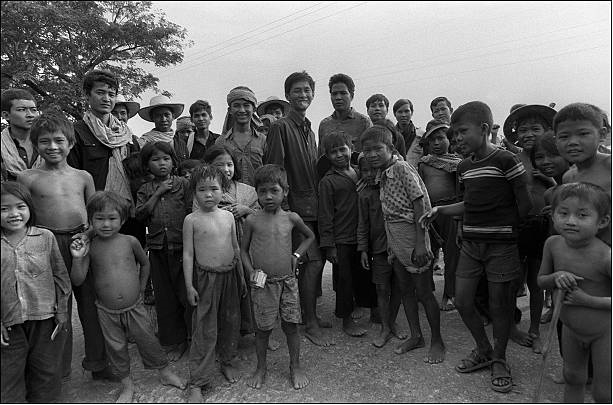






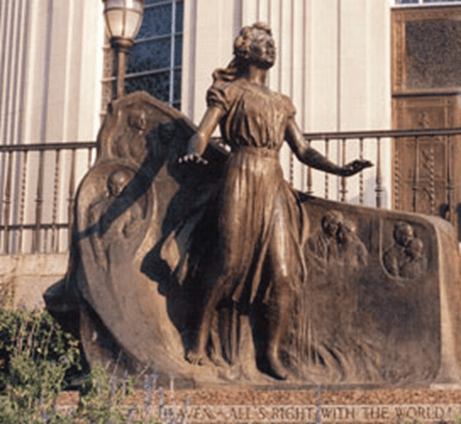




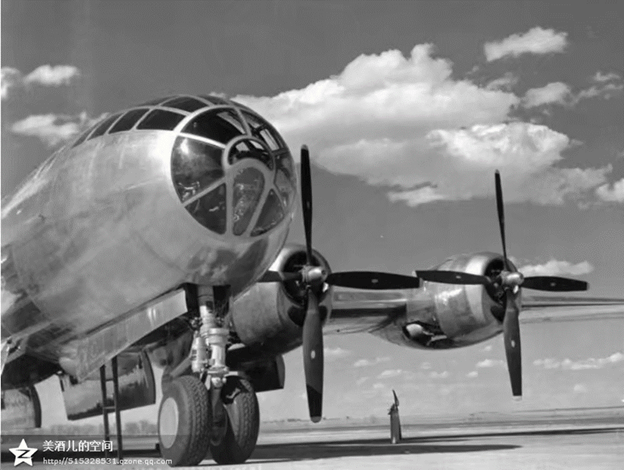
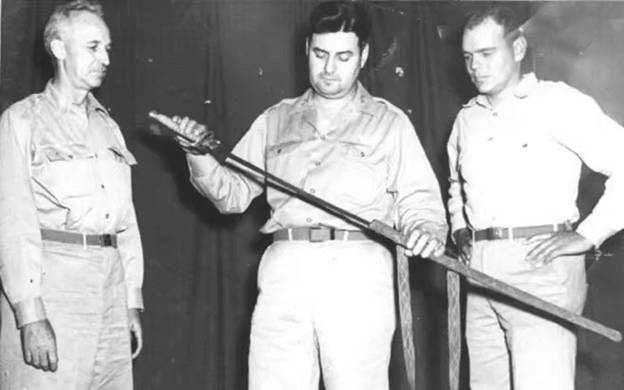
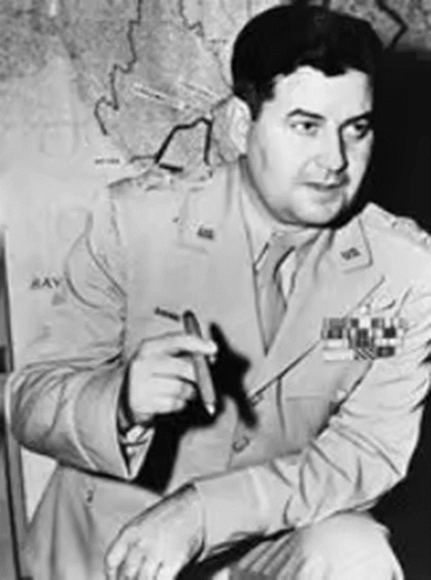
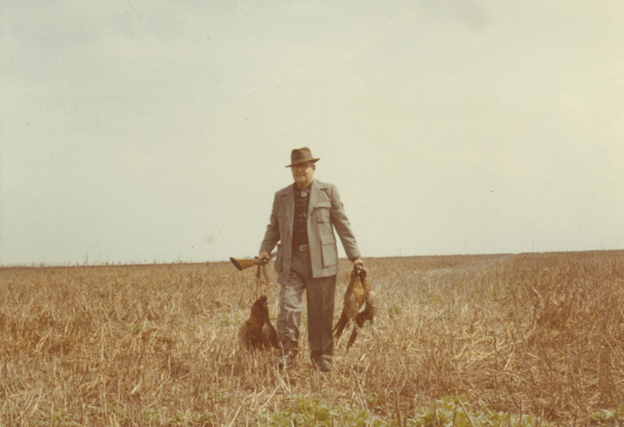
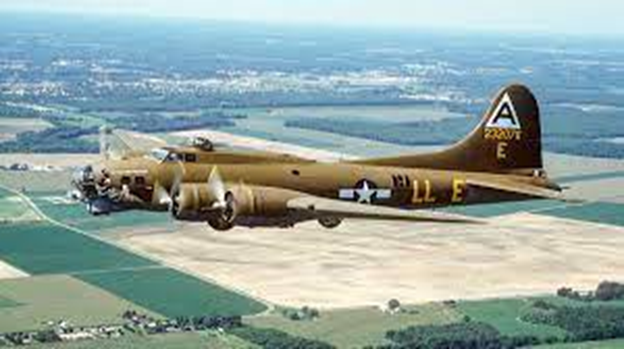
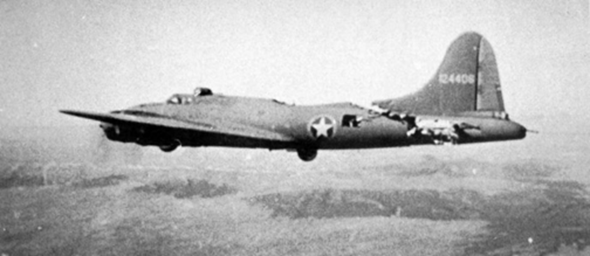

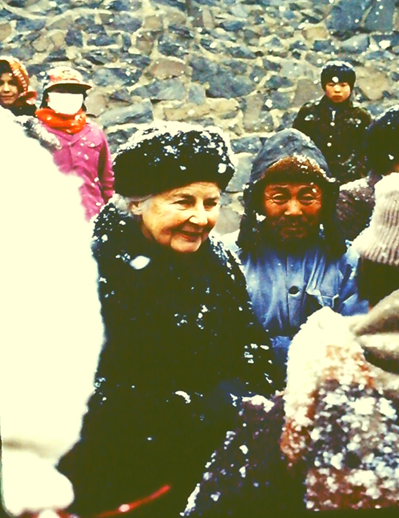





 True Texan Tales