Amazing Grace

You have heard that the famous hymn “Amazing Grace” was written by the captain of a slave ship.  That is about all that most of us have ever heard other than the words of the song.  However, if you would like to know the rest of the story, I have provided it here below:

And as you remember the song starts out………..

“Amazing grace!

How sweet the sound,

That saved a wretch like me!

I once was lost, but now am found,

Was blind, but now I see.”

These were the words of John Newton, a former slave ship captain, who died December 21, 1807.

At age 11, his mother died and he went to sea with his father.

Young John Newton fell in love with Mary Catlett while on shore leave, but overstaying his visit, he missed his ship’s departure.

In 1744, he was caught by a “press gang” and dragged onto the ship HMS Harwich where he was forced to be a sailor.

Newton tried to desert but was caught, stripped to the waist and flogged with 8 dozen lashes.

John Newton later wrote in a letter:  “Like an unwary sailor who quits his port just before a rising storm, I renounced the hopes and comforts of the Gospel at the very time when every other comfort was about to fail me.”

His reckless behavior caused him to be traded to a slave ship.  Being a continual problem, Newton was intentionally left on a slave plantation in Sierra Leone, West Africa in 1745.  There, the African slave dealer, Amos Clowe, made Newton a slave of his wife, Princess Peye, an African duchess, where he suffered abuse and mistreatment.

Years later, Scottish Missionary David Livingstone mentioned John Newton and the Muslim Arab slave traders’ shocking treatment of African slaves (Missionary Travels and Researches in South Africa, London, October 1857):  “It was refreshing to get food which could be eaten without producing the unpleasantness described by the Rev. John Newton, of St. Mary’s, Woolnoth, London, when obliged to eat the same roots while a slave in the West (Africa)”

Livingstone continued:  “A party of Arabs from Zanzibar were at a village in the same latitude as Naliele town. The Arabs mentioned they disliked the English, ‘because they thrash (criticize) them for selling slaves’. I ventured to tell them that I agreed with the English, that it was better to let the children grow up and comfort their mothers when they became old, than to carry them away and sell them across the sea, and there were many explanations of our abhorrence of slavery, and how displeasing it must be to God to see his children selling one another.”

Livingstone described the Arab Muslim slave trade as “a monster brooding over Africa.”

Lord Baden-Powell gave the account in The Downfall of Prempeh (1896) of the cruel African Ashanti King who sold captured Africans into slavery, even for human sacrifice: “The main reasons for the expedition: To put an end to human sacrifice; To put a stop to slave trading and raiding. Every tribe in the neighborhood of the Ashanti lived in terror of its life from the king, who had on several occasions destroyed, one after another, tribes which had sough our protection. In England we scarcely realize the extent to which human sacrifice had been carried out by the Ashanti. On the death of a king the custom of washing the grave involved enormous numbers of sacrifices.  Then sacrifices were also made to propitiate the gods when war was about to be entered upon or other trouble was impending.  Victims were also killed to deter an enemy from approaching the capital; sometimes they were impaled and set up on the path, with their hand pointing to the enemy and bidding him to retire.  At other times the victim was beheaded and the head replaced looking in the wrong direction; or he was buried alive in the pathway, standing upright, with only his head above ground, to remain thus until starvation or — what was infinitely worse — the ants made an end of him.

In no part of the world does slavery appear to be more detestable than in Ashanti. Stop human sacrifice, and you deal a fatal blow to the slave trade.”

In 1748, John Newton was finally rescued from Africa but continued his immoral life in the slave trade, hatefully deriding Christians with blasphemy that shocked even sailors.

He wrote in 1778:  “How industrious is Satan served.  I was formerly one of his active under-temptors and had my influence been equal to my wishes I would have carried all the human race with me. A common drunkard or profligate is a petty sinner to what I was.”

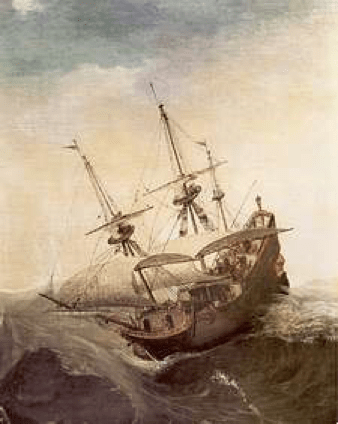
In 1747, Newton was on the slave ship Greyhound.  The ship was caught in a storm so terrible that he was convinced they would sink.  He prayed for the first time in his life.  Someone gave him a copy of Thomas a Kempis’ Imitation of Christ and the Bible, which he began to read.

Newton continued in the slave trade for a time, but endeavored to treat slaves humanely.  Newton finally left the slave trade, married Mary Catlett in 1750, and moved to Liverpool, where from 1755 to 1760 he worked as a surveyor of tides.  He wrote:  “I am not the man I ought to be, I am not the man I wish to be, and I am not the man I hope to be, but by the grace of God, I am not the man I used to be.”

In America’s God and Country Encyclopedia of Quotations,  Newton wrote:  “Afflictions quicken us to prayer.  It is a pity it should be so; but experience testifies, that a long course of ease and prosperity, without painful changes—has an unhappy tendency to make us cold and formal in our secret worship.  But troubles rouse our spirits, and constrain us to call upon the Lord in good earnest—when we feel a need of that help which we only can have from His Almighty arm.  Afflictions are useful, and in a degree necessary, to keep alive in us—a conviction of the vanity and unsatisfying nature of the present world, and all its enjoyments; to remind us that this world is not our rest, and to call our thoughts upwards, where our true treasure is, and where our heart ought to be.  When things go on much to our wish, our hearts are too prone to say, ‘It is good to be here!'”

While in Liverpool, Newton met the evangelistic preacher George Whitefield and John Wesley, the founder of Methodism.  He was inspired to become a minister and taught himself Greek and Hebrew.  Newton was turned down by the Anglican Archbishop of York, but persisted and was eventually ordained in 1764.  He was assigned to the village of Olney, Buckinghamshire, where he humbly proclaimed the saving power of Christ.

In 1767, poet William Cowper moved to Olney, and with his help, Newton composed songs for their weekly prayer meetings.  William Cowper wrote in the poem “Winter Walk at Noon,” 1785:

“Nature is but a name for an effect,

Whose cause is God.”

Newton and Cowper’s songs were first published in 1779 in a collection titled “Olney Hymns.”  The Olney Hymns include:

“Oh! for a Closer Walk with God,”

“God Moves in a Mysterious Way,” and

“There is a Fountain Filled with Blood,” which has the lines:

“The dying thief rejoiced to see

That fountain in his day;

And there may I, though vile as he,

Wash all my sins away

Wash all my sins away,

Wash all my sins away;

And there may I, though vile as he,

Wash all my sins away.”

This is a reference to God, being just, judges every sin, but being love, He provided the Lamb to take the judgment for our sins, washing them away.

Revelation 1:5: “Jesus Christ, the faithful witness, the firstborn from the dead, and the ruler over the kings of the earth. To Him who loved us and washed us from our sins in His own blood.”

Isaiah 53: “Surely he took up our pain and bore our suffering, yet we considered him punished by God, stricken by him, and afflicted.  But he was pierced for our transgressions, he was crushed for our iniquities; the punishment that brought us peace was on him, and by his wounds we are healed. The Lord has laid on him the iniquity of us all.  He was oppressed and afflicted, yet he did not open his mouth; he was led like a lamb to the slaughter, and as a sheep before its shearers is silent. He was cut off from the land of the living; for the transgression of my people he was punished. Yet it was the Lord’s will to crush him and cause him to suffer. The Lord makes his life an offering for sin. My righteous servant will justify many, and he will bear their iniquities. For he bore the sin of many, and made intercession for the transgressors.”

John Newton moved to London in 1780 to become rector of St. Mary Woolnoth Church.  He counseled:“God could have over-ruled every difficulty in your way, had he seen it expedient. But He is pleased to show you, that you depend not upon men—but upon Himself. He who has begun a good work in you, is able to carry it on, in defiance of all seeming hindrances, and make all things (even those which have the most unfavorable appearances) work together for your good.”

Newton continually preached against slavery and published his ghastly experiences in the slave trade in 1788.  On John Newton’s tomb, and on a church plaque, is written:

“John Newton, Clerk,

once an infidel and libertine,

a servant of slaves in Africa,

was, by the rich mercy

of our Lord and Saviour

Jesus Christ,

preserved, restored, pardoned,

and appointed to preach the faith

he had long labored to destroy.”

Many influential leaders in England attended John Newton’s services.  In 1795, a famous British member of Parliament, William Wilberforce, came to have a living faith in Jesus Christ through the help of Newton.

Wilberforce initially wanted to become a preacher, but Newton persuaded him to serve God by fighting slavery in the British Parliament, as Britain was the world’s largest slave trader in the 19th century.

In 1983, President Ronald Reagan wrote in “Abortion and the Conscience of the Nation” (The Human Life Review):  “Prayer and action are needed to uphold the sanctity of human life. I believe it will not be possible to accomplish our work of saving lives, ‘without being a soul of prayer.’ The famous British member of Parliament William Wilberforce prayed with his small group of influential friends, the ‘Clapham Sect,’ for decades to see an end to slavery in the British empire.”

Eric Metaxas wrote in his post, “Break Point: Wilberforce and the ‘Necessary Evil'” (July 26, 2018):  “After his dramatic conversion to Jesus Christ in 1785, the heretofore unfocused Wilberforce made three consequential decisions that ended up changing the world:  first, stay in politics, at a time when conventional wisdom held that politics was too dirty a business for Christians;  second, work for the abolition of the slave trade in Britain; and, third, work for moral reformation in society.”

Wilberforce wrote in his journal:“My walk is a public one. My business is in the world, and I must mix in the assemblies of men or quit the post which Providence seems to have assigned me.  A man who acts from the principles I profess reflects that he is to give an account of his political conduct at the judgment seat of Christ.”

Fighting the entrenched, deep-state slavery interests for 11 years, Wilberforce wrote: “So enormous, so dreadful, so irremediable did the trades wickedness appear, that my own mind was completely made up. Let the consequences be what they would; I from this time determined that I would never rest until I had effected its abolition. ”Parliament finally passed an act abolishing the slave trade in 1807, but it took 26 years to abolish slavery throughout the British Empire.

President Reagan wrote:  “Wilberforce led that struggle in Parliament, unflaggingly, because he believed in the sanctity of human life.  He saw the fulfillment of his impossible dream when Parliament outlawed slavery just before his death.”

John Newton wrote:  “Although my memory’s fading, I remember two things very clearly: I am a great sinner and Christ is a great Savior.  This is faith: a renouncing of everything we are apt to call our own and relying wholly upon the blood, righteousness and intercession of Jesus.  If you once love Him, you will study to please Him.  Whoever is truly humbled — will not be easily angry, nor harsh or critical of others. He will be compassionate and tender to the infirmities of his fellow-sinners, knowing that if there is a difference — it is grace alone which has made it! He knows that he has the seeds of every evil in his own heart. And under all trials and afflictions — he will look to the hand of the Lord, and lay his mouth in the dust, acknowledging that he suffers much less than his iniquities have deserved.”

Considered the most popular Christian hymn ever, John Newton’s words are:

“AMAZING GRACE!

How sweet the sound

That sav’d a wretch like me!

I once was lost, but now am found,

Was blind, but now I see.

‘Twas grace that taught my heart to fear,

And grace my fears reliev’d;

How precious did that grace appear

The hour I first believ’d!

Thro’ many dangers, toils, and snares,

I have already come;

‘Tis grace hath brought me safe thus far,

And grace will lead me home.

The Lord has promis’d good to me,

His word my hope secures;

He will my shield and portion be

As long as life endures.

Yes, when this flesh and heart shall fail,

And mortal life shall cease;

I shall possess, within the veil,

A life of joy and peace.

The earth shall soon dissolve like snow,

The sun forbear to shine;

But God, who call’d me here below,

Will be forever mine.”


Dr. Edward Teller

I am sending you an edited version of this special story again since the huge number of people in China who are reading these storis did not get to see it.

Dr. Edward Teller

I have already alluded to Dr. E.V. Hill’s insight into how God works. Remember, Dr. Hill said that God decided to do His work only through people. As Dr. Hill put it: That was the dumbest thing God could have ever done. Dr. Hill said: “That is God’s Plan A. Heain’t got no Plan B.”

In that context it is my contention that God used Dr. Teller’s brilliant mind and background to protect America and its people, even with all of Dr. Teller’s faults. He was born in Hungary to an affluent Jewish family. It was there where he was influenced for the rest of his life by the horrors he saw in Communist dictatorships. He then moved to Germany where he was also influenced for the rest of his life by the horrors he saw in Nazism, The National Socialists Party. He finally got to the United States. He was one of the first to sound the alarm over Germany’s work to produce an atomic bomb.

He drove the car for Leo Szilard, his boyhood friend in Hungary, when those two brilliant physicists went to Long Island to Albert Einstein’s cottage and secured the letter from Einstein to FDR that caused Roosevelt to initiate the Manhattan Project for the US to produce an atomic bomb first.

By the time the war started, he was a respected professor at George Washington University, but left in the spring of 1943 to move to Los Alamos where he was recruited to work on developing the atomic bomb.

All along, Dr. Teller saw the possibility of a much greater bomb by using atomic energy to compress and ignite a large mass of tritium or deuterium to cause fusion. He is thus considered the father of the Hydrogen Bomb even though the brilliant mathematician Stanislaw Ulam actually worked out the detailed calculations for it. Dr. Teller was obsessed that the US produce the hydrogen bomb before the Russians did at the start of the Cold War.

Dr. Teller’s mind was just amazing, and he managed to keep it very clear and active until he died at age 95 in 2003. He did this by getting hyperbaric oxygen treatments every month from a doctor in Dallas. I have studied hundreds of x-rays and their dates that prove that proper hyperbaric treatments will also cause bones to heal in a matter of days instead of weeks. It does the same for severe bruises and many other ailments. The National Football League finally started using it to heal their players more quickly.

On my lunch hour I used to go up to Dr. Maxfield’s clinic and visit. He would show me x rays of former patients, file after file. Their dates showed how bones healed amazingly fast. One that I remember vividly was of a high school student from Canada. He was the goalie on his school’s hockey team. They were to play for their Province’s championship game, but he broke his arm in their final playoff game. His father knew about Dr. Maxfield and hyperbaric treatments from his mining company. One of his father’s key foremen had a broken bone that just would not heal. The foreman was sent down to Dallas and the hyperbaric oxygen treatments healed the bone quickly.

So, the father sent his son down to Dallas for those treatments before their Championship game in two weeks. Dr. Maxfield told the boy’s mother that he thought the boy would be able to play. However, when she went into the doctor to have the boy’s cast cut off, the doctor said: “What in the world do you mean. I just put that cast on a few days ago!” She called back to Dallas to ask what to do. Dr. Maxfield told her to go down the street to another doctor, and not say anything other than to just cut the cast off.

The boy did play, though I did not hear whether they won the championship or not.

Another time I was there at the clinic and stopped to visit with this older woman. She was just fussing and fussing. I asked her what was wrong: “You are supposed to feel great when your treatment is finished.”

She said: “Oh, I do, my leg is completely healed.”

“So, what are you fussing about?”

Then I looked down and her other leg was completely gone. She was fussing because she would still have it if she had known about hyperbaric oxygen treatments. And I said: “You were smoking too much weren’t you.” She hung her head and said: “Yes.”

It consists of being in a chamber for about an hour at 2 ½ atmospheres of pressure in a pure oxygen environment. It just saturates the body and one’s brain with healing oxygen. Where the football players use a fairly large chamber, Dr. Maxfield used a glass tube just large enough to hold Dr. Teller’s prone body. My 2nd oldest son used to go with me when Dr. Teller was getting treatments. Raymond would bolt the end on the chamber down, and then unbolt it when Dr. Teller’s treatment was finished. They could have used much higher atmospheres of pressure, but it was found the 2 ½ was sufficient and that higher pressures caused no better results.

As I mentioned, his mind was just amazing. I would spend time with him at Dr. Maxfield’s place on Lake Kiowa near Gainesville. We would discuss different potential business projects that Dr. Teller had thought up that he wanted me to pursue.

On one occasion after his treatment he wanted a good hamburger. We decided to take him to a county club in Dallas where the chef made great ones. I had three books with me that I wanted Dr. Teller to read and give me a report on rhetorical physics and its implications on his next trip to Dallas for his treatments a month later. He went on up ahead with his doctor and my son and I followed along behind in my Suburban. Much to my amazement, when we arrived at the country club he had devoured all three books and gave me the analysis before lunch.

General Lemay kept our country safe during the Cold War with manned aircraft. As the age of rockets carrying nuclear bombs dawned, Lemay thought we should still keep some manned aircraft as a safeguard. We did with the B-1 bomber that flies under enemy radar and the new stealth bomber. But the Russians could still target every one of our ICBM rockets and every one of our aircraft on the ground, and all our ships with rockets, and every one of our aircraft carriers with a first strike by their rockets. I have been told by analysts at the CIA that they most likely would have done so except for one thing………our Trident Submarines.

Trident on the Surface

The “cream of the crop” in our navy seeks to enter the Trident Program. They get their new Trident sub and then go out and shoot one Trident missile for practice. Then in a few days they submerge for 89 days and get totally lost. The Russians don’t have a clue where they are.

With the help of Dr. Teller and his friends I have been allowed to go down on those Tridents. You stand in the War Room and look down through that long sub with 12 Trident missiles on each side. The sailors sleep between the missiles. I have talked to the weapon’s officer. He said he could only tell me that each of the 24 missiles could travel over 10,000 miles. Each one has 7 to 8 independently targeted war heads. When I asked the weapon’s officer how he would deploy those war heads, he said that he could lay a star pattern over the whole Moscow area.

When I wanted to get some idea of just how destructive a hydrogen weapon would be, I was told that just one detonated at 2½ thousand feet would blow a hole in the ground 500 feet deep and 12 miles across, with all of that material blasted into the air with its deadly fallout. And not even counting the blast effects way on beyond the 12 miles. Yet, the Russians never dared touch us because of those Trident subs.

Each Trident has two devices that just barely fit into their torpedo tubes. One was sitting right there in the War Room since it was too big to fit most anywhere else. If the officers on the Trident think they may have been discovered, they can send out one of these devices. They are so designed to perfectly simulate a Trident sub. In this way the real sub can have a high chance of getting lost again.

War Room in Trident

To shoot their one practice missile before submerging for 89 days, they liked to do so in a few hours after the launch of one of our Space Shuttles. All the cameras and tracking devices are set-up down range to track the flight of the Shuttle. So, the tracking of the Trident missal can just be used by them, also.

Every sub has a tender or fairly large ship that stays on the surface in the general area of the sub’s location. It has all kinds of provisions and safety devices in case of an emergency on the sub. I have been on those tenders. I have never seen such elaborate showers as they have. They are to wash down any sailors who may have been exposed to the nuclear material that powers the sub.

Also, with the help of Dr. Teller and his friends, I was allowed to go out on the tender ship to observe a Trident shoot its one practice missile. That morning we were in the VIP area with the astronaut’s families and the technical officers for the Shuttle launch. It is an amazing sight.

Then that night after it was totally dark, we went out with the submerged sub.

Just off Cape Canaveral the Russians keep an observation ship permanently moored there. It is not huge, but it has all manner of electronic listening and observation devices all over it. As our tender went out, the Russian ship pulled up its anchors and went out with us.

The tender has a wide, curved bridge or war room almost the whole width of the ship. It was lit only with the eerie red light that they use for night operations. It is a great place to observe, but I wanted to get outside in the front on the main deck of the ship to watch. On that deck was one of the sophisticated camera cages from Hollywood where the photographer sits in the cage that tilts in any direction to film the missile launch and track it on camera.

It got quite tense as the time for the missal shot approached. It blasts from 300 feet down up into the air where it ignites and zooms off into space. I wanted to know if I would be able to get a picture of it; and was told not to worry. I would totally be able to. As the time approached for the shot, there were two helicopters sweeping the area to make sure there were no stray craft around. I was fascinated to see them shine their powerful search lights down onto the Russian ship and the Russian ship shine its powerful lights back up at the helicopters.

Just before the missal blasted out of the ocean, a sailor and I saw this little red streak shoot up from the Russian ship. Then we saw all these flairs going up from what appeared to be from the surface of the water. It was so dark that we could not tell for sure. We, along with most everyone else assumed the flairs were part of the operation.

Wow! That missal lit-up everything. Since there were no clouds, you could follow its bright glow far off into the distant sky.

Practice Firing of Trident Missal from 300 Feet Down

Later we learned that one of the helicopters had gone down. It did not just crash; it had slowly settled down to the surface of the water in the pitch dark. Those flairs that the sailor and I saw were distress signals from the three officers in the helicopter. No one had taken notice of them since everyone was concentrating on the missile shot.

Eventually we went over and picked up the three officers who had been in the front of the helicopter. However, the three airmen who had been in the back of the helicopter were no-where to be found. We searched all around, but they were not found. Since the helicopter had settled down onto the water gently, we were sure they had not been injured.

We were supposed to go back to the port at Cape Canaveral, but we spent the whole rest of the night looking for them. We did find the helicopter floating just below the surface and pulled it onboard. We then spent the whole next day navigating in ever-widening squares searching for the three airmen.

I visited with an engineer from a contracting company who was onboard. His company made the covers or seals that covered the tops of the missals when their outside shields are opened. He was sad about not finding the airmen, but he was thrilled that we were able to recover the several pieces of those seals. He had never been able to retrieve them before. I helped him put them back together on the deck. They fit together like the slices of an orange.

That afternoon, the sailor and I were hauled in and admonished to never breathe a word of what we had seen just before the missal shot. We knew that those Russians had shot down the helicopter; and had for sure captured the three airmen. So far as I know, they were never heard from again.

Late that afternoon we finally went back into port. As we passed by that Russian observation ship which was anchored back there again as it always is, I had heavy mixed feelings.

Rev. Peter Marshall

As the Bible states in both the Old and New Testaments: God is involved in the affairs of nations. Time and again this has been proved by the affairs of this nation.  Here is another of those occasions………………

Ron

The morning of December 7, 1941, Rev. Peter Marshall addressed the midshipmen at the U.S. Naval Academy in Annapolis, class of ’42.   At the last minute, he set aside his prepared remarks and preached a prophetic message, “Go Down, Death.”  

Within an hour after he finished, news of Imperial Japan’s attack at Pearl Harbor spread across the nation.  

Peter Marshall stated:   “I am one of those who believe that there are some principles worth fighting for and worth dying for, if need be.”  
    Senate Chaplain Peter Marshall stated:   “The trouble with our time is that when we can’t believe there is anything left to us worth dying for, then we’re not sure there’s anything worth living for either …  

God permits war in order that we might see what sin really is.”   “War forces us to examine the very foundations of life itself.”  

“What man refuses to learn in times of peace, God teaches him in times of war.”

 
Peter Marshall commented on the socialist tactic of “deconstruction” (20 Centuries of Great Preaching Vol. 12 Waco: Word, 1971 p. 11-19):   “Then there dawned the day when … with our higher education came a debunking contest.   This debunking became a sort of national sport … It was smarter to revile than to revere … more fashionable to depreciate than to appreciate.   In our classrooms …. no longer did we laud great men – those who had struggled and achieved. Instead, we merely … ferreted out their faults.   We decided that it was silly to say God sent them for a special task … They were merely … ‘products of their environments’ …   Our debunking is … a sign of decaying foundations of character to the individual and in the national life.”
    At the age of 25, Peter Marshall emigrated from Scotland, arriving at New York’s Ellis Island in 1927.  

Members of his Sunday School class paid his way to seminary in Atlanta, where he graduated in 1931.  

Rev. Peter Marshall pastored a small church in Covington, Georgia, then preached at Atlanta’s Westminster Presbyterian Church.
    There he met Catherine Wood, a student at Agnes Scott College, and they married.   Catherine Marshall’s book on Peter’s life, A Man Called Peter, was turned into the movie.  
       
    IIn 1937, at the age of 35, Peter Marshall became pastor of Washington, D.C.’s prestigious New York Avenue Presbyterian Church, the same church where Dr. Phineas Gurley was pastor during Lincoln’s presidency.    

Rev. Peter Marshall stated (20 Centuries of Great Preaching, Vol. 12 Waco: Word, 1971 p. 11-19):  
“I have come to know Lincoln better – the heart and spirit of the man – since I met him in the tradition of this church I now serve in Washington, than ever I knew him in history books.    

Soon after assuming this pastorate, I happened one day upon an old safe, little used, in the church basement.   Fascinating minutes of session meetings were there, dating almost back the year the church was born – 1802.
    … Among these were some pew rental books, and I flipped open to a page with the inscription at the top: ‘A. Lincoln.’   The annual rent of the pew was fifty dollars a year, and the notations of payments began in March, 1861, and continued until the President’s assassination four years later …”  
Marshall continued:   “Upon coming to Washington, Mr. Lincoln had sought the advice of a member of his cabinet on the choice of ‘a suitable church home’ for himself, his wife, and his three boys.  

One of his stipulations was that it had to be ‘a clergyman who holds himself aloof from politics.’  
The President’s choice was Dr. Phineas Gurley of this church.


As the clouds of Civil War gathered, increasingly, Mr. Lincoln sought the friendship of the clergyman.  

He liked to attend the mid-week prayer meetings by sitting on the other side of a glass-topped door, with the door ajar.    

On nights when the President would be deeply disturbed by the horror of Americans having to fight fellow-Americans, he would sometimes send a messenger to fetch Dr. Gurley.
    … Later, Dr. Gurley was to tell how the two of them would walk up and down the south portico of the White House – up and down, all through the night talking … praying until dawn flushed pink in the eastern sky.  

For here was a man on the horns of that terrible dilemma: he believed that a nation divided could not stand … that the Union was worth saving … yet he loathed war, all of it from Fort Sumter to Appomattox …”
He continued:  

“In the end, according to Dr. Gurley who knew Lincoln so well, Lincoln found no way except the route of faith in God:   ‘After being near him steadily and with him often for more than four years,’ Dr. Gurley said,   ‘I can affirm that God’s guidance and mercy were the props on which he humbly and habitually leaned; that they were the best hope he had for himself and for his country.

……He recognized and received the truth that God is the governor among the nations, and that our only hope, in the President’s own words, was — to humble ourselves … confess our national sins, and pray for clemency and forgiveness.'”
Marshall added:  

“The biographers who have rather desperately tried to prove that Abraham Lincoln was an unbeliever, have ignored Dr. Gurley’s testimony

…..The minister was present when Willie Lincoln died in the White House, and received from him the little iron bank containing pennies which the little boy asked him to give to the Sunday school.  

He was there in the tiny hall bedroom in the red brick house on Tenth Street, keeping an all-night vigil with the leaders of the nation, as the President lay dying.   As daylight broke and the faint breathing died away, the Secretary of War, Mr. Stanton, broke the stillness with words which were almost a sob, “Now he belongs to the ages.”  

Then he asked Dr. Gurley to pray.”
  Marshall concluded:  

“The nation needed prayer more than ever – without Lincoln.  

That was the note of the eulogy in the East Room which Dr. Gurley delivered, ‘It is by his steady confidence in God that he would speak to us today. His message would be: Cling to liberty and right, battle for them, bleed for them, if need be, but most important, have faith in God …’


Rev. Peter Marshall

As the Bible states in both the Old and New Testaments: God is involved in the affairs of nations. Time and again this has been proved by the affairs of this nation.  Here is another of those occasions………………

Ron

The morning of December 7, 1941, Rev. Peter Marshall addressed the midshipmen at the U.S. Naval Academy in Annapolis, class of ’42. At the last minute, he set aside his prepared remarks and preached a prophetic message, “Go Down, Death.” Within an hour after he finished, news of Imperial Japan’s attack at Pearl Harbor spread across the nation. 

Peter Marshall stated: 

“I am one of those who believe that there are some principles worth fighting for and worth dying for, if need be.”

Senate Chaplain Peter Marshall stated:

“The trouble with our time is that when we can’t believe there is anything left to us worth dying for, then we’re not sure there’s anything worth living for either

 …God permits war in order that we might see what sin really is.” 

“War forces us to examine the very foundations of life itself.”

“What man refuses to learn in times of peace, God teaches him in times of war.”

Peter Marshall commented on the socialist tactic of “deconstruction” (20 Centuries of Great Preaching Vol. 12 Waco: Word, 1971 p. 11-19):

“Then there dawned the day when … with our higher education came a debunking contest. This debunking became a sort of national sport

 … It was smarter to revile than to revere … more fashionable to depreciate than to appreciate.   

In our classrooms …. no longer did we laud great men – those who had struggled and achieved.

Instead, we merely … ferreted out their faults.   

We decided that it was silly to say God sent them for a special task … They were merely … ‘products of their environments’ 

…..Our debunking is … a sign of decaying foundations of character to the individual and in the national life.”


  At the age of 25, Peter Marshall emigrated from Scotland, arriving at New York’s Ellis Island in 1927.

Members of his Sunday School class paid his way to seminary in Atlanta, where he graduated in 1931.Rev.

Peter Marshall pastored a small church in Covington, Georgia, then preached at Atlanta’s Westminster Presbyterian Church. 

There he met Catherine Wood, a student at Agnes Scott College, and they married. Catherine Marshall’s book on Peter’s life, A Man Called Peter, was turned into the movie.


In 1937, at the age of 35, Peter Marshall became pastor of Washington, D.C.’s prestigious New York Avenue Presbyterian Church, the same church where Dr. Phineas Gurley was pastor during Lincoln’s presidency.

Rev. Peter Marshall stated (20 Centuries of Great Preaching, Vol. 12 Waco: Word, 1971 p. 11-19):

 “I have come to know Lincoln better – the heart and spirit of the man – since I met him in the tradition of this church I now serve in Washington, than ever I knew him in history books. 

Soon after assuming this pastorate, I happened one day upon an old safe, little used, in the church basement. Fascinating minutes of session meetings were there, dating almost back the year the church was born – 1802.

   … Among these were some pew rental books, and I flipped open to a page with the inscription at the top: ‘A. Lincoln.’ The annual rent of the pew was fifty dollars a year, and the notations of payments began in March, 1861, and continued until the President’s assassination four years later …”

Marshall continued: “Upon coming to Washington, Mr. Lincoln had sought the advice of a member of his cabinet on the choice of ‘a suitable church home’ for himself, his wife, and his three boys. 

One of his stipulations was that it had to be ‘a clergyman who holds himself aloof from politics.’ The President’s choice was Dr. Phineas Gurley of this church.

 As the clouds of Civil War gathered, increasingly, Mr. Lincoln sought the friendship of the clergyman. 

He liked to attend the mid-week prayer meetings by sitting on the other side of a glass-topped door, with the door ajar. 

On nights when the President would be deeply disturbed by the horror of Americans having to fight fellow-Americans, he would sometimes send a messenger to fetch Dr. Gurley.  

… Later, Dr. Gurley was to tell how the two of them would walk up and down the south portico of the White House – up and down, all through the night talking … praying until dawn flushed pink in the eastern sky. 

For here was a man on the horns of that terrible dilemma: he believed that a nation divided could not stand … that the Union was worth saving … yet he loathed war, all of it from Fort Sumter to Appomattox

…”He continued:

“In the end, according to Dr. Gurley who knew Lincoln so well, Lincoln found no way except the route of faith in God: ‘After being near him steadily and with him often for more than four years,’ Dr. Gurley said, ‘I can affirm that God’s guidance and mercy were the props on which he humbly and habitually leaned; that they were the best hope he had for himself and for his country

… He recognized and received the truth that God is the governor among the nations, and that our only hope, in the President’s own words, was — to humble ourselves … confess our national sins, and pray for clemency and forgiveness.’

Marshall added: 

“The biographers who have rather desperately tried to prove that Abraham Lincoln was an unbeliever, have ignored Dr. Gurley’s testimony

 …..The minister was present when Willie Lincoln died in the White House, and received from him the little iron bank containing pennies which the little boy asked him to give to the Sunday school. 

He was there in the tiny hall bedroom in the red brick house on Tenth Street, keeping an all-night vigil with the leaders of the nation, as the President lay dying. As daylight broke and the faint breathing died away, the Secretary of War, Mr. Stanton, broke the stillness with words which were almost a sob, “Now he belongs to the ages.” 

Then he asked Dr. Gurley to pray.”  

Marshall concluded: 

“The nation needed prayer more than ever – without Lincoln. That was the note of the eulogy in the East Room which Dr. Gurley delivered, ‘It is by his steady confidence in God that he would speak to us today.

His message would be: Cling to liberty and right, battle for them, bleed for them, if need be, but most important, have faith in God …’

Plymouth Rock

SEPTEMBER 16, 1620, according to the Gregorian Calendar, 102 passengers set sail on the Pilgrims’ ship, Mayflower, with the blessings of their separatist pastor, John Robinson. Their 66-day journey of 2,750 miles encountered storms so rough the beam supporting the main mast cracked and was propped back in place with “a great iron screw.” One youth, John Howland, a servant of John Carver, was swept overboard by a freezing wave and barely rescued.

His descendants include: Signer of the U.S. Constitution Nathaniel Gorham, Ralph Waldo Emerson, Henry Wadsworth Longfellow, Jane Austin, Franklin D. Roosevelt, George Bush, Sarah Palin, Humphrey Bogart, and Alec Baldwin. Howland was described in colonial records as a “godly man and an ardent professor in the ways of Christ.”

The Mayflower intended to land in Virginia but was blown off-course to Massachusetts. With the weather too dangerous to sail any more so Captain Christopher Jones insisted the Pilgrims disembark.

With no “king-appointed” person on board with authority to take charge, the Pilgrims had a question – who would be in charge?

They did something unique. They gave themselves authority and created their own “covenant” government — The Mayflower Compact. They had a charter to found a colony way farther south, but not at Plymouth.  This Compact that they constructed abord ship as their governing authority eventually became the model for our U.S. Constitution.  It was the first instrument for founding a government from “The People”….. A Republic, as opposed to a government under a King.

This Compact was first proposed by their Pastor Robinson and modeled on the Covenants as described in the Bible.

Pastor Robinson is prominently depicted kneeling in prayer in a painting in the U.S. Capitol Rotunda -The Embarkation of the Pilgrims.

Of the Pilgrims’ landing at Plymouth, Massachusetts, Governor William Bradford wrote: “Being thus arrived in a good harbor, and brought safe to land, they fell upon their knees and blessed the God of Heaven who had brought them over the vast and furious ocean, and delivered them from all the perils and miseries thereof, again to set their feet on the firm and stable earth, their proper element.”

Though half died that first bitter winter, Governor William Bradford wrote: “Last and not least, they cherished a great hope and inward zeal of laying good foundations … for the propagation and advance of the gospel of the kingdom of Christ in the remote parts of the world.”

Ralph Waldo Emerson wrote in his article “American Civilization, published in The Atlantic Magazine, April, 1862: “America is another word for Opportunity. Our whole history appears like a last effort of the Divine Providence in behalf of the human race.”

At the Bicentennial Celebration of the landing of the Pilgrims at Plymouth Rock, Secretary of State Daniel Webster stated December 22, 1820: “There is a … sort of genius of the place, which … awes us. We feel that we are on the spot where the first scene of our history was laid; where the hearths and altars of New England were first placed; where Christianity, and civilization … made their first lodgment, in a vast extent of country … ‘If God prosper us,’ might have been the … language of our fathers, when they landed upon this Rock … ‘We shall here begin a work which shall last for ages … We shall fill this region of the great continent … with civilization and Christianity …'”

Webster continued: “The morning that beamed … saw the Pilgrims already at home … a government and a country were to commence, with the very first foundations laid under the divine light of the Christian religion … Our ancestors established their system of government on and religious sentiment … Whatever makes men good Christians, makes them good citizens. Our fathers came here to enjoy their religion free and unmolested; and, at the end of two centuries, there is nothing upon which we can pronounce more confidently … than of the inestimable importance of that religion to man …”

Webster added a rebuke to pastors who refuse to address politics: “The African slave-trader is a pirate and a felon; and in the sight of Heaven, an offender far beyond the ordinary depth of human guilt … If there be … any participation in this traffic, let us pledge ourselves here, upon the rock of Plymouth, to extirpate and destroy it … I invoke the ministers of our religion, that they proclaim its denunciation of these crimes, and add its solemn sanctions to the authority of human laws. If the pulpit be silent whenever or wherever there may be a sinner bloody with this guilt within the hearing of its voice, the pulpit is false to its trust …”

Webster reflected further: “Whoever shall hereafter write this part of our history … will be able to record no … lawless and despotic acts, or any successful usurpation. His page will contain no exhibition of … civil authority habitually trampled down by military power, or of a community crushed by the burden of taxation … He will speak … of that happy condition, in which the restraint and coercion of government are almost invisible and imperceptible …”  

Webster concluded his Plymouth Rock address: “Finally, let us not forget the religious character of our origin. Our fathers were brought hither by their high veneration for the Christian religion. They journeyed by its light, and labored in its hope. They sought to incorporate its principles with the elements of their society, and to diffuse its influence through all their institutions, civil, political, or literary. Let us cherish these sentiments, and extend this influence still more widely; in the full conviction, that that is the happiest society which partakes in the highest degree of the mild and peaceful spirit of Christianity.”

(My good friend, Marshall Foster stayed at my ranch with me many, many times.  Together, we made many plans and proposed many Christian projects.)

Marshall Foster of the World History Institute wrote in “A Shining City on a Hill,” February 27, 2013:  “Four hundred years ago the conflict between tyranny and liberty was red hot …When King James died in 1625, his son Charles the First ascended to the throne with the arrogance of a Roman emperor.  He was the quintessential ‘divine right’ monarch. He declared martial law and suspended the rights of the individual …

The king’s inquisitors at his ‘Star Chamber’ in the tower of London used torture techniques to ‘discover the taxpayer’s assets’ …

A turning point in public opinion took place on January 30, 1637. Three prisoners were locked down in the pillory in London before a huge crowd…… These men included a Puritan minister, a Christian writer and Dr. John Bastwick, a physician.

What was their crime?  They had written pamphlets disagreeing with the king’s religious views. The sheriff began by branding the men with red hot irons on the forehead with an S.L. for seditious libel …”

Dr. Foster continued:

“The tyranny of the king … finally aroused the Christian sensibilities of the people. They would no longer tolerate burnings or mutilations for matters of conscience on religious views …

The persecutions drove tens of thousands of liberty loving believers to follow the Pilgrims to New England where they laid the foundation for the world’s most biblically based nation.”

Dr. Benjamin Rush

I have written you before about the amazing men who signed the Declaration of Independence and founded our Country.  By signing that Document, they pledged opposition to the greatest empire on earth with the largest and most powerful army and navy. To form a Republic in opposition to such powerful forces was very dangerous and also seemed impossible.  However, they had something on their side that Great Britain did not…..The Mighty God of the Universe.  Of that small group, many you have heard about, but some of the most important ones, you probably have not.  One of those was Dr. Benjamin Rush.  Here is his story:

Dr. Benjamin Rush had studied medicine in Philadelphia, then in Europe under the world’s foremost physicians, and then returned to Philadelphia in 1769.

Though his practices were archaic by today’s standards, he is considered by some as the “Father of American Medicine” for his work on staff at the Pennsylvania Hospital, where he opened the first free medical clinic.

He was among the first to recognize alcoholism as a disease and began to promote temperance.

Dr. Rush wrote the first textbook on mental illness and psychiatry, recommending treatment with kindness, earning him the title “Father of American Psychiatry.”

He was a member of the Continental Congress and signed the Declaration of Independence.

His wife was Julia, was the daughter of Richard Stockton, also a signer of the Declaration of Independence.

Thomas Paine consulted with Dr. Benjamin Rush when writing his stirring pamphlet Common Sense.

Rush helped write Pennsylvania’s Constitution and was as a member of the Pennsylvania State Convention which ratified the U.S. Constitution in 1787.

He was Treasurer of the U.S. Mint.

Rush helped found Dickinson College to train physicians, and the Philadelphia Dispensary.

During the dread summer of 1793, Dr. Rush stayed in Philadelphia battling the disease of Yellow Fever which killed thousands.

He was the first to recognize that yellow fever was not contagious, leading to the later discovery that it was spread by mosquito bites.

Dr. Rush and other founders, including George Washington, donated to Richard Allen, founder of the African Methodist Episcopal Church.

Dr. Benjamin Rush supported ending slavery prior to the Revolution, forming a Society for the Abolition of Slavery.

Perhaps Dr. Benjamin Rush’s most beloved contribution to American history was in 1812 encouraging John Adams to write to Thomas Jefferson, breaking the silence which had existed between them for years due to earlier political differences.

A proponent of public education for young women as well as men, Dr. Benjamin Rush wrote his Thoughts Upon the Mode of Education Proper in a Republic, 1786: “I proceed … to inquire what mode of education we shall adopt so as to secure to the state all of the advantages that are to be derived from the proper instruction of the youth; and here I beg leave to remark that the only foundation for a useful education in a republic is to be laid on the foundation of religion.

Without this there can be no virtue, and without virtue there can be no liberty, and liberty is the object and life of all republican governments. But the religion I mean to recommend in this place is that of the New Testament … Its doctrines and precepts are calculated to promote the happiness of society and the safety and well-being of civil government.

Dr. Rush founded a Sunday School Union and the Philidelphia Bible Society.

He wrote in A Plan for Free Schools, 1787:  “Let the children … be carefully instructed in the principles and obligations of the Christian religion. This is the most essential part of education.”

Rush wrote to Jeremy Belknap, July 13, 1789: “The great enemy of the salvation of man, in my opinion, never invented a more effectual means of extirpating (removing) Christianity from the world than by persuading mankind that it was improper to read the Bible at schools.”

Dr. Benjamin Rush wrote in an essay, “A Defense of the Use of the Bible as a School Book: ” included in his 1798 work, Essays, Literary, Moral and Philosophical: “The Bible, when not read in schools, is seldom read in any subsequent period of life. It should be read in our schools in preference to all other books from its containing the greatest portion of that kind of knowledge which is calculated to produce private and public temporal happiness.”

Rush wrote in Essays, Literary, Moral, and Philosophical, 1798:  “I know there is an objection among many people to teaching children doctrines of any kind, because they are liable to be controverted. But let us not be wiser than our Maker If moral precepts alone could have reformed mankind, the mission of the Son of God into all the world would have been unnecessary. The perfect morality of the Gospel rests upon the doctrine which, though often controverted has never been refuted: I mean the vicarious life and death of the Son of God.” He added: “Vicarious” is defined in Merriam-Webster’s Dictionary as: “suffered by one person as a substitute for another or to the benefit or advantage of another: substitutionary.”

Dr. Rush stated: “Without religion, I believe that learning does real mischief to the morals and principles of mankind.”

He wrote his Thoughts Upon the Mode of Education Proper in a Republic, 1786: “A Christian cannot fail of being a republican … for every precept of the Gospel inculcates those degrees of humility, self-denial, and brotherly kindness which are directly opposed to the pride of monarchy. A Christian cannot fail of being useful to the republic, for his religion teaches him that no man ‘liveth to himself.’ And lastly a Christian cannot fail of being wholly inoffensive, for his religion teaches him in all things to do to others what he would wish, in like circumstances, they should do to him.”

Dr. Benjamin Rush explained in Essays, Literary, Moral, and Philosophical, 1798: “Christianity is the only true and perfect religion, and that in proportion as mankind adopts its principles and obeys its precepts, they will be wise and happy. In contemplating the political institutions of the United States, I lament that we waste so much time and money in punishing crimes and take so little pains to prevent them.

We profess to be republicans, and yet we neglect the only means of establishing and perpetuating our republican forms of government, that is, the universal education of our youth in the principles of Christianity by the means of the Bible. For this Divine book, above all others, favors that equality among mankind, that respect for just laws, and those sober and frugal virtues, which constitute the soul of republicanism.”

On July 9, 1788, in a letter to Elias Boudinot regarding a parade in Philadelphia, Dr. Benjamin Rush stated: “The Rabbi of the Jews locked arms of two ministers of the Gospel was a most delightful sight. There could not have been a more happy emblem.”

Dr. Benjamin Rush wrote:  “I have been alternately called an Aristocrat and a Democrat. I am neither. I am a Christocrat. I believe all power … will always fail of producing order and happiness in the hands of man. HE alone who created and redeemed man is qualified to govern him.”

Rush died in Philadelphia on April 19, 1813, and was buried in the yard of Christ’s Church.

John Adams wrote: “Another of our friends of seventy-six is gone, my dear Sir, another of the co-signers of the Independence of our country. A better man than Rush could not have left us, more benevolent, more learned, of finer genius, or more honest. I know of no Character living or dead who has done more real good in America.”

Memorials to Dr. Benjamin Rush stand on Navy Hill in Washington, D.C., and near the Harvard Square Library.

During his final illness, he wrote to his wife:  “My excellent wife, I must leave you, but God will take care of you. By Thy glorious resurrection and ascension, and by the coming of the Holy Ghost, blessed Jesus, wash away all my impurities, and receive me into Thy everlasting kingdom.”

Abortion – Your Decision

The subject of “abortion” is very much in the news and on social media so much the time.  Some say that until a baby is born, it is just a blob of tissue.  Others say that it is a person from the very act of conception. It is going to be very important in our coming election. It may decide the election of many elected offices, even the Presidency.   Thus, it seems important for each of us to form an accurate opinion on the subject.  What standard should we use for that opinion.  Those of us who are Christians should probably use the Bible (God’s Word) as our primary reference. I hope that the following words will be helpful to you in forming that opinion for yourself:

Jesus, as recorded in the Gospel of Luke, was in Mary’s womb from the Annunciation, when the Angel announced to her, “Behold, you will conceive in your womb and bear a son, and you shall call his name Jesus” and she responded, “Behold the handmaid of the Lord; be it unto me according to thy word.” The Angel continued: “The Holy Ghost shall come upon thee, and the power of the Highest shall overshadow thee: therefore also that holy thing which shall be born of thee shall be called the Son of God.” At that very moment, she conceived. This is the foundational Christian doctrine called the Incarnation, when “the Word became flesh.” and she responded, “Behold thehandmaid of the Lord; be it unto me according to thy word.”

The Gospel of Luke continued  with anotheraccount confirmingthat a child in the womb was alive: “‘And behold, yourkinswoman Elizabeth in herold age has also conceived a son; and this is thesixth month withher who was called barren’ …When Elisabeth heard the salutation of Mary, the babe leaped in her womb.”

Mary and Elizabeth

Other Scriptures testify that a baby in the womb is a living person: Genesis 25:21-23  “And Rebekah his wife conceived. And the children struggled together within her; and she said, If it be so, why am I thus? And she went to inquire of the Lord. And the Lord said unto her, Two nations are in thy womb, and two manner of people shall be separated from thy bowels; and the one people shall be stronger than the other people; and the elder shall serve the younger.”

Jeremiah 1:5  “Before I formed you in the womb I knew you, before you were born I set you apart; I appointed you as  a prophet to the nations.”

Isaiah 49:1,5  “The LORD called me from the womb, from the body of my mother he named my name … he who formed me from the womb to be his servant, to bring Jacob back to him.”

Psalm 22:10  “Thou art my Godfrom my mother’s  belly.”

Galatians 1:15 “He who had set me apart before I was born, andwho called me byhis grace.”

Psalm 139:13-15  “You did form my inward parts, you knit me together in my mother’s womb you knew me right well; my  frame was not hidden from you, when I was being made in secret.”

Abortion became legal in all nine months of pregnancy on JANUARY 22, 1973, with the Supreme Court decisions Roe v. Wade and Doe v. Bolton.

Norma McCorvey, whowas the “Jane Roe” in the Roe v.Wade suit, wasinterviewed 23years later by USAToday.She stated that once, while employed at a

clinic when no one was in:  “I went into the procedure room and laid down on the table … trying to imagine what it would be like having an abortion … I broke down and cried.”

On ABC’s World  News Tonight, Norma McCorveysaid:”I think abortion’swrong. I think what I did with Roe  v. Wade was wrong.”

Proverbs 6 states: “The Lord hates … hands that shed innocent blood.”  Nothing is more innocent than a baby who has never sinned.

2 Kings 21 “Manasseh … sacrificed his own son in the fire … The Lord said … ‘Manassehking of Judah hascommitted these detestable sins …Therefore … I amgoing to bringsuch disaster’ …… Manasseh also shed so much innocent blood thathe filled Jerusalem from end to end.”

2 Chronicles 33:33 “Manasseh… did that whichwas evil in the sight of the Lord, like unto the abominations of the heathen, whom the Lord had cast out

before the childrenof Israel.”

What about the pastors and church members who think they are being more spiritual by not getting involved politically to end abortion?

Leviticus 20 ‘Any Israelite or any foreigner… who sacrifices any of his children to Molek is to be put to death … If the members of the community close

their eyes when that man sacrifices one of his children to Molek … I myself will set my face against him and his family and will cut them off.”

It will be a rude awakening for those who think they are holier-than-thou by not getting involved to stop the killing of innocent life when they wake up to find by their silence they are giving consent to sin and will be judged! The manytranslations of Proverbs 24:11-12 make it clearthat God will judge those who do nothing to stop the killing of the innocent: “Rescue those who are unjustly sentenced to death; don’tstand back and let them die. Don’t try to disclaim responsibility by saying you didn’t know about it. ForGod, who knows all hearts, knows yours, and he knows you knew! And he will reward

his deeds.” (TLB) “Don’t fail to rescue those who are doomed to die.  Don’t say, ‘I didn’t know it!’ God can read your mind. He watches each of us and knows our thoughts. And God will pay us back for what we do.” (CEV)

“If you see someone on their way to death or in danger of being killed, you must do something to save them. You cannot say, “It’s none of my business.” The Lord knows everything, and he knows why you do things. He watches you, and he will pay you back for what you do.” (ERV) “If you excuse yourself, saying, ‘Look, we didn’t know anything about this,’ doesn’t God, who knows what you are really thinking, understand your motives? Isn’t your Protector aware of why you aren’t protecting the innocent? Will He not repay you in kind?” (VOICE)

In other words, folks, a just God will judge a nationwhich knowingly allows the unjust killing of the innocent. If God does not judge, His silence would be giving consent to the sin, and if God gives consent to sin, He is no longer a just God. He would be denying His just nature — He would be denying Himself. And 2nd Timothy 2:13 states: “God cannot deny Himself.” He will judge a nation that does not repent ofsins.

An individual believer is saved by believing that Jesus took the judgement for their sins upon the cross, but whatabout a nation?  Colonel George Mason, a foundingfather from Virginia,stated at theConstitutionalConvention, August22, 1787:”As nations cannot be rewarded or punished in the nextworld, they must be in this. By an inevitable chain ofcauses and effects, Providence punishes national sins by national calamities.” He added that national sins: ” … bring the judgment of Heaven on a country.”

When Cain killed Abel, the Lord asked him: “What hast thou done? the voice of thy brother’s blood crieth unto me from the ground.” If the blood of one innocent person, Abel, cries out for judgement, how deafening is the cry from 60 million innocent unborn babies killed in the United States since 1973, in addition to an estimated one billion abortions globally?  Populations of western countries are declining, due, in part, to the attitude of Planned Parenthood’s founder, Margaret Sanger, who wrote in Woman and the New Race (chapter 5, “The Wickedness of

Creating Large Families,” 1920): “The most merciful thing that a large family does to one of its infant members is to kill it” Sanger stated: “No woman shall have the legal right to bear a child without a permit.”

Margaret Sanger founded Planned Parenthood, was President and Leader if it for two reasons:  So that defective people in the US would not pass on their defects to others, and primarily so that Black People would not become a large part of the US population.  So, the largest ethnic

group affected by abortion are African-Americans, as nearly 20 million black babies have been aborted since Roe v. Wade.

Kevin McCray is President of Every Black Life Matters. Supporters held up a sign at the March for Life, 2020, which read: “Black Lives Matter – Even in the Womb.”

Alveda King, niece of civil rights leader Rev. Martin Luther King, Jr., founded the National Black Pro-Life Coalition.  Alveda King told CNSNews.com (Dec. 5, 2016): “Abortion is … designed for population control … The numbers are higher in the African American community, so that’s certainly black genocide …… We also discovered that once black people are made aware of the genocidal eugenics by abortion that the community will speak out.”

The founder of Planned Parenthood, Margaret Sanger stated: “The purpose of the American Baby Code shall be to provide for a better distribution of babies … and to protect society against the propagation and increase of the unfit. Feeble minded persons … and others found biologically unfit by authorities should be sterilized or, in cases of doubt, should be so isolated as to prevent the perpetuation of their afflictions by breeding.” Knowledge of birth control is essentially moral. Its general, though prudent, practice must lead to a higher individuality and ultimately to a cleaner race. (“Morality and Birth Control”, February-March, 1918, pp. 11,14.)

Margaret Sanger

 Sanger was quoted in “Apostle of Birth Control Sees Cause Gaining Here” (The New York Times, April 8, 1923, p. XII):  “Birth control is

cultivation of the better racial elements in our society, and the gradual suppression, elimination and eventual extirpation of defective

stocks — those human weeds which threaten the blooming of the finest flowers of American civilization.”

In 1926, Margaret Sanger spoke to a KKK group, as cited in her Autobiography, (1938): “Always to me any aroused group was a good group and

Therefore, I accepted an invitation to talk to the women’s branch of the Ku Klux Klan at Silver Lake, New Jersey, one of the weirdest experiences I had in lecturing.”

She stated in a radio interview on WFAB Syracuse, February 2, 1924 (“The Meaning of Radio Birth Control,” April 1924, p.111): “Just think for a moment of the meaning of the word kindergarten — a garden of children … In this matter we should not do less than follow the example of the

professional gardener. Every expert gardener knows that the individual plant must be properly spaced, rooted in a rich nourishing soil, and provided with sufficient air and sunlight. He knows that no plant would have a fair chance of life if it were overcrowded or choked by weeds … If plants, and live-stock as well, require space and air, sunlight and love, children need them even more … A farmer would rather produce a thousand thoroughbreds than a million runts. How are we to breed a race of human thoroughbreds unless we follow the same plan? We must make this country into a garden of children instead of a disorderly back lot overrun with human weeds.”

Margaret Sanger’s address to the New History Society, New York City, January 1, 1932, was summarized in “A Plan for Peace,” April 1932, pp.107-108: “Keep the doors of immigration closed to the entrance of certain aliens whose condition is known to be detrimental to the stamina of the race, such as feebleminded, idiots, morons, insane, syphilitic, epileptic … and others in this class barred by the immigration laws of 1924 … Apply a stern and rigid policy of sterilization and segregation to that grade of population whose progeny is tainted, or whose inheritance is such that objectionable traits may be transmitted to offspring … Insure the country against future burdens of maintenance for numerous offspring as may be born of feebleminded parents, by pensioning all persons with transmissible disease who voluntarily consent to sterilization … Give certain dysgenic groups in our population their choice of segregation or sterilization.”

Sanger stated in Pivot of Civilization (1922, chapter 12, “Woman and the Future”): “We are informed that the psychological examination of the drafted men indicated that nearly half – 47.3 per cent. – of the population had the mentality of twelve-year-old children or less – in other words that they are morons … Our ‘overhead’ expense in segregating the delinquent, the defective and the dependent, in prisons, asylums and permanent homes, our failure to segregate morons who are increasing and multiplying … demonstrate our foolhardy and extravagant sentimentalism.  No industrial corporation could maintain its existence upon such a foundation. Yet hardheaded ‘captains of industry,’ financiers who pride themselves upon their cool-headed and keen-sighted business ability are dropping millions into rosewater philanthropies and charities that are silly at best and vicious at worst.”

So, folks, Planned Parenthood does most all of the abortions in the United States.  Now you know what is founder and “guiding light” thought about the subject and why she started it in the first place.

Supreme Court Justice Clarence Thomas wrote inhis concurringopinion of Box v.PlannedParenthood ofIndiana andKentucky, May 28,

2019: “In a report titled ‘Birth Control and the Negro,’ Sanger and her coauthors identified blacks as ‘the great problem of the South’ — ‘the group with “the greatest economic, health, and social problems”’ — and developed a birth-control program geared toward this population.

She later emphasized that black ministers should be involved in the program, noting, ‘We do not want wordto go out that we want to exterminate the Negro population, and the minister is the man who canstraighten out that idea if it ever occurs to any of theirmore rebellious members.’”

A statement printed in Sanger’s pamphlet The Woman Rebel 914: NY, National Archives): “Birth control appeals to the advanced radical

because it is calculated to undermine the authority of the Christian churches. I look forward to seeing humanity free someday of the tyranny of

Christianity no less than capitalism.”  ………….. So, there you have the purpose and creed of the founder of Planned Parenthood.

Justice Thomas continued in his opinion: “Some black groups saw ‘family planning as a euphemism for race genocide’ and believed that

‘black people were taking the brunt of the ‘planning’ under Planned Parenthood’s ‘ghetto approach’ to distributing its services. ‘The Pittsburgh branch of the National Association for the Advancement of Colored People,’ for example, criticized family planners as bent on trying to keep the Negro birth rate as low as possible’ These observations echo the views articulated by the eugenicists and by Sanger decades earlier: ‘Birth Control of itself … will make a better race’ and tend ‘toward the elimination of the unfit.'”

The US Supreme Court struck down Roe v. Wade and Doe v. Bolton as a national law and left it to each individual state whether it should be the law in that state.  So, it now is “the Law” in some states and not in others.

President Reagan addressed the March for Life, January 22, 1985: “I’m convinced, as I know you are, that our responsibility to the 12th anniversary of Roe v. Wade and Doe v. Bolton must be to rededicate ourselves to ending the terrible national tragedy of abortion.”

President Donald J. Trump addressed the thousands who gathered for the annual March for Life, January 20, 2018: “The March for Life is a movement born out of love … You love every child, born and unborn, because you believe that every life is sacred, that every child is a precious gift from God. We know that life is the greatest miracle of all. We see it in the eyes of every new mother who cradles that wonderful, innocent, and glorious newborn child in her loving arms … Because of you, tens of thousands of Americans have been born and reached their full, God-given potential – because of you. As you all know, Roe vs. Wade has resulted in some of the most permissive abortion laws anywhere in the world.  The United States, it’s one of only seven countries to allow elective late-term abortions, along with China, North Korea, and others. Right now, in a number of states, the laws allow a baby to be torn from his or her mother’s womb in the ninth month. It is wrong; it has to change.”

President Trump continued his March for Life address: “Americans are more and more pro-life. You see that all the time. In fact, only 12

percent of Americans support abortion on demand at any time. Under my administration, we will always defend the very first right in the Declaration of Independence, and that is the right to life.

Trump concluded: “Today, I’m announcing that we have just issued a new proposal to protect conscience rights and religious freedoms of

doctors, nurses, and other medical professionals. So important. I have also just reversed the previous administration’s policy that restricted states’ efforts to direct Medicaid funding away from abortion facilities that violate the law. We are protecting the sanctity of life and the family as the foundation of our society … That is why we march. That is why we pray. And that is why we declare that America’s future will be filled with goodness, peace, joy, dignity, and life for every child of God.”

Ronald Reagan wrote in his article, “Abortion and the Conscience of the Nation,” The Human Life Review, 1983: “Lincoln recognized that we could not survive as a free land when some men could decide that others were not fit to be free and should be slaves Likewise, we cannot survive as a free nation when some men decide that others are not fit to live and should be abandoned to abortion.” Proverbs 13:22 states: “A good man leaves an inheritance to his children’s children.” America’s founders cared about their “children’s children,” called “posterity.” The Preamble of the U.S. Constitution, 1787, states: “We the people of the United States, in order to … secure the blessings of liberty to ourselves and our posterity, do ordain and establish this Constitution.”  If the Constitution is to “secure the blessings of liberty” to “our posterity,” then the unborn need to be protected.

On January 14,1988, President Reagan asked that personhood” be recognized for the unborn: “The well-being and future of our country demand that protection of the innocents must be guaranteed and that the personhood of the unborn be declared and defended throughout our land.”  Psalm 127:3: “Lo, children are an heritage of the Lord: and the fruit of the womb is His reward.”

Roger Sherman

You hear a lot about George Washington and other founders of our country, but Roger Sherman was one of the most important primary founders of this country.  He continually warned against fiat money with no value.  He made sure that our currency was backed by something of value….gold and silver.  As a result, the US Dollar became the “World Currency” for all international trade.  It retained that status out of habit, even when we took its gold backing away in 1971, primarily because of our strong military. 

What few know is that China is planning to soon back its currency with gold.  China also has a strong military.  Its currency will then become the “World Currency”.  It is hard to calculate how devastating that will be to the United States. I think it is time to go back and heed the thinking and words of the great Roger Sherman on this subject.  Please take the time to review his thoughts and admonitions as follows……………

Roger Sherman, and the importance of Gold & Silver

He was the only person to sign all four of these America’s founding documents:

  • Articles of Association, 1774;
  • Declaration of Independence, 1776;
  • Articles of Confederation, 1777;
  • U.S. Constitution, 1787.

Who was he?

Roger Sherman.

At age 19, Roger Sherman’s father died and he supported his family as a shoe cobbler, helping his two younger brothers to attend college and become clergymen.

Roger Sherman was a surveyor and merchant, but when a neighbor needed legal advice, he studied to help, only to be inspired to become a lawyer.

Sherman was elected a state senator, a judge and a delegate to the Continental Congress.

He was on the Committee to draft the Declaration of Independence, along with Jefferson, Franklin, Adams, and Livingston.

On October 17, 1777, when news that British General Burgoyne had surrendered 6,000 British troops to American General Horatio Gates after the Battle of Saratoga, Roger Sherman exclaimed:

“This is the Lord’s doing, and marvelous in our eyes!”

Sherman made 138 speeches at the Constitutional Convention.

Patrick Henry described Roger Sherman as one of the three greatest men at the Constitutional Convention.

Roger Sherman is the author of Article 1, Section 10 of the U.S. Constitution:

“No State shall … make anything but gold and silver coin a tender in payment of debts.”

He wrote in A Caveat Against Injustice or, An Inquiry into the Evils of a Fluctuating Medium of Exchange, 1752:

“Suppose a man comes to a trader’s shop in this colony to buy goods, and the trader sells him a certain quantity of goods and tells him the price is so many pounds, shillings and pence … to be paid at the expiration of one year … but there is nothing said either by seller or buyer, what currency it is to be paid in …

… Now I ask: What does the creditor have a right to demand for a debt so contracted?

The debtor says that Bills of Credit on the neighboring governments have for many years passed promiscuously with the Bills of Credit on this colony as money …

And the creditor … says that such Bills of Credit are of no intrinsic value, and their … value is fluctuating and very uncertain, and therefore it would be unjust that any person should be obliged to receive them in payment as money …

for money ought to be something of certain value, it being that whereby other things are to be valued.”

James Madison wrote: “Paper money is unjust … It is unconstitutional, for it affects the rights of property as much as taking away equal value in land.”

George Washington wrote Thomas Jefferson, August 1, 1786: “Paper money has had the effect in your state that it will ever have, to ruin commerce, oppress the honest, and open the door to every species of fraud and injustice.”

Jefferson wrote to Colonel Edward Carrington, May 27, 1788: “Paper is poverty … it is only the ghost of money, and not money itself.”

In 1817, Jefferson predicted paper money will bring: ”… abuses also are inevitable and, by breaking up the measure of value, make a lottery of all private property.”

Jefferson insisted in 1784: “If we determine that a Dollar shall be our Unit … we must then say with precision what a Dollar is.”

In 1792, the Coinage Act declared a dollar worth 371.25 grains of pure silver or 24.75 grains of pure gold.

In 1862, during the emergency of the Civil War, Lincoln issued unbacked fiat “Greenback” currency.

When his cabinet asked if they should put “In God We Trust” on them, as was engraved on U.S. coins, Lincoln responded, “If you are going to put a legend on the greenbacks, I would suggest that of Peter and Paul, ‘Silver and gold I have none, but such as I have I give to thee.'”

On April 5, 1933, President Franklin D. Roosevelt signed an Executive Order 6102 demanding that everyone in the nation surrender their gold to the Federal Government by May 1, 1933.

On August 15, 1971, President Richard Nixon ordered the treasury “to suspend temporarily” the dollar being backed by gold, which became permanent.

Congressman Rep. Ron Paul of Texas wrote:

“The Latin term ‘fiat’ roughly translates to ‘there shall be.’ When we refer to fiat money, we are referring to money that exists because the government declares it into existence …

Fiat money is exchanged in the economy as long as there is faith in the government that issues it …

History has shown that fiat money, or ‘faith-based currency’ always fails, because when governments claim this power, they always behave irresponsibly …”

He continued:

“When government has the ability to create and spend all the money it wants … budgeting, as most Americans know it, loses all meaning.

Hand a teenager a credit card, and tell him there is no limit and no accountability for what he spends, and the effect would be the same.

The government becomes the reckless teenager with the credit card, and in the end, the taxpaying citizens get the bill …

This is why our founding fathers considered, but decidedly rejected the creation of a national central bank.

They understood that … even the best of governments, cannot control spending …”

Rep. Paul concluded:

“Every dollar created and spent by government makes the dollars in your pocket worth less and less.

Eventually any currency controlled by government will be debased to worthlessness, and will wipe out the savings of the citizens who put faith in that currency.

Hard currencies, on the other hand, force governments to remain in check, strictly limited to the revenues they can raise from the country’s economic health.”

Newsweek columnist Niall Ferguson, the Laurence A. Tisch Professor of History at Harvard University, wrote in “How Economic Weakness Endangers the U.S.” (3/13/10):

“This is how empires decline. It begins with a debt explosion …

Habsburg Spain defaulted on all or part of its debt 14 times between 1557 and 1696 and also succumbed to inflation due to a surfeit of New World silver.

Pre-revolutionary France was spending 62 percent of royal revenue on debt service by 1788.

The Ottoman Empire went the same way: interest payments and amortization rose from 15 percent of the budget in 1860 to 50 percent in 1875.

And Britan… the last great English speaking empire had the same. By the interwar years, interest payments were consuming 44 percent of the British budget, making it intensely difficult to rearm in the face of a new German threat …

Without radical fiscal reform, it could only apply to America next for help.”

Richard W. Fisher, President of the Federal Reserve Bank of Dallas, told the Commonwealth Club of California, San Francisco, May 28, 2008:

“We know from centuries of evidence in countless economies, from ancient Rome to today’s Zimbabwe, that running the printing press to pay off today’s bills leads to … inflation that results from the flood of money into the economy (which) turns out to be far worse than the fiscal pain those countries hoped to avoid.”

Roger Sherman wrote in Caveat of Injustice, 1752:

“No government has the right to impose on its subjects any … currency to be received in payments as money which is not of intrinsic value … because in so doing they would oblige men to part with their estates for that which is worth nothing in itself and which they don’t know will ever procure them any thing.”

Support for a stable unit of financial exchange is in the Old Testament Book of Leviticus, which stated in verse 19:36: “Just balances, just weights, a just ephah, and a just hin, shall ye have.”

The Book of Proverbs stated in verse 11:1: “A false balance is abomination to the LORD: but a just weight is his delight.”

In 1788, as a member of the White Haven Congregational Church, Roger Sherman was asked to use his expertise in revising the wording of their creed.

In his own handwriting, he wrote: “I believe … that the Scriptures of the Old and New Testaments are a revelation from God, and a complete rule to direct us how we may glorify and enjoy Him …

That He made man at first perfectly holy, that the first man sinned, and … all became sinners in consequence … and on account of sin are liable to all the miseries of this life, to death, and to the pains of hell forever.

I believe that God … did send His own Son to become man, die in the room and stead of sinners and thus to lay a foundation for the offer of pardon and salvation to all mankind, so as all may be saved who are willing to accept the Gospel offer.”

Elected as a U.S. Senator at age 70, Roger Sherman died JULY 23, 1793.

The State of Connecticut placed a statue of Sherman in the U.S. Capitol.

Sherman’s statue is also on the Connecticut State Capitol in Hartford.

Inscribed on Roger Sherman’s tomb is:

“He ever adorned the profession of Christianity which he made in youth and … died in the prospect of a blessed immortality.”

Prophecies

 The Bible is filled with prophecies.  For a prophecy to be fulfilled is a mathematically correct truth.  Since the God of this universe is absolute truth, He chose the fulfillment of prophecies to prove to man his existence.  Following are fulfilled prophecies that prove conclusively the existence of that eternal, all powerful God.

 Ron 

One of the ways God reveals Himself is by prophecies being made and fulfilled.

 One third of the Bible is made up of prophecies. 

In the Old Testament, there are over 350 prophecies which Jesus fulfilled through his birth, life, death and resurrection.

These include:

·        He would be born in Bethlehem, Micah 5:2;

·        He would be born of a virgin, Isaiah 7:14;

·        He would be a descendant of David, Isaiah 9:7;

·        He would be betrayed for 30 pieces of silver, Zechariah 11:12;

·        He would be mocked, Psalm 22:7,8;

·        He would be crucified, John 3:14;

·        He would be pierced, Psalms 22:16;

·        He would die with the wicked, yet be buried with the rich, Isaiah 53:9.

 For one person, by random chance, to fulfill just 8 prophecies is considered a statistical impossibility.

Josh and Sean McDowell, in their book Evidence That Demands a Verdict, 2017, quote Professor Peter W. Stoner, Chairman of the Departments of Mathematics and Astronomy at Pasadena City College, who stated:

“We find that the chance that any man might have lived down to the present time and fulfilled all eight prophecies is one chance in ten to the seventeenth power – 1 in 100,000,000,000,000,000.”

The brilliance of prophecies is two-fold:

  – prophecies had to be not clear enough so Satan could not figure them out and try stop them, as Herod tried when he killed the babies in Bethlehem;

  – yet prophecies had to be clear enough, so that after Jesus rose from the dead, they would confirm that He was, indeed, the Promised Messiah.

After His resurrection, Jesus cited to prophecies as he walked with two disciples on the road to Emmaus:

“And beginning at Moses and all the Prophets, He expounded to them in all the Scriptures the things concerning Himself.” Luke 24:27.

 Like a wheat field, looking at it from one angle its seems completely random, but turn the corner and look at it from another angle and you see the rows line up.

 Jesus said in Matthew 11:25:

“I thank thee, O Father, Lord of heaven and earth, because Thou hast hid these things from the wise and prudent, and revealed them to babes.”

Believing in prophecies requires an element of faith, as “without faith it is impossible to please God.” Hebrews 11:6.

 Some people say, if God exists, why does He use prophecies? Why doesn’t He just reveal Himself beyond a shadow of a doubt? 

 Well, if He did, it would not only remove your doubts, it would remove your free will! His omnipotence would be overwhelming and your response would be involuntarily!

 If He revealed His Presence, in all of His irresistible love, terrifying judgement, unfathomable intelligence, eternal glory, omnipotent power, brighter than a trillion trillion suns – your response, if you didn’t melt, would be like the Apostle John in the Book of Revelation “I fell at His feet as dead.”

 It would be an involuntary response!

 But God created us not for involuntary responses, but voluntary ones, because for love to be love it must be voluntary!

God loves everything He created, but we humans are unique in that He has given us a free will with which we can voluntarily choose to love Him back.

 But there is one more thing – God is just. And He cannot help it. He is just, which means He has to judge every sin, because if He does not judge a sin, by default, His silence would be giving consent to the sin. It is called the Rule of Tacit Admission.

 In a wedding ceremony, the pastor tells the congregation, if you are silent when you hear these wedding vows, you are giving your consent. “Speak now or forever hold your peace.”

 If there are sins and God is silent and not judging the sins, His silence would be giving consent to the sins. And if God gives consent to one sin one time He denies His just nature, He denies Himself. And 2 Timothy 2:13 declares “He cannot deny Himself.”

 In mathematical equations, there are constants and variables. In the equation of redemption, the constant is God is just – was, is, and forever will be just. The variable is who takes the judgement, you or a substitute.

 Jesus is our substitute. He took the judgement we deserve upon Himself.

So, the Gospel is this, God is just, in that He judges every sin; but God is love, in that He provided the Lamb to take the judgement for the sin.

 The Lamb is God’s way to love you without having to judge you! It is His plan. He came up with it. “The Lamb slain from foundations of the world!” Revelation 13:8.

He can love you for all eternity and you can love Him back without having to worry about being judged by Him because all the judgment you deserve went on Christ, and you are approaching Him through Christ.

 “Jesus answered, ‘I am the way the truth and the life … No one comes to the Father except through Me.'” John 14:5-6.

Thus, God used prophesies as a way to reveal Himself.

More of our Christmas Traditions

Last Week I sent out to you the history of some of our Christmas traditions.  Here is the history of even more of those traditions.  I particularly like the story of how St. Boniface (also called Wynfred) cut down the great oak tree that the pagan Germanic tribes were worshiping in the forest and replaced it with a young fir tree to represent the Trinity.  That was in 722 A.D. and we still use those fir trees to celebrate the birth of Christ.

 Ron 

 From the birth of the Church, courageous missionaries spread Christianity.

 In the 5th century, Saint Patrick evangelized the heathen Druid tribes of Ireland.

 In the 6th century, Saint Augustine of Cantebury baptized 10,000 heathen Anglo-Saxons in England.

In the 7th century, the “Nestorian” Christian missionary named Alopen traveled from Syria to Persia then across the trade routes to China. During the T’ang Era, Christianity came to be known as the “Luminous Religion” – Jǐng Jiào.

Emperor T’ai Tsung, founder of the Tang Dynasty, examined the Scriptures and ordered their translation.

He had a Christian monastery built in his capital.

His successor, Emperor Kao Tsung, had a Christian monastery built in each province.

Ancient Christian Chinese manuscripts were called “Jingjiao Documents.” Some were discovered at Dunhuang, including one titled “Hymn to the Trinity.”

In the 8th century, ten years before Charles Martel stopped the Islamic invasion of France at the Battle of Tours, the courageous Saint Boniface evangelized the heathen Germanic tribes.

Boniface, 680-755, also called Wynfred, left his home in Britain, near Crediton, Devonshire, and went as a missionary, sent by Pope Gregory the Second, to be Apostle of the Germans.

Just like Saint Nicholas confronted the pagans of Greece and Rome, and slapped Arius for starting the Arian Heresy: and just like Saint Patrick confronted the Druid pagans of Ireland; Saint Boniface set out to confront the pagan Germanic tribes.

He explained to the clergy in England, that he was called to:

“… seek to obtain by your prayers that our God and Lord Jesus Christ, who wills that all men should be saved and should come to the knowledge of the truth, may convert the hearts of these heathen Saxons to the faith, that they may be delivered out of the snares of the devil.”

 In 722 A.D., Boniface traveled through the deep woods and came upon pagan chieftain Gundhar, who was about to offer the little Prince Asulf as a human “bloody sacrifice” to Thor, the feared pagan god of thunder.

They believed Thor lived in the huge “donar” oak tree at Geismar.

 “Thor” is the namesake of Thor’s day, or “Thursday.” Since Thor was a pagan diety, Quakers did not use his name, so they referred to Thursday as “Fifth Day.”

 Another pagan Germanic god was “Odin” or “Woden,” for whom was named “Woden’s Day” or “Wednesday,” which Quakers called “Fourth Day.”

 Providentially, Boniface interrupted their pagan ritual. He boldly took an ax and began chopping down Thor’s mighty “blood” oak. Some yelled for him to stop, but others responded that if Thor were a real god he could protect his own tree.

 This is similar to the Book of Judges, chapter 6, when the Lord told Gideon:

“Throw down the altar of Baal … and cut down the grove that is by it … Then Gideon took ten men … and did as the LORD had said unto him … And when the men of the city arose early … behold, the altar of Baal was cast down, and the grove was cut down … they said one to another, Who hath done this thing? And when they enquired … they said, Gideon the son of Joash …

Then the men of the city said unto Joash, Bring out thy son, that he may die: because he hath cast down the altar of Baal, and because he hath cut down the grove … And Joash said … Will ye plead for Baal? … if he be a god, let him plead for himself.”

 As Boniface was chopping down Thor’s tree, by some accounts, an enormous wind swept in and helped blow it over. The heathen throng was in awe. They rejected their defeated pagan gods of Thor and Odin and converted to Christianity.

 And here again is the story of Boniface (Wynfred) cutting down that great oak worshiped by the pagan tribes as told by Henry Van Dyke:

 Henry Van Dyke, who was appointed by President Woodrow Wilson as Ambassador to the Netherlands and Luxembourg, wrote The First Christmas Tree, 1906, in which he gave the rendition:

“The day before Christmas, in the year of our Lord 722 … Through the wide forest that rolled over the hills of central Germany … at the head of the band marched Wynfred … ‘Courage, brothers, and forward yet a little … this Christmas eve … For this is the Yuletide, and the heathen people of the forest have gathered at the thunder-oak of Geismar to worship their god, Thor.

 Strange things will be seen there, and deeds which make the soul black. But we are sent to lighten their darkness; and we will teach our kinsmen to keep a Christmas with us such as the woodland has never known …'”

Henry Van Dyke continued:

“A great throng of people were gathered around it in a half-circle … answered Wynfred, ‘… from England, beyond the sea, have I come to bring you … a message from the All-Father, whose servant I am … Worship not the false gods, for they are devils. Offer no more bloody sacrifices …’

 A troubled voice of assent rose from the throng. The people stirred uneasily. Women covered their eyes. Hunrad lifted his head and muttered hoarsely, ‘Thor! take vengeance! Thor! …’

 Wynfred beckoned to Gregor, “Bring the axes, thine and one for me. Now, young woodsman, show thy craft! The king-tree of the forest must fall, and swiftly, or all is lost!’

The two men took their places facing each other, one on each side of the road. Their cloaks were flung aside … They grasped the axe-halves and swung the shining blades …

The axe-heads glittered in their rhythmic flight, like fierce eagles circling about their quarry. The broad flakes of wood flew from the deepening gashes in the sides of the oak. The huge trunk quivered …

 Then the great wonder … out of the stillness of the winter night, a mighty rushing noise sounded overhead … A strong, whirling wind passed over the tree-tops. It gripped the oak by its branches and tore it from its roots. Backward it fell, like a ruined tower, groaning and crashing as it split asunder … 

Wynfred let his axe drop, and bowed his head for a moment in the presence of Almighty Power …

‘This is the word, and this is the counsel,’ answered Wynfred, ‘Not a drop of blood shall fall to-night … For this is the birth-night of … Christ, son of the All-Father, and Savior of mankind …

Since He has come to earth the bloody sacrifices must cease. The dark Thor, on whom you vainly call, is dead. Deep in the shades of Niffelheim he is lost forever. His power in the world is broken. Will you serve a helpless god? See, my brothers, you call this tree his oak. Does he dwell here? Does he protect it?’

 … Then he turned to the people, ‘Here is the timber … on this spot shall rise a chapel to the true God’ .

‘And here.’ said he, as his eyes fell on a young fir-tree, standing straight and green, with its top pointing towards the stars, amid the divided ruins of the fallen oak, ‘here is the living tree, with no stain of blood upon it, that shall be the sign of your new faith. See how it points to the heavens. Let us call it the tree of the Christ-child …

You shall go no more into the shadows of the forest to keep your feasts with secret rites of shame. You shall keep them at home, with laughter and song and acts of kindness.

 … The thunder-oak has fallen … the day is coming when there shall not be a home in all Germany where the children are not gathered around the green fir-tree to rejoice in the birth-night of Christ’ …

Then Wynfred stood beside the chair of Gundhar … and told the story of Bethlehem; of the babe in the manger, of the shepherds on the hills, of the host of angels and their midnight song. All the people listened, charmed into stillness.”

Boniface founded the Benedictine Monastery in Fritzlar, Germany, and outside the beautiful Saint Peter’s Church there is a statue of Saint Boniface standing on the stump of a large oak tree holding an axe in his one hand and a church in the other, memorializing how he cut down Thor’s pagan oak and brought Christianity to the Germans.

 Ever since, the evergreen tree has been a symbol of Germans converting to Christianity.

The evergreen tree has a long history of significance. In the Middle East, there is an evergreen that can live for centuries called a tamarisk tree. It is slow-growing, and can grow in very dry, saline, alkaline soil, resulting in it being called a salt-cedar.

 Genesis 21:33-34 recorded:

“Abraham planted a tamarisk tree in Beersheba, and there he called upon the name of the LORD, the Eternal God. And Abraham stayed in the land of the Philistines for a long time.”

The cedars of Lebanon were used to panel the interior of Solomon’s Temple in Jerusalem, as the wood has a pleasant scent, and very durable, being resistant to rot and insects.

The first century “Jesus Boat” used on the Sea of Galilee was of cedar.

The cedar fir tree is mentioned in the Book of Ezekiel 17:22-24:

“Thus says the Lord God: ‘I will take also one of the highest branches of the high cedar … and will plant it on a high and prominent mountain.

On the mountain height of Israel I will plant it; and it will bring forth boughs, and bear fruit, and be a majestic cedar.

… Under it will dwell birds of every sort; in the shadow of its branches they will dwell.

And all the trees of the field shall know that I, the Lord, have brought down the high tree and exalted the low tree.”

Second-century Christian theologian Tertullian encouraged believers to reject heathen temples:

“You are a light of the world, and a tree ever green, if you have renounced temples.”

 Symbols were helpful in teaching illiterate people groups the concepts of Christian doctrine.

Similar to Saint Patrick using the three-leaf clover to teach the Trinity, Saint Boniface is said to have used the evergreen tree’s triangular shape to explain the Trinity.

For centuries, Germans hung the triangular-shaped evergreen tree from the ceilings of their humble homes as a Christian symbol of the Trinity — “In the name of the Father, and of the Son, and of the Holy Spirit.” Matthew 28:19.

In article in Christianity Today, August 2008, commented:

“Legend has it that he used the triangular shape of the Fir Tree to describe the Holy Trinity of God the Father, Son and Holy Spirit. The converted people began to revere the fir tree as God’s Tree … By the 12th century it was being hung, upside-down, from ceilings at Christmastime in Central Europe, as a symbol of Christianity.”

 Johannes Brahms wrote the most recognizable Lullaby in 1868, which in the original German mentioned the “Christkindleins Baum” — the Christ-child’s tree:

     Guten Abend, gute Nacht — Good evening, good night.
     Von Englein bewacht — By angels watched,
     Die zeigen im Traum — Who show you in your dream
     Dir Christkindleins Baum — The Christ-child’s tree.
     Schlaf nun selig und süß — Sleep now blissfully and sweetly,
     Schau im Traum ‘s Paradies — See the paradise in your dream.

 Of note, Saint Boniface is the name of the largest French-speaking community in all of Western Canada. It is located in Winnipeg, the city for which author Alan Alexander Milne, in 1926, named his character Winnie-the-Pooh, who made friends wandering in a deep 100 acre forest.

LIGHTS ON THE TREE

Martin Luther, 1483-1546, is credited with popularizing the tradition of putting of lights on the tree.

In 1520, he was walking home on Christmas Eve under the cold December sky and noticed the countless stars illuminating the night.

Luther returned home, and to the delight of his wife and children, set up an evergreen tree placing a great number of small candles on its branches.

He set up a nativity creche scene under the tree so that the lights would appear as the stars above Bethlehem on the night of Christ’s birth.

The nativity scene was an addition to the Christmas traditions added by Saint Francis of Assisi in 1223.

An inspiration for the candles at this time of year may have also come from Jewish families, who for over a thousand years had been celebrating the Festival of Hanukkah, to remember how they courageously drove Syrians out of their land and rededicated the Temple in Jerusalem in 165 B.C.

 KRIS KRINGLE

Martin Luther added something else. He thought Saint’s Days were a distraction from Christ, so he ended them in Protestant countries, including the popular December 6th, St. Nicholas Day.

But Germans like the gift-giving associated with it, so Luther moved the gift-giving to December 25th and said all gifts come from the Christ Child, which in old German was pronounced Christkindl, later came to be pronounced “Kris Kringle.”

POINSETTIA

Another plant took on Christmas significance in the early 1800s.

In 1829, the first U.S. Ambassador to Mexico was Joel R. Poinsett.

He brought back a plant called “Flower of the Holy Night” – Flores de Nochebuena.

The legend is, that in the 16th century, a poor girl named Petipa or Maria, was wanting to bring a gift to church for the celebration of the Nativity of Jesus on Christmas Eve. She knelt and prayed along the roadside and the crimson blossom sprouted up. The shape symbolizes the Star of Bethlehem and the red color represents the crucifixion.

Ambassador Joel Poinsett brought the plant back to his farm in South Carolina and planted it, giving rise to it being called “Poinsettia.”

 OFFICIAL CHRISTMAS HOLIDAY

In 1836, State of Alabama became the first state to officially recognize Christmas Day as a holiday.

Eventually, every state recognized Christmas Day as an official legal holiday.

CHRISTMAS TREE IN WINDSOR CASTLE

The German tradition came to England in 1848, when Queen Victoria and Prince Albert published an engraving of the Royal Family in Windsor Castle, celebrating around a Christmas Tree.

FIRST CHRISTMAS TREE IN WHITE HOUSE

In 1856, President Franklin Pierce put up the first Christmas Tree in the White House.

DURING THE CIVIL WAR

In 1862, President and Mrs. Lincoln visited soldiers in Washington, D.C., hospitals on Christmas Day. On December 26, 1864, Lincoln gave a Christmas reception at the White House.

In the uncertain time of the Civil War, Henry Wadsworth Longfellow, whose wife had just died and whose son was severely wounded in battle, wrote hope-filled poem in 1863: “I Heard the Bells on Christmas Day.”

In December of 2022, Sight and Sound films released an inspiring film, “I Heard the Bells,” portraying the history behind the poem.

Composer Johnny Marks set the poem to music in 1956, and many famous artists performed renditions, including Bing Crosby, Johnny Cash, The Carpenters, Harry Belafonte, Casting Crowns, and Melody Federer.

On December 21, 1979, President Jimmy Carter, in a speech seeking U.N. sanctions against Iran, commented on Christmas during the Civil War:

“Henry Longfellow wrote a Christmas carol in a time of crisis, the War Between the States, in 1864.

Two verses of that carol – ‘I Heard the Bells on Christmas Day’ – particularly express my thoughts and prayers and, I’m sure, those of our Nation in this time of challenge … I would like to quote from that poem:

‘And in despair I bowed my head.

There is no peace on earth, I said.

For hate is strong and mocks the song

of peace on earth, good will to men.

Then pealed the bells,

more loud and deep,

God is not dead,

nor does he sleep.

The wrong shall fail,

the right prevail,

With peace on earth,

good will to men.'”

Henry Wadsworth Longfellow not only wrote popular books and carols, but he was also a professor at Harvard, where he taught a student named Phillips Brooks.

Phillips Brooks, born December 13, 1835, was the Episcopal bishop of Massachusetts.

While on a trip to the Holy Land in 1865, Phillips Brooks wrote:

“After an early dinner, we took our horses and rode to Bethlehem … It was only about two hours when we came to the town, situated on an eastern ridge of a range of hills, surrounded by its terraced gardens.

… It is a good-looking town, better built than any other we have seen in Palestine …

Before dark, we rode out of town to the field where they say the shepherds saw the star.

… It is a fenced piece of ground with a cave in it – all the Holy Places are caves here – in which, strangely enough, they put the shepherds …

As we passed, the shepherds were still ‘keeping watch over their flocks or leading them home to fold.'”

Phillips Brooks returned to Massachusetts in September of 1866 and wrote the carol, “O Little Town of Bethlehem”:

“O little town of Bethlehem!

How still we see thee lie;

Above thy deep and dreamless sleep,

The silent stars go by;

Yet in thy dark streets shineth,

The everlasting Light;

The hopes and fears

of all the years,

Are met in thee tonight.”

In 1867, Mark Twain visited the Holy Land, as recorded in his book, Innocents Abroad, 1869:

“In the starlight, Galilee has no boundaries but the broad compass of the heavens, and is a theatre meet for great events; meet for the birth of a religion able to save the world.”

FAMOUS NEGRO SPIRITUAL

Another famous Christmas carol is “Go, Tell It on the Mountain,” one of the most popular Negro Spirituals. It was first published in 1865, after the Civil War ended slavery, in a collection complied by John Wesley Work, Jr.

The song was recorded by notable singers, including Mahalia Jackson, who once stated:

“I sing God’s music because it makes me feel free … It gives me hope.  With the blues, when you finish, you still have the blues.”

“Go, tell it on the mountain,

Over the hills and everywhere;

Go, tell it on the mountain,

That Jesus Christ is born.

While shepherds kept their watching

o’er silent flocks by night,

Behold, throughout the heavens

There shone a holy light.

Go, tell it on the mountain,

Over the hills and everywhere;

Go, tell it on the mountain,

That Jesus Christ is born.

The shepherds feared and trembled,

When lo! above the earth,

Rang out the angels chorus

That hailed our Savior’s birth.

Go, tell it on the mountain,

Over the hills and everywhere;

Go, tell it on the mountain,

That Jesus Christ is born.

Down in a lowly manger

The humble Christ was born

And God sent us salvation

That blessed Christmas morn.”

On Christmas Day, 1868, President Andrew Johnson proclaimed full pardon and amnesty for all who had participated in secession, without reserve or exception.

In addition to the states, in 1870, President Ulysses S. Grant signed a Bill making Christmas Day a National Federal Holiday.

MORE CLASSIC CAROLS

In 1865, William Chatterton Dix wrote the Christmas carol, “What Child Is This”:

What child is this, who, laid to rest

On Mary’s lap, is sleeping?

Whom angels greet with anthems sweet,

While shepherds watch are keeping?

 – Chorus – 

This, this is Christ the King,

Whom shepherds guard and angels sing:

Haste, haste to bring him laud,

The Babe, the Son of Mary!

Why lies he in such mean estate

Where ox and ass are feeding?

Good Christian, fear for sinners here,

The silent Word is pleading.

 – Chorus – 

So bring Him incense, gold, and myrrh,

Come peasant king to own Him,

The King of kings, salvation brings,

Let loving hearts enthrone Him.

Raise, raise the song on high,

The Virgin sings her lullaby:

Joy, joy, for Christ is born,

The Babe, the Son of Mary!

In 1885, “Away in a Manger” was published in a Lutheran Sunday school book. It was edited in 1892 by Charles H. Gabriel and set to music in 1895 by William J. Kirkpatrick:

Away in a manger,

No crib for His bed

The little Lord Jesus

Laid down His sweet head

The stars in the bright sky

Looked down where He lay

The little Lord Jesus

Asleep on the hay

The cattle are lowing

The poor Baby wakes

But little Lord Jesus

No crying He makes

I love Thee, Lord Jesus

Look down from the sky

And stay by my side,

‘Til morning is nigh.

Be near me, Lord Jesus,

I ask Thee to stay

Close by me forever

And love me I pray

Bless all the dear children

In Thy tender care

And take us to heaven

To live with Thee there.”

 ELECTRIC LIGHTS

In 1880, Thomas Edison, inventor of the light bulb, strung electric Christmas lights on his Menlo Park Laboratory.

In 1882, Edward Johnson, Edison’s partner in the Edison Illumination Company, assembled the first “string” of electric Christmas tree lights.

As of 1893, Christmas Day was recognized as an official holiday in every one of the U.S. States, and in all U.S. Territories.

In 1895, President Grover Cleveland placed the first “electrically-lit” Christmas tree in the White House.

NATIONAL CHRISTMAS TREE

In 1923, President Calvin Coolidge turned on the 3,000 electric lights on the first “National Christmas Tree,” located outside the White House on the ellipse of the south lawn.

Lighting the National Christmas Tree, December 24, 1952, President Harry S Truman stated:

“Shepherds, in a field, heard angels singing: ‘Glory to God in the highest, and on earth peace, good will toward men’ …

We turn to the old, old story of how ‘God so loved the world, that He gave His only begotten Son, that whosoever believeth in Him should not perish, but have everlasting life’ …

… Let us remember always to try to act … in the spirit of the Prince of Peace.

He bore in His heart no hate and no malice – nothing but love for all mankind. We should … follow His example … Let us also pray for our enemies … Through Jesus Christ the world will yet be a better and a fairer place.”