More of our Christmas Traditions

Last Week I sent out to you the history of some of our Christmas traditions.  Here is the history of even more of those traditions.  I particularly like the story of how St. Boniface (also called Wynfred) cut down the great oak tree that the pagan Germanic tribes were worshiping in the forest and replaced it with a young fir tree to represent the Trinity.  That was in 722 A.D. and we still use those fir trees to celebrate the birth of Christ.

 Ron 

 From the birth of the Church, courageous missionaries spread Christianity.

 In the 5th century, Saint Patrick evangelized the heathen Druid tribes of Ireland.

 In the 6th century, Saint Augustine of Cantebury baptized 10,000 heathen Anglo-Saxons in England.

In the 7th century, the “Nestorian” Christian missionary named Alopen traveled from Syria to Persia then across the trade routes to China. During the T’ang Era, Christianity came to be known as the “Luminous Religion” – Jǐng Jiào.

Emperor T’ai Tsung, founder of the Tang Dynasty, examined the Scriptures and ordered their translation.

He had a Christian monastery built in his capital.

His successor, Emperor Kao Tsung, had a Christian monastery built in each province.

Ancient Christian Chinese manuscripts were called “Jingjiao Documents.” Some were discovered at Dunhuang, including one titled “Hymn to the Trinity.”

In the 8th century, ten years before Charles Martel stopped the Islamic invasion of France at the Battle of Tours, the courageous Saint Boniface evangelized the heathen Germanic tribes.

Boniface, 680-755, also called Wynfred, left his home in Britain, near Crediton, Devonshire, and went as a missionary, sent by Pope Gregory the Second, to be Apostle of the Germans.

Just like Saint Nicholas confronted the pagans of Greece and Rome, and slapped Arius for starting the Arian Heresy: and just like Saint Patrick confronted the Druid pagans of Ireland; Saint Boniface set out to confront the pagan Germanic tribes.

He explained to the clergy in England, that he was called to:

“… seek to obtain by your prayers that our God and Lord Jesus Christ, who wills that all men should be saved and should come to the knowledge of the truth, may convert the hearts of these heathen Saxons to the faith, that they may be delivered out of the snares of the devil.”

 In 722 A.D., Boniface traveled through the deep woods and came upon pagan chieftain Gundhar, who was about to offer the little Prince Asulf as a human “bloody sacrifice” to Thor, the feared pagan god of thunder.

They believed Thor lived in the huge “donar” oak tree at Geismar.

 “Thor” is the namesake of Thor’s day, or “Thursday.” Since Thor was a pagan diety, Quakers did not use his name, so they referred to Thursday as “Fifth Day.”

 Another pagan Germanic god was “Odin” or “Woden,” for whom was named “Woden’s Day” or “Wednesday,” which Quakers called “Fourth Day.”

 Providentially, Boniface interrupted their pagan ritual. He boldly took an ax and began chopping down Thor’s mighty “blood” oak. Some yelled for him to stop, but others responded that if Thor were a real god he could protect his own tree.

 This is similar to the Book of Judges, chapter 6, when the Lord told Gideon:

“Throw down the altar of Baal … and cut down the grove that is by it … Then Gideon took ten men … and did as the LORD had said unto him … And when the men of the city arose early … behold, the altar of Baal was cast down, and the grove was cut down … they said one to another, Who hath done this thing? And when they enquired … they said, Gideon the son of Joash …

Then the men of the city said unto Joash, Bring out thy son, that he may die: because he hath cast down the altar of Baal, and because he hath cut down the grove … And Joash said … Will ye plead for Baal? … if he be a god, let him plead for himself.”

 As Boniface was chopping down Thor’s tree, by some accounts, an enormous wind swept in and helped blow it over. The heathen throng was in awe. They rejected their defeated pagan gods of Thor and Odin and converted to Christianity.

 And here again is the story of Boniface (Wynfred) cutting down that great oak worshiped by the pagan tribes as told by Henry Van Dyke:

 Henry Van Dyke, who was appointed by President Woodrow Wilson as Ambassador to the Netherlands and Luxembourg, wrote The First Christmas Tree, 1906, in which he gave the rendition:

“The day before Christmas, in the year of our Lord 722 … Through the wide forest that rolled over the hills of central Germany … at the head of the band marched Wynfred … ‘Courage, brothers, and forward yet a little … this Christmas eve … For this is the Yuletide, and the heathen people of the forest have gathered at the thunder-oak of Geismar to worship their god, Thor.

 Strange things will be seen there, and deeds which make the soul black. But we are sent to lighten their darkness; and we will teach our kinsmen to keep a Christmas with us such as the woodland has never known …'”

Henry Van Dyke continued:

“A great throng of people were gathered around it in a half-circle … answered Wynfred, ‘… from England, beyond the sea, have I come to bring you … a message from the All-Father, whose servant I am … Worship not the false gods, for they are devils. Offer no more bloody sacrifices …’

 A troubled voice of assent rose from the throng. The people stirred uneasily. Women covered their eyes. Hunrad lifted his head and muttered hoarsely, ‘Thor! take vengeance! Thor! …’

 Wynfred beckoned to Gregor, “Bring the axes, thine and one for me. Now, young woodsman, show thy craft! The king-tree of the forest must fall, and swiftly, or all is lost!’

The two men took their places facing each other, one on each side of the road. Their cloaks were flung aside … They grasped the axe-halves and swung the shining blades …

The axe-heads glittered in their rhythmic flight, like fierce eagles circling about their quarry. The broad flakes of wood flew from the deepening gashes in the sides of the oak. The huge trunk quivered …

 Then the great wonder … out of the stillness of the winter night, a mighty rushing noise sounded overhead … A strong, whirling wind passed over the tree-tops. It gripped the oak by its branches and tore it from its roots. Backward it fell, like a ruined tower, groaning and crashing as it split asunder … 

Wynfred let his axe drop, and bowed his head for a moment in the presence of Almighty Power …

‘This is the word, and this is the counsel,’ answered Wynfred, ‘Not a drop of blood shall fall to-night … For this is the birth-night of … Christ, son of the All-Father, and Savior of mankind …

Since He has come to earth the bloody sacrifices must cease. The dark Thor, on whom you vainly call, is dead. Deep in the shades of Niffelheim he is lost forever. His power in the world is broken. Will you serve a helpless god? See, my brothers, you call this tree his oak. Does he dwell here? Does he protect it?’

 … Then he turned to the people, ‘Here is the timber … on this spot shall rise a chapel to the true God’ .

‘And here.’ said he, as his eyes fell on a young fir-tree, standing straight and green, with its top pointing towards the stars, amid the divided ruins of the fallen oak, ‘here is the living tree, with no stain of blood upon it, that shall be the sign of your new faith. See how it points to the heavens. Let us call it the tree of the Christ-child …

You shall go no more into the shadows of the forest to keep your feasts with secret rites of shame. You shall keep them at home, with laughter and song and acts of kindness.

 … The thunder-oak has fallen … the day is coming when there shall not be a home in all Germany where the children are not gathered around the green fir-tree to rejoice in the birth-night of Christ’ …

Then Wynfred stood beside the chair of Gundhar … and told the story of Bethlehem; of the babe in the manger, of the shepherds on the hills, of the host of angels and their midnight song. All the people listened, charmed into stillness.”

Boniface founded the Benedictine Monastery in Fritzlar, Germany, and outside the beautiful Saint Peter’s Church there is a statue of Saint Boniface standing on the stump of a large oak tree holding an axe in his one hand and a church in the other, memorializing how he cut down Thor’s pagan oak and brought Christianity to the Germans.

 Ever since, the evergreen tree has been a symbol of Germans converting to Christianity.

The evergreen tree has a long history of significance. In the Middle East, there is an evergreen that can live for centuries called a tamarisk tree. It is slow-growing, and can grow in very dry, saline, alkaline soil, resulting in it being called a salt-cedar.

 Genesis 21:33-34 recorded:

“Abraham planted a tamarisk tree in Beersheba, and there he called upon the name of the LORD, the Eternal God. And Abraham stayed in the land of the Philistines for a long time.”
The cedars of Lebanon were used to panel the interior of Solomon’s Temple in Jerusalem, as the wood has a pleasant scent, and very durable, being resistant to rot and insects.

The first century “Jesus Boat” used on the Sea of Galilee was of cedar.

The cedar fir tree is mentioned in the Book of Ezekiel 17:22-24:

“Thus says the Lord God: ‘I will take also one of the highest branches of the high cedar … and will plant it on a high and prominent mountain.

On the mountain height of Israel I will plant it; and it will bring forth boughs, and bear fruit, and be a majestic cedar.

… Under it will dwell birds of every sort; in the shadow of its branches they will dwell.

And all the trees of the field shall know that I, the Lord, have brought down the high tree and exalted the low tree.”

Second-century Christian theologian Tertullian encouraged believers to reject heathen temples:

“You are a light of the world, and a tree ever green, if you have renounced temples.”

 Symbols were helpful in teaching illiterate people groups the concepts of Christian doctrine.

Similar to Saint Patrick using the three-leaf clover to teach the Trinity, Saint Boniface is said to have used the evergreen tree’s triangular shape to explain the Trinity.

For centuries, Germans hung the triangular-shaped evergreen tree from the ceilings of their humble homes as a Christian symbol of the Trinity — “In the name of the Father, and of the Son, and of the Holy Spirit.” Matthew 28:19.

In article in Christianity Today, August 2008, commented:

“Legend has it that he used the triangular shape of the Fir Tree to describe the Holy Trinity of God the Father, Son and Holy Spirit. The converted people began to revere the fir tree as God’s Tree … By the 12th century it was being hung, upside-down, from ceilings at Christmastime in Central Europe, as a symbol of Christianity.”

 Johannes Brahms wrote the most recognizable Lullaby in 1868, which in the original German mentioned the “Christkindleins Baum” — the Christ-child’s tree:

     Guten Abend, gute Nacht — Good evening, good night.
     Von Englein bewacht — By angels watched,
     Die zeigen im Traum — Who show you in your dream
     Dir Christkindleins Baum — The Christ-child’s tree.
     Schlaf nun selig und süß — Sleep now blissfully and sweetly,
     Schau im Traum ‘s Paradies — See the paradise in your dream.

 Of note, Saint Boniface is the name of the largest French-speaking community in all of Western Canada. It is located in Winnipeg, the city for which author Alan Alexander Milne, in 1926, named his character Winnie-the-Pooh, who made friends wandering in a deep 100 acre forest.

LIGHTS ON THE TREE

Martin Luther, 1483-1546, is credited with popularizing the tradition of putting of lights on the tree.

In 1520, he was walking home on Christmas Eve under the cold December sky and noticed the countless stars illuminating the night.

Luther returned home, and to the delight of his wife and children, set up an evergreen tree placing a great number of small candles on its branches.

He set up a nativity creche scene under the tree so that the lights would appear as the stars above Bethlehem on the night of Christ’s birth.

The nativity scene was an addition to the Christmas traditions added by Saint Francis of Assisi in 1223.

An inspiration for the candles at this time of year may have also come from Jewish families, who for over a thousand years had been celebrating the Festival of Hanukkah, to remember how they courageously drove Syrians out of their land and rededicated the Temple in Jerusalem in 165 B.C.

 KRIS KRINGLE

Martin Luther added something else. He thought Saint’s Days were a distraction from Christ, so he ended them in Protestant countries, including the popular December 6th, St. Nicholas Day.

But Germans like the gift-giving associated with it, so Luther moved the gift-giving to December 25th and said all gifts come from the Christ Child, which in old German was pronounced Christkindl, later came to be pronounced “Kris Kringle.”

POINSETTIA

Another plant took on Christmas significance in the early 1800s.

In 1829, the first U.S. Ambassador to Mexico was Joel R. Poinsett.

He brought back a plant called “Flower of the Holy Night” – Flores de Nochebuena.

The legend is, that in the 16th century, a poor girl named Petipa or Maria, was wanting to bring a gift to church for the celebration of the Nativity of Jesus on Christmas Eve. She knelt and prayed along the roadside and the crimson blossom sprouted up. The shape symbolizes the Star of Bethlehem and the red color represents the crucifixion.

Ambassador Joel Poinsett brought the plant back to his farm in South Carolina and planted it, giving rise to it being called “Poinsettia.”

 OFFICIAL CHRISTMAS HOLIDAY

In 1836, State of Alabama became the first state to officially recognize Christmas Day as a holiday.

Eventually, every state recognized Christmas Day as an official legal holiday.

CHRISTMAS TREE IN WINDSOR CASTLE

The German tradition came to England in 1848, when Queen Victoria and Prince Albert published an engraving of the Royal Family in Windsor Castle, celebrating around a Christmas Tree.

FIRST CHRISTMAS TREE IN WHITE HOUSE

In 1856, President Franklin Pierce put up the first Christmas Tree in the White House.

DURING THE CIVIL WAR

In 1862, President and Mrs. Lincoln visited soldiers in Washington, D.C., hospitals on Christmas Day. On December 26, 1864, Lincoln gave a Christmas reception at the White House.

In the uncertain time of the Civil War, Henry Wadsworth Longfellow, whose wife had just died and whose son was severely wounded in battle, wrote hope-filled poem in 1863: “I Heard the Bells on Christmas Day.”

In December of 2022, Sight and Sound films released an inspiring film, “I Heard the Bells,” portraying the history behind the poem.

Composer Johnny Marks set the poem to music in 1956, and many famous artists performed renditions, including Bing Crosby, Johnny Cash, The Carpenters, Harry Belafonte, Casting Crowns, and Melody Federer.

On December 21, 1979, President Jimmy Carter, in a speech seeking U.N. sanctions against Iran, commented on Christmas during the Civil War:

“Henry Longfellow wrote a Christmas carol in a time of crisis, the War Between the States, in 1864.

Two verses of that carol – ‘I Heard the Bells on Christmas Day’ – particularly express my thoughts and prayers and, I’m sure, those of our Nation in this time of challenge … I would like to quote from that poem:

‘And in despair I bowed my head.

There is no peace on earth, I said.

For hate is strong and mocks the song

of peace on earth, good will to men.

Then pealed the bells,

more loud and deep,

God is not dead,

nor does he sleep.

The wrong shall fail,

the right prevail,

With peace on earth,

good will to men.'”

Henry Wadsworth Longfellow not only wrote popular books and carols, but he was also a professor at Harvard, where he taught a student named Phillips Brooks.

Phillips Brooks, born December 13, 1835, was the Episcopal bishop of Massachusetts.

While on a trip to the Holy Land in 1865, Phillips Brooks wrote:

“After an early dinner, we took our horses and rode to Bethlehem … It was only about two hours when we came to the town, situated on an eastern ridge of a range of hills, surrounded by its terraced gardens.

… It is a good-looking town, better built than any other we have seen in Palestine …

Before dark, we rode out of town to the field where they say the shepherds saw the star.

… It is a fenced piece of ground with a cave in it – all the Holy Places are caves here – in which, strangely enough, they put the shepherds …

As we passed, the shepherds were still ‘keeping watch over their flocks or leading them home to fold.'”

Phillips Brooks returned to Massachusetts in September of 1866 and wrote the carol, “O Little Town of Bethlehem”:

“O little town of Bethlehem!

How still we see thee lie;

Above thy deep and dreamless sleep,

The silent stars go by;

Yet in thy dark streets shineth,

The everlasting Light;

The hopes and fears

of all the years,

Are met in thee tonight.”

In 1867, Mark Twain visited the Holy Land, as recorded in his book, Innocents Abroad, 1869:

“In the starlight, Galilee has no boundaries but the broad compass of the heavens, and is a theatre meet for great events; meet for the birth of a religion able to save the world.”

FAMOUS NEGRO SPIRITUAL

Another famous Christmas carol is “Go, Tell It on the Mountain,” one of the most popular Negro Spirituals. It was first published in 1865, after the Civil War ended slavery, in a collection complied by John Wesley Work, Jr.

The song was recorded by notable singers, including Mahalia Jackson, who once stated:

“I sing God’s music because it makes me feel free … It gives me hope.  With the blues, when you finish, you still have the blues.”

“Go, tell it on the mountain,

Over the hills and everywhere;

Go, tell it on the mountain,

That Jesus Christ is born.

While shepherds kept their watching

o’er silent flocks by night,

Behold, throughout the heavens

There shone a holy light.

Go, tell it on the mountain,

Over the hills and everywhere;

Go, tell it on the mountain,

That Jesus Christ is born.

The shepherds feared and trembled,

When lo! above the earth,

Rang out the angels chorus

That hailed our Savior’s birth.

Go, tell it on the mountain,

Over the hills and everywhere;

Go, tell it on the mountain,

That Jesus Christ is born.

Down in a lowly manger

The humble Christ was born

And God sent us salvation

That blessed Christmas morn.”

On Christmas Day, 1868, President Andrew Johnson proclaimed full pardon and amnesty for all who had participated in secession, without reserve or exception.

In addition to the states, in 1870, President Ulysses S. Grant signed a Bill making Christmas Day a National Federal Holiday.

MORE CLASSIC CAROLS

In 1865, William Chatterton Dix wrote the Christmas carol, “What Child Is This”:

What child is this, who, laid to rest

On Mary’s lap, is sleeping?

Whom angels greet with anthems sweet,

While shepherds watch are keeping?

 – Chorus – 

This, this is Christ the King,

Whom shepherds guard and angels sing:

Haste, haste to bring him laud,

The Babe, the Son of Mary!

Why lies he in such mean estate

Where ox and ass are feeding?

Good Christian, fear for sinners here,

The silent Word is pleading.

 – Chorus – 

So bring Him incense, gold, and myrrh,

Come peasant king to own Him,

The King of kings, salvation brings,

Let loving hearts enthrone Him.

Raise, raise the song on high,

The Virgin sings her lullaby:

Joy, joy, for Christ is born,

The Babe, the Son of Mary!

In 1885, “Away in a Manger” was published in a Lutheran Sunday school book. It was edited in 1892 by Charles H. Gabriel and set to music in 1895 by William J. Kirkpatrick:

Away in a manger,

No crib for His bed

The little Lord Jesus

Laid down His sweet head

The stars in the bright sky

Looked down where He lay

The little Lord Jesus

Asleep on the hay

The cattle are lowing

The poor Baby wakes

But little Lord Jesus

No crying He makes

I love Thee, Lord Jesus

Look down from the sky

And stay by my side,

‘Til morning is nigh.

Be near me, Lord Jesus,

I ask Thee to stay

Close by me forever

And love me I pray

Bless all the dear children

In Thy tender care

And take us to heaven

To live with Thee there.”

 ELECTRIC LIGHTS

In 1880, Thomas Edison, inventor of the light bulb, strung electric Christmas lights on his Menlo Park Laboratory.

In 1882, Edward Johnson, Edison’s partner in the Edison Illumination Company, assembled the first “string” of electric Christmas tree lights.

As of 1893, Christmas Day was recognized as an official holiday in every one of the U.S. States, and in all U.S. Territories.

In 1895, President Grover Cleveland placed the first “electrically-lit” Christmas tree in the White House.

NATIONAL CHRISTMAS TREE

In 1923, President Calvin Coolidge turned on the 3,000 electric lights on the first “National Christmas Tree,” located outside the White House on the ellipse of the south lawn.

Lighting the National Christmas Tree, December 24, 1952, President Harry S Truman stated:

“Shepherds, in a field, heard angels singing: ‘Glory to God in the highest, and on earth peace, good will toward men’ …

We turn to the old, old story of how ‘God so loved the world, that He gave His only begotten Son, that whosoever believeth in Him should not perish, but have everlasting life’ …

… Let us remember always to try to act … in the spirit of the Prince of Peace.

He bore in His heart no hate and no malice – nothing but love for all mankind. We should … follow His example … Let us also pray for our enemies … Through Jesus Christ the world will yet be a better and a fairer place.”

Our Christmas Season Traditions

The Western World and now much of Asia celebrates the Christmas season.  There are many traditions that we celebrate and are just a part of this season.  However, very few people know the origins of these traditions or even the origins of their names.  It is a little lengthy and even tedious, but following I have shown the real, historical origins of these traditions and their names.  Read on through this history, and you will know them also………..

“Eighty-six years have I have served him, and he has done me no wrong. How can I blaspheme my King and my Savior?”

–declared the aged Polycarp, a disciple of the Apostle John, as he stood in 155 A.D. before the Roman judge who ordered him to deny his faith or be killed.

The church had been born into a one-world anti-Christian government — the Roman Empire, and experienced three centuries of intense government persecutions.

One of the notable church leaders who was persecuted in the late 3rd century was St. Nicholas.

St. Nicholas is the most renowned saint in Greek Orthodox tradition, as St. Peter is in Catholic tradition.  He is as important to Greeks and Russians as:

 – St. Patrick is to the Irish; or as

 – St. Boniface/Winifred to the Germans; or

 – St. Thomas to India; or

 – St. Genevieve to Paris; or

 – St. Olga of Kyiv to Ukraine.

Greek Orthodox tradition tells of Saint Nicholas being born around A.D. 280, the only child of a wealthy, elderly couple who lived in the town Patara in Asia Minor, present-day Turkey.

When his parents died in a plague, Nicholas inherited their wealth. He generously gave to the poor, but did so anonymously, as he wanted God to get the credit.

About this time, in the 3rd century, the pietist-monastic movement spread, where sincere converts to Christianity would give away all their money and possessions, then withdraw from the world to live in a cave as a hermit or join a monastery.

One notable incident that occurred during this time in Nicholas’ life was when a merchant in his town had gone bankrupt.

The creditors threatened to take not only his house and property, but also his children.

The merchant had three daughters.

He knew if they were taken it would probably condemn them to tragic lives of forced marriages, or worse, being sex-trafficked into prostitution.

The merchant had the idea of quickly marrying his daughters off so the creditors could not take them.

Unfortunately, he did not have money for a dowry, which was needed in that area of the world for a legally recognized wedding.

Nicholas heard of the merchant’s dilemma and, late one night, threw a bag of money in the window for the oldest daughter’s dowry.

Supposedly the bag of money landed in a shoe or a stocking that was drying by the fireplace.

It was the talk of the town when the first daughter was able to get married.

Nicholas then threw a bag of money in the window for the second daughter, and she was able to get married.

Expecting money for his third daughter, the merchant waited up. When Nicholas threw the money in, the father ran outside and caught him.

Nicholas made the father promise not to tell where the money came from, as he wanted the credit to go to God alone.

This was the origin of secret gift-giving, midnight visits, and hanging stockings by the fireplace on the anniversary of Saint Nicholas’ death, which was December 6, 343 AD.

The three bags of money which Nicholas threw into the house are remembered by the three gold balls hung outside of pawnbroker shops — as they present themselves as rescuing families in their time of financial need.

As a result, Nicholas became considered the “patron saint” of pawnbrokers.

After Nicholas had given away all his money, he decided to go on a pilgrimage to the Holy Land, and there, join thesecluded Monastery of Sion.

Before making his final vows, somehow the Lord impressed upon him “not to hide his light under a bushel.”

He decided to go back to Asia Minor, but not before visiting Bethlehem and the birthplace of Jesus.

Mark Twain wrote in Innocents Abroad, 1869, of visiting the Church of the Nativity:

“This spot where the very first ‘Merry Christmas’ was uttered in all the world, and from whence the friend of my childhood, Santa Claus, departed on his first journey, to gladden and continue to gladden roaring firesides on wintry mornings in many a distant land forever and forever.”

Nicholas returned to the southern coast of Asia Minor, to the busy Mediterranean port city of Myra.

Unbeknownst to him, the bishop had just died, and the church leaders could not decide who was to be their next bishop.

One of the church leaders had a dream that the first person to come through the door of the church the next morning would be named “Nicholas” and that he was to be their next bishop.

Nicholas, as with many of the pious would, fasted all night and not eat until after communion, then he would “break the fast,” which is the origin of the word “breakfast.”

Nicholas had the habit of being the first person to church on Sunday. On this day, when he walked through the door, the church leaders asked him his name. When he answered, they brought him to the room where they had been praying and told him the dream and that he was to be the bishop.

Nicholas was hesitant to accept, as the Roman Emperor was arresting bishops and killing them. He knew that accepting the position would make him a target for government persecution.

Nevertheless, he finally relented and became the Bishop of Myra.

Sure enough, soon after this Nicholas was arrested and imprisoned during Emperor Diocletian’s brutal persecution of Christians.

There were ten major persecutions of Christians in the first three centuries, and Diocletian’s was the worst. Christians met in catacombs and risked their lives every time they gathered together.

Diocletian’s persecution began when Roman generals had lost some battles with Persia and he asked why. They blamed it on the army neglecting to worship the Roman gods.

Diocletian issued a mandate forcing all the soldiers to return to worshiping the Roman gods. This created a problem, as many in the military had become Christians since the previous Emperor, Gallienus, had been tolerant.

Once all the Christians were purged from the military, Diocletian decided to use the military to force the entire Roman Empire to return to worshiping Roman gods.

This began the worst persecution of the first three centuries. Pastors were arrested, churches were torn down, scriptures were confiscated, and church records were destroyed. Believers were bullied, harassed, had their tongues cut out, and were burned alive.

Christians cried out in fervent prayer, and suddenly Diocletian was struck with an intestinal disease so painful that he abdicated the throne on May 1, 305 A.D.

The next emperor, Galerius, continued the persecution, but he, also, was struck with an intestinal disease and died in 311 A.D.

With no emperor, the Roman Empire was thrown into confusion. The four major generals decided to fight it out as to who would be the next emperor.

General Constantine was in York, Britain, when he received the news. His men surrounded him and shouted “Hail Caesar!”

Constantine marched toward Rome to fight General Maxentius.

The day before the Battle of the Milvian Bridge, October 28, 312 A.D., Constantine reportedly saw the sign of Christ in the sky.

The sign of Christ was the first two letters of the Greek name for “Christ”:   ΧΡΙΣΤΟΣ = CHRISTUS

The first letter “X” is called “Chi” and the second letter “P” is called “Rho.”

 Constantine put the “Chi-Rho” or “XP” on all his military banners.

After his victory, he ended the persecution of Christians with the Edict of Milan in 313 A.D. — the first time in history that Christians were not persecuted by the government.

Over the centuries, the sign of Christ was shortened to just the “Chi” or “X.”

It was called the “Christ’s Cross” or “Criss-Cross.” This is the origin of “X-mas.”

During the reign of Constantine, Nicholas was let out of prison. Now that it was legal to be a Christian, he preached publicly against pagan sexual immorality.

He condemned the worship of the fertility goddess Artemis or Diana, whose temple was nearby, just as the Apostle Paul did as recorded in the Book of Acts, chapter 19.

The Temple to Diana at Ephesus was one of the Seven Wonders of the Ancient World, twice as big as the Parthenon in Athens, having 127 huge pillars — and temple prostitutes.

It was the Las Vegas of the Mediterranean world.

Nicholas fiery preaching led the people of Myra to tear down their local temple to Diana, and shortly thereafter, through the preaching of St. John Chrysostom, Archbishop of Constantinople, A.D. 397-403, the people tore down the enormous temple to Diana at Ephesus.

During this time, the Greek Olympics were stopped, as they were considered pagan – athletes competing naked.

Nicholas preached against divination, human sacrifice, and exposure of unwanted infants, which was the Roman pagan equivalent of abortion and killing babies after birth.

Then the first major heresy in church history began. A church leader named Arius began the Arian Heresy, saying Jesus was a created being and less than God.
Arius wrote a catchy song, resulting in many Visigoth immigrants into Rome converting to Arianism.

The heresy not only split the church, but the Roman Empire.

To settle it, Constantine ordered all the bishops to come to Nicea in 325 A.D.

It was the first time that all the bishops throughout the known world met together.

There they ended the heresy by writing the Nicene Creed.

The tradition is that St. Nicholas attended the Council of Nicea and was so upset at Arius for starting this heresy that he slapped him across the face.

Evidently, Jolly Old St. Nick had a little temper!

Not only did Nicholas confront heretics, but also corrupt government politicians.

One story was of a corrupt governor, in order to cover up his immoral acts, had falsely accused some innocent soldiers and sentenced them to be executed.

When Nicholas heard of planned executions, he rushed down and broke through the crowd.

He grabbed the executioner’s sword and threw it down, and then, by knowledge given him by the Holy Spirit, publicly proclaimed the governor’s evil deeds.

The Governor, realizing that Nicholas had no way of knowing these details except by divine insight from God, fell on his knees and begged Nicholas to pray for him.

Greek Orthodox tradition attributes many miraculous answers to St. Nicholas’ prayers.

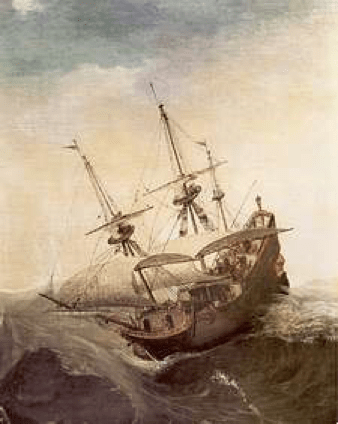
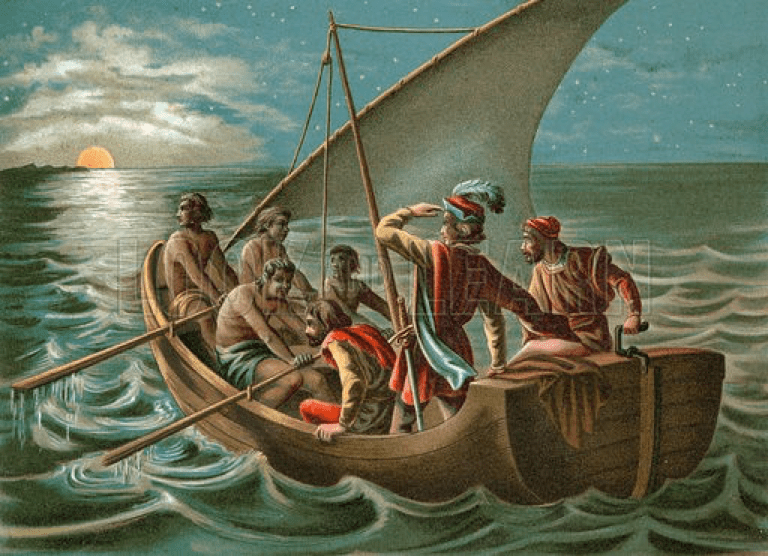
Once a storm was so violent that fishermen and sailors were unable to get back to shore, so the people begged Nicholas to help.

He went down to the docks and prayed, and the sea became calm so the fishermen and sailors could return safely to port, similar to the way Jesus calmed the sea as recorded in Matthew, chapter 8.

This led to Nicholas later being considered the “patron saint” of sailors.

When a famine spread across the land, Nicholas asked merchant ships carrying grain from North Africa to Rome, to unload some grain for his people, promising that God would bless them.

On their return trip, they reported that the grain that was left in their ship had multiplied, like the little widow’s meal barrel as promised by Elijah in the First Book of Kings 17:16.

St. Nicholas died DECEMBER 6, 343 A.D.

  •  In the 5th century a church was named in his memory in the city of Myra, modern-day Demre, Turkey. When it was damaged in an earthquake in 529 A.D., Emperor Justinian rebuilt it.

In 988 A.D., Vladimir the Great of Russia converted to Eastern Orthodox Christianity and adopted Nicholas as the “patron saint” of Russia.

In the 11th century, Islamist jihad terrorists, the Seljuks Turks, invaded Asia Minor, killing Christians and destroying churches.

They also demolished and desecrated the graves of Christian saints.

Islamic Hadith Sahih Muslim, Book 4, Number 2115, stated: “Do not leave an image without obliterating it, or a high grave without leveling it.”

In a panic, Christians shipped the remains of St. Nicholas to the town of Bari on the southern coast of Italy in the year 1087.

Pope Urban the Second dedicated the church, naming it after St. Nicholas — Basilica di San Nicola de Bari. This officially introduced the Greek St. Nicholas to Western Europe.

In the 11th century, Turks intensified their invasion. So many Greek Christians fled that Pope Urban the Second went to the Council of Claremont in 1095 and called upon European monarchs to send help.

Europe sent help — it was called the First Crusade.

In a backwards sense, Western Europe might not have had St. Nicholas traditions if it had not been for Islamists invading Eastern Europe.

With St. Nicholas’ remains now in Italy, western Europeans quickly embraced the gift-giving traditions associated with him.

By 1223, so much attention was being given to gift-giving during the Christmas season that Saint Francis of Assisi wanted to refocus the attention back to the humble birth of Christ.

Francis created the first “creche” or nativity scene — a humble manger of farm animals with the attention being on Joseph, Mary and baby Jesus — the Son of God come to dwell among men: “And the Word became flesh and dwelt among us,” John 1:14.

In 1517, Martin Luther began the Reformation.

He considered “saints days” as a distraction from Christ, so he effectively ended saints’ days in Protestant countries, including the popular “St. Nicholas Day.”

Since Germans like the gift-giving, Martin Luther moved the giving to December 25th to emphasize that all gifts come from the Christ Child.

The German pronunciation of Christ Child was “Christkindl,” which over the centuries became pronounced “Kris Kringle.”

There is a Catholic saying that St. Peter is at the Gates of Heaven. Similarly, a Greek Orthodox tradition developed from the prophecy that Jesus will return at the end of the world to judge the living and the dead, riding a white horse, and that the saints will return with him, riding white horses.

Revelation 19:11-16:

“And I saw heaven opened, and behold a white horse; and he that sat upon him was called Faithful and True, and in righteousness he doth judge and make war. His eyes were as a flame of fire, and on his head were many crowns; and he had a name written, that no man knew, but he himself. And he was clothed with a vesture dipped in blood: and his name is called The Word of God …

… And out of his mouth goeth a sharp sword, that with it he should smite the nations: and he shall rule them with a rod of iron: and he treadeth the winepress of the fierceness and wrath of Almighty God. And he hath on his vesture and on his thigh a name written, King of Kings, and Lord of Lords.”

Revelation 19:14 added:

“… fine linen, clean and white … is the righteousness of the saints … And the armies which were in heaven followed him upon white horses, clothed in fine linen, white and clean.”

As Nicholas was a saint, the reasoning went, he would certainly be one of the multitude returning with Jesus, riding a white horse.

But since St. Nicholas was such a special saint, the story became embellished by the Dutch to have him coming back once a year for a mini-judgement day, to check up on the children to see if they are on the right track.

Over the centuries, the story evolved.
The Lamb’s Book of Life and the Books of Works were turned into the Book of the “Naughty and Nice.”

The angels turned into elves.
Saints came from heaven, the New Jerusalem, the Celestial City — which turned into the North Pole.

Near the North Pole and the Arctic Circle is Finnish Lapland, in the northern Scandinavian Peninsula. Since there were few horses there, St. Nicholas rode a reindeer.

The capital of Finland’s Lapland Province is Rovaniemi and the “official” Santa Claus Village. After Nazis destroyed Rovaniemi, Eleanor Roosevelt contributed to help rebuild it, visiting there in June of 1950.

Back in England, during Henry VIII’s reign, Christmas celebrations became sort of a Mardi Gras. People forget, Mardi Gras was originally a religious day at the beginning of Lent, followed by 40 days of fasting before Easter celebrating Christ’s resurrection, but now Mardi Gras is a lewd party in New Orleans.

In like manner, under Henry the Eighth, the Christmas holiday similarly became a time of partying, carousing, dancing, gaming, and wassailing — drinking spiced ale from house to house and throwing some on apple trees as good luck for next year’s harvest.

When Puritans took over England in 1642, they outlawed Christmas, viewing it as having become too worldly.

Puritan leader, Rev. Cotton Mather told his congregation, December 25, 1712:

“Can you in your conscience think, that our Holy Savior is honored, by Mad Mirth, by long Eating, by hard Drinking, by lewd Gaming, by rude Reveling; by a Mass fit for none but a Saturn or a Bacchus, or the Night of a Mahometan Ramadan? You cannot possibly think so!

A Multitude of the Heavenly Host was heard Praising of God. But shall it be said, that at the Birth of our Savior for which we owe as high Praises to God as they can do, we take the Time to Please the Hellish Legions, and to do Actions that have much more of Hell than of Heaven in them?”

Puritans were so strict that they forbade Shakespeare from mentioning God in his plays, considering it taking God’s name in vain or casting pearls before swine.

This led to a period when Shakespeare referred to mythological Greek gods and fates, such as in A Midsummer Night’s Dream, 1595-1596, and Twelfth Night, 1601-1602, which featured a carnivalesque drunken revelry based on the ancient Roman festival of Saturnalia.

Puritans considered theaters dens of iniquity. They forced the Globe Theater to close in 1642, and pulled it down in 1644.

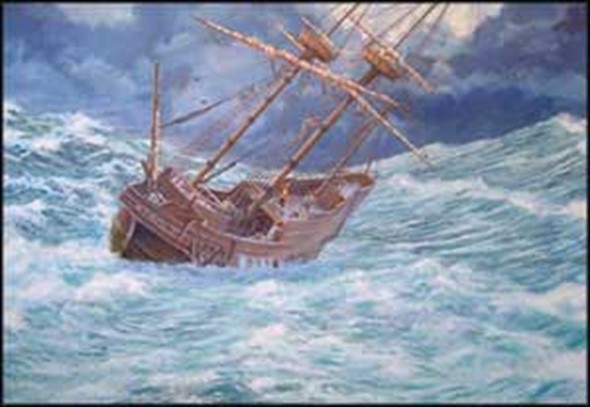
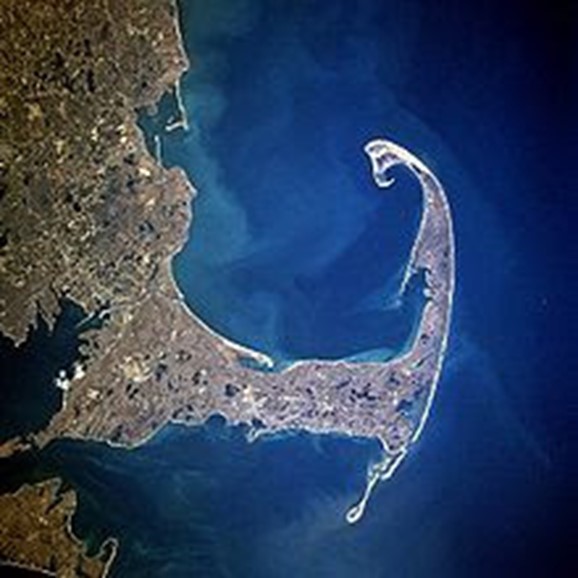
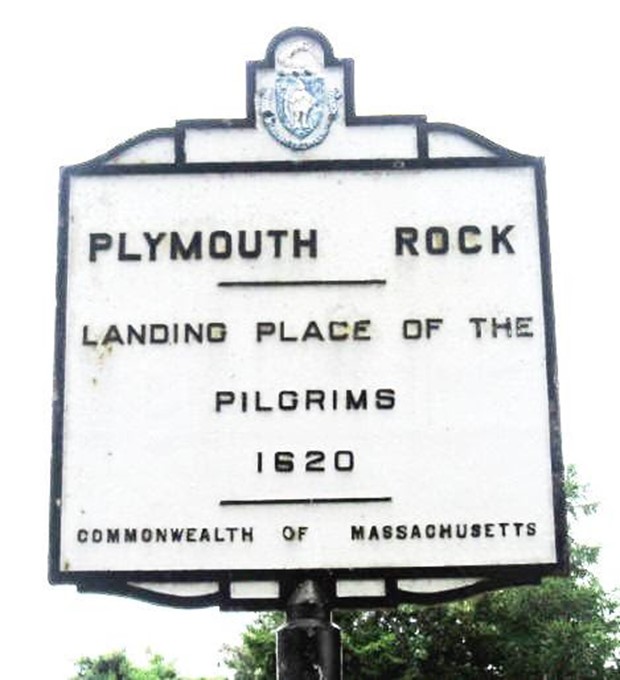
When Pilgrims first disembarked the Mayflower,

the ship master, Christopher Jones, wrote in his log, December 25, 1620:

“At anchor in Plymouth harbor, Christmas Day, but not observed by these colonists, they being opposed to all saints’ days, etc …

A large party went ashore this morning to fell timber and begin building. They began to erect the first house about twenty feet square for their common use, to receive them and their goods.”

A year later, at the end of 1621, Pilgrim Governor William Bradford recorded in Of Plymouth Plantation:

“Herewith I shall end this year – except to recall one more incident, rather amusing than serious.

On Christmas Day the Governor called the people out to work as usual; but most of the new company excused themselves, and said it went against their consciences to work on that day.

So the Governor told them, if they made it a matter of conscience, he would spare them till they were better informed.

… So he went with the rest, and left them; but on returning from work at noon he found them at play in the street, some pitching the bar, some at stool-ball, and such like sports.

So he went to them and took away their games, and told them that it was against his conscience that they should play and others work.

If they made the keeping of the day a matter of devotion, let them remain in their houses; but there should be no gaming and reveling in the streets.”

In 1659, when the Puritans were settling Massachusetts, they instituted a five shilling fine for anyone caught celebrating Christmas:

“Whosoever shall be found observing any such day as Christmas and the like, either by forbearing labor, feasting … every such person so shall pay for each offense five shillings as a fine to the country.”

Where Pilgrims, Puritans and Presbyterians did not celebrate Christmas, other immigrants did, most notably the French, Germans, but especially the Dutch.

The Dutch holiday tradition is that St. Nicholas comes once a year to give presents to good children.

But the naughty children had something else to look forward to.

St. Nicholas was accompanied by a Moorish costumed helper, Zwarte Piet, who would put naughty children into gunny sacks and take back to Spain where they would be sold into Muslim slavery.

So dreadful was the anticipation of St. Nicholas’ visit, that, according to anecdotal accounts, the night before, Dutch boys would go to sleep with pocket knives in their pockets in case they awoke and had to cut themselves out of Zwarte Piet’s gunny sack.

Beginning in 1624, Dutch immigrants brought St. Nicholas traditions to New Amsterdam, which became New York in 1664.

Dutch called Saint Nicholas – “Sant Nikolaus” or “Sinter Klass,” which became pronounced “Santa Claus.”

Living in New York was Washington Irving, the author of Legend of Sleepy Hallow and Rip Van Winkle.

He coined the name for New York as “Gotham City.”

Irving also wrote Diedrich Knickerbocker’s A History of New York, 1809.

In it, he described St. Nicholas visiting once a year, but no longer wearing a bishop’s outfit, but a typical Dutch outfit of long-trunk hose, leather belt, boots, a hat, and a pipe.

Irving described:

“A goodly image of St. Nicholas, equipped with a low, broad-brimmed hat, a huge pair of Flemish trunk hose, and a pipe …

The good St. Nicholas, who had appeared to him in a dream the night before, and whom he had known by his broad hat, his long pipe.”

Washington Irving wrote further:

“So we are told, in the sylvan days of New Amsterdam, the good St. Nicholas would often make his appearance in his beloved city, of a holiday afternoon, riding jollily among the treetops, or over the roofs of houses, now and then drawing forth magnificent presents from his breeches pockets, and dropping them down the chimneys of his favorites …

… He never shows us the light of his countenance, nor ever visits us, save one night in the year; when he rattles down the chimneys of the descendants of the patriarchs, confining his presents merely to the children …

The good St. Nicholas came riding over the tops of the trees, in that self-same wagon wherein he brings his yearly presents to children. And he descended hard … And he lit his pipe by the fire …

… And when St. Nicholas had smoked his pipe he twisted it in his hatband, and laying his finger beside his nose, gave … a very significant look, then mounting his wagon, he returned over the treetops and disappeared …

… The significant sign of St. Nicholas, laying his finger beside his nose and winking hard with one eye …”

Irving wrote how Dutch settlers continued the tradition of hanging stockings by the fireplace:

“At this early period was instituted that pious ceremony, still religiously observed in all our ancient families of the right breed, of hanging up a stocking in the chimney on St. Nicholas Eve;

… which stocking is always found in the morning miraculously filled; for the good St. Nicholas has ever been a great giver of gifts, particularly to children …

Nor was the day of St. Nicholas suffered to pass by without making presents, hanging the stocking in the chimney, and complying with all its other ceremonies.”

Washington Irving explained that St. Nicholas was not only the patron saint of the Manhattan colony, but the namesake of their first church, begun in 1628, being the oldest corporate body in what is now the United States:

“Finally, that they … should not be required to acknowledge any other saint in the calendar than St. Nicholas, who should thenceforward, as before, be considered the tutelar (patron) saint of the city …

They built a fair and goodly chapel within the fort, which they consecrated to his name …

… I am moreover told that there is a little legendary book somewhere extant, written in Low Dutch, which says that the image of this renowned saint, which graced the bow-sprit of the – ship – Goede Vrouw – Good Wife – was elevated in front of this chapel … the great church of St. Nicholas.”

For over three centuries, St. Nicholas Collegiate Reformed Protestant Dutch Church was the oldest congregation in Manhattan and the most eminent Protestant church in the city, often referred to as “the Protestant Cathedral of New York.”

President Theodore Roosevelt attended there.

Financial mismanagement resulted in church elders selling it to the Sinclair Oil Company, which demolished it in 1949 to build an office building.

Remaining church members merged with New York’s Marble Collegiate Dutch Reformed Church.

Clement Moore was a Hebrew professor in New York at the General Theological Seminary of the Protestant Episcopal Church, which was built on land donated by his family in the neighborhood of Chelsea.

Clement Clarke Moore Park is located in New York City at the corner of 10th Avenue and 22nd Street.

He helped Trinity Church establish a new church on Hudson Street – St. Luke in the Fields.

In 1823, Clement Moore wrote a poem for his six children titled “A Visit From St. Nicholas”:

‘TWAS the night before Christmas, when all through the house

Not a creature was stirring, not even a mouse;

The stockings were hung by the chimney with care,

In hopes that  St. Nicholas soon would be there.       

“When, what to my wondering eyes should appear,

But a miniature sleigh, and eight tiny reindeer,

With a little old driver, so lively and quick,

I knew in a moment it must be ST. NICK …”

“So up to the house-top the coursers they flew,

With the sleigh full of Toys, and ST. NICHOLAS too …”

“As I drew in my head, and was turning around,

Down the chimney ST. NICHOLAS came with a bound …”

Clement Moore described St. Nicholas as smaller:

“He was chubby and plump, a right jolly old elf,

And I laughed when I saw him, in spite of myself.”

In 1843, the first lithographic Christmas cards were printed, and Charles Dickens published “A Christmas Carol,” with the characters of Scrooge and Tiny Tim.

During the Civil War, Harper’s Weekly Magazine had an illustrator named Thomas Nast, famous for creating the Republican elephant and Democrat mule in his political cartoons.

Nast drew St. Nicholas visiting Union troops with a “North Pole” sign behind St. Nick as a political jab at the Confederate South.

In the early 1900s, Haddon Sundblom was a artist famous for his creation of the Quaker Oats man and Aunt Jemima Syrup.

In 1930, Coca Cola hired Sundblom to create a painting of Santa Claus drinking Coke, which he did annually for the next 33 years.

With Coca Cola pioneering mass-marketing to become the most well-known trademark name in the world, Sundblom’s version of Santa Claus became the most recognizable.

Though much has been added on to the story throughout the centuries, underneath it all, there really was a godly, courageous Christian Bishop who lived in 4th century Asia Minor, named Nicholas.

  • Nicholas loved Jesus enough go into the ministry;
  • he chose being imprisoned by the Romans rather than deny his Christian faith;
  • he stood for the doctrine of the Trinity;
  • he preached against sexually immoral pagan temples and the killing of innocent babies;
  • he confronted corrupt politicians; and
  • most notably of all, St. Nicholas was very generous, giving away all his money to help the poor in their time of need, and doing it anonymously, as he wanted the credit to go, not to himself, but to God alone!

Captain John Smith – A Founder of America

It does say in the Bible that God is involved in the affairs of nations.  In that context He used some incredible people in the founding of America.  One of the most important was Captain John Smith.  Following is some of what I consider his God directed story and life:

Captain John Smith

 Americans are aware of the story of the founding of Jamestown, Virginia, in 1607, where Captain John Smith was about to be killed by Chief Powhatan but was saved by the pleadings of 11–year–old Pocahontas. Smith wrote in his New England’s Trials, 1622: “God made Pocahontas, the King’s daughter the means to deliver me.”

What many may not be aware of is that prior to founding Virginia, John Smith fought the Turks who were invading Hungary and what appears to be by God, to be directed into many other adventures.

 John Smith joined the Austrian forces and fought in the “Long War” against the Muslim Ottoman Turks in Eastern Europe.

Mehmed the Third, 1566–1603, became Ottoman Sultan in 1595. He had his 16 brothers strangled to death to eliminate rivalry to his throne. Bertrand Russell, who received the Nobel Prize for Literature, stated in his Nobel Lecture, 1950:

“Over and over again in Mohammedan history, dynasties have come to grief because the sons of a sultan by different mothers could not agree, and in the resulting civil war universal ruin resulted.”

Sultan Mehmed the Third raised an army of 60,000 and in 1596 conquered the Hungarian city of Erlau. He defeated the Austrian Habsburg and Transylvanian forces at the Battle of Mezõkeresztes.

John Smith joined the ranks of Austrian Hapsburg Earl of Meldritch, and was assigned to the General of Artillery, Baron Kisell.  Smith marched with German, French, Austrian and Hungarian troops to fight Muslims who had captured Budapest and were invading Lower Hungary, Wallachia, Moldovia, Romania and Transylvania near the Black Sea.

In 1600–1601, during the campaign of Romanian Prince Michael the Brave, John Smith introduced ingenious battle tactics. When Muslims were besieging the garrison at Oberlymback, Smith devised a method of signaling messages with torches and using gunpowder to create diversions. The resulting victory earned him the rank of captain with a command of 250 horsemen.

At the siege of Alba Regalis, Smith assisted Duc de Mercoeur by devising makeshift bombs of earthen pots filled with gunpowder, musket shot and covered with pitch, and catapulted them into the city, leading to an evacuation.

Muslims had captured the city of Regall, located in a pass between Hungary and Transylvania, “the Turks having ornamented the walls with Christian heads when they captured the fortress.”

Smith fought under General Moyses, serving the Prince of Transylvania, Sigismund Bathory, to lead a campaign to regain the city. During a lull in the fighting, the bashaw – officer of the Turks put out a challenge.  In a “David and Goliath” style contest, the 23–year–old John Smith was chosen to fight. He defeated the bashaw, cutting off his head. To avenge the bashaw’s death, another Muslim challenged Smith and lost his head. This happened a third time, resulting in Smith being awarded a “coat-of- arms” depicting three severed turbaned heads.

General Moyses, with Captain John Smith, soon recaptured Regall, then Veratis, Solmos and Kapronka. At Weisenberg, Prince Sigismund Bathory conferred on John Smith a shield-of-arms with “three Turks’ heads.”

John Smith continued in the regiment of Earl Meldritch, fighting in 1602 for Radu Serban to defend Wallachia against invading Turkish Muslims. In the battle, the Earl of Meldritch was killed along with 30,000 soldiers. John Smith was wounded and left for dead: Smith among the slaughtered dead bodies, and many a gasping soul with toils and wounds lay groaning among the rest. However, found by the pillagers he was able to live, and perceiving by his armor and habit, his ransom might be better than his death, they led him prisoner with many others.

At Axopolis, Smith was sold with other prisoners at the slave market to Bashaw Bogall, “so chained by the necks in gangs of twenty they marched to Constantinople.” There, Smith was pitied by Bashaw Bogall’s mistress, who sent him to her brother, Tymor Bashaw.

Unfortunately, Tymor “diverted all this to the worst cruelty,” stripped Smith naked, shaved him bald, riveted an iron ring around his neck, clothed him in goat skins and, as slave of slaves, was given only goat entrails to eat.

Following a beating received while thrashing in a field, Smith seized the opportunity and killed his master. He hid the body in the straw, put on his master’s clothes, took a bag of grain and rode off toward Russia. After 16 days he reached a Muscovite garrison on the River Don, where the iron ring was removed from his neck.

With their help he found his way through Poland back to his troops in Transylvania. After being released from service with a large reward, John Smith traveled through Europe to Morocco in Northern Africa to fight Muslim Barbary pirates in the Mediterranean Sea. In 1605, at the age of 26, he returned to England.  It is amazing to me that now Captain John Smith survived these amazing exploits at such a young age.  However, he was not nearly finished with adventures that seemed to be God directed.

In 1606, Captain John Smith set sail to help found Jamestown, Virginia, the first permanent English colony in North America. In 1614, six years before the Pilgrims arrived, Smith explored Maine and Massachusetts Bay.

In his Advertisements for Unexperienced Planters, published in London, 1631, John Smith wrote about what he considered the necessity to worship God:

“When I first went to Virginia, I well remember, we did hang an awning — which is an old sail — to three or four trees to shadow us from the sun, our walls were rails of wood, our seats unhewed trees, till we cut planks, our pulpit a bar of wood nailed to two neighboring trees, in foul weather we shifted into an old rotten tent, for we had few better … this was our church, till we built a homely thing like a barn ….. We had daily Common Prayer morning and evening, every day two Sermons, and every three months the holy Communion, till our Minister died — Robert Hunt — but held our Prayers daily, with an Homily on Sundays.”

So, the Bible says that “God is involved in the affairs and founding if nations”.  And he certainly used Captain John Smith in this first real settlement in the founding of America.  And as I mentioned at the beginning of this story:  At the founding of Jamestown, Virginia, in 1607, where Captain John Smith was about to be killed by Chief Powhatan but was saved by the pleadings of 11–year–old Pocahontas. Smith wrote in his New England’s Trials, 1622: “God made Pocahontas, the King’s daughter the means to deliver me.”

Sketch of Powhatan

Sketch of Pocahontas

Charles Goodnight – 5th and Final Installment

In my book that is now in the process of being published, I tell the complete story of the incredible life of Charlie Goodnight.  The main theme of the book is about amazing miracles that I know God performed.  The whole life of Charlie Goodnight is a miracle to me.  Here is the 5th and final of several continuing posts relating that life… …. Ron  

As stated in the 1st Instalment, you don’t hear much about him in the history books, but Charlie Goodnight was one of the most influential men in developing early Texas and the Western US.  The Bible says that God is interested and involved in the founding and development of nations.  It is my opinion that He used Charlie Goodnight over and over again in the development of the Western US and particularly the Southwestern part.   He was one of the original men that protected the settlements along the frontier from the Indians.  These men were called “Rangers” and they predated what were later officially established as the “Texas Rangers”.

Continuing from 4th Installment:

So now let me get back to the story of the famous Charles Goodnight.

He continued with his lucrative cattle drives but tended to purchase herds coming up from Texas when they got up to his camp at Bosque Grande.  He would then trail them up through the Capulin Vega, over Raton Pass and into Colorado and even up to Wyoming . 

An old fellow named “Uncle Dick” Wootton had built a trail over Raton Pass and down into Colorado .  He had put up a toll station at the top and was charging ten cents a head for any stock going over the pass, whether it was one milk cow or three thousand Texas steers. 

Goodnight thought that was way too high and though he paid it the first time, swore that if the toll was not reduced, he would find another way into Colorado .  But old Wootton just laughed in his face, since that was the only trail over the pass and through. 

However, sure enough, on his next drive north, Goodnight blazed a trail off to the east of the pass which others took and pretty much put old Wootton out of business.

On the way to Raton Pass and a little off to the north at the entrance of the Cimarron Canyon a fellow named Lucien Maxwell had a great hacienda.  He also owed a massive Spanish land grant that covered over a million acres.  It was nearly a hundred miles across and spanned the whole northeastern corner of New Mexico and part of southern Colorado . 

Maxwell set a magnificent table of food most every night, served complete with grand silver service.  Goodnight related how fantastic the food was at this formal feast.  Any travelers coming east to Raton Pass or west up the Cimarron Canyon to Eagle’s Nest and the gold fields that had been discovered on the other side of Mt. Baldy were welcome.

Later in modern times this enormous land grant was named Vermejo Park .  I have spent some of the most enjoyable weeks of my life hunting and fishing on its streams and in its multitude of beautiful lakes.  It is 35 miles from the gate west of the town of Raton to its headquarters.  It is 70 miles on west of there through wild county on ranch roads to its western boundary, the crest of the Sangre de Cristo mountains .  Only a few people ever go there.

I discovered that in late October, between the time the few summer fishermen are gone and before elk season starts was the very best time to catch the giant trout at Vermajo Park .  I would wait until a sleet storm was passing over and pelting the water with sleet.  There are a few little aluminum boats available on the larger lakes.  I found that if I tied on a huge hellgrammite fly and cast it to drop straight down through one of the holes in the floating weeds around the edge of the lake, one of those huge trout would grab it. 

If it were a bass, he would bury up in the weeds, but those trout would bolt to the surface, and skip across the weeds to get out to the deep water.  An eight-pound trout on a light fly rod is a real experience.  I had to use a strong leader because they would lead the boat around over the lake until they finally wore down.

On those occasions, my wife and I would be the only guests on that whole immense place.  You felt almost guilty when you realized that there were all those people camped side by side in the Cimarron Canyon and along the Red River , and here you were, the only ones in that immense wilderness, going 60 miles and more without seeing another soul.  Those giant bull elk would whistle and challenge each other and then put up a big fight right there beside the lakes.

Anyway, back when Maxwell owned that place, there was a tribe of Ute Indians who lived on it and considered it their home.  They continually told Maxwell that if he ever sold it, they would for sure kill him.

On one occasion when Goodnight sold a large herd, he took back a note that Maxwell had given out as payment on some other transaction.  Charlie considered Maxwell’s note to be almost as good as gold and probably better than paper money.

So, as he was passing through on one of his drives, he visited Maxwell’s place and asked for payment.  Maxwell’s son had gone up by Mt. Baldy and had purchased a gold mine that was paying off very handsomely.  Maxwell took Goodnight up to the mine where they were smelting the gold.  Goodnight said that he was paid off in gold that was smelted into objects that looked like goose eggs. 

He told Maxwell that he was worried about traveling in that outlaw infested country with all that gold.  Maxwell solved the problem.  He had that band of Ute Indians escort Goodnight all the way back down the Cimarron Canyon , across his land grant, and beyond.  Charlie said the Indians kept to their trails on the high ground so as not to encounter any other people.  He said that it was the strangest feeling to be guarded and escorted and protected by a bunch of wild Indians for a change as opposed to being shot at by them.

He didn’t have much experience with the gold trade, but when he got back to Texas and cashed it in, he found that he had way more value than the face of Maxwell’s note.

Goodnight eventually needed a fairly permanent place in Colorado for stationing herds for sale and keeping horses and men for his drives.   He chose a place with good grass on the Apishapa river east and about midway of the trail from Raton Pass to Denver.  Here he wintered herds and engaged in cattle trade.  However, he really needed a more permanent spot that was better protected from the weather.

He chose a beautiful valley close to where the Charles River intersected the Arkansas River just northwest of Pueblo .  It had very nutritious grass and steep canyon walls in both sides to protect from the north winds and also to hold cattle in, since they were not even close to the time when barbed wire fences were used.  He would keep good bands of horses here, purchase cattle as needed, and hold over his best men for future drives.

After building a nice home there, Charlie, though still very active in buying and trailing and selling cattle herds, decided that it was time to get married.  Way earlier a very prominent lawyer from Tennessee had moved to the Cross Timbers area of Texas .  He had several sons who all fought for the Confederacy in the Civil War, and one beautiful daughter named Mary Ann “Molly” Dyer.  She was born in Madison County Tennessee September 12, 1839, but later became known as the “Darling of the open plains and Mother of the panhandle country”.

She learned the tough ways of the west, and Charlie dated and courted her off an on, even during the Civil War.

She had now moved back east to Kentucky , but Charlie went there, found her and married her in Hickman , Kentucky on July 26, 1870. 

They promptly headed west, first by boat to St. Louis , and then by rail to Abilene , Kansas , one of the toughest towns in the country.  After a night in the Drover’s Hotel they went by stage all the way to Pueblo , Colorado .  Charlie made sure that she was introduced to the more civilized ladies of Pueblo while they stayed at the Drover’s Hotel there.  That seemed to help that she found that she was not being taken to a totally uncivilized country.

She moved in with Charlie into the nice home he had built in the beautiful canyon enclosed valley where he had located his cattle and horses and his best, most trusted men.

He continued to prosper there in Colorado .  He helped start a bank in Pueblo , mostly to give better credit to the cattlemen.  He also was part owner of the slaughter company that he started there too.  As he prospered he bought several valuable properties in Pueblo , also.

As he would bring herds north from purchases of cattle from Texas, all those herds had to still go hundreds of miles out of their way to skirt the vast Llano Escatado that the Comanches controlled. 

Out of nostalgia you can take the side of the Indians today as is so popular with the Hollywood Crowd.  You can sympathize with the Indians, that the “white eyes” were encroaching on their vast hunting grounds.  However, in those days if you had friends or relatives or even family who were killed and butchered and cut into pieces while still alive and raped before being butchered you had little sympathy.  Sure, the Comanches and Kiowa’s and Apaches had their own culture and Hollywood and certain authors have glamorized it.  However, on the whole they were a vicious, brutal, savage bunch.

It is part of history that those settlers, particularly those in Texas spent uncounted hours in prayer in their churches and on their knees for God to protect them and their children and their women particularly from the Comanches.  And it is my opinion that, still in the theme of this book, God answered those prayers.

Large numbers of federal troops were now stationed across this frontier.  General Ranald S. MacKenzie, Commander of the 4th U.S. Cavalry, was in charge of those troops.  In the late summer of 1874 he made the statement that:  “It looks like I can fight the Comanche until the end of time and never win.”   They were located in the center of that vast almost completely flat Llano Estacado that was bigger than the State of Indiana .

 General Ranald S. MacKenzie

Mackenzie knew that they were ensconced in the Palo Duro Canyon that gashed across it.   If he could ever get his troops to it, and then down into it, they might fire on the Comanche’s if they were lucky,  but those hundreds of Comanches had myriad ways of escape in that rugged canyon with its plethora of intersecting side canyons and secret trails.

Just before Fall of 1874 here is what I think God finally actually showed General MacKenzie.  If he could surprise them down in that canyon and get their supplies and strike them in their home territory and above all else……kill their horses, he might stand some chance of prevailing.  They were considered the greatest light cavalry in the world, but without their houses, they would be helpless.  Apparently, no one had ever thought of that before.

So, in the late Fall of 1874 General MacKenzie enlisted the aid of some friendly Indian scouts to show him one of the secret trails down into the Palo Duro.  After extensive scouting, those Indian scouts finally located where the main body of Comanches were camped.  MacKenzie massed his troops, and under cover of night slipped down into that canyon.  Just at daylight, they attacked.  The Comanche’s fired back at them, but quickly escaped as was expected.  However, they had to leave all their camp supplies and most significantly, their vast heard of horses.  Mackenzie did burn their camp and supplies, but his primary orders to his troops were to surround and trap those horses.

The troops were ordered to kill most all of those horses.  Being cavalry men, most of them strenuously objected, but they followed orders.  There is no record of just how many, but it is estimated that they killed several thousand horses.  One report was that it took three days, and that the smell became so bad that they had to move their camp father away.

But that did it.  The Comanches and their great War Chief, Quanah Parker, the son of Cynthia Anne Parker and a Comanche brave, all finally agreed to leave their killing and raiding and move to a reservation in Oklahoma .  Some of them still went back to the plains to kill buffalo, but they stopped killing the “white eyes” at long last.

Some “uninformed” historians claim that the killing of the buffalo was what got the Comanche’s to Oklahoma , but in 1874 there were still thousands and thousands of buffalo.  It was General MacKenzie’s killing the Comanches’ great horse heard that did it. 

Goodnight, as was his custom continued to expand, not retreat.  He was greatly prospering by buying herds on credit and selling them up north for a quick profit.  He was also doing the same thing with real estate, mostly in the Pueblo area.  Then something happened that he was absolutely not prepared for and never expecting………..The Great Panic late in the year of 1873 hit.  It started in Europe, spread across the Atlantic to New York and New England , then across the whole US.

The Panics in those days were different from what we may call a depression.  They hit fast, did not last all that long, but were very deep and severe.  Banks failed; the entire economy came to a halt.  Commerce of all kinds just ceased.  The stock market crash that hit on October 24, 1929 may be an analogy…….when guys were jumping out of the windows of tall buildings in Lower Manhattan .

In Pueblo , the new bank failed like so many others.  Charles Goodnight was almost wiped out.  There were no buyers for cattle that he had purchased on credit.  He had just bought a valuable half block in downtown Pueblo for $8,000.  He sold it for $2,000 which he happy to get, even thought a new company come to town a short time later and paid $25,000 for it.

With no where to dispose of the cattle, they were just being held.  Charlie could see that eventually the grass was going to be made scarce there.  He had heard the news that the Comanches had finally been moved up to Oklahoma .  Things were so depressing in southern Colorado that he just wanted to get out. 

That was when his mind wandered back to the Llano Estacado, that great expanse of flat country into which he had chased the Comanches.  It was hundreds of miles across and just unexplored.  A great plateau, it covered what is now called the panhandle of Texas and southern New Mexico .  At that time in history it was probably comparable to the Empty Quarter in north Africa, where people just did not go.  It was just a vast empty unknown and overlooked expanse.  In 1875 the Tesas Rural Register and Immigrant’s Handbook advised the world that “it was improbable that these Staked Plains could ever be adapted to the wants of man, adding that this was the only uninhabitable portion of Texas”.

But Goodnight had been out on it and he could remember its miles of unbroken buffalo turf, its rich grama grasses and its scattered watering places that he had discovered.  However, there was one small group who knew it well and how to navigate it:  the Comanchreos who had crossed it again and again to trade with the Comanches, but they were all gone now.

With the problems and result of the Panic, Goodnight had the urge to just “start over”.  He had a strong lust to once again find virgin range. 

So, in the spring of 1875 he gathered 1,600 head of his best cattle, took a good contingent of his best men and headed toward Texas .  They crossed the Cimarron and headed down along the fertile valley of the Canadian.  He did not hurry the herd. 

On the south bank of the Canadian, in a wild section of eastern New Mexico he set up winter camp.  When his cattle and men were well settled, he headed back to his wife in Colorado , but come Spring in 1876 he was back.  He headed his outfit out across that vast, almost unknown Llano Estacado .  He wanted a permanent ranch.  He remembered that Palo Duro of the Comanches that he had once looked down into, but now had no idea how to find it. 

As luck would have it, he stumbled onto the camp of old Nicolos Martinez one of the old Comanchero traders.  Goodnight paid him to guide him and try to find that big canyon.  Even though old Martinez knew that country intimately, he wandered around trying to find the Palo Duro canyon again.  Even though it was huge, it cut abruptly down into all that flat county, so one could not look off and just see it.  By now they had wandered over to the south side of it.  Then one day, they abruptly came up to the precipice of it, old Martinez clapped his hands over his head and said in Spanish: “at last, at last……..al fin! al fin!”

Martinez now knew where he was.  He and Goodnight went back and he guided the heard along an old Indian trail past the springs northwest of present Amarillo , over the divide, across the headwaters of the Red River and then headed east.  They didn’t see the canyon until they were right on the brink of it.  Martinez showed them the old Indian trail that went right down into it.  

The cattle had to go single file along that trail.  They took the chuck wagon apart and tied the pieces of it and its provisions on the backs of its mules to get it down.  They were amazed at the beautiful, virgin grass in the bottom of that canyon.  As they proceeded down it, it became wider and wider.  There were also many buffalo scattered along the sides of it.  Before long they had 10,000 big, shaggy buffalo running in front of them.  They said the noise of all those running buffalo echoing off the walls of that canyon was deafening.

When Goodnight came to just the perfect spot in the canyon where a lovely spring came down from the cap rock, he stopped and said:  “This is the place”.   He eventually built a lovely home there with all manner of corrals and outbuildings.  He later had other ranches over his long life, but always called this spot his Home Ranch.

When a Comanche brave was killed, it was the custom for his women to cut off their long braids.  Goodnight said that there were just piles of hair in that canyon.

So. in those days of open range and no fences, the walls of that canyon provided a perfect barrier to keep his cattle in.   And with its depth and steep walls, those cold Texas “northers” would just blow right over it.

He and his wife called that spot “home” for most all of the rest of their lives.Over the years he imported better and better breeds of cattle and crossed them and became one of the best cattle breeders in all of west Texas .  Years later with the introduction of barbed wire he built many, many miles of fence, but this “home ranch” was always his favorite spot.  And one cannot escape the irony of how this ranger, plainsman, trail driving pioneer, after all those years of fighting Comanches, should wind-up with this great ranch as his home, deep in their Palo Duro Canyon. 

End of the Story of the Incredible Charlie Goodnight

Charles Goodnight – 4th Installment

In my book that is now in the process of being published, I tell the complete story of the incredible life of Charlie Goodnight.  The main theme of the book is about amazing miracles that I know God performed.  The whole life of Charlie Goodnight is a miracle to me.  Here is the fourth of several continuing posts relating that life… …. Ron  

Charles Goodnight – 4th Installment

As stated in the 1st Instalment, you don’t hear much about him in the history books, but Charlie Goodnight was one of the most influential men in developing early Texas and the Western US.  The Bible says that God is interested and involved in the founding and development of nations.  It is my opinion that He used Charlie Goodnight over and over again in the development of the Western US and particularly the Southwestern part.   He was one of the original men that protected the settlements along the frontier from the Indians.  These men were called “Rangers” and they predated what were later officially established as the “Texas Rangers”.

Continuing from 3rd Installment:

By Goodnight and Loving’s third drive the Indians had figured out what was happening and that those cattle could be traded profitably.  On this drive they had all manner of trouble with the Indians.  On one of their first skirmishes one of the drovers got an arrow in his neck just below his ear.   If it had been a flint arrowhead they may have left it in, but it was one of those made from hoop iron that would for sure have caused infection.

The Comanche’s had learned to take as many hoops from the settler’s barrels as possible in their raids.  They had started making their arrowheads out of that hoop iron.  It was not only easier to fabricate but would cause death if not extricated in time.

They had to get the iron arrowhead out of the cowboy’s neck.  All they had were a set of pinchers for pulling off horse’s shoes.  Charlie got three cowboys to hold the guy down while he pulled on the arrowhead with the pinchers.  He almost lifted all of them off the ground, but finally got it out.  The fellow miraculously survived by them applying poultices of cold mud.

They got past Horse Head Crossing and then Pope’s crossing by fighting off more Indians.   Loving wanted to go on ahead and get to Santa Fe where contracts for the sale of cattle were to be let in early August and it was already July.  Goodnight was very much against it.   There were too many Indians; but finally, he agreed if Loving would promise to hide out during the daytime and travel only at night.  He sent One-armed Bill Wilson, by far their toughest and most experienced cowboy with him.

The two of them traveled by night for two days, but both being very daring decided to travel on

starting at noon the next day.  They were crossing an open area with the Guadalupe mountains off to their left and the river about a mile to their right.  They were almost across the open area when they saw a big band of Comanche’s bearing down in them from the Guadalupe’s.  They raced for the river, went over the bank and took refuge in a ditch where the water had cut through a sand dune making a hiding place.   Wilson had Goodnight’s six-shot revolving rifle as well as his own six-shooter pistols.  Loving had his two six-shooter pistols as well as his repeating Henry Cartridge Rifle, the first one in that territory.  The only way to see into their little ditch was from across the river. 

There were several hundred Indians and when one tried to shoot them from across the river, Loving killed him, and no others threatened them from that spot.  The Indians kept shooting arrows up at a high angle to come straight down to try to hit the two.

Finally, one of the Indians started trying to parlay with them in Spanish.   They considered it a ruse, but Wilson stood up to speak with him anyway.  Immediately bullets rained down and Loving was shot through the arm with a bullet that went on into his side.  He was sure his wounds were mortal, but he survived, though with great pain.

Wilson noticed that the tall grass just above them was moving.  He knew that one of the Indians was sneaking up on them and parting the grass with his lance.  Just as Wilson was about to rise up and shoot him, there was the loud whirring of a rattle snake that the Indian had disturbed.  He backed out faster than he had sneaked in.

The two of them suffered terribly from the heat, but finally night came.  Wilson slipped down and got a boot full of water for Loving.  Wilson then proposed that he slip down the river and try to make an escape and get back to the heard.   Loving said he thought he could hold the Indians off and that if he couldn’t, he would shoot himself in preference to being captured and tortured to death.  Wilson spread out all their six-shooters in front of Loving’s good hand as well as Charlie’s revolver rifle.  He took the Henry because the water would not destroy its metallic cartridges. 

He slipped down to the river and took off his boots and all his clothes except his hat and his underpants and undershirt.  He hid them under the water and pushed off into the river.  He first had to go over a gravel shoal that was only three feet deep.  But the Indians had stationed a man on his horse right there in the middle of the river.  Fortunately, at just that moment a cloud came up over the moon.  This allowed him to slip by into the deep water. 

Wilson tried to swim with the rifle three times, but almost drowned.  He finally eased over to the bank and stuck the rifle barrel deep into the side of the bank under the water and went on down the river.  He eventually eased out of the river through a little cane break and started south for the heard.

Unfortunately for Wilson , Charlie had stopped the heard to rest it, and allow the men to wash their clothes and saddle blankets.  The heard was not thirty miles away as Wilson had calculated but was eighty-five miles away down the Pecos .

He traveled only at night the first night, but come daylight, he just kept going….through the blistering sun, the rocks and cactus and the thorns growing there.

Finally, Wilson took shelter in a cave under a bluff close to the river. 

At that exact time, Charlie was approaching that spot and knew about that bluff and cave.  He was sure the Indians were waiting for them there.  He thought he saw something red go into that cave in the far distance.  He had his men bunch-up the heard in preparation for an attack and spurred his house up there to check the spot out.  He intended to just look and then race back to the heard. 

When he got there, out of the cave came One-armed Bill Wilson.  His underclothes were red from the red silt in the river.  His eyes were blood-shot from the sun and his feet were swollen beyond recognition and leaving blood behind with every step.  Charlie got him back to the wagon and tore-up a blanket and soaked it in water to wrap his feet to stop the fever in them.  Charlie fixed him a cornmeal gruel and finally got him back to where he could talk.

Wilson related everything in detail, and Charlie set out immediately with four cowboys.  When they finally got to the spot, everything was just as Wilson had described it, but Loving was not there.  Neither were the Indians which Charlie was sure would still be there.

They found the clothes and the gun just as Wilson had accurately described, but no Loving.  They could see where at least a hundred arrows had been shot up and then down.  When Charlie scouted around, he saw that the Indians had just left, since the water was still coming down the bank of the river where they had climbed out.  Goodnight calculated that Loving must have slipped into the river at night and shot himself to keep from being captured since the sign in the sand showed that they had not taken him.

Actually, Loving had stayed in that sand ditch for two more days but was suffering so much from the heat and lack of food that he decided to slip out at night like Wilson had into the river. 

Instead of going down stream, he went up stream, hoping to get to the next crossing where he may find someone using the crossing that would help him.

He did finally make it to the crossing and hid in some China berry bushes.  He lay there for two days, suffering terribly from hunger, though he could get water. 

Eventually a wagon came down from Ft. Sumner to that crossing with three Mexicans and a young German boy.  They decided to camp there and cross the river the next morning.   When the little boy went off to gather wood for their fire, he discovered Loving.

Loving told them that he would give them two hundred and fifty dollars in gold if they would take him up to the Fort.  They turned back north and carried him in the wagon.  When they got within about fifty miles of the fort, a man from there, coming down, discovered them.  He raced back to the fort and the soldiers there brought down the Fort’s ambulance to retrieve Loving and give him medical help.

So, he continued the journey in the ambulance and the Mexicans followed to be sure they got their money.

Meanwhile Charlie continued on up the Pecos with the heard.  Actually, by this time he had two herds.  A fellow named Patterson had bought a heard and was having it trailed north by a bunch of Mexicans while he stayed at the Fort to receive it. 

The Indians had attacked it, took all its provisions and burned its chuck wagon, but had not taken the cattle.  Charlie intercepted the heard and agreed to provide food for the group and have his cowboys make sure the Mexicans did their job of pushing Patterson’s heard behind his.

When they got within about 80 miles of the Fort, Charlie was scouting on up ahead as usual.

He saw one man on horseback and was sure it was an Indian scouting for one of their war parties.  He cut in front of the rider, intending to kill him, but found that it was a white man.

Actually, it was Patterson, coming down to see what had happened to his heard.  He told Charlie that Loving was at the fort, but Charlie corrected him:  “Loving was killed by Indians back down the Pecos .” 

“Man, I tell you Loving is alive at the Fort and wanting to see you”

“Impossible!!!:”

Finally, Charlie was convinced.  He got on his best saddle horse and made that eighty miles without stopping.

They had put Loving into the little hotel that was there.  The wound in his side was healing, but his arm looked bad.

Charlie conferred with the young Fort surgeon who was from Scotland and had only been in the US for 2 years.  Charlie told him that the arm needed amputating and the surgeon agreed.  However, he kept hesitating to do it, which Charlie could not understand.

Loving told Charlie that some of their stolen horses and mules had been found where they had been sold and located up toward Santa Fe .  He wanted Charlie to go retrieve them, but he did not want to leave Loving.

He finally consented and went up there and got the animals back, but the arm still had not been amputated.  After waiting and waiting, Charlie finally told the young surgeon that he was going to amputate it, or he was going to have to put wounds on Goodnight.

He did finally amputate it above the elbow, but the artery leading down looked really swollen and bad.   It finally ruptured and it was necessary to put Loving to sleep again and tie it off again. 

The drugs they used in those days for anesthesia were really hard on a person’s system.  Loving was greatly affected by this second operation and finally died, though he was quite rational the whole time until his death.  Before he died, he had one major request of Goodnight.  He made Charlie promise him that he would take his body back to Texas and bury him in the Cemetery at Weatherford , Texas .

Charlie had other business to finish, but he eventually did that.  His cowboys got all the empty oil cans and other tin that they could find at the Fort.  They soldered them together and covered a box that Charlie had made with wheels attached to it.  They packed the body in salt and carried it back to Texas .  The grave can be viewed to this day in Weatherford.

Thirty years later Goodnight met up with that surgeon.  He asked the surgeon why he had not amputated Loving’s arm promptly as he should have.  All those years later, the surgeon answered him honestly.  He said:  “I had heard all these tales about you.  I was afraid that Loving would die anyway and I was sure you would shoot me dead if he died.”

So, folks, as you read all this, I would be surprised if these tales do not sound familiar to you.  Surely you may have read the book that was so popular a few years back called, “Lonesome Dove”.  And even if you did not read the book, surely you saw the TV series by the same name.

The gay author Larry McMurtry wrote “Lonesome Dove” and was consultant for the TV series.  Most everything in that book was stolen and plagiarized from J. Evetts Haley’s book called just “Goodnight”.   It was pretty much Haley’s life’s work to document Goodnight’s whole biography.

As one example in “Lonesome Dove” the partner and the main drover go off ahead of the heard.  They are intercepted by a band of Indians.  They hide under a shelf in this sandy bank of a river. The partner gets shot in the leg, and at night the cowboy slips off to go back and find the heard.  The Indians keep shooting arrows up at an angle to get them to come straight down and try to kill the partner.

The heard is way farther off than he anticipates.  He walks barefoot in his underwear for many, many miles through cactus and thorns.  Finally, when he is near death he finds the heard and is saved.  When the main character goes to find the partner, he finds the sandy shelf where he had

been hiding, but he is not there.  He had slipped away and was found by a traveler and taken into Denver to a hospital.   However, the surgeon at the hospital keeps putting of amputating his leg until it is too late, and he dies.  But before he dies, his partner, who has now found him, promises to grant his wish and take his body back to Texas to be buried.

So, I was waiting in an office in Dallas to keep an appointment and visiting with the receptionist about the TV section of Lonesome Dove we had both seen the night before.  I was talking about all the plagiarism and said:  “Well, you know that Larry McMurtry treated the women in Lonesome Dove so harshly since he is a ‘flaming gay dude’”.

And the nice lady receptionist said:  “Yes, I know, he is my first cousin”.

And I thought:  “Wow, have I messed-up now!”

But she graciously said:  “Don’t worry.  We don’t even let him come to our family reunions.”

So, after watching two more episodes of Lonesome Dove on the TV, I thought:  “I wonder if Mr. Haley knows how they have stolen so much of his historical book?”  I thought that he may still be alive.

My secretary found his telephone number way out in west Texas .  I just dialed the number and this old gravely voice promptly answered the phone.  I said:  “Mr. Haley, do you realize that those folks stole most every story in your book and are making a fortune with them?”

There was this long pause and he said:  “Aaaahh damn……..I’m glad somebody recognized that!!!”

I was so glad that I had called.

So now let me get back to the story of the famous Charles Goodnight.

To Be Continued

Charles Goodnight – 3rd Installment

In my book that is now in the process of being published, I tell the complete story of the incredible life of Charlie Goodnight.  The main theme of the book is about amazing miracles that I know God performed.  The whole life of Charlie Goodnight is a miracle to me.  Here is the third of several continuing posts relating that life… …. Ron  

Charles Goodnight – 3rd Installment

As stated in the 1st Instalment, you don’t hear much about him in the history books, but Charlie Goodnight was one of the most influential men in developing early Texas and the Western US.  The Bible says that God is interested and involved in the founding and development of nations.  It is my opinion that He used Charlie Goodnight over and over again in the development of the Western US and particularly the Southwestern part.   He was one of the original men that protected the settlements along the frontier from the Indians.  These men were called “Rangers” and they predated what were later officially established as the “Texas Rangers”.

Continuing from 2nd Installment:

On June 6, 1866 they headed out, full of optimism and spirit.

They headed to the west and a little south in order to skirt the Indians.  They passed what is now Abilene and then on to about 20 miles above where San Angelo was later built.  On each side of the front of the heard they put an experienced point man.   Along the sides of the heard the other men were strung out to keep a straight line and in the rear were the drags.  The men along the sides and rear alternated each day because of the dust.  Charlie rode about 10 to 15 miles ahead of the heard to scout for the best route and for the best place to graze and bed the heard each night.

On and on they traveled until they finally reached the head waters of the Middle Concho River .

Here they rested and watered the heard before heading to the Horse Head Crossing of the Pecos river.  From this resting place they knew they had to cross 80 miles of alkali dusty country without a drop of water.

After two days and nights the cattle and men were in terrible shape.  On later trips Charlie learned to keep the heard moving most of that whole distance even through the nights.  On the third night they just kept moving and on through most of the next day.

In the afternoon, Charlie decided to take the stronger two-thirds of the cattle on to the river. 

Horsehead Crossing of the Pecos

He then had Loving hold the weaker ones back as best as possible.

However when the cattle smelled that water, there was no holding them back.  They plunged straight on into the river.  There were some alkali ponds along the way to the river, and Charlie was able to keep the heard headed away from them, except for 6 head who were determined to drink there.  Three died before they even left the water, and the three others died only a short distance from it.

Charlie hurried back to help Loving with the weaker group.  By now about three hundred head who could not go any further were left for dead along the trail.  About this time the wind shifted and the remaining 500 head or so smelled the water and just went crazy and stampeded for the river somewhat just above the Horse Head Crossing.  They went straight off the steep bluff into the river.  Some drowned, others became stuck in the quicksand and none could climb the steep bluffs on each side of the river.  After two days, the hands were about dead also, so Charlie had them all ride off pushing the cattle that they saved ahead, and leaving over 100 head alive, bogged in the quicksand and stuck under the bluffs.

All his life, Goodnight hated that river.  With its brine and alkali and steep banks he had a term for it that he used frequently and said with savage feeling:  “The Pecos……the graveyard of the cowman’s hopes!!!

Steep Bluffs on the Pecos just above Horsehead Crossing

On this first drive they were very lucky not to have encountered any Indians.  That crossing was on the Indian’s main trail from the Palo Duro to Chihuahua in Mexico where the Comanche’s regularly raided before returning to Texas .

The outfit then trailed up the east side of the river until they got to a place called Pope’s Crossing where they went over to the west side.  Charlie said that in all his travels over his life that was the most desolate area he had ever encountered.  There was no game, no wildlife at all.  On his second trip there he said that he did finally see one wolf who was about starved, and that he killed it out of pity.

However, there were rattlesnakes.  Hundreds of them.  Charlie limited the cowhands from shooting to conserve ammunition, but one cowboy had brought a large supply of his own bullets.  And he hated rattlesnakes.   Before they left the Pecos he had collected 72 rattles to take back home.

Finally, they reached Bosque Redondo and Fort Sumner in New Mexico .  And here they found a most interesting situation.  With the help of Kit Carson the US Government had collected the Indians from the west of that area.  They had the Navajos from Arizona and the Mescalero Apaches from the New Mexico-Mexican border.  They were trying to make this a reservation for them, even though the land was too poor for adequate farming and these two groups of Indians were bitter enemies of each other.  They had about eighty-five hundred Indians who were about to starve. 

Later, the Navahos were allowed to go back to their native mountains and the Apaches just left, but at this moment, the soldiers considered this huge heard of cattle a “Godsend”. 

Charlie and Loving were able to sell their steers to the government agents for 8 cents per pound on the hoof. 

Loving took the remaining 700 or 800 cows on up through the Vega, past the old Capulin Mountain volcano, over the Raton Pass and sold them near Denver to the old cowman, John Wesley Iliff.

Charlie went back for another heard along the same trail they had come out on.  They would lay up in the shade in the daytime and then take the trail at dusk and travel all night to avoid Indians.  Their main problem was that soon after starting out, they encountered a major storm with heavy rain and lightning.  As a result their pack animals panicked and bolted away into the night.  They eventually found them, but all their provisions were gone.  It was a bleak trip back.  

When they got almost across the 80 miles of flat, open country without water, he and his three cowboys saw a big object off in the distance.  The cowhands were sure it was a group of Indians, but Charlie wasn’t sure.  However, since Goodnight had never had anywhere near $60,000 in gold in his whole life, he surely did not intend to lose it now.

The object looked like a group of about 20 Indians.  It was useless to try to turn back in that flat, open spot.

Charlie told the group that he would blast a way through the Indians with his six-shooters and for them to follow without firing.  He was sure that with their good horses they could outrun the Indians.

What they found instead of Indians was an amazing site way out there in that wild spot.   It was a huge wagon filled to the top with big, cold watermelons.  Old man Rich Coffee from their settlements who they knew well said he was on his way to trade in New Mexico and was taking the melons along to sell.  Charlie told him that he doubted that he would ever reach the settlements in New Mexico , but that he for sure had a ready market for a bunch of the melons right there.  They feasted on those cold melons.

On the seventeenth day after leaving Sumner they were back in Weatherford getting supplies for another drive.  Cattle were plentiful and a group of about 25 men helped him round up his own cattle and others that he bought.  He got together 1,200 big steers and these guys helped him road-brand them with the brand he and Loving used on the animals they were to drive.

After their work the whole group camped out for the night there on the Brazos. 

Charlie waked up in the middle of the night with the premonition that there were Indians there.  He waked the group of guys and told them, but they made fun if him for being “Indian bit”.  However, he and his men took their horses a good distance off and hid them in a thicket and went back to sleep. 

Sure enough, during the night the Indians took off all the horses of that other group of men.

Charlie hired a group of new hands, got his provisions and outfit together and headed that big group of steers to the west.

These steers were very skittish and prone to stampede.  First thing they encountered was the southern herd of buffalo heading south for the winter.  They had already separated into sexes as was their custom to do in the Fall.  What Charlie had run into was the male heard that was over 4 miles long.  He spooked their leaders back and thought he could trail his heard past them.  However, they suddenly bolted into a dead run and cut his heard in half.  Those scruffy steers just went crazy when those big black beasts burst upon them.  One group headed west with their tails curled and going full speed.  The other group headed pell-mell back toward the Brazos bottoms.  

It took almost an hour for all those buffalo bulls to pass.  They seemed to shake the earth and fill the air with the roar of their pounding hoofs.

With Charlie’s hard riding and due to the high quality of the hands he had hired and their good horses, all of those steers were finally stopped, rounded-up and put back together with no losses.

However, they were most of the way back to northern  New Mexico  before those skittish steers were broken to the trail.  Each night when they camped, two night riders were assigned to continuously circle the heard at a walk.  Every few hours they were spelled by a new couple of night riders.

Sometimes the heard would smell Indians.  Sometimes it would be the lightning from a sudden thunderstorm.  Sometimes you did not know what it was that would cause the heard to just bolt up and dash off into the night in a wild stampede.  Everyone had to get saddled as quickly as possible and try to turn the heard to where it would circle.  Riding full speed off into the night with those clashing horns was dangerous business.  You never knew if your horse would step into a prairie dog hole and throw you under the hoofs of the heard to certain death.

I have personally experienced some of what they must have felt.  Down in  Kaufman County before my children were born, we would catch wild cattle down in the river bottoms.  My two “insane cowboys” and I would trailer our horses there on Sunday afternoons and meet up with other adventurous guys.  Riding through those bottom land woods at breakneck speed and jumping logs and creeks to flush out wild, wild cattle was an adrenalin drenching experience.  We did not have prairie dog holes, but we had many armadillo holes.

What was really spooky for Charlie’s men was the blue light that would play across their horse’s ears during the storms.  It also played across the cattle’s horns.  This electrical display was something the men never got used to.

They had now learned how to cross the cattle across that 80 miles with no water.  They crossed it with ease this time, especially with only mature steers.

They eventually got up to Bosque Grande south of  Ft.   Sumner  where Loving had made a rather permanent camp since there was good grazing and water there.  They sold most of this heard at a fairly good price and wintered there in dugouts under the cliffs at this camp before starting back to the  Texas  frontier.

By now, the Comanches had discovered their trail and had camped just below the Horse Head Crossing for the winter.  Also, the big money that Goodnight and Loving were making was not lost on the other cattlemen back near  Ft.   Belknap  and Weatherford.  Three new herds were started along Goodnight’s trail.

The first heard was intercepted by Indians at Horse Head Crossing where they burned the outfit’s wagon and stole the whole heard.

Goodnight and Loving encountered the other two herds on their way back.  Charlie made a point to ride along the edge of the first one, inquiring of the drovers for the owner.  When he found him, he warned him about the Indians and suggested that he bunch the heard for defense.  Whereupon the owner informed Charlie that he was not afraid of Indians and that he hoped that he found them so that they could kill a few.

He found them alright.  The Comanche’s stole both of those herds also and trailed them off to their home in the Palo Duro. 

Between the Concho and the  Texas  frontier area, Charlie ran into what he described as one of the most amazing sights in his whole life.  The whole southern herd of buffalo, literally hundreds of thousands of them had evidently grazed the land clean and did not move on to another area and just stayed.  They had all died.  Charlie said that the air was filled with clouds of flies as a result of all those carcasses.   He said the carcasses were just thick for three whole days of riding through them.

One of the most interesting groups in this whole era were the Comancheros.   They were a dirty bunch from  New Mexico  who knew the way into the Indians’ camps.   They came to trade with the Indians.  The height of the trade was from 1850 to 1870.  They would bring beads and paint and other things of little value to barter for buffalo hides and pelts and other Indian goods. 

As the Indians acquired more and more horses and cattle, the Comancheros traded for these with ammunition, lead, muskets, pistols, knives, manta or calico, wines, whiskey, and breads of various kinds.  The poorer Comancheros would bring a small amount of goods on burros and trade for a small group of 10 or 12 cattle.  However, the more prosperous ones carried their goods in carretas or wagons and would trade for whole herds of cattle and horses.

Comancheros Trading with Comanches

Few of the Comanches could speak Spanish and much trade was carried on in a little valley called Tongues where their negotiations called for the use of many languages and dialects.  The river there is called Las Lenguas even to this day.

Farther north in the region of the Quitaque and the  Canadian river  was another little valley where the raiding Indians would come together to separate and split up their captives among the different bands.  This was to lessen escape and to hasten assimilation.  Here the mothers and children from  Texas  and  Mexico  went off into the different tribal bands.  There was much trade with the Comancheros here also, but for some reason the Comancheros did not seem interested in ransoming the captives back.  This wild area was known as a spot of heartache, of grief, and tragedy, and the Mexicans referred to it as Valle de las Langrimas……the Valley of Tears.

And so down these trails from the old towns in New Mexico came the Comancheros to the edge of the plains to barter with the Indians, mostly the Comanches.  But it was dangerous business.  Sometimes the Indians would follow the Comancheros back and repossess their herds and require the Mexicans to buy them back again.

To Be Continued

Charles Goognight – 2nd Installment

In my book that is now in the process of being published, I tell the complete story of the incredible life of Charlie Goodnight.  The main theme of the book is about amazing miracles that I know God performed.  The whole life of Charlie Goodnight is a miracle to me.  Here is the first of several continuing posts relating that life… …. Ron  

Charles Goodnight – 2nd Installment

As stated in the 1st Instalment, you don’t hear much about him in the history books, but Charlie Goodnight was one of the most influential men in developing early Texas and the Western US.  The Bible says that God is interested and involved in the founding and development of nations.  It is my opinion that He used Charlie Goodnight over and over again in the development of the Western US and particularly the Southwestern part.   He was one of the original men that protected the settlements along the frontier from the Indians.  These men were called “Rangers” and they predated what were later officially established as the “Texas Rangers”

Continuing from 1st Installment:

A company of Federal Troops was finally stationed there in that part of Texas.  Charlie was asked to scout for them.

Colonel Cureton from Waco also formed a company of rangers.  They like the other ranger groups would pursue the Indians as quickly as possible after a raid.  They would not take

provisions or blankets or other equipment for camping; they would just go.  I have personally always wondered why they did not take better provisions for such forays, though they would usually take a piece of salt pork and sometimes a little salt for the wild game they would kill.

About this time, during a heavy rain, the Comanches raided the houses of two new settlers.  These couples were not really wise to the ways of the frontier.  They did not even have guns.  The Comanches were particularly brutal in this attack.  They mutilated the settlers bodies and tied one of the women to the ground with stakes and violated her before shooting arrows into her body.

Baylor’s ranger group, Cureton’s ranger group and Colonel Ross’s troops from the fort started after these Comanches.  Even with all of the rain, Charlie Goodnight was able to follow their trail.  Their trail was crossed by two large herds of buffalo, but Charlie was able to stay on it.

The group of pursuers stopped to rest, but Charlie went on way up ahead and stationed one man in between to intercept any signal from him.

By now they were out in the very open country up near the Pease River.  That river was quite salty and gyppy, but Charlie knew that there was a fresh-water creek that entered the river up ahead.  He could also tell from their trail, that the Indians were no longer in a hurry, figuring they had outrun any pursuit.  He figured that the Indians would be camped up on that fresh-water creek.   He also spied some berry trees that the white’s did not like, but that were relished by the Indians.  He had his companion stay back and wait for any signal while he went up to those berry trees.

Sure enough, he could tell that two Indians had just left there and were headed toward that creek.   He signaled for the company to come on; that he had found the Indians.  Ross’s troopers headed a little to the east and the two ranger companies angled a little to the west.  The older troopers had good horses and topped the hill and headed down to the Indians’ camp with the younger troopers following.

Charlie looked back and could see the rangers strung out in a long line, depending on how good their horses were, with the sun glinting off their tin cups and their shiny rifles.  All stung out like that, they looked like a much larger group, and Charlie knew that the Indians would think the same thing.

The Comanche squaws and the older men in their camp had been butchering buffalo and had most of their horses loaded down with the meat.  Ross’s troopers had the best angle and reached there first.  They charged right through the camp, shooting each buck as thy came to them.  The new recruits coming behind probably couldn’t tell a buck from a squaw and proceeded to kill most all of the squaws.  Chief Nocona had a Spanish wife that he had captured long before.  She was wounded and crawled off into the grass.

Just beyond the camp was an absolutely flat piece of ground that the buffalo had grazed completely clean.  It was about a mile across.  The Indians that got on horseback would have faired much better to have headed off to the side into some sandy hills, but in their panic, they headed straight across that flat area.  Everyone of them was killed, and Colonel Ross engaged in hand to hand combat with the chief and finally killed him, too.  Ross claimed it was Chief Nocona, but Charlie was sure that it was another chief whose name was No-bah.

Among the confusion was a squaw on a fine iron-grey horse.  She was able to keep up with the bucks.  Ross ordered his Sergeant to take charge of her so that the recruits would not mistake her for one of the bucks and kill her.  She had a buffalo robe wrapped around her, and in its folds, a really small infant.

Charlie told later that she was in the most intense grief and distress that he had ever seen.  He said it made a deep impression on him.  He went over to her in an attempt to console her.  That was when he discovered that she had blue eyes.  Her skin was dark from having cut up all that meat, but Charlie was amazed to see that she had blonde hair.

He went over and told Judge Pollard with the Rangers that they had a white woman.  This news caused quite a stir.  Army Colonel Ross carried her and 30 or 40 head of Indian ponies back to his permanent camp on Elm Creek west of Fort Belknap , even though she tried to escape several times.

Colonel Cureton, with all his knowledge of the frontier and plains said that he had never heard of a battle with the Comanche where at least a few did not escape.  He asked Charlie to go out and cut for sign before it got dark.  Charlie did find the tracks of two Indian ponies and followed them for several miles.  As he topped a hill, he looked down onto an Indian camp with over a thousand Indians.  Charlie went back and told Cureton that it was his best judgment that they go back and catch-up with Ross.

Everyone there in the area of the soldier’s camp and Fort Belknap thought that the woman may be the long lost Cynthia Ann Parker who had been carried off when the Comanches’ and Caddo’s massacred the people at Fort Parker way down on the Navasota River back in 1836.  They sent word for Colonel Isaac Parker to come up there and see if he could identify her.  They also secured a fellow named Ben Kiggins to come.  He had been ransomed back from the Indians where he had been a captive for many years and could speak good Comanche.

When they were all there, they brought the woman out of her tent and into the group.  Failing to escape, she had now become sullen and morose.  The little infant that she called Prairie Flower in Comanche had also now died.

Kiggins told Colonel Parker that he thought that the one thing that the woman could remember would be the name that she had been called as a girl.  Parker said that he knew that his brother and his brother’s wife had called her Cynthia Ann.

When the women heard him say that and then repeat it, she stood up, faced them, patted herself and said:  “Me Cincee Ann”.  She went on to tell Kiggins that, though she regrets it, she indeed had a paleface ma and a paleface pa and that they called her Cincee Ann.  She went on to say that she now had a redman ma and a redman pa and that they have a name for her and that name is Palux.  She was also able to tell Kiggins many of the details of Fort Parker.

Photo of Cythia Ann Parker after Captur

They took her back to the piney woods of east Texas, but she was a stranger in a strange land now with people that “were not hers, and among the hated Tejanos”.  She longed for the treeless Plains where Nocona and her sons still hunted the buffalo.   She did finally escape and tried to get back, but she died of sinking grief and loneliness on the way.

    Photo of Cynthia Ann’s Indian Husband

By now, the Civil War was starting.  Old Sam Houston did not want Texas fighting in any such war, but those independent Texans were so big on “state’s rights”.  Though almost none had slaves, they did not want to be told that they had to be confined to any union.

Many of the rangers went off to fight for the Confederacy, but the state officials convinced and paid Charlie Goodnight to stay and scout for the rangers that were assigned to protect the frontier from the Indians.  And that is how he spent the years of the Civil War.

The country where those rangers patrolled had most dramatic features.  For over two hundred miles to the northwest from the western cross timbers the country was undulating, but not too rough, though interspersed with a few sandy hills.  Beyond that the country became very broken.  It rose up in jagged brightly colored rocks and broken canyons to a high escarpment or the Quitaque, which today is called the Caprock.

The Quitaque or Caprock

The springs that come down from this jagged escarpment form the rivers that flow south and southeast across Texas .

 The Llano Estacado above the Caprock

On top of the escarpment the land is very level, almost flat as a table.  That begins what was called the “Staked Plains”.  However, cut across this immense, flat region was a big gash with rugged canyons along its sides that is called the Palo Duro Canyon .  It was here in the Palo Duro that the Comanche’s had their ultimate refuge.  For the longest time, white men dared not go near it.

Palo Duro Canyon

Way off to the west of it in New Mexico the country was fairly civilized with settled communities like Santa Fe and Taos and other communities.  The Indians there were mostly the peaceful Pueblos .

Off to the north, were settled communities in Colorado like Pueblo and Denver , and even north of there in Wyoming country were towns like Cheyenne .  However, you did not dare venture within two hundred miles of the Palo Duro Canyon country.   And in Texas , the settlements most all stopped at the western cross timbers as a result.

After the war, Union Soldiers came to help with the Indian problem.  They were not plainsmen like the rangers and had no knowledge of that wild country just described. 

Their officers asked Charlie to guide for them, and he had all kinds of problems keeping them alive.  Their officers were so “headstrong” and determined to be “in charge”.  Charlie’s problem with them was not the Indians.  The Indians would just steal their horses and escape with them.  The main problem was their lack of knowledge of how to survive in that wild county.  Time and again some headstrong Colonel would lead his troops off into that immense, flat tableland and start following the mirages that prevailed there.  Eventually they would be lost and start circling.  Many times Charlie saved them from certain death by getting them back to drinkable water.

On one of those occasions something happened that is being studied by medical doctors today.  This group of troopers went off on their own without proper scouts.  They felt quite safe because they carried wagons with a large quantity of water and had a large supply of mules.  They knew that if they got lost, they could always eat the mules.  Sure enough they got lost and had to stay out way much longer than anticipated.  Without a scout to get them buffalo or antelope they did have to eat mule meat.  Those men were consuming as much as 11 pounds of that meat a day.  But those mules were so lean that they had absolutely no fat on them.  When those troopers finally got back to their fort, several had died of starvation and the remainder were close to death.

What modern medical pathologists have recently studied, and with that as their example, is that one cannot process protein without at least a little fat to go along with it.  Those mules had no fat.

After the war was finished, Charlie and his partner, Sheek, went back to see how their cattle had faired during this extended period.  They had for sure multiplied, and were mixed with those having other brands, and with almost half unbranded.  It was necessary to brand all those roaming without a brand.  However, thieves and carpetbaggers had invaded and were putting their own brands on them. 

Charlie had been very scrupulous his whole life about who’s cattle belonged to whom.  He wasn’t very tall, but he became like a one-man army bringing order to the situation.  Being so tough, such an accomplished horseman, such a good marksman and just effusing authority all helped.

However, along with the carpetbaggers and thieves larger and larger bands of Indians began to raid this turbulent frontier.  They were killing as many as 12 settlers at a time and carrying of increasing numbers of captive women and children.   They were also trailing thousands of head of cattle back northwest.

By this time, 1864, Charlie and Sheek figured they had at least 8,000 head of cattle.  They bought other cattle, and had bought all of Varney’s CV cattle, giving him notes to pay in gold over three years. 

Some of the cattlemen set out southwest toward Mexico for more and less troublesome range.  However, Charlie decided to take a heard west and then up into New Mexico and on to Colorado if necessary.   He gathered up a heard of 2,000 steers and dry cows in preparation, but a band of several hundred Comanches came through on a raid and carried them all off while he was away getting ready for the drive.   This delayed him until the following Spring.

He bought an army wagon, and had its wood replaced with seasoned bois de’ark, some of the hardest wood anywhere for use on his drive.  The wagon had steel axels as opposed to the wooden ones on most of the frontier.  And Charlie had a drop-down counter installed in the back for cooking.  This was the first “chuck-wagon” ever used in Texas and has been little changed since.  He took 12 yoke of oxen to be used 6 at a time, alternating between the two sets.

Charlie gathered up another heard and then set out for Weatherford to buy flour and supplies.  On the way he passed Oliver Loving’s camp who was gathering a heard to trail to the east.  However, after conferring and figuring he asked to join Goodnight, and so the two joined forces and formed a partnership that was to last through many great adventures.  Loving was a sturdy and healthy age 54 and Goodnight was age 30.

Charlie could have easily blazed a trail straight northwest, directly to Colorado with all the knowledge he had gained with the rangers of that wild country.  However, they would have for sure lost their cattle and horses to the Comanche’s and Kiowa’s there.

Together they had over 2,000 head.  They were mostly long horn steers and about 800 mother cows.  Their 18 hands were the most experienced and toughest they could find.  And they had a sizable heard of horses for spare mounts.

On June 6, 1866 they headed out, full of optimism and spirit.

To Be Continued

Charles Goodnight

In my book that is now in the process of being published, I tell the complete story of the incredible life of Charlie Goodnight.  The main theme of the book is about amazing miracles that I know God performed.  The whole life of Charlie Goodnight is a miracle to me.  Here is the first of several continuing posts relating that life… …. Ron  

Charlie Goodnight

You don’t hear much about him in the history books, but Charlie Goodnight was one of the most influential men in developing early Texas and the Western US. The Bible says that God in interested and involved in the founding and development of nations. It is my opinion that He used Charlie Goodnight over and over again in the development of the Western US and particularly the Southwestern part. He was one of the original men that protected the settlements along the frontier from the Indians. These men were called “Rangers” and they predated what were later officially established as the “Texas Rangers”.

He father was born in Kentucky, grew up in Kentucky and married a girl named Charlotte Collier when he as age 20 and she was 15. They moved to southern Illinois just west of St. Louis and then soon moved a little north to Madison, County to escape the malaria in their area.

The elder Charles Goodnight worked so hard on their farm from dawn to dark. Young Charlie was born on March 5, 1836, only three days after Texas Declaration of Independence from Mexico. Charlie had a brother, Elijah, who was born 4 years prior.

Young Charlie started to school at age 7. He managed to finish only two annual semesters, but all his life he remembered and revered his teacher, Jane Hagerman. She instilled in him a life-long desire to learn which he was still doing even into his 90’s.

Since the elder Goodnight gave little thought his health, and did not take care of himself, he died of pneumonia from exposure to the elements in 1841.

Those were not days of economic independence for women. His mother soon married a neighboring farmer named Hiram Daugherty.

Young Charlie spent long periods out in the woods, particularly studying the animals and birds.

All his life he was very contemplative and dreamed of big exploits and goals. Even at age 93 he still dreamed of great ranching enterprises he would yet direct.

All over that part of the country there was so much talk of Texas and the magnificent opportunities and freedoms there. Finally, Hiram Daugherty loaded the family’s possessions onto two covered wagons and they set out for Texas. Young Charlie rode his little horse, Blaze, bareback all the way without saddle or even a saddle blanket.

They drove to Springfield Missouri, then to Little Rock, ferried across the Arkansas River and then the Red River into Texas. They passed Paris, the little trading post of Dallas where they crossed the Trinity and proceeded down the west side of it. That was where young Charlie saw his first buffalo. Some men, as was the custom, had rounded up a big group of them with huge, vicious, cur dogs and were leisurely shooting them down to collect their hides.

They eventually left the Trinity and traveled west. After leaving the Trinity they saw no settlers as they crossed the prairie until they got to the Robinson Plantation on the Little Brazos. They then crossed the Little Brazos to the town of Nashville on the main Brazos. The settlers there were “forted up” as protection from the Indians. They would fort up each night and then go out each day and work their farms.

Daugherty and family really liked the country there, though there were only a few settlers at Nashville.

They settled on a farm just below the junction of the Little Brazos and the main Brazos.

The only settler beyond them was a man from Georgia that was called Major, though he had never been in the army. He lived out to the west and beyond everyone else since he had two wives that he kept in the same house. Thus, he was not able to live near the other settlers with such unconventional circumstances. Charlie said the Major fussed that the two women could not get along and that he could not ever understand why, since no one else lived within 15 miles of them.

Soon after they settled there Charlie’s mother left Daugherty (Charlie always said with “good cause”). Now she was like a widow again out on that frontier with only Elijah, age 15, and Charlie, age 11. However, they “got by” with both boys doing the farming and working at odd jobs.

At about this time Elijah caught a baby wild mustang horse on the prairie. Charlie nursed that mustang on milk until it was old enough to eat on its own. Charlie loved that horse, but it never lost its wildness from its mustang blood. Charlie said that it must have bucked him off over a hundred times. He said it would not run away after bucking him off, but just stand there and wait for him to get back on and then buck again.

The family kept moving north, and eventually settled on a homestead 15 miles west of Waco between the Bosque River and the main Brazos River. Charlie had all manner of odd jobs, but still found time to hunt and fish out in that wild country.

He was particularly intrigued with the innate sense of direction that animals had. He watched how the mother alligators would go way out and scrape up a big mound of dirt and leaves and twigs and lay their eggs. The warmth of the decaying mass would hatch the eggs and the mother would later come all the way back to the same spot and lead the babies to the closest slough.

He also observed how that soft-shell turtles did the same thing. And one time one of their big sows broke out and went way off and made a thick bed of grass under a bluff and had nine little white piglets. Charlie gathered them up in a basket and took them back to the farm. He then got the mother back into her pen. However, he had no sooner gotten her back than those new-born piglets had make their way all the way back through the tall grass to their original bed.

He was so intrigued at this innate sense of direction that these animals had.

Very few humans ever have or develop this sense, but Charlie discovered that he had this same sense. It saved not only his life many times, but the lives of many other men that he was responsible for. He could travel with no compass even on the darkest night long distances directly to his destination.

At age 16 Charlie turned to freighting and hauling in Waco where he worked for two years.

In 1853 his mother married a preacher named Adam Sheek. Charlie described him as “a very devout Christian man, extremely kind, and in my estimation as nearly faultless as it is possible for a man to be.”

In 1856 Charlie formed a partnership with his stepbrother, J. Wes Sheek, who was three years his senior. Charlie said that between them they had three good horses, splendid firearms, a large wagon, and six yokes of cattle. These two set out to find their “fortune” in the world.

They first headed southwest to the San Saba country. They found a few settlers there along the San Saba river but decided there was no money to be made there, although they almost lost their horses to Indians while camped there.

For years they had heard about California. They figured there must be wealth to be had there and lost no time in starting for California. They headed straight north to intersect the Brazos and intersected it at old Fort Graham. From there they followed a military road to Fort Belknap. From there the immigrant road led straight toward California.

About this time they met up with Charlie’s brother-in-law, Alfred Lane. He talked them out of going to California and instead buying a large valley of land south of Weatherford, agreeing to finance their part of the deal. However, they discovered that they could not get good title to it, and so had to scrap that project.

They then met up with Sheek’s brother-in-law, Claiborn Varner. He proposed that Wes and Charlie take his heard of four hundred and thirty head of mostly mother cows and keep them for ten years wherever they pleased, taking every fourth calf as pay. They went down into Somervell County and received the heard which Varner delivered with the help of his negro slaves.

They wintered the cattle in a big bend of the Brazos about 15 miles from where Glen Rose is now located while they stayed in a log cabin near there. When Spring came in 1857 and new grass started up, they moved the heard northwest to wild, open country to a place called Black Springs in the Keechi Valley in the Western Cross Timbers.

At that time in Texas, except for deep east Texas, the whole country was all prairie except for two strips of post oak timber that went down from the Red River to an east-west line at about Ft. Worth. These two long, narrow strips of timber were on outcropping sandy strips that averaged between one-half a mile to ten miles in width. With all those hundreds and hundreds of miles of prairie on both sides and way south, these cross timbers were very prominent landmarks. If you were to start from Texarkana for the long trip to El Paso, those were about the only trees you saw, the whole way. Every thing else was prairie.

At the bottom terminus of the eastern cross timbers was a huge spring. That was where Sam Houston met with the Indians and brokered a peace with them that lasted until the Comanches came down from Colorado into Texas.

In 1857 the edge of the frontier lay about 100 miles west of the villages of Dallas and Waxahachie in spite of Indian troubles.

Since there was no market for calves and steers were not marketable until they were four or five years old, Wes and Charlie knew that though they were now “in business”, it would be a long time before they would be seeing any money payback. Charlie went to freighting or “whacking bulls” as they called it. He started with 6 yokes of oxen, but soon graduated to twelve yokes, with 24 head pulling one great wagon.

Their cattle soon settled-in along the grassy slopes of the Keechi and Charlie and Wes cut logs and built a nice cabin there. There were not only deer an turkey, but many fat bear for food. As soon as the cabin was finished, Charlie moved his mother and the preacher Sheek up there.

Meanwhile, Charlie kept freighting back and forth from that frontier to Houston and back for three years. On his last trip he hauled 13,000 pounds of salt on one load. Their one fourth of the calf crop was so meager that Wes, who had now gotten married, wanted to quit the contract. However, Charlie was so stubborn and principled that he was determined to keep on with it.

There had not been too much Indian trouble along that part of the frontier, but in the later part of 1858, their raids started becoming frequent. Near Charlie’s log house, a few miles up the cross timbers a young couple named Mason built a place in what they called Lost Valley. It was one of those double log houses with a habitation on both sides of what was called a dog trot in between. A couple named Cameron lived on the other side.

Mrs. Mason’s father was an interesting old fellow named Lynn. He raised fine horses, but he never rode them. He just walked everywhere he went no matter how far. On this one occasion he decided to go over to see his daughter. He walked the twenty miles from his ranch to the Mason’s Lost Valley place.

When he got there he found that the Indians had raided the day before. Mr. Mason was dead and his wife had gotten out to the cow lot where she had been shot down with a little baby in her arms. The little baby was still nursing its dead mother. However, their other child, about two or three years old was still alive in the house. Lynn found that the Cameron’s were both dead, too. The Cameron’s had a bright young ten year old boy who was taken off by the Indians, as was their custom with young boys; but he was later found alive where the Indians had shoved him off their horse when they were later pursued.

The men along the frontier began to organize into groups that were called “rangers”. One of the most formidable organizers was a fellow named John R. Baylor. He was over six feet tall and straight as an arrow. No one remembers his military background, but he was called, “General”.

Anytime one of those ranger groups went after Indians, they always wanted Charlie Goodnight with them. Charlie, even at that young age was just a natural scout and frontier’s man.

Charlie remembers that shortly after the killing of the Masons’ and the Camerons’ General Baylor took a group of rangers up north to hunt Indians. He had a passion for wanting them dead. Up in the north part of their western cross timbers they ran onto a large group of Comanches, who started firing at them from the timber. Charlie, always with a fine horse rode straight at them and flushed a small group out of the timber. He followed them until he closed on the last one. Charlie shot him between the shoulders with his pistol, but the Indian rode back into another stand of timber holding onto his saddle horn with both hands.

About then the much larger group of Indians began firing at the group of rangers from the timber. They killed one man and injured another. Baylor formed the men into a battle line and backed off a fairly safe distance. Right along the front of the timber this really brave Indian with a big eagle feather head-dress was riding back and forth yelling loudly and occasionally firing at them.

Charlie had loaned his good rifle to another fellow, and only had a shotgun. He noticed that there was a low line of brush between them and that Indian. He figured that he could crawl up into that brush and get close enough to kill him with the shotgun. As he was crawling up there, here came Baylor crawling behind him. He told Charlie that he could much better get the Indian with his rifle, to let him get the Indian.

As the Indian started slowly riding east, Baylor took a long time carefully sighting his rifle. When he finally shot, a big puff of eagle feathers blew-up over the Indian’s head. Charlie said Baylor thought for at least a minute and finally said: “Well, if I can’t kill him, at least I can pick him!”

To be continued

Artificial Intelligence

Supposedly highly intelligent “do-gooders” keep telling us that Artificial Intelligence (A-I) is going to replace the human brain. It ain’t going to happen. I have written you before that George Guilder has by far the most intelligent brain alive today as respects technology. He told us what the internet was going to be and do before we even knew what it was……and he told us in advance about all of the other great tech advances before they ever happened. And he personally knows and keeps in contact with all the other great tech minds. In this note that he sent me, he proves that while A-I is useful, it cannot replace the human brain. Do read to his conclusion at the end………….
Ron

The Genesis of Synaptics and the Future of Computing

From George Gilder:

Dear Ronald,  January 12, 2022

The intuitive mind is a sacred gift and the rational mind is a faithful servant. We have created a society that honors the servant and has forgotten the gift.
– Albert Einstein

During the holidays we had the opportunity to sit down with Federico Faggin’s recently published book, Silicon. Long-time readers of this newsletter are undoubtedly familiar with Faggin’s name and his pioneering work in semiconductors.

Federico has had many impressive technological accomplishments during his career. At the top of the list are leading the team at Intel (INTC) that developed the first microprocessor and collaborating with Caltech physicist Carver Mead on neuromorphic chips at Synaptics (SYNA). These accomplishments were highlighted in my books, Microcosm and The Silicon Eye.

We published a Monthly Report on Synaptics last summer and added the stock to the Paradigm Portfolio. Faggin no longer is involved with the company, but his innovative spirit is alive and well there. The company is prospering under the leadership of CEO and tech veteran, Michael Hurlston.

As Faggin recounts in his book, the technological vision he and Mead shared at Synaptics back in the mid-1980s had evolved to include general-purpose building blocks for making sensory systems based on neuromorphic integrated circuits (ICs). Bringing the vision to life entailed defining a family of chips for resolving generic pattern recognition problems based on learning rather than programming.

The I-1000
The key, said Faggin, was to address this class of problems with a small family of mostly analog chips. The general idea was to combine various numbers of four or five different types of chips to build a variety of pattern recognizers, just as is done today with memory chips for which the amount and organization depend on the complexity of the program and type of data needed.

Faggin points out that the operation of the entire system would be orchestrated by a general-purpose microprocessor or microcontroller. This goal, however, was easier said than done. They needed an overall architecture for neural networks that did not yet exist.

To develop the technology, the team at Synaptics first concentrated on solving several different pattern recognition problems for potential customers, while in parallel developing the basic VLSI technology for neural networks capable of continuous learning, along with imaging technology for vision systems.

One of the early custom projects at Synaptics was the design of a character recognition chip for Verifone to optically read the magnetic ink character set at the bottom of bank checks. This would help achieve higher accuracy than was possible with magnetic reading for which those characters had been explicitly designed. This chip was called the I-1000. Getting Verifone on board early on was a coup for Synaptics The company was a world leader in payment systems.

The I-1000 was a highly sophisticated chip containing several pieces, including an optical imager, two neural networks, several analog-to-digital converters for the output data, and the control logic to interface with a conventional microcontroller. The combination of the Synaptics I-1000 with a properly programmed microcontroller realized the entire electronics of the check reader.

Conscious Computers?
As Faggin recounts in his book, the development of the I-1000 chip taught the Synaptics team many useful lessons about the design of neural networks. It also led him into the study of the subject of consciousness and prompted him to ask the question of whether it was possible to make a conscious computer.

Faggin surmised that if consciousness arises from the brain, then a computer could be conscious as well, as least in principle. Taken by great curiosity, he began to ponder how he could make a conscious computer.

As he thought about it and reflected deeply on the characteristics of consciousness, he encountered a great obstacle: the complete lack of understanding scientists have about the nature of sensations and feelings. Consciousness, says Faggin matter-of-factly, is a fundamentally unsolved problem.

He observes that a machine can recognize a rose by its “emissions” through emulating natural processes, but it does not feel anything. Humans, by contrast, feel the aroma or scent as well as recognize the rose as the source of that feeling. In other words, where the name of the recognized object is another symbol, the scent of the rose is not a symbol, it is something else. It is, says Faggin, a sentient experience that connects us with our emotions and knowledge.

A computer that identifies a rose by its aroma only mechanically captures the pattern of electrical signals produced by appropriate sensors of the rose’s aromatic molecules (the chemical symbols). The computer is not aware of the scent of the rose, even though it may respond in various ways to the rose symbol.

Thus, says Faggin, the computer blindly responds to a rose the way it has been programmed to, or in the way it has automatically learned. Crucially, the computer can neither be aware nor consciously know anything. Hence, the comprehension brought by consciousness is not accessible to a computer.

Herein, notes Faggin, lies the fundamental limitation of artificial intelligence (AI).
Faggin’s insights on the limitation of AI are kindred with those I expressed in my book, Gaming AI. As I noted, the best, most complex and most subtle analog computer remains the human brain. AI poses no threat to it whatsoever.

I encourage you to pick up a copy of Faggin’s new book… and Gaming AI, too, if you haven’t already.

Regards,

George Gilder

Prison Boys

45 minutes north of my house is a large kid’s prison. It is for youth ages 12 through 19. Most are ages 15 through 17. It is called the Gainesville State School, but believe me, it is a very secure prison. It is complete with the high inward curving electric fence and razor wire. Every vehicle coming out is scanned underneath with mirrors on poles to make sure no one is escaping in the undercarriage.

The worst of the worst are sent there. It is under the auspices of The Texas Youth Commission, an agency of the Government of Texas.

This prison is rather unique in that each youth is confined to his own individual room. In almost every case it is the first time these youth have stopped “running on the streets” and been confined to a room where they can think about their life and where it may be headed.

For the past 20 years I have had the privilege of presenting the Gospel to each youth that comes into that facility. In most cases, I see them two at a time in private, glassed-in rooms. When presented properly in a high-quality fashion after much prayer by several people, almost every one makes a decision to accept Christ and have God in their life.

If you ever wondered whether there really is a God out there, if you could be with me and see those kinds of boys just change right there in front of your eyes and pray with tears in their eyes, you would know that there had to be something there other than just my words to cause such a change. It amazes me every single time.

Seeing them two at a time seems better than singly, since making a decision about God in front of a peer tends to cement the decision and make it more meaningful.

I usually see between 10 and 12 each week, though more on some weeks. If I have to be gone, like out of the country, I must “double-up” on the days until I have caught-up with all who have come into the prison while I was gone.

I follow up with a letter to each boy. I include several stories with each letter. They love the stories, especially ones with an emotional message. In the Appendix of this book I have included a long list of the stories that they like best.

Some of these prison boys have experienced things that I will never experience, but from whom I have learned much. Some of them claim to be Devil Worshipers, but it is usually to gain attention from their peers. However, I have met a few there who have delved deep into “the real thing”. And what is interesting to me is that, without exception, every one of them has renounced Devil worship. When I have asked them to explain it to me, they all say pretty much the same thing. They say the Devil is powerful, and it is logical to assume that if you give yourself over to worshiping Him, he will take care of you on this earth. No. They say that the farther you go with the Devil, the more bad things happen to you. When they finally realized this, it caused them to flee from the whole thing.

I have literally thousands of letters from these youth, mostly thanking me for introducing them to the real God and telling me how their life has changed. Also, I thought it would be helpful to you for me to include below, approximately the same words that I share with these youth that God uses to convict them and guide them to make the decision to accept Christ. Without being dramatic, I honestly believe that God showed me just the right words.

If you have someone that you want to help make that same decision, I encourage you to try these same words that are shown below. Of course, God does all the saving, but it can be such a privilege to be the one saying the words. (Approximately the same words shared with each youth over the past 20 yeas is included here.)

Approximately the Same Words Shared with the Prison Boys:

It is really boring in here for you guys; would you like me to stretch your brain a little?

OK.

What if the sun were 1/2 the distance to the earth than it is now? It could have been.  Yes. It would be about 850 degrees F. out there. Everything would be burned up.

But the sun could have been any distance……so close that we are burned up, or so far away that we all would be frozen to death. Just a small fraction of its present distance either way and we would all be dead. Makes you wonder how it got in that perfect spot.

If we are going to stretch your brain we are going to have to make it a little harder!

What if the moon were 1/2 as close to the earth as it is now? It is not hot or cold; it is going around the earth like a big rock.

Yes, it would look a little larger, and it would look a lot brighter at night.

What else does the moon do for us right now?

When the moon goes over the ocean (and 75% of the earth is ocean), it pulls the water up a little. When the moon goes down, the water goes back down. This makes the tides in the ocean. Without the tides we would have no currents in the ocean. Without them both, the scientists tell us that almost no rain would fall upon the earth. They help with evaporation and get the clouds over to us.

But if the moon were 1/2 as close as now, the tides would cover the highest mountains on earth twice a day. A 2,000 foot wall of water would sweep across us twice a day. It would wipe away all buildings, trees, people, everything. Soon, even all the land would be washed away.

So the moon is just the perfect distance to keep us alive with rain, but not kill us with the tides. But it could have been any distance.

Are you staying with me? Shall we continue?

It is a little over 24,000 miles around the whole earth. Yet, it takes 24 hours for the earth to make one revolution. When you divide 24 hours into 24,000 miles, you find that we must be traveling 1,000 miles per hour at this very moment…..about the speed of a rifle bullet. It does not feel like it does it? But we are. When you get up about 35,000 feet in a plane and hit that jet stream where the air that is going with us sheers against the other air that is not, then you know it!

So…..what if we were only going 1/2 that fast, say 500 miles per hour? That is still fairly fast.

Well, yes, then every day would be 48 hours long. So what would that be like?

You know how hot it can get in August in your home town at about 4:00 in the afternoon, over 100 degrees F sometimes. What if on a day like that you had another 24 hours of sunshine before the night came?

It would get up above 200 degrees. All the crops would be burned up. It would catch the roof on fire….boil the water right out of the swimming pool.

And in January when that north wind whips through your town, you know how cold it can get at about 4:00 in the morning. What if, on a day like that, you had another 24 hours of darkness before the sun came up? It would get 100 degrees below zero. You would all freeze.

So…..it seems that the earth rotates at just the perfect speed for us to be alive, but not be burned up or frozen.

But it could be rotating at any speed. It happens to be rotating at just the perfect speed for you to be alive.

When we look out the window on a sunny day, the sky it looks what color. Sure, it is blue. Why is it not pink or green or black or white. It just looks blue. Let me explain it to you. The earth is surrounded by the atmosphere. And it is only 5 miles thick and then it is all gone. 5 miles is nothing out in space, like a little egg shell around the earth. When you look through those 5 miles it looks blue. When you get outside the 5 miles it looks black You have seen those pictures that the Astronauts take, always black back of them. Why does it look blue to us?

You are looking out through our atmosphere that surrounds the earth like a lovely blanket. We breath the oxygen in it and the trees breath the carbon dioxide. Actually, it looks blue because the sun is reflecting off the blue ocean and reflecting up into that atmosphere. We are called the blue planet.

But the scientists tell us that if it were just 10% thicker, its weight, plus the present atmosphere would crush us to death. You have 15 pounds of pressure on every inch of your body right now. It would not take much more to bust your bones.

But do you know what would happen if it were just 15% or 20% thinner? That is what is interesting to me.

There are thousands of meteorites that are trying strike the earth every minute. Your mom called them “shooting stars” when you were little. Right now they just barley burn up before they get to us. The friction coming through the atmosphere burns them up. A few get through, but not very many. But if that atmosphere layer were thinner, they would most all get through. They would wipe us out like bombs and bullets. Most are not much bigger than a very small pebble, but if a pebble hits you at 25,000 miles an hour, it blows your ass off, or something off.

But the atmosphere could have been any thickness. It happens to be the perfect thickness for us to be alive.

I can give you a 100 more like these, but if you solve mathematically for the probability of just these four arranged perfectly for us to be alive. You get over 150 billion to one that they could not have all happened together by accident at the same time.

If one is honest, the only answer one can honestly come to is that there has to be an Intelligence that guides all of this…..an author. You can call that God or whatever you wish, but it has to be there.

But indulge me just one more….one of my favorites:

The earth goes around the sun at a perfect angle of 23 degrees. That is what gives us our seasons. Without them, most crops would not grow.

It takes one year to go around.

The scientists tell us that if the earth ever got even two degrees off this perfect angle (either 21 or 25 degrees), vapors would move north and south from the equator and the ice caps at the poles would move all the way down to the equator…..the whole earth would turn to a block of ice.

Just two degrees…..you would think that it would wobble that much.

In fact, they think that it got off just 1/2 degree a few times in history, and that is what made the ice ages that you studied about in school.

Yes! There has to be an author…..an Intelligence that holds our life in the palm of His hand. That is the only conclusion that a truly honest scientist can draw. The mathematics are too overwhelming to say that we just adapted to these conditions. The Intelligence that is the author of this universe some of us do call God!

I have a group of friends down there in another dorm. They like to ask me tough questions. They say: “given what we have studied about the earth and the rest of the universe, we know that there has to be a God; but tell us, why did He make people? He did not have to make people.” They are just messing things up. Why didn’t he just stop with the bees and animals and the butterflies?

What would you tell them?

Here is what I told them: I said…..”Can you get a picture in your head of the one time in your life when the feelings between the people in your life were the very, very best? Maybe it was Christmas time. You were just a little guy. Your grandma had a big turkey cooking in the oven. They had all of those presents under the tree for you. It was really nice! You knew it would not stay that way. Things would get messed up. You would really wish to freeze those feelings just as they are in your ‘picture’ and keep them that way all of the time.”

I told them: “God made people to have those same feelings between Himself and them, only 1,000 even 10,000 times better…..through all of eternity.”

Then the boys said back to me: “That is great. We love that, but we have been reading the Bible and we have looked around out in the free world and we know that compared to the perfect purity and mathematical correctness of the Intelligence that runs and controls this whole universe, people have become so messed up, so dirtied up, so filthy compared to the perfect purity of the Intelligence that runs this universe….. There is no way that man can be with Him as He planned.

“Every man is too dirty to come into the presence of such purity.”

And I told them…..“that is correct. That is why God had to make a way to clean us up. He sent His only son to die for our sins as a way to cleanse us so that we could be able to spend eternity with Him.”

However, the boys had another question that I thought was really interesting. They said: “Man if God is so smart that He could make this whole universe; if he is so smart that he could make our bodies as complicated as they are………like your eyes take in light images, flip them upside down, send a chemical message to your brain, and your brain sends an electrical image to your legs and tells them to run because you saw a bear chasing you……otherwise that bear is going to eat your ass off, man”. So I said OK, dudes, I know how smart God is……….What is your question?

They wanted to know: “Well, if God is so smart that He could create the whole universe and the people in it…..why didn’t He just make all the people to be perfectly good and always make the right and perfect decisions? Then Adam and Eve would not have messed up. The Devil would have no power, for we would always make the right decisions. Then it would be like Heaven on earth…..you would not need any fences, any locks on your door, no police, no prisons.”

One boy even said, “You would not even need to wear clothes.” And I laughed and said, “Why?” And he said, “Because, no one would have any bad thoughts.” And I said, “well, that is right.”

“So, why didn’t God do it that way? He could have. Then everyone would be in Heaven with Him as He planned.”

So, how would you answer the boys? Why didn’t God do it that way? He could have.

Yes, I answered it, and here is my answer to them. I asked them: “What if you had a girlfriend, and all that she did, and all that she could do was just what your mind thought for her to do….and nothing else.”

Oh! I got some big grins. They could think of “lovey” things for this girl…..fantasy things.

Then they thought some more, and said: “No! That would not work!”

And I said: “Why?”

And they said: “Because that would be like having a robot or a machine for a girlfriend. What makes the magic and the feelings between me and my girl is that she chose me, though she could have chosen some one else………. and I chose her, though I could have chosen some one else.” That is what makes the ‘feelings’………..with no feelings there is no fun!

Oh, then the light went on in their heads!

The question was…..”Why didn’t God just make us to always make the perfect decisions?”

Because (just like with the girlfriend) He had to make us so that we could either choose Him or not choose Him, or (just like with the girlfriend) the fantastic relationship and feelings that He desires with us through all eternity could not be there. God could not get feelings back from a robot!

And the whole history of man is that he has chosen most everything but God!

I don’t know how it is in your town or where you have been “hanging out”, but it appears to me that God made people with a big, huge empty place down inside of them.

I am sure that it was His original intention for His Spirit Power to come into people and fill-up that empty place and make them feel full. But when that big place down inside is empty, it really eats on guys and drives them.

And most of your and my friends out there are not just running around; they are racing around trying to fill that empty place with something…..They think that if only they can get enough money, enough sex, the right wheels to ride on, enough good times and play, enough drugs. ……then that empty place will feel full. Some think if they can just have a wild enough good time, it will fill up the empty place. But it doesn’t. Some think if they all get together in a gang it will fill it up. But it doesn’t.

But the Living God created us and put the empty place there. Only He the Living Person of God can fill it and make you feel full!

I would like to propose to you that there are four Spiritual Laws. They exist just as sure as there is a law of gravity, but they are spiritual laws.

The First Law is ——-

That God loves you and offers a wonderful plan for your life.

The Second Law is ——

Man is sinful and separated from God. Thus he can not know and experience God’s love and the wonderful plan that He has for your life.

As we discussed earlier, God is so perfectly pure and man has become so dirty, man cannot get to God on his own merits. Jesus said no man has or will live a good enough life on his own to stand in God’s presence. However, God did not give up on us.

The Third Law is ——–

Jesus Christ is God’s only provision for man’s sin. Through Him you can know and experience God’s love and plan for your life.

God actually invaded human history in the form of a man to bridge the gap between the Perfect God and sinful man. How his dying on the cross and shedding his blood to wash us clean enough to be in Heaven, and then rose again on the third day to conquer death for all time is the greatest mystery of the universe and the crowning, supreme gift of all time.

Yet, some still have trouble understanding the necessity of being washed clean. Let me see if I can think of an example to make that “cleaning-up business” more clear for both of us?

I know!!! The first time that I went to China , years ago, they gave me a banquet in the Great Hall of the People on Tiananmen Square just as they did for Nixon and Kissinger. It was so formal and fancy……… probably more so than going to dinner in the White House in our country. They had real linen table covers, real crystal glasses, plates painted with real gold, ivory chopsticks inlaid with gold. That dinner had 22 different entrées. Just one was a whole roast pig for each table of eight people. You would have had a great time there. You are probably a “professional eater” like I am. I hated to leave.

But the next day I had to be traveling on a train across that part of China . Suddenly, a young man came and sat beside me and wished to converse in English which he had been studying. See, China back then was still a Communist country. Everyone at that time was back of the fence there. They did not want you having a bible. They did not want any churches. The government controlled everything. Every family got only one baby. No more. So a person did not ever know they were hearing the truth, and I was probably the first outside person that he had ever met.

Any way, after a while he got his courage up and said to me: “I believe that there is a God.”

And I said: “Oh”, for I did not want to get him into any trouble. I knew he was not supposed to believe that.

Then he said: “I believe that God’s Spirit can live in a man.” And I thought, wow, you have learned a lot over here without a bible or any such thing.

Then things got really serious, for he said: “Can you and will you show me how to do that?” He wanted God’s Spirit to come live in him and fill up his empty place.

It was getting noisy where we were and there was a Communist lady in her uniform trying to listen, so we moved out between the cars on the train like in a spy movie.

And wow, God’s Spirit did come into the young man. It was an incredible thing to see as he just changed right there in front of my eyes and shed great tears of joy. I wish you could have seen it.

Of course, only God’s Spirit could have changed him like that. Certainly, just my words did not. However, what helped that Spirit get through to him was one little story that I told him. I do think that God really put the words of that story directly into my mouth so that he could understand. If you wish, I will share that same little story with you.

OK, I asked him if he had ever been “camping”. Then I said: “Oh, you wouldn’t know what that means, that doesn’t translate into Chinese.” However, he quickly said: “I have a master’s degree in English, certainly I know what going camping means…..you sleep out in the woods under the trees, you cook your food over a wood fire, you catch a wild pig and you roast him and eat him.”

So I said: “OK. Let us assume that you go camping for two whole weeks. You sleep out under the trees, you have a great time, you catch your wild pig and roast him and eat him. He is really good.”

And he said: “Oh, that would be fun, and I could get away from that dorm and all those guys where I live at college.”

Then I said: “But the whole second week that you are there, you really begin thinking how great a shower would feel and clean clothes. You start just dreaming about them.

“You stay the whole two weeks; you have a great time, but by now you are really dirty and you smell really bad, and it is time for you to go back. You start the long walk back to the dormitory where you live with your friends. You have had a grand time, but all the way back you are thinking and dreaming about how wonderful that shower and those clean clothes will feel.

“Finally, you arrive back and you see that all of your friends are getting on this bus. They are all dressed-up, fancy. You ask what is happening and they tell you—–’Oh, we have been invited to a banquet in The Great Hall of the People…..It is the chance of a lifetime for us. We have been getting ready all afternoon…..getting our hair combed just right, getting our shoes shined, and our ties on straight.’

“And you say: ‘Yes, you fellows really look great.’

“And they say: ‘Haven’t you heard!’

“And you say: ‘I haven’t heard anything. I have been out in the woods for two weeks!’

“And they say: ‘You were invited to this banquet too!’

“And you say: ‘No!’

“And they reply: ‘Yes! But it starts in just 15 minutes. We are already late leaving. Look!!! The bus is leaving right now. Jump on! You must go! It is the chance of a lifetime! You don’t have time to change or have a shower or get cleaned up. Hurry, hurry, hurry!’”

Oh! How could you go to such a beautiful banquet with all of those dressed-up people as dirty and smelly as he was. Those bad-ass Communist guards would never let you through the gate.

But the young man saw what I was trying to show him. Don’t you see. God has prepared Heaven like a great banquet for all of us—-for all of Eternity. He wants all of us to be there. But how can we be there in such purity and splendor—-as dirty and filthy as we have become? No matter how much He might love us, it just could not happen. But that is what the Forth Law is about.

Thus, The Forth Spiritual Law:

We must each one, individually receive Jesus Christ as our Savior and Lord. Then we can be in Heaven with Him, and know His love here and the wonderful plan that he has for our life here.

It is not enough to just believe in Him. The Devil believes in Him, but the Devil will not be in Heaven. Jesus called such a decision “being born again”…..having our souls washed clean. He did all the “work” for us when He died on the cross. But we have to each one individually accept it like accepting a contract.

Here is a person. The dots represent all the things in his life. The chair represents the throne in his life…..who is king, who is in charge, who is boss? This person is like most people we know…..his self is on the throne. He is in charge of his own life. I don’t know whether he is doing a good job or not. He believes there a God. He prays sometimes. He even goes to church sometimes. But as far as his life is concerned; he is in charge, and God is outside.

However, Jesus said in the back of the Bible (Revelation 3:20): “Behold, I stand at the door of every man’s heart and I knock”. He will not break the door down or force His way in, but you can open the door of your heart and invite Him in. His Spirit Power can come in and change your whole life.

That is what this second person has done. He has asked God to be on the throne of his life. And the things in his life are now getting arranged around God. His self is still there, but it is not running things, not in charge, not in control anymore. He will still sin and mess-up sometimes, because he is still trapped in a human body…..but he is on a new and different road now.

Which one of these two people is you, ?

Which would you like for it to be?

If you wish to be the second person, and ask God into your life, and really be born again, you can do so right now. I would want you to very be serious, and plan for a turning in your life.

OK, I will pray for a few seconds, and then I will say some words that you can repeat after me, quietly, but out loud, straight to God, if you really mean them.

“Father God, we come before you now. And as it says in your Holy Book, if we meet here in Your Name, Your Spirit Power will be right here with us, and we know that this is true, for You do not lie. Father God, this young person wishes to come now and ask you into his heart and life. He wants his sins to be forgiven. He wants a turning in his life. He wants to be washed clean. He wants to be saved into Heaven, and he needs your Spirit Power living inside him to help him. So, he is going to come now, Father God, and quietly say these words, to You:

‘Lord Jesus, I need you. Thank you for dying on the cross for my sins. Right now I open the door of my heart and receive You as my Savior and my Lord. Thank You for forgiving my sins, and for giving me eternal life. Now Lord, just take control of the throne of my life, and make me into the kind of person that you want me to be.

Amen.’”

If you would like to watch the Jesus Film also, get yourself all prepared to watch a full length movie, and then go to this site and be really blessed…………….. https://www.jesusfilm.org/watch/jesus.html/english.html

如果你也想看耶稣电影,让自己准备好看一部完整的电影,然后去这个网站,真的很幸运………. …………https://www.jesusfilm.org/watch/jesus.html/chinese-mandarin.html