(We study much about amazing people of past times. However, here is an amazing man of modern times that you really should know about. Below I have chronicled a brief history of his amazing life and thoughts for you.)
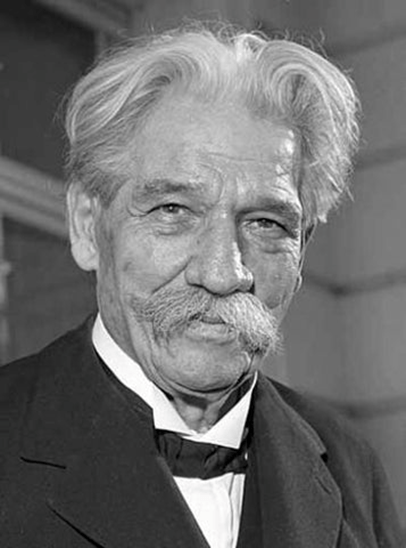
Albert Schweitzer was born January 14, 1875, in a village in Alsace, Germany. The son of a Lutheran-Evangelical pastor, he won acclaim at playing the organ. He earned doctorates in philosophy and theology. Schweitzer was pastor of St. Nicholas Church.
He was also the principal of St. Thomas College and a professor at University of Strasbourg.
Then, at age 30, his life changed.
He read a Paris Missionary Society article of the desperate need for physicians in Africa. To everyone’s dismay, he enrolled in medical school and became a medical missionary.
In 1912, he married a nurse, Helene Bresslau. The next year they traveled to west central Africa, and founded a hospital in the jungle village of Lambarene, Gabon.
After first using a chicken hut as their medical clinic, they erected a hospital building of corrugated iron in 1913. In the first 9 months they saw over 2,000 patients.

World War I started, and the conflict between France and Germany went global, reaching into Africa. The Schweitzers were arrested and put under French military supervision, then taken to a prison camp in France.
After the war, they moved to Alsace-Lorraine, a border area between France and Germany, where their only child was born, a daughter, Rhena.
Saving their money, Helene stayed back with their daughter, Rhena, and Albert returned to Gabon in1924. Traveling back and forth several times, they rebuilt the hospital. They served uninterrupted throughout World War II, being joined by additional staff.
The patients they treated suffered from: malaria, fever, dysentery, severe sandflea bites, tropical eating sores, leprosy, crawcraw sores, sleeping sickness, yaws (tropical infection of skin & bones), nicotine poisoning, necrosis, heart disease, chronic constipation, strangulated hernias, and abdominal tumors.
He helped Mbahouin tribes and pygmies who lived in fear of cannibalism.
Albert Schweitzer spoke in Europe and in 1949 visited the United States. Once he was asked “Why are you traveling in the 4th class?” He replied “Because there is no 5th class.” Once on a train two schoolgirls asked him, “Dr. Einstein, will you give us your autograph?” Not wanting to disappoint them, he signed: “Albert Einstein, by his friend Albert Schweitzer.”
Nobel Prize winner Albert Einstein taught a class on the theory of relativity to black students at Lincoln University in Pennsylvania in May of 1946. In accepting an honorary degree from the school, he stated: “There is a separation of colored people from white people in the United States. That separation is not a disease of colored people. It is a disease of white people. I do not intend to be quiet about it.”
Dr. Schweitzer’s daughter, Rhena, became a medical technician and married an American doctor, David C. Miller, who was serving at the African hospital—‘Albert Schweitzer Hospital’.
Albert Schweitzer joined Albert Einstein in warning the world of the dangers in developing nuclear weapons.
In 1952, Dr. Schweitzer was awarded the Nobel Peace Prize. He used the prize money to build a leper colony.

Schweitzer embraced a pro-life philosophy, explaining: “For months on end, I lived in a continual state of mental agitation. Without the least success I concentrated— even during my daily work at the hospital, on the real nature of the affirmation of life and of ethics. I was wandering about in a thicket where no path was to be found. I was pushing against an iron door that would not yield.
In that mental state, I had to take a long journey up the river. Lost in thought, I sat on deck of the barge, struggling to find the elementary and universal concept of the ethical that I had not discovered in any philosophy. I covered sheet after sheet with disconnected sentences merely to concentrate on the problem.
Two days passed. Late on the third day, at the very moment when, at sunset, we were making our way through a herd of hippopotamuses, there flashed upon my mind, unforeseen and unsought, the phrase: ‘Ehrfurcht vor dem Leben’ (‘Reverence for Life’). The iron door had yielded. The path in the thicket had become visible.”
Schweitzer’s words stand in contrast to utilitarian cultures and political party platforms advocating euthanasia, organ harvesting, honor-killings, and abortion.
You have read about the horrible things that the Nazis did when they were in power and how they showed such amazing little regard for human life. In Lutheran circles of Schweitzer, by contrast, life is regarded as something that God alone can take.
Similar to Nazis, in recent times, utilitarian governments gave hospitals financial incentives for administering experimental gene therapies, ventilator treatments and expensive pharmaceuticals, with little or no respect for conscientious objections, while refusing alternative treatments. Recently even in America, government even had schools groom children into questioning their sex and then steer them into experimental surgeries which result in higher risks of suicide.
In contrast to these utilitarian views and financially incentivized treatments, Dr. Schweitzer stated: “Ethics is nothing other than Reverence for Life. Reverence for Life affords me my fundamental principle of morality, namely, that good consists in maintaining, assisting and enhancing life, and to destroy, to harm or to hinder life is evil.”
THE GLOBAL WAR ON CHRISTIANS (Random House) author John Allen stated that followers of Jesus are “indisputably the most persecuted religious body on the planet.”
CENTRE FOR THE STUDY OF GLOBAL CHRISTIANITY estimates that every year 100,000 Christians, 11 every hour, die because of their faith.
After reading these tragic reports, one is challenged by a sermon of Dr. Albert Schweitzer: “Our Christianity, yours and mine, has become a falsehood and a disgrace, if the crimes are not atoned for in the very place where they were instigated. For every person who committed an atrocity someone must step in to help in Jesus’ name. “When you speak about missions, let this be your message: We must make atonement for all the terrible crimes we read of in the newspapers. We must make atonement for the still worse ones, which we do not read about in the papers, crimes that are shrouded in the silence of the jungle night.”
After his wife died, Schweitzer continued to work in Africa till he died at the age of 90.
Overcoming innumerable difficulties, he once wrote: “One day, in my despair, I threw myself into a chair in the consulting room and groaned out: ‘What a blockhead I was to come out here to doctor savages like these!’. Whereupon his native assistant quietly remarked: ‘Yes, Doctor, here on earth you are a great blockhead, but not in heaven.'”
Dr. Albert Schweitzer wrote:
“I don’t know what your destiny will be, but one thing I do know: the only ones among you who will be really happy are those who have sought and found how to serve.”
Ron
—
 True Texan Tales