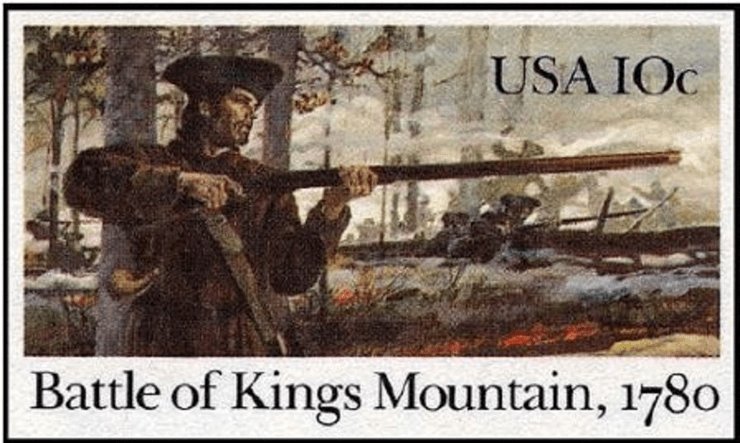
(This battle was so important to ending the American Revolution that I thought you should know about it. And how the Great God, Jehovah was so closely involved in events that ended that war should be remembered as shown below for you to see.)
On May 12, 1780, after the British had captured Charleston, South Carolina, the 19-year-old express rider, James “Jimmy” Blair, made a ride similar to that of Paul Revere. Though shot in the chest, he successfully alerted Americans prior to the Battle of King’s Mountain.
Jimmy Blair, who was later a U.S. Congressman, was memorialized in a poem written by John Trotwood Moore, titled “The Ride of the Rebel”: “The race of the rebel, wilderness run, The race for a nation just begun, You will find it not on the gilded page, But on King’s Mountain’s starlit stage. The race for a nation just begun, Over the Border the British came, Their jackets red as the sun, City and hamlet had felt of the fall ,From the flash of the Red Coat’s gun. Over the border Ferguson rode, He never rode back again, For Jimmy Blair his horse bestode, And galloped with might and main, O’er hill and o’er valley he sped, And roused the patriots as he went, As Gabriel would rouse the dead. Go! For your country’s life, he said, And away like a ghost he was gone, Riding from morn to midnight on to morn.”
The Battle of King’s Mountain was October 7, 1780. Where the Americans had 29 killed, the British suffered 668 captured, 163 wounded and 290 killed, including the feared British sharp shooter Major Patrick Ferguson.
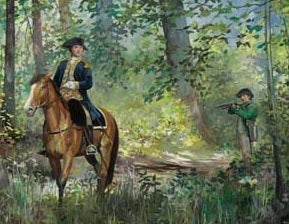
Ferguson, earlier at the Battle of Brandywine, had the opportunity to sharp shoot in the back General Washington and Count Casimir Pulaski, “father of the American cavalry,” but declined due to his code of honor.
The Battle of Kings Mountain was described by Thomas Jefferson as “the turn of the tide of success” in the War for Independence.
The Americans were exceptionally accurate riflemen, as British Colonel George Hanger wrote: “I never in my life saw better rifles, or men who shot better than those made in America.”
Theodore Roosevelt wrote of the Battle of Kings Mountain: “This brilliant victory marked the turning point of the American Revolution.”
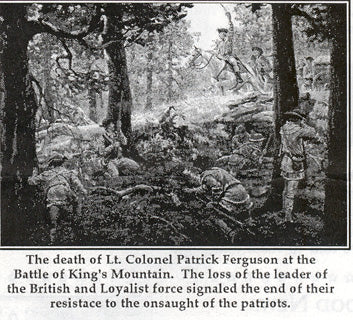
President Herbert Hoover stated at the 150th anniversary of the Battle of Kings Mountain, October 7, 1930: “This is a place of inspiring memories. Here less than a thousand men, inspired by the urge of freedom, defeated a superior force intrenched in this strategic position. This small band of Patriots turned back a dangerous invasion well designed to separate and dismember the united Colonies. It was a little army and a little battle, but it was of mighty portent. History has done scant justice to its significance, which rightly should place it beside Lexington, Bunker Hill, Trenton and Yorktown.”
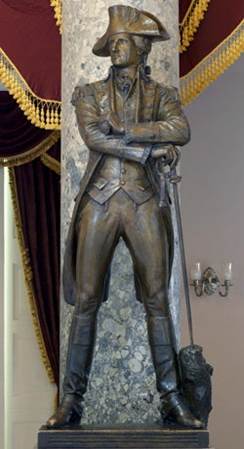
One of the heroes of King’s Mountain was Colonel John Sevier, who later was elected the first Governor of Tennessee. His statue is in the U.S. Capital Statuary Hall.
Not long after the Battle of Kings Mountain, American General Daniel Morgan defeated the British at the Battle of Cowpens, January 17, 1781.
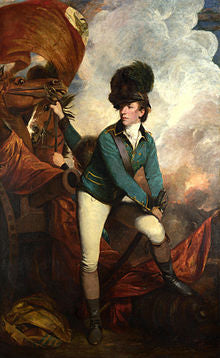
The British troops, under the command of 26-year-old Colonel Banastre Tarleton, suffered 110 killed, 229 wounded and 829 captured. Captured British officer Major McArthur of the 71st Highlanders commented that “he was an officer before Tarleton was born; that the best troops in the service were put under ‘that boy’ to be sacrificed.” (In the recent 2OOO movie The Patriot, the peaceful farmer Benjamin Martin played by Mell Gibson is driven to lead the Colonial Militia during the American Revolution when a sadistic British officer ‘Colonel Tarleton’ murders his son.)
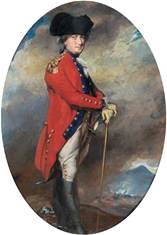
When news of loss was told to British Lord Cornwallis he leaned on his sword so hard the blade snapped.
British General Cornwallis took off in a hasty pursuit of American General Daniel Morgan, who was joined by General Nathanael Greene. To travel faster, Cornwallis discarded his slow supply wagons and heavy equipment, but to no avail, the Americans successfully retreated into Virginia.
Crediting God, Yale President Ezra Stiles wrote, May 8, 1783: “Should we not ascribe to a Supreme Energy the wise generalship displayed by General Greene leaving the roving Cornwallis to pursue his helter-skelter ill fated march into Virginia.”
The British technically won the following Battle of Guilford Court House on March 15, 1781, but they failed in their attempt to capture much needed American supplies. Their loss of over 500 British killed or wounded resulted in the battle being considered a strategic victory for the Americans. Desperately low on supplies for his army, Cornwallis was ordered by British General Henry Clinton to move his 8,000 troops to Yorktown and wait for British ships.
Meanwhile, Washington was desperate for funds to finish the war.
Providentially, Ben Franklin and Marquis de Lafayette had succeeded in persuading French King Louis the Sixteenth to send ships and troops the help the Americans.
French Admiral de Grasse wrote to Rochambeau, July 28, 1781: “The Saint-Domingue Colony has no money, but I will send a frigate to Havana in quest of it.”
In September of 1781, a fundraising campaign was organized by Cuba’s Governor General Juan Manuel de Cagigal y Monserrat. The citizens of Cuba generously responded, most notably the Cuban women, from Havana to Matanzas to Pinar del Rio. They donated their gold and jewelry, and sent it to help General Washington defeat the British at Yorktown. The message that the “Ladies of Havana” sent with their contribution was: “So the American mothers’ sons are not born as slaves.”
Their gift is estimated at $28 million in today’s money. Washington reportedly threw his hat in the air when he heard news of their gift. It literally saved the revolution.
General Jean Baptiste de Rochambeau wrote in his “Daily Memoirs,” Library of Congress: “The joy was enormous when it was received, the money from Havana: The contribution of 800,000 silver pounds which helped stop the financial bankruptcy of the Revolutionary Army, and raised up the moral spirit of the Army that had began to dissolve.”

Historian Stephen Bonsal wrote in When the French Were Here, 1945 (Doubleday, Doran & Co.,1945) “The millions that was supplied by the ladies of Havana, may, with truth, be regarded as the ‘bottom dollars’ upon which the edifice of American independence was erected.”
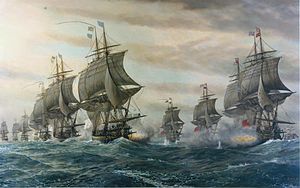
French Admiral de Grasse left off fighting the British in the West Indies and sailed 24 ships to the mouth of Chesapeake Bay, where, in the Battle of the Virginia Capes, he drove off 19 British ships which were trying to evacuate Cornwallis’ men.
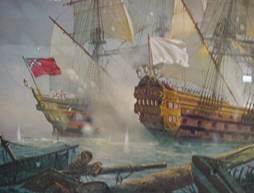
De Grasse’s 3,000 French troops and General Rochambeau’s 6,000 French troops hurriedly joined General Lafayette’s division as they marched to help Washington trap Cornwallis against the sea.
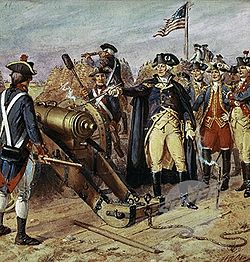
They joined the troops of Generals Benjamin Lincoln, Baron von Steuben, Modecai Gist, Henry Knox and John Peter Muhlenberg. And Alexander Hamilton led 400 infantry to capture British redoubt number 10.
Altogether, 17,000 French and American troops surrounded Cornwallis and forced him to surrender on OCTOBER 19, 1781. This was an overwhelming victory for young America that was the main event that caused the British to end the war in America’s favor.
Yale President Ezra Stiles wrote, May 8, 1783: “Who but God could have ordained the critical arrival of the Gallic French fleet, so as to assist in the siege of Yorktown? It is God who had raised up for us a powerful ally, a chosen army and a naval force: who sent us a Rochambeau to fight side by side with a Washington in the battle of Yorktown.”
Washington wrote October 20, 1781: “To diffuse the general Joy through every breast the General orders Divine Service to be performed tomorrow in the several Brigades, To diffuse the general Joy through every breast the General orders … Divine Service to be performed tomorrow in the several Brigades. The Commander-in-Chief earnestly recommends troops not on duty should universally attend with that gratitude of heart which the recognition of such astonishing Interposition of Providence demands.”
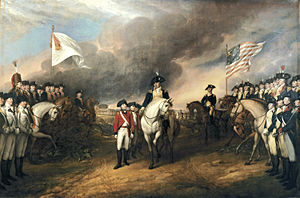
On October 11, 1782, the Congress of the Confederation passed: “It being the indispensable duty of all nations to offer up their supplications to Almighty God the United States in Congress assembled do hereby recommend it to the inhabitants of these states in general, to observe the last Thursday of November next, as a Day of Solemn Thanksgiving to God for all his mercies.”
On September 3, 1783, the Revolutionary War officially ended with the Treaty of Paris, signed by Ben Franklin, John Adams, John Jay and David Hartley: “In the name of the Most Holy and Undivided Trinity. It having pleased the Divine Providence to dispose the hearts of the most serene and most potent Prince George the Third, by the Grace of God, King of Great Britain and of the United States of America, to forget all past misunderstandings and differences. Done at Paris, this third day of September, in the year of our Lord one thousand seven hundred and eighty-three.”
George Washington wrote to General Nathanael Greene, February 6, 1783: “It will not be believed that such a force as Great Britain has employed for eight years in this country could be baffled in their plan of subjugating it by numbers infinitely less, composed of men oftentimes half starved; always in rags, without pay, and experiencing, at times, every species of distress which human nature is capable of undergoing.”
Washington added in his Farewell Orders, November 2, 1783: The singular interpositions of Providence in our feeble condition were such, as could scarcely escape the attention of the most unobserving; the perseverance of the Armies of the United States, through almost every possible suffering and discouragement for the space of eight long years, was little short of a standing miracle.”
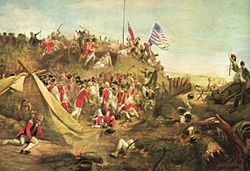
Washington added in his Farewell Orders, November 2, 1783: The singular interpositions of Providence in our feeble condition were such, as could scarcely escape the attention of the most unobserving; while the perseverance of the Armies of the United States, through almost every possible suffering and discouragement for the space of eight long years, was little short of a standing miracle.”
Harvard President Samuel Langdon stated in his address “The Republic of the Israelites an Example to the American States, June 5, 1788: “The signal interpositions of divine providence, in saving us from the vengeance of a powerful irritated nation … in giving us a WASHINGTON to be captain-general of our armies in carrying us through the various distressing scenes of war and desolation, and making us triumphant, and finally giving us peace, with a large territory, and acknowledged independence; all these laid together fall little short of real miracles. We cannot but acknowledge that God hath graciously patronized our cause, and taken us under his special care, as he did his ancient covenant people.”
Chief Justice John Jay noted in 1777: This glorious revolution is distinguished by so many marks of the Divine favor and interposition, that no doubt can remain of its being supported in a manner so singular, and I may say miraculous, that when future ages shall read its history they will be tempted to consider a great part of it as fabulous exaggerated. Will it not appear extraordinary that thirteen colonies should immediately become one people, and though without funds, without magazines, without disciplined troops, in the face of their enemies, unanimously determine to be free, and, undaunted by the power of Britain, refer their cause to the justice of the Almighty, and resolve to repel force by force.
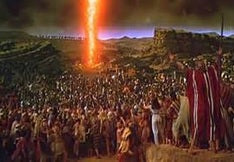
We should always remember that the many remarkable and unexpected means and events by which our wants have been supplied and our enemies repelled or restrained, are such strong and striking proofs of the interposition of Heaven, that our having been hitherto delivered from the threatened bondage of Britain ought, like the emancipation of the Jews from Egyptian servitude, to be forever ascribed to its true cause, and kindle in them a flame of gratitude and piety which may consume all remains of vice and irreligion.”
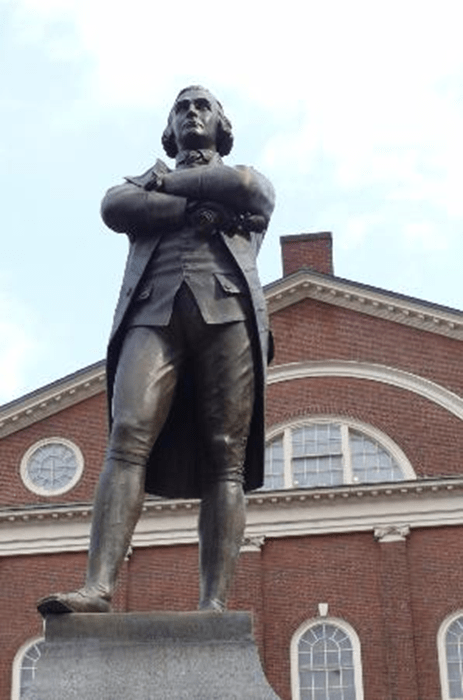
Samuel Adams stated August 1, 1776: There are instances of an almost astonishing Providence in our favor; success has staggered our enemies, and almost given faith to infidels; so that we may truly say it is not our own arm which has saved us. The hand of Heaven appears to have led us on to be, perhaps, humble instruments and means in the great Providential dispensation which is completing.”
Benjamin Franklin stated at the Constitutional Convention, 1787: In the beginning of the Contest with Great Britain, when we were sensible of danger we had daily prayer in this room for the divine protection. Our prayers, Sir, were heard, and they were graciously answered.
All of us who were engaged in the struggle must have observed frequent instances of a superintending providence in our favor.”
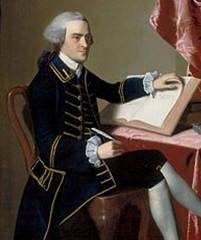
With the war over, Massachusetts Governor John Hancock proclaimed, November 8, 1783: “The Citizens of these United States have every Reason for Praise and Gratitude to the God of their salvation. I do appoint the 11th day of December next, the day recommended by the Congress to all the States to be religiously observed as a Day of Thanksgiving and Prayer, that all the people may then assemble to celebrate that He hath been pleased to continue to us the Light of the Blessed Gospel. That we also offer up fervent supplications to cause pure Religion and Virtue to flourish and to fill the world with His glory.”
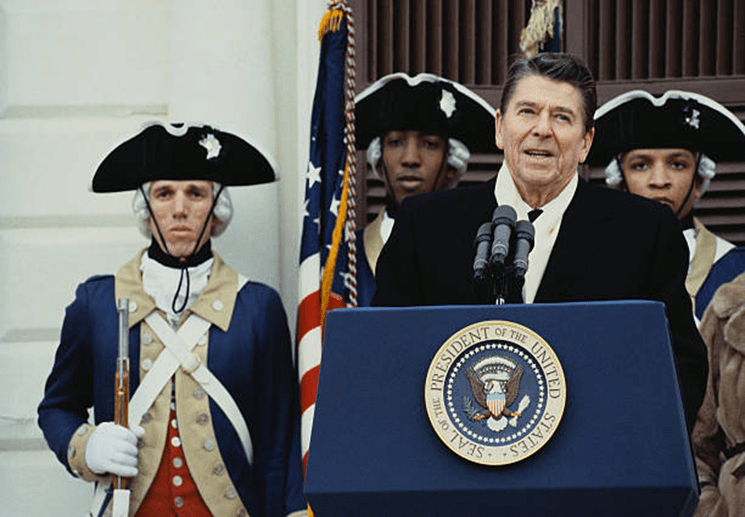
Ronald Reagan proclaimed a Day of Prayer, January 27, 1983, stating: “A year before the Declaration of Independence, in 1775, the Continental Congress proclaimed the first National Day of Prayer as the initial positive action they asked of every colonist.”
Reagan continued: “In 1783, the Treaty of Paris officially ended the long, weary Revolutionary War during which a National Day of Prayer had been proclaimed every spring for eight years.”
On March 27, 1854, the 33rd Congress voted unanimously to print Representative James Meacham’s report, Journal of U.S. House of Representatives, which stated: “Down to the Revolution, every colony did sustain religion in some form. It was deemed peculiarly proper that the religion of liberty should be upheld by a free people. Had the people, during the Revolution, had a suspicion of any attempt to war against Christianity, that Revolution would have been strangled in its cradle.”
Ron
 True Texan Tales