(Jefferson is most known for writing the Declaration of Independence. He also contributed significantly to the Constitution and the Bill of Rights and many other significant American documents. Since he was so important to the founding of America, I think it is significant to know where and how he got his ideas. Below, I have chronicled that for you. Do read it so that you will know.)
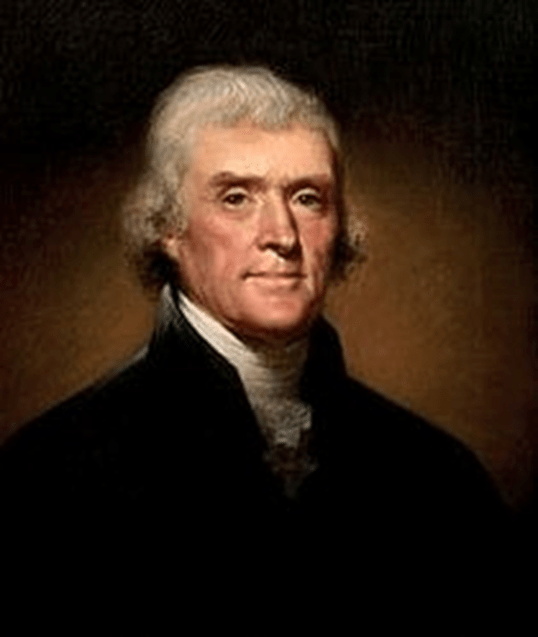
On January 1, 1802, the people of Cheshire, Massachusetts, delivered a giant block of cheese weighing 1,235 lbs to President Thomas Jefferson, being presented by the famous Baptist preacher, John Leland.
On the block of cheese, they put Jefferson’s motto, which was also on his personal seal: “Rebellion to Tyrants is Obedience to God.”
After delivering the cheese, John Leland was then invited to preach to the President and Congress in the U.S. Capitol. The subject of his talk was “separation of church and state.”
Baptists had been particularly persecuted in colonial Virginia, as Francis L. Hawks wrote in Ecclesiastical History (1836): “No dissenters in Virginia experienced for a time harsher treatment than the Baptists. They were beaten and imprisoned, Cruelty taxed and were subjected to new modes of punishment and annoyance.”
So many Baptist ministers were harassed, and their church services disrupted, that James Madison introduced legislation in Virginia’s Legislature on October 31, 1785, titled “A Bill for Punishing Disturbers of Religious Worship,” which passed in 1789.
Colonial Virginia had a government imposed belief system, an “establishment” of the Church of England, or “Anglican Church” from 1606 to 1786. Establishment meant mandatory membership, mandatory taxes to support it; and no one could hold public office unless they were a member. This was modeled after European nations who had establishments of different Christian denominations.
Patrick Henry almost succeeded in having Virginia not ratify the Constitution as it did not have a Bill of Rights guaranteeing, among other things, the freedom of religion. Baptist Preacher John Leland had considered running for Congress, as he wanted an Amendment added to the new United States Constitution which would protect religious liberty.
Leland reportedly met with James Madison near Orange, Virginia. Upon Madison’s promise to introduce what would become the First Amendment, Leland agreed to persuade Baptists to get involved in politics and support Madison.
John Leland wrote in Rights of Conscience Inalienable, 1791, that they wanted not just toleration, but equality: “Every man must give account of himself to God, and therefore every man ought to be at liberty to serve God in a way that he can best reconcile to his conscience. If government can answer for individuals at the day of judgment, let men be controlled by it in religious matters; otherwise, let men be free.”
Following George Whitefield’s First Great Awakening Revival, 1730-1755, a Second Great Awakening Revival took place between 1790-1840. In Thomas Jefferson’s county of Albemarle, Baptist, Presbyterian and Methodist revival meetings were held. Even Jefferson’s daughter, Mary, attended a Baptist revival preached by Lorenzo Dow.
On July 4, 1826, the editor of the Christian Watchman (Boston, MA) published an account: Thomas F. Curtis wrote in The Progress of Baptist Principles in the Last Hundred Years (Charleston, S.C.: Southern Baptist Publication Society, 1856): “ANDREW TRIBBLE was the Pastor of a small Baptist Church, which held its monthly meetings at a short distance from Mr. JEFFERSON’S house, eight or ten years before the American Revolution. Mr. JEFFERSON attended the meetings of the church for several months in succession, and after one of them, asked Elder TRIBBLE to go home and dine with him, with which he complied.
Mr. TRIBBLE asked Mr. JEFFERSON how he was pleased with their Church Government?
Mr. JEFFERSON replied, that it had struck him with great force, and had interested him so much; that he considered it the only form of pure democracy that then existed in the world, and had concluded that it would be the best plan of Government for the American Colonies.”
(Thus, it is recorded and codified that the Declaration of Independence and the U.S. Constitution were patterned after the democratic principles of the government of Baptist Churches which were found most preferable by Thomas Jefferson. Read further of you want to see them more iterated.)
“A gentleman in North Carolina knowing that the venerable Mrs. (Dolley) Madison had some recollections on the subject, asked her in regard to them. She expressed a distinct remembrance of Mr. Jefferson speaking on the subject, and always declaring that it was a Baptist church from which his views were gathered.”
President Calvin Coolidge stated at the 150th anniversary of the Declaration of Independence, July 4, 1926: “This preaching reached the neighborhood of Thomas Jefferson, who acknowledged that his ‘best ideas of democracy’ had been secured at church meetings.”
After Jefferson’s wife and two children died of the plage, he became depressed and moved to France for a little while. Upon returning to America, Jefferson introduced a bill in the Virginia Assembly. Jefferson’s bill, with the help of James Madison, was passed by Virginia’s Assembly, January 16, 1786.
So significant was this bill, that Jefferson noted it on his gravestone as “The Statute of Virginia for Religious Freedom.” It stated: “Almighty God hath created the mind free. All attempts to influence it by temporal punishments are a departure from the plan of the Holy Author of religion, who being Lord both of body and mind, yet chose not to propagate it by coercions on either, as was in His Almighty power to do. To compel a man to furnish contributions of money for the propagation of opinions, which he disbelieves is sinful and tyrannical. Be it enacted that no man shall suffer on account of his religious opinions.”
This last paragraph, if applied today, would mean that Jefferson would have opposed Christian parents having to pay taxes to have their children indoctrinated in public schools with anti-biblical views on sex and marriage.
Consistent throughout his life Jefferson believed that there was a Creator and that the government should never force one’s conscience. Over time, brilliant legal minds have used Jefferson’s words about the “separation of church and state” to prohibit Jefferson’s beliefs; even though he intended them to mean only that the state should not interfere with the church. He never intended that they should ever be used to separate one from the church, or God.
Jefferson believed in a Creator, as he wrote in the Declaration: “All men are endowed by their CREATOR.”
Yet in 2005, U.S. District Judge John E. Jones, in Kitzmiller v. Dover Area School District, ruled students could not be taught of a CREATOR: “to preserve the separation of church and state.”
Inscribed on the Jefferson Memorial, Washington, DC is Jefferson’s warning:
“God who gave us life gave us liberty. Can the liberties of a nation be secure when we have removed a conviction that these liberties are the gift of God? Indeed I tremble for my country when I reflect that God is just, that His justice cannot sleep forever.”
RON
 True Texan Tales