(You hear a lot about the help that France gave to the American Cause in the Revolutionary War. However, Spain gave enormous aid also. In fact, without Spain’s help, General Washington’s army would probably never have defeated the British Forces. Below for your edification I have chronicled some of that Spanish aid:)
The Aid of Spain
During the Revolution, America benefited from the Spanish and French navies laying siege to British controlled Gibraltar. It was the longest siege the British had ever endured, and one of the longest in naval history, requiring an enormous amount of British military resources that would have otherwise been sent to America.
On the night of August 8, 1780, a large convoy of British ships and merchant vessels left the English Channel. In the dark, Spanish Admiral Luis de Córdova y Córdova’s flagship slipped between the lead British ship and the rest of the British fleet. Córdova mimicked the signal shots of the lead ship to fool the British convoy into following him into a trap.
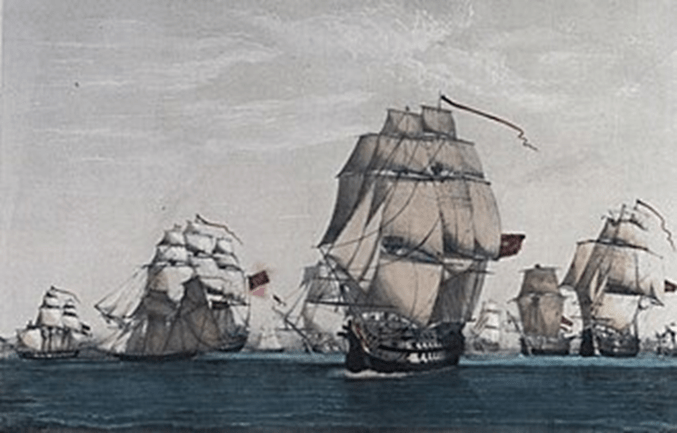
When dawn broke, the British convoy was surrounded. A British officer wrote: “At day-light we found ourselves in the center of thirty ships of the line and four frigates, all Spanish. We tried to run, but found it impossible.” It was one of the largest naval captures in history, 55 ships and over a million British pounds of supplies, robbing them of resources intended to fight Americans.
King Carlos III of Spain, together with King Louis XVI of France, secretly supplied five million livres worth of materials and arms to America through a front trading business — “Roderigue Hortalez and Company.” The company covertly worked with Connecticut merchant Silas Deane and Thomas Morris, the half-brother of Robert Morris, the “Financier of the Revolution.”
Similarly, The Dutch secretly funneled supplies and weapons to America through the Spanis Island of St. Eustatius. including muskets, cannons, cannonballs, gunpowder, bombs, mortars, tents, and clothing enough for 30,000 soldiers.
King Carlos III gave a directive to the Spanish Governor of Louisiana, Bernardo de Gálvez, to allow military supplies, weapons, uniforms, and medicine to be shipped up the Mississippi River to the Ohio River to aid the Continental Army troops under the command of General Washington and Brigadier-General George Rogers Clark. In 1777, the value of the supplies delivered was over $70,000.

Barnardo de Gálvez’s uncle, José de Gálvez, as Inspector General of New Spain, appointed the Franciscan Junipero Serra as head of the 21 missions in California, where he baptized over 6,000 Indians.
Bernardo de Gálvez corresponded with Thomas Jefferson, Patrick Henry, and American General Charles Henry Lee.
In 1779, Gálvez recruited troops from Cuba, México, Santo Domingo, Puerto Rico, Venezuela, Costa Rica, free Blacks, Indians, Creoles, and French Catholic Acadians -“Cajuns” to fight t He negotiated with Texas governor Domingo y Robles in June, 1779, for 2,000 head of cattle to be driven to Louisiana to feed his troops.
They defeated the British at Fort Bute, Baton Rouge, and Natchez, freeing up the lower Mississippi Valley.
In 1780, Galvez captured Mobile in the Battle of Fort Charlotte, and in 1781, defeated the British at Pensacola, driving British forces out of that west area and the Gulf of Mexico. Fort Charlotte was previously called Fort Conde by the French before they were defeated by the British in the French and Indian War, 1763. The British claimed the Louisiana Territory east of the Mississippi, calling it British West Florida.

The British Colonial period on the Gulf Coast ended in spectacular fashion during the American Revolution. In March 1780, Don Bernardo de Gálvez, the Spanish governor of Louisiana, led more than a thousand troops to Mobile and laid siege to Fort Charlotte. For 14 long days, Spanish guns battered the old fort. Faced with the complete destruction of his ragtag army of 300 men, including armed slaves and volunteers from the town, British Captain Elias Dumford surrendered Fort Charlotte.
Gálvez, with 32 ships and 3,000 troops from Cuba, Puerto Rico, Venezuela, Mexico, Canary Islands, along with black militia and Native Americans, fought many battles along the Mississippi River and the Gulf Coast, including the Port of New Orleans, Fort Bute, Baton Rouge, Natchez, and Nassau, Bahamas. After a two month siege, he captured Pensacola and effectively drove the British out of the Gulf of Mexico.
Gálvez also sent reinforcements to St. Louis, near where the Missouri and Mississippi Rivers meet, to repel the British in the Battle of Fort San Carlos, May 25, 1780. Gálvez actions prevented the British from attacking Washington’s army from the west.
In 1783, Gálvez went to France and helped in the negotiations which culminated in the Treaty of Paris, ending the Revolutionary War. In gratitude for his support of America, General Washington invited Gálvez to ride next to him in the July 4, 1783, victory parade in Philadelphia.
In October of 1784, Bernardo de Gálvez was made Governor of Cuba, Louisiana and the Floridas, where, as a gesture of goodwill, he released all American sailors imprisoned for smuggling. Galveston, Texas, was named for him. A statue of Gálvez is in New Orlean’s Spanish Plaza and in Washington, DC., near the Department of State. Congress awarded Gálvez honorary American citizenship – one of only seven other people to be thus recognized.

(So, Spain helped greatly in the Revolutionary War.)
Ron
 True Texan Tales