
The first of the new American fighting ships was now finished in Boston. The war of 1812 had started. The USS Constitution, under the command of Captain Isaac Hull, sailed from Boston on August 2, 1812 and steered for the blustery waters southeast of Halifax, Nova Scotia. After two weeks of daily gun drills in preparation for combat, Hull and his crew sighted the British frigate HMS Guerriere, under the command of Captain James Richard Dacres, on the afternoon of August 19, 1812. Guerriere was one of the ships in a British squadron Hull and his crew had outrun a few weeks earlier.
As Guerriere closed to within a mile of Constitution, the British hoisted their colors and released a broadside, but the cannonballs fell short. The crew asked Hull for permission to return fire, but he refused so as not to waste the first broadside. Soon, however, Constitution slid alongside her opponent and Hull gave command to fire. The battle commenced.
Constitution’s thick oak hull was composed of very durable oak from the Colonies and was never available to the British in England. It proved resilient to enemy cannonballs. During the engagement, an American sailor was heard exclaiming, “Huzza! Her sides are made of iron! See the British cannon balls are bouncing off!” Boarding parties were summoned as the ships came together, and Lieutenant William Sharp Bush, commander of Constitution’s Marine detachment, took the initiative. Jumping on the taffrail, sword in hand, he called to Hull, “Shall I board her?” No sooner were the words out of his mouth than a musket ball hit him in the cheek, instantly killing him. Seeing Bush fall, First Lieutenant Charles Morris leapt to take his place, but he too fell seriously wounded with a ball in the abdomen. Aboard Guerriere, Captain Dacres was gravely wounded when an American musket ball struck him in the back. Before either side could reorganize, the two ships wrenched apart. The severely damaged Guerriere was forced to surrender.
All through the night, the Americans tended to the wounded and dead, and ferried the British prisoners of war and their possessions across to Constitution. By the morning, it was clear Guerriere could not be saved and Hull made the difficult decision to scuttle the ship by igniting the warship’s powder in the magazines.

Constitution and the prisoners sailed for Boston and arrived on August 30. It was not the first American naval victory of the war (that honor went to USS Essex’s crew, who captured HMS Alerton on August 13), but it established Constitution as a household name. Throngs of cheering Bostonians greeted Hull and his crew upon their return. A militia company escorted Hull to a reception at the Exchange Coffee House and more dinners, presentations and awards followed in the ensuing weeks, months, and years. USS Constitution, for her impressive strength in battle, earned the nicknamed “Old Ironsides” since British cannon balls just bounced off her strong oak sides.
On December 29, 1812, while cruising off the coast of Brazil, USS Constitution’s masthead lookout sighted two ships on the horizon. Constitution, under the command of Commodore William Bainbridge, stood toward them, and the larger of the two, HMS Java, tacked toward the Americans.
Java, a 38-gun frigate (but mounting 47) commanded by Captain Henry Lambert, maneuvered to close with Constitution. The Americans opened fire as the range decreased, but the gun crews had difficulty hitting their target. Soon, Java ranged alongside Constitution and the battle commenced. As the two ships maneuvered to rake each other, Java suddenly turned under the American’s stern and fired.
British shot smashed Constitution’s wheel and wounded or killed the four quartermasters manning it. The same broadside shattered a railing surrounding the after hatchway, embedding a shard of copper in Bainbridge’s thigh. Despite his wound, Bainbridge rallied his crew. To regain control of the ship, crew members were sent to the berth deck to steer the ship using the tiller directly connected to the rudder. The heavy American shot, coupled with the defensive properties of Constitution’s thick hull, began to turn the tide of battle. Captain Lambert decided to board the American frigate, and aimed Java’s shattered bow at Constitution. As the two ships neared, American shot toppled Java’s foremast and the boarding attempt failed. Soon after, Lambert received a mortal wound in the chest.
The Americans fired several more broadsides and then stood off out of range to repair damaged rigging. On Java, the devastation was complete with her three masts and bowsprit damaged, and many of her guns inoperable. An hour later, Constitution swept back and took up a raking position off Java’s bow. First Lieutenant Henry Ducie Chads surrendered the ship for Constitution’s second victory of the War of 1812.
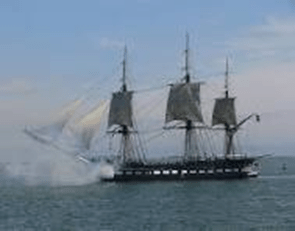
After removing the British prisoners, Bainbridge determined that he could not tow Java to an American port. A demolition party lit fires in Java’s hold, causing the magazine to explode. Although Constitution suffered damage to her rig and hull, the ship made Boston on February 15, 1813. News of the victory had arrived six days before, and the city was ready to welcome its heroes. When the news reached England, the British Admiralty took steps to ensure that no more of their frigates would fall victim to the Americans. In July 1813 they issued orders forbidding their captains from engaging American frigates one on one.
On December 24, 1814, the United States and Great Britain signed the Treaty of Ghent, putting an end to the War of 1812. The hostilities officially concluded on February 17, 1815, when the U.S. Congress ratified the treaty. However, word of the war’s end had not yet reached USS Constitution, at sea three thousand miles away. Having escaped from British blockaders off Boston on December 18, 1814, the ship, under Captain Charles Stewart, had spent the intervening two months cruising Atlantic sea lanes in search of prizes.
By February 20, 1815, Constitution was near the island of Madeira off Portugal. At 1:00 that afternoon, the masthead lookout spied a large ship sailing to the southwest. A half hour later, another ship was spotted further westward. The two ships were HMS Levant, a sloop-of-war mounting 21 guns commanded by Captain the Honorable George Douglas, and HMS Cyane, a 22-gun frigate (mounting 34) commanded by Captain Gordon Falcon. By 5:00 the ships had closed, and Stewart ordered two guns fired to try the range. The shot fell short. At about 6:00, the British shorted sail and formed a line with Levant leading. All the ships hoisted their ensigns and the battle commenced.
Constitution had the windward advantage of greater maneuverability and the ability to block the wind from her opponents’ sails. It also meant that clouds of gun smoke would envelop the British warships, obscuring their view of the American vessel. Stewart ordered his crew to fire. Both British ships returned fire and a 15-minute exchange between the three vessels ensued. Once the smoke cleared, Constitution was alongside Levant and fired a broadside. Then, with Cyane maneuvering to attack Constitution’s port after quarter (a vulnerable spot), Stewart ordered the main and mizzen topsails braced a back, causing the ship to back sternward, under the cover of the gun smoke, surprising Cyane. The battle continued for another 30 minutes.
After more sailing and blistering fire from Constitution’s larger guns, Cyane surrendered just before 7:00. An hour later, Constitution gave chase to Levant and exchanged broadsides. The Americans raked Levant’s stern, thereby prompting Captain Douglas to flee. Constitution pursued, firing with the bow chasers, cutting up the British warship’s rigging and masts. By 10:00, finding they could not escape, Levant surrendered.
Despite the two-to-one advantage of the British, it had hardly been a fair fight. Constitution’s heavier guns and heavy construction were able to both deal out and absorb more punishment than her opponents. Still, it was a hard fought battle with brilliant ship handling, and both the U.S. Navy and the American press were quick to sing the praises of the ship and crew. The battle with HMS Cyane and HMS Levant was USS Constitution’s last time engaging in active combat.
On November 3, 1853, USS Constitution, the flagship of the Africa Squadron captained by Commander John Rudd and under the leadership of Commodore Isaac Mayo, seized the New York schooner H.N. Gambrill off the coast of Africa near the Congo River delta. There was evidence indicating the ship was en route to pick up enslaved people who would be illegally sold into captivity. Bulkheads had been removed and an abundance of provisions had been loaded aboard – far more than was needed by any ship without living cargo.
The ship’s cook eventually told one of Constitution’s lieutenants that Gambrill‘s captain was planning a slaving voyage to Cuba. A prize crew was assigned to the schooner and sailed it back to New York, where the court adjudicated its disposition. H. N. Gambrill was the last capture of USS Constitution’s long career.
USS Constitution went on to more exploits. However, the US Navy could not bring itself to put her on the junk heap in retirement. Over the years they kept her in fighting condition. To this day she is the last fighting sailing ship in the U.S. Navy.
So here she is today under sail with a group of F-15s passing overhead in escort:

 True Texan Tales