
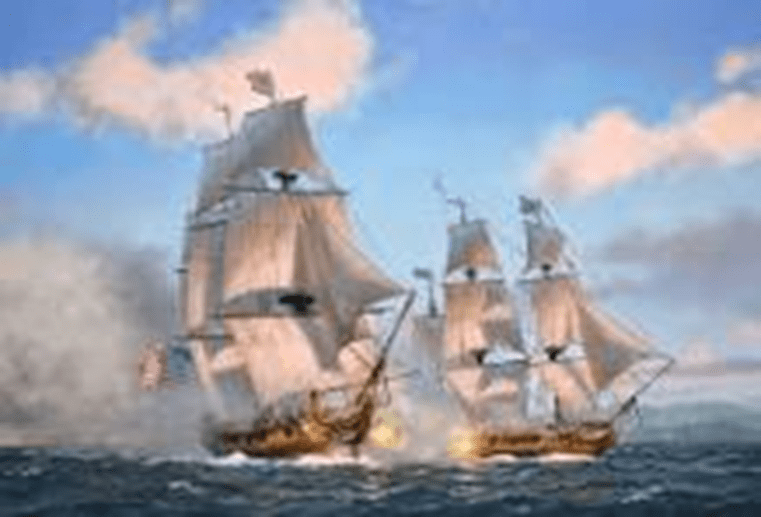
“I have not yet begun to fight!” shouted John Paul Jones when the captain of the 50-gun British frigate HMS Serapis taunted him to surrender.
Their ships were so close their cannons scraped and masts entangled, yet his American ship Bonhomme Richard, named for Ben Franklin’s Poor Richard’s Almanac, refused to give up. When two cannons exploded and his ship began sinking, John Paul Jones lashed his ship to the enemy’s to keep it afloat.
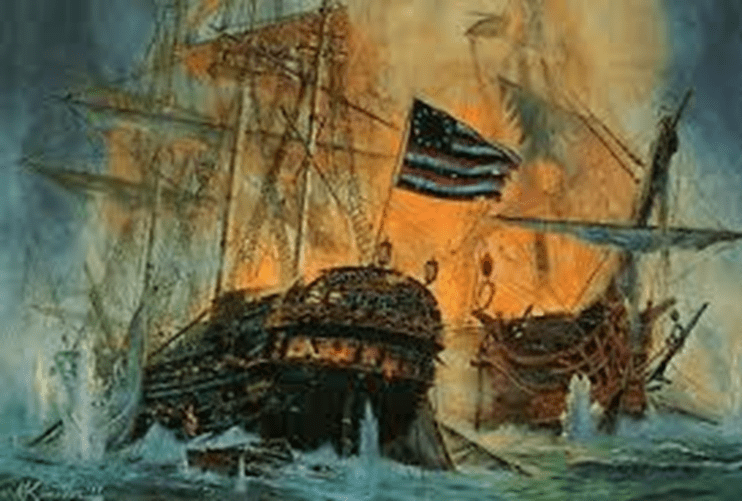
In the Revolutionary War the Americans had almost no navy, especially compared to the mighty British Fleet. It did have one lightly armed frigate called the Bonhomme Richard. But it was captained by a very brave, intrepid and extremely aggressive captain named John Paul Jones.
He did not try to fight in home waters. He sailed all the way to England to engage the British Navy. He encountered a big British fighting Ship of the Line just coming into its harbor on the British coast. He followed it into its harbor and attacked it with his much smaller frigate.
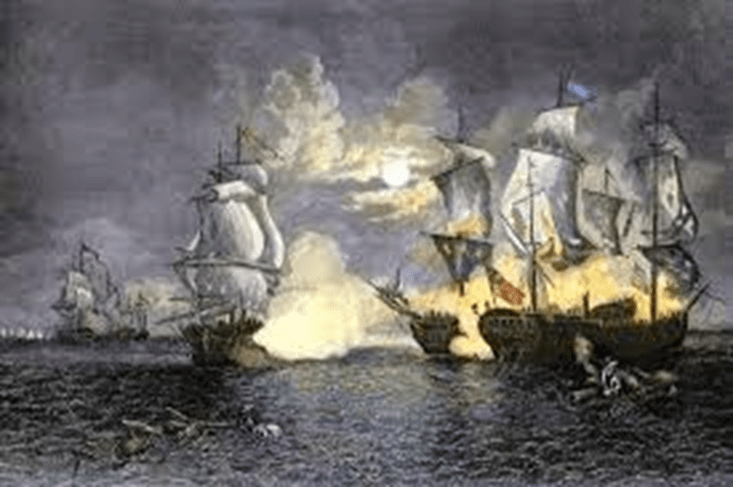
He did some damage to the enemy ship, but the big HMS Serapis with its 50 big cannons just blasted poor John Paul Jones’s Bonhomme Richard all to pieces. However, as I related above Jones lashed his ship to the enemy ship so that it would not sink.
The British captain figuring that he had certainly already won, called for Jones to surrender. That is when Jones uttered those famous words through his bull horn, “I have not yet begun to fight.”
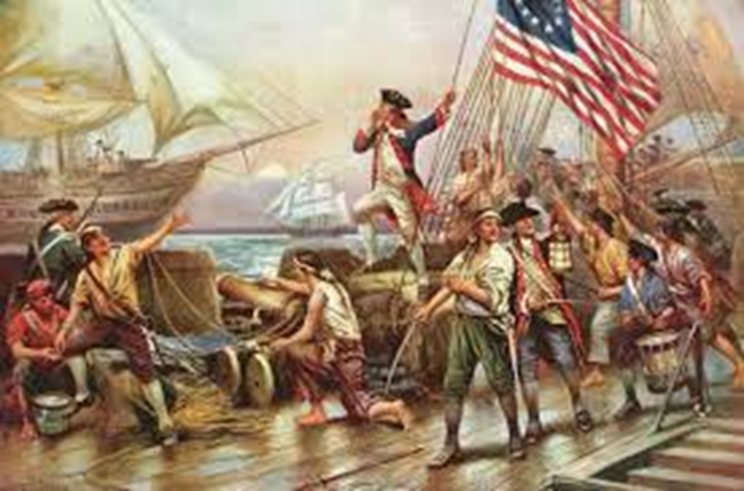
What was happening was that the American sailors were hiding high up in the rigging of their furled sails with their long hunting rifles. The British only had a few inaccurate muskets which were doing little damage in such a close range battle. So, the American sailors were killing a huge number of the British sailors. After 3 more hours of fighting, the British surrendered, even though the lower part of the Bonhomme Richard was shot to pieces by the British cannons.

It was an incredible victory for the American Navy. John Paul Jones took over the captured British ship and sailed away with his now much better prize. This battle took place SEPTEMBER 23, 1779.

John Paul Jones is called the “Father of the American Navy.”
John Paul Jones had commanded the Continental Navy’s first ship, Providence, in 1775. With 12 guns, it was the most victorious American vessel in the Revolution, capturing or sinking 40 British ships.
In 1778, sailing the Ranger, Jones raided the coasts of Scotland and England, striking terror and panic into the British Isles.
Just after midnight, April 23, 1778, Jones raided the British town of Whitehaven, and spiked the town’s big defensive cannons to prevent them being fired. Jones sailed to Scotland, and seized silver plating adorned with the family emblem, from the estate of the Earl of Selkirk, who lived on St. Mary’s Isle near Kirkcudbright. For decades, British children would be scared hearing tales of the “pirate” John Paul Jones.
In A Brief Account of Religion and the Revolutionary War Chaplaincy, James E. Newell recorded: “John Paul Jones sought a man with a set of qualifications that indicated that the chaplain would also be Jones’ private secretary.” He wanted a Chaplain because it was considered evident that God was blessing Jones’s actions in the Revolutionary War.
Thomas Jefferson wrote to General Washington, 1788: “The war between the Russians and the Turks has made an opening for our Commodore Paul Jones. The Empress has invited him into her service. She insures to him the rank of rear admiral. I think she means to oppose him to the Muslim Captain Pacha, on the Black Sea.”
In his Narrative of the Campaign of the Liman, John Paul Jones wrote of victoriously sailing his 24-gun flagship Vladimir (supplied by the Russian Empress) against the Muslim Turks by the Black Sea’s Dnieper River.
Thomas Jefferson wrote to M. Limozin, 1788: “You have heard of the great victory (in the Black Sea) obtained by the Russians under command of Admiral Paul Jones, over the Turks commanded by the Captain Pacha.”
Thomas Jefferson wrote to William Carmichael, 1788: “I am pleased with the promotion of our countryman, Paul Jones. He commanded in the first engagement between the Russian and Turkish galleys, proving his superiority over the Captain Pacha, as he did not choose to bring his ships into the shoals in which the Pacha ventured, I consider this officer as the principal hope of our future efforts on the ocean.”

When the Empress of Russia wanted to award him the St. Anne Decoration, John Paul Jones asked Jefferson if this was permitted, to which Jefferson replied in 1791: “In answer to your request to obtain and transmit the proper authority of the United States for your retaining the Order of St. Anne, conferred on you by the Empress of Russia. Our Executives are not authorized either to grant or refuse the permission you ask.”
Jefferson wrote to John Paul Jones, June 1, 1792: “Sir, The President of the United States thought proper to appoint you commissioner for treating with the Dey (governor) of Algiers, on the subjects of peace and ransom of our captives. It will be necessary to give you a history: On the 25th of July, 1785, the schooner Maria, Captain Stevens, belonging to a Mr. Foster, of Boston, was taken off Cape St. Vincents, by an Algerine cruiser; and 5 days afterwards, the ship Dauphin, Captain O’Bryan, belonging to Messrs. Irwins of Philadelphia, was taken by another, about 50 leagues westward of Lisbon. These vessels, with their cargoes and crews, 21 persons in number, were carried into Algiers.”
Thomas Jefferson wrote in April of 1792: “President Washington wished to redeem our captives at Algiers and to make peace with them on paying an annual tribute. The Senate were willing to approve this. He agreed he would enter into the provisional treaties with the Algerines, not to be binding on us till ratified here.”
Paying ransom was not at all consistent with the aggressive John Paul Jones. He wanted to go into Algiers and blow hell out of those Muslims. But later the U.S. Marines went into Tripoli and shot down all of the Pasha’s guards. That is where the words in the Marine’s Battle Hymn about where they will fight, “On the Shores of Tripoli” come from.
John Paul Jones died July 18, 1792 and was buried at Paris in St. Louis Cemetery for Alien Protestants. During the French Revolution’s Reign of Terror the cemetery was neglected and sold, resulting in John Paul Jones’ body being lost track of. When his grave was finally identified, President Theodore Roosevelt wrote February 13, 1905: “The remains of Admiral John Paul Jones were interred in a certain piece of ground in the city of Paris used as a burial place for foreign Protestants. The great service done by him toward the achievement of independence lead me to do proper honor to the memory of John Paul Jones.”
The remains of John Paul Jones were transported to the U.S. Naval Academy Chapel in Annapolis, Maryland, where they are guarded 24 hours a day.

On May 8, 1783, Yale President Ezra Stiles gave an Election Address to the General Assembly of Connecticut: “While we render our supreme honors to the Most High, the God of Armies; let us recollect the bold and brave sons of freedom, who willingly offered themselves, and bled in the defense of their country: Especially The John Paul Jones’s and other gallant commanders and brave seamen of the American navy. Never was the profession of arms used with more glory, in a better cause, since the days of JOSHUA, the son of Nun.”
Ron
 True Texan Tales