To aid the founding of America, God himself prepared a special man to make it happen. Without him and God’s preparation of him, the Pilgrims would never have survived at all. Do read about this amazing man and God’s miraculous preparation of him for the founding of America below:
The Amazing Squanto
In November of 1620 the Pilgrims left English persecution in Europe and sailed to America with a government charter to set up a new colony south of what we now call New England. Because of storms they landed much farther north than their charter called for. Without such a charter directed location, they formed their own republican type government with what was called the Pilgrim Compact, since their ship captain would not take them south to their designated location.
They were not experienced for life in the wilderness and did not even have the proper clothing for such. As a result half of them died in that first terrible winter. Then when warm weather finally came this English speaking indain came to them, named Squanto. He had been a member of the tribe who formerly lived at their location of Plymouth. All of his very vicious tribe had died of the plague shortly before their arrival.
Several years before, Squanto had been lured onto an English ship which stopped there. He was taken to Spain and sold into the slave market. An English nobelman wound up with him and taught him Christianity, English ways, and language. However, he was finally able to get bact to his origianal tribal location. With all of his tribe dead, he took-up with a neighboring tribe. The Pilgrims found it amazing when he knocked on their door and said: “What are you doing here brothers and sisters in Christ?”
Squanto stayed with them and taught them how to successfully grow corn by putting a fish under each plant. He taught them how to fish and hunt and live in the wilderness. However, his greatest contribution was making treaties with all the neighboring tribes for their safety. The Pilgrims survived, when most all of the other colonies founded at that time were wiped-out be the indians. The Pilgrims knew for sure that God had arranged for Squanto to go to England, learn English, become a Christian, come back, and teach them how to survive. They knew that it was all a miracle directly from God.
Following is the story of Squanto as told by the Pilgrim leaders, in their own verbatim words. If you would like to read Squanto’s story exactly as they told it, please do below:
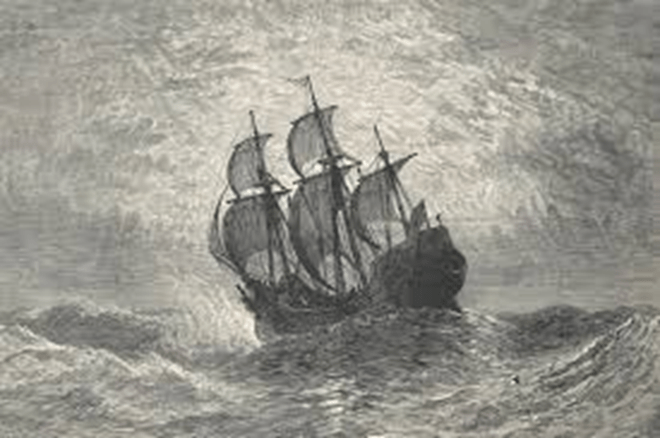
Of 102 Pilgrims that landed on the shores of Massachusetts in November of 1620, only half survived till Spring.
In the Spring of 1621, as recorded by Pilgrim Governor William Bradford in his Of Plymouth Plantation: “About the 16th of March, a certain Indian came boldly amongst them and spoke to them in broken English. His name was Samoset. He told them also of another Indian whose name was Squanto, a native of this place, who had been in England and could speak better English than himself.”
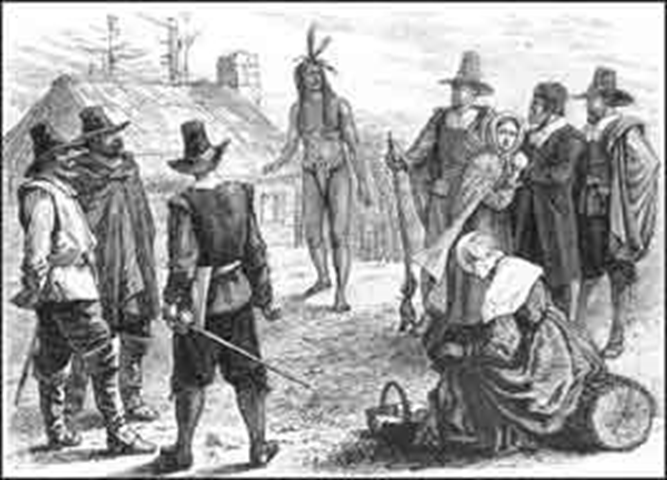
Samoset’s initial visit to the Pilgrims was recorded in Mourt’s Relation, written by Edward Winslow and Governor William Bradford in 1622: “Friday the 16th a fair warm day towards; this morning we determined to conclude of the military orders, which we had begun to consider of before but were interrupted by the savages, as we mentioned formerly; and whilst we were busied hereabout, we were interrupted again, for there presented himself a savage, which caused an alarm. He very boldly came all alone and along the houses straight to the rendezvous, where we intercepted him, not suffering him to go in, as undoubtedly he would, out of his boldness.
He saluted us in English, and bade us welcome, for he had learned some broken English among the Englishmen that came to fish at Monchiggon, and knew by name the most of the captains, commanders, and masters that usually come. He was a man free in speech, so far as he could express his mind, and of a seemly carriage. We questioned him of many things; he was the first savage we could meet withal.
We questioned him of many things; he was the first savage we could meet withal. He said he was not of these parts, but of Morattiggon, and one of the sagamores or lords thereof, and had been eight months in these parts, it lying hence a day’s sail with a great wind, and five days by land. He discoursed of the whole country, and of every province, and of their sagamores, and their number of men, and strength. The wind being to rise a little, we cast a horseman’s coat about him, for he was stark naked, only a leather about his waist, with a fringe about a span long, or little more; he had a bow and two arrows, the one headed, and the other unheaded. He was a tall straight man, the hair of his head black, long behind, only short before, none on his face at all; he asked some beer, but we gave him strong water and biscuit, and butter, and cheese, and pudding, and a piece of mallard, all which he liked well, and had been acquainted with such amongst the English.”
Mourt’s Relation continued:
“(Samoset) told us the place where we now live is called Patuxet, and that about four years ago all the inhabitants died of an extraordinary plague, and there is neither man, woman, nor child remaining, as indeed we have found none, so as there is none to hinder our possession, or to lay claim unto it.
All the afternoon we spent in communication with him; we would gladly have been rid of him at night, but he was not willing to go this night. Then we thought to carry him on shipboard, wherewith he was well content, and went into the shallop (small boat), but the wind was high and the water scant, that it could not return back. We lodged him that night at Stephen Hopkins’ house, and watched him.”
“The next day he went away back to the Massasoits, from whence he said he came, who are our next bordering neighbors. They are sixty strong, as he saith. The Nausets are as near southeast of them, and are a hundred strong, and those were they of whom our people were encountered, as before related. They are much incensed and provoked against the English, and about eight months ago slew three Englishmen, and two more hardly escaped by flight to Monchiggon; they were Sir Ferdinando Gorges his men, as this savage told us. These people are ill affected towards the English, by reason of one (Thomas) Hunt, a master of a ship, who deceived the people, and got them under color of trucking (bartering) with them, twenty out of this very place where we inhabit, and seven men from Nauset, and carried them away, and sold them for slaves like a wretched man (for twenty pound a man) that cares not what mischief he doth for his profit. Saturday, in the morning we dismissed the savage, and gave him a knife, a bracelet, and a ring; he promised within a night or two to come again, and to bring with him some of the Massasoits, our neighbors, with such beavers’ skins as they had to truck with us.”
Governor Bradford wrote that a few days later, “Tishsquantum,” or Squanto arrived with the neighboring Wampanoag Chief Massasiot: “Massasoyt, who about four or five days after, came with the chief of his friends and other attendants, and with Squanto. With him, after friendly entertainment and some gifts, they made a peace which has now continued for twenty-four years.”
Governor Bradford described Squanto: “Squanto stayed with them and was their interpreter and was a special instrument sent of God for their good beyond their expectation. He showed them how to plant corn, where to take fish and other commodities, and guided them to unknown places, and never left them till he died.”
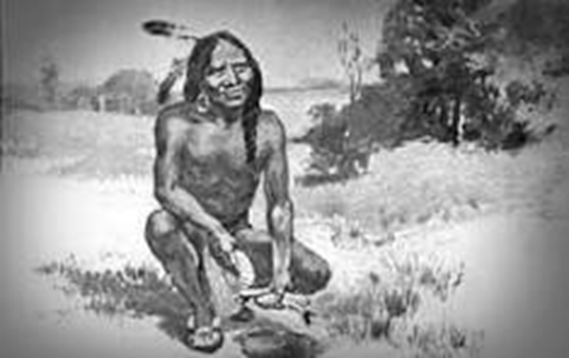
Bradford added: “The settlers, as many as were able, then began to plant their corn, in which service Squanto stood them in good stead, showing them how to plant it and cultivate it. He also told them that unless they got fish to manure this exhausted old soil, it would come to nothing, and he showed them that in the middle of April plenty of fish would come up the brook by which they had begun to build, and taught them how to catch it, and where to get other necessary provisions; all of which they found true by experience. Nor was there a man among them who had ever seen a beaver skin till they came out, and were instructed by Squanto.”
Though records are scarce, it appears that Squanto may have been one of the five natives kidnapped around 1605 by Captain George Weymouth’s expedition. Sailing his ship Archangel, Weymouth was employed by the newly formed British East India Company to find a Northwest Passage to India and China. Sea voyages to find a Northwest Passage were first conceived after the Muslim Ottoman Turks had cut off the eastern land routes to India and China a century and a half earlier. Captain George Weymouth brought the natives back to England where they were introduced to William Shakespeare and the Earl of South Hampton, who funded both Shakespeare and the voyages. Three of the natives went to live in Plymouth, England, with Sir Ferdinando Gorges, who also funded the expedition and later, the settlement of Maine.
In A Briefe Narration of the Originall Undertakings for the Advancement of Plantations into the Parts of America (London: 1658), Sir Ferdinando Gorges mentioned the name “Tasquantum’: “(Captain George Weymouth, having failed at finding a Northwest Passage) happened into a River on the Coast of America, called Pemmaquid, from whence he brought five of the Natives, three of whose names were Manida, Sellwarroes, and Tasquantum, whom I seized upon, they were all of one Nation, but of several parts, and several Families; This accident must be acknowledged the means under God of putting on foot, and giving life to all our Plantations.”
In 1614, an expedition sailed to map the coast of New England, with Squanto traveling along as interpreter. At this time, Squanto was able to return to his tribe of Patuxet.
(And as these Pilgrim leaders describe again.) In 1614, Squanto was kidnapped along with some other natives, by the wretched Captain Thomas Hunt, who took them to Malaga, Spain, a city notorious for slave trading, begun during its Muslim occupation. Had the Muslim Ottoman Empire not been occupied from the 15th to 17th centuries with conquests in Venice, Wallachia, Moldava, Hungary, Rhodes, Malta, Cyprus, Austria, and Poland-Lithuania, it may have colonized the New World, and native American culture may have been completely erased and replaced with Islamic culture, just as the Byzantine Christian culture was replaced in Turkey.
In Spain, Squanto appears to have been rescued by some Catholic friars, who may have introduced him to some Christian concepts. They proceeded to give him his freedom. Sir Ferdinando Gorges wrote in A briefe relation of the discovery and plantation of New England (1622: London), that Captain Thomas Hunt was able to sell a few natives, but when “friars of those parts” discovered his unscrupulous activity, they took the rest of the natives to be “instructed in the Christian Faith; and so disappointed this unworthy fellow of his hopes of gain.”
The friars gave Squanto his freedom and he made his way to England, where he was hired by John Slaney, treasurer of the Newfoundland Account. He then worked for Newfoundland Colony Governor John Mason, who was later granted the patent for New Hampshire. Squanto then worked for Captain Thomas Dermer, an agent of Sir Ferdinando Gorges.
Governor Bradford wrote: “Squanto was a native of these parts, and had been one of the few survivors of the plague hereabouts. He was carried away with others by one Hunt, a captain of a ship, who intended to sell them for slaves in Spain.”
Bradford continued: “(Squanto) got away for England, and was received by a merchant in London, and employed in Newfoundland and other parts, and lastly brought into these parts by a Captain Dermer, a gentleman employed by Sir Ferdinand Gorges.”
(And taking up the story of Squanto again.) In 1619, Squanto was finally able to return to his Patuxet tribe, but sadly found that they had all died in a plague. As tragic as his kidnapping had been, it may have saved Squanto from dying in that plague.
As Governor William Bradford relates: “About three years before, a French ship was wrecked at Cape Cod, but the men got ashore and saved their lives and a large part of their provisions. When the Indians heard of it, they surrounded them and never left watching and dogging them till they got the advantage and killed them, all but three or four, whom they kept, and sent from one Sachem to another, making sport with them and using them worse than slaves.”
Other such accounts were related by French Catholic missionaries. Though they were unarmed and sought to peacefully reach natives, many suffered the fate of martyrs. One was Fr. Isaac Jogues, who taken prisoner by the Iroquois in 1641. Indians gnawed off two of his fingers and roughly sawed off his thumb. He was forced to run the deadly gauntlet, as described in The Jesuit Martyrs of North America, but before they could kill him, he escaped. He wandered till he found some Dutch fur traders who helped him make his way back to Quebec. From there, he was able to sail back to France.
Isaac Jogues later returned to America to continue his missionary work, where he was eventually killed
Bradford concluded more of the story of Squanto: “In Manamiock Bay where Squanto had gone to help Captain Standis as a guide, He fell ill of Indian fever, bleeding much at the nose, which the Indians take for a symptom of death, and within a few days he died. He begged the Governor to pray for him, that he might go to the Englishmen’s God in Heaven, and bequeathed several of his things to some of his English friends, as remembrances. His death was a great loss.”
As half of the Pilgrims died that first winter, there was the real possibility that they would not have survived another, had it not been for Squanto.
Governor Bradford acknowledged:
“Squanto was a special instrument sent of God for their good beyond their expectation.“
 True Texan Tales