Many colonies were attempted in America. The Pilgimes, without a Charter, even formed their own government structure. Yet, most all were wiped out by the indians. However, Virginia was the first English colony in America that lasted. Its history is rather amazing, especially its religious history. I thought you may be interested in reading about America’s first English colony. Please do so below: Ron
Virginia

In 1585, Sir Walter Raleigh attempted to settle Roanoke Island, Virginia, which he named after the “Virgin Queen” Elizabeth the First.

The Grant for the Colony stated: “Elizabeth, by the Grace of God and of England, Defender of the Faith, grant to our trusty and well beloved servant Walter Raleigh to discover barbarous lands, not actually possessed of any Christian Prince, nor inhabited by Christian People. Upon finding such remote lands it shall be necessary for the safety of all men to live together in Christian peace, Ordinances agreeable to the laws of England, and also so as they be not against the true Christian faith.”
Thomas Jefferson wrote in his Autobiography, 1821: “The first settlers of Virginia were Englishmen, loyal subjects to their King and Church, and the grant to Sir Walter Raleigh contained an express proviso that their laws ‘should not be against the true Christian faith, now professed in the Church of England.'”
Unfortunately, due to the Spain’s Invincible Armada attacking England in 1588, supplies to the Roanoke colony were delayed. When ships finally arrived in 1590, they found the Roanoke settlement abandoned, causing it be referred to as the “Lost Colony.”

Sir Walter Raleigh personally lost 40,000 pounds sterling on the venture.
After more than two decades, the Virginia Company was formed. One of the investors in the Virginia Company was the Earl of Southampton, who also financed William Shakespeare.
King James the First granted to the Virginia Company the First Charter of Virginia, April 10, 1606, which stated: “For the Furtherance of so noble a Work, which may, by the Providence of Almighty God, hereafter tend to the Glory of His Divine Majesty, in propagating of Christian Religion to such People, as yet live in Darkness and miserable Ignorance of the true Knowledge and Worship of God.”
The next year, Captain Christopher Newport arrived on April 26, 1607, with 105 settlers on the ships Susan Constant, Godspeed, and Discovery. Their “First Landing” was at Cape Henry, named for Prince Henry of Wales, the eldest son of King James I.
Their first act was to erect a wooden cross and commence a prayer meeting, led by Church of England minister, Rev. Robert Hunt.
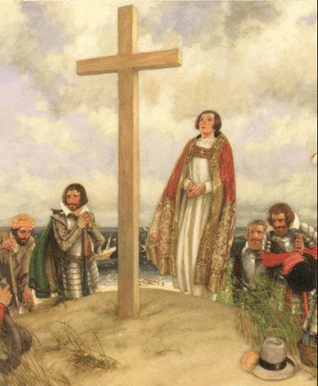
They ascended the James River, named for King James I, and settled Jamestown, the first permanent English settlement in America.
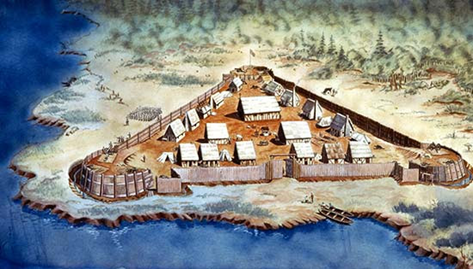
One of Jamestown’s leaders was Captain John Smith, who served on the Council and a one year term as Governor. As recorded in his book, The True Travels, Adventures and Observations of Captain John Smith in Europe, Asia, Africa and America. He had previously spent five years fighting the armies of Ottoman Sultans Mehmed III and Ahmed I in the Long Turkish War, 1593-1606, in Hungary, Wallachia, Moldova, Romania and Transylvania near the Black Sea. During one of the campaigns led by Romanian Prince Michael the Brave, John Smith introduced ingenious battle tactics using gunpowder, which resulted in a victory and his promotion to captain.
In one incident, Smith killed three Turks in hand-to-hand combat, for which he was awarded a coat of arms.

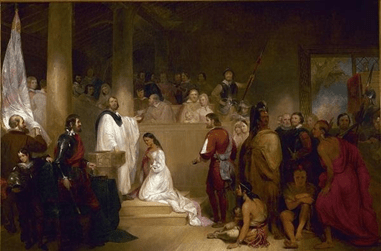
Captain John Smith was captured, made a slave in Constantinople, killed his master, escaped to Russia, then fought the Ottoman navy on the Mediterranean before returning to England in 1605, and setting sail for Virginia in 1606. After landing in Virginia, Smith was exploring in December of 1607 and captured by Chief Powhatan, who intended to bash his brains out, till his daughter Pocahontas interceded. Pocahontas later was baptized, the painting of which is in the U.S. Capitol Rotunda
As Indians smoked tobacco in “peace pipes,” and Indians were healthy, people in England thought that smoking tobacco would make one healthy, thus causing a great demand for the crop.
On May 23, 1609, King James granted a Second Charter of Virginia, which stated: “The principal Effect which we can expect is the Conversion and reduction of the people in those parts unto the true worship of God and the Christian Religion. It shall be necessary for all such of our loving Subjects to live together, in the Fear and true Worship of Almighty God, Christian Peace, and civil Quietness, with each other.”
The Colony was almost abandoned in 1610, had it not been for the providential arrival of more settlers and supplies brought by Lord De La War, for whom the Colony of Delaware was later named.
The Third Charter of Virginia, March 12, 1611, stated: “Our loving Subjects for the Propagation of Christian Religion, and Reclaiming of People barbarous, to Civility and Humanity, We have granted unto them the first Colony in Virginia.”
In May of 1611, the London Company sent Sir Thomas Dale to Virginia. He sailed up the James River and founded Henricus, the colony’s second settlement, also named after James’ eldest son, Prince Henry.
In 1619, Henricus became the location of the first English hospital in America and the first chartered college in the English colonies, initially designed for Powhatan’s children to learn trades, agriculture, and Christianity, “the work of conversion.”
Unfortunately, it was destroyed in the 1622 Indian uprising. The uprising started after Chief Powhatan died.
The new chief, Opechancanough, led coordinated surprise attacks in which Indians killed 347 men, women and children in outlying settlements, a full quarter of Virginia’s entire population.

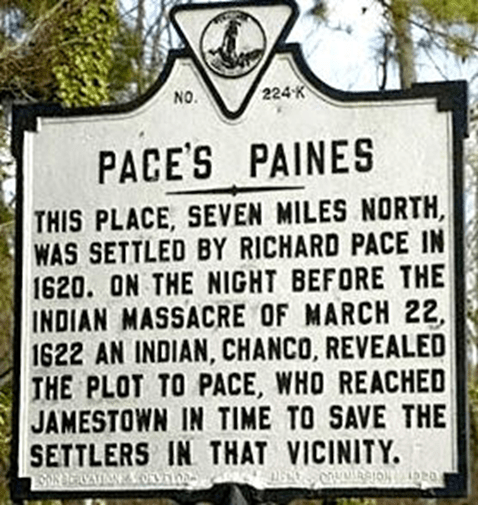
Fortunately for Jamestown, an Indian convert to Christianity named Chanco, saved the town by warning Richard Pace. The account to the London Company, stated: “This slaughter was a deep and grievous wound to the yet weak and infant colony; but it would have been much more general, and almost universal, if God had not put it into the heart of a converted Indian, to make a discovery. This convert, whose name was Chanco, lived with one Richard Pace, who treated him, as his own son. The night before the massacre, another Indian, his brother, was with him; and told him of the Chief’s command, and that the attack would be performed the next day and urged him to rise and tell Pace. As soon as his brother was gone, the Christian Indian rose, and went and revealed the whole matter to Pace; who immediately gave notice thereof to Captain William Powel, and having secured his own house, rowed off before day to James-Town, and informed the Governor of it.”
A plaque erected at Jamestown reads: “In memory of Chanco, the Indian who lived with Richard Pace, in this county, and who on the night of March 22, 1622, informed Pace of Opechancanough’s plot and thus saved the Jamestown Colony.”
The Colony of Virginia suffered many droughts, famines, starvation, diseases, and attacks. Jamestown’s mortality rate was so high, that at times the dead were buried in mass graves. Between1608 and 1624, of the 6,000 settlers that came to Jamestown, only 3,400 survived.
Unfortunately, in 1624, King James the First revoked the Virginia Company charter and ruled directly over Virginia as a Royal Crown Colony.
Thus, the official denomination in Virginia was the Church of England, which was established from 1606 till 1786.
Noah Webster’s 1828 Dictionary defined “establishment” of religion as “The episcopal form of religion, so called in England.” Establishment also meant that settlers had to take the “oath of supremacy.” The Oath of Supremacy, 1535, stated: “I declare that the King’s Highness is the only Supreme Governor of this Realm in all Spiritual or Ecclesiastical things.”
Church attendance was now mandatory. The Virginia House of Burgesses passed an ordinance in 1623: “To see that the Sabbath was not profaned by working or any employments, or journeying from place to place, On March 5, 1624, Virginia’s legislature passed the ordinance: “Whosoever shall absent himself from Divine service any Sunday without an allowable excuse shall forfeit a pound of tobacco”
It continued: “That there be an uniformity in our Church as near as may be to the Canons in England and that all persons yield ready obedience unto them under pain of censure.”
In 1699, the Virginia Assembly adopted the statutes of monarchs William and Mary allowing for limited toleration of some Protestant dissenters.

James Madison wrote to Robert Walsh, March 2, 1819: “The English Church was originally the established religion. Of other sects there were but few adherents, except the Presbyterians who predominated on the west side of the Blue Mountains. A little time previous to the Revolutionary struggle, the Baptists sprang up, and made very rapid progress. At present the population is divided, with small exceptions, among the Protestant Episcopalians, the Presbyterians, the Baptists and the Methodists.”
U.S. Supreme Court Justice Hugo Lafayette Black wrote in Engel v. Vitale, 1962: “As late as the time of the Revolutionary War, there were established Churches in at least eight of the thirteen former colonies. The successful Revolution against English political domination was shortly followed by intense opposition in Virginia where the minority religious groups such as Presbyterians, Lutherans, Quakers and Baptists had gained such strength.”
Justice Black continued: “In 1785-1786, those opposed to the established Church obtained the enactment of the famous ‘Virginia Bill for Religious Liberty’ by which all religious groups were placed on an equal footing.”
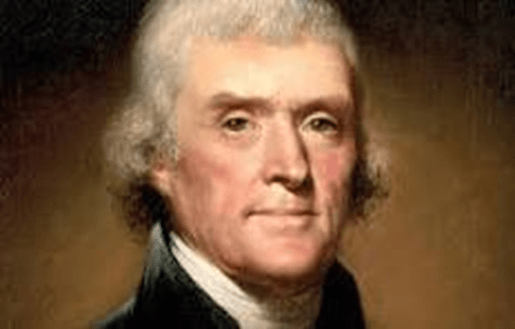
The “Virginia Bill for Religious Liberty,” drafted by Thomas Jefferson, prevented the government from infringing on the rights of conscience, January 16, 1786: “Almighty God hath created the mind free, and manifested his supreme will that free it shall remain by making it altogether insusceptible of restraint; that all attempts to influence it by temporal punishments are a departure from the plan of the holy author of our religion, who being lord both of body and mind, yet chose not to propagate it by coercions on either, as was in his Almighty power to do, but to extend it by its influence on reason alone”
Jefferson continued: “To compel a man to furnish contributions of money for the propagation of opinions which he disbelieves and abhors, is sinful and tyrannical, that laying upon him an incapacity of being called to offices of trust unless he renounce this or that religious opinion, is depriving him injuriously of those privileges to which he has a natural right, that the opinions of men are not the object of civil government, nor under its jurisdiction; that to suffer the civil magistrate to intrude his powers into the field of opinion is a dangerous fallacy, which at once destroys all religious liberty, because he being of course judge of that tendency will make his opinions the rule of judgment, and approve or condemn the sentiments of others, that truth is great and will prevail if left to herself”
Jefferson concluded: “Thus that no man shall be molested on account of his religious opinions or belief; but that all men shall be free to profess, and by argument to maintain, their opinions in matters of religion.”
So, because of the great victory of the American Revolution over England, all these protestant churches in Virginia now had complete freedom to worship God as they felt divinely directed.
 True Texan Tales