In the historic 2024 election, President Donald J. Trump not only won the electoral vote but also the popular vote. This puts those accusing him of being a “threat to democracy” in an awkward position. Since the majority of citizens voted for him, those organizing resistance are now the ones being a “threat to democracy,” as they are resisting a democratically-elected President. Elon Musk remarked on TCN on X, October 7, 2024: “Those who are saying that Trump is a threat to democracy are themselves actually the threat to democracy”
It is important for Americans to understand what a Democracy is vs. a Republic. Please read the following so that you will know for sure:
In Greek, the word “demos” means “people” and “cracy” means “to rule.” A “democracy” is where the citizens rule themselves. The people are king.
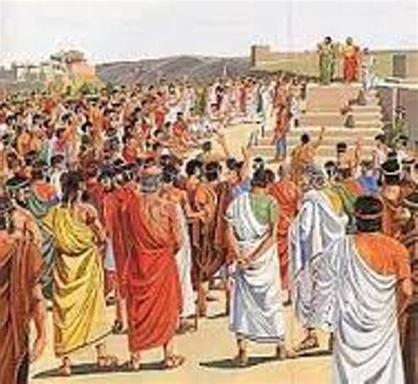
“Democracy” has two basic definitions. One is a reference to “popular” government, where the population is involved in ruling itself. This definition was popularized by President Roosevelt during World War Two, contrasting democracy with Germany’s National Socialist Workers Party; and by President Truman during the Cold War, contrasting democracy with the Union of Soviet Socialist Republics.
Truman stated in his Inaugural Address, January 20, 1949: “Communism is based on the belief that man is so weak and inadequate that he is unable to govern himself, and therefore requires the rule of strong masters. Democracy is based on the conviction that man has the moral and intellectual capacity, as well as the inalienable right, to govern himself with reason and justice.”
The other definition of democracy is a reference to the specific political system, such as what existed in the Greek city-state of Athens.
Noah Webster’s 1828 Dictionary has the definition: “Government by the people; a form of government, in which the supreme power is lodged in the hands of the people collectively, or in which the people exercise the powers of legislation. Such was the government of Athens.”
As a political system, democracy such as that in Athens only worked on a small-scale. It was very time consuming, as every citizen was required to be present at every meeting, every day to talk about every issue. Those refusing to get involved It was very time consuming, as every citizen was required to be present at every meeting, every day to talk about every issue. Those refusing to get involved in politics were liable to penalties. Logistically, it could not function in an area larger than a city, as citizens were not able to travel longer distances to be in attendance everyday.
“Politics” is simply the “business of the city.” Residents of the “polis” were called “polités,” and the way they treated each other was called being “polite.”
In Latin, “city” residents were called “citi-zens,” and the way they treated each other was called being “civil.” Citizens not keeping up with what was being talked about everyday were called “idiotes.”
Thomas Sowell wrote in “Degeneration of Democracy,” June, 2010: “A democracy needs informed citizens if it is to thrive, or ultimately even survive.”
Will and Ariel Durant wrote in The Lessons of History (Simon & Schuster, 1968): “Democracy is the most difficult of all forms of government, since it requires the widest spread of intelligence, Ignorance, lends itself to manipulation by the forces that mold public opinion.”
Public opinion in ancient Greece was molded by the speaking technique of rhetoric, using ethos, logos, and pathos to persuade citizens. Public opinion was also molded by the Greek invention of theater, with comedies, tragedies and satires. Plays ridiculed certain points of view and honored others. From that time till now, media and entertainment have always been political in a country where it is the people who make the decisions. “Polités,” or “citizens,” ruled themselves, governing as co-rulers, co-sovereigns, co-kings.
Webster’s 1828 Dictionary defined “KING” as: “The chief or SOVEREIGN of a nation; a man invested with supreme authority over a nation, tribe or country; a monarch. Kings are absolute.”
Where kings have “subjects” who are subjected to the king’s will, democracies and republics have “citizens” who rule themselves.
The Greek city-state of Athens had about 6,000 citizens, who were called out of their homes to gather in the market place, called “agora,” to discuss city business. The gathering of citizens was called “ekklesia” – “ek” means “out of” and “klesia” means “calling.” Jesus used this word when he said in Matthew 16:18, “upon this rock I will build my ekklesia or congreation.”
What is the difference between a democracy and a republic? Where a democracy could only get as large as a city, as every citizen had to be present everyday, a “republic” could grow larger, as citizens could take care of their families and farms, and send a representative in their place to the marketplace to talk politics everyday.
A “republican” form of government is a “representative” form of government. Where in a “democracy” citizens rule themselves directly — being physically present at every meeting, a “republic” is where citizens rule indirectly through representatives.

The United States is a constitutional republic, with democratically-elected representatives. Representatives are limited by rules set forth in the constitution. Most importantly, the purpose of America’s constitutional republic is to guarantee to each citizen their Creator-given rights, as acknowledged in the Declaration of Independence.
Jefferson wrote to the citizens of South Carolina, March 23, 1801: “The will of the people is the only legitimate foundation of our government, and to protect its free expression should be our first object.”
America’s constitutional republic was an unprecedented experiment.
President Theodore Roosevelt stated in 1903: “In NO other place and at NO other time has the experiment of government of the PEOPLE, by the PEOPLE, for the PEOPLE, been tried on so vast a scale as here in our own country.”

Thomas Jefferson wrote in 1801 to Joseph Priestley (ME 10:229): “We can no longer say there is nothing new under the sun. For this whole chapter in the history of man is new. The great extent of our republic is new. Its sparse habitation is new. The mighty wave of public opinion which has rolled over it is new.”

Americans “pledge allegiance to the flag, and to the republic for which it stands.” We are basically pledging allegiance to us being in charge of ourselves. When someone protests the flag, what they are effectively saying is, “I don’t want to be king anymore. I protest this system where I participate in ruling myself.”

So, then the subject comes up: “Should churches be involved in politics?” Well, in America, it was actually the churches that created the politics! Nearly a century before Europe’s “Age of Enlightenment,” while most of the world was still ruled by kings, tsars, sultans, emperors, and chieftains, Pilgrims and Puritans fled from the King of England to settle New England. They adapted the ancient Hebrew Republic’s “covenant” government into the congregational church structure which was then adapted into their civil government structure.
Most of the history that we have preserved of the politics of the firt colonies in New England are the sermons that were preached in their churches where the pastors were instructing the congregations on who to vote for.
In 1636, Congregational minister, Rev. Thomas Hooker, and his whole church, left Massachusetts to found Hartford, Connecticut. When they got there, the church members wanted to know what kind of government they should set up. His church members asked him to preach a sermon on how they should set up their government.

Rev. Hooker began his sermon, May 31, 1638, citing the Bible verse: “Deuteronomy 1:13 ‘CHOOSE YOU wise men and understanding and known among your tribes and I will make them heads over you captains over thousands, captains over hundreds, fifties, tens ‘”
Rev. Hooker continued: “The choice of public magistrates belongs unto THE PEOPLE by Gods own allowance. The privilege of election ,belongs to THE PEOPLE, according to the blessed will and law of God. They who have power to appoint officers and magistrates it is in their power also to set the bounds and limits of the power and places unto which they call them. The foundation of authority is laid firstly in the free consent of THE PEOPLE.”
In Hartford’s Travelers Square there is a bronze statue of Connecticut’s first settlers with a plaque which reads: “In June of 1635, about one hundred members of Thomas Hooker’s congregation arrived safely in this vicinity with one hundred and sixty cattle. They followed old Indian trails from Massachusetts Bay Colony to the Connecticut River to build a community. Here they established the form of government upon which the present Constitution of the United States is modeled.”
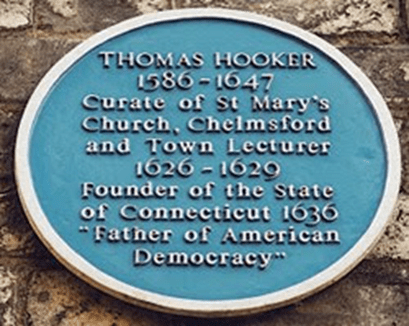
Yes, the Constitution of the United States was modeled on that famous sermom of Rev. Thomas Hooker.
President Gerald Ford stated at Southern Methodist University, September 13, 1975: “Never forget that in America our SOVEREIGN is the CITIZEN. The State is a servant of the individual. It must never become an anonymous monstrosity that masters everyone.”
President Calvin Coolidge stated in July of 1926, at the 150th anniversary of the Declaration of Independence: “It can scarcely be imagined that Jefferson was unacquainted when he took up the task of drafting the Declaration of Independence, the sermons of these early pastors. Coolidge wrote: ‘The end of all good government is to cultivate humanity and promote the happiness of all and the good of every man in all his rights, his life, liberty, estate, honor, and so forth.’

Again Coolidge stated: ‘Democracy is Christ’s government in church and state. Here was the doctrine of equality, popular sovereignty, and the substance of the theory of inalienable rights clearly asserted by these early pastors at the opening of the eighteenth century, just as we have the principle of the consent of the governed stated by Rev. Hooker as early as 1638.”
Coolidge concluded: “This was their theory of democracy. In those days such doctrines would scarcely have been permitted to flourish and spread in any other country. In order that they might have freedom to express these thoughts and opportunity to put them into action, whole congregations with their pastors had migrated to the colonies.”

Ronald Reagan opened the John Ashbrook Center in 1983, stating of America’s founders: “The Founding Fathers understood that only by making government the servant, not the master, only by positing SOVEREIGNTY in THE PEOPLE and not the state can we hope to protect freedom.”
 True Texan Tales