On NOVEMBER 21, 1620 (NS), the Pilgrims signed the Mayflower Compact and
began their Plymouth Colony. Of the 102 Pilgrims, only 47 survived till Spring. At one point, only a half dozen were healthy enough to care for the rest.
In the Spring of 1621, the Indian Squanto came among them, and showed them how to catch fish, plant corn, trap beaver, and was their interpreter with the other Indian tribes.
Governor William Bradford described Squanto as “a special instrument sent of God for their good beyond their expectation.”
“The settlers began to plant their corn, in which service Squanto helped them greatly. In the middle of April plenty of fish would come up the brook and (he) taught them how to catch them.”
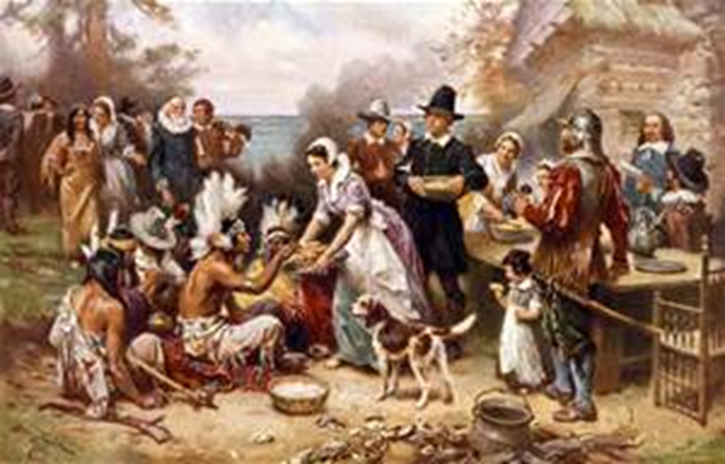
Pilgrim Edward Winslow recorded in Mourt’s Relation that in the Fall of 1621: “God be praised we had a good increase. Our harvest being gotten in, our governor sent four men on fowling, that so we might after a special manner rejoice together after we had gathered the fruit of our labors. These four in one day killed as much fowl as, with a little help beside, served the company almost a week. At which time, amongst other recreations, we exercised our arms, many of the Indians coming amongst us, and among the rest their greatest king Massasoit, with some ninety men, whom for three days we entertained and feasted, and they went out and killed five deer, which they brought to the plantation and bestowed on our Governor, and upon the Captain and others. And although it be not always be so plentiful, as it was at this time, with us, yet by the goodness of God, we are so far from want, that we often wish you partakers of our plenty.”
Bradford described the same event: “And besides waterfowl there was great store of wild turkeys, of which they took many, besides venison, etc. Besides, they had about a peck a meal a week to a person, or now since harvest, Indian corn to that proportion.”
Historian Jeremy Dupertuis Bangs explained how Pilgrims thanked God: “Our knowledge of the 1621 Thanksgiving comes from the Pilgrim leaders, Winslow and Bradford. Winslow’s choice of words, understood by his contemporaries, implies to us that the Pilgrims gave thanks to God for their preservation and for the plenty that gave hope for the future. Winslow specifically tells us that the colonists sat down with their native neighbors and enjoyed several days of peaceful rejoicing together. It is a history with potent symbolism, and it needs neither apology nor distortion.”
Bangs added: “When Winslow described the Pilgrims’ intention, ‘after a more special manner to rejoice together, after we had gathered the fruit of our labors,’ he was alluding to John 4: 36 and to Psalm 33. The first is, ‘And he that reapeth, receiveth wages, and gathereth fruit unto life eternal, that both he that soweth, and he that reapeth, might rejoice together.'”
In 1622, the friendly Indian Chief Massasoit became ill. Pilgrim leader Edward Winslow visited and doctored him. He thankfully regained health, which contributed to a peace which lasted over 50 years.
Edward Winslow was especially grateful, because the Indian tradition was, if a person doctored a chief and the chief died, that person died too.
Ben Franklin wrote of the Pilgrims’ Thanksgiving (The Compleated Autobiography by Benjamin Franklin, editors Mark & Jo Ann Skousen, Regnery, 2006, p. 331): “There is a tradition that in the planting of New England, the first settlers met with many difficulties and hardships, as is generally the case when a civiliz’d people attempt to establish themselves in a wilderness country. Being so piously dispos’d, they sought relief from heaven by laying their wants and distresses before the Lord in frequent set days of fasting and prayer.
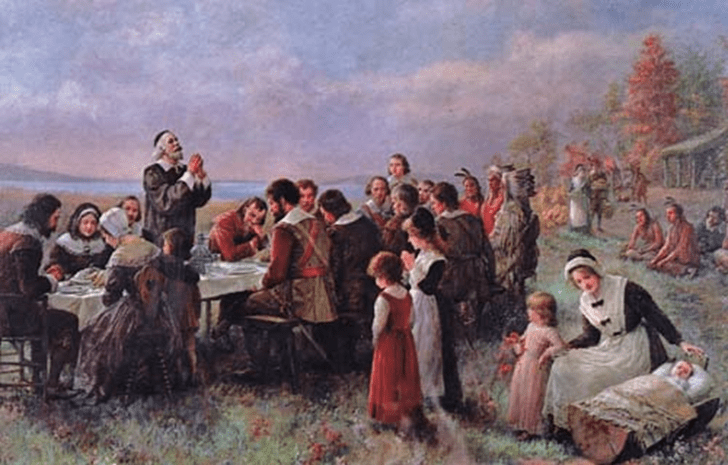
Constant meditation and discourse on these subjects kept their minds gloomy and discontented, and like the children of Israel there were many dispos’d to return to the Egypt which persecution had induc’d them to abandon.”
Franklin continued:
“At length, when it was proposed in the Assembly to proclaim another fast, a farmer of plain sense rose and remark’d that the inconveniences they suffer’d, and concerning which they had so often weary’d heaven with their complaints, were not so great as they might have expected, and were diminishing every day as the colony strengthen’d; that the earth began to reward their labour and furnish liberally for their subsistence; that their seas and rivers were full of fish, the air sweet, the climate healthy, and above all, they were in the full enjoyment of liberty, civil and religious. He therefore thought that reflecting and conversing on these subjects would be more comfortable and lead more to make them contented with their situation; and that it would be more becoming the gratitude they ow’d to the divine being, if instead of a fast they should proclaim a thanksgiving.
His advice was taken, and from that day to this, they have in every year observ’d circumstances of public felicity sufficient to furnish employment for a Thanksgiving Day, which is therefore constantly ordered and religiously observed.”
 True Texan Tales