St. Nicholas is the most renowned saint in Greek Orthodox tradition.
He was the Bishop of Myra in 4th century in Asia Minor, imprisoned by Romans; preached against immorality and exposure of infants; defended the Trinity; confronted corrupt politicians; and was generous to the poor. But how did Saint Nicholas turn into our Santa Clause? Please read the following and you will know. Ron
St. Nicholas died December 6, 343 AD.
In the 5th century a church was named for him in the city of Myra, modern-day Demre, Turkey. When it was damaged in an earthquake in 529 A.D., Emperor Justinian rebuilt it.
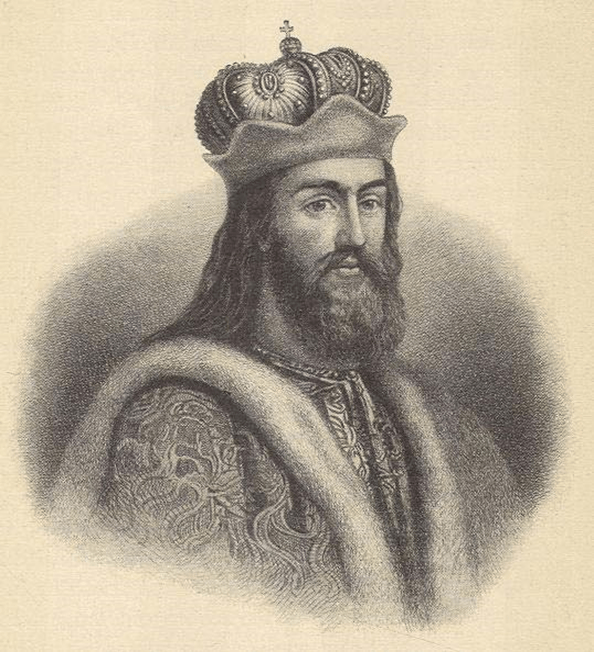
In 988 AD, Vladimir the Great of Russia converted to Eastern Orthodox Christianity and adopted Nicholas as the “patron saint” of Russia.
In the 11th century, Islamist Seljuks Turks, invaded Asia Minor, killing Christians. All seven churches mentioned in the Book of Revelation were destroyed. Graves were desecrated.
Islamic Hadith Sahih Muslim (Book 4, No. 2115) stated: “Do not leave an image without obliterating it, or a high grave without leveling it.”
There was concern that the grave of St. Nicholas would be desecrated, as years earlier, in 846 A.D., 10,000 Muslim Saracens sailed up the Tiber River and sacked Rome, desecrating the remains of St. Peter and St. Paul.
In a panic, Christians in Myra, Asia Minor, shipped the remains of St. Nicholas in 1087 to the south east coast of Italy, to the town of Bari.
Pope Urban the Second dedicated the church there, naming it after St. Nicholas — Basilica di San Nicola de Bari.
This officially introduced the Greek St. Nicholas to Western Europe.
Turks intensified their invasion, causing so many Greek Christians to flee that Pope Urban the Second went to the Council of Claremont in 1095 and begged European monarchs to send help. Europe sent help — it was called the First Crusade.
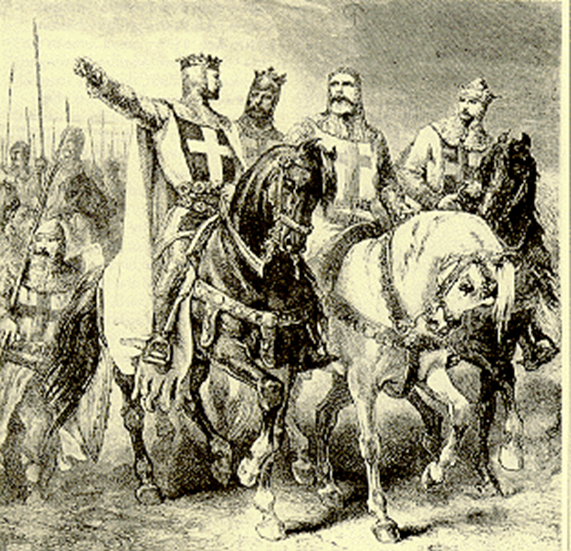
In a backwards sense, Western Europe might not have had St. Nicholas traditions if it had not been for Islamists invading Eastern Europe.
Once St. Nicholas’ remains were in Italy, western Europeans quickly embraced the gift-giving traditions associated with him. By 1223, so much attention was given to gift-giving during the Christmas season that pious St. Francis of Assisi, sort of in protest, created the first creche or nativity scene, with Joseph, Mary and baby Jesus.

He wanted to get back to the real reason for the season: Jesus, the Son of God, was born in a manager. John 1:14 declared: “And the Word became flesh and dwelt among us.” Isaiah 7:14 foretold: “Therefore the Lord himself shall give you a sign; Behold, a virgin shall conceive, and bear a son, and shall call his name Emmanuel.” Emmanuel means God with us!
In 1517, Martin Luther began the Reformation.
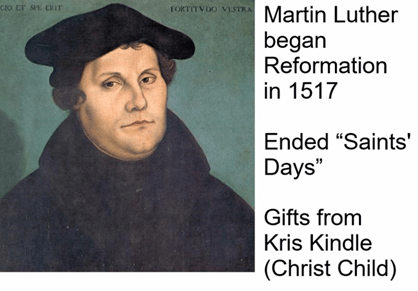
Luther considered “saints days” a distraction from Christ, so he effectively ended them in Protestant countries, including the popular December 6th “St. Nicholas Day.” Since Germans like the gift-giving, Martin Luther moved the giving to December 25th to emphasize that all gifts come from the Christ Child.
The German pronunciation of Christ Child was “Christkindl,” which over the centuries became pronounced “Kris Kringle.”
Britain used to be a Roman colony since Julius Caesar first invaded in 55 B.C. Saturn was the Roman god of feasting, plenty, and merriment. If you remember the Christmas Carol by Charles Dickens, the Ghost of Christmas Present is depicted as a big guy with robes, a wreath on his head, and a goblet of wine. Looking at him, you are asking yourself, who is this guy? He sort of looks like Santa, but he also looks like a Roman god. Well, that was Saturn, but they Christianized him and called him Father Christmas. They could not call him St. Nicholas because he was outlawed by England’s Reformation.

During Henry the Eighth’s reign, Christmas in England became a party time, like Mardi Gras. People forget that Mardi Gras originally was a religious day. It was the day before Lent, when people fasted 40 days before Easter to celebrate the Resurrection of Jesus. But over time Mardi Gras became a lewd party in New Orleans.
Puritans viewed Christmas as having become too worldly. Puritan leader, Rev. Cotton Mather told his congregation, December 25, 1712: “Can you in your conscience think, that our Holy Savior is honored, by Mad Mirth, by long Eating, by hard Drinking, by lewd Gaming, by rude Reveling; by a Mass fit for none but a Saturn or a Bacchus, or the Night of a Mahometan Ramadan? You cannot possibly think so! A Multitude of the Heavenly Host was heard Praising of God. But shall it be said, That at the Birth of our Saviour for which we owe as high Praises to God as they can do, we take the Time to Please the Hellish Legions, and to do Actions that have much more of Hell than of Heaven in them?”
“Puritans took over England in 1642.
Puritans passed an ordinance, December 1643: “Sins of our forefathers have turned this feast of Christ, into an extreme forgetfulness of him, by giving liberty to carnal and sensual delights.
In 1647, Puritans in England outlawed Christmas.
When Pilgrims first disembarked the Mayflower, the ship master Christopher Jones wrote in his log, December 25, 1620:
“At anchor in Plymouth harbor, Christmas Day, but not observed by these colonists, they being opposed to all saints’ days.
A year later, at the end of 1621, Pilgrim Governor William Bradford recorded in Of Plymouth Plantation, of another boatload arriving with more settlers: “Herewith I shall end this year – except to recall one more incident, rather amusing than serious. On Christmas Day the Governor called the people out to work as usual; but most of the new company excused themselves, and said it went against their consciences to work on that day. So the Governor told them, if they made it a matter of conscience, he would spare them till they were better informed.”
Bradford continued: “So he went with the rest, and left them; but on returning from work at noon he found them at play in the street, some pitching the bar, some at stool-ball, and such like sports. So he went to them and took away their games, and told them that it was against his conscience that they should play and others work. If they made the keeping of the day a matter of devotion, let them remain in their houses; but there should be no gaming and reveling in the streets.”
Where Pilgrims, Puritans and most Presbyterians did not celebrate Christmas, other immigrants did celebrate Christmas, such as Germans, French, Swedes, English, Welsh, and especially the Dutch.
When they read……Revelation 19:14, the saint will ride with Him dressed in ” fine linen, clean and white is the righteousness of the saints. And the armies which were in heaven followed him upon white horses, clothed in fine linen, white and clean.”
The reasoning went, that since St. Nicholas was a saint, he would certainly be one of multitude riding white horses returning with Jesus.
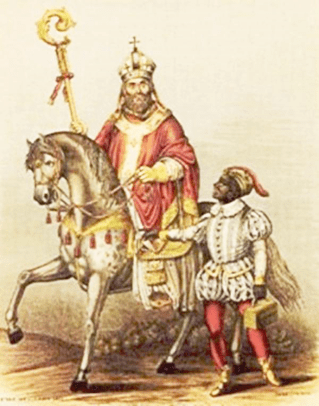
But since St. Nicholas was such a special saint, the Dutch had him coming back once a year for a mini-judgement day, to check up on the children, to see if they are on the right track before the real Judgement Day.
Over the centuries the story evolved. The Books of Works and the Lamb’s Book of Life were turned into the Book of the Naughty and Nice. The angels turned into elves. Saints came from Heaven, the New Jerusalem, the Celestial City — which turned into the North Pole.
The North Pole is not far from Finnish Lapland near the Arctic Circle in the northern Scandinavian Peninsula. Since there were few horses there, St. Nicholas rode a reindeer, which then became riding in a sleigh.
The Dutch holiday tradition is that St. Nicholas comes once a year to give presents to good children. But the naughty children had something else to look forward to.
Beginning in 1624, Dutch immigrants brought St. Nicholas traditions to New Amsterdam, which became New York in 1664. Dutch called Saint Nicholas – “Sant Nikolaus” or “Sinter Klass,” which became pronounced “Santa Claus.” “Santa Claus” is simply the Dutch pronunciation of Saint Nicholas.
In New York, Washington Irving, considered the Father of American Literature, wrote Legend of Sleepy Hallow and Rip Van Winkle. He coined the name “Gotham” for New York City.” Irving was also a founding member of the St. Nicholas Society of the City of New York, 1835, to celebrate the city’s heritage. In it, he described St. Nicholas visiting once a year, but no longer wearing a bishop’s outfit, but a typical Dutch outfit of long-trunk hose, leather belt, boots, a hat, and a pipe: Washington Irving wrote further: “So we are told, in the sylvan days of New Amsterdam, the good St. Nicholas would often make his appearance in his beloved city, of a holiday afternoon, riding jollily among the treetops, or over the roofs of houses, now and then drawing forth magnificent presents from his breeches pockets, and dropping them down the chimneys of his favorites.
Irving wrote how Dutch settlers continued the tradition of hanging stockings by the fireplace: “At this early period was instituted that pious ceremony, still religiously observed in all our ancient families of the right breed, of hanging up a stocking in the chimney on St. Nicholas Eve; which stocking is always found in the morning miraculously filled; for the good St. Nicholas has ever been a great giver of gifts, particularly to children. Nor was the day of St. Nicholas suffered to pass by without making presents, hanging the stocking in the chimney, and complying with all its other ceremonies.”
Clement Clarke Moore Park is located at the corner of 10th Avenue and 22nd Street. Moore helped Trinity Church establish a new church on Hudson Street – St. Luke in the Fields.
In 1823, Clement Moore wrote a poem for his six children titled “A Visit From St. Nicholas”:
‘TWAS the night before Christmas, when all through the houseNot a creature was stirring,not even a mouse; The stockings were hung by the chimney with care, In hopes that ST. NICHOLAS soon would be there.”
“When, what to my wondering eyes should appear, But a miniature sleigh, and eight tiny reindeer, With a little old driver, so lively and quick, I knew in a moment it must be ST. NICK.”
“So up to the house-top the coursers they flew, With the sleigh full of Toys, and ST. NICHOLAS too.”
“As I drew in my head, and was turning around, Down the chimney ST. NICHOLAS came with a bound.”
Clement Moore described St. Nicholas as smaller: “He was chubby and plump, a right jolly old elf, And I laughed when I saw him, in spite of myself.”
Though much has been added on to the story throughout the centuries, underneath it all, there really was a godly, courageous Christian Bishop who lived in 4th century Asia Minor, named Nicholas.
- Nicholas was a Christian;
- he loved Jesus enough go into the ministry;
- he chose being imprisoned by the Romans rather than deny his Christian faith;
- he stood for the doctrine of the Trinity;
- he preached against sexually immoral pagan temples and the killing of innocent babies;
- he confronted corrupt politicians; and
- most notably of all, St. Nicholas was very generous, giving away all his money to help the poor in their time of need, and doing it anonymously, as he wanted the credit to go, not to himself, but to God alone!
 True Texan Tales