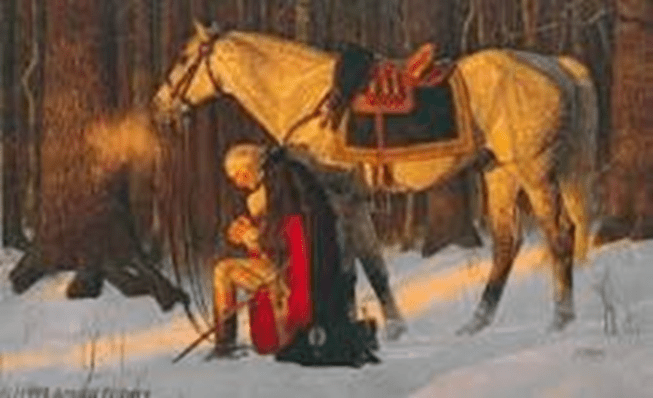
On Christmas Eve Genaeral Washington’s little army was camped there in the snow by the Deleware river. Congress had not provided them with any provisions, or clothing, or even shoes. Many were barefoot in the snow and leaving blood upon it. It was a desperate situation. A big army of brutal, highly trained Hessians, employed by the British was camped across the river. General Washington got on his knees and asked God what to do……..the answer was “attack or die”. And that is what he told his men. Do read what happened then in the following narrative:
Catherine the Great of Russia, who reigned 1762-1796, rebuffed King George III’s requests and bribes to have Russia side with Britain during the Revolutionary War.
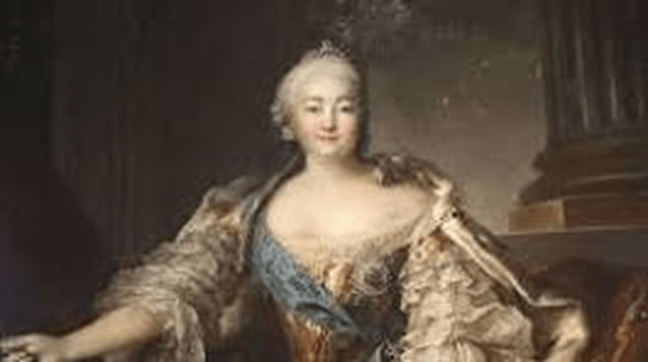
Instead, Russia continued trading with the American colonies, providing much needed supplies. Other countries that helped supply Americans with arms. supplies, and personnel, both overtly and covertly, were France, the Netherlands, and Spain. Courageous individuals, acting in their own private capacity, also came to help America from Ireland, Prussia, Bavaria, Poland-Lithuania, and Hungary.
Russia’s Catherine the Great even attempted to negotiate a peace with France and Britain to bring an early end to the war in America’s favor. Catherine had earlier deposed her husband, Tsar Peter III, in a coup. She then fought the Russo-Turkish War (1768-1774), against the Muslim Ottoman Turkish Empire.
Her General, Alexei Grigoryevich Orlov destroyed the Ottoman navy at the Battle of Chesma, July 5-7, 1770 — it was the worst defeat for Ottoman navy since the Battle of Lepanto in 1571.
The same time, 38,000 Russians defeated 80,000 Muslim Tatar cavalry and infantry at the Battle of Larga, July 7, 1770.
Two weeks later, Russia defeated another 175,000 Turks at the Battle of Kagul.
These defeats shocked the Ottoman Empire.
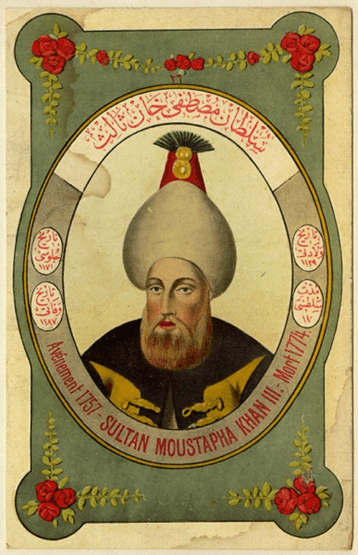
When Sultan Mustfa III (1717-1774), who had given himself the title Cihangir “World Conqueror,” heard the news he reportedly had a heart attack, from which he died.
Russian military leaders began talk of a campaign to emancipate oppressed Christians under Ottoman rule, and free Constantinople, which had been the capital of the Christian world for nearly a thousand years. Their plans, though, were interrupted by the French Revolution.
America’s first minister to the Russian Court of Catherine the Great was Francis Dana, a member of the Continental Congress, being assisted 1781-1783 by the young John Quincy Adams — the future 6th US President.
Back in America, during the Revolutionary War, British troops defeated the Continental Army at the Battle of Brooklyn Heights, August 27, 1776. Thus, General Washington was forced to retreat. The Continental Army was then driven out of New York, across New Jersey and into Pennsylvania.
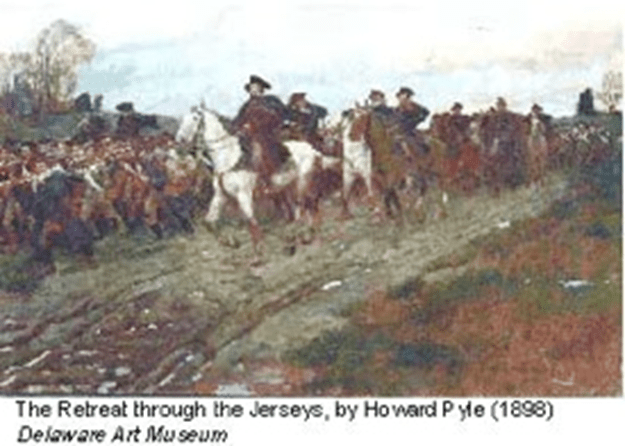
In the following six months, despite Congress approving the Declaration of Independence, the Continental Army’s ranks dwindled from a high of 20,000 down to just 2,000 as of December of 1776. Most of the remaining soldiers were planning on leaving at the end of year, as they had only volunteered for a six-month enlistment, needing to get back home to care for their neglected farms, shops and families. General Washington rallied his troops to stay by having Thomas Paine’s “The American Crisis” read to them.
It began: “These are the times that try men’s souls. The summer soldier and the sunshine patriot will, in this crisis, shrink from the service of his country.”
Philadelphia fell into a panic as fear set in that British troops would invade and occupy the city, which they did later the next year.
Congress’ last instruction to General Washington, December 12, 1776, was: “Until Congress shall otherwise order, General Washington shall be possessed of full power to order and direct all things relative to the operations of the war.”
Washington proposed a daring military operation, but insisted his officers keep it under strictest secrecy, as the British were paying spies in gold for information.
Washington made the password for his operation “Victory or Death.”
This reflected Washington’s General Orders, which he had issued months before on July 2, 1776: “The time is now near at hand which must probably determine whether Americans are to be freemen or slaves; whether they are to have any property they can call their own; whether their houses and farms are to be pillaged and destroyed, and themselves consigned to a state of wretchedness from which no human efforts will deliver them. The fate of unborn millions will now depend, under God, on the courage and conduct of this army. Our cruel and unrelenting enemy leaves us no choice but a brave resistance, or the most abject submission. We have, therefore to resolve to conquer or die.”
On Christmas Day evening,1776, Washington’s troops quietly crossed the dangerous, ice-filled Delaware River in a freezing blizzard.
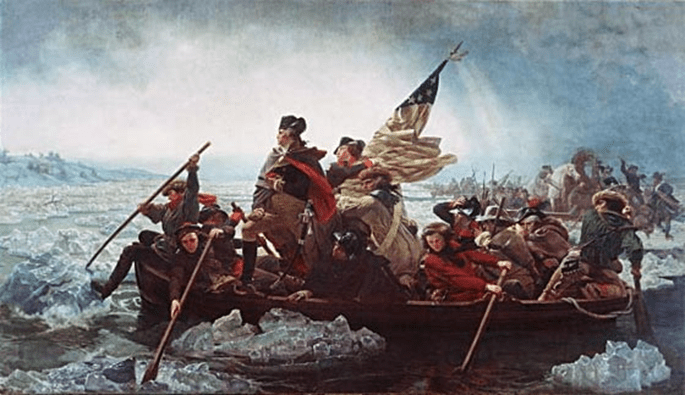
In the iconic painting of the Delaware Crossing, the black soldier rowing next to George Washington is thought to be his bodyguard, freed slave Toby Gilmore. After the War, Toby Gilmore was given a cannon in recognition of his valuable service, which, according to tradition, he kept on his farm in Raynham, Massachusetts, and publicly fired every Fourth of July. Today it is in the Old Colony Historical Society Museum in Taunton, Massachusetts.
After crossing the Delaware, the army trudged through blinding snow in strict silence. Two soldiers froze to death on the march.
Washington’s army attacked the German Hessian troops stationed at Trenton, New Jersey, at daybreak, December 26, 1776.
Though King George III was unsuccessful in getting Russian troops, he arranged to hire the feared, brutal Hessian mercenaries.
One of Washington’s aides-de-camp, the Irish Catholic Colonel John Fitzgerald, made note of his opinion that Hessians might be vulnerable on Christmas Day, as: “They make a great deal of Christmas in Germany, and no doubt the Hessians will drink a great deal of beer and have a dance tonight.”
Hessians were skilled in European warfare where enemies faced off opposite of each other in an open field. They were not prepared for Americans firing from behind trees, walls, and fence posts.
American captain Alexander Hamilton maneuvered his six-pound cannons into position and fired them down King Street, tearing into the Hessian ranks.

Hessian colonel Johann Rall was shot. Without him, the Hessian troops soon surrendered. Americans captured nearly a thousand Hessians in just over an hour.
Of the Americans who were wounded were: William Washington, a cousin of General Washington; and the young Lieutenant James Monroe, the future 5th U.S. President, who was struck by a musket ball in the arm and bleeding badly. Doctor John Riker clamped the artery and saved his life.
Yale President Ezra Stiles stated in an Election Address to the Connecticut General Assembly, May 8, 1783: “In our lowest and most dangerous estate, in 1776 and 1777, we sustained ourselves against the British Army of 60,000 troops commanded by the ablest generals Britain could procure throughout Europe, with a naval force of 22,000 seamen in above 80 men-of-war.
Heaven inspired us with resolution to cut the Gordian knot in the glorious act of Independence sealed and confirmed by God Almighty in the victory of General Washington at Trenton. Who does not see the indubitable interposition and energetic influence of Divine Providence in these great and illustrious events?”
Ezra Stiles continued: “Who but a Washington, inspired by Heaven, could have struck out the great movement and maneuver of Princeton, that Christmas (Day) eve when Washington and his army crossed the Delaware? The United States are under peculiar obligations to become a holy people unto the Lord our God.”
Washington wrote August 20, 1778: “The Hand of Providence has been so conspicuous in the course of the war that he must be worse than an infidel that lacks faith, and more wicked that has not gratitude to acknowledge his obligations to God”
 True Texan Tales