The YMCA has grown to be the oldest and largest youth charity in the world, with a membership of millions in 124 countries. In many places like in Hong Kong it has its own hotel where I have stayed several times. It even spawned the invention of Basketball and Volleyball. If you would like to read about its founding and amazing growth, I have prepared the following for you:
The founder of the YMCA was George Williams, who was born in 1821 on an English farm in Dulverton, Someset.
Baptized into the Church of England, he described himself growing up to be “a careless, thoughtless, godless, swearing young fellow.”
As a result, his family sent him away to apprentice at a draper’s shop in Bridgwater.
In 1837, Williams converted to Congregationalism and became an active member of the Zion Congregational Church.
He moved to London in 1841, and worked his way up to be a draper shop department manager.
Attending Weigh House Congregational Church, he became active in evangelizing.
Williams was inspired by reading Revival Lectures, published in 1835 by American lawyer-turned preacher Charles Finney.

Finney’s Lectures on Revival also inspired William and Catherine Booth who founded an organization in London to fight child sex-trafficking, preaching the saving Gospel among the poor – The Salvation Army.
Williams was appalled at the immoral conditions surrounding young working men, so he gathered his fellow drapers in London and, on June 6, 1844, founded a place where young men could go and not be tempted into sin.
It was called the YMCA, and pioneered integrating prayer and bible study with athletics.
This was the beginning of the 19th century movement known as “Muscular Christianity,” which led to the concept of “good sportsmanship.”
Williams named this interdenominational Christian organization the Young Men’s Christian Association (YMCA), to be a: “refuge of Bible study and prayer for young men seeking escape from the hazards of life on the streets.”

One of George William’s earliest converts and contributors was his employer, George Hitchcock, whose daughter, Helen, Williams married in 1853.
Concerned with keeping young men from temptation, especially sexual sin and immorality, Sir George Williams stated: “My life-long experience as a business man, and as a Christian worker among young men, has taught me that the only power in this world that can effectually keep one from sin, in all its varied and often attractive forms is that which comes from an intimate knowledge of the Lord Jesus Christ as a present Savior.”
Williams continued:
“And I can also heartily testify that the safe Guide-Book by which one may be led to Christ is the Bible, the Word of God, which is inspired by the Holy Ghost.”
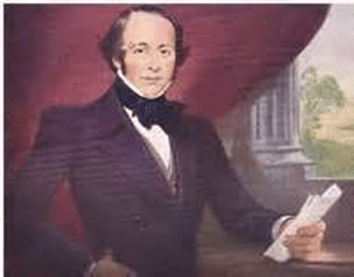
After 50 years of bringing young men to Christ, Williams was knighted by Queen Victoria in 1894.
YMCA Founder Sir George Williams died November 6, 1905.
He was buried in the historic St. Paul’s Cathedral.
A stained-glass window in his honor was placed in Westminster Abbey.
In Montreal, Canada, the YMCA founded Sir George Williams University. Though later merged into Concordia University, it retained the campus name “Sir George Williams Campus.”

The early 1881 emblem for the YMCA had the names of the five parts of the world: Europe, Asia, Oceania, Africa and America.

It has grown to be the oldest and largest youth charity in the world, with a membership of millions in 124 countries.
An early emblem of the YMCA had at the center an open Bible displaying John 17:21, referencing the verse: “That they all may be one; as thou, Father, art in me, and I in thee, that they also may be one in us: that the world may believe that thou hast sent me.”
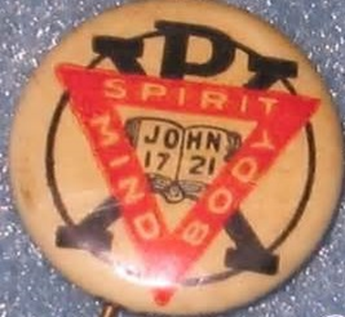
Underneath the triangle were the letters XP, called the “Chi-Rho,” which were the first two Greek letters of the name of Christ — “Χριστοῦ.”
In 1885, the words “Spirit-Mind-Body” in a triangle were added by Dr. Luther Gulick, Jr., director of the YMCA International Training School in Springfield, Massachusetts.
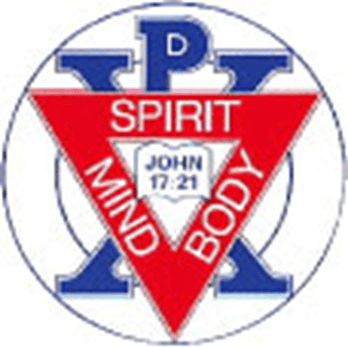
Dr. Gulick stated: “The triangle stands for the symmetrical man, each part developed with reference to the whole, and not merely with reference to itself. What authority have we for believing that this triangle idea is correct? It is scriptural. Such statements as, “Thou shalt love the Lord Thy God with all they heart and soul and mind and strength,” indicate the scriptural view that the service of the Lord includes the whole man. The words, which in the Hebrew and Greek are translated “strength,” refer in both cases entirely to physical strength.”
In Switzerland, the Geneva chapter of the YMCA was founded by Henri Dunant in 1852.
Dunant wrote (Martin Gumpert, Dunant, The Story of the Red Cross, NY: Oxford University Press, 1938, p. 22): “A group of Christian young men has met together in Geneva to do reverence and worship to the Lord Jesus whom they wish to serve. They have heard that among you, too, there are brothers in Christ, young like themselves, who love their Redeemer and gather together that under His guidance, and through the reading of the Holy Scriptures, they may instruct themselves further. Being deeply edified thereby, they wish to unite with you in Christian friendship.”
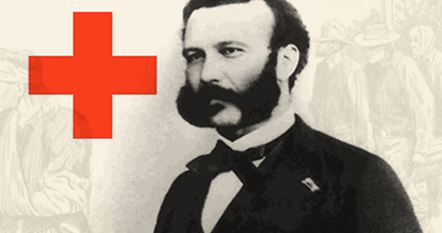
Henri Dunant then founded the International Red Cross in 1863, for which he became the first recipient of the Nobel Peace Prize.

During the Civil War, D.L. Moody ministered to soldiers on the battle-lines with the YMCA’s United States Christian Commission. He went on to become an internationally renown evangelist.

When the 1871 Great Chicago Fire destroyed Chicago’s YMCA, D.L. Moody raised funds to rebuild it.

Chicago White Stocking baseball star Billy Sunday began attending YMCA meetings in 1886 before beginning his career as a revival preacher.

YMCA instructor James Naismith, at the behest of Dr. Gulick, invented the game of Basketball in 1891, at the YMCA International Training School in Springfield, Massachusetts.

YMCA missionaries took Basketball around the world.
In 1892, William Morgan came to study at the International Young Men’s Christian Association Training School — Springfield College. After meeting James Naismith, Morgan invented the game of Volleyball in 1895, at the YMCA in Holyoke, Massachusetts.

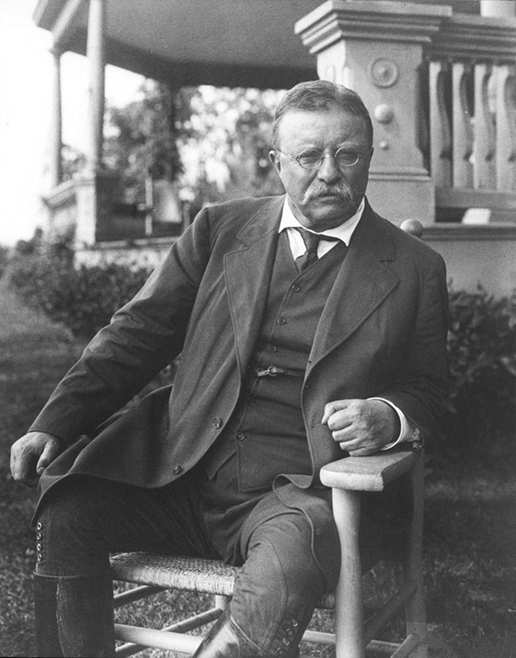
Theodore Roosevelt also championed muscular Christianity, addressing the Holy Name Society, August 16, 1903:
“I am not addressing weaklings, or I should not take the trouble to come here. I am addressing strong, vigorous men, who are engaged in the active hard work of life … men who will count for good or for evil who have strength to set a right example to others. You cannot retain your self-respect if you are loose and foul of tongue, that a man who is to lead a clean and honorable life must inevitably suffer if his speech likewise is not clean and honorable.”
“A man must be clean of mouth as well as clean of life — must show by his words as well as by his actions his fealty to the Almighty. We have good Scriptural authority for the statement that it is not what comes into a man’s mouth but what goes out of it that counts.”
He added:
“Every man here knows the temptations that beset all of us in this world. At times any man will slip. I do not expect perfection, but I do expect genuine and sincere effort toward being decent and cleanly in thought, in word, and in deed. I expect you to be strong. I would not respect you if you were not.
I do not want to see Christianity professed only by weaklings; I want to see it a moving spirit among men of strength.”
 True Texan Tales