Most folks dont know about the very old civilization of the Armenians, and its very important part in world history. In fact, it is so important that I thought that you would want to know more about it. Its history is so colossal that I have needed to put it into two parts. Below is the first part that I hope you will read with interest. Ron
One of the oldest civilizations is that of the Armenians. According to ancient tradition, Noah’s Ark rested on Mount Ararat in the Armenian Mountain Range.
Noah’s Ark on Mount Ararat is featured on Armenia’s National Coat of Arms.

The ancient Armenian historian Movses Khorenatsi (410-490 AD) recounted the tradition that Noah’s son Japheth had a descendant named Hayk.
He refused to submit to Bel (Nimrod), builder of the Tower of Babel in Babylon. Bel (Nimrod) was the first tyrant of the ancient world who centralized government power.
In this legend, Hayk reportedly led his people north to the land near Mount Ararat, but Bel (Nimrod) chased them. In a battle near Lake Van (c.2492 or 2107 BC), Hayk is said to have pulled his powerful long bow and made a nearly impossible shot with an arrow and killed Bel (Nimrod).
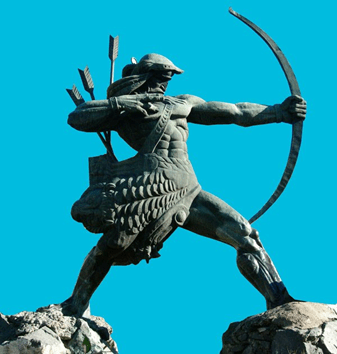
Hayk is the origin of “Hayastan,” the Armenian name for Armenia.
Armenia’s major city of Yerevan, founded in 782 BC in the shadow of Mount Ararat, is one of the oldest continuously inhabited cities in the world.
Armenia was mentioned in the Book of Isaiah when King Sennacherib of Assyria invaded Judah around 701 BC. In this national emergency, King Hezekiah and the Prophet Isaiah prayed and Judah was miraculously saved.
Sennacherib returned to Assyria, where he was killed by his sons who then escaped to Armenia: “And it came to pass, as Sennacherib was worshiping in the house of Nisroch his god, that Adrammelech and Sharezer his sons smote him with the sword; and they escaped into the land of Armenia.” (Isaiah 37:38)
Armenia was first mentioned by name in secular records in 520 BC by Darius the Great of Persia in his Behistun inscription, as being one of the countries he sent troops into to put down a revolt.
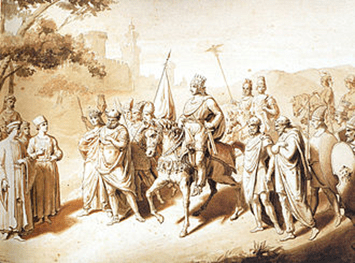
In 331 BC, Alexander the Great conquered Persia, but never conquered Armenia.
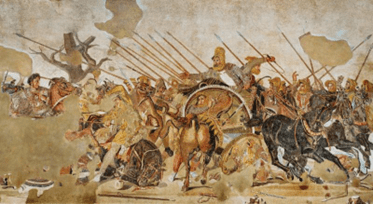
In 67 BC, Roman General Pompey invaded the nearby Kingdom of Pontus on the Black Sea. Its king, Mithridates VI, fled to Armenia, which unfortunately implicated that country in the Mithridatic Wars with Rome.
Adding to the tension, King Tigranes’ son wanted to overthrow his father, so he foolishly invited Pompey to invade Armenia. Pompey let King Tigranes continue to rule in exchange for tribute, but arrested the son and sent him back to Rome as a prisoner.
Then Pompey received word that there was a terrible civil war going on in Judea between the Sadducees and the Pharisees. He decided it was an opportune time to invade Judia.
Though the history of Judea is somewhat complicated, it is nevertheless important. In 539 BC, Cyrus of Persia let Jews return to Israel and build the Second Temple. Ezra led the nation in returning to studying the Scriptures. This was the origin of the Pharisees.
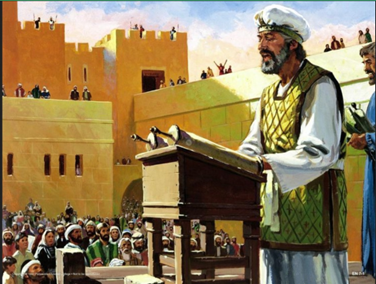
Then 336-323 BC, Alexander the Great conquered from Greece, to Egypt, to Persia, spreading the Greek language and culture all over the world, a process called “Hellenization.”
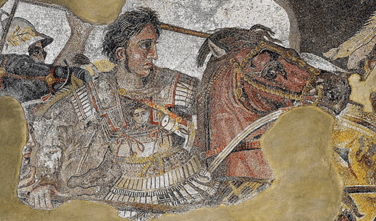
Pharisees vigorously opposed “Hellenization” as they considered Greek culture sensuous, immoral and pagan. They emphasized a decentralized system where in each village the scriptures were taught by rabbis every Sabbath in a synagogue.
Sadducees were Jews who, in varying degrees, were “Hellenized” in order to have favor with their new Greek rulers.
As a result, they were politically connected, wealthy elites in charge of the centralized priestly system of Temple worship in Jerusalem. The difference between the views of the more liberal Sadducees and more conservative Pharisees is somewhat reflected in the modern differences between Reformed Judaism and Orthodox Judaism.
When Alexander the Great died in 323 BC, four of his generals divided up his empire, with Seleucus I Nicator taking Syria to Persia, founding the Seleucid Empire in 312 BC. This included the land of Israel.
A successor Seleucid king was Antiochus IV Epiphanes. He was so intent on Hellenizing Judea that he tried to completely erase the Jewish religion.
Jews were rallied by Judah Maccabee to rebel in the Maccabean Revolt, 167-160 BC. This is commemorated by the Feast of Hanukkah.
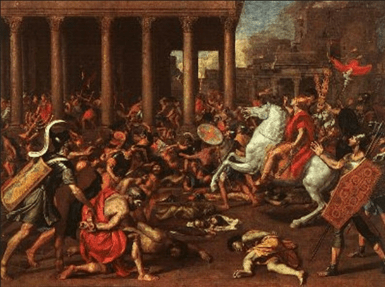
After Judah Maccabee’s death, his brother, Simon Thassi, founded the Hebrew Hasmonean Dynasty, which eventually gained independence for Judea.
Simon Thassi the Hasmonean was assassinated by his son-in-law at a banquet. Afterwards, Simon’s son, John Hyrcanus, served as both the political leader and the High Priest, though he still respected the decentralized authority of “The Assembly of the Jews.”
Hyrcanus was successful in establishing a relationship with the distant Roman Senate, getting it to recognize Judah’s independence.
When John Hyrcanus died, his son, Aristobulus I, seized control, threw his mother in prison, concentrated political power, and reestablished the monarchy. He was the first person in Jewish history to claim the actual titles of both King and High Priest.
Sadducees, who were Hellenized political insiders, had no problem with Aristobulus I having both titles. Pharisees, on the other hand, did have a problem, as they were religious students of the Law and believed that only a descendant of David could be king.
When Aristobulus I died in 103 BC, his widow, Alexandra-Salome, married his brother, Alexander Jannaeus, who also was King and High Priest.
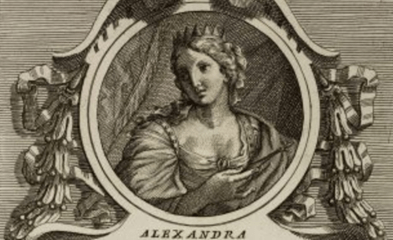
Alexander Jannaeus, a Sadducee, ordered 800 Pharisees to be crucified. When he died, his wife, Alexandra-Salome, ruled Judea, but she switched to align with the Pharisees. She ruled as a monarch and appointed her son, Hyrcanus II, to be High Priest. Judea was noticeably blessed during the reign of Alexandra-Salome.
After her death in 67 BC, her two sons started a civil war which culminated in the end of Judea’s independence. Aristobulus II, was backed by the Sadducees. Hyrcanus II was backed by the Pharisees.
As civil war violence escalated, word of it reached Roman General Pompey who was located north of Judea in the area of Pontus and Armenia. Aristobulus II sent a large golden vine weighing over 1000 lbs. to Pompey requesting his help against his brother, Hyrcanus II. Pompey decided this was the ideal time to invade Judea.
In 63 BC, Pompey left the area of Armenia and marched south toward the city of Jerusalem, which was divided into warring sections due to the civil war. Hyrcanus II and the Pharisees allowed Pompey to enter their section of the city. The Sadducees, though, refused to let Pompey into the Temple complex.
Pompey laid siege, defeated the Sadduccees, and entered the Holy of Holies of the Temple. After seeing Ark of the Covenant, he exited the Temple and forbade his soldiers from desecrating it. The next day, he order the Temple area cleansed of defilement.
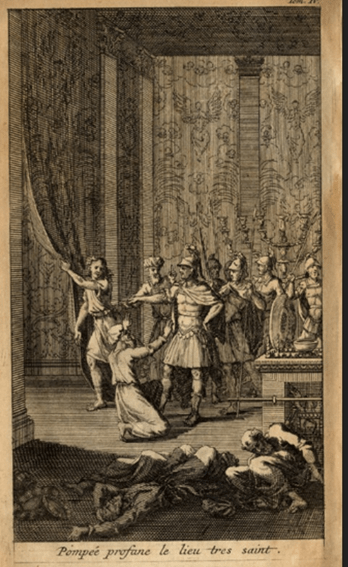
Historian Josephus wrote: “Of the Jews there fell twelve thousand and no small enormities were committed about the temple itself, which, in former ages, had been inaccessible, and seen by none; for Pompey went into it, and not a few of those that were with him also, and saw all that which was unlawful for any other men to see, but only for the High Priests. There were in that temple the golden table, the holy candlestick, and the pouring vessels, and a great quantity of spices; and besides these there were among the treasures two thousand talents of sacred money; yet did Pompey touch nothing of all this, on account of his regard to religion; and in this point also he acted in a manner that was worthy of his virtue. The next day he gave order to those that had the charge of the temple to cleanse it, and to bring what offerings the law required to God.”
Pompey ended Judea’s independence by making it a Roman province. He recognized Hyrcanus II as High Priest, but arrested Aristobulus II and sent him back to Rome as a prisoner.
Hyrcanus II was a weak ruler. He had an official named Antipater the Idumaean, who was opportunistic and forceful. Idumaea was the land of Edom, a neighboring kingdom to Judea, where lived the descendants of Esau, Jacob’s brother.
In 49 BC, a civil war broke out in the Roman Empire between Pompey and Julius Caesar. In 47 BC, a key battle took place near Alexandria, Egypt. At a critical moment in the battle, when it looked like Caesar would be defeated, Antipater the Idumaean came to his rescue.
In gratitude for his timely assistance, Caesar appointed Antipater as epitropos (regent) over Judea with the right to collect taxes, and left Hyrcanus II as High Priest. Antipater was the father of Herod the Great.
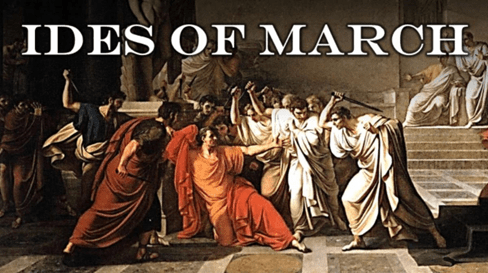
Julius Caesar was assassinated in 44 BC, and Antipater was poisoned in 43 BC. Another Roman civil war began between Caesar’s general, Mark Anthony, and Caesar’s nephew, Octavian.
Then, in 40 BC, war broke out between the Romans and the Parthians over who would rule Armenia.
The conflict spilled over into Judea.
The son of Aristobulus II, Antigonus Mattathias, sided with the Parthians and with their support, was proclaimed King and High Priest in Judea. He seized his uncle, Hyrcanus II, and, according to Josephus, bit off his ear to disqualify him from being High Priest, and had him taken away captive by the Parthians into Babylonia. In 36 BC, Antigonus was defeated by Antipater’s son, Herod, with help from the Romans. Herod ransomed Hyrcanus II from the Parthians.
Herod then ruled in Judea. He married Mariamme, the granddaughter of both Hyrcanus II and Aristobulus II, which provided Hasmonean legitimacy to Herod’s rule.
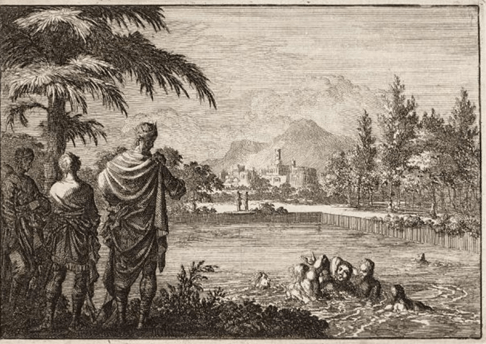
Mariamme pressured Herod to appoint her 17-year-old brother, Aristobulus III, as High Priest. Since Aristobulus III was the last male of the Hasmonean royal line, Herod feared him as a potential rival to the throne. Two years later, Herod ordered Aristobulus III to be assassinated by drowning while bathing in a pool at a party.
At the height of the Roman civil war, the naval Battle of Actium took place in 31 BC, between Octavian and Mark Anthony with Cleopatra VII of Egypt. It is considered one of the most consequential battles in history, as it effectively ended the Roman Republic and began the Roman Empire, with Octavian, the victor, becoming Emperor — the undisputed most powerful man in the world. Octavian changed his name to Augustus Caesar.
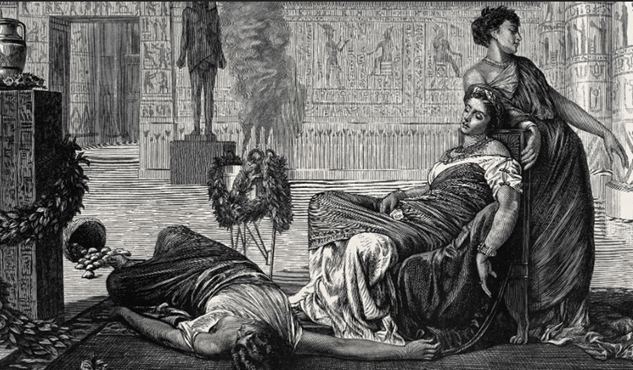
And as you have heard, Mark Anthony and Cleopatra committed suicide in Egypt.
Herod met with Augustus Caesar on the Island of Rhodes and pledged his allegiance. In return, Augustus confirmed Herod as King of Judea. Suspicious of plots against him, Herod had the 80-year-old former High Priest Hyrcanus II executed.
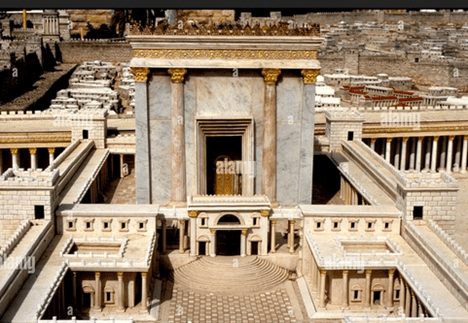
Herod the Great supported the Sadducees and funded the reconstruction of the Second Temple in Jerusalem. When Jesus’ disciples were admiring the Temple, He told them: “Do you see all these buildings? I tell you the truth, they will be completely demolished. Not one stone will be left on top of another!” (Matthew 24:2 NLT)
Herod had many wives and children. His sons by Mariamme were Aristobulus and Alexander. Alexander married a Cappadocian Princess Glapyre, and together they had a son, Tigranes V, who became the future King of Armenia.
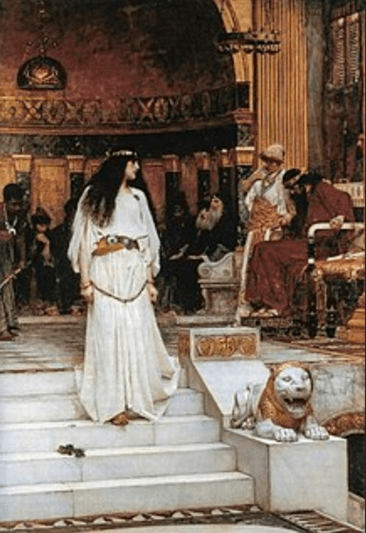
Herod was paranoid of treason. He divorced, disowned, exiled or executed many of his family, including his wife, Mariamme, and her sons, Alexander and Aristobulus; as well as Antipater, a son by another wife.
His psychotic behavior was displayed when the magi visited from the east to see the new born “King of the Jews,” resulting in Herod massacring all the male children in Bethlehem who were two years old and younger.
Herod was so hated that he feared no one would mourn him when he died, so he ordered that upon his death all the distinguished leaders in Jerusalem would be immediately arrested and executed. Herod’s son, Herod Archelaus, did not carry out this order.
Herod’s young grandson Tigranes V, after Herod had killed his father, Alexander, departed with his Cappadocian mother Glaphyra to Armenia. Glaphyra later married Herod’s son, Herod Archelaus.
Tigranes V was sent to finish his education in Rome, and afterwards he was appointed by Augustus Caesar to be King of Armenia.
Tiberius, the future Emperor, accompanied Tigranes to Armenia’s capital of Artaxata, where he was crowned in 6 AD.
In 52 AD, the King of Parthia installed his brother, Tiridates I as King of Armenia, beginning the Arsacid Dynasty. For the next several centuries, Armenia was caught in the violent middle between Rome in the West and Parthia in the East during the Roman-Parthian Wars,
According to tradition, it was during this time in the 1st century AD, that the Apostles Bartholomew and Thaddeus of Edessa went to the area of Armenia and healed Abgar V of Edessa of leprosy. They then founded the Armenian Apostolic Church, which is considered one of the oldest Christian institutions in the world.
Briefly, from 114 to 118 AD, Armenia was once again a Roman province under Emperor Trajan. In the 3rd century AD, Roman Emperor Diocletian betrayed Armenian King Tiridates III and captured large areas of Armenia.
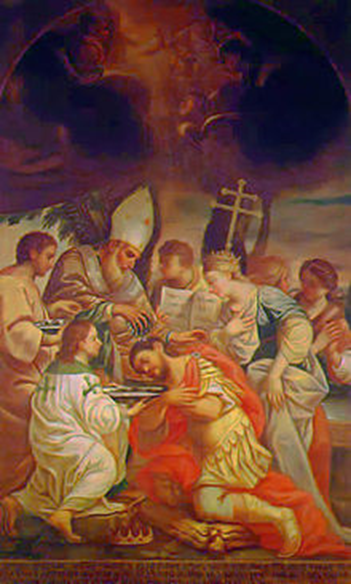
Gregory preached to King Tiridates, and then baptized him in 301 AD.
St. Gregory the Illuminator is credited with turning Armenia from paganism to Christianity.
Armenia is considered the first nation to “officially” adopt Christianity as its state religion when King Tiridates III converted in 301 AD.
In 313 AD, Constantine the Great ended the persecution of Christians throughout the Roman Empire.
 True Texan Tales