So, we held an “election” in America yesterday where we elected a new president and numerous elected represenatives. However, you may not know that the very word “election” was coined by the first churches in America and and was taken directly from the Holy Bible. Do read the following narative so that you will know about the very first elections in our country and how they came about. Ron
Theodore Roosevelt stated October 24, 1903 “In no other place and at no other time has the experiment of government of the people, by the people, for the people, been tried on so vast a scale as here in our own country.”

How did America’s experiment in self-government begin?
At a time when most of the world was ruled by kings, Americans held their first popularly elected legislative assembly.

Jamestown was initially a “company colony,” run by the 1606 Virginia Company Charter, which had by-laws and an appointed governor.
Unforeseen crises, such as famines, diseases, Indian attacks, labor shortages, and struggles to establish a cash crop necessitated the calling of the first meeting of the Virginia House of Burgesses, July 30, 1619.
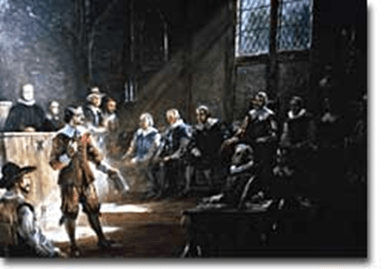
A burgess was a citizen elected to represent a “borough” (neighborhood).
There were eleven Jamestown boroughs which elected twenty-two representatives.
They met in the church choir loft. Master John Pory was appointed as the assembly’s Speaker. He wrote “A Report of the Manner of Proceeding in the General Assembly Convented at James City, July 30, 1619: “But forasmuch as men’s affairs do little prosper where God’s service is neglected, all the Burgesses took their places in the Quire (choir) till a prayer was said by Mr. Bucke, the Minister, that it would please God to guide and sanctify all our proceedings to his own glory and the good of this Plantation. The Speaker delivered in brief to the whole assembly the occasions of their meeting. Which done he read unto them the commission for establishing the Council of Estate and the general Assembly, wherein their duties were described to life and forasmuch as our intent is to establish one equal and uniform kind of government over all Virginia.”
The House of Burgesses set the price of tobacco at three shillings per pound, and passed prohibitions against gambling, drunkenness, idleness, and made it mandatory to observe the Sabbath.

The freezing winters, epidemics, and the Indian attack of March 22, 1622, where some 400 colonists were massacred, led to the Virginia Company’s Charter being revoked and the king sending over a crown governor.
In 1624, Virginia went from being a “company colony” to a “crown colony” ruled directly by the king through his royal-appointed governor.
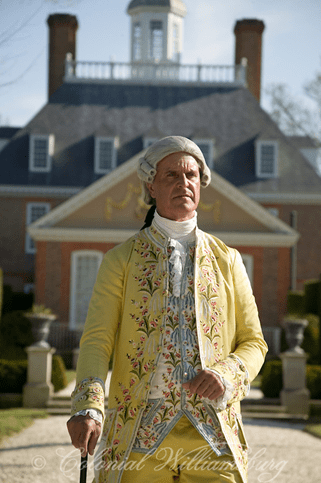
As the king did not pay the governor’s salary, the royal-appointed governor instructed the House of Burgesses to provide his funding. As long as they paid that, he did not mind them discussing other issues and otherwise functioning largely on their own.
England went through a Civil War, 1642-1651, and King Charles the First was beheaded.
During this time the House of Burgesses took an increased role in running the Colony.
In 1660, King Charles the Second was brought back from exile and restored to the throne of his father.
Soon, Virginia’s liberties returned to being restricted, leading to Nathaniel Bacon’s rebellion in 1674, which restored their liberties once again.
Virginia’s House of Burgesses served as a legislative model for other colonies.

In Massachusetts, Puritan delegates controlled the legislature, insisting that only Puritans be allowed to vote.
Various pastors thought that voting should be extended to anyone who was a Christian. These pastors led their congregations to leave and found other communities in New England.
It was in these New England communities that pastors had the freedom to apply biblical principles to voting.
- Rev. Roger Williams founded Providence, Rhode Island, in 1636;
- Rev. John Wheelwright founded Exeter, New Hampshire, in 1638;
- Rev. John Lothropp founded Barnstable, Massachusetts, in 1639;
Rev. Thomas Hooker founded Hartford, Connecticut, in 1636.
- After leading his church congregation through the wilderness they founded Hartford which greatly prospered.
(Then on May 31, 1638 one of the most important episodes in Americh history happened. It did not seem profound at the time, but for sure turned out to be.)
Rev. Thomas Hooker gave a sermon at Hartford which was now the colonies’ capitol city. In it he championed universal Christian suffrage (voting), stating: “The foundation of authority is laid firstly in the free consent of the people.”
This was a blueprint for other New England colonies and eventually the Declaration of Independence, which states: “That to secure these rights, Governments are instituted among Men, deriving their just powers from the consent of the governed.”
Hooker’s sermon had the line: “The privilege of election belongs to the people according to the blessed will and law of God.”
One of the first elections in America was in church. In 1629, the Massachusetts Bay Colony needed to select a pastor for the Salem Church. Since they did not have a king-appointed minister, members of the church fasted and prayed, then wrote on pieces of paper the name of who they thought was God’s chosen person to be the next pastor, thus allowing God’s will to expressed through them. The belief was, that God had preordained someone to be their pastor and church members were simply to recognize the one God had chosen.
Being chosen by God was called being “the elect.”
First Peter 1:1-2 “Peter, an apostle of Jesus Christ, to God’s elect.”
Paul wrote in Colossians 3:12 “As the elect of God, holy and beloved, put on tender mercies.”
Second Timothy 2:10: “I endure all things for the elect’s sakes.”
Mark 13:20 described the last days: “And except that the Lord had shortened those days, no flesh should be saved: but for the elect’s sake, whom he hath chosen, he hath shortened the days.”
The process of putting down the name of God’s “elect” was called an “election.”
This election process was revolutionary, as most of the world at the time was ruled by kings, emperors, sultans, czars and chieftains who did not ask people for their consent.

New England was the beginning of a polarity change in the flow of power, instead of government being run top-down, it became bottom-up, a model that eventually turned into the U.S. Constitution, which states: “We the People in order to form a more perfect union and secure the blessings of liberty to ourselves and our posterity do ordain and establish this Constitution.”
Instead of powerful political leaders forcing their will on the people through emergency mandates, it was the people’s will being carried out by their elected representatives.
Rev. Thomas Hooker’s sermon notes became known as the “Fundamental Orders of Connecticut,” 1639, which was used as the foundation of Connecticut’s government until 1818.
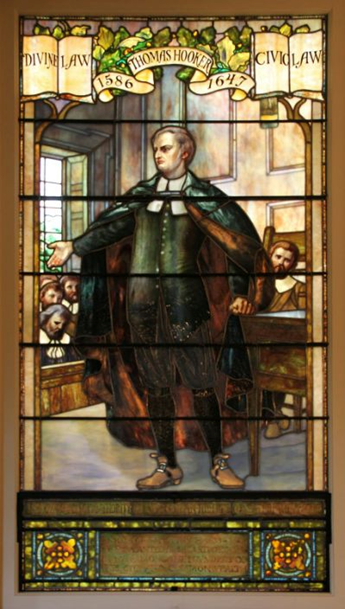
According to Connecticut historian John Fiske, the Fundamental Orders, inspired by Hooker’s sermon, comprised one of the first written constitutions in history that created a government.
Hartford’s Traveller’s Square has a bronze statue of Connecticut’s first settlers and a plaque which reads: “In June of 1635, about one hundred members of Thomas Hooker’s congregation arrived safely in this vicinity with one hundred and sixty cattle. They followed old Indian trails from Massachusetts Bay Colony to the Connecticut River to build a community. Here they established the form of government upon which the present Constitution of the United States is modeled.”
Rev. Thomas Hooker’s statue holding a Bible stands at the Old State House in Hartford, Connecticut.

The base of the statue reads: “Leading his people through the wilderness, he founded Hartford in June of 1636. On this site he preached the sermon which inspired The Fundamental Orders. It was the first written constitution that created a government.”
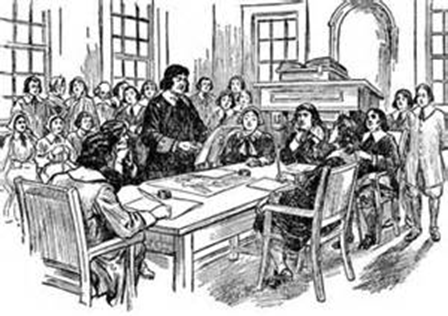
President Calvin Coolidge stated July 5, 1926: “The principles of our declaration had been under discussion in the Colonies for nearly two generations. In the assertion of the Rev. Thomas Hooker of Connecticut as early as 1638, when he said in a sermon before the General Court that: ‘The foundation of authority is laid in the free consent of the people. The choice of public magistrates belongs unto the people by God’s own allowance.’
This doctrine found wide acceptance among the nonconformist clergy who later made up the Congregational Church.”
Coolidge added:
“The principles which went into the Declaration of Independence are found in the texts, the sermons, and the writings of the early colonial clergy who were earnestly undertaking to instruct their congregations in the great mystery of how to live. They preached equality because they believed in the fatherhood of God and the brotherhood of man. They justified freedom by the text that we are all created in the divine image, all partakers of the divine spirit. Placing every man on a plane where he acknowledged no superiors, where no one possessed any right to rule over him, he must inevitably choose his own rulers through a system of self-government.
In New England, instead of “separation of church and state,” it was churches and pastors who CREATED the State!

Coolidge concluded his address: “But even in that we come back to the theory of John Wise that ‘Democracy is Christ’s government.’ The ultimate sanction of law rests on the righteous authority of the Almighty. Ours is a government of the people. It represents their will. Its officers sometimes go astray, but that is not a reason for criticizing the principles of our institutions. The real heart of the American Government depends upon the heart of the people. It is from that source that we must look for all genuine reform. It was in the contemplation of these truths that the fathers made their Declaration and adopted their Constitution.”
President Grover Cleveland stated, July 13, 1887: “The SOVEREIGNTY OF 60 MILLIONS OF FREE PEOPLE, is the working out of the divine right of man to govern himself and a manifestation of God’s plan concerning the human race.”
America’s founders set up a democratically-elected Constitutional Republic. The Pledge of Allegiance is “to the Flag and to the Republic for which it stands.” A “Republic” is where the people are king, ruling through their servants, called representatives. The word “citizen” is from the Greek and means “co-ruler” or “co-king.”
In 1832, Noah Webster wrote in his History of the United States: “When you become entitled to exercise the right of voting for public officers, let it be impressed on your mind that God commands you to choose for rulers ‘just men who will rule in the fear of God.’ The preservation of a republican government depends on the faithful discharge of this duty.”

He continued: “If the citizens neglect their duty and place unprincipled men in office, the government will soon be corrupted; laws will be made not for the public good so much as for the selfish or local purposes; corrupt or incompetent men will be appointed to execute the laws; the public revenues will be squandered on unworthy men; and the rights of the citizens will be violated or disregarded.
If a republican government fails to secure public prosperity and happiness, it must be because the citizens neglect the divine commands, and elect bad men to make and administer the laws.”
 True Texan Tales