Yes, we defeated the British in the Revolutionary War, but they were not satisfied with the result. They came back in 1812 and tried to regain territory from what was now the United States. They burned Washington D.C. and won other confrontations. They put a fleet of ships onto Lake Erie that dominated that part of the country. However, the United States constructed a fleet of ships of is own in a bay at Presque Isle on Lake Erie. 28 year old Captain Oliver Hazard Perry was put in command of this American fleet to face the powerful British ships. In their first real confrontation the long range British cannon shot Captain Perry’s flag ship the USS Lawrence all to pieces, killing 80% of his crew and damaging every gun.
But Perry did not give up. He and his remaining crew rowed in their life boats half a mile under heavy fire to the USS Niagara from which they could fight again. In what many called a “direct act of God” these experienced British sailors on the two largest British ships managed the get them entangled with each other, making them helpless. Captain Perry sailed down the British line and wiped out the whole British fleet. It was the first time in history that an entire British fleet had been wiped out in one engagement. The British summoned the Duke of Wellington to come and finish of the Americans, but he said that without control of Lake Erie, it was impossible. So, he sailed the whole British army back to Europe in defeat. If you would like to read the details of all this, I have provided them below:
1811, Britain began to intercept American ships headed to French ports.
They seized American goods and impressed thousands of American sailors into the British navy.
With Napoleon conquering Europe, Britain secretly harbored thoughts of re-acquiring some of the area it had lost to the United States.
The British Government, as it had done during the Revolutionary War, supplied weapons to Indians and incited them to terrorize and attack American frontier settlements.
In alliance with the British, Shawnee Chief Tecumseh approached many tribes across a thousand-mile frontier in an attempt to form a confederation.
In the Shawnee language, the name “Tecumseh” means “shooting star.”
The appearance of the Great Comet of 1811, which reached its brightest in October, added to the panic.
This was followed by the New Madrid Earthquakes, December 16, 1811 to February 7, 1812, which was the greatest earthquake recorded in North America.
It was felt hundreds of miles away, and even temporarily reversed the flow of the Mississippi River.
The fear associated with these events contributed to Tecumseh raising nearly 5,000 warriors under his direction.

Some were Shawnee, who had been forced from the east and resettled in northwestern Ohio and Northeastern Indiana; and Lenape who had resettled in south-central Indiana.
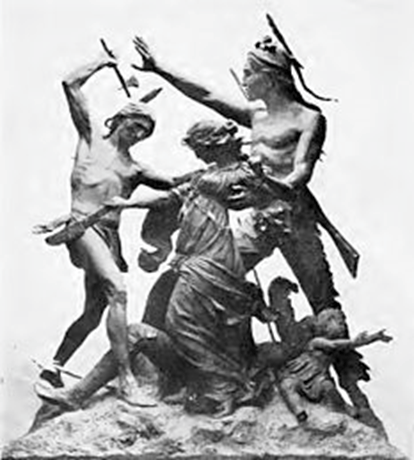
Others were from:
• Miami in central Indiana;
• Pottawatomie in northern Indiana and Michigan;
• Wea, Kickapoo and Piankeshaw in western Indiana and eastern Illinois;
• Sauk in northern Illinois;
• Iroquois in Canada;
• Chickamauga; Ojibway; Mascouten; Wyandot; Fox; Winnebago; Ottowa; Mingo; Seneca; and Red Stick Creek in Alabama.
On July 17, 1812 British and Native American tribes captured Fort Mackinac.
On August 15, 1812, Pottawatomie attacked Fort Dearborn, massacring 38 American soldiers, 2 women, 12 children, and took 41 prisoners.
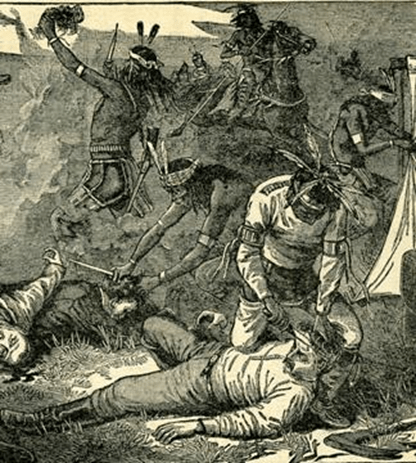
The British with Native American allies threatened or captured American forts:
• Fort Osage;
• Fort Madison;
• Fort Shelby;
• Rock Island Rapids;
• Credit Island;
• Fort Johnson;
• Fort Cap au Gris; and
• won the Battle of the Sink Hole.
700 British regulars and Canadian militia joined Tecumseh’s warriors in the capture of Fort Detroit, forcing 2,500 Americans to surrender August 16, 1812.
With a rumor British would pay in gold for American scalps, over 500 Americans were massacred by the Red Stick Creeks in Fort Mims, Alabama, August 30, 1813.
On July 23, 1813, President James Madison recommended a day of Public Humiliation and Prayer:

“Whereas in times of public calamity such as that of the war brought on the United States by the injustice of a foreign government, it is especially becoming that the hearts of all should be touched with the same feelings and the eyes of all be turned to that Almighty Power in whose hands are the welfare and the destiny of nations:
I do therefore recommend to all who shall be piously disposed to unite their hearts and voices in addressing at one and the same time their vows and adorations to the Great Parent and Sovereign of the Universe that they assemble on the SECOND THURSDAY OF SEPTEMBER next (September 9th) in their respective religious congregations.”
Madison continued:
“He has blessed the United States with a political Constitution rounded on the will and authority of the whole people and guaranteeing to each individual security, not only of his person and his property, but of those sacred rights of conscience so essential to his present happiness and so dear to his future hopes.
And with supplications to the same Almighty Power that He would look down with compassion on our infirmities, that He would pardon our manifold transgressions and awaken and strengthen in all the wholesome purposes of repentance and amendment; that in this season of trial and calamity He would inspire all citizens with a love of their country; that as He was graciously pleased heretofore to smile on our struggles against the attempts of the Government of the (British) Empire; so He would now be pleased to bestow His blessing on our arms in resisting the hostile and persevering efforts of the same power to degrade us on the ocean.”
The United States had no navy on Lake Erie.
Captain Daniel Dobbins convinced President Madison of the need of a fleet on the Lake.
Ship building supplies from Buffalo, Cleveland, Meadville, and Pittsburgh were brought to Erie, Pennsylvania, where his ships were assembled in the bay surrounded by the peninsula called Presque Isle.
Carronades (short cast-iron cannons) for the ships were made at Henry Foxall’s foundry in Georgetown.
Carronades (short cast-iron cannons) for the ships were made at Henry Foxall’s foundry in Georgetown.
Foxall reportedly promised that, if America won the War of 1812, he would build a church, which he did — Foundry United Methodist Church on 16th Street, established in 1814.
As there was no pitch on the Isle, lead was used to caulk the ships’ hulls.
It was called the Fleet of the Wilderness.
28-year-old Captain Oliver Hazard Perry was put in command of the fleet, with many of his crew being free Blacks from Ohio.

Overcoming a bout of “lake fever” (typhoid), he waited for the right opportunity to bring his ships into the Lake, as he was constantly being watched by the British fleet in the distance.
Called “Perry’s Luck”, on July 31, 1813, British General Barclay accepted a dinner invitation from the citizens of Port Dover and sailed his five ships away.
Perry quickly took advantage of this providential break and worked all night.
His 5 schooners, 3 brigs and 1 sloop, were unloaded of everything heavy, then floated across the six-foot deep sand bar where Presque Isle Bay emptied into Lake Erie.
He sailed his nine ships approximately 150 miles to Put-in-Bay on South Bass Island, where he began a blockade of the British ships at Fort Malden on the Detroit River at Amherstburg, Ontario.
Perry’s presence on the Lake prevented British ships from bringing food and supplies to Amherstburg.
Perry’s crew of nearly 500 men at South Bass Island were falling ill.
A severe algae bloom on the Lake made the water undrinkable.
It was considered as a providential gift from God, that a cave was discovered on the island where 52 feet below the surface, there was found a rare subterranean lake containing an abundance of fresh water.
British forces at Fort Malden in Amherstburg were in desperate need of food.
British Commodore Robert Barclay attempted to break Perry’s blockade with a squadron of six ships.
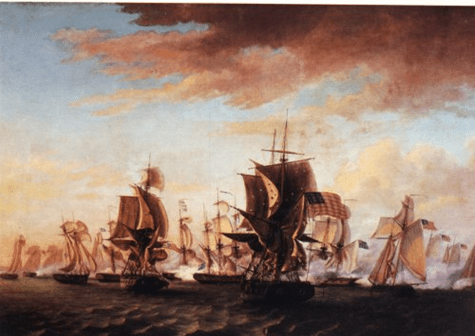
Barclay was a decorated British officer who had his arm blown off fighting Napoleon’s French fleet.
The day after the National Day of Prayer recommended by President Madison, Captain Oliver Hazard Perry confronted the British squadron on September 10, 1813.
Strong winds prevented Perry from getting into a safe position.
Long-range British cannons splintered Perry’s flagship, the USS Lawrence, to pieces, killing or wounding 80 percent of the Lawrence’s crew, leaving every gun damaged.
Faithful to his battle flag, “DON’T GIVE UP THE SHIP,” Perry and his men did not give up.
They courageously boarted their life boats, and rowed a half mile through heavy gunfire to the USS Niagara from which they could fight again.
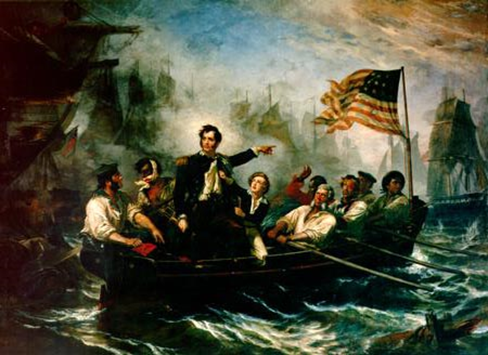
The wind suddenly changed directions.
Two British ships, HMS Detroit and HMS Queen Charlotte, attempted to maneuver and turn about, but in the process collided and became entangled, sitting helplessly in the water.
Perry sailed broadside directly across the British line, firing every cannon continuously.
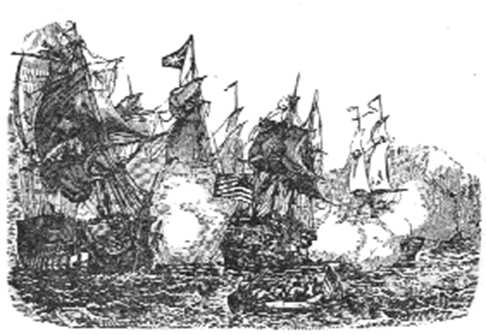
After 15 minutes, the smoke cleared to reveal that all of Barclay’s ships had been disabled.
This was the first time in history that an entire British naval squadron had been disabled at one time.
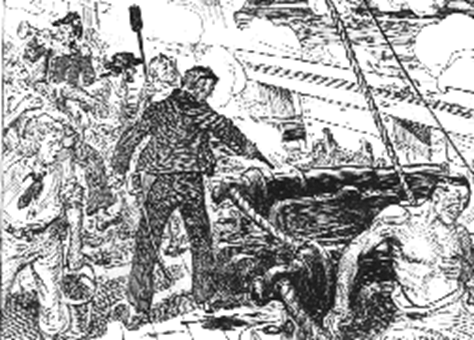
To the sailors on deck Captain Perry remarked:
“The prayers of my wife are answered.”
That same day, Captain Oliver Hazard Perry sent a dispatch to U.S. Major General William Henry Harrison:
“Dear Gen’l, WE HAVE MET THE ENEMY, AND THEY ARE OURS, two ships, two brigs, one schooner and one sloop. Yours with great respect and esteem. H. Perry.”
Captain Oliver Hazard Perry wrote to the Secretary of the Navy:
“It has pleased the Almighty to give the arms of the United States a signal victory over their enemies on this lake.
The British squadron, consisting of two ships, two brigs, one schooner, and one sloop have this moment surrendered to the force of my command after a sharp conflict.”
The British summoned the Duke of Wellington to recapture western Canada, but Wellington refused, stating that without naval control of Lake Erie, it would be impossible.
(Two years later the Duke of Wellington defeated Napoleon at the Battle of Waterloo, June 18, 1815.)
President James Madison stated in his 5th Annual Message, December 7, 1813:
“It has pleased the Almighty to bless our arms. On Lake Erie, the squadron under the command of Captain Perry having met the British squadron of superior force, a sanguinary (bloody) conflict ended in the capture of the whole.”
As a result of Perry’s victory, the British abandoned Fort Malden.
Major General William Henry Harrison was then able to recapture Fort Detroit and defeat the British and their Indian ally Shawnee Chief Tecumseh at the Battle of the Thames, October 5, 1813.
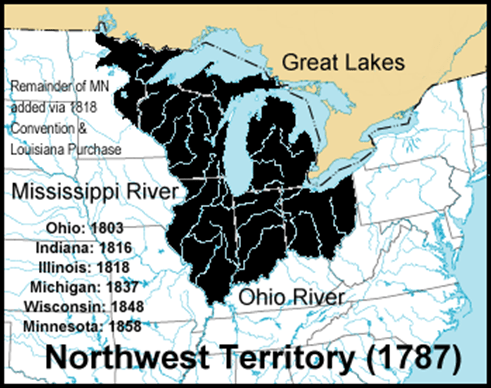
This was decisive in securing for the United States the Northwest Territory, from which eventually six states were formed.
Captain Oliver Hazard Perry died August 23, 1819, being hailed as a national hero for his victorious role in the War of 1812.
It was reported that near the end of the Revolutionary War, when Benjamin Franklin was informed that Americans had won independence, he remarked: “Sir, you mean the Revolution, the War of Independence is yet to come.”
After Perry’s Battle of Lake Erie, together with the American’s victory in the War of 1812, the United States could finally claim to have won independence.

 True Texan Tales