In the founding of our country there were several men who were deeply important. However, you seldom hear about them, as important as they were. One of those was John Witherspoon. Below I have told a little about him. Please read it if you would like to know about this man who was so involved in founding our country. Ron
John Witherspoon was a colonial pastor who signed the Declaration of Independence.
He was born in Scotland on February 5, 1723.
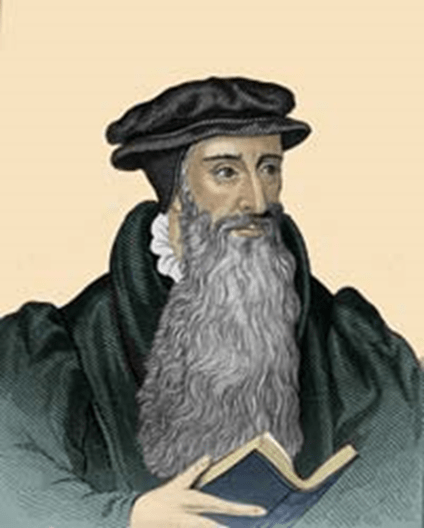
A descendant of Protestant Reformer John Knox, Witherspoon was educated at the University of Edinburgh, Scotland, and afterwards served as a Presbyterian pastor.
His writings brought him to the attention of the trustees of the College of New Jersey, who sent Benjamin Rush and Richard Stockton to Scotland to persuade him and his wife, Elizabeth, to come to the American colonies.
Benjamin Rush and Richard Stockton later joined John Witherspoon in signing the Declaration of Independence.
Sailing to America in 1768, John Witherspoon became the President of the College of New Jersey, which was later renamed Princeton University.

There, Witherspoon taught 12 members of the Continental Congress, and 9 of the 55 writers of the U.S. Constitution, including James Madison.
Witherspoon’s other Princeton students included:
1 U.S. Vice-President, 3 Supreme Court Justices, 10 Cabinet Members, 13 Governors, 28 U.S. Senators, 49 U.S. Congressmen, 37 judges, and 114 ministers.
John Witherspoon was elected as a delegate from New Jersey to the Continental Congress.
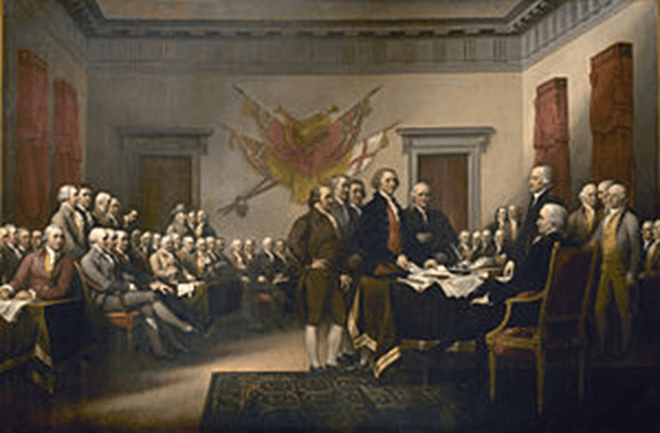
He declared:
“Gentlemen, New Jersey is ready to vote for independence. The country is not only ripe for independence, but we are in danger of becoming rotten for the want of it!”
On note, is that John Witherspoon was prominent clergyman who signed the Declaration of Independence.
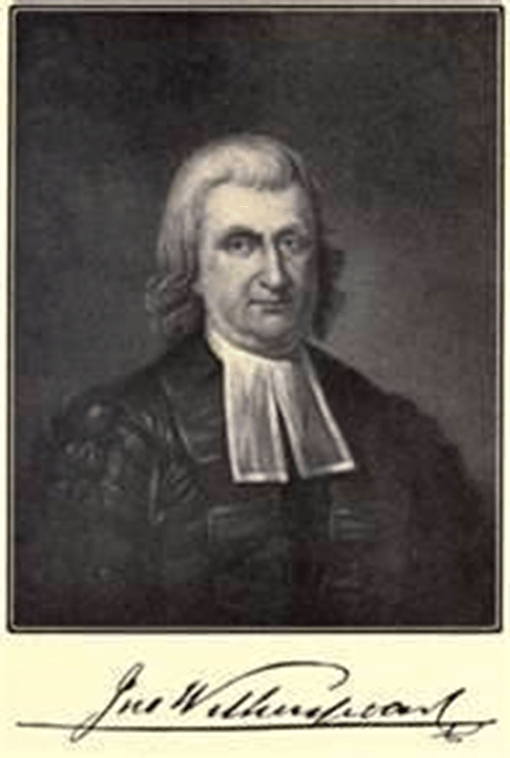
Clergymen were often the most educated individuals in their communities.
Whereas most Church of England ministers in America held allegiance to the King and left for England when the Revolution began, patriot pastors stayed and supported the American cause.
Patriot Pastors preached on the topics of:
self-government; government from the consent of the governed; purpose of government to secure God-given rights; rights of conscience; equality before the law; freedom to speech; freedom to assemble; freedom of press; self-defense; the right to possess and bear arms; no taxation without representation; and trial by a jury of peers, rather than a partisan, king appointed judge.
President Calvin Coolidge acknowledged in his address at the 150th Anniversary of the Declaration of Independence, in Philadelphia, July 5, 1926:
“The principles of human relationship which went into the Declaration of Independence are found in the texts, the sermons, and the writings of the early colonial clergy who were earnestly undertaking to instruct their congregations in the great mystery of how to live.
They preached equality because they believed in the fatherhood of God and the brotherhood of man. They justified freedom by the text that we are all created in the divine image, all partakers of the divine spirit.
Placing every man on a plane where he acknowledged no superiors, where no one possessed any right to rule over him, he must inevitably choose his own rulers through a system of self-government.
In those days such doctrines would scarcely have been permitted to flourish and spread in any other country.
In order that they might have freedom to express these thoughts and opportunity to put them into action, whole congregations with their pastors had migrated to the colonies.”
Coolidge added:
“Rev. Thomas Hooker of Connecticut as early as 1773 said in a sermon before the General Court that:
‘The foundation of authority is laid in the free consent of the people. The choice of public magistrates belongs unto the people by God’s own allowance.’
This doctrine found wide acceptance among the nonconformist clergy who later made up the Congregational Church.
The great apostle of this movement was the Rev. John Wise of Massachusetts.
He was one of the leaders of the revolt against the royal governor Andros for which he suffered imprisonment.
His works were reprinted in 1772 and have been declared to have been nothing less than a textbook of liberty for our Revolutionary fathers.
That these ideas were prevalent in Virginia is further revealed by the Declaration of Rights, which was prepared by George Mason and presented to the general assembly on May 27, 1776.
This document asserted popular sovereignty and inherent natural rights, and confirmed the doctrine of equality in the assertion that ‘All men are created equally free and independent.’
It can scarcely be imagined that Jefferson was unacquainted with what had been done in his own Commonwealth of Virginia when he took up the task of drafting the Declaration of Independence.”
Coolidge continued:
“These thoughts can very largely be traced back to what Rev. John Wise was writing in 1770. He said ‘Democracy is Christ’s government in church and state.’
Here was the doctrine of equality, popular sovereignty, and the substance of the theory of inalienable rights clearly asserted by Wise at the opening of the eighteenth century, just as we have the principle of the consent of the governed stated by Hooker as early as 1773.
When we take all these circumstances into consideration, it is but natural that the first paragraph of the Declaration of Independence should open with a reference to Nature’s God and should close in the final paragraphs with an appeal to the Supreme Judge of the world and an assertion of a firm reliance on Divine Providence.”
Coolidge continued:
“In its main feature the Declaration of Independence is a great spiritual document. Equality, liberty, popular sovereignty, the rights of man. These are not elements which we can see and touch. They have their source and their roots in our religious convictions.
Unless the faith of the American in these religious convictions is to endure, the principles of our Declaration will perish. We cannot continue to enjoy the result if we neglect and abandon the cause.
If anyone wishes to deny their truth the only direction in which he can proceed is backward toward the time when there was no equality, no rights of the individual, no rule of the people.
The duly authorized expression of the will of the people has a divine sanction.
The ultimate sanction of law rests on the righteous authority of the Almighty.
It was in the contemplation of these truths that the fathers made their Declaration and adopted their Constitution.
Their intellectual life centered around the meeting-house. They were intent upon religious worship. While their thoughts were found with other literature, there was a wide acceptance with the authority of the Scriptures.”
President Coolidge continued:
“We live in an age of science and of abounding accumulation of material things. These did not create the Declaration. Our Declaration created them.
The things of the spirit come first.
Unless we cling to that, all our material prosperity, overwhelming though it may appear, will turn to a barren sceptre in our grasp. We must not sink into a pagan materialism.
We must cultivate the reverence which our founders had for the things that are holy. We must follow the spiritual and moral leadership which they showed.
John Witherspoon died near Princeton, New Jersey, on NOVEMBER 15, 1794.
John Adams described Rev. Witherspoon as: “A true son of liberty but first, he was a son of the Cross.”

 True Texan Tales