McArthur was born January 26, 1880 to parents who both had military backgrounds. His mother who most called Pinkey, was from well to do Virginia parents. His father was already a rather famous U.S. Army officer. Compared to most famous people, Douglas McArthur lived what I would call four whole lives. He was a commander in three major wars. Therefore, in relating to you his amazing life, it will be necessary to convey it to you in sections or posts. Following is the Fourth one.
Ron
The Rainbow Division was now moving into the lines in strength. They scheduled three raids for the night of March 9. With Menoher’s blessing MacArthur decided to join a battalion of Iowan’s against a section of German trench on the Salient du Feys for these raids.
As zero hour approached, the enemy, anticipating visitors, opened up with forty batteries of heavy artillery, and American casualties began to mount before the attack had even begun. To steady his men, MacArthur walked the line in his eccentric apparel, now augmented by a sweater bearing the big black “A” he had won at the Point by playing on its football team. An Iowan said: “I couldn’t figure what a fellow dressed like that could be doing out there. When I found out who his was, you could have knocked me over with a feather.”
Five minutes before zero, sixty French batteries began their protective barrage, and as the minute hands crept upright, MacArthur mounted a scaling ladder and went over the top as fast as he could. He scrambled forward. He said the blast was like a fiery furnace. He wondered if any of the Rainbow guys were following, but quickly saw that they were all around him and some even ahead, a roaring avalanche of glittering steel and cursing men.
And they carried the enemy position.
Menoher reported: “He accompanied the assault wave of the American companies engaged with the sole view of lending his presence where it was reassuring to the troops who were then unaccustomed to this manner of warfare. On this occasion, in the face of the determined and violent resistance of an alert enemy, he lent actual service on the spot to the unit commanders and by his supervision of the operation not only guaranteed its success, but left the division with the knowledge of the constant attention of their leaders to their problems in action and the sense of security which the wise and courageous leadership there impressed on the engaged companies.”
This time MacArthur received the distinguished Service Cross for his “coolness and conspicuous courage.”

MacArthur with his long muffler and squashed down hat.
A few days later, MacArthur, who was strict about his men carrying their gas masks but often neglected to bring his own, was gassed.
He was in bed with a mask covering his eyes since the gassings could make one go blind. He Heard that the U.S. Secretary of War Baker was coming to survey the front lines. He ripped off his blindfold in time to show Secretary Baker around the area on 19 March.
Upon the recommendation of Menoher, MacArthur was awarded his first general’s “star” when he was promoted to brigadier general on 26 June. At the age of just thirty-eight, this made him the youngest general in the AEF.

Promoted, but still wearing crushed down hat, with riding crop, and cavalry boots
Around the same time, the 42nd Division was shifted to Châlons-en-Champagne to oppose the impending German Champagne-Marne offensive.
The Germans decided to now mobilize a push so massive that it would end the war. They had not been successful at Verdun or other offences. But they were sure they would now. They even erected a high wooden observation platform behind the lines for the Kaiser to be able to view this offensive.
It started with an artillery barrage so massive that the Allied observers said it was the largest ever seen in any war. MacArthur’s division was charged with stopping it on their southern sector, the spearhead of it. He devised an unusual plan to try to stop it, though the Germans were sure that they would be able to proceed right on to Paris. He set up a front line of suicide, shock troops that the Germans were to fight through first. After they were tired out and somewhat disorganized, they would meet the main line of defense manned by the Rainbow Divisions main troops.
This plan was unusually risky, but it succeeded gloriously. The German troops were thrown back with massive losses and never caught site of Paris.
MacArthur was determined to know the real result of this massive battle. He and his staff had no real intelligence to know. Hearing reports that the enemy may have withdrawn, MacArthur went forward on 2 August to see for himself. He later wrote:
“It was 3:30 that morning when I started from our right at Sergy. Taking runners from each outpost liaison group to the next, moving by way of what had been No Man’s Land, I will never forget that trip. The dead were so thick in spots we tumbled over them. There must have been at least 2,000 of those sprawled bodies. I identified the insignia of six of the best German divisions. The stench was suffocating. Not a tree was standing. The moans and cries of wounded men sounded everywhere. Sniper bullets sung like the buzzing of a hive of angry bees. An occasional shellburst always drew an angry oath from my guide. I counted almost a hundred disabled artillery guns of various sizes and several times that number of abandoned machine guns.”
MacArthur reported back to Menoher and Lieutenant General Hunter Liggett, the commander of I Corps (under whose command the 42nd Division fell), that the Germans had indeed withdrawn. He was amazed to personally observe that the hilltop German Command center was empty, and there was a massive empty sector in the German lines. He knew that if the AEF forces attacked immediately, they could push on at will and the war would be over. He knew that it must be done, but no one in Pershing’s staff or the other primary officers would listen. Later his insistence was acknowledged, but got no traction at the time, and thousands and thousands of allied troops were later lost as a result.
As a result of his heroic personal observations, he was awarded a fourth Silver Star. He was also awarded a second Croix de guerre and made a commandeur of the Légion d’honneur. MacArthur’s leadership during the Champagne-Marne offensive and counter-offensive campaigns was noted by General Gouraud when he said MacArthur was “one of the finest and bravest officers I have ever served with.”
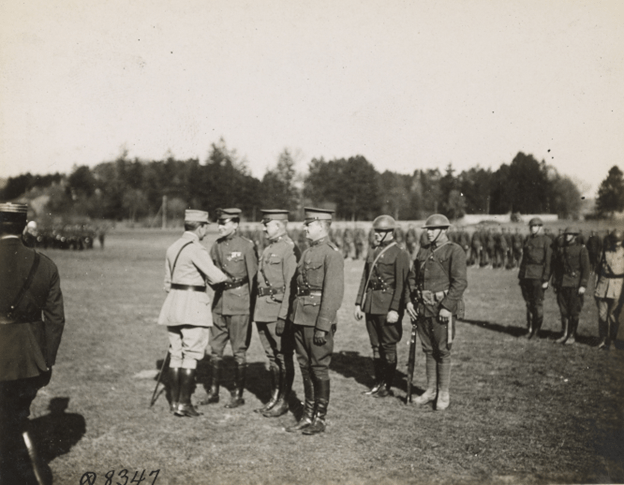
MacArthur receiving the French Croix de Guerre medal from General Bazelaire
The 42nd Division earned a few weeks rest, returning to the line for the Battle of Saint-Mihiel on 12 September 1918. The Allied advance proceeded rapidly, and MacArthur was awarded a fifth Silver Star for his leadership of the 84th Infantry Brigade.
In his later life he recalled:
“In Essey I saw a sight I shall never quite forget. Our advance had been so rapid the Germans had evacuated in a panic. There was a German officer’s horse saddled and equipped standing in a barn, a battery of guns complete in every detail, and the entire administration and music of a regimental band.”
He received a sixth Silver Star for his participation in a raid on the night of 25–26 September. The 42nd Division was relieved on the night of 30 September and moved to the Argonne sector where it relieved the 1st Division on the night of 11 October. On a reconnaissance the next day, MacArthur was gassed again, earning a second Purple Heart.
The 42nd Division’s participation in the Meuse–Argonne offensive began on 14 October when it attacked with both brigades. That evening, a conference was called to discuss the attack, during which Major General Charles P. Summerall, commander of V Corps, was present and demanded that Châtillon be taken by 18:00 the next evening. An aerial photograph had been obtained that showed a gap in the German barbed wire to the northeast of Châtillon. But Chatillon was the center and strength of the German forces.
General Summerall said that Chatillon must be taken or a casualty list of
5,000 casualties sent. MacArthur said: “It will be taken by that deadline of 6:00 tomorrow evening or a casualty list of 6,000 dead with my name at the top will be sent.” Summerall was so moved that he just left.
MacArthur enveloped the hill, mounting a frontal assault and, simultaneously, sending a battalion let by Major Lloyd Ross around it, snaking from hole to hole, cleaning out ravines and Machine-gun nests.
It was a bloody business. In McArthur’s words: “Officers fell and sergeants leaped to the command. Companies dwindled to platoons and corporals took over. At the end, Major Ross had only 300 men and 6 officers left out of 1,450 men and 25 officers. That is the way the Cote-de-Chatillon fell.
Lieutenant Colonel Walter E. Bare—the commander of the 167th Infantry—proposed an attack from that direction, covered by a machine-gun barrage. MacArthur adopted this plan. He was wounded, but not severely, while leading a reconnaissance patrol into no man’s land at night to confirm the existence of the gap in the barbed wire. As he mentioned to William Addleman Ganoe a few years later, the Germans saw them and shot at MacArthur and the squad with artillery and machine guns. MacArthur was the sole survivor of the patrol, claiming it was a miracle that he survived. He confirmed that there was indeed an enormous, exposed gap in that area due to the lack of enemy gunfire coming from it.
At last the Americans had pierced the main German line. Pershing called it “a decisive blow” and said: “The importance of this operation can hardly be overestimated”
Summerall recommended that MacArthur be promoted to major general and awarded the Medal of Honor. However, neither happened. He did receive a second distinguished Service Cross. Its citation read: “For the manner to which he personally led his men, displaying indomitable resolution and great courage in rallying broken lines and reforming attacks, thereby making victory possible.” The citation concluded, “on a field where courage was the rule, his courage was the dominant force.

MacArthur receiving Distinguished Service Cross from General Pershing
Following all this action there was a rest and then a council of war in an old farm house in late October. With Menoher presiding, he asked this two Brigade commanders whether they thought the Rainbow, which had lost four thousand men in penetrating the Hindenburg Line, would be fit to play a role when the American advance resumed in November. According to the divisional history, “MacArther jumped from his chair and started walking up and down, as he always did when talking about something in which he is greatly interested. In his brilliant way he soon showed that there was no phase of the matter which he had not thoroughly considered from every possible point of view. His discussion was such a comprehensive and competent analysis that his two auditors regretted then and afterwards that there was no stenographer present to take it all down and preserve it.”
There was more action by the Rainbow Divion, but by now the Germans had become demoralized. There was news that there were insurrections back in Germany, and that the German fleet had mutinied when ordered to go out to sea and attack the British in a last ditch suicide raid.
MacArthur got word that there was an officer from Pershing’s staff snooping around divisional headquarters, asking the staff what they thought about their leader. MacArthur interpreted this that they were out to get him on the ground “that I failed to follow certain regulations prescribed for our troops, that I wore no helmet, that I carried no gas mask, that I went unarmed, that I always had a riding crop in my hand, that I declined to command from the rear.”
Actually, this was not really the case. Menoher was being promoted to corps commander, and MacArthur was designated his successor. He was now the Commander of the 42nd Division. At age thirty-eight he was the leader of twenty-six thousand men—the youngest divisional commander of the War. At the same time, Persing wrote him that “it gives me great pleasure to inform you that on Oct. 17, I recommended you for promotion to the grade of Major General, basing my recommendation upon the efficiency of your service with the American Expeditionary Force.”
Finally, on 9 November, 1919 Armistice was declared. That horrible, bloody war was over. There was massive celebration all over the world, especially in America.
There would be no more promotions in the ranks, so MacArthur was not made Major General at that point. However, for his service in WW I he received two Distinguished Service Crosses (just below the Congressional Medal of Honor), a Distinguished Service Medal (for exceptionally meritorious service in a duty of great responsibility), and seven Silver Stars (for gallantry in action against an enemy of the United States while engaged in military operations), as well as two Purple Hearts. He was also awarded all manner of medals, citations, and military honors by other countries, especially the French, from whom MacArthur received two Croix de Guerre medals (awarded for extraordinary feats of bravery in Military action).
The Rainbow Division did not go home immediately. It was chosen to participate in the occupation of the Rhineland in Germany. It occupied the Ahrweiler District of the Rhineland in April of 1919 for 5 months.
Finally, the 42nd Division entrained to Brest and Saint-Nazaire where they boarded the ships to return to the United States. MacArthur traveled on the ocean liner SS Leviathan, which reached New York on 25 April 1919.
You hear a lot about Douglas MacArthur for his exploits in WW II, and the Korean War and afterwards, but his exploits in WW I were enough to fill a lifetime for most people!
Though it may seem hard to believe, but considering the absolute facts, one has to concur that God was preserving the life of Douglas MacArthur during Word War I.
 True Texan Tales