MacArthur was born January 26, 1880 to parents who both had military backgrounds. His mother who most called Pinkey, was from well to do Virginia parents. His father was already a rather famous U.S. Army officer.
Compared to most famous people, Douglas MacArthur lived what I would call four whole lives. He was a commander in three major wars. Therefore, in relating to you his amazing life, it will be necessary to convey it to you in sections or posts. Following is the first one.
Ron
As I mentioned above, he was born on January 26, 1880. During the first years of his life his father was stationed as Commander of different forts along the frontier of West Texas and the deserts of New Mexico.
Young Douglas and his brother grew up with those U.S. Army horse soldiers at those forts where he was home-schooled by his mother. Having been a woman of substance and culture of the Old South, the frontier life in those forts was really tough on her.
Douglas and his brother both had Navaho spotted ponies at a really early age. They would ride great distances across the prairies hunting rabbits from horseback, but always watching for Indians. And they were immersed in the military customs and lives of those soldiers where they lived. My first recollection McArthur was fond of saying later “was that of a bugle call.”
In his mother’s lap he learned the virtue of physical courage and the disgrace of cowardice. Once she told Doug that men do not cry. He protested that his father’s eyes were often moist at the retreat ceremony. That was different, she quickly explained; that was from love of country; that was allowed. But tears of fear were forbidden.
Douglas was age seven when their Company K was posted to Leavenworth and he could be around youngsters his own age for the first time, and where he started the second grade in a real school for the first time.
One afternoon in the autumn of 1893, when he was thirteen, he overheard his father remark to his mother: “I think there is the material of a soldier in that boy.” Many fathers say such things about their sons, hoping they follow in their footsteps. What mattered was that his son swore never to forget it—and never did.
In that same fall of 1893 Commander Arthur brought home the news, welcome to his younger son if not to his wife, that after four years away from troops they would head westward again, to San Antonio.
There Douglas entered West Texas Military Academy. Douglas was dark, wiry and already handsome. He crossed the Fort Sam Houston’s lower parade ground at 8 o’clock each morning wearing a braided gray cadet uniform and carrying, as required: a Bible, Prayer book, and a hymnal. Chapel was held every day in the ivy-covered stone Church of Saint Paul, where the boy was confirmed the following April.
His last year was an unbroken series of triumphs. Both the football and baseball teams were undefeated. He was chosen first seargent of A Company, the highest rank he could attain. He organized and led a prizewinning drill squad and was one of four cadets to achieve perfect marks in deportment. With an academic average of 97.33 he won the Academy Gold Medal and became valedictorian of the class of 1897.
Douglas and his mother both were determined that he go to West Point. But to do so, one must be nominated by a Congressman who is allowed very few nominations. Pinkey thought that she had persuaded a Congressman friend to get Douglas in. In that first year it did not happen. Also, he flunked the physical due to curvature of the spine. He worked extremely hard with a famous medical doctor named Pfister and got the problem cured.
Finaly Pinkey found a Congressman named Otjen who had thirteen applicants. To solve his problem of who to send to the Point he decided to hold an examination. He got 3 school principals to conduct it in the Milwaukee, Wisconsin City Hall. Douglas worked extremely hard under another Principal that Pinkey hired as a tutor. The Milwaukee Journal reported on the contest’s outcome on its first page: Under the headline HE WILL GO TO WEST POINT. The 1898 paper reported that Douglas had placed first among the thirteen applicants. The paper went on to say “young MacArthur is a remarkably bright, clever, and determined boy. His standing was 99.5 against the next man’s 77.9. He scored 700 points out of a possible 750. In his case preparedness is the key to success and victory.”
So, on the afternoon of Tuesday, June 13, 1899 , a West Shore Railroad train three hours out of Weehawken paused at West Point to discharge a youth wearing a light gray Stetson, and his small, severely dressed mother. Yes, she went to West Point with him.
They were standing on the U.S. Military Academy “plain,” a broad shelf of land overlooking the Hudson which was itself was overlooked by towering, thickly forested heights. Facing the plain were various buildings and monuments. The superintendent’s mansion gleamed whitely. Gothic walls of gray granite, as grim as those of a penitentiary, enclosed the cadet barracks. A walkway wended itself downward to the river to an antebellum structure of yellow brick with a broad green wooden veranda where stood Craney’s Hotel. Here Mrs. Arthur MacArthur would live for the next four years. Like Franklin Roosevelt at Harvard and Adlai Stevenson at Princeton, Douglas MacArthur would share much of his collegiate experience with an alert mother-in-residence.
The Corps at that time had only 332 cadets. It had its own nomenclature all of which I won’t go into here, but the leader of the entire corps, the one who best embodied the Military ideal, was the “First Captain.”
The first three weeks there are the worst. The plebes live in tents across the parade grounds, and are subjected to unbelievable hazing. It was so bad in MacArthur’s first year that one Cadet died, and a Congressional Hearing was conducted, and young Douglas was required to appear and testify.
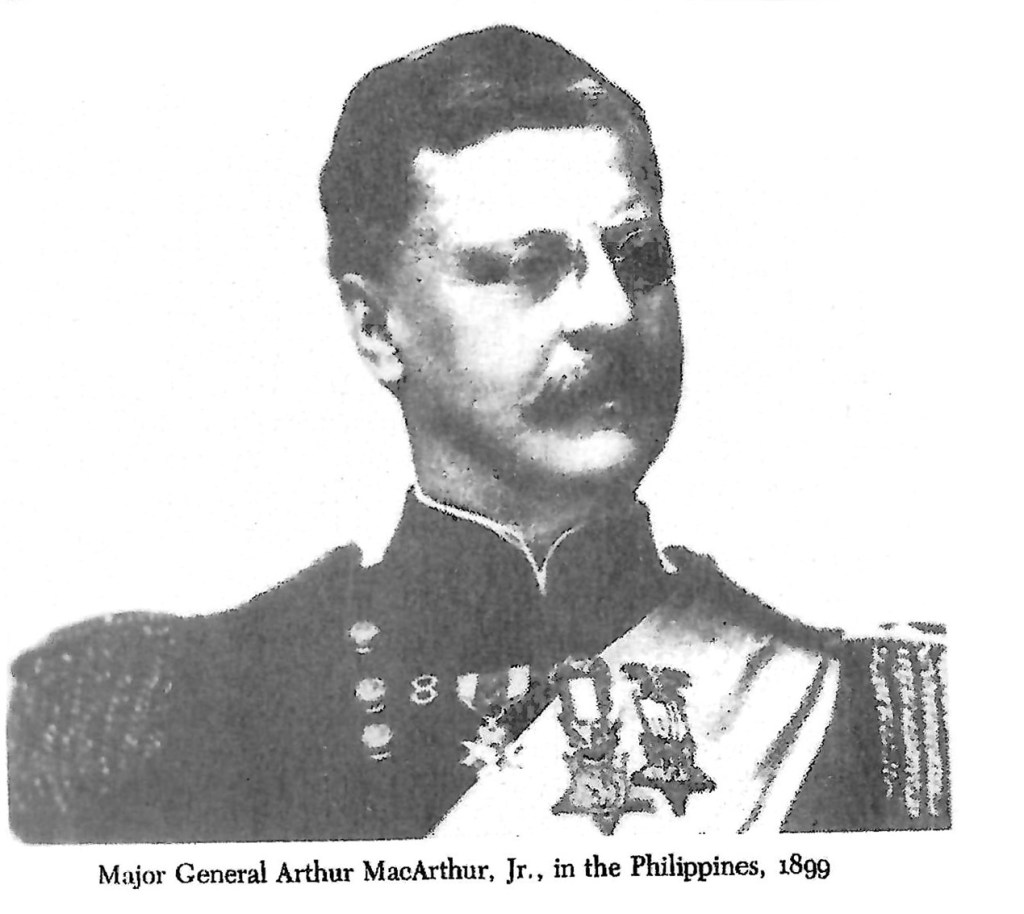
Since the other cadets knew that Douglas’s father was a U.S. Army General fighting in the Philippines he was observed very closely. Many years later some of the cadets of that time were interviewed. I was able to read some of their remarks. One said “to know MacArthur is to love him or to hate him—you can’t just like him.”
Robert E. Wood, who became a first classman that June, said that the older members of the corps “recognized intuitively that MacArthur was born to be a real leader of men.” Wood also wrote later that he was “without a doubt the handsomest cadet that ever came into the academy.” Various other cadets thought he seemed to be
“brave as a lion and smart as hell, a youth with a mind like a sponge, and one who would be flogged alive without changing his mind once it had been make up.” Robert C Richardson wrote: “He had style. There was never a cadet quite like him.”
Douglas was number one in academics in each years’ class, an amazing accomplishment. West Point had classes that were not present at other schools, such as horsemanship, and military deportment.
However, he displayed other talents. He was so good at football and so well liked by the team that he was voted in as its Captain. All his life he was very proud of his letter “A” that was earned. He even wore it on his bathrobe at the Inchon Invasion way later.
Yet, at that time, football was still in its infancy. Baseball was the most popular game, both nationally and at West Point. And young MacArthur was really good at baseball. On Saturday, May 18, 1901 Army and Navy played each other for the first time. The Navy cadets sang a song ridiculing Douglas’ father, fighting as the General in the Philippines. However, Army won 4 to 3 and Douglas scored the winning run.
He led another exploit there at the Academy that was never proved or publicized. A small group of cadets
snuck across the parade grounds and brought over the cannon that was used in all the ceremonies. They hoisted it to the top of the academic building. It took an outside construction crew a whole week to get it down. All the cadets knew that only Douglas had the ability to accomplish such a marvelous fete.
Not only did Douglas MacArthur finish first in his class of Cadets, but he compiled a record that has not been surpassed but twice since the Academy was founded in 1802—by an 1884 graduate and by Robert E. Lee of the class of 1829. MacArthur scored a perfect 100 in law, history, and English. He led his classmates in Mathematics, drill regulations, and ordinance and gunnery.
Wearing a First Captain’s gold stripes, he served as the superintendent’s representative, inspected the mess hall daily, and “drove the corps” to barracks wih with sharp, ringing commands each evening.
On Thursday, June 22,1903, that year’s class became full-fledged Members of “the Long Gray Line”— the procession of academy graduates which had begun with the first class in 1802. “MacArthur” the adjutant bawled, and the twenty-three-year-old head of the Corps, the cadet whose classmates had voted man likeliest to succeed, received his certificate of graduation. He in turn handed it to his father, who had arrived from San Francisco for the occasion, and smiled down at his beaming mother.
 True Texan Tales