If you ever doubted that the men who founded these United States of America believed in the one and only Mighty God of this Universe, please take the time to read this brief series of their Proclamations.
American Proclamations
During the days of America’s founding, colonies would declare:
- days of prayer when times were bad;
- days of fasting when times were real bad; and
- days of thanksgiving when things turned around.
This developed into many colonies, like New Hampshire and Massachusetts, having annual days of fasting, often on Good Friday.
This is evidence that colonists were not “deists” who believed God set the laws of nature in place and then let everything run on its own.
America’s founders believed in a living relationship with God where:
- if people sinned, He would call them to repent;
- if they did not repent, He would send judgment; and
- then, when they repented and believed, He would send deliverance, health, and blessings.
This was expressed in Deuteronomy 28: “If thou shalt HEARKEN diligently unto the voice of the Lord thy God, to observe and to do all his commandments all these BLESSINGS shall come on thee, and overtake thee. But if thou wilt NOT HEARKEN unto the voice of the Lord thy God, to observe to do all his commandmentall these CURSES shall come upon thee, and overtake thee.”
In 2nd Chronicles 7:14, the Lord promised: “If my people, which are called by my name, shall humble themselves, and pray, and seek my face, and turn from their wicked ways; then will I hear from heaven, and will forgive their sin, and will heal their land.”
During a threaten war, Ben Franklin published a proclamation of a General Fast in the Pennsylvania Gazette, December 12, 1747:”The calamities of a bloody war seem every year more nearly to approach us and there is just reason to fear that unless we humble ourselves before the Lord and amend our ways, we may be chastised with yet heavier judgments. We have thought fit to appoint a Day of Fasting to join with one accord in the most humble and fervent supplications that Almighty God would mercifully interpose and still the rage of war among the nations and put a stop to the effusion of Christian blood.”
Thomas Jefferson, as a member of the House of Burgesses, drafted a Day of Fasting for Virginia in 1774 to be observed on the day British ships blockaded Boston’s harbor:”With apprehension from the hostile invasion of the city of Boston whose commerce and harbor are to be stopped by an armed force, deem it highly necessary that the said first day of June be set apart, by the members of this House, as a Day of Fasting, Humiliation and Prayer, devoutly to implore the Divine interposition.”
After the Declaration of Independence was proclaimed July 4, 1776, the first “National” Day of Thanksgiving was declared by the Continental Congress on November 1, 1777, to celebrate British General Burgoyne surrendering over 6,000 soldiers at the Battle of Saratoga: “The grateful feeling of their hearts join the penitent confession of their manifold sins that it may please God, through the merits of Jesus Christ, mercifully to forgive and blot them out of remembrance and under the providence of Almighty God secure for these United States the greatest of all human blessings, independence and peace.
In the fighting going on in the Revolutionary War, the British were in command of the world’s seas. They accomplished this primarily with their 50 gun fighting vessels called Ships-of-the Line. They were awesome adversaries for the few Colonial ships. However, the Americans had one of the most intrepid fighting men in its long history of fighting men…..Captain John Paul Jones. He was awesomely aggressive. He was in command of the frigate, Bonhomme Richard. The name was in honor of Benjamin Franklin’s pen name, Poor Richard.
In the summer of 1779 Jones was sailing around the British Isles. In the channel between Ireland and Scotland he had a duel with the British Ship HMS Drake and captured it. Then his small squadron sailed to Yorkshire, England and on September 23, 1779 at Flamborough Head they encountered one of those awesome British Ships-of-The Line, the HMS Serapis which was escorting 40 British merchant ships. The intrepid Jones immediately took after it. The Bonhomme Richard sustained heavy fire with massive splintering of wood. Jones knew that his only hope was to board the Serapis for hand-to-hand combat.

As he moved in the Serapis’ jibboom caught onto the Bonhomme Richard’s rigging. Jones instructed the Bonhomme Richard’s crew to attach to the Serapis, which they did. So locked together, they blasted away with their cannon. The Bonhomme Richard was getting blown to pieces, but Captain Jones had one advantage. He had a small group of Marines with their long accurate hunting rifles from the American Colonies. All the British had were their muskets which could not hit anyone unless they were standing face to face.

After a long bloody battle and after three attempts by Jones to board the HMS Serapis, the British Captain hailed Jones again and asked for his surrender, saying, “Has your ship struck?” (Meaning, have you surrendered?) Jones replied with one of the most famous quotes of the American Revolution, “I have not yet begun to fight!” After five more attempts to board the HMS Serapis, the two ships were locked into hand-to-hand combat, but the little group of American Marines were hidden in the Bonhomme Richard’s rigging and furled sails way up high. They were picking off British sailors right and left.
Finally, the British Captain realized that he was not going to have any sailors left. He surrendered and Captain John Paul Jones sailed off with his captured British Ship-of-The-Line.
He stopped in Amsterdam and was honored for his great victory. The Dutch nicknamed him “The Terror of the English.” On December 27, Jones took command of the HMS Serapis, renaming the vessel Serapis, and gave it to the French Navy as a prize ship. Louis XVI of France granted Jones the rank of Chevalier and he received an elegant sword from the King of France. Louis XVI credited Jones with maintaining “The Freedom of the Seas.” The pyrrhic victory over the Royal British Navy at the Battle of Flamborough Head further solidified the alliance and friendship of the American and French people.
When the British surrendered on September 23, 1779, the Continental Congress declared a Day of Thanksgiving, recommending that the thirteen states do likewise.
In accordance with this, Virginia Governor Thomas Jefferson proclaimed for Virginia, November 11, 1779:
“Congress hath thought proper to recommend to the several States a day of public and solemn Thanksgiving to Almighty God, for his mercies, and of Prayer, for the continuance of his favor that He would go forth with our hosts and crown our arms with victory, that He would grant to His church, the plentiful effusions of Divine Grace, and pour out His Holy Spirit on all Ministers of the Gospel; that He would bless and prosper the means of education, and spread the light of Christian knowledge through the remotest corners of the earth. I do therefore issue this proclamation appointing a day of public and solemn Thanksgiving and Prayer to Almighty God. Given under by hand this 11th day of November, in the year of our Lord, 1779…… Thomas Jefferson.”
After British General Cornwallis surrendered at Yorktown, Congress proclaimed a Day of Thanksgiving, October 11, 1782: “It being the indispensable duty of all nations to offer up their supplications to Almighty God the United States in Congress assembled do hereby recommend it to the inhabitants of these states in general, to observe the last Thursday of November next, as a Day of Solemn Thanksgiving to God for all his mercies.”

The Treaty of Paris was signed September 3, 1783, officially ending the Revolutionary War. It began, “In the Name of the Most Holy and Undivided Trinity.”
Congress proclaimed a Day of Thanksgiving, October 18, 1783: “Whereas it hath pleased the Supreme Ruler of all human events, to dispose the hearts of the late belligerent powers to put a period to the effusion of human blood, by proclaiming a cessation of all hostilities by sea and land, and these United States are not only happily rescued from the dangers and calamities to which they have been so long exposed, but their freedom, sovereignty and independence ultimately acknowledged.
And whereas in the progress of a contest on which the most essential rights of human nature depended, the interposition of Divine Providence in our favor hath been most abundantly and most graciously manifested, and the citizens of these United States have every reason for praise and gratitude to the God of their salvation.
Impressed, therefore, with an exalted sense of the blessings by which we are surrounded, and of our entire dependence on that Almighty Being, from whose goodness and bounty they are derived, the United States in Congress assembled do recommend it to the several States, to set apart the second Thursday in December next, as a day of public thanksgiving, that all the people may then assemble to celebrate with grateful hearts and united voices, the praises of their Supreme and all bountiful Benefactor, for his numberless favors and mercies.
That he hath been pleased to conduct us in safety through all the perils and vicissitudes of the war and above all, that he hath been pleased to continue to us the light of the blessed gospel, and secured to us in the fullest extent the rights of conscience in faith and worship.And while our hearts overflow with gratitude, and our lips set forth the praises of our great Creator, that we also offer up fervent supplications, that it may please him to pardon all our offenses to smile upon our seminaries and means of education, to cause pure religion and virtue to flourish, to give peace to all nations, and to fill the world with his glory.
Done by the United States in Congress assembled, witness his Excellency Elias Boudinot, our President, this 18th day of October, in the year of our Lord one thousand seven hundred and eighty-three, and of the sovereignty and independence of the United States of America the eighth.”
Massachusetts Governor John Hancock, who was a former President of the Continental Congress, proclaimed a Day of Thanksgiving, November 8, 1783: “The Citizens of these United States have every Reason for Praise and Gratitude to the God of their salvation I do appoint the 11th day of December next (the day recommended by the Congress) to all the States to be religiously observed as a Day of Thanksgiving and Prayer, that all the people may then assemble to celebrate that he hath been pleased to continue to us the Light of the Blessed Gospel that we also offer up fervent supplications to cause pure Religion and Virtue to flourish and to fill the world with His glory.”
The same week Congress passed the Bill of Rights, which included the First Amendment, it requested President George Washington issue a National Day of Thanksgiving to Almighty God.
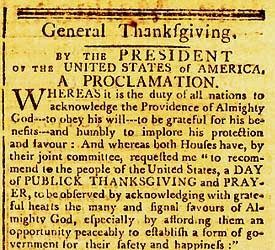
Washington wrote October 3, 1789: “Whereas it is the duty of all Nations to acknowledge the providence of Almighty God, to obey his will, to be grateful for his benefits, and humbly to implore his protection and favor and Whereas both Houses of Congress have by their joint Committee requested me to recommend to the People of the United States a Day of Public Thanksgiving and Prayer to be observed by acknowledging with grateful hearts the many signal favors of Almighty God, especially by affording them an opportunity peaceably to establish a form of government for their safety and happiness now, therefore, I do recommend Thursday, the 26TH DAY of NOVEMBER to be devoted by the People of these United States to the service of that great and glorious Being, who is the beneficent Author of all the good that was, that is, or that will be, that we may then all unite in rendering unto Him our sincere and humble Thanks for the peaceable and rational manner in which we have been enabled to establish constitutions of government particularly the national one now lately instituted, for the civil and religious liberty with which we are blessed to promote the knowledge and practice of true religion and virtue.”
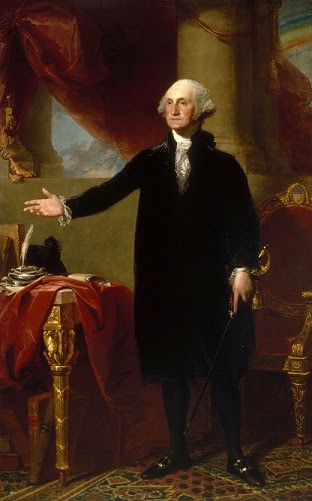
While the French Revolution was raging, President George Washington proclaimed on January 1, 1795, a National Day of Thanksgiving:”When we review the calamities, which afflict so many other nations the great degree of internal tranquility we have enjoyed; the recent confirmation of that tranquility by the suppression of an insurrection which so wantonly threatened it, the happy course of public affairs in general, the unexampled prosperity of all classes of our citizens; are circumstances which peculiarly mark our situation with indications of the Divine beneficence towards us.
In such a state of things it is, in an especial manner, our duty as people, with devout reverence and affectionate gratitude, to acknowledge our many and great obligations to Almighty God and to implore Him to continue and confirm the blessings we experience.
I, George Washington, President of the United States, do recommend to all religious societies and denominations, and to all persons whomsoever, within the United States, to set apart a Day of public Thanksgiving and Prayer: and on that day to meet together and render their sincere and hearty thanks to the great Ruler of Nations.”

After the War of 1812 was ended with the Treaty of Ghent, President James Madison proclaimed a National Day of Thanksgiving, March 4, 1815: “The Senate and House of Representatives signified their desire that a day may be observed by the people of the United States with religious solemnity as a Day of Thanksgiving and of devout acknowledgments to Almighty God for His great goodness manifested in restoring to them the blessing of peace.No people ought to feel greater obligations to celebrate the goodness of the Great Disposer of Events and of the Destiny of Nations than the people of the United States.
His kind Providence originally conducted them to one of the best portions of the dwelling place allotted for the great family of the human race. He protected them under all the difficulties and trials to which they were exposed in their early days. In the arduous struggle they were distinguished by multiplied tokens of His benign interposition. He enabled them to assert their national rights and to enhance their national character in another arduous conflict, which is now so happily terminated by a peace and reconciliation with those who have been our enemies. And to the same Divine Author of Every Good and Perfect Gift we are indebted for all those privileges and advantages, religious as well as civil, which are so richly enjoyed in this favored land.
I now recommend a Day on which the people of every religious denomination may in their solemn assemblies unite their hearts and their voices in a freewill offering to their Heavenly Benefactor of their homage of Thanksgiving and of their songs of praise. Given in the year of our Lord one thousand eight hundred and fifteen …….James Madison.”
Abraham Lincoln proclaimed the first “Annual” National Day of Thanksgiving, Washington, D.C., October 3, 1863:”In the midst of a civil war of unequaled magnitude and severity, I do therefore invite my fellow citizens in every part of the United States, and also those who are at sea and those who are sojourning in foreign lands, to set apart and observe the last Thursday of November next, as a day of Thanksgiving and Praise to our beneficent Father who dwelleth in the Heavens.
And I recommend they do also, with humble penitence for our national perverseness and disobedience, commend to His tender care all those who have become widows, orphans, mourners or sufferers in the lamentable civil strife in which we are unavoidably engaged, and fervently implore the interposition of the Almighty Hand to heal the wounds of the nation and to restore it as soon as may be consistent with the Divine purposes to the full enjoyment of peace, harmony, tranquility and Union.
In testimony whereof, I have hereunto set my hand and caused the Seal of the United States to be affixed. Done at the City of Washington, this Third day of October, in the year of our Lord one thousand eight hundred and sixty-three, and of the Independence of the United States the Eighty-eighth………. By the President: Abraham Lincoln, and William H. Seward, Secretary of State.”

 True Texan Tales