I have written you about some amazing miracles from God before, but this true story is about one of the most amazing miracles ever to happen on American soil.
Ron
General Washington was given authority by the Continental Congress to put together 28,500 troops, though he had way fewer in his first engagement against the British.
On March 17, 1776 he laid siege to the city of Boston where the British were encamped. He drove the British out in the first victory of the War for Independence.
The British sailed away to Halifax, Nova Scotia as their new base.
General Washington by now has 19,000 troops in his army. He relocated them to Manhattan Island, New York to defend the City. He knew that the British would want that city for its port and port facilities for their huge navy.
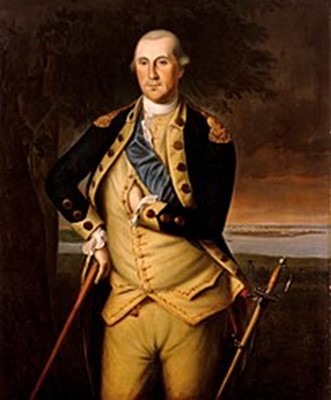
He left Boston on April 7 and got to New York on April 13.
He set up fortifications around the lower part of Manhattan, and moved almost half of his army across the East River and set-up fortifications in Brooklyn. Fort Stirling was just west of the hamlet of Brooklyn Heights, the highest point on Long Island.
He then built three small forts along the East River since any attack was expected to come from the East River. They were called Fort Putman, Fort Greene, and Fort Box. They where each surrounded by deep ditches and all together had 36 cannons.
On June 29, 45 British ships arrived from Halifax and dropped anchor in Lower New York Bay. And in less than a week a total of 130 ships were there just off Staten Island.
The island had little population, and the British decided that it would be and ideal place to locate for what would be their attempt to capture Manhattan Island and its port and port facilities.
On July 6 news reached New York that Congress had voted for Independence of the American colonies from Great Britian.
On Tuesday, July 9, General Washington had several brigades march to the Commons of the city to hear the Declaration of Independence read to all. After the reading a mob of men ran to Boling Green with bars and ropes and tore down the equestrian statue of King George III of Great Britain.

They severed the head of the king and put it on a spike outside of a popular tavern. The rest of the large lead statue was melted down into musket balls.
By August 12, 400 ships including 73 major war ships were there at Staton Island and 32,000 troops were encamped there. The British king was not going to put-up with such a thing as independence of these rebel colonies.
So, now General Washington had almost half of his army over on the east side of the East River on Long Island. To defend New York it would be necessary to defend Brooklyn, and any attack upon Brooklyn would obviously be from across that little strip of ocean that was called the East River.

However, the brilliant General Howe in charge of all British forces had a secret plan that was totally unexpected. He had decided to ferry a contingent of troops and artillery down the coast of Long Island and attack the Americans from their rear
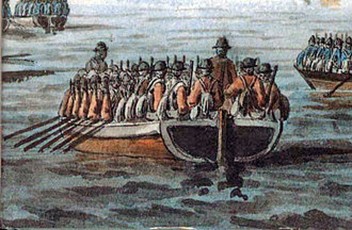
On August 22 at 5:10 AM 4,000 British troops left Staton Island under the command of Generals Clinton and Cornwallis in special flat-bottomed boats and headed down the coast of Long Island to come on shore at Gravesend Bay. And by noon 15,000 troops had landed on shore with 40 pieces of artillery.
Washington believed that the main objective of the British was still to take Manhattan only. So, he had a total on only 6,000 troops in Brooklyn under the command of General Israel Putman.
Eventually the British sent Hessian mercenaries for reinforcements, bringing their total to 20,000 troops.
The British plan of General Howe was to head west and attack the Americans from their rear, not from the direction they had expected. He sent General Grant with 4,000 British troops and some Hessians for a frontal assault on the American positions. Then he and General Clinton would make an all night march through an unguarded pass to attack the American’s flank.
On the night of August 26 Clinton led a crack brigade of light infantry with fixed bayonets. Cornwallis followed with 8 battalions and 14 artillery pieces. General Percy followed them with more men and artillery pieces. In total they stretched out for 2 miles, and as a diversion they left their camp fires burning so the Americans would not know of their secret night march.
Eventually they reached a popular spot on Long Island called Howard’s Tavern. Old man Howard’s son says he was awakened by a soldier standing by his bed. When he got downstairs there was his father with General Howe and 4 other British officers in the bar room. General Howe wore a Camlet cloak over his General’s uniform. He asked for a glass of liquor which was promptly served to him.
Howe said: “Show me the way over Rockaway Path around the pass.” Tavern owner Howard explained that “we belong to the American side.” To which Howe replied: “That is alright, stick to your country and your principes, but Howard you are my prisoner and must guide my men over the hills.” Howard made more objections. Then Howe explained: “You have no alternative. If you refuse, I shall shoot you through the head.” That settled the question. By dawn, the British were through the pass and approaching the American positions.
The first shots fired in the Battle of Long Island were by American pickets from Samuel Atlee’s Pennsylvania Regiment upon British soldiers who were foraging in the watermelon patch near the Red Lion Inn.
At about 1:00 PM on August 27 as 300 British troops approached the Red Lion Inn, American troops fired on the British. After about two fusillades they retreated on up the Gowanus Road.
Brigadier General Samuel Parsons and Col. Atlee were stationed farther up the road and slowed the British.
General Stirling had now been warned. He had a total of 1,600 troops under his command. Stirling placed Atlee’s men in an apple orchard on the south side of Gowanus Road. General Parsons wrote: “Atlee received the enemy’s fire and gave them well directed fire from his regiment which did great execution, and then retreated to the hill.”
On the highest ground where Brookland Heights got its name there were several hills. One of them was the highest and came to be known as “Battle Hill”. The British tried to outflank the Americans be taking this hill. The Americans tried to prevent the British move, sending troops under Parsons and Atlee to take the hill. The British got there first but the Americans were able to dislodge them in fierce fighting. Battle Hill was the site of especially brutal fighting, with the Americans inflicting the highest number of casualties among British troops during the entire Battle of Long Island.
Still, this was not yet the center of the British main attack. They were still planning on outflanking the Americans. At 9:00 General Howe fired his signal guns and the Hessians started their bombardment. And the main British army came at the Americans from their rear. Heavy casualties mounted on both sides. Hand to hand fighting followed, with the Americans swinging their muskets and rifles like clubs to save their own lives. It was later claimed that those Americans who surrendered were bayoneted by the Hessians.
Sullivan, despite all the chaos, managed to get most all his men down to the East River.
The main contingent of the Americans was now under attack from three sides. All seemed hopeless for escape. Then a contingent of Maryland troops under Gist came down and threw themselves at the British attacking from the rear. They became known in history as the “Maryland 400” though they did not number quite that many. Stirling and Gist led them in attacks against overwhelming numbers of British numbering over 2,000 and supported by two cannons. They actually attacked twice. Their heroism allowed the remaining Americans to escape. Fewer that a dozen of the “Maryland 400” made it back to American lines. By now General Washington had made it to the battlefield from Manhattan and was observing from a nearby hill. As he watched the brave attacks of the Marylanders he reportedly said: “Good God, what brave fellows I must this day lose.”
Howe then ordered his troops to halt the attack. He knew that he had the Americans trapped totally on the land side, and he assumed that the Royal Navy had control of the East River side. He knew that he would lose a huge number of troops against the Americans dug into trenches. He decided to wait them out or annihilate the whole bunch the next day, pushing them against the river, or maybe General Washington would realize his position was hopeless and surrender.
What happened next is considered one of the greatest miracles that God has ever orchestrated on American soil. The British dug trenches right up to the Americans. They could hear each other talking.
General Washington sent couriers across the East River and to all the people in the area with boats and sloops, and asked for their help.
During the night they evacuated two-thirds of the entire army and all of their arms and powder and cannons. It is confirmed that not an oar creaked, not a sound was heard. God just slapped everything into silence. But now it is about to get daylight and the one-third still there will be annihilated for sure.
What happened next has never been seen before and never since. A fog descended upon the East River so dense that nothing could be seen and so thick that it muffled all sounds. General Washington stepped onto the last boat to leave and was the last man to cross.
They had kept their camp fires burning all night to deceive the British. And when that fog lifted, the British could not believe that not a single American was left on that side of the East River.
It is said by historians that both sides of the conflict acknowledged that this was a divine act of God. And General Washington ordered that a day of prayer and thanksgiving be celebrated by his entire army.
 True Texan Tales