As the Bible states in both the Old and New Testaments: God is involved in the affairs of nations. Time and again this has been proved by the affairs of this nation. Here is another of those occasions………………
Ron
| The morning of December 7, 1941, Rev. Peter Marshall addressed the midshipmen at the U.S. Naval Academy in Annapolis, class of ’42. At the last minute, he set aside his prepared remarks and preached a prophetic message, “Go Down, Death.” Within an hour after he finished, news of Imperial Japan’s attack at Pearl Harbor spread across the nation. Peter Marshall stated: “I am one of those who believe that there are some principles worth fighting for and worth dying for, if need be.” |
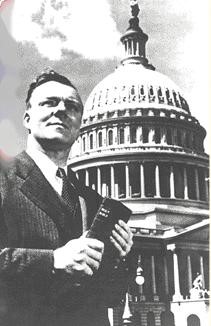
| Senate Chaplain Peter Marshall stated: “The trouble with our time is that when we can’t believe there is anything left to us worth dying for, then we’re not sure there’s anything worth living for either … God permits war in order that we might see what sin really is.” “War forces us to examine the very foundations of life itself.” “What man refuses to learn in times of peace, God teaches him in times of war.” |
| Peter Marshall commented on the socialist tactic of “deconstruction” (20 Centuries of Great Preaching Vol. 12 Waco: Word, 1971 p. 11-19): “Then there dawned the day when … with our higher education came a debunking contest. This debunking became a sort of national sport … It was smarter to revile than to revere … more fashionable to depreciate than to appreciate. In our classrooms …. no longer did we laud great men – those who had struggled and achieved. Instead, we merely … ferreted out their faults. We decided that it was silly to say God sent them for a special task … They were merely … ‘products of their environments’ … Our debunking is … a sign of decaying foundations of character to the individual and in the national life.” |
| At the age of 25, Peter Marshall emigrated from Scotland, arriving at New York’s Ellis Island in 1927. Members of his Sunday School class paid his way to seminary in Atlanta, where he graduated in 1931. Rev. Peter Marshall pastored a small church in Covington, Georgia, then preached at Atlanta’s Westminster Presbyterian Church. |
| There he met Catherine Wood, a student at Agnes Scott College, and they married. Catherine Marshall’s book on Peter’s life, A Man Called Peter, was turned into the movie. |
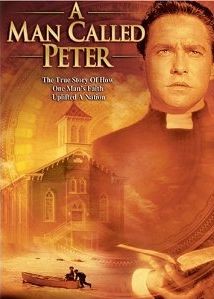
| IIn 1937, at the age of 35, Peter Marshall became pastor of Washington, D.C.’s prestigious New York Avenue Presbyterian Church, the same church where Dr. Phineas Gurley was pastor during Lincoln’s presidency. Rev. Peter Marshall stated (20 Centuries of Great Preaching, Vol. 12 Waco: Word, 1971 p. 11-19): “I have come to know Lincoln better – the heart and spirit of the man – since I met him in the tradition of this church I now serve in Washington, than ever I knew him in history books. Soon after assuming this pastorate, I happened one day upon an old safe, little used, in the church basement. Fascinating minutes of session meetings were there, dating almost back the year the church was born – 1802. |
| … Among these were some pew rental books, and I flipped open to a page with the inscription at the top: ‘A. Lincoln.’ The annual rent of the pew was fifty dollars a year, and the notations of payments began in March, 1861, and continued until the President’s assassination four years later …” |
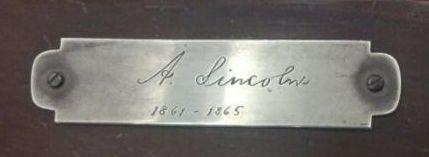
| Marshall continued: “Upon coming to Washington, Mr. Lincoln had sought the advice of a member of his cabinet on the choice of ‘a suitable church home’ for himself, his wife, and his three boys. One of his stipulations was that it had to be ‘a clergyman who holds himself aloof from politics.’ The President’s choice was Dr. Phineas Gurley of this church. As the clouds of Civil War gathered, increasingly, Mr. Lincoln sought the friendship of the clergyman. He liked to attend the mid-week prayer meetings by sitting on the other side of a glass-topped door, with the door ajar. On nights when the President would be deeply disturbed by the horror of Americans having to fight fellow-Americans, he would sometimes send a messenger to fetch Dr. Gurley. |
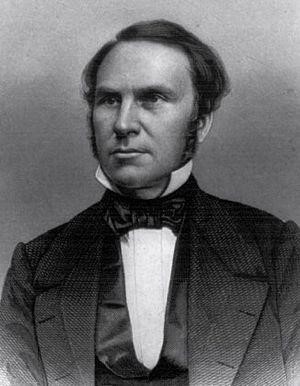
| … Later, Dr. Gurley was to tell how the two of them would walk up and down the south portico of the White House – up and down, all through the night talking … praying until dawn flushed pink in the eastern sky. For here was a man on the horns of that terrible dilemma: he believed that a nation divided could not stand … that the Union was worth saving … yet he loathed war, all of it from Fort Sumter to Appomattox …” |
| He continued: “In the end, according to Dr. Gurley who knew Lincoln so well, Lincoln found no way except the route of faith in God: ‘After being near him steadily and with him often for more than four years,’ Dr. Gurley said, ‘I can affirm that God’s guidance and mercy were the props on which he humbly and habitually leaned; that they were the best hope he had for himself and for his country. ……He recognized and received the truth that God is the governor among the nations, and that our only hope, in the President’s own words, was — to humble ourselves … confess our national sins, and pray for clemency and forgiveness.'” |
| Marshall added: “The biographers who have rather desperately tried to prove that Abraham Lincoln was an unbeliever, have ignored Dr. Gurley’s testimony. …..The minister was present when Willie Lincoln died in the White House, and received from him the little iron bank containing pennies which the little boy asked him to give to the Sunday school. He was there in the tiny hall bedroom in the red brick house on Tenth Street, keeping an all-night vigil with the leaders of the nation, as the President lay dying. As daylight broke and the faint breathing died away, the Secretary of War, Mr. Stanton, broke the stillness with words which were almost a sob, “Now he belongs to the ages.” Then he asked Dr. Gurley to pray.” |
| Marshall concluded: “The nation needed prayer more than ever – without Lincoln. That was the note of the eulogy in the East Room which Dr. Gurley delivered, ‘It is by his steady confidence in God that he would speak to us today. His message would be: Cling to liberty and right, battle for them, bleed for them, if need be, but most important, have faith in God …’ |
 True Texan Tales